Oceans

Preserving the history of Alaska’s canned seafood

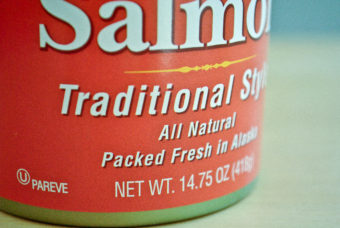
Canned Alaska salmon. (Creative Commons photo courtesy of cookbookoman17)

There used to be hundreds of seafood canneries all along Alaska’s coastline. Two people are involved in documenting and preserving some of that rich history in order to share it with others.

When Anjuli Grantham was growing up she would help her family beach seine on the west side of Kodiak Island. It was the same place that an old cannery site had once operated.

“My early childhood memories are playing in cannery rubble,” Grantham said.

Now Grantham is an Alaska historian based in Kodiak working as the Director of the Historic Canneries Initiative. It’s part of the Alaska Historical Society. The Initiative is a statewide grassroots effort to help educate people about the history of the seafood industry in Alaska.

“We’re looking at all fisheries but mostly on canneries because they’re such magnificent, dilapidated structures all along Alaska’s coastline and very little attention’s been paid to the documentation and preservation of these places,” she said.

These places, the old cannery sites, have been around since 1878 when the first ones opened in Sitka and Klawock. Over the next hundred years, their popularity grew and hundreds of processing sites popped up along Alaska’s coastline.

“It was really important to have processing sites on the fishing grounds because there was no refrigeration and so you had to be putting up fish nearby where people were fishing otherwise you know how quickly fish will go bad,” Grantham said.

Canned salmon label courtesy of Karen Hofstad

Canning was the favorite form of seafood processing for many years. But in recent decades the number of cannery sites dropped dramatically with the onset of refrigeration technology.

“Suddenly tenders could go longer distances as well and so people can fish wherever and deliver to a centralized location because of refrigerated seawater and freezer capacity,” Grantham said.

Now freezing salmon and other seafood is the most common method of moving the fish to market.

While it lasted, the business was booming and canned salmon was in high demand. And every can needed a label. Petersburg resident Karen Hofstad is kind of a canned salmon label expert.

“There’s not a lot that say canned in Alaska,” Hofstad said. “In the olden days they were shipped out and stored down south in Washington or somewhere and then the brokers would sell the product and then those people like it may be some Jones grocery store, they want their own labels on it.”

Canned salmon label courtesy of Karen Hofstad
Canned salmon label. (Courtesy of Karen Hofstad)

Hofstad’s collected canned salmon labels for over 50 years. It started slowly with just a few at a time but once the word spread that she was collecting many people came forward giving her what they had, even anonymously sending them through the mail. She’s proud that she’s never collected them over the internet.

“Now I have thousands,” she said. “I’m sure I have the largest label collection, for sure in Alaska, maybe the West Coast.”

About 300 of the labels are still on the original tin cans.

Along with collecting canned salmon labels, Hofstad found herself researching the history of them.

“I have a lot of fish packers’ records that go back from the early 1900s that lists all of the labels that were members of that association and I have all of the Pacific Fishermen starting in 1900,” Hofstad said. “A lot of research information there.”

Hofstad has been carefully archiving all of her labels and plans to eventually donate her collection to a museum.

Both and Karen Hofstad and Anjuli Grantham are presenting their historical projects tonight in Petersburg at the public library at 6:30 p.m. A reception will follow at the Clausen Museum.

Limited funding for the Historic Canneries Initiative has been pieced together from multiple sources: the Alaska Historical Society, Alaska Seafood Marketing Institute, Alaska Sea Grant, Alaska Historical Commission, and individual donors.

Amid Industry Downturn, Global Shipping Sees Record-Low Growth

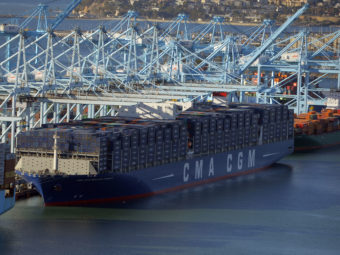
After its maiden voyage from China, the largest container ship to ever make port in North America, unloads its cargo in the Port of Los Angeles on Dec. 26, 2015. The major shipping companies in Europe and Asia began ordering the state-of-the-art, supersized ships back in 2011, when times were better. Scott Varley/AP
After its maiden voyage from China, the largest container ship to ever make port in North America, unloads its cargo in the Port of Los Angeles on Dec. 26, 2015. The major shipping companies in Europe and Asia began ordering the state-of-the-art, supersized ships back in 2011, when times were better.
Scott Varley/AP

The massive container ships that ply the high seas bring us pineapples and mangoes in winter, and computers and cheap t-shirts all year round. But the shipping industry is a volatile, cyclical and ferociously competitive business. There are good years and bad years.

And then there’s this year.

“This is likely to be one of the worst years ever in terms of losses,” says Janet Porter, editor-in-chief of containers at Lloyd’s List, a shipping industry news provider. She says over the years, global shipping companies got used to growth of 6, 7 or 8 percent. This year it’ll be close to zero.

“It is a very simple supply-and-demand imbalance — too many ships and not enough cargo,” she says.

Container ships are vital cogs in the global economy. Jonathan Roach, a container market analyst at Braemar ACM shipbroking in London, says slowing economies in Europe and China are hitting the industry hard.

Indian shipbreakers work at the Sosiya-Alang Ship Recycling yard on March 4, 2013. Many ships are heading to scrap heaps, like this one, the world's largest, to help reduce the number competing for market share. SAM PANTHAKY/AFP/Getty Images
Indian shipbreakers work at the Sosiya-Alang Ship Recycling yard on March 4, 2013. Many ships are heading to scrap heaps, like this one, the world’s largest, to help reduce the number competing for market share.
SAM PANTHAKY/AFP/Getty Images

“China is a big factor in the container industry — where China is really the factory of the world and when the advanced economies slow, we’re seeing less exports coming out of China,” he says.

The economic slowdown comes as fleets of huge, new ships are coming online. The major shipping companies in Europe and Asia began ordering the state of the art, super-sized ships back in 2011, when times were better.

Porter says this is partly a self-inflicted crisis because many of the companies are over-ordering.

“There’s a little bit of ‘boys and their toys’ in the shipping lines,” she says. “One line will order so the next one does and the next one does, and now all these ships are starting to be delivered.”

Now, orders for new vessels have dried up. William Bennett, a senior analyst at VesselsValue in London, which follows the cargo markets, says companies ordered about 1,500 new vessels in 2015.

In contrast, “What we’ve had in the first half of this year, we’re looking at 293 vessels ordered,” he says. “There’s just no appetite for ordering at the moment.”

Bennett says the shipping crisis will have little impact on consumers. He says shelves in your favorite shops will remain stocked.

It’s the ship owners bearing the brunt, he says — they’re hemorrhaging money at the moment.

A truck carries a container past a ship at the port in Qingdao, in China's Shandong province on Feb. 15, 2016. China's sagging economy has hurt the shipping industry this year. STR/AFP/Getty Images
A truck carries a container past a ship at the port in Qingdao, in China’s Shandong province on Feb. 15, 2016. China’s sagging economy has hurt the shipping industry this year.
STR/AFP/Getty Images

Because of the glut of ships, freight rates have plummeted over the past year, cutting deeply into profits, says Nils Haupt, the communications director for Hapag-Lloyd, the world’s fourth largest container shipping line.

“I can just tell you that the costs for shipping are enormously low,” he says, adding that transportation costs for manufacturers are at rock-bottom.

“A t-shirt, just for shipping transportation, this is like one or two U.S. cents… a pair of sneakers which is $100 in the shop…ocean transport cost per pair approximately between 20 to 25 U.S. cents. So this is a ridiculous amount of money,” he says.

For oil tankers, the situation is even more dire. Earnings at the turn of the year were around $50,000 to $60,000 per day. Bennett, with VesselsValue, says they’re now looking at $1,000 a day. “So you can see the situation has gone incredibly sour,” he says.

Bennett says shipping lines are looking to be more efficient and cut costs. He says mergers and acquisitions are happening at a record rate. And many ships are heading to scrap heaps, like the one in Alang, India — the world’s largest — to help reduce the number competing for market share.

“We need 1,000 ships to be scrapped in order for a market recovery,” he says.

At least that will be good news for the scrapyards.

Copyright 2016 NPR. To see more, visit http://www.npr.org/.

Researchers developing cheaper, faster monitoring method for paralytic shellfish poisoning

Researchers are developing a field test kit that would make it easier to monitor for paralytic shellfish poisoning.

Project partners include NOAA researchers from the Lower 48 as well as community testers based on Kodiak Island and in the Alaska Peninsula.

Despite the high level of toxicity found in shellfish in the Kodiak Archipelago, people still harvest them.

Julie Matweyou, who works in the Alaska Sea Grant Marine Advisory Program and has been a long-term researcher of PSP, said a person becomes sick when they eat shellfish that have consumed toxic plankton.

She explains paralytic shellfish poisoning is exactly what it sounds like.

“The PSP toxins can cause tingling of the mouth, paralysis, tingling of the extremities, nausea, headache, people describe a floating sensation,” she said. “And in a severe toxin event, the person would experience paralysis of the limbs, which would progress into paralysis of your diagram, which would cause respiratory paralysis.”

A faster, cheaper way to monitor for PSP could prevent sickness in harvesters and even save lives. The testing also would be helpful in collecting more data about when toxicity peaks and when it declines.

Researchers are in phase one of the three-year project, which began in July and is funded through the North Pacific Research Board.

Pat Tester, a former supervisory oceanographer and current affiliate for NOAA and works in North Carolina, explains that the chemical based methods the state of Alaska uses for testing toxicity are expensive and lengthy. She said for monitoring in the field, researchers would try an anti-body based test.

“We’ve developed antibodies to two of the most potent toxins in the shellfish, and we can give you then a digital readout of those toxins in the shellfish in the field very quickly and very much less expensively than the state does the regulatory testing.”

Some samples will go to researchers in the city of Kodiak for monitoring and, from there, they will be sent to North Carolina for validation via chemical analysis, she said.

Catastrophic floods in Louisiana have caused massive housing crisis

Devastating floods in Louisiana have left an estimated 40,000 houses damaged; some 86,000 people have applied for federal disaster aid in the wake of the disaster.

It’s a crisis some people are comparing to the aftermath of Hurricane Katrina.

The disaster area stretches over 20 parishes, Eileen Fleming of member station WWNO reports, and officials are working to determine how to provide temporary housing to meet the extreme need.

One challenge, as FEMA Administrator Craig Fugate told NPR, is that the Federal Emergency Management Agency can’t rely on one of its normal strategies for rehousing those pushed out by flooding: rental assistance.

There simply aren’t habitable homes available for rent.

“There’s not that much that wasn’t damaged in some of these parishes,” Fugate says, adding that FEMA is working on helping homeowners clean out and repair their homes as quickly as possible.

The impact of the flood is still ongoing; floodwaters are draining south and still rising in some areas.

But as water begins to recede in some regions, Fleming reports, the state is beginning a new push to look for flooding victims.

“Gov. John Bel Edwards says initial search and rescue operations were focused on responding to people who reported they were in trouble,” she says.

Now, Edwards says, it’s time to “go back and do a comprehensive search, house by house, whether or not there was a call for assistance, to make sure there isn’t someone in that house who was unable to call for assistance.”

At least 13 people are known to have died in the flooding.

Some 30,000 people were rescued — not just by the National Guard and official search and rescue teams, but by neighbors equipped with personal boats. The volunteer rescuers are known as the “Cajun Navy,” as Ryan Kailath of WWNO has reported.

Now, as southern Louisiana tries to move forward, the challenge of recovering from this flood is daunting in part because the disaster caught so many people off guard.

While the [National] Weather Service had predicted a high risk of serious flooding, “nobody, I think, was prepared for that much rain in that short of a time,” FEMA chief Fugate said.

And as NPR’s Debbie Elliott reports, waters rose astonishingly high in places that historically have not experienced flooding.

“Even for a state accustomed to natural disasters, this flood is like nothing they’ve ever seen before,” Debbie says.

She spoke to Wayne Norwood, who, with his wife, Debbie, owns an antiques museum that was destroyed in the flooding. The couple, both retired police officers, also had four rental homes damaged in the disaster.

“We have fire insurance, but we don’t have flood insurance because we’re not in the flood zone,” Wayne Norwood tells Debbie. “And that’s what happened to thousands of people.”

For homeowners in parishes that have been declared disaster areas by the federal government, FEMA will be offering grants of up to $33,000 to help with repairs.

Meanwhile, there are questions about whether the U.S. has been paying enough attention to the disaster. Some people have compared the response to the historic flooding to the often wall-to-wall coverage given to named hurricanes and tropical storms.

President Obama hasn’t made a public statement about the flooding or planned a visit. And national media outlets have been criticized for their coverage; The New York Times’ public editor wrote a piece several days ago concluding that the newspaper had been slow in paying adequate attention to the crisis.

Copyright 2016 NPR. To see more, visit http://www.npr.org/.

Engineless boat ‘Race to Alaska’ that ends in Ketchikan is on for 2017

Organizers announced last week that the Race to Alaska is a go for the summer of 2017. The 750-mile engineless boat race begins with a qualifying heat from Port Townsend, Washington, to Vancouver, British Columbia.

Qualifiers then race to Ketchikan by sailing, paddling or using any other, non-motorized means.

2017 will be the third year of the race. Daniel Evans, the event’s race boss, said from the beginning, they decided to determine annually whether to hold another race.

The main consideration is safety, Evans said.

“Were we vetting the right people? Is this really the right thing to do? Are people challenging themselves? Do they have the capability to stay safe? Are they staying safe? That answer was ‘yes’ both years.”

Evans said they also considered whether participants, viewers and organizers were enjoying the experience.

“We thought it was such a fun idea. It’s been wonderful. It’s been such a great thing to develop, and have received by others and clued others in. It was a question of ‘Are we still having fun?’”

There’s already interest in next year’s race, Evans said. Team KELP, with an all-female crew, completed the qualifying leg to Vancouver this year, but did not continue on to Ketchikan.

When the team learned 2017 was a go, they contacted him and committed to finishing next year, he said.

“They sent pictures and a real scroll, a proclamation, proclaiming their intention to do the race next year. On top of that, Matthew from Team Liteboat out of France has already said that he is designing a boat and wants to do it next year. We’ve had interest from a number of racers saying they’re going to try it again, which always surprises me.”

The winning team receives $10,000 cash. Evans said this in no way compensates the amount teams spend to participate, but is more of a prize of congratulations. The race is done to create a community, he said, and light-heartedly pokes fun at yachting and racing in general.

“This race is, in part, a response to things that have become so elite, like the America’s Cup and other races, that we have also created our own yacht club. It’s a virtual yacht club. You can get parking passes, though we don’t have a place to park, and a membership card, though we don’t have a club house. But, they’re excellent fodder if you’re trying to get your way into any other yacht club or other parking events.”

There will be some rule changes for next year, Evans said. Those change will be revealed on Sept. 9 during the Wooden Boat Festival in Port Townsend.

On the scene with the Crystal Serenity

081616_CrystalSerenity_Rwaldholz
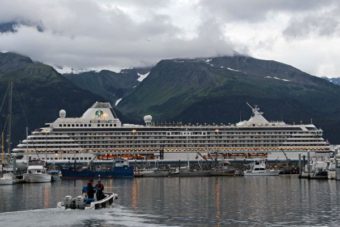
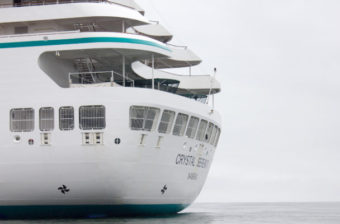
The Crystal Serenity docked in Seward Alaska on Aug. 16th, 2016

The cruise ship Crystal Serenity cast off from Seward Tuesday for a first-of-it’s kind trip through the Arctic’s Northwest Passage to New York City. It’s the first luxury liner to attempt the route — and the largest passenger ship by far.

Many people are wondering if it’s a sign of what’s to come, as the Arctic sees increasingly ice-free summers.

Rachel Waldholz, from Alaska’s Energy Desk was in Seward as passengers boarded the ship.

TOWNSEND: Rachel, remind us why this is a big deal. There’s been a lot of attention to it nationally, internationally. Why is it a big deal?

WALDHOLZ: Well, it’s a big deal because this is a big ship. It can carry more than 1,600 people, including more than 1,000 passengers and more than 600 crew. A ship of that kind hasn’t attempted to cross through the Arctic before. And it’s in a region that hasn’t seen anything remotely on this scale before, it’s not sure the region is prepared for that. There just isn’t the kind of infrastructure or search and rescue capabilities. The towns it’s visiting haven’t seen this kind of tourism and cruise companies haven’t proven yet that they can handle the Arctic safely. This is really the first test. And to that end, it’s been a real wake-up call for authorities about getting ready for more shipping traffic in the Arctic. The U.S. Coast Guard and military actually have a joint exercise planned with Canadian forces next week in the Bering Strait, and they will simulate rescuing 250 people from a cruise ship, and it’ll happen just a few days after the Crystal Serenity passes through the region.

TOWNSEND: Have you been able to get aboard the ship? What’s it like?

WALDHOLZ: Well, I haven’t been able to get on yet. I have a tour scheduled for 3 p.m. and I’m really excited because it’s supposed to be super top-end luxery cruise ship. The basic stateroom is more than $20,000 — the highest end penthouse — which comes with personal butler service — is listed at more than $120,000. So this is really a very high-end cruise. It has as many as eight restaurants, a casino, a dance club, a spa, designer boutiques. That’s probably good, because this is a long trip and there aren’t that many places to stop along the way. It will take more than a month to travel from Seward to New York City. It’s stopping in Kodiak, Unalaska and Nome on its way, as well as several stops in Canada and Greenland.


Site notifications
Update notification options
Subscribe to notifications