Oceans

Crystal Serenity cruises on amid environmental concerns

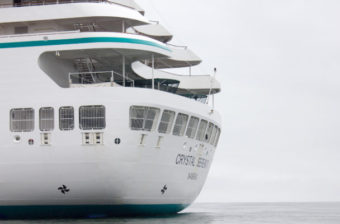
The luxury cruise liner Crystal Serenity arrived off the coast of Nome on Sunday. (Photo by Lauren Frost/KNOM)

The Crystal Serenity cruise ship is making a 32-day voyage from Anchorage to New York City.

The ship is the largest vessel ever to travel the Northwest Passage with about 1,000 passengers aboard.

Meanwhile, the potential environmental impact of a journey of that scope has some worried.

Austin Ahmasuk, a marine advocate at the Kawerak regional non-profit corporation, is nervous about what happens when a floating city moves through a delicate region like the Arctic.

Ahmasuk refers to the Crystal Serenity as “a floating city.”

It certainly contains enough people, and produces enough waste.

“We have some very deep-felt and heartfelt concerns about what is happening in the Arctic,” he said.

Alaska Native communities rely on fish and marine mammals for subsistence.

Ahmasuk worries that cruise ships could damage the ecosystem and threaten that subsistence lifestyle.

What’s more, he does not think the cruise industry is listening.

“Honestly, I don’t know that our concerns are being fully heard,” he said. “I honestly cannot say that with a straight face.”

He’s not alone in his misgivings.

Marcie Keever, who directs the oceans and vessels program at an environmental group called Friends of the Earth, also is worried.

“When a ship like Crystal is going, because of its size, because of the length of time, there’s lots of reasons why a ship like that is a big concern,” Keever said.

In June, Friends of the Earth released their latest cruise ship report card, which grades cruise lines on their commitment to protecting the environment.

What grades did Crystal Cruises get?

Sewage treatment: F. Air pollution reduction: F. Transparency: F. It ranked 17 th out of 17 cruise lines.

Crystal Cruises has spoken out against the report card, and so has the Cruise Lines International Association.

Alaska branch president John Binkley said that people should look to the Coast Guard to regulate the industry, not to environmental groups.

“And similar to our political parties today, I believe that the Friends of the Earth are trying to divide people, really, with radical and unfounded claims,” Binkley said.

While the Crystal Serenity does not meet the standards set by Friends of the Earth, it does comply with all federal regulations.

The ship also has pledged to use cleaner fuel while it’s in Alaskan waters.

Even Keever admits that the Crystal Serenity is not at the heart of the problem.

“Our concern is not necessarily just the Serenity,” she said. “It’s the number and size of cruise ships and other ocean-going vessels that are going up over the top of the world.”

If the Crystal Serenity successfully completes its voyage, then other large ships likely will follow.

The Serenity already plans to return in 2017.

Keever points out that if those ships contribute to climate change in the Arctic, then they are making their own passage just a little bit easier — melted ice means a smoother trip.

“The only reason that this cruise is even possible is due, in small part, to the cruise industry,” Keever said.

The Crystal Serenity is expected to arrive Sunday in Pond Inlet.
Science and cooking collide to fight botulism

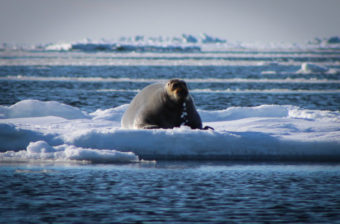
A bearded seal, or ugruk, on the sea ice.
A bearded seal, or ugruk, on sea ice. (Courtesy of Kawerak Subsistence Program)

Food scientists with the help of a botulism expert are trying to combine science and traditional Alaska Native methods to make one prohibited food safe to eat.

Regulated programs under the State of Alaska Food Safety and Sanitation Program are not allowed to accept or distribute seal oil due to the danger of botulism, a potentially fatal disease which is caused by bacteria in contaminated food.

But how or when the neurotoxins enter the rendering process is still a mystery. That’s what researchers want to find out.

Val Kreil describes seal oil as “a little bit like a heavy olive oil.” He’s the administrator of Utuqqanaat Inaat, a long-term care facility in Kotzebue that falls under the Maniilaq Association.

He says elders at the facility identified seal oil as a priority food.

“For them it’s like eating butter. This is just part of their daily diet. This is what they’ve always been eating and, in terms of health, it’s actually healthier than fish oil. So, there’s a lot of benefit to eating seal oil.”

But because the bacteria that causes botulism grows in anaerobic environment – or one without exposure to oxygen – traditional methods using containers like bottles or barrels to render the seal oil can lead to contamination. The challenge is how to prevent the risk of poisoning while working with the traditional techniques.

Kreil says beginning last year; Maniilaq started looking for ways to get a variance approved to distribute seal oil. He says he’s one of a number of Alaskans interested in getting prohibited traditional foods safe and approved for consumption, and he hopes to clear the way for other programs.

The first step in the mission was to turn to regulators.

Lorinda Lhotka, a section manager with the State of Alaska Food Safety and Sanitation Program, says the state was willing to allow organizations to serve the seal oil if they could demonstrate a safe process.

However, she explains Lorinda Lhotka needed to reach out to resources other than the state.

“We do testing, but it’s usually in result of outbreaks of illness, and we don’t do a lot of preventative testing to help evaluate the safety of the product. So, it’s usually just in response to illnesses, and our labs don’t have that capacity.”

So, along the way, Maniilaq got in touch with UAF’s Kodiak Seafood and Marine Science Center, and Dr. Eric Johnson, a botulism specialist and professor of bacteriology at the University of Wisconsin – Madison.

He has a long history in researching botulism and his lab is registered for toxin analysis.

Johnson says he’ll watch the traditional process in action in the community of Kotzebue and, once he understands the preparation, examine samples in his lab.

“My interest is in helping validate the process from a safety perspective – for example, what aspects in this process may contribute to the growth of clostridium botulinum and its formation of toxins and to implement minor changes in the process that will enhance its safety.”

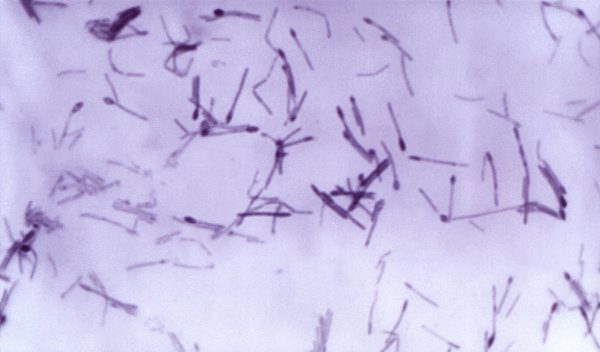
Bacteria that causes botulism.
Bacteria that causes botulism. (Public domain image)

While the Seafood and Marine Science Center is not registered to work with toxins, it does focus on the research of seafood. Associate Professor of Seafood Microbiology Brian Himelbloom explains they can study the other aspects of a seal oil sample, like what it’s composed of and how much water is left in the extract.

“Because that will give us an idea when things go bad maybe that’s because some of that seal oil has some residual water available and that’s where we theorize clostridium botulinum is actually going to operate.”

Himelbloom says, in theory, the preparers of the seal oil can avoid a botulism incident if they pour off 100% oil.

“But in their mixing, if there’s splash over from water or they’re not careful how they’re pouring it off, maybe that’s the situation – because under what we call ambient temperatures, room temperature or outside temperature, that’s probably in the range where this organism can proliferate.”

So far, it’s all speculation. The trick according to Himelbloom and the other researchers is to find the solution while keeping scientific intervention to a minimum.

“We know something about clostridium botulinum and how it acts and how it behaves and where it can be found and how you test for it and how do you assay for the toxin, and so if we can combine those two worlds of traditional knowledge and Western science, we might actually come to the point of oh, now we know how we can most likely guarantee, hopefully, that there won’t be a botulism incident if they follow these particular steps.”

Next, researchers will observe the traditional process, and then, through collaboration with each other, Maniilaq, and other community partners in Kotzebue, they’ll decide on what they should test and how much of it.

Johnson will visit Kotzebue today and Friday to watch how local processors render seal oil.


Protected Marine Area Near Hawaii Is Now Twice The Size Of Texas

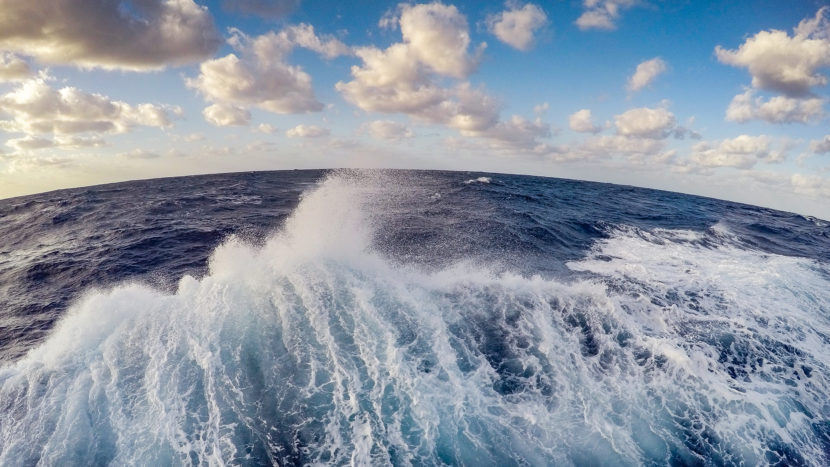
Rough seas prevented the NOAA's Okeanos Explorer from collecting data in the the Papahānaumokuākea Marine National Monument in February. NOAA Office of Ocean Exploration
Rough seas prevented the NOAA’s Okeanos Explorer from collecting data in the the Papahānaumokuākea Marine National Monument in February.
NOAA Office of Ocean Exploration

President Obama is expanding a national monument off the coast of Hawaii, more than quadrupling it in size and making it the world’s largest protected marine area.

The Papahānaumokuākea Marine National Monument was created by President George W. Bush in 2006. At the time, it was seven times larger than all the other U.S. marine sanctuaries combined and the biggest marine reserve in the world.

On Friday, Obama signed a proclamation expanding the monument to more than 580,000 square miles — twice the size of Texas, and once again the world’s largest.

“The monument designation bans commercial fishing and any new mining, as is the case within the existing monument,” The Associated Press notes. “Recreational fishing will be allowed through a permit, as will be scientific research and the removal of fish and other resources for Native Hawaiian cultural practices.”

It’s not the first time Obama has expanded a Bush-era marine monument; in 2014, he expanded the Pacific Remote Islands Marine National Monument to 490,000 square miles, making it the largest in the world at the time.

Now that title has returned to Papahānaumokuākea. And we’ll pause here to say, if you’re wondering how to pronounce that name, take a listen to newscaster Korva Coleman rattling it off on NPR on Friday morning:

The Pew Charitable Trusts, which pushed for the expansion of the monument, celebrated Friday’s announcement and highlighted the region’s biodiversity:

“Although much of the region remains to be fully explored, Papahānaumokuākea is home to more than 7,000 species, a quarter of which are endemic, or found nowhere else on Earth; some have only recently been discovered. The area provides habitat for rare species such as threatened green turtles, endangered Hawaiian monk seals, and false killer whales, as well as 14 million seabirds representing 22 species. This year, scientists exploring these waters discovered a new type of ghostlike octopus they nicknamed Casper, as well as three new species of fish.”

But the Western Pacific Regional Fishery Management Council was disappointed to see hundreds of thousands of square miles closed to fishing. In a statement, the group’s leaders said they believed the expansion was driven by politics rather than science, and criticized the Pew’s Ocean Legacy program as an “agenda-driven environmental organization.”

“Closing 60 percent of Hawaii’s waters to commercial fishing, when science is telling us that it will not lead to more productive local fisheries, makes no sense,” Council Chair Edwin Ebiusi Jr. said in the statement.

The monument was created and expanded under the Antiquities Act of 1906, a law signed by Teddy Roosevelt that established America’s first-ever program for protecting cultural or natural resources.

Under the law, the president can designate as national monuments any federal lands containing objects of “historic or scientific interest.” In this case, the waters are scientifically unique in their geological and biological resources, and also have cultural significance, the White House said in Friday’s announcement.

“Native Hawaiian culture considers the Monument and the adjacent area a sacred place. This place contains the boundary between Ao, the world of light and the living, and Pō, the world of the gods and spirits from which all life is born and to which ancestors return after death,” the statement read.

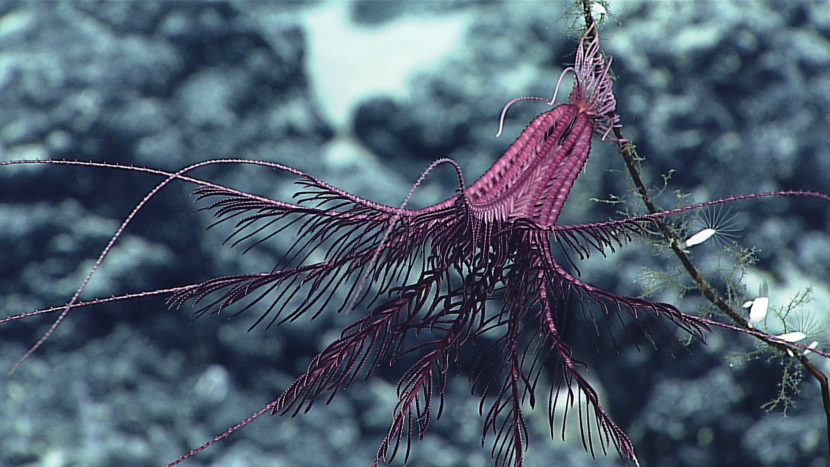
A purple crinoid "hangs out on a dead coral stalk," as NOAA scientists put it, in the Papahānaumokuākea Marine National Monument off the coast of Hawaii. NOAA Office of Ocean Exploration
A purple crinoid “hangs out on a dead coral stalk,” as NOAA scientists put it, in the Papahānaumokuākea Marine National Monument off the coast of Hawaii.
NOAA Office of Ocean Exploration

Shipwrecks from the Battle of Midway in World War II are also located in the waters, the administration notes.

Access to the monument is currently by permit only. But several of the islands in the original monument area can be seen on Google Street View, where you can take a scroll down Tern Island and East Island at French Frigate Shoals, Laysan Island, Lisianski Island, Pearl and Hermes Atoll and Midway Atoll.

Copyright 2016 NPR. To see more, visit http://www.npr.org/.

Marine mammal camp nurtures budding scientists

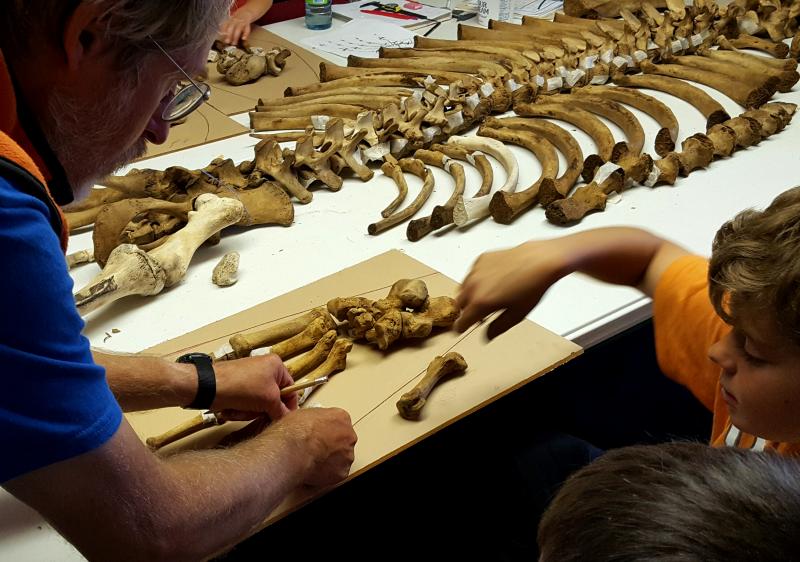
Homer resident Lee Post (a.k.a. "Mr. Bone") helps a camper position sea lion flipper bones. (Photo by Shahla Farzan/KBBI)
Homer resident Lee Post helps a camper position sea lion flipper bones. (Photo by Shahla Farzan/KBBI)

The phrase “summer camp” usually brings to mind images of toasted marshmallows, campfires and wobbly canoe trips.

One thing that you won’t find at a typical summer camp: bones.

For the kids at this year’s “Marine Mammal Mystery Camp,” bones are a pretty big part of the experience.

“That’s a really strange shaped bone. It reminds me of a camel,” one camper said, giggling.

You see, instead of making s’mores, these kids are putting together a sea lion skeleton.

“That bone goes there, this one goes there,” said one camper as she carefully positions the flipper bones.

Every year, the Center for Alaskan Coastal Studies in Homer hosts the five-day, four-night camp at Peterson Bay Field Station.

Campers range in age from 9 to 15, but they have one thing in common: they’re seriously into marine mammals.

Homer resident Lee Post, aka “Mr. Bone,” helps the campers arrange the 10-foot Stellar sea lion skeleton on three folding tables.

“For a lot of these kids that’s the first time they’ve gotten to hold real bones or look at ’em,” Post said.

The curved rib bones and knobby vertebrae look like weathered pieces of wood. Putting the skeleton together has been a little difficult, Post said, because some of the bones are missing.

“It’s a total missing piece puzzle!” Post said.

With a total of 20 kids, this is the biggest marine mammal camp they’ve had since it began in 2011.

They do a variety of activities, but a whale watch is clearly the highlight of the week.

The next morning, the campers pile onto the Torega, a 30-foot boat painted canary yellow.

Captain Karl Stoltzfus carefully maneuvers around Gull Island in Kachemak Bay. The rocky little island is covered in dozens of seabirds.

Local naturalist and one of the counselors leading the camp Axel Gillam points out the different seabirds.

“The ones with the long weird necks? Those are called cormorants,” Gillam explains.

Captain Karl scans the horizon, looking for the spray of a whale surfacing. Although humpback whales are the most common species in Kachemak Bay, he said that you can sometimes see orcas and other fin whales.

“You never know what’s gonna be out here,” he said, squinting into the sun.

In the back of the boat, Axel tells the campers what to expect.

“What you guys want to look and listen for is the blow. So when the whale comes up to the surface, it’ll go ‘PSSHH’,” Gillam said, mimicking the sound of a whale.

They peer through binoculars, jostling for a spot at the edge of the boat.

“There she blows!” one camper shouts.

The glossy dark skin of a humpback appears above the water for a few moments, then the whale dives again, showing its curved tail flukes.

Axel lowered a special piece of underwater equipment called a hydrophone, or a small golf ball-sized microphone on a long cord, into the water.

“Since we’re listening for humpbacks, it’s going to sound like a classic whale noise,” he said.

The kids pressed their ears against a big speaker, straining to hear the sounds of the whale.

The humpback appeared again in the distance, but the speaker was silent.

Later in the week, the campers return to Homer. They clustered around a plastic folding table under a pop-up tent. They’re about to watch a sea otter necropsy, which is like an autopsy, but for animals.

Adriana Ferello-Shehan, who works with the U.S. Fish and Wildlife Marine Mammal Management office, lays out her dissection tools on the table along with a pile of plastic vials.

The otter on the folding table is 5 feet long from head to tail and about 80 pounds. He was found washed up on the Homer spit, but Adriana isn’t sure why he died.

That’s what the necropsy is for.

“Do you guys know what rigor is? Yeah, rigor mortis,” she said. “He’s still a little stiff, which is good because that means that he’s fresh.”

Ferello-Shehan is a bit like a detective collecting evidence. She takes samples from a tooth, whiskers, fur, urine and feces. She also collects tiny pieces of the otter’s organs to send away for analysis, including his heart and liver.

She carefully dissected the heart, revealing a huge blood clot.

“I opened it up and you guys can see how much clotting there is,” she said, holding the otter’s heart in her hand.

The kids leaned in for a closer look.

Inside one of the otter’s main arteries near its legs is another big clot.

“You see how thick it is. And you can actually feel the jello feel that we were feeling with those clots,” Ferello-Shehan said.

Clotting in the heart and arteries is a good indication that this otter died from a bacterial infection, she said.

Last year, several hundred otters died around Kachemak Bay from Streptococcus bacterial infections.

She’s quick to point out that while this type of bacteria can be fatal for otters, humans can’t catch it.

The Center for Alaskan Coastal Studies provides a variety of programs throughout the year for all ages. More information is available at http://www.akcoastalstudies.org.

City investigates vessel found burning in Captains Bay

A vessel caught fire in Unalaska waters last weekend.

The incident is still under investigation, but City Manager Dave Martinson said efforts are already underway to address the damaged boat.

“On Saturday, the vessel Rebecca was found burning at the end of Captains Bay,” he said. “There was a potential hazard, so the Department of Public Safety has worked with Resolve Marine Group and the U.S. Coast Guard. We’re going to execute a $30,000 contract to remove it.”

After finding diesel sheen in water around the boat, the harbormaster deployed oil-absorbent boom to contain the hazard, with help from Resolve and the Coast Guard’s Marine Safety Detachment (MSD) Unit.

MSD officials said they’ve since received reports that Resolve has removed the residue, along with a leaking tank and battery.

While the city is fronting the money for cleanup, Martinson said they’ll eventually try to recover costs from the vessel’s owner.

“We believe it’s important enough not to fight through the process of trying to get him to do it,” he said. “Let’s get this done quick enough that it doesn’t result in something more catastrophic.”

Public Safety Director Mike Holman said the vessel is owned by a local resident. But with a criminal investigation ongoing, he said he can’t share any more information right now.

No one was aboard the vessel when it was found burning.

Cruise-ship evacuation exercise begins as luxury liner prepares for Arctic trek

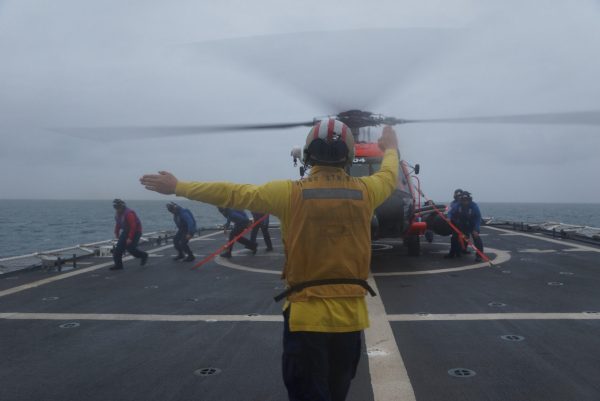
A member of the Stratton’s crew signals to the pilot of a Coast Guard helicopter during a training exercise held earlier this month off Alaska’s northern coast. The agency has stationed two MH-60 helicopters in Kotzebue to help it respond more quickly to emergencies around the remote Arctic expanse. (Photo by Gina Caylor, U.S. Coast Guard)
A member of the Stratton’s crew signals to the pilot of a Coast Guard helicopter during a training exercise held earlier this month off Alaska’s northern coast. The agency has stationed two MH-60 helicopters in Kotzebue to help it respond more quickly to emergencies around the remote Arctic expanse. (Photo by Gina Caylor, U.S. Coast Guard)

The U.S. Northern Command and Coast Guard have launched a major field-training exercise off Alaska’s northwest coast.

Arctic Chinook is intended to demonstrate how local, state and federal agencies would respond to a simulated cruise ship accident.

Coincidentally, a big luxury cruise ship will sail through the area while the exercise is under way.

And to further complicate things, bad weather has just set in.

Arctic Chinook planners have had to incorporate some extra precautions into the exercise because of rough weather that set in over the weekend over the Bering and Chukchi seas, said Coast Guard Commander Mark Wilcox.

“We are having to adapt our exercise just slightly to accommodate what is going to be gale-force winds,” he said.

The National Weather Service had issued a gale warning effective through Tuesday evening for waters off the Seward Peninsula, where the exercise will be held.

It’s also where the luxury liner Crystal Serenity and its 1,600 passengers and crew will soon be traveling through en route to the Northwest Passage and on around to New York.

The weather service predicted the storm would whip up 35- to 45-knot winds off Alaska’s coast, and it issued a winter storm warning and forecast up to 8 inches of snow on the western end of the North Slope.

The Coast Guard and the U.S. Northern Command, or NorthCom, scheduled Arctic Chinook for now because usually it’s the best time of year to conduct such an exercise, Wilcox said.

“We place a lot of these sort of key events – we time them for August, because we expect to get the best weather and least sea ice,” Wilcox said. “Mother Nature doesn’t always let us move forward as planned.”

Wilcox said the exercise is intended to test the ability of local, state and federal emergency responders to rescue 200 passengers from a cruise ship that’s run into trouble in those waters, The scenario calls for bringing passengers to shore around Tin City, near the westernmost tip of the Seward Peninsula – where rescuers would face their next logistical challenge. (This morning, organizers announced they’d moved the evacuation portion of the exercise to the Kotzebue Long Range Radar Site, due to rough weather.)

“So, how do we keep people alive on the beach while the secondary round of rescue assets that will bring them to an Arctic hub or village – how do we keep alive in that time span?”

The exercise scenario called for responders on the beach to triage the evacuees, sending uninjured passengers to Nome, then on to Anchorage. Fifty people will play the role of injured passengers, who’ll be taken initially to Kotzebue, said Army Col. Michael Forsyth. He’s chief of staff for Alaskan Command, the NorthCom subordinate agency based at Joint Base Elmendorf-Richardson that’s helping the Coast Guard manage the training exercise.

“There’s about 50 folks who will actually get in lifeboats. They are going to … casualties that the municipal community will have to react to.”

Forsyth said Arctic Chinook will involve up to thousand people from several agencies, along with three ships, about a dozen aircraft and many other types of equipment. He said agencies involved include U.S. Army Alaska; Air National Guard; federal Homeland Security Department and its state counterpart and the Arctic Domain Awareness Center, Homeland Security’s University of Alaska-affiliated research arm.

“Canada is also contributing to the exercise a helo, a fixed-wing aircraft and also dozens of personnel.”

Forsyth said other Arctic nations are sending observers. He said management of the complex exercise will be done out of the Alaskan Command’s facilities at JBER, where many of the agencies already have offices.

Site notifications
Update notification options
Subscribe to notifications