Oceans

NOAA to examine dead humpback in Sitka Sound

160915 Sitka Dead Whale
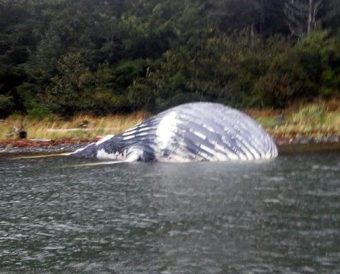
A dead whale carcass at the southern entrance to Olga Strait near Sitka on Sept. 15, 2016. (Photo courtesy Henry Larsen)

A fisherman has spotted the dead humpback whale in the Sitka area that the National Oceanic and Atmospheric Association was interested in studying.

Fisherman Henry Larsen spotted Thursday it at the southern entrance to Olga Strait on the western shore. Larsen said the carcass was beached, but looked likely to refloat on the rising tide. He expected it to eventually drift south on the ebb.

The animal’s body was moored to the beach. NOAA’s Julie Speegle confirmed it will be examined.

Dr. Kathy Burek, a veterinarian from Alaska Veterinary Pathology Services, is scheduled to fly to Sitka on Saturday to perform a necropsy.

Ocean sustainability tops agenda of this week’s global conference

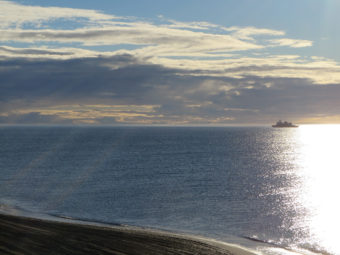
The U.S. Coast Guard icebreaker, Healy, sits just offshore of Barrow, shortly before setting sail on Arctic Shield 2013.
The U.S. Coast Guard icebreaker, Healy, sits just offshore of Barrow, shortly before setting sail on Arctic Shield 2013. (Photo courtesy of NOAA Office of Response and Restoration)

Over 450 representatives from 90 countries are expected to attend a two-day conference in Washington D.C. on the health and sustainability of the world’s oceans.

U.S. Secretary of State John Kerry is hosting the Our Ocean 2016 conference on Thursday and Friday.

President Barack Obama and Kathryn Sullivan, Under Secretary of Commerce for Oceans and Atmosphere, are expected to attend along with more than 40 foreign ministers and heads of state, plus explorers and scientists, members of the private sector and environmental activists from around the globe.

“Clearly, the challenges facing our ocean respect no boundaries,” Kerry said in a video posted on a U.S. State Department website.

Kerry said that’s why there’s a need to come up with global solutions.

He said government leaders, civil society, and business leaders have already pledged $4 billion in maritime sustainability initiatives, and promised to set aside an area nearly the twice the size of India in marine protected areas.

“Today, our ocean is suffering from massive quantities of plastic waste and pollution that run off from streets and farmlands around the world,” Kerry said. “The richness and diversity of our marine resources are being decimated by reckless and illicit fishing practices. Climate change and the excess carbon dioxide that helps cause it is making our ocean warmer and more acidic, hurting our fisheries. Climate change is also increasing the intensity of coastal storms, damaging the environment and putting at risk the billions of people who live in coastal communities, many of whom are economically dependent on the ocean and its resources.”

This year’s conference is a follow up to Our Ocean 2014 and will focus on protecting marine areas, mitigating the impacts of climate change, promoting sustainable fisheries and combating illegal fishing, and reducing marine pollution.

During a briefing with stakeholders Tuesday, U.S. State Department officials said this week’s events also will a feature a youth conference at Georgetown University that will be attended by 150 youth leaders from 50 countries.

Transboundary mine developer shutting down

Acid drainage from the Tulsequah Chief Mine, discolors a leaking containment pond next to the Tulsequah River in British Columbia in 2013. (Photo courtesy Chris Miller/Trout Unlimited)
Acid drainage from the Tulsequah Chief Mine discolors a leaking containment pond next to the Tulsequah River in British Columbia in 2013. Developer Chieftain Metals is in receivership. (Photo courtesy Chris Miller/Trout Unlimited)

The company trying to reopen the controversial Tulsequah Chief Mine, upstream from Juneau, is being taken over by an investor that’s owed millions of dollars.

It means polluted water could continue to drain from mine tunnels into a Taku River tributary. But there are disagreements over what, if any, damage is being done.

Toronto-based Chieftain Metals has been trying to reopen the historic Tulsequah Chief Mine for about six years.

The zinc, copper and gold mine is in northwest British Columbia, about 20 miles from the Alaska border. It’s next to a waterway that drains into the Taku River, near the capital city.

Biologists call it one of Southeast Alaska’s largest salmon-producing watersheds.

But a major investor wants its debt repaid.

Chieftain Metals doesn’t have enough money to do it. So, it’s going into receivership, which can lead to bankruptcy.

“What it means for the Taku watershed is the pollution is likely to continue.” said Chris Zimmer, Alaska campaign director for Rivers Without Borders. It’s one of a number of groups critical of mines and exploration projects along British Columbia rivers that flow into Alaska.

An aerial view of the Tulsequah Chief Mine mine site. (Photo by Joe Hitselberger, ADF&G)
The Tulsequah Chief Mine is on the banks of its namesake river, which flows into the Taku River, which enters an ocean inlet near Juneau. (Photo by Joe Hitselberger/ADF&G)

“When this mine was abandoned in 1957, no reclamation was done. And so for almost 60 years, we’ve had acid mine drainage, which is very toxic to aquatic critters, flowing right into the Taku, out of this mine, really unabated, without any reasonable attempt at cleanup that actually worked,” he said.

British Columbia regulators required Chieftain to reduce that pollution when it was solvent. The company built a plant, but said it was too expensive to operate without the mine opening and generating revenue.

Whether that acidic water and dissolved metals are a serious threat to salmon is disputed.

A number of environmental, tribal, municipal and fishing groups say it is. They point to a study estimating 15 tons of metals leech into the Taku watershed a year.

But a 2014 report released by mine developers said it’s not enough to cause problems. A state report issued two years earlier said concentrations in fish tissue are below federal safety requirements.

That study’s been expanded and redone.

“We received more money from the legislature to continue to investigate the metal concentrations in resident fish tissues at the mine and then above the mine and below the mine,” said Jackie Timothy, Southeast regional supervisor for the state Department of Fish and Game’s Habitat Division.

She said the new study will be published within the next month.

British Columbia also plans additional research.

Mines Minister Bill Bennett said Chieftain Metals was supposed to further evaluate the impacts of mine discharges. Since it’s no longer solvent, he says the government will take over the work.

“The most important thing is for us to do the right thing and make sure the site is not damaging the water that flows down through British Columbia and into Alaska waters,” he said. “There’s no question about our responsibility and there’s no question about our willingness to make sure we do what’s required here.”

But that doesn’t mean B.C. will treat the water or stop its flow into the river. Bennett says such actions will depend on the results of its research.

Transboundary mine critic Zimmer says that’s not good enough.

The Tulsequah Chief Mine is northeast from Juneau, just across the border in British Columbia. (Map by Chieftain Metals)
The Tulsequah Chief Mine is northeast of Juneau, just across the border in British Columbia. (Map by Chieftain Metals)

“If B.C. and its mining companies can’t operate or clean up the Tulsequah Chief in a way that doesn’t threaten the Taku, how can we have any confidence that much bigger mines like KSM, like Red Chris in the Unuk and in the Stikine can be operated as well without threatening our water quality and fisheries downstream?” he asked.

Chieftain Metals officials did not respond to phone and email requests for comment.

But a press release posted on its website confirms the company is in receivership, which means a representative of its largest investor is taking over its assets.

The release also said the majority of its board of directors has resigned.

Chieftain ran into financial trouble earlier this year after the Toronto-based investment company West Face Capital noted it had not paid more than $4 million in Canadian dollars in interest and fees.

West Face in August demanded repayment of its full $26-plus million investment. Chieftain does not have that much on hand, which led to its assets going into receivership.

Alaska prepares for vessel disasters

A helicopter practices dropping an Emergency Towing System on the Coast Guard cutter Morgenthau. (Zoe Sobel/KUCB)

On one of the nicest days of the summer, the Coast Guard cutter Morgenthau needs help. The boat is playing the role of distressed vessel. A local tug slowly approaches its bow while crew members ready the Emergency Tow System. Horns blare and bang. One end of the rope is on the tug and the other on the Morgenthau. On both sides, people scramble to secure the lines for towing.

Coast Guard Lt. Andres Ayure is coordinating the drill. He says the practice helps ensure everything is in working order.

“If you don’t exercise it yearly, then with some time, some of these components could start decaying or start to break down,” Ayure said. “We wouldn’t find out until we have an actual emergency, which is not when we want to find out.”

The city purchased its first Emergency Towing System after the 2004 grounding of the Selendang Ayu. When that ship split in half in rough seas off Unalaska’s coast, six people died and thousands of gallons of oil spilled in sensitive coastal habitat

If you ask conservation biologist Rick Steiner, it’s only a matter of time before the next disaster.

“After that you’ll see all these politicians and people running around in their orange suits, clipboards and hardhats saying we need to do something better,” Steiner said. “All of that will be useless at that point.”

As a member of the Shipping Safety Partnership, Steiner has helped institute some improvements in boating safety since the Selendang Ayu’s grounding. The Marine Exchange of Alaska has added more than 100 monitors to track boats 24 hours a day. Last year, the International Maritime Organization approved shipping buffer zones in the Aleutians to keep vessels further from shore.

But Steiner says there’s still a lot to do. He wants better navigation aids, increased financial liability for shippers, and, most important, all-weather rescue tugs.

Members of the Coast Guard secure the Emergency Towing System. (Zoe Sobel/ KUCB)

“Let’s say you get this portable tow package on the bow of a disabled tanker out at Shemya,” he said. “What then? You don’t have an adequate rescue tug of open ocean, powerful thrust and capability to actually hook it and render ‘a save’ in most scenarios.”

Steiner says the smaller, less busy Prince William Sound has 11 tugs. He’d be happy with three for the Aleutians and he wants to use the $5 billion Oil Spill Liability Trust Fund to pay for them.

It’s impossible to eliminate all risk, but Steiner says preventative measures, like buying tugs, would be economical. Oil spills are expensive to clean up and not very effective.

Ed Page knows about the cost of oil spills firsthand. He spent 30 years in the Coast Guard, three of those cleaning up the Exxon Valdez spill.

“Three years, $2 billion, 10,000 people, picked up 10 percent,” Page said. “That’s not a very good return on investment. So you want to say it’s difficult, yeah, that’s almost an understatement. It’s almost an exercise in futility. You got to give it a shot. Picking up 10 percent is better than picking up nothing, but still, prevention is clearly the way to go. There’s no doubt.”

Cleaning up spills in the Aleutians or the Arctic would be even more costly.

Now Page heads up the Marine Exchange of Alaska which works to improve safety by monitoring the locations of vessels in Alaskan waters. He says the size of Alaska’s monitoring network is massive — 1.5 million square miles — larger than anywhere else in the world.

The statewide tracking system provides automatic alerts anytime a ship slows down or gets too close to shore.

But now Page says, larger vessels, some bigger than the Empire State Building, are traversing Alaskan waters. And he says, there are no boats powerful enough to save them.

“They’ve got 18,000 containers and they carry a tremendous amount of oil,” he said. “If you took the containers off the deck and lined them on the dock end-to-end, they would go 60 miles. If that vessel gets in trouble, there’s nobody who can give them a hand.”

The boats are too big to stop in Alaskan ports. Page says they’re only passing through, just like the Selendang Ayu.

The task of improving maritime safety is ongoing. Page says now they’re working on a new device — a parachute ship arrestor — that would work like a huge sea anchor to slow down and stabilize distressed vessels — providing more time for repairs or a rescue.

European green crab found in Puget Sound

European Green Crab.
European Green Crab. (Public Domain photo courtesy of Washington Sea Grant)

Last week, an invasive species known as the European green crab was found in Puget Sound. The marine-focused environmental group that found the crab, Washington Sea Grant, is still trying to find out if it was just a lone crab, or if a population has been established.

While the alarms are sounding in Washington State, green crab populations are already establishing themselves off British Columbia’s coast and are moving further north.

Alaska Fish & Game Invasive Species Coordinator, Tammy Davis, said the green crab found in Puget Sound last week isn’t a concern for Southeast Alaska.

“The finding in Puget Sound is concerning to Puget Sound. That doesn’t concern me as much as the detection as new green crab populations farther north along the coast of British Columbia,” said Davis. Sean McDonald, a research scientist

Sean McDonald, a research scientist for the University of Washington, said green crab is native to the northeast Atlantic Ocean and has established itself all over the world.

“They spread to a number of different locations including east and west coast North America, Patagonia, Australia, Tasmania, South Africa as well,” said McDonald.

He said these invaders were found in San Francisco Bay in 1989 and have been moving farther north ever since.

Its northbound movement is a concern for two reasons, it populates areas quickly, and it’s an extremely efficient predator.

“When you pack a lot of crabs into a small space and they’re all looking for food, they can be a little destructive,” said McDonald.

They dig holes searching for food in marshes, eelgrass beds and can decimate populations of “clams, snails and other small organisms.”

“Those impacts could cascade through our local ecosystem. These pocket estuaries and marsh habitats are also very important nursery grounds for a lot of other animals and important stopover areas for migrating birds,” said McDonald.

“And, so you can see where impacts to these habitats could actually have profound impacts to the overall ecosystem if left unchecked.”

Eelgrass beds provide habitat for juvenile salmon and other wildlife life in Southeast such as waterfowl and shellfish. Fish & Game’s Davis said the crab’s progress is actually much closer to Southeast than Puget Sound.

She says it’s been known to inhabit the inland waters of Vancouver Island for years, but it’s just in the last few years that they’ve been detected in Fish Egg Inlet in Queen Charlotte Sound.

Higins passage, about 240 miles south of Metlakatla.
Higins passage, about 240 miles south of Metlakatla. (Courtesy of Google Maps)

Davis learned from the Department of Fisheries and Oceans Canada this summer that an established population was found in Higgins Passage between Prince and Swindle Islands, about 240 miles south of Metlakatla.

Populations are finding their way north during its larval stage, carried by ocean currents and fishing and shipping vessels.

Davis said if a population was detected in Southeast waters, Fish and Game would attempt to eradicate them.

“Well we have a response kit located in Ketchikan and we have one here in Juneau. What we would attempt to do is trap them out,” she said.

She said baited traps would be set during low tide cycles. Thomas Terriault, a research scientist for Fisheries and Oceans Canada said it experimented with the approach on Vancouver Island, but without success.

“We haven’t been able to deplete a crab population. We’ve been able to shift the age structure and composition of the population, but we haven’t been able to knock it out completely,” said Terriault.

He said remote locations like Higgins Passage make it even more difficult to mitigate populations. Currently, British Columbia isn’t trapping the crabs in Fish Egg Inlet or Higgins Passage, making Davis nervous about the future.

The Smithsonian oversees a monitoring program on the Pacific Coast and in Southeast. Several environmental, state and federal agencies participate in that program.

Davis said they currently trap in search of green crab in Ketchikan and Sitka during the summer months.

She said if anyone sees unusual species or plants, they can always send a picture to Fish & Game’s invasive species department, or call the hotline.

As waters warm, Arctic fish populations change

Arctic cod is an important part of the marine food web. (Photo courtesy of NOAA)

A new report shows more fish are moving to Arctic waters. The U.S. Geological Survey and the Bureau of Ocean Energy Management teamed up to create the inventory, which describes more than 100 species of fish found in the Chukchi and Beaufort Seas — including 20 species new to the region.

The Alaska Arctic Marine Fish Ecology Catalog for the Beaufort and Chukchi Seas has been a long time coming. Biologist Milton Love has been working on the project since 2009. He says both Arctic seas appear to be changing.

“We’re starting to see either new introductions of temperate fishes from the south or at least larger numbers of them, particularly in the Beaufort Sea,” said Love.

At this point, Love isn’t sure what these changes mean for fish traditionally found in the Arctic. Since the area has historically been difficult to sample, it’s hard to establish if fish are coming from the south, growing in population, or both.

One species that could be affected is Arctic cod, a major player in the marine food web. Love says the species does better in near-freezing water.

“If ice becomes less predominant over time and waters warm, then perhaps Arctic cod will not do as well,” he said. “There are a number of predatory birds and mammals that certainly feed in great quantity on Arctic cod.”

If those species aren’t able to eat anything else, they could be impacted, too.

Because of the importance of Arctic cod, the team analyzed the effects of a warming climate on the species as well as its major competitor – saffron cod. As temperatures rise, both species will likely shift north. That would expand the range for saffron cod, but restrict the range for Arctic cod.

Love sees a wide range of uses for the new report, from evaluating environmental impacts on the region to monitoring changes in fish distribution and managing fisheries. It also includes traditional Iñupiaq names to improve communication between researchers and local communities.

Site notifications
Update notification options
Subscribe to notifications