Oceans

On the Serenity, keeping alert for an icy voyage ahead

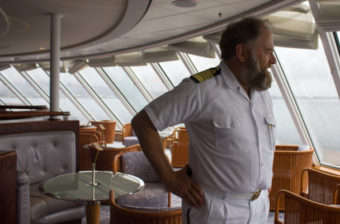
Birger Vorland is the captain of the Crystal Serenity, and he doesn’t shake hands, he touches elbows.

“Make sure everybody stays healthy,” said Vorland. “It’s a Crystal handshake.”

The Crystal Serenity is carrying 980 passengers on a 32-day journey from Anchorage to New York City.

The cruise ship is the largest ever to navigate the Northwest Passage, a voyage of many other firsts for Crystal Cruises, according to Captain Vorland.

“I mean, this is the longest single cruise we’ve ever made,” he said. “And it is the most expensive cruise we’ve ever made. And it’s the one that sold out the fastest — 48 hours, it was basically gone.”

A trip like that comes with a lot of pressure.

“The captain never sleeps heavy,” Vorland said. “He always sleeps a little light.”

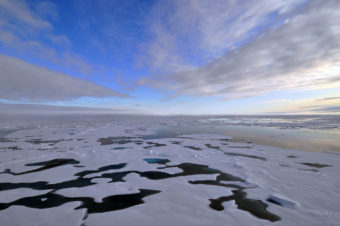
Vorland’s biggest concern is the ice that the ship might encounter further north.

The ship is equipped with searchlights, an ice radar, thermal-imaging technology and a Canadian navigation program called IceNav, all to detect that ice.

The icebreaker vessel Ernest Shackleton joins the cruise in Ulukhaktok.

Vorland thinks that ice isn’t all bad.

“This goes two ways,” he said. “We don’t want ice, but we do want ice because if we don’t have ice, we don’t have polar bears.”

This is one paradox of the Crystal Serenity’s current voyage.

The ice is the greatest threat to the ship, but it’s also why the ship is traveling through the Northwest Passage in the first place.

Crystal Cruises Land Programs vice president John Stoll thinks the passengers are on this cruise for the Arctic wildlife sightings, first and foremost.

“So if we have to, we’re going to convince the captain to go where we need to go to spot the wildlife,” Stoll said.

In the Crystal Serenity’s open, airy Palm Court lounge, Stoll showed off the ship’s Cineflex system.

Giant television screens line the dance floor.

During wildlife sightings, the onboard cameraman will zoom in on the animals and broadcast those images to the screens, as well as to the TVs in all the state rooms.

The system has already been put to use. On their way to Nome, they spotted a pod of whales.

On this voyage of new experiences, one thing isn’t new: the passengers.

Keith Steiner is a passenger who has sailed 81 cruises with Crystal. He said he’s seeing a lot of familiar faces onboard.

“Many of them are seasoned cruisers,” Steiner said. “I think all but six people have sailed Crystal at least one time or more beforehand. So that’s very unique. You have people who cruise every year, they cruise for many days.”

There are even three passengers who currently live full-time aboard the Crystal Serenity.

Although many passengers participated in a variety of tours while in Nome, approximately 200 passengers never deboarded the ship.

To some, the Northwest Passage is a chance for a new adventure, and to others, it’s cruising as usual.

Back in the Palm Court lounge, Captain Vorland looked out the window at the rain.

He sees himself as part of tradition as well.

Not a tradition of cruising, but a tradition that hearkens back to Roald Amundsen, who became the first explorer to travel the Northwest Passage by ship in 1906.

Amundsen was Norwegian, just like Vorland. And like the seafarers of old, Vorland isn’t above a little superstition.

“I told my wife when I went on the world cruise in January, I said, ‘Honey, when I come back from the world cruise, I’m going to stop shaving,” he said. “I am going to keep it that way until all the ice is behind me, and then I’m going to shave again.’ Once we leave Greenland, and all the ice is behind us, the beard is going off.”

On this voyage, Captain Vorland isn’t taking any chances. Not even with his facial hair.

More stories about the Crystal Serenity

NASA keeps watch of shrinking Arctic ice

The future of monitoring Arctic ice begins in space.

NASA scientist Thomas Wagner said to think of the IceSat-2 like a giant laser pointer.

Rather than entertaining your cat, these lasers can measure the height of ice above the water. A total of six of them will be beamed down to Earth.

“The point being that we’re going to get our most accurate maps ever of the thickness of the Arctic sea ice,” Wagner said. “And that’s one of the most important things that we put into our models.”

Those models could influence conservation and planning decisions in the Arctic, Wagner said.

NASA launched a prototype of IceSat in the early 2000s, but it was decommissioned in 2010.

This new and improved satellite — along with additional measurements collected by NASA — will help determine what the future could look like in the Arctic.

And it’s happening at an important time.

“A lot of ice experts, including myself, thought we were headed for a record year minimum,” said Hajo Eicken, a professor at the International Arctic Research Center at the University of Alaska Fairbanks.

Arctic sea ice is important because it acts like a giant air conditioner for our planet, he said.

This year, a combination of events, such as a major ice retreat near Russia, left scientists wondering if the summer would beat a previous low. The last recorded minimum in the Arctic was in 2012.

But wind patterns offset the loss of sea ice and things cooled down a little.

“So now it looks like we’ll have well below normal ice extent, but we won’t have that record minimum,” Eicken said.

Still, Eicken said scientists are trying to figure out how the blob — a large pool of warm water in the Pacific Ocean — could be affecting the Arctic.

Sunlight is the most effective way to melt ice.

“However, the heat that comes up from below, some of it actually survives the winter,” Eicken said. “So in part, what we’re seeing now is that we have years where some of the heat that’s put into the ocean, upper ocean, from the sun and the atmosphere in the summer survives well into the winter.”

That could mean melt episodes even in the colder months.

Eicken is excited about the NASA satellite, which can help document these changes.

Even though what it finds might appear alarming, Wagner said people should be concerned, not afraid.

Look, I have kids, too, and I’m not hopeless at all,” Wagner said. “All the time I see things that are going on in society that make me think that we are generating the social will to deal with this. And I think we’re getting a better handle on the challenges that we face today, and I think we are going to be able to deal with them.”

IceSat-2 is set to launch in 2018.

Nome greets massive Serenity with drums, dance, festivity

Despite rainy weather, the luxury cruise liner Crystal Serenity arrived in Nome on schedule, Sunday morning.

About a thousand people poured out of the floating hotel and emptied into the town of Nome for a full day of scheduled activities and events, including the formal commemoration held at the Nome Mini Convention Center.

Commemoration speaker and Nome Mayor Richard Beneville said it’s days like these that make him feel excited to be mayor of Nome.

“And I got to be honest with you, as mayor of this town, I am so proud,” Beneville said. “I am so proud of our city employees that have come out to help this happen; I’m so proud of our volunteers that have worked on it; I’m so proud of Kawerak, who brought people in from the villages to sell goods. So it’s such a win-win-win, and it’s beautiful, and there’s a buzz in the air, and it’s energy, and it feels great.”

Many of the passengers getting off the boat were stepping onto Alaskan soil for the first time, Beneville learned from people onboard.

Passenger Marc Sola described the activities he was able to participate in as he ventured into Nome.

“We went to the church, we went to the visitors’ center, and then, there’s a little gift gallery we went to, and now we’re over here at the blueberry festival,” Sola said. “We just came out of that, all kinds of things going on in there, singing, gifts, all that kind of stuff.”

Carl Topkok and Linda Kimoktoak, a drummer and dancer for the King Island Dance Group, were thrilled to share some of their culture with these newcomers inside the Mini Convention Center.

“It really means a lot to us, it has to come from the heart, and you have to want to love it to do these songs,” Topkok said.

“Oh, it’s amazing to pass down our culture to people who haven’t experienced it before,” Kimoktoak said. “You kind of get goosebumps, and you get a really good, tingly feeling.”

Crystal Serenity captain Birger Vorland will have to traverse the icy Arctic waterway in order to successfully land in New York City within 30 days. An icebreaker vessel is accompanying the cruise liner throughout the journey.

The Norwegian ship captain was presented with a key to the City of Nome yesterday in the Mini Convention Center, and he took the opportunity to sink all rumors of his cruise liner being the next Titanic.

“We are the largest ship ever to attempt to go through the Northwest Passage, and when I say ‘attempt,’ that’s just for show, you know. We are going to make it, guaranteed,” Vorland said.

Captain Vorland and the Crystal Serenity’s next stop will be Ulukhaktok in the Northwest Territories of Canada.

Crystal Cruises is already booking passengers for another trip through the Northwest Passage next year.

Alaska group works to let locals test shellfish for toxins

KODIAK — An Alaska group is working to create an at-home tester for detective toxins in local seafood.

The Kodaik Daily Mirror reports that Alaska SeaGrant officials are working on a tester for paralytic shellfish poisoning, an illness that can cause tingling in the lips, tongue, fingers and toes and eventual breathing problems. Officials say testing currently costs $125 per test and has a time delay, as samples need to be sent in to the state.

Researchers have developed an electrochemical tester for PSP inspired by the blood sugar tests diabetics use. Pat Tester with Ocean Tester says the machine currently takes 20 minutes, but that time will hopefully drop to five minutes or less over the next few years.

Plankton population and the power of pink salmon

Plankton collected in the Pacific Ocean with a 0.1mm mesh net. Seen here is a mix of multicellular organisms — small zooplanktonic animals, larvae and single protists (diatoms, dinoflagellates, radiolarians) — the nearly invisible universe at the bottom of the marine food chain. Christian Sardet/CNRS/Tara Expeditions
A variety of plankton from the Pacific Ocean. (Christian Sardet/CNRS/Tara Expeditions)

After combing through data from the Aleutian Islands, a scientist has discovered an unexpected relationship between plankton and pink salmon. Although plankton might seem like an ecological afterthought, biological oceanographer Sonia Batten disagrees. She calls them the most important organisms in the ocean.

“They’re the basis of every marine food chain pretty much,” said Batten. “They support directly, or indirectly, the resources that we value.”

That means even if a species isn’t eating the plankton itself, its food source probably is. Scientists consider plankton good indicators of what’s happening in the environment.

“Because they have short life cycles, they have very limited ability to move, and they’re not commercially fished,” she said. “They react very quickly to changes in their environment in a relatively unambiguous way.”

Batten has 15 years of data from plankton pulls in Alaskan waters. That involves dragging a net behind commercial cargo ships. When there are a lot of pink salmon, they eat up a lot of animal plankton. But when pink salmon numbers are low, the animal plankton flourish.

Those impacts permeate the entire food chain — past their immediate prey. And if the pink salmon eat a lot plankton, there may not be much food left for other predators.

In 2013, Batten started seeing something unusual.

“This was the first time that I’ve seen that the fish are actually influencing the plankton,” she said.

2013 was a bumper year for pinks, and the data began to look different. Batten didn’t see that big decrease in plankton. And now she’s left with a question: What changed?

“Pink salmon were supposedly in really high numbers in 2013, so I would have expected to see the same numbers,” she said. “But I didn’t, so that suggests that something’s going on in the environment that I don’t know about yet.”

Batten says it could be that the salmon are eating something else. She’s planning to continue looking for answers.

Correction: A previous version of this story indicated that plankton pulls were done using commercial fishing boats. In fact, scientists used commercial cargo ships.

Is the Arctic ready for the Crystal Serenity?

The Crystal Serenity is the largest passenger ship to traverse the Northwest Passage, traveling from Seward to New York City. Photo: Rachel Waldholz, Alaska’s Energy Desk
The Crystal Serenity is the largest passenger ship to traverse the Northwest Passage, traveling from Seward to New York City. (Photo by Rachel Waldholz/ Alaska’s Energy Desk)

The luxury liner Crystal Serenity is on its way from Seward to New York City through the Northwest Passage.

It’s the largest cruise ship to navigate the route, which hugs the coasts of Alaska, Canada and Greenland. And it’s attracted international attention, with many wondering if it’s a sign of what’s to come as the Arctic sees increasingly ice-free summers.

The ship has 13 decks, eight restaurants, a casino, and a spa. Staterooms for this trip started at about $20,000 and run as high as $120,000 (with personal butler service).

Sitting in her room, with a deck looking out over the Seward harbor, passenger Moira Somers said for most of the people on board, the ship is as much a destination as the Arctic.

“When you start your cruise, no matter where in the world you are, and you see the ship, it’s goosebump stuff,” she said.

Somers and her husband live in Victoria, B.C. (she’s originally from Namibia). Like the majority of people on board, they’re repeat cruisers – she says this is perhaps her 16th trip with Crystal.

But this time is a little bit different.

“Maybe we’re not so sure what we’re letting ourselves in for?” she said, with a laugh. “But there’s so much, we’ve read so much, we’ve prepared ourselves, and we know it’s a big thing.”

Until about a decade ago, the Northwest Passage was only open to ships with icebreaking capabilities. And while smaller cruise ships have visited the region for years, the Crystal Serenity, with more than 1600 guests and crew, will become the largest passenger ship to traverse the full, winding route across the top of Canada.

It’s a dry run for large-scale tourism in a region that hasn’t seen anything like it before.

But the man in charge is not concerned.

Captain Birger Vorland of the Crystal Serenity has spent 38 years at sea. “Nobody has ever planned a cruise as diligently and as detailed as Crystal Cruises has done for this particular voyage,” he said. Photo: Rachel Waldholz, Alaska’s Energy Desk
Captain Birger Vorland of the Crystal Serenity has spent 38 years at sea. “Nobody has ever planned a cruise as diligently and as detailed as Crystal Cruises has done for this particular voyage,” he said. (Photo by Rachel Waldholz/ Alaska’s Energy Desk)

Birgir Vorland, the master of the Crystal Serenity, has spent 38 years at sea. Originally from Norway, he says the Northwest Passage has special resonance.

“My countryman Roald Amundsen did the first transit here, between 1903 and 1906,” Vorland said. “He spent three years on this passage. We’re going to do it in 32 days and a lot more comfort.”

Crystal Cruises has spent more than three years planning the trip. Standing on the navigation bridge, Vorland ticked off the special preparations: systems to detect ice, two Canadian ice pilots joining him in Nome, an escort ship in case he runs into trouble.

“We have crossed all the t’s, dotted all the i’s,” he said. “Nobody has ever planned a cruise as diligently and as detailed as Crystal Cruises has done for this particular voyage.”

As the ship prepared to leave Seward, passengers participated in an emergency drill. In the casino, guests wearing life jackets gathered around staff holding signs that read, “Life Boat 6.”

Passengers took part in an emergency drill before the Crystal Serenity left Seward. Photo: Rachel Waldholz, Alaska’s Energy Desk
Passengers took part in an emergency drill before the Crystal Serenity left Seward. (Photo by Rachel Waldholz/ Alaska’s Energy Desk)

Despite Vorland’s assurances, plenty of people are worried about what happens if this scenario plays out in real life.

“There’s absolutely no capacity to respond to accidents,” said Elena Agarkova, who tracks shipping for the World Wildlife Fund, a conservation group.

There’s very little search and rescue infrastructure in the region, a major concern for authorities. On August 24th, just as the Crystal Serenity passes through the region, the Coast Guard, U.S. military and Canadian forces will stage a major training exercise in the Bering Strait. Called Arctic Chinook, it will simulate the response to a cruise ship going down with 250 people on board.

The question isn’t just whether the Crystal Serenity is ready for the Arctic, but if the Arctic ready for the Crystal Serenity. Some of the communities it’s visiting in Canada have populations smaller than the ship itself.

Agarkova said Crystal Cruises has done a good job of working with communities and addressing environmental concerns, with plans to forgo heavy fuel oil and exceed standards for discharging wastewater. But, she said, there’s no guarantee those precautions will be taken in the future.

“They’re doing these measures voluntarily,” she said. “So there’s nothing that would require cruise lines or cruise ships that would follow in their steps to adhere to the same kinds of standards.”

Agarkova also pointed out the irony of this new era — when the very changes making the region accessible are also transforming it.

That’s not lost on passenger Moira Somers.

“One kind of feels – I won’t say guilty, but you’re taking advantage of what is happening,” Somers said, adding that she hopes the cruise is raising awareness of climate change.

As for her more immediate goals? “My big dream is to see a polar bear,” she said.

After a moment she added, with a laugh, “And just being able to have a successful trip, I think. Getting through with no hiccups.”


Site notifications
Update notification options
Subscribe to notifications