Oceans

Walrus return to Point Lay — but this year, they’re late

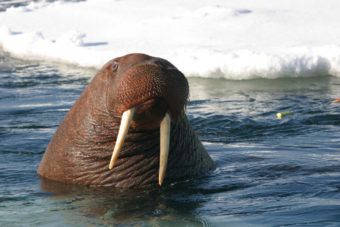
A young Pacific Walrus bull in coastal Alaska waters. (Photo by Joel Garlich-Miller/USFWS)

About a thousand walruses are hauled out on a barrier island near the village of Point Lay, about 180 miles southwest of Barrow.

The haul out is part of an unnerving trend. This year marks the eighth time in a decade that large numbers of walruses have crowded onto land in the area. The animals have been driven to shore as sea ice retreats, limiting access to their usual feeding grounds.
But this year’s haul out — so late in the fall — was a surprise.

Andrea Medeiros is a spokesperson for the U.S. Fish and Wildlife Service. She said scientists were pretty sure it wasn’t going to happen this year. Then, she said, “Next thing I know, I get an email from one of our biologists saying, ‘The walruses are hauling out,’ and I’m like, ‘Ahh!'”

Residents in Point Lay contacted the Fish and Wildlife Service with the news Friday morning.

Medeiros said the haul out is forming about a month later than in the past. Usually at this time, walruses are heading south to Russian waters for the winter. And although sea ice receded to its second lowest level on record this summer, there was lingering ice over the walruses’ traditional feeding grounds.

The Fish and Wildlife Service and the Native village of Point Lay are asking people to stay away from the area during the haul out to avoid disturbing the animals and causing a stampede.

“The risk there is when they are onshore and the animals get spooked, the larger animals will flee to the water and crush the small animals in the process,” Medeiros said. “So it leads to a lot of preventable mortality.”

Biologists are continuing to monitor the haul out as it forms. In the past, up to 40,000 animals have gathered in the area.

British Columbia, Alaska sign transboundary mine agreement

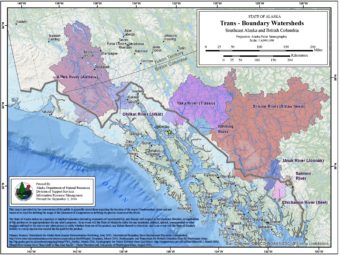
The state has identified eight transboundary watersheds feeding Southeast Alaska rivers. (Map by Alaska Department of natural Resources.)
Eight transboundary watersheds feed Southeast Alaska rivers. A new agreement with British Columbia aims to protect them from mining pollution. Critics say it doesn’t do the job. (Map by Alaska Department of Natural Resources.)

Alaska and British Columbia officials signed a statement of cooperation Thursday aimed at protecting rivers that flow through the province and the state.

Transboundary mine critics say it’s not strong enough.

The document is the result of about a year of talks following citizen warnings about B.C. mines and mining projects near the border.

Local and tribal governments, as well as fishing and environmental groups, said such mines could release pollution that would damage Alaska fisheries and traditional food-gathering.

British Columbia Mines Minster Bill Bennett said the agreement will give the state more input into the province’s environmental-assessment and permitting process.

He said the agreement will establish a technical committee — of experts, not politicians — to set up new water-monitoring systems.

British Columbia Mines Minster Bill Bennett signs a document on Thursday that promises to cooperate on monitoring and protecting water quality. (Photo courtesy B.B. Ministry of Energy and Mines)
British Columbia Mines Minster Bill Bennett signs a document on Thursday that promises cooperation on monitoring and protecting water quality. (Photo courtesy B.B. Ministry of Energy and Mines)

“We need baseline information so that we know whether there’s going to be or will be impact in the future from mining operations,” he said. “We need these folks to figure out how we’re going to pay for it and who’s going to do it.”

Alaska Lt. Gov. Byron Mallott, who has led the state’s effort on the issue, called the terms “another step in Alaska’s commitment to open and transparent collaboration.”

“It creates a technical working group to allow us to essentially put our hands on the power levers of the British Columbia government in its entire regulatory process of permitting mines,” he said.

The agreement was drawn up with feedback from mining, government, fisheries, community and environmental groups, as well as state and provincial officials.

Bennett said his ministry also reached out to First Nations members living in affected areas. He said similar outreach happened in Alaska.

“So I think on both sides of the border, we’re quite proud of the fact that this is not something that the two governments are imposing. This is something that, I think, has developed from the grass roots,” he said.

Some people disagree.

The Tlingit-Haida Central Council's Rob Sanderson Jr. talks about transboundary mining concerns at a Native Issues Form on March 9, 2016, in Juneau. (Photo by Ed Schoenfeld/CoastAlaska News)
The Tlingit-Haida Central Council’s Rob Sanderson Jr. talks about transboundary mining March 9, 2016, in Juneau. (Photo by Ed Schoenfeld/CoastAlaska News)

Ketchikan’s Rob Sanderson Jr., who works with the United Tribal Transboundary Mining Work Group, said tribal governments on both sides of the border should be co-signers of the agreement.

Sanderson also said it doesn’t address their most fundamental concerns.

“It’s not our business to issue permits to mining companies,” he said. “Our business, in my opinion, is to maintain our culture for all future generations. This agreement does not do that.”

Sanderson and other mine critics said the statement of cooperation, part of a larger memorandum of understanding, has little power to make significant mine-safety improvements.

They want the state to continue pursuing involvement of the International Joint Commission. That’s a U.S.-Canada panel handling cross-border water disputes.

“This memorandum of agreement throws a wrench into that. It’s because when you’re looking at it from the outside, they’re saying, ‘Well, probably, maybe we don’t need it. The state has a memorandum with the British Columbian government, so why go there?’ ” he asked.

Lt. Gov. Mallott said the statement of cooperation will not interfere with the state’s pursuit of joint commission action.

“We view this as a multi-track process, of which the SOC is but one,” he said.

The Southeast Alaska Conservation Council’s Guy Archibald said the document is much improved from earlier versions.

But in an email, he said some of its wording, such as the definition of “significant degradation,” is not strong enough.

Chris Zimmer of Rivers Without Borders was also critical. He said the agreement’s terms seem to answer British Columbia’s concerns more than those from Southeast Alaskans.

Lt. Gov. Byron Mallott signs a statement of cooperation with British Columbia Thursday. It targets protecting transboundary rivers. (Photo courtesy Office of the Governor)

B.C. mining companies and regulators said the existing process already safeguards transboundary rivers.

That’s a position taken by Alaska officials in past years, before citizen concerns led to talks that resulted in this agreement.

Only one mine – Red Chris – is up and running in the transboundary area. A second – Brucejack – is under construction. A third – Tulsequah Chief – is closed and needs cleanup.

But Bennett said another handful of exploration projects are far from development, due to technical and economic challenges.

“So, I don’t think you’re ever going to see a sudden emergence of a half-a-dozen new mines or something in northwestern British Columbia. But you will see other projects come along in the next two, three, four or five years,” he said.

Critics said even if it’s just one mine, it still threatens the environment and livelihoods in Southeast Alaska.

Oil and energy company Caelus announces big oil find on North Slope

Oil and energy company Caelus Energy said it’s made a major oil discovery on the North Slope, at Smith Bay.

The company estimates the oil under its current state leases at 6 billion barrels and said as much as 10 billion may lie under the shallow bay.

“It’s going to be a massive development,” Caelus CEO Jim Musselman said. “Very important for the state of the Alaska, and it’s going to create, you know, thousands of jobs.”

Musselman said two wells drilled this year, sidewall core samples and 3-D seismic work suggest a large reservoir of light oil in good rock.

“And we have the same fan complexes under each well, so that gives us courage that the fan extends over this big area,” Musselman said.

Production is years away.

The company says the development could eventually boost the amount of oil going down the Trans-Alaska Pipeline by about 200,000 barrels per day, an increase of nearly 40 percent over current daily averages.

Musselman said, the light oil will help cut sludge, improving the pipeline’s flow.

The CEO estimates the cost of the project at $8 billion to $10 billion. He’s confident he can get financing if the price of oil goes up to at least $65 a barrel. State tax credits are also important, he said.

“We can in fact help with their fiscal crisis going forward if they’ll help us, and I think that’s all we’re looking for,” Musselman said.

This summer, Gov. Bill Walker vetoed oil tax credits worth $430 million, saying the state couldn’t afford to pay so much to oil companies.

Smith Bay is between Barrow and Prudhoe Bay.

The Caelus leases are in state waters, offshore of the National Petroleum Reserve-Alaska.

Hurricane Matthew Looms As A Category 4 Storm

Forecasters expect Hurricane Matthew to pass between Jamaica and Hispaniola before hitting parts of Cuba and the Bahamas. NHC/NOAA
Forecasters expect Hurricane Matthew to pass between Jamaica and Hispaniola before hitting parts of Cuba and the Bahamas.
NHC/NOAA

It may weaken somewhat as it spins in the Caribbean, — but forecasters still say that Hurricane Matthew will likely bring winds topping 100 mph when it makes landfall. Parts of Haiti, Cuba and Jamaica are on alert, as Matthew’s maximum sustained winds were measured at 140 mph Saturday afternoon.

Hurricane conditions could hit Jamaica and Haiti by Monday, with tropical storm conditions possible by late Sunday, the National Hurricane Center says. It adds that hurricane conditions could also hit eastern Cuba by Monday night.

Matthew strengthened into a category 5 storm at the end of the week before weakening somewhat Saturday; the NHC’s forecasters say the storm is “expected to remain a powerful hurricane through Monday.”

Citing data from an Air Force Reserve Hurricane Hunter aircraft, the weather agency said that as of Saturday morning, Matthew’s maximum sustained winds were near 145 mph, with higher gusts.

A satellite image shows Hurricane Matthew's location around midday Saturday. The storm is expected to move to the north and northwest. NOAA
A satellite image shows Hurricane Matthew’s location around midday Saturday. The storm is expected to move to the north and northwest.
NOAA

The hurricane center’s Robbie Berg says Matthew is expected to “remain a very dangerous major hurricane” as it moves to the northwest and north across the Caribbean, through at least Monday.”

Forecasters say while Matthew is expected to experience some gradual weakening over the next 24 hours, “conditions appear conducive for restrengthening once Matthew moves into the Bahamas” after the storm passes the islands of Jamaica, Hispaniola, and Cuba.

Copyright 2016 NPR. To see more, visit http://www.npr.org/.

Skagway tourism season comes to a close

As the air gets colder and the days shorter, the Skagway tourism season is coming to a close.

Overall, tourism staff said this summer was a success.

The last cruise ship of the season has come and gone and shop owners around Skagway are preparing for winter, cleaning up and closing their doors.

The streets that were recently busy with visitors are quieting down.

“Overall I think our 2016 season went remarkably well,” said Cody Jennings, Skagway’s tourism director. “From the feedback that I’ve had from local business owners and tour operators, everybody is really pleased with the season.”

Skagway saw the biggest ship it’s ever seen this summer.

The Royal Caribbean Explorer of the Seas made weekly visits to town, and holds just over 4,000 passengers at capacity.

Jennings says the new addition was a success.

“It went really great,” Jennings said. “I think it was a great addition to the mix of ships that we get here, everybody seemed to enjoy it.”

The summer was not without its challenges.

One day in September two ships couldn’t dock because of high winds. The Crown Princess holds just more than 3,000 passengers, the Nieuw Amsterdam about 2,000.

“And all-in-all while that was unfortunate I think all-in-all that was really the only sort of hiccup that we had during the season,” Jennings said.

There also was some concern going into the season about the exchange rate for Canadian tourists.

The slumping Canadian dollar is about $0.76 against the stronger U.S. currency.

But Jennings says it doesn’t seem to have been a problem.

“From the feedback that I’ve received for example from hoteliers and the restaurants and stuff, obviously being on the border we get a fair amount of travelers just from our Canadian neighbors,” Jennings said. “But really we didn’t see much of an impact. Even in the RV parks. My understanding is the long weekends that they came down the continued to do so despite the dollar difference.”

Jennings said Skagway continues to have a lot to offer visitors.

“They come into this community and they see the effort that’s made in maintaining our downtown historic district,” Jennings said. “It’s incredibly charming and one of the things that we see often in our comment cards here is that the staff and community members are incredibly friendly. So I think that leaves an impression on our visitors and definitely one we want to leave.”

She won’t have hard statistics on tourism dollars and numbers of visitors until later this year.

The town anticipated 800,000 cruise ship visitors and 125,000 non-cruise ship travelers.

With the last cruise ship gone, Jennings is confident it was a strong season.

Whales, Sea Turtles, Seals: The Unintended Catch Of Abandoned Fishing Gear

There are fewer than 500 North Atlantic right whales left in the world. And now, one less: This weekend, one of the 45-ton creatures was found dead off the coast of Maine, completely entangled in fishing line — head, flippers and all.

This was not an isolated incident.

In late June, an endangered blue whale wrapped in fishing gear was seen struggling off the coast of Dana Point in Southern California. Rescuers were unable to extricate it before it swam away. And earlier this month, rescuers unsuccessfully tried to free an entangled humpback whale near Newport. Spotters say they believe the humpback eventually found its way free of most of the gear, though they’re unsure if there’s anything still trapped in its mouth.

While any kind of fishing gear can be lost or abandoned at sea, gillnets, crab pots and traps are the most common types that continue to “ghost fish” — entrapping marine animals like whales, seals, sea lions and sea turtles.

Last year, the West Coast saw 61 whale entanglements — a record number that is nonetheless likely to be broken this year. So far in 2016, there have been 60 reports of entanglements as of late September. Why it’s happening is unclear. Researchers say there’s more derelict gear in the water today, and more reported sightings, but population numbers and migratory patterns of whales have also shifted.

What happens when a whale becomes entangled is grim.

“The gear is really, really heavy and when a whale comes in contact with it, it thrashes around to shed the gear,” says Kristen Monsell, an attorney with the Center for Biological Diversity. Sometimes that works; sometimes it entangles the whale even further.

“Sometimes it can drown the whale immediately, or it can happen over weeks, because they get so tired,” she says. “They eventually die of exhaustion. If the gear is in their mouths, it impedes their ability to feed. It can amputate their tails or other parts of the body. And for younger whales, the gear may wrap around them, but the whale keeps growing and it cuts into their flesh.”

To combat the problem, California Gov. Jerry Brown signed The Whale Protection & Crab Gear Retrieval Act into law on Friday. A first of its kind for the state, the new law is designed to reduce the number of whales caught in fishing gear by creating financial incentives for the state’s Dungeness and rock crab fishermen to collect any abandoned gear they find during the offseason. An estimated 40,000 Dungeness crab pots may be lost every year between California and the Canadian border. And that’s just one fishery in one region.

But until now, plucking lost gear out of California waters was illegal.

“There was an existing law that made it unlawful to move, damage or disturb any trap that belongs to another person. And you [couldn’t] have gear on your boat outside of the season,” says Monsell, a member of the fishing gear group that worked on strategies to reduce whale entanglements.

Unlike many other types of fishing gear, crab pots are traceable to the owner. Fishermen who collect abandoned gear in the offseason will be paid a recovery bounty by the owner who lost the trap. Fishermen who do not buy back their lost or abandoned traps will not be allowed to get their vessel permit for the following season. In California, the Dungeness crab season typically runs Nov. 15-June 30, although last year’s season was delayed because of a toxic algae bloom.

“We’re doing everything we can,” says longtime crabber Larry Collins, president of the Crab Boat Owners Association in San Francisco. “Three or four years ago we got trap limits. No one can throw more than 500 traps. We’ve decreased the gear in the water, and we’re looking at that again.”

Washington and Oregon also have postseason recovery programs, but unlike California’s, fishermen are allowed to keep or sell the gear they retrieve.

Not all entanglements come from abandoned or lost gear. Whales can be caught up in active fishing gear, too, especially when changing ocean conditions move prey, like schools of anchovies, closer to shore.

“Entanglements are a hard issue. When you have a whale, you don’t know if it’s active or abandoned fishing gear,” says Sherry Lippiatt, California Regional Coordinator, NOAA Marine Debris Program.

The West Coast isn’t alone in being a problem spot. It’s estimated there are more than 85,000 derelict traps in the Florida Keys, affecting 79 species and killing 630,000 lobsters a year. An estimated 450,000 pots used to catch blue crab are lost each year in Louisiana. In the Chesapeake Bay, where nearly half of all U.S. blue crabs are landed, 160,000 crab pots go astray annually. And according to the environmental group World Animal Protection, of the 3 million lobster pots that go into the water in Maine, an estimated 10 percent are lost each year.

Last year the group launched the Global Ghost Gear Initiative to tackle the issue.

Elizabeth Hogan, campaign manager with World Animal Protection, says that each year around the globe, 640,000 tons of gear is getting lost in the ocean. “It adds up. Very little of it is getting pulled out,” she says.

And lost gear has been known to travel great distances. “Colleagues in the U.K. found lobster pots from Maine and Canada on the shores of the U.K. That gear crossed the ocean,” she says.

Ghost gear can continue to trap fish and shellfish — and impact the health of a fishery. In the Chesapeake Bay, researchers found that removing just over 34,000 derelict pots allowed the fishery to harvest an additional 13,500 metric tons of crab worth $21.3 million.

There are other financial incentives to getting abandoned gear out of the water. Influential groups like Seafood Watch take ghost gear into account when rating a fishery if there’s strong evidence that it’s a problem, while the Marine Stewardship Council’s certification includes criteria on effects from gear loss.

Chelsea Rochman, a professor at the University of Toronto who studies ocean debris, including derelict fishing gear, says that while the new California legislation is helpful, she’s not sure whether it will ultimately save whales.

“In terms of marine debris and derelict fishing gear, it’s a first step. But what’s special about this law is that the fishermen are on board. It incentivises them to pick up their gear,” she says. “I think it’s a great first step.”

Collins says that’s because fishers had a voice at the table when the working group first sat down to address the issue.

“We’re trying to be proactive and get ahead of this. Now, at the end of the season, we can pick up the gear and get it out of the ocean, because we love whales like everyone else,” says Collins.

Copyright 2016 NPR. To see more, visit http://www.npr.org/.
Site notifications
Update notification options
Subscribe to notifications