Oceans

Storm Leaves Thousands Without Power In Pacific Northwest

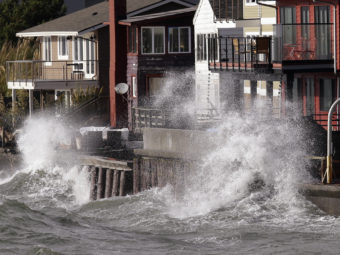
Waves batter a seawall on Friday in Seattle. The remnants of a typhoon brought rain and wind to the Pacific Northwest on Friday and Saturday. Elaine Thompson/AP
Waves batter a seawall on Friday in Seattle. The remnants of a typhoon brought rain and wind to the Pacific Northwest on Friday and Saturday.
Elaine Thompson/AP

A pair of storms brought strong winds and heavy rain to parts of Washington state and Oregon this weekend.

The National Weather Service reported the remnants of a typhoon caused wind gusts around 50 mph on Saturday evening in Washington state, and heavy rain flooded some roads. More than 25,000 people lost power.

The weather service predicts more rain in the region on Sunday.

Sunday morning, Puget Sound Energy, the major electrical utility for the Seattle region, said crews were still working to restore electricity to tens of thousands of people.

Overnight on Friday, another typhoon-remnant flooded parts of northwest Oregon. The Portland Tribune reported rain and wind delayed trains in Portland and caused the city’s streetcar service to shut down briefly on Friday night.

But the biggest problem was the wind, which the National Weather Service says gusted to 50 mph in Portland and up to 80 mph in some places on the coast. It brought down trees and power lines across northwest Oregon. The Tribune reported 37,000 people were without power on Saturday afternoon, and on Sunday Portland General Electric said electricity still had not been restored to more than 4,200 people.

Both storms were forecast to be more serious than they turned out to be because the National Weather Service initially thought they would hit the coast more directly than they did. On Friday, the National Weather Service office in Seattle issued a warning for damaging winds and heavy rain, and forecast wind gusts of 65 to 70 mph on Saturday for the area around the city.

In preparation for the storm, Seattle’s mayor activated the city’s emergency operations center, and warned residents to “defer traveling during the storm.”

The Portland Bureau of Transportation warned of “flying debris” and recommended that residents cancel unnecessary travel.

On Sunday, some people took to Twitter to point out that the winds in Seattle had not been as strong as predicted, and some expressed frustration that the National Weather Service had not predicted the storm more accurately.

The National Weather Service responded with tweets pointing out the many difficulties of forecasting a storm coming over the ocean, and sharing a map of the storm’s trajectory from the south Pacific all the way to the Pacific Northwest.

Copyright 2016 NPR. To see more, visit http://www.npr.org/.

Video: Whale skeleton takes flight in Anchorage

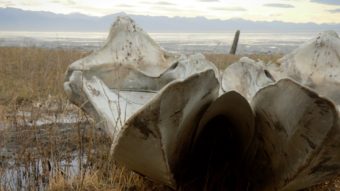
Researchers from the University of Alaska Fairbanks were at Kincaid Beach in Anchorage to finish recovering the skeleton of the humpback whale that washed up there in July. The team, led by Mammals Collection Manager Aren Gunderson, removed half the whale by hand in September then came back the next month with a helicopter for the remaining large bones. The massive specimen will become part of the largest marine mammal collection in North America housed at the University of Alaska Museum in Fairbanks.

Fisheries panel hears transboundary mine concerns

Hazeltine Creek, once a narrow waterway, is filled with mud, silt and logs following August 2014’s tailings dam breach at the nearby Mount Polley Mine. (Photo courtesy Chris Blake/MineWatch Canada)
Hazeltine Creek, once a narrow waterway, is filled with mud, silt and logs following August 2014’s tailings dam breach at the nearby Mount Polley Mine. Southeast Alaskans testifying at a recent hearing say a similar dam break could damage the region’s rivers. (Photo by Chris Blake/MineWatch Canada)

Critics of British Columbia mining told a legislative committee Wednesday about the dangers of mineral extraction along transboundary rivers.

Tribal leaders, scientists, fishermen and community members warned House Fisheries Committee members of the consequences of a cross-border mining disaster during the public hearing.

The focus was on the Taku, Unuk and Stikine Rivers, which begin in British Columbia and flow through Southeast Alaska to the ocean.

One speaker was Central Council of Tlingit and Haida Indian Tribes of Alaska President Richard Peterson of Juneau. He pointed to 2014’s Mount Polley Mine disaster, when a dam holding back silty, polluted water broke and spilled millions of gallons into nearby waterways.

Central Council of Tlingit and Haida Indian Tribes of Alaska President Richard Peterson. (Photo courtesy CCTHITA)
Central Council of Tlingit and Haida Indian Tribes of Alaska President Richard Peterson spoke at Wednesday’s hearing. (Photo courtesy CCTHITA)

“We’re terrified that that’s what’s going to happen here. And they we’re going to share their fate. We couldn’t sustain our traditional way of life. We couldn’t sustain our economic way of life, if that happened,” he said.

The B.C. government and the mine owner have said the Mount Polley spill caused no long-term damage.

But United Tribal Transboundary Mining Work Group Chairman Frederick Olsen Jr. of Kasaan said the impacts have been underplayed.

“When you call something a tailings storage facility, you treat it a lot differently than you would treat a lake of poison that’s held back by sand. But that is what we have. Mount Polley had a lake of poison held back by sand. And it was supposed to last forever. But it lasted fewer than 20 years,” he said.

The fisheries committee heard from several scientists who addressed the frequency and impacts of mine spills.

One was Center for Science in Public Participation Founder Dave Chambers. He said his research shows falling metals prices and rising costs putting a lot of pressure on mines to boost production.

“We’re seeing an increasing number … of large tailings dam failures because they’re being built and operated by companies under financial stress,” he said.

The state and British Columbia recently signed a statement of cooperation on transboundary mining. It promised Alaskans will play a larger role in resource development planning and permitting.

But tribal, or First Nations, leaders from across the border warned that the province has a bad track record of living up to such deals.

Alaska Lt. Gov. Byron Mallott discusses the Xat’sull people’s traditional fishing on the Fraser River with tribal council official Jacinda Mack on May 6, 2015. The Xat'sull live in the area damaged by August's Mount Polley Mine tailings dam collapse. They’re concerned about reopening plans. (Photo courtesy Office of the Governor)
Alaska Lt. Gov. Byron Mallott discusses the Xat’sull people’s traditional fishing on the Fraser River with tribal council official Jacinda Mack on May 6, 2015. (Photo courtesy Office of the Governor)

Bev Sellars chairs First Nations Women Advocating Responsible Mining.

“My recommendation based on my lifelong experience with the British Columbia government … is to try to get a solid country-to-country agreement on paper. Don’t put all your trust in the province of British Columbia,” she said.

She said the state should instead push for involvement of the International Joint Commission. That’s a U.S.-Canada body charged with resolving boundary water disputes. The Walker administration and Alaska’s Congressional delegation have asked for that action.

Like Sellars, Jacinda Mack is from a community directly affected by the Mount Polley spill. She said federal involvement is needed because there was little or no advanced planning for the Mount Polley disaster.

“It will be an adaptive management or a figure-it-out-as-we-go approach. And that is not good enough. And it’s something we’ve had to deal with and this is something I think we can get out in front of with these transboundary mines. The hearing, held in Juneau, was attended by most Southeast lawmakers,” he said.

Chairwoman Rep. Louise Stutes, who represents Kodiak, Yakutat and Cordova, acknowledged the importance of the issue. She said she plans to hold more hearings to continue looking into the impacts.

Hydaburg mayor named temporary head of Federal Subsistence Board

Hydaburg Mayor Tony Christianson accepts an award from the U.S. Forest Service in May, 2013.
Hydaburg Mayor Tony Christianson accepts an award from the U.S. Forest Service in May 2013. (Public Domain photo courtesy of the U.S. Forest Service)

Anthony “Tony” Christianson of Hydaburg has been named interim chair of the Federal Subsistence Board.  The announcement was made by Secretary of the Interior Sally Jewell on Tuesday. Secretary of Agriculture Tom Vilsack concurred with the appointment.  Christianson says he is pleased to have been selected.

“Through a couple of years of learning, I really liked being involved. When that opportunity came up, I thought I would take a stab at it.”

Christianson was appointed to the Federal Subsistence Board in 2012 as one of the first public members representing rural Alaskans.  He says serving on the board is rewarding.

“I’ve really enjoyed being able to help rural members find the food they need, basically. That’s been my interest all the time. To make sure rural people are considered the priority and can access the resource to meet the demands of their needs.”

Christianson says he is impressed with the other people who serve on the board.

“A really good, professional group of people that really looks out for the best interest of the subsistence and federal needs across the state. Not just the subsistence users, but all of the user groups across the state, to regulate the wildlife and fisheries.”  

Christianson is the mayor of the City of Hydaburg and works as the natural resource director for the Hydaburg Cooperative Association, a federally recognized tribe. He is also a commercial fisherman.

The Federal Subsistence Board was created in the early 1990s and is the decision-making body that oversees management of fish and wildlife resources for subsistence uses on federal public lands and waters in Alaska.

Christianson will take the place of Chairman Tim Towarak, who retired. A permanent chair is expected to be appointed in the next several months. Christianson says he has put his name in for consideration.

Hurricane Matthew Blamed For 7 Deaths In N.C.; Flood Perils Continue

Chief of Police George Brothers walks along what used to be a four-lane national scenic byway that's now covered in sand after Hurricane Matthew hit the beach community of Edisto Beach, S.C., Saturday. David Goldman/AP
Chief of Police George Brothers walks along what used to be a four-lane national scenic byway that’s now covered in sand after Hurricane Matthew hit the beach community of Edisto Beach, S.C., Saturday.
David Goldman/AP

At least 16 deaths are now associated with Hurricane Matthew, the powerful storm that made landfall in South Carolina as it made its way up the Atlantic coast Saturday. After more than a foot of rain fell in several parts of North Carolina, officials said seven people died from the storm.

“As the sun rises in North Carolina and the blue sky returns, our state is facing major destruction and sadly, loss of life,” Gov. Pat McCrory said Sunday. “This storm is not over for North Carolina.”

Emergency crews in the state had performed 887 swift water rescues by Sunday morning, McCrory said.

Now rated as a post-tropical cyclone, Matthew is moving eastward away from North Carolina, according to the National Hurricane Center. In its 2 p.m. ET update on the storm, the center said Matthew’s center was 150 miles east of Cape Hatteras.

But while work crews are contending with fallen power lines and downed trees, flooding — particularly from swollen rivers — remains a key concern in North Carolina, South Carolina and Georgia, where many waterways that are absorbing torrential rainfall aren’t expected to crest until Monday or Tuesday.

As of early Sunday afternoon, the AP reported, “The death toll in the U.S. climbed to at least 16, nearly half of them in North Carolina.”

Two North Carolina counties — Tar Heel and Bladen — had more than 16 inches of rain, McCrory said in an update as officials took stock of the situation on Sunday. The governor said he has signed an expedited major disaster declaration that’s being sent to President Obama, so that the state can quickly receive federal assistance.

“As of mid-morning Sunday, there were more than 760,000 power outages in central and eastern North Carolina,” according to member station WUNC.

Here are more updates on the storm’s effects:

In South Carolina: “Currently more than 700,000 homes are without power,” South Carolina Public Radio’s Vince Kolb-Lugo reports in Columbia. “Meanwhile, authorities continue to monitor the levels of two rivers, the Waccamaw and Little Pee Dee, which are both expected to rise even more in the coming days.”

In Georgia: “The mandatory evacuation notice along the Georgia coastline is lifted, so residents here can start returning to their homes,” NPR’s David Schaper reports. “But in Savannah, Chatham County Chairman Al Scott is warning them not to just yet, because he says conditions in many areas are still not safe.”

In Haiti, where the storm killed hundreds of people: “A massive relief effort is being mounted for hurricane-ravaged parts of Haiti,” NPR’s Jason Beaubien reports from Port au Prince, “with President Obama urging Americans to give whatever they can.”

Jason adds:

“Aid groups say they’re sending in relief supplies by any means possible including boats, trucks and small planes. The main road linking the capital Port au Prince with the hardest-hit part of the country was initially blocked after Matthew tore across the south of Haiti. Despite a bridge being washed away, trucks from the United Nations and aid groups are now getting across by driving through a shallow point in the river.”

Copyright 2016 NPR. To see more, visit http://www.npr.org/.

U.S. Rushes Aid To Haiti, Where Hurricane Matthew Killed Hundreds

Residents carry a coffin containing the remains of a pregnant woman killed by Hurricane Matthew, in Jeremie, Haiti. People across southwest Haiti are salvaging what they can from wreckage the Category 4 storm caused. Dieu Nalio Chery/AP
Residents carry a coffin containing the remains of a pregnant woman killed by Hurricane Matthew, in Jeremie, Haiti. People across southwest Haiti are salvaging what they can from wreckage the Category 4 storm caused.
Dieu Nalio Chery/AP

As fears are confirmed about the extent of the damage Hurricane Matthew inflicted on Haiti — with a government agency saying 470 people died in one district alone — USAID is airlifting more than 480 metric tons of relief supplies to the small nation.

An official in Haiti’s Civil Protection Agency tells the AP that in addition to the 470 deaths he’s confirmed in one district, “The death toll is sure to go up.”

The U.S. aid agency says it’s sending supplies that could help up to 100,000 people, including 40,000 blankets, 20,000 hygiene kits, and nearly 18,700 kitchen sets. Some of the aid will be delivered by the U.S. Navy.

From Port au Prince, NPR’s Jason Beaubien reports for our Newscast unit:

“Tens of thousands of people remain in shelters after the storm. The USAID shipments includes rolls of plastic sheeting to help people temporarily replace roofs that were ripped away by the Category 4 hurricane.

“The U.S. Navy amphibious transport ship Mesa Verde is also expected to arrive off the coast with 700 sailors and Marines aboard. The Navy plans to use helicopters and landing craft to ferry relief supplies ashore.”

The U.S. Department of Defense’s role in the aid effort comes after Hurricane Matthew crippled access to southwest Haiti and other hard-hit areas, washing out bridges and roads.

The immediate need for food and shelter could mushroom into other needs in the near future. As Jason reported yesterday, “Hundreds of thousands of people had their homes partially or totally destroyed. Crops have been wiped out.”

And as NPR’s Rebecca Hersher reported for the Two-Way this week, “Amidst the flooding, the specter of a spike in cholera cases has aid organizations worried that the physical destruction of buildings could be just the beginning of Matthew’s deadly effects in Haiti.”

Rebecca also noted that Hurricane Matthew has forced another delay in Haiti’s already-delayed presidential election.

Copyright 2016 NPR. To see more, visit http://www.npr.org/.
Site notifications
Update notification options
Subscribe to notifications