Oceans

Groups announce intent to sue over polluted Fairbanks air

ANCHORAGE — Three environmental groups are turning up legal pressure on a federal agency to require a cleanup of polluted Fairbanks air.

The groups in June sued the Environmental Protection Agency to force an agency decision on whether to accept a state plan to reduce unhealthy fine particulate produced by wood stoves and other sources.
The groups Wednesday sent a letter to the EPA announcing their intent to sue again because the agency has missed a deadline to require the Fairbanks North Star Borough to address pollution controls.

A letter giving 60-day notice is required before a lawsuit can be filed.

Earthjustice is representing the groups. Attorney Kenta Tsuda says federal law requires the EPA to designate the Fairbanks borough as a “serious non-attainment area” that would trigger additional pollution controls.

Tour boat captain fired; naturalist tells of vessel sinking

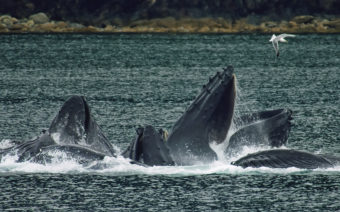
Humpback whales in North Pass between Lincoln Island and Shelter Island in the Lynn Canal north of Juneau. (Creative Commons Photo by Evadb)
Humpback whales in North Pass swim between Lincoln Island and Shelter Island in the Lynn Canal north of Juneau Saturday, August 18, 2007. (Creative Commons Photo by Evadb)

Multiple boats helped rescue 18 people from the Dolphin Jet Boat Tours whale-watching vessel, Big Red, which struck a rock and sank Sunday.

The Coast Guard received a distress call that the tour boat was taking on water at 12:17 p.m. Sunday.

Douglas Ward, the owner of Dolphin tours, said he was shocked by the accident and was grateful everyone made it off the boat safely.

The Big Red’s captain was fired, Ward said.

Mike Clasby, a naturalist with Dolphin tours, said he and the Big Red’s captain were bringing 16 tourists back to Juneau after a tour.

They were between Shelter Island and Aaron Island, passing the southern tip of Aaron Island in Favorite Channel. The boat struck an uncharted rock, according to Coast Guard spokeswoman Lauren Steenson, petty officer 3rd class.

He said the sinking couldn’t have taken more than five to six minutes.

“I was facing the stern of the boat and looking at the passengers and all of the sudden there was this horrific bang,” Clasby said. “I thought we hit a whale. Then I realized that it was a little more than that because I ended up on the floor of the boat.”

Clasby first checked on the passengers and the captain, he said. Then went to see whether the engine compartment was damaged.

“I said, ‘OK, I’ll be right back,’ and I went back and opened the stern (door), and popped open the starboard hatch, and there was water coming in the engine compartment,” he said.

With water coming on too fast, Clasby thought about deploying the life raft but said he instead decided it was more important to get everyone in life vests first.

“The captain and I went towards the back, and then (water) was really coming onboard,” Clasby said. “We made a plan that he was going to try and get the life raft, which was now underwater actually, released.”

That’s when he said they saw a boat.

“I yelled, and yelled, and screamed, and he was waving, and I was waving and all of the sudden this boat called Sea Ya waved back and turned towards us,” Clasby said.

The Sea Ya was the first vessel to reach the Big Red. The Juneau harbormaster’s office said the boat measured about 30 feet long. Clasby said it wasn’t big enough, but they still managed to fit almost everyone aboard.

“Then all the sudden the boat (Big Red) sank,” Clasby said. “It was taking that much water on. There was four of us that didn’t make it onto the Sea Ya, we were hanging on the edge. And the captain, who was the last one off of our boat, had a life jacket and he drifted away, unfortunately, which turned out to be OK.”

Clasby and remaining passengers made it aboard the Sea Ya, he said. The captain later was retrieved from the water.

The St. Herman, Allen Marine Tour’s boat, collected the Big Red’s passengers and returned them to shore.

Capital City Fire/Rescue reported all of the tour boat’s passengers and crew refused medical treatment, including one person who suffered a knee injury.

Northern Alaska Peninsula has strong 2016 sockeye returns

Wood River sockeye are pictured in this June 2016 photo. CREDIT KDLG NEWS
Wood River sockeye are pictured in this June 2016 photo.
(Photo by KDLG Staff)


Bob Murphy, the Area Management Biologist at Port Moller, said the North Peninsula has had a strong harvest so far this summer, with a little more than 3 million sockeye hauled in for the entire North Alaska Peninsula management area, including Nelson Lagoon and the Northwestern District harvests. That’s more than the 2.2 million sockeye harvest forecast.

Area M fishermen have hauled in nearly 9 million salmon so far this summer, including almost 5.5 million sockeye. Most of that catch comes from the North Alaska Peninsula.

The catches were strong enough to prompt processors to limit fishermen’s daily deliveries for most of July; a move that Murphy said has been common in recent years. Murphy said most rivers also went over their escapement goals.

But not every section performed as well. The Outer Port Heiden section is at the northwest end of the North Alaska Peninsula fishery, and genetics last spring showed that many of those fish are headed on to the Ugashik District in Bristol Bay. Despite a good year in Ugashik, Murphy said it was not a particularly strong year at Outer Port Heiden.

“Overall, the harvest in the Outer Port Heiden section this year was not as strong as we typically see it,” Murphy said. “We had about 585,000 fish harvested in the OPH section to date. That’s probably average or actually maybe even below average, considering that we did have pretty strong runs throughout the North Peninsula and Bristol Bay this year.”

The last Outer Port Heiden fishing period closed at 6 p.m. July 27. Elsewhere in the North Peninsula, catches will continue through August and beyond. The late Bear River sockeye run typically begins around August 1 and continues through mid-September, depending when processors stop buying.

“It’s not as strong as the early run at Bear River, but it is a significant run and in some years has produced catch and escapement of over a million fish,” Murphy said.

Passengers rescued after tour boat sinks

A second humpback has been swimming alongside the entangled humpback since at least June 4, when this photo was taken. The second whale may also be entangled in the anchor line, complicating the entanglement situation. (Public Domain photo by NOAA Fisheries)
Two humpback whales near Juneau on Saturday, June 4, 2016. (Public Domain photo by NOAA Fisheries)

Editor’s note: We’ve published an expanded and recast version of this story here.

Update

Capital City Fire and Rescue reported all of the tour boat’s passengers and crew refused medical treatment, including one person whose knee was injured.

Original story | 7:06 p.m.

Two boats rescued the passengers of a whale watching vessel that sank Sunday.

U.S. Coast Guard PO3 Lauren Steenson said the tour boat Big Red reported it was taking on water early in the afternoon.

“Coast Guard Watchstanders issued an urgent marine information broadcast and there were a couple (of) good Samaritans that responded,” Steenson said.

The Sea Ya, the first vessel to reach the Big Red, took most of the 16 passengers and two crew members aboard. Later, an Allen Marine Tours vessel, the St. Herman, came on scene.

“But once the St. Herman got there, all 18 people were recovered from the water and the other boat and transported to Allen Marine Dock,” Steenson said.

The passengers and crew reached shore about two hours after they called for help. Steenson wasn’t certain what condition they were in. She said one person had a knee injury.

Steenson said the Coast Guard rarely sees vessels sink in the Juneau area, but they do see an increase in calls for vessels taking on water during the summer months.

“Especially during those months we definitely like to stress the importance of having all your safety gear up to date and having life vests for each person on board and functioning communication equipment,” Steenson said.

Lt. Jennifer Ferreira, Coast Guard Sector Juneau command duty officer said in a press release, all of the Big Red’s passengers were given life vests.

The Big Red was operated by Dolphin Jet Boat Tours. The company didn’t immediately respond to attempted requests for comment.

The cause of the boat sinking is under investigation.

This is a developing story.

Correction: An earlier version of this story had misspelled the good Samaritan vessel’s name. It’s the Sea Ya, not the See You. Also, the Coast Guard spokesperson’s assertion that four people waited in the water has been deleted because an eyewitness had a contradictory account. 

Warm water Blob survives as El Niño dies

Sea surface temperature observations in late July 2016 show higher-than-normal temperatures lingering in the North Pacific and Bering Sea.
Sea surface temperature observations in late July 2016 show higher-than-normal temperatures lingering in the North Pacific and Bering Sea. (Courtesy of National Oceanic and Atmospheric Administration’s National Centers for Environmental Prediction)

It’s being called a marine heat wave. The combination of the strongest El Niño in recent history and the warm water anomaly known as the Blob generated the greatest amount of warm ocean water that has ever been recorded, possibly affecting marine life up and down the West Coast.

New research has now linked the two phenomena, with each believed to be alternately affecting the other through the atmosphere and the ocean.

El Niño is the warming of the equatorial Pacific Ocean and it can affect wind, temperature and precipitation patterns around the globe. While the latest El Niño did bring some needed precipitation to parts of the drought-stricken West Coast, it was also blamed for flooding, mudslides and other damage in California, according to an ABC News story in January.

After peaking in late 2015 with sea surface temperatures of at least 2 degrees Celsius above normal, the latest El Niño has disappeared. The National Oceanic and Atmospheric Administration’s Climate Prediction Center in Maryland recently reported that sea surface temperatures have dropped to below average in the eastern equatorial Pacific over the last two months.

But while El Niño is dead, the Blob lives on.

“To put it in a little bit more colorful terms, kind of a lingering hangover,” said Nicholas Bond, a research meteorologist at the University of Washington and the state climatologist for Washington.

Bond said latest sea surface temperature measurements show that unusually warm conditions are still persisting, especially in the Gulf of Alaska and the Bering Sea.

“For the Gulf of Alaska, 2.5 degrees C warmer than normal and in parts of the Bering Sea it’s 4 degrees C, or 7 degrees Fahrenheit warmer than normal,” Bond said. “I noticed some temperatures there near the west coast of Alaska that were 16 degrees C. That’s over 60 degrees (Fahrenheit) in the Bering Sea.”

Bond first identified the warm water anomaly three years ago and nicknamed it The Blob. He said unusual weather patterns have allowed the ocean to retain that heat.

“It got quite a bit warmer than normal, quite deep depths, as deep as 300 meters or so,” Bond said. “There was just a tremendous reservoir of this extra heat that is taking a long time to go away.”

That means that Alaskans, especially along the coast, could expect warmer weather this summer.

Climate hypothesis to explain the generation, evolution and persistence of the North Pacific warm anomaly between the winters of 2013/14 and 2014/15.
Climate hypothesis to explain the generation, evolution and persistence of the North Pacific warm anomaly between the winters of
2013/14 and 2014/15. (Di Lorenzo & Mantua, Nature Climate Change, 2016)

New research suggests a link between the Blob in the North Pacific and the former El Niño in the tropical Pacific.

“El Niño was kind of in the middle of the event in terms of changing the pattern of ocean warming and making it last for three years,” said Nate Mantua, a climate and fisheries research scientist at NOAA’s Southwest Fisheries Science Center in Santa Cruz, California.

In a paper published in July in the journal Nature Climate Change, Mantua and his co-author, Emanuele Di Lorenzo of the Georgia Institute of Technology, examined the connections between the two separate ocean events despite the great distance between them.

The Blob’s formation in the Western Pacific’s extratropics, or mid-latitudes beyond the tropics, in 2013 could have had a small influence on the development of the weak tropical El Niño of 2014. Then, during the stronger El Niño that developed in 2015, warm temperatures at the equator remotely affected the storm track and weather patterns in the North Pacific extratropics.

“The El Niño influence favors a much stormier weather pattern that includes a lot of wind from the south along the coast of the Pacific Northwest into Alaska,” Mantua said. “That is what caused the offshore warm Blob to move inshore and to expand.”

Mantua calls it a marine heat wave, and he said the amount of warm water was dramatically more than any other event in the historical record dating back to 1880.

The Blob and El Niño tag team is the prime suspect for several unusual biological events along the West Coast in the last three years. They include sea bird die-offs, giant algal blooms, demoic acid in shellfish, whale and marine mammal strandings, and low salmon returns and lightweight salmon.

“This is all indicative of a lot of stress on the marine food web lower productivity that’s in keeping with this idea of what warm water typically does,” Mantua said. “It just reduces the ability to get nutrients up into the sunlit upper ocean and cuts down on the abundance of the lipid-rich, sub-Arctic species that we find at the base of the food web.”

Mantua said there’s no evidence yet that global warming prompted the recent arrival of the Blob. But he and his co-author do believe that such events may happen more often and with greater intensity as the ocean warms.

“We see that the energy in the climate patterns that caused the warm Blob, it increases,” Mantua said. “By the end of this century, the energy increases about 16 percent over that from the late 20th century.”

Short-term relief may just be around the corner. Temperatures in the equatorial Pacific Ocean are cooling, finally signaling an end to one of the strongest El Niños in 20 years. Bond said there’s an increased chance that the pendulum will swing the other way this winter toward La Niña, or equatorial cooling.

“And, if it has the usual sort of atmospheric pressure and wind patterns associated with it, then we should continue to see continued moderation of temperatures in the Northeast Pacific, Gulf of Alaska, Bering Sea, and off the Pacific Northwest Coast,” Bond said.

“And more wind out of the north, more cold storms, and that could start moving the Blob out,” Mantua said.

Mantua notes that current weather patterns are already much different than those that created the Blob. He said we’ll know more in six to nine months.

“So, La Niña would be good for bringing things back to normal, maybe even getting us a little cooler than normal,” Mantua said.

United Fishermen launches survey on communication, salmon habitat

Chinook King Salmon Yukon Delta
Chinook salmon, Yukon Delta NWR. (Public domain photo by Craig Springer/U.S. Fish & Wildlife Service)

The United Fishermen of Alaska is working on a project to figure out what issues the salmon fleet is concerned about – and how to reach the commercial fishermen.

“Our goal is to get more efficient as a committee, to get more efficient as an organization, to help consolidate information, to ensure that salmon fishermen in Alaska are as informed as they want to be about what’s happening with salmon habitat,” said Lindsey Bloom, an at-large board member of UFA. “Our hunch is that they will then be engaged with decision-makers about what’s happening.”

The project developed as UFA board members noticed just how overwhelming the wide-range of salmon habitat concerns and information can be.

“There’s just so much coming at us in such a quickly changing world, that we are hoping that we can help consolidate information, distill it down, and present it and provide it to a fishermen in a way that’s more tangible and less overwhelming,” Bloom said.

The group is exploring communication to find a more tangible, less overwhelming way of presenting information.

“Communications … in some ways there’s a lot of opportunity, but we just don’t know or understand what works best for fishermen,” Bloom said. “For example, do they want to be texted to be notified about public comment periods about habitat issues, or are they active enough on social media that they’re going to get all their information that way, or how much of the fleet just wants to get something in the mail.”

To gather all that information, there’s a survey online at UFAfish.org.

Site notifications
Update notification options
Subscribe to notifications