Oceans

New walrus haul out could interrupt Bristol Bay fishing

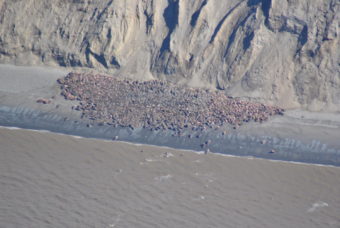
Photo taken by US Fish and Wildlife Service of walrus hauled out at Cape Grieg, just north of the Ugashik fishing district line, earlier this spring.
Photo of walrus hauled out at Cape Grieg, just north of the Ugashik fishing district line, earlier this spring. (Public domain photo courtesy of U.S. Fish and Wildlife Service)

The Alaska Department of Fish and Game says it will be up to fishermen to avoid problems with the walrus hauling out near Ugashik north line this summer.
The new walrus haul out at Cape Greig in Bristol Bay could create some problems for the Ugashik and Egegik salmon fishing districts. But right now the Department of Fish and Game says they’ll start the fishery business-as-usual.

The new haul out was spotted this spring, first by residents flying over the north coast of the Alaska Peninsula. It was confirmed by the US Fish and Wildlife Service. No one is sure yet why the walrus are there, but hope that they might go elsewhere is running thin.

“I’ve seen them anywhere from 300 to 2000 on the beach at Cape Grieg,” said Daniel Peppin, a wildlife biologist and pilot with the Alaska Peninsula/Becharof NWR. Peppin has been keeping an eye on them by air this spring. “I mean, it’s anybody’s guess how long they’re going to be there.”

On a flight last week he counted 1500.

While a new, more accessible walrus haul out might be welcome by some, that spot is awfully close to the boundaries of the Ugashik commercial fishing district. The Dept. of Fish and Game area management biologist for Ugashik and Egegik is Paul Salomone has been looking at pictures of the haul out over the past month or so.

“There’s a bluff right on the north line of Ugashik, and it seems to be towards the north end of it,” said Salmone. “My best estimate of it, at this point, there about a half mile north of the north line.”

That could be a problem in one of the busiest, most crowded fisheries in the state. Last July, when the fishing in Ugashik got hot, there were over 300 Bristol Bay drift permits registered to fish there. Just north of that district, even more fishermen keep their nets wet in the Egegik district. With tenders and other transiting vessels, the amount of traffic near the haul out increases the concern for the safety of those walrus hauling out near the line and feeding wherever it is they feed. Walrus are protected from disturbance by the Marine Mammal Protection Act.

There are guidelines published by the US Fish and Wildlife Service concerning how close vessels can come to haul outs, what operations are not allowed nearby, and how much sound can be generated. If the fleet familiarizes and follows those rules, Salmone believes the fishing should not be interrupted.

“As of right now, we’re still planning on business-as-usual. We’re not planning on making any changes to the way we approach the season at this point,” he said, adding a big caveat concerning enforcement of those federal rules. “We are putting a lot of the onus on the fishermen.”

The consequences of fishing boats triggering a stampede or walrus showing up dead from obvious fishing related causes could be severe, Salomone warned. He said he’s hoping it’s a non-issue.

The federal government has jurisdiction over enforcement to protect the mammals. Commercial fishing in the district opened Wednesday.

“Weeks or months” before NOAA knows what killed whale

Carol Fairfield, Bureau of Ocean & Energy Management, takes samples during a necropsy of a fin whale in Resurrection Bay, Seward, Alaska. Jennifer Gibbins/Alaska SeaLife Center
Carol Fairfield of the Bureau of Ocean & Energy Management takes samples during a necropsy of the fin whale. (Photo courtesy of 
Jennifer Gibbins/Alaska SeaLife Center)

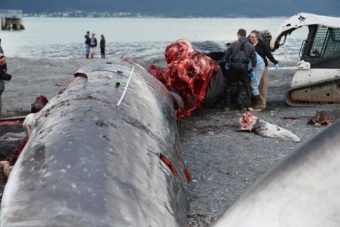
It could take weeks or months before scientists know what killed a fin whale stuck on the bow of a Holland America cruiseship. The whale carcass was found Sunday when the cruiseship docked in Seward.

Julie Speegle, spokesperson for the National Oceanic and Atmospheric Administration, says the endangered juvenile fin whale was about 50 feet long. It was moved to a nearby beach where a two-day necropsy took place.

Speegle said the lead pathologist took a number of tissue samples to determine the cause of death.

“Some of the samples she took were intended to be tested for exposure to harmful algal blooms, which means if those tests (come) back positive it could be related to the unusual mortality event of large whales,” Speegle said.

Last year, nine fin whales were found dead in Southcentral Alaska waters. Speegle said NOAA doesn’t know what caused the whale deaths, but algal blooms — caused by warming ocean temperatures — are the leading theory.

“The harmful algal blooms have a toxin in them that get into the phytoplankton, which the whales eat, which then introduces the toxin to the whale.”

Essentially, poisoning the whale.

Russ Andrews, Carol Fairfield and Laura Morse participated in the necropsy. The whale's body will be buried on the beach. Later, the bones could be dug up and re-articulated for display. (Photo courtesy of Jennifer Gibbins from the Alaska SeaLife Center)
Russ Andrews, Carol Fairfield and Laura Morse participated in the necropsy. The whale’s body will be buried on the beach. Later, the bones could be dug up and re-articulated for display. (Photo courtesy of Jennifer Gibbins/Alaska SeaLife Center)

Speegle says the fin whale discovered Sunday could have died from natural causes. A predatory killer whale could have harmed it, or it could have died from illness.

There’s also the possibility the cruise ship struck it at sea. Speegle says Holland America reported that they didn’t notice anything when they entered Resurrection Bay.

Holland America could not be reached for comment.

As Arctic Ocean Gets Spicier, Hunting May Be More Dangerous

A bearded seal, or ugruk, on the sea ice.
A bearded seal, or ugruk, on the sea ice. (Courtesy of Kawerak Subsistence Program)

The Arctic Ocean is getting spicier. A new study published in the Journal of Physical Oceanography suggests that rising temperatures in the far north could result in spicier water, or warmer water whose density is more affected by temperature than salinity.

This could make marine mammal hunting off Alaska’s coast more dangerous.

Mary-Louise Timmermans is a professor and oceanographer at Yale University. She studies how ocean circulation affects sea ice in the Arctic.

“For it to get ‘spicier’ means it’s going to get warmer, and changes in temperature will affect density to the same measure that changes in salinity affect density,” Timmermans explained.

The deeper you go in the ocean, the colder it gets. That’s because cold water is denser than warm water, so naturally it sinks to the ocean floor. But the dynamics are different in the Arctic.

“At low temperatures, the water doesn’t really care whether it’s warm or cold,” Timmermans said.

Seawater in the Arctic Ocean is so cold that temperature isn’t the deciding factor in its density. Instead, Timmermans said, salinity, or how salty the water is, makes more of a difference.

But that’s about to change as the climate changes.

“As you warm up the ocean, it turns out temperature changes can have a bigger impact on density than in a cooler ocean,” explained Timmermans.

Timmermans teamed up with Steven Jayne of the Woods Hole Oceanographic Institution. The two found that a spicier Arctic will likely be able to store more heat.

“This means that the way that the Arctic Ocean works will be somewhat different,” Timmermans said.

It’s tough to predict just how different the Arctic will be, but she said warmer seawater may speed up sea ice melt. That’s bad news for marine mammal hunters like Brandon Ahmasuk.

“The sea ice, it offers a protective barrier,” Ahmasuk explained. “It keeps the ripples and waves down, it keeps them from forming.”

Ahmasuk is Kawerak’s Subsistence Director based in Nome. He grew up out on the water hunting with his dad. He now takes his own kids with him to hunt for bearded seal, or ugruk, and walrus.

“When you have that larger open water, it’s more susceptible to large waves (and) bad weather,” Ahmasuk added.

He says if warmer, saltier seawater makes for thinner, sparser sea ice, most hunters won’t fare too well in their standard, 18-foot Lund boats.

“Your side height on a Lund boat is only 28 inches, but if you have four or six-foot rollers coming at you, you’re probably not going to want to be out there.”

But some villages, especially the ones without grocery stores to rely on, might not have any other choice. Despite the potentially more dangerous conditions to hunters like Ahmasuk, a spicier ocean is still the best grocery store around.


Scientists study steelhead for salmon’s secrets

Steelhead Salmon
Researchers used steelhead, like the one pictured, to see whether group size affected fish’s ability to choose the right stream to swim home in. (Photo courtesy Oregon Department of Fish and Wildlife)

Each summer, millions of fish return to Bristol Bay and then swim on to the stream where they were born to spawn, and die. Exactly what compels them to return to the right spot is unknown, but scientists think that some hatchery-raised steelhead in Oregon might hold a clue.

Peter Westley, an assistant professor at the University of Alaska Fairbanks School of Fisheries and Ocean Sciences, and colleague Andrew Berdahl, from the Santa Fe Institute, are trying to figure out why salmon choose to swim up a given stream.

“(Some 50 million) fish last season migrated into Bristol Bay in the course of just a couple of weeks, and that’s a classic thing is that the fish all come at the same time, and it’s kind of curious to think, is there a potential social role in that?” Westley asked. “They all come as a major wave, and is it because they are in these groups and they are sort of following the leader and using social dynamics to aid their migrations.”

To try and parse that out, the researchers have been digging fake streams at an Oregon lab for steelhead to swim in.

“We actually tested this idea by giving steelhead that had migrated home to a hatchery, we brought them to the Oregon Hatchery Research Center and gave them a choice between water that smelled more like home, or all of the foreign water that came from the stream where the hatchery research center was based,” he said. “One of the things we showed with this steelhead system that indeed, fish that are moving upstream and are moving around are very social. They don’t move independently. They’re in groups moving around.”

Westley said steelhead are a good proxy for salmon because they’re pretty similar fish in terms of life history and a predictable return to their birthplace.

“They are a good model for these migratory sea-going fish that come back home,” he said. “They have subtle differences in life history but in terms of the social aspects and the migration and the orientation, I think they are a good model.”

Right now, the research is relatively small, and Westley said there are many details to work out and enhance in future experiments: this is really just a tantalizing teaser of some possible results. But it’s a little step closer to figuring out what compels salmon to come home each year.

Westley and Berdahl have been interested in this social side of fish behavior for some time, and their collaboration started with a paper that just looked at existing literature and data.

“(The paper) poses this idea of a collective social role of salmon as they are migrating home, such that salmon or other migratory fish can school together, and by being in groups, they can share information and pool their abilities to navigate and orient and by doing so the group is much more likely to get home than if the group was smaller or the individual is traveling by itself and the onus of getting to the right spot would all be on the individual,” Westley explained.

The idea behind the study is that salmon may smell their way to the right stream.

“So you can imagine, fish that are headed to the Kvichak versus the Nushagak, if it’s better to be with your Nushagak group, how do you know that you’re with the right group? Salmon have an amazing ability to use pheromones and essentially of course they’re smelling their way home once they’re in freshwater,” he said.

The role of scent is another thing the team would like to test. Westley said they’d like to repeat the experiment with a stronger scent of home-streams.

There are other changes the team is looking at in the future, too – like trying larger groups of fish, and adjusting the timing to tie-in more closely to when salmon are actually on the move.

Somewhere on the list, Westley said he’d also like to look at how wild fish fare, rather than just using hatchery steelhead – a choice made, so far, to keep things simple. And, he said, using hatchery fish can look at another interesting question: how hatchery fish impact wild fish when the two are mixing in places where they co-exist, like Alaska.

Westley said the issue of straying, or hatchery fish that go home to the wrong place, could result from those fish just following wild fish to spawning grounds.

“The challenge is always trying to scale from what you’re doing at sort of an experimental level up into the complexity of nature, and trying to assess what you’ve done at this small controlled scale, does it relate to nature as a whole,” he said. “It’s always a challenge.”

Predictions of a megaquake rocking the Aleutians

Geologists on Sedanka Island examine drift logs carried more than a half mile from shore by a 1957 tsunami. This information helps researchers estimate the minimum run-up of tsunami waves. (Photo by Robert Witter)

In the next 50 years, there’s a 9 percent chance of an Aleutian Islands earthquake so strong it could send a devastating tsunami to Hawaii. That’s according to researchers from the University of Hawaii at Manoa.

A magnitude 9.0 or greater earthquake is what researchers are referring to. But what does a megaquake look like? Think big – like Tohoku the 2011 Japan earthquake and tsunami.

Geologist Rob Witter works for the United States Geological Survey. His work looks at the frequency of past giant earthquakes in the Aleutians — especially large quakes that might cause tsunamis.

“If there were to be another really, really giant earthquake in the Aleutians it would have the potential to generate a tsunami like what we’ve seen,” Witter said.

This research can be used for national seismic hazard maps as well as to create tsunami evacuation plans.

While Witter studies what happened in the ancient past, University of Hawaii at Manoa geophysicist Rhett Butler looks to the future. He works on estimating the probabilities of future earthquakes.

While watching a video of Tohoku, Butler began wondering if Hawaii had its estimates right.

“We’re surrounded by the ocean here,” Butler said. “So when we’re hit by a very large tsunami wave it affects all sides of the island. If you’re in California you just walk 10 km islands and gee you hardly notice anything other than it’s a general panic. Here in the islands all of our roads are along the seashore. We have lots of hospitals. We have airports. It would be an absolute infrastructure disaster.”

An infrastructure disaster that the state of Hawaii multi-hazard mitigation plan estimates could cost about $40 billion.

Here in Unalaska if you feel the ground move, Witter said to be prepared to move.

“If you feel strong shaking for 30 seconds of more – you should get to high ground quickly,” Witter said. “If you’re in the maritime community or trade you have to get to deep water fast as well because even in the protected waters of the harbors strong currents can occur and those can cause damage to ports and harbor facilities.”

Butler’s research does not guarantee a megaquake. The pressure in the Aleutian subduction zone could be released by a series of smaller earthquakes.

And Butler said he’s not trying to scare anyone.

“You like the place you live it comes with risks,” Butler said. “It’s good to be aware of the risks. It doesn’t mean it’s going to happen in your time. The Japanese didn’t think it would happen in their time, so they were surprised.”

He wants to provide data, so everyone can make informed decisions.

Observation group launches info hub on Cook Inlet beluga whales

Beluga coming to the surface to breathe.
Beluga coming to the surface to breathe. (Creative Commons photo by Eva Hejda)

The Alaska Ocean Observing System recently rolled out a new information hub that’s all about beluga whales. The Cook Inlet Beluga Ecosystem Portal is a one-stop shop for beluga data that its creators hope will help scientists and the public make more informed decisions in the future.

From aerial views of Alaska’s coastline to environmental data to social statistics, the new beluga ecosystem portal has a lot of information.

“So, the intention of the portal is to provide a user-friendly location that anybody from a researcher to an environmental manager to the general public can go and access information that’s freely available,” said Stacey Buckalew, a project coordinator with Axiom Data Science, which she described as a technical arm of the Alaska Ocean Observing System (AOOS). “It puts it in a user-friendly interface so you don’t have to be an expert in GIS or computers to be able to navigate the portal.”

The portal collates data from a number of sources.

Beluga whale populations have been on the decline in Cook Inlet for many years.

“It pulls information primarily from a Cook Inlet beluga whale siting database that was funded by the National Marine Fisheries Service (NMFS) that integrates about 10 years of their aerial surveys of beluga whales as well as land-based beluga whale surveys by a number of other projects,” Buckalew said.

The portal also includes environmental data not specific to whales, like ocean temperature trends over time, water salinity stats and more.

“We are expecting that it’s really going to help with ecosystem-based management,” said Holly Kent, Director of Administration and Outreach for AOOS. “Like, well, where do the beluga normally hang out? And what time of year and what kind of ocean conditions are happening when they’re in this particular area? That might help us to make a plan about when we should have ship traffic going by, for instance, or something like that.”

There are a few stakeholders AOOS hopes will be able to use the portal immediately, like the Alaska Coastal Impact Assistance Program, Alaska’s Comprehensive Wildlife Conservation Plan, and the National Fish Habitat Action Plan, among others.

Online information hubs like this one have been gaining in popularity in recent years for groups like these, said Buckalew.

“It’s a new way that we’re accessing technology in the scientific world and also in the public arena as there’s so much information available,” she said.

For Kent, it’s a step in the right direction from the days of calling agency after agency asking the same questions over and over again and poring through books and papers to find information.

“So, it could take weeks or months to get all that information together. But now, anybody at an agency or anywhere else can go right to our website and they can do all of that. They can look at it, they can download it. It’s a huge time saver and it also shows information that maybe people didn’t know existed,” Kent said.

More information can be found at portal.aoos.org.

Site notifications
Update notification options
Subscribe to notifications