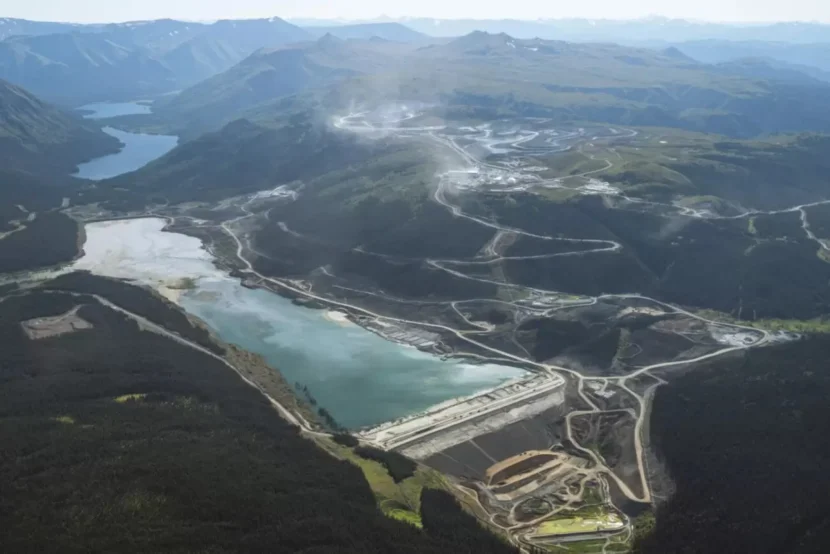
Red Chris Mine’s tailings waste facility and open pit in the headwaters of the Iskut River, a major tributary of the salmon-bearing Stikine River. (Photo courtesy of Colin Arisman)
Southeast Alaska tribes and environmental groups have delivered nearly 30,000 messages to British Columbia lawmakers about transboundary mining.
Earthjustice, the international conservation organization Re:wild and the tribal commission said the letters encourage British Columbia to pause mining developments in the headwaters of the Stikine, Unuk and Taku Rivers that drain into Southeast Alaska.
The Southeast Alaska Indigenous Transboundary Commission represents 14 tribal nations downstream from the mines. Executive Director Guy Archibald said it wasn’t just Alaskans who sent the letters.
“It was people from all over the country and all over the world that recognize that Southeast Alaska is a very unique and valuable place in the world for climate protections, for cultural protections and diversity,” he said.
The environmental groups urged British Columbia officials to freeze “mining activity in this region until SEITC member tribes are given free, prior and informed consent.”
They said the messages point to growing concern over mining in the region. This includes at least eight proposed and operating mines that threaten the transboundary watersheds.
Four mines in the Stikine River watershed
Archibald said there’s many active explorations going on with mines in British Columbia and eight is just the minimum. There are four mines the groups are concerned about in the Stikine River alone. They are Red Chris, Galore Creek, Schaft Creek and Red Mountain Mines.
“These mines pose a significant risk to the Stikine River, and so far, they’ve been permitted without any adequate consultation with the Southeast tribes,” he said.
Previous studies have shown that minimal regulation of mines leads to polluted watersheds. This affects where people who survive on subsistence food can hunt and fish.
British Columbia say they take their obligations ‘very seriously’
The British Columbia Environmental Assessment Office wrote in an email that they take their obligations “very seriously – including with tribes in the U.S.” They said they will continue to fulfill their constitutional obligations by consulting with U.S. tribes when mining practices impact aboriginal rights under the Canadian Constitution. Currently, the office said seven mines are permitted in the transboundary area.
This includes two fully operational mines — Premier Mine and Brucejack Mine — and five permitted for exploration or that have limited construction — Eskay Creek Mine, KSM Mine, Skip Mine, Scottie Gold and Galore Creek.
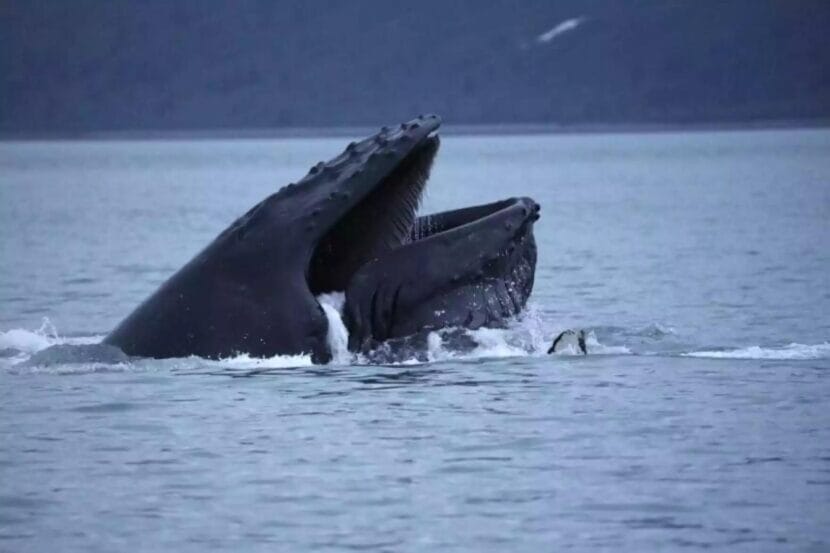
A whale surfaces in Glacier Bay in July 2023. (Clarise Larson /KTOO)
Researchers say vessel strikes are a major threat for whales, including in the waters off Alaska. A new technology is aiming to change that by using AI, thermal imagining and marine observers.
Matson’s container ships bring cargo and cars from Tacoma, Washington to Anchorage, Kodiak and Dutch Harbor. The company has partnered with WhaleSpotter, a new system that helps ships detect whales, said Matson’s CEO Matt Cox.
“Every handful of years, we, unfortunately, do have a strike, and of course, we report that up,” Cox said. “But the hope is, this new technology will make that even more rare of an occurrence in the future.”
WhaleSpotter was introduced commercially about a year ago and is now used by a dozen companies, including some in Alaska, said Shawn Henry, the company’s chief executive officer. He said Matson is their latest partner and the first container ship company to use the system.
Danger of ship strikes
Researchers say ship strikes are one of the leading causes of whale deaths worldwide. In the Juneau area alone, at least nine humpback whales were hit by ships in the last five years, according to a local project called Juneau Whale HEALTH.
“Vessel strikes are a major threat to whales,” said Heidi Pearson, a professor of marine biology at the University of Alaska Southeast and a principal investigator for the project. “Most ship strikes go undocumented. Especially if it’s a large vessel, they could hit a whale and not even know it.”
Andy Szabo, the director of conservation and research organization the Alaska Whale Foundation, said ship strikes are especially prominent in the areas frequented by cruise and cargo ships.
“Whenever you’re running high-speed, large boats through whale waters, that increases the likelihood of strikes,” he said.
Humpback whales are the most prone to strikes because they often swim close to the surface and close to shore, Szabo said.
The harm from the vessel strikes is compounding on top of other challenges whales face, he said. Recently, a marine heatwave in the Pacific known as the Blob disrupted ecosystems along the West Coast of the U.S., causing thousands of humpbacks to starve, Szabo said.
He said the population still has not recovered.
“They’re not doing great at all,” Szabo said. “So when you have that, and then you overlay on top of that vessel strikes, even if it’s not a lot of animals, it can have an impact.”
The new whale-detection system
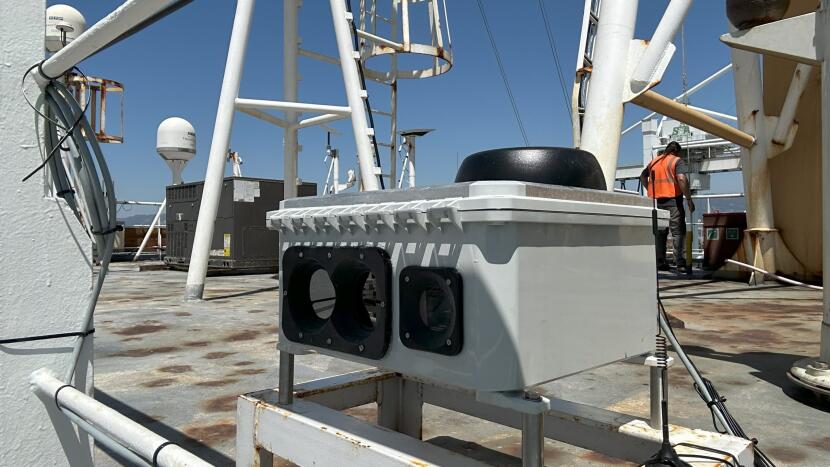
WhaleSpotter technology is designed to alert ship crews when there is a whale nearby and give them an opportunity to change course or stop.
“We are enabling a vessel to detect a whale well ahead of the amount of time it needs to make a turn or slow down,” said Henry with WhaleSpotter.
Thermal cameras track temperature changes in a four-nautical-mile radius around a ship, Henry said. Then, the technology uses artificial intelligence to determine which images likely captured whales. Remote marine mammal observers – real people watching the data feed from elsewhere – do the last checks. Then the system sends an alert to crews about a possible whale nearby.
WhaleSpotter technology is designed to detect whales by using AI, thermal imagining and marine observers. (Woods Hole Oceanographic Institution)
The Woods Hole Oceanographic Institution in Massachusetts has been developing the technology for the last 15 years, Henry said. The institute granted WhaleSpotter a license to sell the technology, and the company has been working with different clients for about a year.
“We have a number of different other types of vessels that are using the product,” Henry said. “Some of them – vessel strike avoidance, some of them for marine operations like cable laying and pile driving.”
Cox, the CEO of Matson, said the company tested the technology on their ships. He said the trials showed that the system is effective at detecting individual whales and pods, and sometimes even the direction the whale is traveling in.
“We’ve had cases where those whale detections have been spotted, and we’ve been able to navigate around the pod or the individual whale to lessen the chances of a strike,” Cox said. “It’s worked really well.”
Now Cox said Matson plans to have it on all three of its Alaska ships. He said the crews are excited about it.
There’s genuine enthusiasm and excitement on board the vessels,” he said.
Pearson, at the University of Alaska Southeast, said the WhaleSpotter technology can be a game changer for whales, vessels and their crews and passengers.
“Of course, if a whale gets hit, it’s awful for the whale, but it can also damage vessels. Whale strikes have also been known to cause damage to human passengers on the boat,” she said. “So anything we can do to mitigate that protects whales and humans as well.”
Szabo, with the Alaska Whale Foundation, said that outfitting ships with technology to detect whales is a good first step, but he wants to know more about what the crews will do with that information.
He said that if the whale is too close, the ship might not have enough time to turn. And if the whale is too far and is moving, the original location might be irrelevant. Plus, he said, if there are many whales in the area, it can be unclear what the best course of action for the ship might be.
Still, Szabo said he is optimistic about the technology.
“It can’t be a bad thing,” Szabo said. “I just hope that there is sufficient effort put into the whole training and procedures and protocol side of things as well, to make it as useful as it could be.”
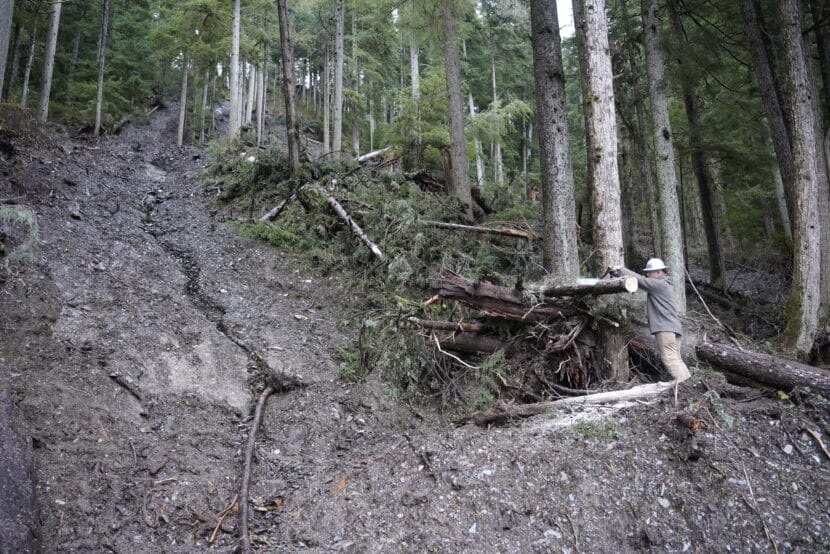
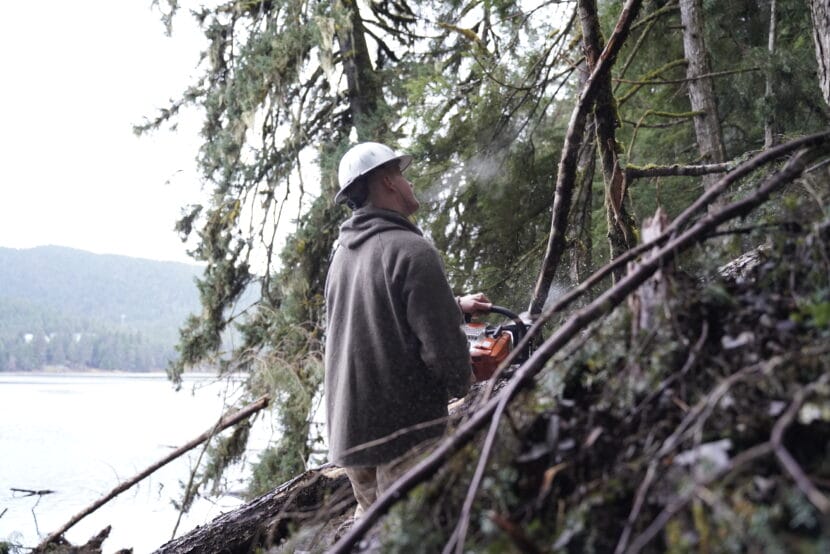
Mark Krumwiede saws through a tree along the edge of a landslide that washed out Auke Lake Trail in September 2025. (Photo by Alix Soliman/KTOO)
Listen to this story:
Two landslides took out Juneau’s popular Auke Lake Trail in September, causing the City and Borough of Juneau to close it to the public. Now, as trail workers repair it, they say it’s an example of climate impacts on local trails they’ve been seeing more frequently in recent years.
On Monday, a trail coordinator used a chainsaw to rip through a fallen tree blocking the path along Auke Lake where landslides washed it out. The trail is flat and follows the contour of the lake next to the University of Alaska Southeast’s Juneau campus. The landslides occurred during an atmospheric river in late September and the trail has been closed since.
In September, two landslides washed out roughly 150 feet of Auke Lake Trail, which is just over a mile long in total. The debris can be seen from the boat launch across the lake. (Photo by Alix Soliman/KTOO)
“We saw footsteps as we were going,” said Meghan Tabacek, the executive director of Trail Mix Inc. “People are already still using this trail.”
Trail Mix is a local nonprofit that maintains more than 200 miles of trails in Juneau, including those owned by the city.
“So our goal is now to make it, one: fully reopen so we can get the trail closed signs down; and two: at least passable,” Tabacek said. “Our first step to passability is using these chainsaws right here to clear all the logs.”
Later, they’ll push those logs into the lake, where much of the debris fell naturally.
Mark Krumwiede saws through a branch along the edge a landslide that washed out Auke Lake Trail in September 2025. (Photo by Alix Soliman/KTOO)
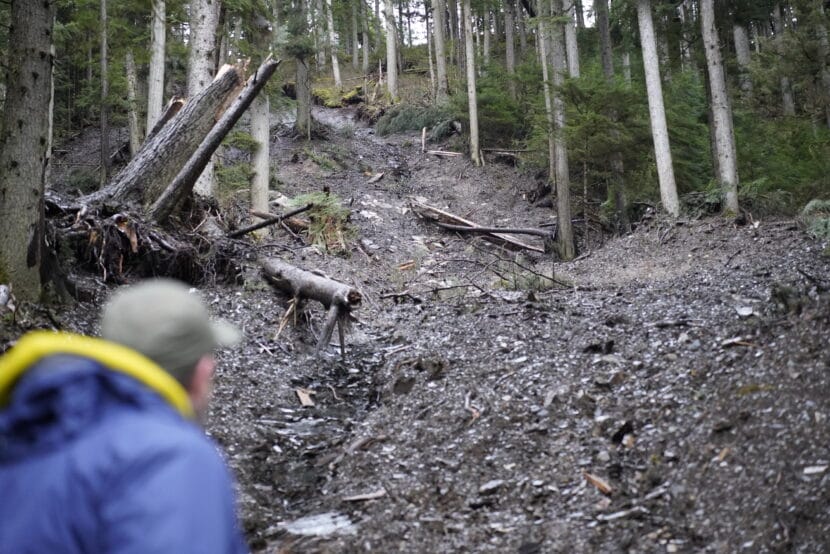
Nick Marinelli is a trail coordinator for Trail Mix. He paced the length of both landslides, which are about 50 feet apart at the trail level, and estimates that about 150 feet of the trail washed out altogether. The slides appear to reach up the slope roughly 400 feet, where they’ve scoured the soil down to bedrock.
He said he has noticed landslides affecting popular Juneau trails more frequently in recent years, including on Perseverance Trail and Montana Creek Trail.
“It seems like with those heavier storm events that happen in September and October, there’s more material coming down,” Marinelli said.
Tabacek said thathas factored into how Trail Mix plans maintenance.
“Especially over the past five years, as climate-related disturbances to trails become a little more frequent, we’ve just started having to budget our time a little bit different,” she said.
She said that Trail Mix now sets aside five to eight weeks each year to handle this extra work. That work has included things like restabilizing a bridge on Black Bear Trail where Montana Creek widened sooner than expected, redirecting water and clearing landslide debris.
Once the workers clear away the logs, Tabacek said they’ll rebuild damaged sections of Auke Lake Trail this week.
“A lot of that is just going to be pushing dirt around,” she said.
Then they’ll layer some gravel on top and build retaining walls. In the spring, she said they’ll probably come back and add moss to the bare soil on the lake-side of the trail. They might also plant blueberry and devil’s club starts on the upward slope.
“But honestly, Southeast kind of takes care of the re-veg(etation) pretty, pretty fast every year,” Tabacek said.
Although the slide chutes seem stable now, she said some trees are loosely attached and a storm could cause further slides.
“Especially on days where you’re getting more than half an inch or a full inch of rain,” she said.
Marc Wheeler peers up at one of the landslides that washed out Auke Lake Trail. (Photo by Alix Soliman/KTOO)
Marc Wheeler, the city’s director of parks and recreation, said residents should always consider the hazards when heading outdoors.
“Like with all of our trails, we just have people use their best judgment,” Wheeler said. “You’re kind of using our trails at your own risk.”
Juneau recreators can fill out a damage report on the Trail Mix website if they encounter fallen trees or slides blocking trails.
The city hopes to reopen Auke Lake Trail at the end of this week.
Clarification: A previous version of this story said Trail Mix hopes to reopen the trail. The City and Borough of Juneau owns Auke Lake Trail.
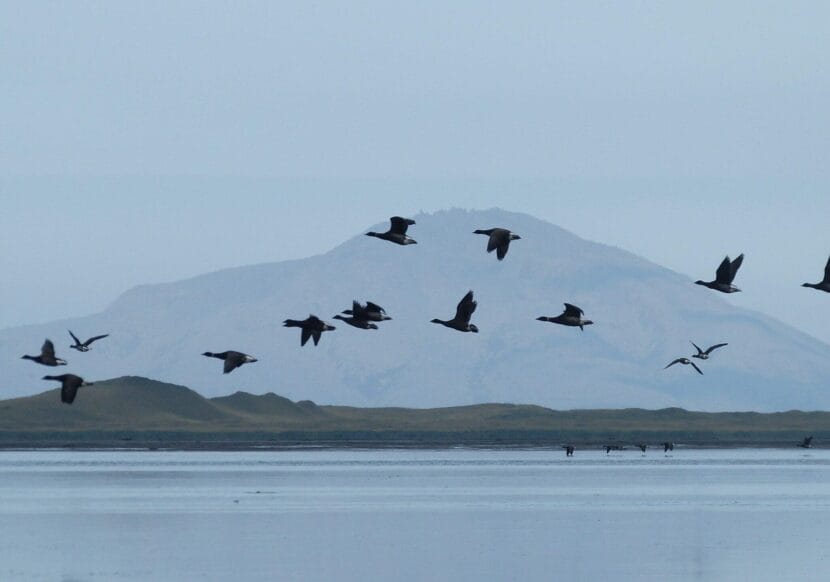
Brant fly over the water on Sept. 28, 2016, at Izembek Lagoon in Izembek National Wildlife Refuge. The refuge supports the entire Pacific population of black brant, a species of goose. (Kristine Sowl/U.S. Fish and Wildlife Service)
Three tribal governments and several environmental groups sued the Trump administration on Wednesday to try to block a land trade that would allow a road to be built through a national wildlife refuge in southwestern Alaska.
The land swap, approved by the U.S. Department of the Interior last month, would open up a section of the Izembek National Wildlife Refuge.
Supporters argue that the road is needed to connect the community of King Cove, home to about 750 people, with a legacy military airstrip that can accommodate jets. That would give King Cove’s residents access to safer medical evacuations if needed. Opponents say the proposed road — to run 18.9 miles in total, most of that within what is currently refuge land — would damage world-class bird habitat that is in the heart of the refuge.
Wednesday’s challenges came in three lawsuits filed in U.S. District Court in Anchorage. All assert that the land trade and road development pose dire threats to migratory bird populations that use Izembek’s wetlands, including species with Endangered Species Act listings, and to the wider ecosystem. All say the trade and planned road violate the Alaska National Interest Lands Conservation Act and other federal laws.
The three lawsuits have their individual characteristics as well.
One of them, filed by tribal governments in the Yukon-Kuskokwim Delta villages, focuses on threats to traditional subsistence hunters who depend on the birds that use Izembek’s wetlands. The tribal plaintiffs are the Native Village of Paimiut, Native Village of Hooper Bay and Chevak Native Village.
“Izembek’s eelgrass wetlands are a lifeline for emperor geese, black brant and other birds that feed our families and connect us to Indigenous relatives across the Pacific,” Angutekaraq Estelle Thomson, traditional council president of the Native Village of Paimiut, said in a statement. “Trading away this globally important refuge for a commercial corridor devalues our lives and our children’s future. We are joining this lawsuit because defending Izembek is inseparable from defending our subsistence rights, our food security and our ability to remain Yup’ik on our own lands.”
The Center for Biological Diversity, an environmental organization, is also a plaintiff in the case.
A second lawsuit, filed by Friends of Alaska National Wildlife Refuges, Wilderness Watch, the Alaska Wilderness League and the Sierra Club, puts a special focus on the process used to achieve the land swap and what it may mean for all wildlife refuges.
“Trading the ownership of refuge lands that Congress designated for conservation is a terrible precedent for the privatization of public lands. Building a road will have tremendous impacts on fish and wildlife habitat and could also greatly increase both disturbance and sport hunting pressure on vulnerable species,” Marilyn Sigman, president of Friends of Alaska National Wildlife Refuges, said in a statement.
The third complaint, filed by Defenders of Wildlife, puts a focus on the wider environmental impacts.
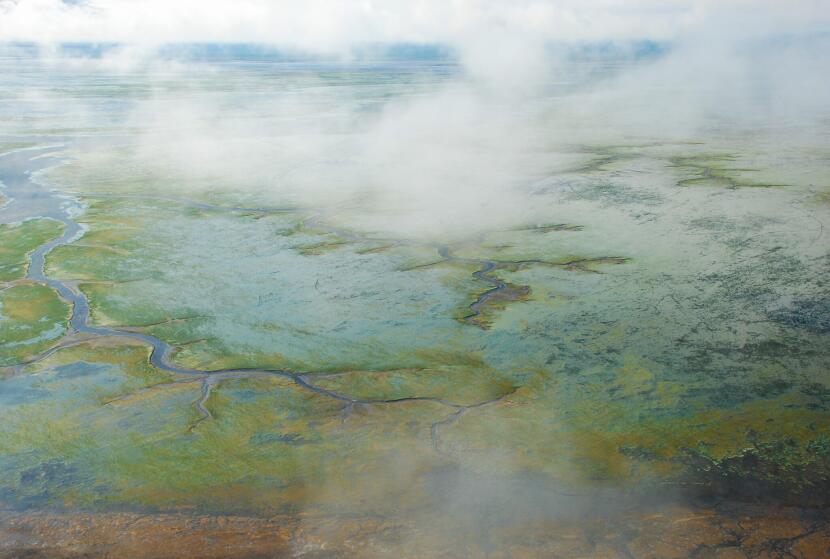
Green eelgrass appears at low tide in the vast wetlands of Izembek Lagoon, at the edge of Izembek Refuge. (Kristine Sowl/USFWS)
The planned road enabled by the land trade would “result in incalculable and irreversible damage” to myriad wildlife species, including marine and land mammals as well as migratory birds, that lawsuit says. The lawsuit alleges that the land deal violates both the National Wildlife Refuge System Improvement Act and the federal Wilderness Act.
“Under the Trump administration, the Interior Secretary entered into an illegal deal done in the darkness of a government shutdown: a sellout of one of our country’s largest and most pristine wildlife refuges and wilderness areas,” Jane Davenport, a senior attorney in Defenders of Wildlife’s Biodiversity Law Center, said in a statement. “Our treasured public conservation lands belong to all Americans. Defenders of Wildlife will stand up in court to hold this administration to account for recklessly and unlawfully trading them away.”
The Izembek Lagoon area, where the road is planned, holds the largest single stand of eelgrass in the world and the largest bed of seagrass along the North American Pacific Coast, according to the U.S. Fish and Wildlife Service. The entire Pacific population of black brant, a type of goose, uses the refuge’s lagoon area, feeding on the eelgrass. The refuge and its eelgrass support several other bird and mammal species; about half the world’s emperor geese use the refuge as a migratory stopover, according to biologists.
A Department of the Interior spokesperson declined to comment Wednesday on the lawsuits.
Last month, however, Interior Secretary Doug Burgum touted the land exchange and planned road as long overdue.
He spoke about the project during an event called “Alaska Day,” a gathering in Washington with Gov. Mike Dunleavy and the state’s three-member congressional delegation. The Izembek land exchange was one of the pro-development Alaska actions announced at the event.
“It just seems preposterous to me that somehow, it’s taken 40 years for us to put people first,” Burgum said at the event. “Because I know one thing as a governor of a state: You can actually do things like build 18 miles of gravel road and still take great care of wildlife.” Burgum was North Dakota’s governor before being appointed as Interior secretary.
The land trade he approved would convey a little less than 500 acres of refuge land, most of it designated wilderness, to the Native-owned King Cove Corp. The corporation would give 1,739 acres of its land to the U.S. Fish and Wildlife Service to be added to the refuge, and the federal government would also pay the corporation for the land.
The idea of a road linking King Cove to the World War II-era military runway at Cold Bay dates back decades. The legal and political battle over the proposal has also been long. Some of the plaintiffs in the new cases were plaintiffs in previous lawsuits over proposed land trades. The dispute was being considered by the 9th Circuit Court of Appeals, but that court in 2023 determined that the case was moot and dismissed it because the Biden administration was not pursuing the plan endorsed by the first Trump administration.
Green eelgrass appears at low tide in the vast wetlands of Izembek Lagoon, at the edge of Izembek Refuge. (Kristine Sowl/USFWS)
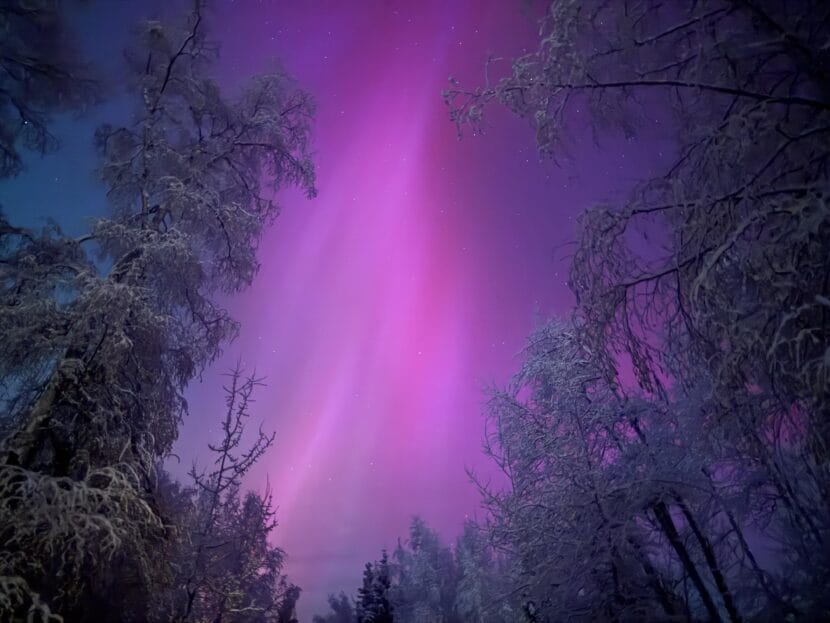
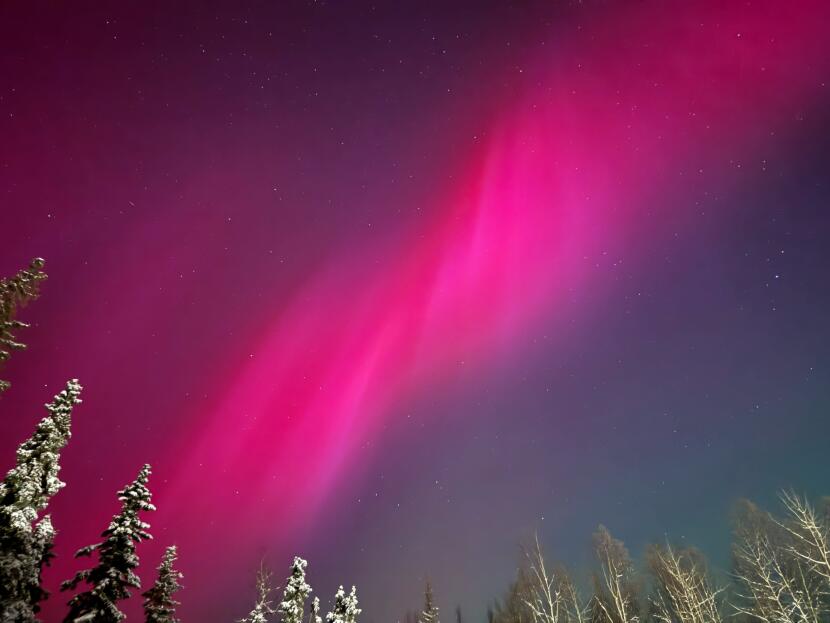
The aurora visible from west Fairbanks on Nov. 11, 2025. (Patrick Gilchrist/KUAC)
It was ten below in Fairbanks on Tuesday night. Undeterred, a crowd of people flocked to a popular overlook at the University of Alaska Fairbanks campus to watch for the aurora.
Fatin Pasha stood outside his car shivering, with a fur trapper hat pulled down over his ears. He said he’d just moved to Fairbanks from Missouri, and the lights were part of what brought him here.
But in the early hours of the night, Pasha said he could only see the faintest blush of color in the skies.
“It’s just a tad reddish,” he said. “Not a whole lot, yet. I’ve seen some beautiful pictures, though. So, I’m hanging around in this negative weather, hoping to catch a glimpse.”
At first, it was hard to tell if the faint glow was the aurora, or just a trick of the city lights, the exhaust from our cars, or the fog of our breath. But about a half hour later, the pink haze deepened into scarlet, and pillars of light danced across the sky.
Those same lights were visible all over the country — as far south as the Florida panhandle.
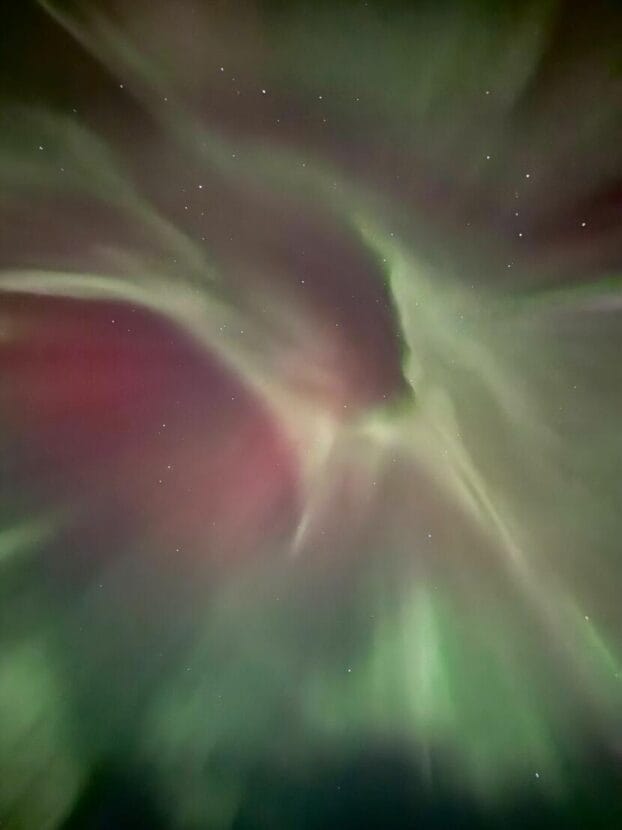
In downtown Minneapolis, Hillary Shepard could see the northern lights from inside her apartment on Nov. 11, 2025. (Hillary Shepard)The northern lights fill the skies above Soldotna on Tuesday, Nov. 11, 2025. (Ashlyn O’Hara/KDLL)
The light show is part of what UAF scientists are calling an unusual series of x-class solar flares that started on Monday, sending out an enormous plasma cloud called a coronal mass ejection, or CME.
The event produced one unsettlingly named “cannibal” ejection, so named because it caught up to and merged with other clouds of plasma.
These x-class flares are the most intense ones — and potentially the most destructive. According to the National Oceanic Atmospheric Administration, they can disrupt satellite communications, GPS systems, power grids, and even trigger radio blackouts.
Mark Conde, a space physicist at UAF, said this three-fold hit is one of the most significant solar events he’s observed in his career. The third wave hit at around 11 a.m. on Tuesday, during Conde’s interview with KUAC. He said it disrupted the monitoring systems he was looking at and briefly prevented him from sharing data.
The northern lights over Soldotna on Tuesday, Nov. 11, 2025. (Ashlyn O’Hara/KDLL)
“They were unlucky,” Conde said. “They put them in this low altitude orbit first. And they happened to experience a storm right when the satellites were most vulnerable.”
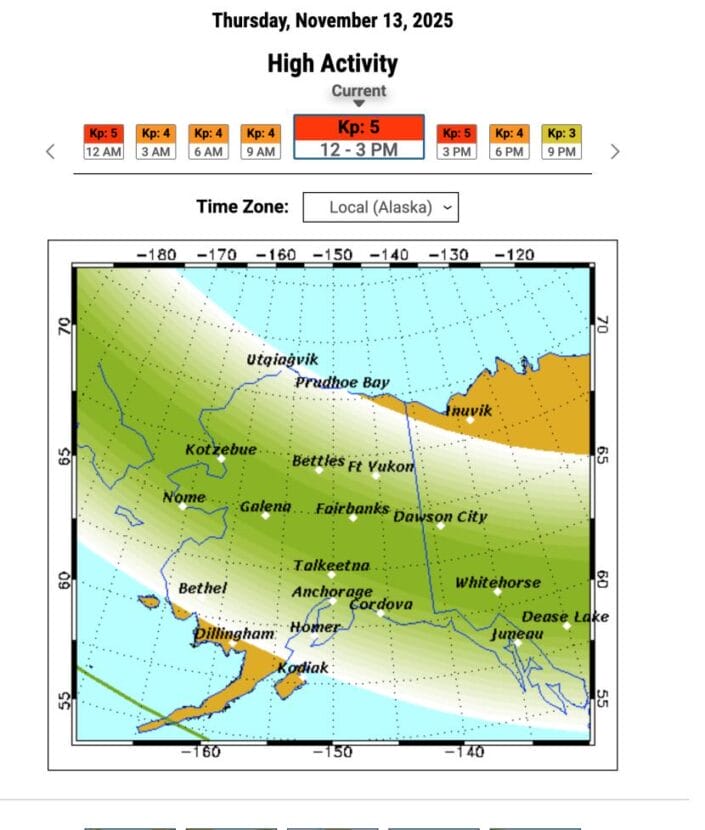
The University of Alaska Fairbanks Geophysical Institute forecasts a high probability of visible aurora on the night of Nov. 13, 2025. (UAF Geophysical Institute)
The predicted speed of the third coronal mass ejection in the series was the highest he’d ever seen: about 870 miles per second. Conde said that although the best auroras were forecast for Tuesday and Wednesday, the lights could continue to shine for the next few days.
“We might get another one or two of these before the solar cycle calms down,” he said. “Then we have to wait another 11 years to get the next one. So the event we’re experiencing right now is certainly not an everyday event by any stretch of the imagination.”
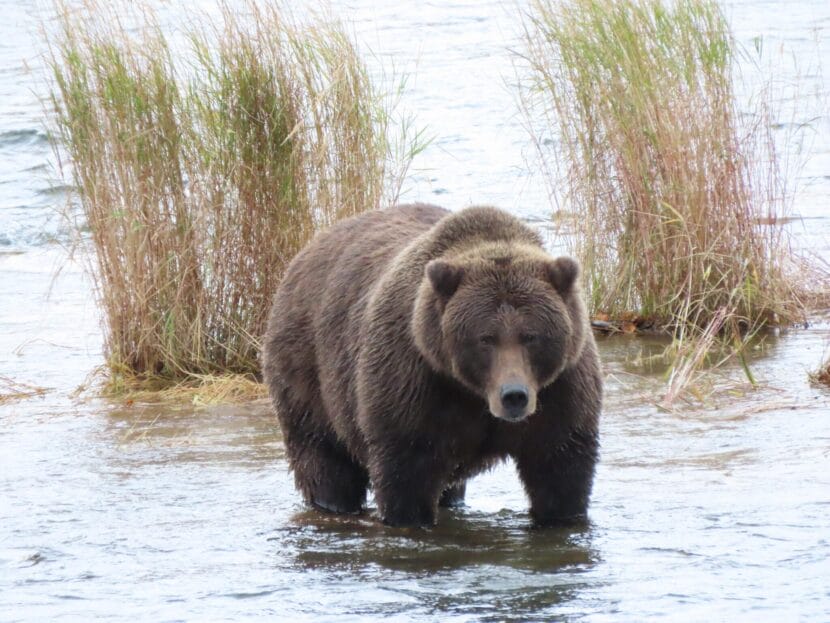
A brown bear stands in water in Katmai National Park on Sept. 27, 2022. A new lawsuit has targeted a revived predator control program that aims to boost Mulchatna caribou herd numbers by killing bears in a portion of the herd’s range. (T. Carmack/National Park Service)
The state’s latest plan to kill bears in part of Western Alaska to try to boost a flagging caribou population has drawn a new legal challenge.
Environmental groups on Monday filed a lawsuit in state Superior Court that seeks to strike down the Alaska Board of Game’s July approval of a controversial predator control program in the part of the state used by the Mulchatna caribou herd.
The lawsuit, filed by the Alaska Wildlife Alliance and the Center for Biological Diversity, is the latest step in a legal and political battle over state efforts to increase the herd size. It names the board, the Alaska Department of Fish and Game and the department’s commissioner as defendants.
The lawsuit argues that the revived program approved by the Board of Game suffers from many of the same flaws that were in the previous program. That program had been approved by the board in 2022 but was overturned by court rulings earlier in the year that resulted from a previous lawsuit filed by the Alaska Wildlife Alliance.
Two state judges found that the program, under which 186 brown bears, five black bears and 20 wolves have been killed since 2023, violated the elements of the Alaska constitution.
Monday’s lawsuit says the new predator control program is largely the same as the old one and it continues to violate the Alaska constitution’s requirement for sustained yield of natural resources. For Alaska, the principle of sustained yield holds that renewable resources should be managed so that they can exist indefinitely.
There are two ways that the sustained yield requirement is violated, according to the lawsuit.
The board, when it approved the predator control plan presented by the Alaska Department of Fish and Game, “failed to take a hard look at brown and black bear population data” for the targeted area, thus failing to properly consider impacts to those populations, the lawsuit said.
And the plan has no end point, meaning there is no trigger for suspension of predator control if bear populations drop below a minimum threshold deemed necessary for their sustainability, the lawsuit said.
“The Board of Game gave the Alaska Department of Fish and Game the authority to aerially shoot any bears of any age across 40,000 square miles until 2028, with no population data or cap on the number of bears killed,” Nicole Schmitt, executive director with the Alaska Wildlife Alliance.
She noted that the southeast border of the targeted area is only 3 miles from Lake Clark National Preserve, 30 miles from Katmai National Park and 50 miles from McNeil and Brooks Falls, sites that are world-famous for the large numbers of brown bears that gather there to fish for salmon. Meanwhile, the western border reaches two national wildlife refuges, “which means this program threatens bears who move across vast stretches of public lands,” she said.
Cooper Freeman, Alaska director at the Center for Biological Diversity, called the program “a disgraceful misuse of public resources and a betrayal of the trust Alaskans place in their wildlife managers.”
“There’s no excuse for the state of Alaska to be gunning down bears from helicopters,” Freeman said in the statement.
The commissioner of the Alaska Department of Fish and Game defended the program, though he did not specifically address the claims in the new lawsuit.
“ADF&G is committed to all users of the herd in rebuilding this population, which has been identified as important for providing high levels of human consumption under state statute and regulation,” Commissioner Doug Vincent-Lang said in a statement.
Vincent-Lang said “intensive management,” or IM, has shown to be helping the caribou herd. Intensive management is the term Alaska wildlife managers use for predator-control programs.
“There is strong evidence that neither disease nor nutrition are preventing this herd from recovering. Department predator removal efforts in the Mulchatna caribou herd IM program are administered to reduce wolf and bear populations in small, defined areas for short periods of time, to enhance caribou calf survival and to increase herd abundance,” Vincent-Lang said in his statement. “Predation has been isolated as the limiting factor preventing the herd from growing, and predator removal is increasing calf survival—we know that now—and we have seen increased calf survival as a result of our past IM efforts.”
The Mulchatna caribou herd crashed in recent decades, and there is heated debate about the cause.
The herd peaked at about 200,000 animals in 1997, when it provided up to 4,770 caribou for subsistence hunting in the region’s communities, according to the Department of Fish and Game. But the population crashed after then and is now estimated at about 16,000 animals, according to the department. Hunting has been closed in recent years.
State wildlife officials argue that predation by bears and wolves on caribou calves is the reason for the decline. The department has stated a goal of boosting the herd to a size ranging from 30,000 to 80,000 animals, enough to support resumption of hunting.
Backers of the Mulchatna predator control program have included the Alaska Federation of Natives, which passed a resolution in 2023 that supported the program because the organization says it is necessary to ensure food security in that part of the state.
But critics of the program, including some veteran Alaska wildlife biologists, argue that other factors caused the herd’s population crash. Among the cited factors is a change in habitat, driven by long-term warming, that makes the region less supportive of lichen-eating caribou and more favorable to moose and other animals dependent on woody plants. Migratory tundra caribou herds around the Arctic have suffered similar problems, with overall population declines of 65% in the past two to three decades, according to the 2024 Arctic Report Card released by the National Oceanic and Atmospheric Administration.
The Board of Game and Department of Fish and Game have lost past court fights over Mulchatna predator control.
Aside from having judges rule that the earlier program was unconstitutional, one of the judges found in May that the department acted in bad faith by continuing to conduct aerial shooting this spring even after the program was declared legally void.
Close
Update notification options
Subscribe to notifications
Subscribe
Get notifications about news related to the topics you care about. You can unsubscribe anytime.