Environment

Juneau Hydropower plans to start building Sweetheart Lake hydroelectric facility next year

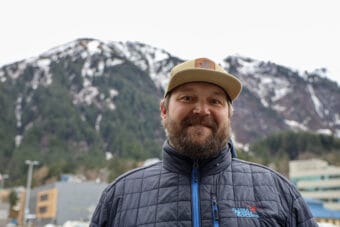
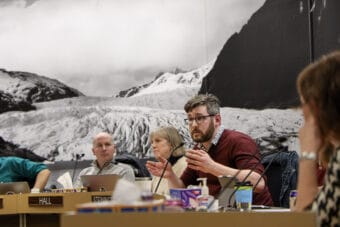
Independent hydropower entrepreneur Duff Mitchell participates in public comment at a Regulatory Commission of Alaska meeting at Centennial Hall in Juneau on Tuesday, Feb. 27, 2018. Mitchell is the managing director of Juneau Hydropower Inc.
Duff Mitchell participates in public comment at a Regulatory Commission of Alaska meeting at Centennial Hall in Juneau on Tuesday, Feb. 27, 2018. Mitchell is the managing director of Juneau Hydropower Inc. (Photo by Jeremy Hsieh/KTOO)

Listen to this story:

The City and Borough of Juneau’s planning commission approved Juneau Hydropower’s permit to build its Sweetheart Lake hydroelectric project at a meeting on Tuesday night.

Duff Mitchell is the managing director of Juneau Hydropower. He said in an interview that this is one of the last permits the new utility needed before breaking ground.

“This is very strong momentum for us, for us meeting our timeline of being in construction next year,” Mitchell said.

It’s been a long time coming. Mitchell started the process more than 15 years ago. 

The proposed Sweetheart Lake hydroelectric project would grow Juneau’s hydropower capacity by 19.8 megawatts. That’s enough to increase the borough’s electricity by around 20%. It would bring renewable energy to rural parts of Juneau — including Coeur’s Kensington Mine, which burns roughly 4.5 million gallons of diesel per year. 

Mitchell said at the meeting that getting the mine on renewable power benefits Juneau. 

“We got mines that want lower-cost power,” he said. “Those mines create not only the jobs, but they also pay our schools through the property tax, and so extending the lives of those mines through lowering their cost of power helps our community.”

He said the project will also provide the capital city with energy security and room to expand industries. 

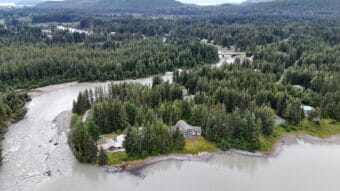
An aerial photo of a lake surrounded by snowy mountains
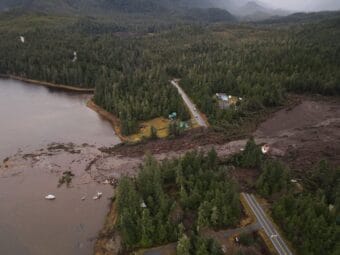
Sweetheart Lake south of Juneau, seen from the air in 2017, will be the site of a new hydroelectric project supplying the Kensington mine and other Juneau-area customers. (Photo by Robert Johnson/Provided by Juneau Hydropower)

Next steps

Mitchell estimates it will cost $270 million to build.

“So the fun part starts now, which is completing our financing,” he said.

He said that he’s seeking a loan through the U.S. Department of Agriculture’s Rural Utility Service that could finance 75% of the project, if approved. He’s also pursuing investment tax credits, which can be sold for cash and could finance a portion of the project.

To shuttle power to Kensington Mine, the company must build several pieces of major infrastructure. Mitchell said the company will start by digging a tunnel that starts near the outlet of Sweetheart Creek at Gilbert Bay and runs up to Lower Sweetheart Lake, around 35 miles southeast of downtown Juneau. 

“We will drive equipment and man and gear and everything else up there to build the intakes, to build the dam, to build the diversion tunnel, and all of the equipment and everything that we need to operate Sweetheart Dam in the Sweetheart Lake,” he said.

Then, he plans to use the tunnel to convey water to the turbines that generate electricity. The company plans to install substations, transmission lines and submarine cables simultaneously. He also plans to build a battery energy storage system to serve as a backup power source if an avalanche or other interruption cuts electricity. It would be charged by surplus hydropower.

Juneau Hydropower is contracting with Ameresco, a company that builds energy infrastructure, and David Burlingame, an electrical engineer with companies based in Anchorage, to design and construct it. Mitchell said around 200 workers will be needed to build it, and he would prefer to use local labor. 

Energy needs

Juneau Hydropower’s only contracted customer so far is Kensington Mine. But Mitchell has a “build it and they will come” mentality, so he’s confident that more customers will emerge. 

“So every interruptible customer is an unmet demand they can be burned onto diesel,” he said at the meeting. “For every dock that’s not electrified, that is an unmet demand.”

Mitchell said he could also supply power to the proposed ferry terminal at Cascade Point, if that comes to fruition, and to any cell service company that wants to bring to life the dead zones at the northern end of the borough.

But Juneau Hydropower and Alaska Electric Light & Power each have their own service territories where they are allowed to sell electricity. To electrify a cruise ship dock, mine, or other customer within AEL&P’s territory, Juneau Hydropower would have to enter into an agreement with the utility and sell them the energy. 

The only commissioner, out of eight, who voted no to approving the conditional use permit was Nina Keller. She said she isn’t sure there is demand for more hydropower.

“I just am not convinced that where we are now, and looking at any forecasts that we have seen that recently came out with where Juneau is going in terms of population, I just don’t see the need, as (of) like today, for it,” she said.

The permit that the city issued has two conditions. First, the company needs to submit photo proof of a barrier to block sound and light from the powerhouse near Sweetheart Creek to protect local wildlife and recreational users. Second, the company needs to get a flood zone development permit. Mitchell said he’s confident he will fulfill both requirements. 

He said Juneau Hydropower could start offering electricity as early as 2028. 

Correction: a photo caption has been updated to remove a former funder that is no longer part of the project. 

A baby seal rescued near Petersburg has been released back into the wild

Jerod Cook opens the door of Bravo’s kennel on Petersburg’s Sandy Beach, releasing the seal back into familiar waters on Oct. 23, 2025.
Jerod Cook opens the door of Bravo’s kennel on Petersburg’s Sandy Beach, releasing the seal back into familiar waters on Oct. 23, 2025. (Olivia Rose/KFSK)

Back in May, National Marine Fisheries Enforcement Officer Jerod Cook responded to a call from Petersburg’s police department about a stranded baby seal at the Libby Straits, south of town.

“He was just hanging on to the beach there,” Cook said. “We never did see a mother for it.”

He moved the seal to a safer location, then came back to check on it the next day.

“It was obvious that something, a decision, needed to be made,” Cook said.

After several weeks of treatment at the Alaska SeaLife Center in Seward, that seal returned home on Oct. 23. Over a hundred people gathered at Sandy Beach to see the nearly five-month-old Bravo get released back into the wild.

Among the excited crowd was coach Matt Pawuk’s middle school basketball team. He admitted that they should have been at practice.

“I like to say it’s because they’re gonna get extra credit in their science class,” Pawuk said. “But mostly I’m doing it out of selfish reasons, because I really want to see this.”

Over 100 people gathered on Sandy Beach in Petersburg to see off the rescued seal on Oct. 23, 2025. (Olivia Rose/KFSK)

Nearby, members of Petersburg’s outdoor child care program gathered along the water.

“We love watching the seals when they’re here,” Kinder Skog co-founder Katie Holmlund said. “So it’s really exciting to get to see one released back into the wild.”

In May, after rescuing the baby seal, Cook sent it on that morning’s jet to Seward.

“His mother hadn’t come to him, and so I checked with the sea life center. They said they’d take him,” Cook said.

Jane Belovarac is the wildlife response curator with the Alaska SeaLife Center. She said they estimated Bravo was about three days old when he was found.

She said there are a number of reasons why a baby could get separated from its mom, but they don’t know what happened with Bravo.

The Alaska SeaLife Center is the only licensed marine mammal rehabilitation center in the state, and they got straight to work getting Bravo ready to go home.

“When this guy first came to us, he was about 16 pounds,” Belovarac said. “He now weighs over 50 pounds, so he is at a really good weight to go back out into the wild and start hunting on his own.”

In addition to helping Bravo pack on the pounds, the center also had to prove that he could hunt on his own and that he would have more than a 50% chance of surviving in the wild.

“We definitely feel very confident that this guy is going to do well,” Belovarac said.

Among the gathering at Sandy Beach, Jonas Banta was waiting for the seal’s arrival. Banta had already gotten a sneak peek of Bravo because he flew in on the same jet. Banta came to Petersburg to go deer hunting, but when he heard about the seal’s release, he came to check it out.

He said flying on the same plane as a seal was “actually very exciting,” and that the smell of the seal was also pretty prominent.

“It was smelly,” he said. “It smelled just like herring.”

Bravo enters the waves at Petersburg’s Sandy Beach on Oct. 23, 2025. (Olivia Rose/KFSK)

Bravo arrived in a kennel in the back of a pickup truck and was promptly swarmed by children, eager to see him. He was soon carried past the excited crowd and brought to the water.

The crowd quieted down as Belovarac told Bravo’s story from the shoreline.

“He hasn’t seen the ocean in a very long time, and he’s never seen this many people. So we don’t want to scare him,” she said, asking the gathering to give the seal space.

Cook opened the door to the kennel, and Bravo hopped out into the waves. He came back to the beach once before heading off into the water, where other bobbing seal heads were waiting.

Belovarac says if you see a marine mammal that you think needs help, you can call the 24-hour NOAA statewide hotline at (877) 925-7773, or the Alaska SeaLife Center 24-hour hotline at (888) 774-7325.

Juneau will pay for part of temporary levee expansion using funds meant for Capital Civic Center

HESCO flood barriers line the Mendenhall River on Tuesday, July 22, 2025. The barriers end before reaching an apartment building that dangled over the river due to erosion during a flood in 2023 (Photo by Clarise Larson, Mikko Wilson/KTOO)

Juneau plans to expand its temporary levee along the Mendenhall River, in part by using money originally intended for a new arts and culture center. 

An ordinance passed unanimously at Monday’s Assembly meeting will allow the city to help protect more homes and businesses from annual glacial outburst flooding by pulling $5 million from the proposed Capital Civic Center. 

The current levee is made of HESCO barriers — steel and mesh baskets filled with sand. It protected hundreds of homes from flooding by a slim margin during the record-breaking glacial outburst flood in August. 

Deputy City Manager Robert Barr said at the meeting that $4 million of the reallocation will go toward Phase 2 of the levee project. 

“These funds would contribute toward ongoing overall protection costs like site preparation, armoring, environmental installation and legal for HESCO barrier installation along (parts of) the Mendenhall River that do not currently have barriers,” Barr said. 

Water seeps between HESCO barriers installed along the Mendenhall River on Wednesday morning, Aug. 13, 2025. (Photo by Clarise Larson/KTOO)

Phase 2 would expand the levee both upstream and downstream, so it would stretch from Back Loop Bridge to just before Juneau International Airport. The city estimates the expansion would cost around $19 million to build. 

The other $1 million pulled from the Capital Civic Center will be used to repair and maintain the existing stretch of HESCO barriers, which leaked, slumped and lost sand during the flood. 

The Capital Civic Center is a proposed project that would replace the current Juneau Arts & Culture Center. Juneau voters rejected a ballot proposition to fund the new civic center in 2019, but the city appropriated funds to a slightly altered version of the project anyway. 

Barr said those funds were meant to be a match for a federal or state grant, which hasn’t materialized. He said that money was originally allocated from the hotel bed tax fund and the general fund.

The Assembly will discuss how to fund the rest of the HESCO barrier expansion at a special assembly meeting on Thursday.

King Cove officials say new land swap agreement brings them closer than ever to building a road to Cold Bay

The road out of King Cove ends at the old hovercraft landing on the shore of Cold Bay, about 7 miles from the city of the same name.
The end of the road leading out of King Cove. June 2024 (Theo Greenly/KSDP)

Department of the Interior Secretary Doug Burgum announced a land exchange agreement Thursday with King Cove’s Native corporation, making way for the controversial construction of what many consider to be a lifesaving stretch of road.

It’s not the first time an agreement like this has been approved for the road, which would connect two eastern Aleutian communities. But according to local leaders, there’s one important difference this time around.

“Having the land exchange agreement already signed, and the ownership of the land now a done deal, that’s never happened before, so that’s big,” said longtime King Cove City Administrator Gary Hennigh in a phone interview Thursday afternoon.

King Cove sits near the western tip of the Alaska Peninsula. It’s a small fishing community that is only accessible by air or water, weather permitting, and its short gravel airstrip is difficult to fly into.

But with the addition of about 11 miles of road, residents could access a neighboring all-weather airport in Cold Bay. King Cove community leaders have fought for that road for decades, arguing that it would provide lifesaving access to emergency medical care.

The problem, though, is that the road would pass through the Izembek National Wildlife Refuge. Environmental groups and several Alaska tribes have said that land shouldn’t be developed in order to protect wildlife.

In 2018, the Trump Administration approved a land swap, which was later revoked by the Biden administration. But Hennigh said this is the first time the land has actually switched hands.

Alaska’s congressional delegation celebrated the agreement at an Alaska Day ceremony Thursday in Washington D.C.

At a press conference after the event, Republican Sen. Lisa Murkowski said the property conveyance, including the patent and the deed to the land, would be recorded Thursday afternoon.

She applauded King Cove’s perseverance.

“They are weary,” Murkowski said. “They are tired of kind of this ‘up and down, and back and forth, and maybe or maybe not.’ They want the certainty that’s going to come with this very small connector road.”

Murkowski said the U.S. Fish and Wildlife Service is swapping 490 acres of federal land for the road. The King Cove Corp. — the local Alaska Native village corporation — will hand over acreage in return.

Some western Alaska tribes have opposed the road, saying it threatens important subsistence species. And federal biologists have acknowledged the road would impact the habitat of Pacific black brant and emperor geese.

Murkowski said she recognizes the significance of those resources and that requirements are in place to ensure the animal populations remain strong.

Nobody’s talking about a multi-lane paved road, moving lots of big trucks back and forth,” she said. “It is still an 11-mile, one-lane gravel, non-commercial-use road.”

The congressional delegation said in a statement that the swap will ultimately “result in the net expansion of the Izembek refuge, clearly adding to its conservation and subsistence values. Under the agreement, Interior will receive or maintain roughly 14 times more land than it gives up.”

Hennigh said there’s still a lot to be done, with things like permitting, public commentary periods and funding to secure. After years of seeing progress toward a road fall back, he said he’s optimistic but cautious.

“We also are not so naive to think that there won’t be some lawsuits along the way,” he said.

Hennigh hopes to see construction begin by 2027.

The Alaska Desk’s Theo Greenly contributed reporting.

Private Beach Meadow in Gustavus protected for public access

Snow geese take off at the Beach Meadows in Gustavus on May 13, 2022. (Photo Courtesy of James Mackovjak)

A private beach in Gustavus known as the Beach Meadows is now protected by a conservation easement the owners signed with the Southeast Alaska Land Trust, or SEALT.

Bailey Williams is an outreach and development specialist at SEALT. She said the temporary easement will protect the land for up to five years.

“We are using that time to secure funding for the permanent conservation easement,” Williams said.

She says it will cost around $800,000.

The easement covers 187 acres of coastal meadow that rose out of the ocean in the last century or so as melting glaciers shed weight from the land. Williams said it’s important habitat for migratory birds, moose, wolves, bears and other animals, and a great place to forage for berries and seaweed.

The land is owned by the DeBoer family, which started a homestead there in the 1950s. The family did not respond to a request for comment.

Mike Taylor is a Gustavus city council member and chair of the Conservation Lands Advisory Committee. He said the current owner has continued his family’s legacy of providing public access.

“He has kept it open, though, and encouraged people to enjoy hiking and picnicking, skiing, birding, berry picking and so forth on it, as his father and grandfather had,” Taylor said.

Taylor said he wanted to formalize that arrangement.

“With their spectacular views of Icy Strait and the Fairweather Range behind, the property could, in the future, be a prime target for development,” he said.

He said this is the first step toward ensuring that doesn’t happen and the land remains accessible to everyone in the community. 

Correction: A previous version of this story included an incorrect estimate provided by SEALT of the permanent easement cost.

Juneau’s fat bears are on the prowl for trash as winter approaches

A black bear glances back at the people yelling from the sidewalk in front of the Triangle Club before ascending the stairs. (Photo by Alix Soliman/KTOO)

Listen to this story:

Although voting for Fat Bear Week in Katmai National Park closed last month, Juneau’s black bears are packing on the pounds to keep from starving during hibernation, and they’re going for whatever they can find.

At about 9 p.m. on a mid-October evening at the Triangle Club, the bartender and patrons dashed outside at the sight of a hefty black bear in the alleyway across the street. The bear sniffed at a row of garbage cans that are bear-resistant, but not bear-proof. 

People banged their fists on a metal trash can and yelled at the bear to go away, for its own sake. 

After glancing back at the row of people standing on the sidewalk, the bear heeded the warning and sauntered up the stairs. 

According to downtown residents, this scene has replayed most nights this month. That’s because autumn is a time when bears in Alaska enter hyperphagia, which is a period of gluttony driven by insatiable hunger. 

Carl Koch, Juneau’s wildlife management biologist at the Alaska Department of Fish & Game, said that the season’s change, marked by a decrease in daylight and drop in temperature, triggers bears to devour massive amounts of food so they can survive the winter. But their usual diet is not as abundant.

“I mean, there may be still some salmon around, but they’re rapidly running out of natural foods,” he said.

The grasses they eat tend to be more nutritious in the spring and berry season has ended. So Koch said he’s been getting calls about bears rummaging through trash. He expects that to slow down in November and December, when bears head uphill to hibernate.

During hyperphagia, black bears’ heart rates can double and they tend to venture farther to find a meal. They spend almost all day, every day eating. It amounts to around 20,000 calories per day — double what they typically eat during the summer — and they can put on around a third of their body weight. 

Koch says the availability of resources, including trash, might make them stay out longer.

“They can delay hibernation if there’s food out,” he said. 

He says he received a report of people feeding a young bear downtown, which is illegal in Alaska and could dangerously train the local bears to associate humans with food. The department euthanized two bears last year that had become aggressive around trash bins on South Franklin Street.

Koch recommends keeping food out of vehicles, bringing bird feeders indoors until winter and keeping trash in secured bins. And he says to follow the city ordinance to put garbage out for pick-up no earlier than 4 a.m. on trash day.

Site notifications
Update notification options
Subscribe to notifications