Weather

Bogoslof Volcano erupts again

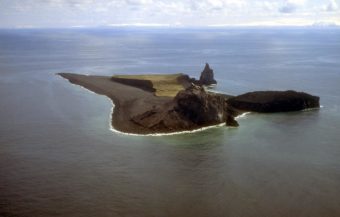
Bogoslof Volcano erupted again Wednesday, spewing a cloud of ash that was visible from Unalaska.

The volcano blew about 1:20 p.m., sending ash at least 31,000 feet into the air and prompting the Alaska Volcano Observatory to raise its alert level to red.

That’s the highest status, indicating a hazardous eruption is underway or imminent.

Bogoslof Volcano is on an uninhabited island 60 miles northwest of Unalaska. It has erupted more than a dozen times since mid-December.

Overdue snowmachiner succumbed to hypothermia, state troopers believe

An overdue snowmachiner, who was traveling to Fairbanks from Shungnak, by way of Huslia, has been found dead near Selawik Hot Springs.

Travis Loughridge, 27, left Shungnak about noon Saturday and was expected to arrive in Fairbanks by Monday evening.

A search-and-rescue team was deployed from Shungnak after Loughridge was not heard from, according to the Alaska State Trooper dispatch.

Ground searchers located Loughridge’s snowmachine and body about 7 p.m. Tuesday near Selawik Hot Springs, which is the midpoint between Shungnak and Huslia.

Loughridge likely broke through the ice at a water crossing and suffered from hypothermia, troopers said.

Efforts to recover Loughridge’s body still are ongoing because of cold weather and frozen terrain, but his next of kin has been notified.

Ask a Climatologist: Why is it so cold here when everywhere else is so warm?

The University of Alaska Fairbanks campus on Jan. 18th, 2017. (Photo by Amanda Frank)

It was -50 degrees today in Fairbanks. Anchorage hit -15 degrees. Much of the state is enduring the coldest temperatures in nearly five years.

Brian Brettschneider is a climatologist in Anchorage who closely tracks Alaska climate data and trends. Alaska’s Energy Desk is checking in with him regularly as part of the segment, Ask a Climatologist.

Points in Anchorage and to the north and west are experiencing their coldest spell in about five years.

“The models have been predicting this for the last week or so,” said Brettschneider. “The fly in the ointment has been cloud cover, so when you have clouds move over, especially when you’re talking those kinds of cold temperatures, it can effect the forecast by 25 or so degrees. So one day if you think it’s going to be clear you might predict -40 or 50, but if clouds hang in there it might only be -20 or so.”

An upper level low pressure system containing a lot of cold air is locked into place over western Alaska, creating these conditions.

“We’re kind of under the bulls eye,” he said. “So if you go over to Canada, the lower 48, even Southeast Alaska, they’re on the warm side of this upper level low pressure, so as far as they’re concerned, they’re asking why’s it so warm, while we’re over here to the west asking why’s it so cold.”

Anchorage only sees about two days a year with a high below zero, but hasn’t seen highs this low since January 2012.

“Before that it had been since January of 2009.,” Brettschneider said.  “So these are things that were more common in the past, they’re harder to achieve in this warmer environment that we live in.”

2016 was the hottest year yet, scientists declare

Chunks of Arctic sea ice, melt ponds and open water are all seen in this image captured by NASA's Digital Mapping System instrument during an Operation IceBridge flight over the Chukchi Sea in July 2016. Last year was particularly bad for Arctic sea ice. (Photo by NASA/Goddard/Operation IceBridge)
Chunks of Arctic sea ice, melt ponds and open water are all seen in this image captured by NASA’s Digital Mapping System instrument during an Operation IceBridge flight over the Chukchi Sea in July 2016. Last year was particularly bad for Arctic sea ice. (Photo by NASA/Goddard/Operation IceBridge)

Last year, global warming reached record high temperatures — and if that news feels like déjà vu, you’re not going crazy.

The planet has now had three consecutive years of record-breaking heat.

The National Oceanic and Atmospheric Administration has just released its annual State of the Climate report, which says it’s the hottest it has been since scientists started tracking global temperatures in 1880.

A separate analysis, by NASA scientists, came to the same conclusion.

The news comes as a confirmation hearing begins for Oklahoma Attorney General Scott Pruitt, who has been nominated to head the Environmental Protection Agency. Pruitt has ardently defended fossil fuels and fought against federal efforts to regulate greenhouse gases that warm the planet.

President-elect Donald Trump has professed open-mindedness about climate change. Still, he once called it a hoax, and scientists have been worried by his picks for his transition team and administration, as well as by the questions asked about climate scientists at the Department of Energy.

As the politics swirls around them, climate scientists keep churning out data.

“[Last year] was the warmest year on record, beating 2015 by a few hundredths of a degree, and together those two years really blow away the rest of our record,” says Deke Arndt, chief of the monitoring group at NOAA’s National Centers for Environmental Information in Asheville, N.C.

2016 Was The Hottest Year On Record

To determine whether a particular year was hotter or cooler than average, climate scientists compare the average land and ocean temperature for that year against the average temperature for the entire 20th century.

Source: NOAA
Credit: Alyson Hurt/NPR

He says 2016 was about 1.7 degrees Fahrenheit above the global average for the 20th century. “And that doesn’t sound like a lot, but when you take that and you average it all the way around the planet, that’s a big number,” Arndt says.

The warming was truly global. “Some part of every continent, and some part of every major ocean basin was warmest on record,” Arndt says, adding that in the United States, only Georgia and Alaska had record-setting warmth but “pretty much the entire country was above normal, and well above normal.”

This represents long-term warming along with the short-term effects of the El Nino weather phenomenon, he explains, predicting that the streak of breaking records will probably end this year as those El Nino effects dissipate. But the long-term warming trend should continue to go up and, Arndt says, threatens new records almost every year.

“The long-term warming is driven almost entirely by greenhouse gases,” Arndt says. “We’ve seen a warming trend related to greenhouse gases for four, five, six decades now.”

Copyright 2017 NPR. To see more, visit http://www.npr.org/.

Mushing, a tradition on the fritz in Bristol Bay

John Hanson Jr. is one of four mushers in New Stuyahok. (Photo by Avery Lill/acKDLG)

Dozens of canines howl in John Hanson Jr.’s dog yard, excited by the sound of a snow machine pulling up to the kennel.

Hanson is one of a handful of dog mushers in New Stuyahok, probably the most active mushing community in a region that has watched participation in the tradition dwindle.

“These other mushers are elderly mushers, and they were in it for 40, 50, 60 years or more,” Hanson said. “I don’t see any other young mushers around in the Bristol Bay region getting involved in dog mushing.”

Part of the reason, Hanson said, is that dogs are a lot of work.

Hanson collects food scraps from neighbors every day.

The aroma of fish and moose guts in the steel drum where he cooks the dog’s food is pungent.

When there’s snow, he runs the dogs on a sled.

When there isn’t, the dogs pull him on a four-wheeler.

For Hanson, caring for dogs is a full-time job.

He lives on money from sponsors and dividend checks from the state’s Permanent Fund and the native corporation.

But it’s an uncertain income, and local sponsors have been hard to come by lately.

It’s been a few years since weather has allowed a race in Bristol Bay, and he’s not optimistic that this year will be any better.

Without races, people and businesses close to home are less interested in sponsoring their local mushers.

Hanson looks elsewhere for sponsors, like to the Yukon-Kuskokwim Delta, so his team can fly to races.

He said there are plenty of races in the Kuskokwim, adding that he believes interest in the sport there is growing, not declining.

Dillingham musher Kyle Belleque has given away or sold most of his sled dogs. (Photo by Avery Lill/KDLG)

Kyle Belleque keeps three older sled dogs in Dillingham.

His dogs might be 12-years-old, but they still love to pull.

As they cut their way across the frosty tundra one recent afternoon, Belleque said he feels at home with his dogs, outside of a snow-machine’s bubble of noise and exhaust.

Belleque has run a few races, but started mushing more for its connection to days gone by. He likes the idea that before it was a sport, many families in the area kept dogs as draft animals.

“That’s how they hauled wood,” Belleque said. “That’s how they went hunting. That’s how they traveled. That’s how they did everything. When I was growing up here in the ’70s, ’80s and ’90s, there were dog yards all over the place.”

Better roads and more snow machines turned dog sledding into more of a hobby than a necessity.

Belleque also believes the decline can be attributed to a time in the ’70s when people first began importing dogs for racing.

“They imported all the other things that came with dogs, and among that was disease,” Belleque said. “There were massive die-offs in the villages. Some guys lost their entire genetic line to parvo and distemper.”

Then came the recent years without snow.

“In the last three years it was darn near treacherous,” Belleque said. “And this year it’s not that bad. Although, I fell in some creeks back here behind the house a couple of weeks ago.”

Belleque has kept dogs for his entire adult life.

Despite his love of mushing and his passion for its history, the empty wooden kennels in his dog yard show that even he has sold or given away most of his team.

“What happened to mushing? You know, it’s what happens to a lot of old things. They just get replaced,” Belleque said, scratching his dog’s head as it noses his hand. “I think the weather has been kind of the nail in the coffin, at least in Bristol Bay.”

Ask a Climatologist: 32 degrees doesn’t sound warm, but still broke records

Graphic Courtesy of the National Weather Service

The forecast for much of Alaska is for extreme cold next week, but the state just recorded its warmest year on record.

Brian Brettschneider is a climatologist in Anchorage who closely tracks Alaska climate data and trends. Alaska’s Energy Desk is checking in with him regularly as part of the segment, Ask a Climatologist.

“It doesn’t matter what geographic area you’re looking at,” Brettschneider said. “Whether you’re talking the globe, Alaska, the United States…everyone had their warmest year on record.”

So, how warm was it? Well, it was freezing. The average temperature for the year was 32 degrees.

“That may not sound very warm,” Brettschneider said, “but when you consider the second warmest year was 30.2 degrees and normal is just over 27 that’s a huge step up.”

2014 had been the previous record holder at 30.2 degrees.

“We busted that by almost two whole degrees,” he said.

Everywhere was warm, from north to south, east to west.

“Anchorage, Nome, Juneau all the way up to the North Slope,” he said. “Everyone except for Fairbanks. They were, I think, the third warmest, but pretty much no matter where you look in the state it was their warmest year on record.”

Places like Utqiagvik and Deadhorse on the North Slope stood out to Bretthschneider for how much they exceeded normal temperatures.

“They were the only places in all of North America that were more than seven degrees above normal for the year. And they broke their annual records by about two whole degrees,” he said. “So that was really the core of where the anomalous warmth was.”

Site notifications
Update notification options
Subscribe to notifications