Husband Scott Blom and the two youngest Blom children, Zach and Katilyn, were lost last week when their plane went down, apparently in Lake Clark. (Photo courtesy the Blom family)
Boat operations have been suspended and aircraft grounded by bad weather with no more signs of a single-engine plane presumed to have crashed in southwest Alaska.
Efforts have stalled in Lake Clark as poor weather is preventing aircraft from continuing the search for the Piper PA-28 Cherokee.
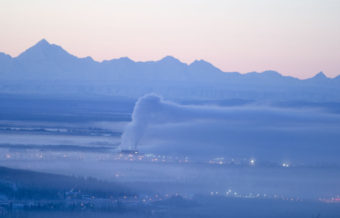
“We are dealing with persistent ice fog off of Lake Clark, and that is hampering the air search,” said Megan Richotte, a spokeswoman with Lake Clark National Park and Preserve on Monday. “Alaska State Troopers arrived on Saturday, and they were able to fly with their helicopter less than an hour over the lake.”
The plane left Port Alsworth at 10:30 a.m. Wednesday but never arrived in Anchorage.
Authorities believe it went down in Lake Clark, killing the four onboard.
Troopers did not see any new debris in the presumed vicinity of the crash.
A boater found items Thursday belonging to occupants on the plane, and on Friday the co-pilot seat and all three wheels were found on the lake, about 11 miles northeast of Port Alsworth.
Presumed dead in the crash are pilot Kyle Longerbeam, 25, passengers Scott Blom, 45, Kaitlyn Blom, 14, and Zach Blom, 13.
Searchers have been grounded since the trooper flight Saturday, Richotte said.
“No one, community members or park aircraft, have been able to fly yesterday or today,” she said.
She said the bay around Port Alsworth is frozen, so searching by boat had been limited to 18-foot Lunds. On Saturday the park service suspended boat operations because of the cold temperatures and ice fog.
Fundraising efforts for travel and funeral expenses for the two families involved collected more than $30,000 in donations this weekend.
Bucking a 44–inch–diameter Sitka spruce on the Tongass National Forest in 1991. (Courtesy U.S. Forest Service)
This first real cold snap in several years around Kodiak has got a local tree expert raising an alarm over tree cutting and log splitting. Dennis Symmons, a tree surgeon when he’s not tending to borough business as an assemblyman, says when the local Sitka Spruce tree freezes, it can become dangerous to handle.
“When it turns to plastic and peanut brittle from the cold, and it’s the one thing that even a professional forgets. And I was reminded yesterday, ‘Oh yeah, they’re not trees anymore.’ They’re giant sticks of celery. And when I attach my body to that, 60-feet off the ground, it takes on a whole different persona. Now, throw into the mix of these frozen sticks of celery, rotten cores, cancered bases, and they’re not trees anymore.”
He said the tree is more like “a sweaty stick of dynamite” at that stage, and the scenario could turn ugly quickly when topping or felling a tree.
“So here’s the novice and the professional putting that deep face, like he would into a green tree. Now that person’s coming through the back cut, and already making the first mistake, because all of that weight is getting smaller and smaller concentrated on one spot. The mistake’s realized, too late. Now that all that weight’s shifting on that little teeny stick, if a climber’s off the ground, that little stick is right in his face and he’s got nowhere to go.”
Symmons said that very thing happened to him some years ago when he was working on a tree.
“It looked like a really simple job … about a 90-foot spruce tree on its root wad. I just walked up it. I’m about 14-feet off the ground, with my sharpest, fastest-running chainsaw. And I zipped the top off really quick. And I step back, and without even computing what I just did, you know, leaving the frozen top, I slowly started cutting on that. And theoretically, the elasticity would just peel me to the ground. You now, kind of a show off mood,” he said.
“Well, I got three-quarters through that, seven-eighths through that, and realized – by that time it was too late – that it hadn’t moved. And then it exploded and it launched me upside down, into the air, feet-first. My experienced ground-man logger from Oregon thought I was showing off, doing some kind of stunt.”
He said the outside couple of inches have the most moisture and freeze the hardest. He says the dangers with cutting Sitka Spruce are present even when bucking up logs for firewood.
“(You) go to sink that saw and, ‘Wow, this is really weird, I know I just sharpened this thing, and it seems really dull.’ And about the time I punches through that inch-and-a-half frozen layer and grabs that soft wood, by then a person has already backed off and relaxed. Now the saw’s kicking back, coming at them, and the log’s trailing it,” Symmons said. “I’m trying to draw a real ugly scenario because that’s what it is – it’s an accident waiting to happen.”
And when the next windstorm hits and temperatures plummet to the single digits, what does Symmons recommend homeowners do if a tree in their yard starts to look threatening?
“I think the best thing to do is to get it secured. No matter what the conditions are, get the thing tied down. That’s a big deal. That’s why a tree gets topped, it stops its momentum,” he said. “Step one, if they’re in doubt, tie the thing down.”
Temperatures are expected to hover around the freezing point all week, but even when it thaws, Symmons cautions that the frozen ring around the Sitka Spruce could stay frozen for weeks afterward.
A pedestrian walks through a snowstorm on Dec. 7, 2016 in Juneau, Alaska. (Photo by Rashah McChesney/Alaska’s Energy Desk)
It’s winter again in Alaska. There’s snow on the ground across most of the state. Some places, notably Juneau, have a lot of fresh snow. It’s cold, too, and those below normal temperatures are expected to stick around for the rest of the month.
Brian Brettschneider is a climatologist in Anchorage who closely tracks Alaska climate data and trends. Alaska’s Energy Desk is checking in with him regularly as part of the segment, Ask A Climatologist.
He spoke with Energy Desk editor Annie Feidt.
Interview Transcript
Brian: This is the coldest statewide that we’ve been since Nov. 16 – 18 of 2015.
Annie: How cold has it been across the state?
Brian: With very few exceptions, everywhere has been below normal. And it’s pretty uniform across the state. The temperatures aren’t uniform, but the magnitude of the cold is pretty uniform across the state.
Annie: In terms of coping with the cold, what have you observed or seen or heard?
Brian: People feel like we’ve got winter again, so I think there’s this initial euphoria of sorts that the several years of above normal winter temperatures are finally relenting. People are feeling like it’s Alaska again.
Annie: Is the cold and snow expected to stick around?
Brian: It’s looking like it will. The new December monthly forecast for Alaska had quite a flip. Now, just about the entire state is supposed to be below normal. It’s a dramatic change from what was forecast just a few weeks earlier. But the state has had 14 consecutive months where it’s been above normal so it’s been warm after warm after warm. Finally, it looks like we may break that string and for a change have a colder than normal month.
Annie: What caused forecasters to make that flip?
Brian: A couple of things. One is La Niña. La Niña did formally kick in, so we’ve had this cooling down in the waters of the tropical Pacific and that has this cascading effect throughout the atmosphere. We generally end up with winds that blow out of the northwest and north and drag down colder air from even higher latitudes. That’s what the models have really captured in the last few weeks.
Tschantz said the likelihood of that much snowfall is “fairly high.”
He said the storm warning is a departure from Juneau’s mild winters and low snow amounts measured over the past couple of years.
“Yeah this is … this will be one of the bigger events so far in probably at least a couple of years,” Tschantz said.
Tschantz said residents should be careful on the roads and if people don’t keep their driveways clear, they could end up with a big buildup on Wednesday.
Department of Transportation workers cleared away slush on Sunday morning, but icy conditions persist because state workers wanted to avoid using too much overtime. (Photo by Emily Files/KHNS)
This weekend’s winter weather raised questions about what level of road maintenance residents can expect this season.
Plows cleared away slushy snow Saturday morning. But icy conditions persisted because state workers wanted to avoid using too much overtime. Budget cuts to the Alaska Department of Transportation will affect drivers for another winter.
In Haines, DOT staff works Monday through Friday.
So when winter weather hits over the weekend, or on a Friday evening, they need to work overtime to get the roads cleared right away.
It’s not that easy on a limited budget, DOT spokesman Jeremy Woodrow said.
“The Department still saw some budget reductions this last legislative session which is last year, which then effects the departments 2017 fiscal budget which is the current fiscal year that we’re in right now,” Woodrow said. “There were some reductions made. We try to spread those reductions out as much as possible across the entire department statewide.”
One way that affects Haines is by limiting overtime hours.
“We’re really not authorized to work overtime at all on the town routes,” Haines DOT Maintenance Foreman Matt Boron said. “But if there are extreme conditions then I can get permission from my boss to go, which is what we did on Saturday.”
“We had 4 inches of slush and I knew it was going to get cold and freeze and if we didn’t get that off then everything would have been completely impassible,” he said.
Woodrow said there are circumstances where weekend work is warranted, and that’s determined by a number of people.
“It’s a combination of working with the local foreman, talking to his supervisors at the regional level of — is this the right opportunity to use this overtime or would it be better to wait until tomorrow,” Woodrow said. “It’s a tough call to make. In years past we’ve had a larger budget and we were able to pay quite a bit of overtime to our maintenance folks.”
Woodrow said winter road maintenance this season will be similar to last year, with roads attended to in order of priority.
The highest priority road in Haines is the highway, followed by Lutak and Mud Bay Roads, and a few streets downtown.
“There will be times when we will be either a little slower responding to different weather events, depending on what windows weather events happen,” Woodrow said. “Then the side roads, lower priority roads, will also see less attention during winter events such as large snowstorms or mixed conditions when you have ice and snow on the roads.”
For Boron, the highway and the airport are the top priorities. He said if there’s extra time after those are cleared during overtime hours, then staff may head to other areas.
“And if I do go out to do those two routes, we have a rule that if we go out we go out for at least four hours,” Boron said. “So some of the town routes might be a beneficiary of that. If I go out to do the highway and have an hour left, then I’ll go around Small Tracts or Mud Bay or maybe go out past the ferry.”
Woodrow says looking back on last year, the DOT did the best they could with the resources they had.
“Our maintenance folks are professionals,” Woodrow said . “They take pride in their work. It’s important to point out that they live in the communities they work in so they want to make sure their roads are safe for their families, their friends and their coworkers just the same as anyone else would.”
Now that the weekend is over, Boron says his crew is sanding and scraping the icy highway, during regular operating hours.
Mount Juneau bears the recent Saturday, Dec. 3, 2016, snowfall that fell on Alaska’s capital city about midday. (Photo by Tripp J Crouse/KTOO)
After a mild start to December, it’s gotten bitter cold in Haines and Skagway, with temperatures dropping into the teens and single digits. With temperatures far below freezing, snowfall from the weekend is not likely to go anywhere soon.
Meteorologist David Levin at the National Weather Service in Juneau said the chilly weather is going to stick around.
Juneau forecast
Expect highs in Juneau to hang around 20 degrees for most of the week, according to the National Weather Service. Lows will drop into the mid- to high teens. Scattered snow showers are expected Tuesday in Juneau, with isolated snow showers on Wednesday.
“Right now we’re expecting it to last through the end of the week and probably into the weekend, next weekend as well,” Levin said.
Levin said the Arctic air is coming from the north, and affecting much of Southeast Alaska.
“Usually to get the cold air into Southeast Alaska you need a big, cold high pressure system over the Yukon,” Levin said. “That kind of forces that cold air through the passes and sometimes over the mountains into the inner channels of Southeast Alaska. You need a pretty strong, high pressure system to do that and that’s kind of what we have going on right now.”
This week’s chilly temperatures are not breaking any records, but they are below average for this time of year.
The average low in Haines is 23 degrees, while the low Monday, was 11 degrees.
Haines and Skagway may get a few inches of snow Tuesday and Wednesday.
At the same time, Southcentral Alaska is experiencing some of the coldest temperatures in a few years.
Close
Update notification options
Subscribe to notifications
Subscribe
Get notifications about news related to the topics you care about. You can unsubscribe anytime.