Weather

Ask a Climatologist: Bitter cold makes a comeback in Alaska

Temperatures in Alaska have spent most of the year in above average territory.
Alaska has settled into a notable stretch of seriously cold weather. Communities around the state are enduring low temperatures they haven’t seen in a few years. And for more than a week, the average statewide temperature index has registered below normal- by far the longest stretch this year.

Brian Brettschneider is a climatologist in Anchorage who closely tracks Alaska climate data and trends. Alaska’s Energy Desk is checking in with him regularly as part of the segment, Ask a Climatologist.

He spoke with Energy Desk editor Annie Feidt.

Interview transcript:

Brian: For example in Fairbanks, they reached minus 31 on Tuesday morning and that’s the first time they’ve been below -30 in two winters. In a typical winter, that happens about 20 times a year.

Annie: What’s causing this?

Brian: With the lack of sun — solar energy in the winter — if you can keep the warmth from the ocean away, cold air tends to build up in the high latitude areas. And those cold air masses, they move with the upper air flow, the jet stream and right now we’re in a pattern where the flow is bringing some of the cold air that’s been slowly building up over the last few weeks, it’s dragging that into Alaska and so we’re all experiencing those below normal temperatures.

Annie: So for the entire state we have the first below normal stretch…

Brian: Right, so basically in the last 10 or 12 days, we’ve been below normal most of that time, which has been the first stretch of below normal days we’ve had in 2016. We’ve even had a significantly below normal day, the first one of 2016.

Annie: And you put this out on social media. What was the reaction you got?

Brian: Well, the reaction from some people is global warming, climate change, it’s over now, since temperatures have become more Alaska-like. But I want to caution people, even the warmest year on record for Alaska, 2014, we still had about 60 significantly below normal days. We’ve now had one. And we’ll probably add to that here in the next two weeks, but even still 2016 is an almost 100 percent lock to be the warmest year on record in Alaska.

Annie: Even if we spend the rest of the year below normal?

Brian: We’d have to have the coldest December of the last 40 years to not have the warmest year on record, so it’s pretty much a done deal.

Mariner safe after vessel loses power, goes aground on Cape Puget

An Air Station Kodiak MH-60 Jayhawk helicopter crew rescued a mariner Monday after his sail boat grounded between Seward and Chenega.

The 47-foot Lieveling lost power and went aground on Cape Puget, about 210 miles north of Kodiak.

The Jayhawk landed on the beach nearby to pick up the sailor and transport him to Seward. He was uninjured.

Watchstanders from Coast Guard Sector Anchorage received a radio call for assistance from the mariner reporting he was drifting toward the rocks and donning his survival suit.

The watchstanders issued an urgent marine information broadcast, diverted the Coast Guard Cutter Mustang, and requested an MH-60 and HC-130 from Air Station Kodiak for assistance.

The Mustang and Jayhawk crews arrived on scene about 2 p.m. and sighted the Leiveling hard aground with the mariner ashore.

There were clear skies and 2-foot seas at the time of the rescue.

Wildfire tears through Tennessee as region suffers exceptional drought

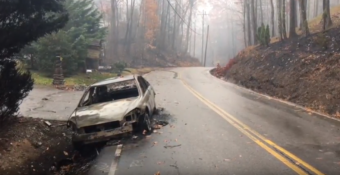
Smoke rises from wildfires in the Great Smoky Mountains near Gatlinburg, Tenn., on Tuesday. (Photo by Great Smoky Mountains National Park)

As a wildfire raced into Tennessee’s Sevier County on Monday evening, local officials rushed to get people out of town.

More than 14,000 people evacuated from the town of Gatlinburg alone — images posted on Twitter by the Tennessee Highway Patrol showed state troopers carrying luggage through neighborhoods surrounded by flames. The nearby town of Pigeon Forge was also threatened.


On Tuesday morning, the extent of the destruction was becoming clear — overnight, the fire damaged or destroyed hundreds of buildings in Gatlinburg, according to the state’s emergency management agency.

Dean Flener with the Tennessee Emergency Management Agency told local TV station News Channel 5 that Monday night was “devastating” for the town.

The Tennessee Emergency Management Agency said Tuesday morning that no fatalities had been reported, but that three people with “severe burns” were being treated in Nashville and a fourth person “with burns to their face” was being evaluated at a hospital in Knoxville.

Hundreds of people are helping to fight the fire, which is uncontained so far. More than 11,500 people didn’t have power on Tuesday morning. Schools were closed in two affected counties.

And Dollywood, the Pigeon Forge theme park founded by country music star Dolly Parton, was also closed on Tuesday — a spokesperson for the park told USA Today the night before that nothing there had been damaged so far.

Gatlinburg and Pigeon Forge are both popular tourist destinations at the edge of the Great Smoky Mountains National Park, where park officials banned all fires earlier this month amid concerns about dry conditions and widespread wildfires in other parts of the Southeastern U.S.

But the burn ban did not prevent the so-called Chimney Top Fire, which park spokesman Warren Bielenberg told the Asheville Citizen-Times was started by a human, and which ballooned from about 10 acres on Sunday to 500 acres on Monday.

“The Chimney Top Fire … spread very rapidly [Monday] evening as high winds pushed flames onto private property,” the Tennessee Emergency Management Agency said in a press release.

Great Smoky Mountains National Park was closed Tuesday.

A wind advisory remained in effect for the area for Tuesday and Wednesday, according to the National Weather Service, fanning not only the Chimney Top Fire but dozens of other blazes burning in eastern Tennessee, eastern North Carolina, Kentucky, Virginia, Georgia, Florida and Alabama.

As The Two-Way has reported, the entire southeastern U.S. is under extreme drought conditions — in some areas, little or no rain has fallen in the past six months, hurting farmers and creating dangerously dry conditions.

Copyright 2016 NPR. To see more, visit http://www.npr.org/.

Ask a Climatologist: Dreaming of a white Thanksgiving? Dream on, Anchorage.

(Graphic courtesy of Brian Brettschneider)

In Alaska, a white Thanksgiving is usually a given for most of the state. But not this year. The entire state is below normal for snowfall.

Brian Brettschneider is a climatologist in Anchorage who closely tracks Alaska climate data and trends. Alaska’s Energy Desk is checking in with him regularly as part of the segment, Ask a Climatologist.

He told Energy Desk editor Annie Feidt a white Thanksgiving is relatively rare for most of the U.S., but Alaska is a different story.

Interview Transcript:

Brian: Everyone’s familiar with a white Christmas, so I thought it would be interesting to look at the climatology of a white Thanksgiving. I pulled all the records for all the stations in Alaska and crunched some numbers and found that Thanksgiving typically- as most Alaskans know- is a full winter holiday, with snow on the ground, possibly new snow falling and cold temperatures.

Annie: What are the chances in Alaska for a white Thanksgiving?

Brian: There are two answers to that questions. One is, what does it look like this year? And then, what does the climatology look like? For the climatology, in Anchorage, there is about an 80 percent probability (of a white Thanksgiving) and then when you work your way northward from Anchorage it turns into basically 100 percent. McGrath has a 100 percent record, Fairbanks has a 100 percent record, Barrow has 100 percent and there are a few places in between that maybe have missed out once. And if you go down to Southeast, to Ketchikan, you’re looking at about a 15 percent probability.

This year, even though the entire state of Alaska is below normal for snowfall, there is at least one to as much as five inches of snow on the ground north of the Alaska Range. So Fairbanks is going to extend their 100 percent record. But from Anchorage south the snow is very meager, so a lot of places that typically have a white Thanksgiving, like Anchorage, aren’t going to have one this year.

Annie: And you said everywhere in the state is below normal?

Brian: Right, so every single station that has a published normal daily snowfall- if you compare what should have happened up to this point this year versus what has fallen, all of them are below normal.

Annie: And do we have any idea why that is?

Brian: There’s a lot of reasons, but we’ve had a stable weather pattern for the late fall and early winter. There just hasn’t been a lot of precipitation and there’s been more clear skies and it’s been a fairly stable pattern for an extended amount of time.

Annie: And how about you personally, are you in favor of a white Thanksgiving?

Brian: I think a lot of people here in Alaska are in favor of snow. It is Alaska and it’s supposed to snow. And here in town without any snow on the ground, it’s quite a bit darker. There’s a lot of recreational opportunities, snowmachining and skiing that people are having to hold off on until the snow falls. So I’m personally in favor of snow, a lot of people I know are in favor of snow. I get a lot of questions about when it’s going to finally snow and I don’t have a great answer for that.


Police, protesters clash near Dakota Access Pipeline route

Police and demonstrators opposed to the Dakota Access Pipeline clashed overnight on a bridge that has been a flashpoint in the ongoing protests.

“Police say protesters set fires in the area Sunday night and threw rocks at officers,” Prairie Public Broadcasting’s Amy Sisk reported. But an activist said in a live-stream video that projectiles fired from the police side started the fires and that demonstrators, who call themselves water protectors, were trying to extinguish the flames.

“Police used tear gas and sprayed water to control the crowd while the temperature dropped below freezing,” Sisk said. “Protest leaders are concerned about hypothermia and injuries sustained by demonstrators.”

The number of people injured ranged from dozens to hundreds, according to varying reports from activist and anti-pipeline groups. At least one person was arrested, Sisk said.

The skirmishes began Sunday evening when hundreds of demonstrators gathered and attempted to move a burned-out car that had been blocking Backwater Bridge, which is about a mile from the pipeline construction area, since another confrontation there several weeks ago. “Authorities have said the bridge is closed due to concerns about its structural integrity since the vehicle fires in October,” according to The Bismarck Tribune.

Demonstrators say the bridge is the primary access to their camp. A statement from anti-pipeline groups said demonstrators were attempting to clear the road to “improve access to the camp for emergency services.” Dallas Goldtooth of the Indigenous Environmental Network said the groups are concerned that “ambulances now have an extra 30 minutes to get to the hospital.”

The groups said medical staff at the protest camp were “overwhelmed” following the skirmishes, and that “the local community of [Cannon Ball] has opened their school gymnasium for emergency relief.”

Demonstrators have rallied since last summer against the Dakota Access crude oil pipeline, which is set to cross the Missouri River just upstream from the Standing Rock Sioux Reservation. The tribe fears the pipeline could contaminate its drinking water and harm its sacred lands. The protests, led by the Standing Rock Sioux, have become a rallying point for other tribes and environmental activists.

The company building the $3.8 billion pipeline maintains that it will be safe. As we reported, the U.S. Army Corps of Engineers said last week that it needed more time to evaluate whether the pipeline should be built on its planned route.

Copyright 2016 NPR. To see more, visit http://www.npr.org/.

With the clock ticking, Emmonak works to fix sewer pipes before they freeze

Yolanda Kelly poses with her granddaughter, son, and other children in her Emmonak living room. (Photo by Adrian Wagner/KYUK)

Inside a modest home on a quiet snow-covered street in Emmonak, water boils and turns into steam.

Yolanda Kelly heats water to bathe her son and granddaughter.

“I make my hot water on the stove, and I put it in the tub, and I give them a bath as much as I can,” Kelly said.

When asked how long it had been, Kelly said “My granddaughter, maybe three or four days.”

On Monday, a fire disabled Emmonak’s sewage treatment plant, leaving the city unable to provide sewer service to hundreds of homes in the village.

The city is racing to fix its damaged water and sewer system before the pipes freeze for good, a battle with the quickly approaching winter that the city is up against.

The city does have running water now, as long as the pipes don’t freeze, but the problem is that they can’t use drains and sewer lines to get rid of waste water or human waste.

Some people resort to using bucket-style, dry toilets.

“We’re using a honey bucket. You can just smell that as soon as you wake up, and it’s constantly there,” Kelly said.

When talking about how this makes her feel, she laughs a little.

“Like we’re living in the old days,” Kelly said.

When she was growing up, her family used honey buckets, and she doesn’t want that for her kids.

She isn’t the only one.

“We got no bathrooms, so we got to go back to the old days, back to the ’60s and ’70s,” said Albert Westlock, an ivory carver by trade who works from home and watches his nieces and nephews while their parents are at work.

He shows off a fossilized saber-toothed tiger tusk and some mammoth bones.

He likes old things, and doesn’t mind old ways.

“To this day I hardly ever take showers, cause I didn’t grow up taking showers,” he said. “I only took hot steam baths. That’s what I’m used to.”

Westlock said that if the pipes do freeze and he can’t get water, it won’t be the end of the world for him. He could go back to hauling water and cutting ice from the river as they did in the old days. However, his nieces and nephews are having a harder time.

“It’s pretty hard on these little kids, you know,” he said. “They’re not used to what we went through a long time ago.”

Family members are now making regular trips to Wesklock’s steam bath.

Despite his old fashioned ways, he wants the plant to start working again soon, just like everyone else.

The sewer plant is 20 yards away. Inside, it’s dark, with wires lying exposed on the floors. The smell of burnt plastic and metal lingers. The center of the room is charred black.

Jamie Awgika, the employee who found the fire, stands in the ash, looking at ruined machinery.

The night of the fire, Awgika’s toilet wasn’t flushing at home, which tipped him off that something was wrong.

“Put on my stuff and came right up, and I noticed there was a fire coming off of vacuum pump number one,” he said. “It wasn’t on fire, only the ceiling was on fire.”

“I was devastated. I couldn’t believe it happened,” Awgika said. “Scared, wondering what to do. I only had one fire extinguisher, and I used it.”

Emmonak's vacuum pump number one, which overheated and then burned through its metal casing and through the roof of the water-sewer plant. (Photo by Adrian Wagner/KYUK)
Emmonak’s vacuum pump number one, which overheated and then burned through its metal casing and through the roof of the water-sewer plant. (Photo by Adrian Wagner/KYUK)

The fire might have burned the entire building had Awgika not come to investigate, and things would be a lot worse.

“The first time, I caught it just in time when I came in,” he said.

This has happened before.

Awgika said this time was the worst, and his boss Arthur Redfox agrees.

This is the third fire in 10 years. The manufacturer of the pumps is called Bush, a German company that Emmonak was in the process of replacing when the fire happened.

Pumps like these are prone to overheating when residents don’t notice vacuum leaks, but they are not supposed to catch on fire.

They’re suppose to shut off when something like this happens, but they don’t.

Or it least they didn’t here.

Despite the faulty equipment, the city is not pursuing legal action.

It’s moving on, and it’s doing it as quickly as it can with repairs were already underway Wednesday morning.

On Tuesday, the Council approved $20,000 to fix the roof of the plant, a first step before replacing a burned-out pump, which caused the fire.

City Manager Martin Moore says this cannot wait.

“The immediate problem is the families,” Moore said. “The families need to have potable water; they need to flush their toilets; and they need to flush the water from the bathtub and showers to the lagoon.”

The contractor estimates three days fix the roof, but Moore says the whole operation could be out of commission for weeks and this worries him.

“If the repair work for the vacuum pump is not done in time, it’s possible that the pipes at the west end and at the east end of town, which provides close to 300 homes, will probably freeze,” Moore said. “And if it freezes, it will become a major disaster.”

If a freeze happens, Moore guesses, then it could take months to fix.  And then there would be another problem.

“We don’t have any money to repair the damages if that were to happen.”

Moore said it could cost more than $1 million and the village would have to go to the state to declare an emergency disaster.

Emmonak has gotten some relief funds already from the Alaska Native Health Consortium: $5,000 for the roof. And the village has requested help from the Rasmuson Foundation. Moore just hopes it will come in time.

As the steam rises from boiling pots, and the ice grows on the river, and the sun sets on Emmonak.

Burnt wiring and pipes inside Emmonak's water-sewer plant. (Photo by Adrian Wagner/KYUK) CREDIT ADRIAN WAGNER / KYUK
Burnt wiring and pipes inside Emmonak’s water-sewer plant. (Photo by Adrian Wagner/KYUK) 
Site notifications
Update notification options
Subscribe to notifications