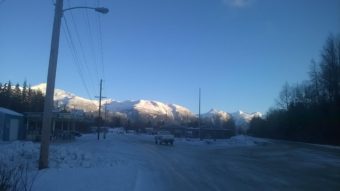
Two men were rescued Saturday, Dec. 3, near Nome after being reported overdue from ATV travel out of the community of White Mountain.
The Alaska Rescue Coordination Center received a report of the missing men, who had planned to travel by single all-terrain vehicle from White Mountain to Nome.
Coordinating with Alaska State Troopers, a UH-60 Black Hawk helicopter was deployed out of the Nome Army National Guard armory.
Alaska Army Guardsmen with the 1st Battalion, 207th Aviation Regiment located the men an estimated 40 miles east of Nome.
The two were transported to the Nome Fire Department for medical evaluation, after having spent the night under a tarp Friday.
The community of Stebbins has been experiencing an ongoing “water crisis” for the better part of this week.
City Administrator Nora Tom said water pipes are breaking, the trucks hauling water are in need of repairs, and the community is waiting on the needed parts.
One concerned citizen said people in Stebbins can’t take showers at the community washeteria and instead must travel to St. Michael.
Stebbins’ water supply is limited. If the situation continues without change, Tom said, then the community will be completely out of water by the end of December.
It is unclear at this time how long it will take to restore the community’s water supply.
Scientists are seeing bigger clusters in recent years, and they’re struggling to figure out what’s happening.
When weather conditions are just right — lots of rising heat and moisture, and vertical wind shear — sometimes you get more than just a tornado. Mathematician Michael Tippett at Columbia University, who tracks these outbreaks, says that while the number of tornadoes nationwide varies a lot year to year, the overall average is pretty steady.
This map from the National Weather Service shows tornado reports (red T), wind reports (blue W) and hail reports (green H) for Tuesday. More than 20 tornadoes were reported as a powerful storm system moved through the Southeast. Zoom in on the map here. (National Weather Service/Google Maps/Screenshot by NPR)
“But the number of tornadoes in outbreaks is increasing,” he says. And the number of tornadoes in the most extreme outbreaks — those where at least a dozen tornadoes hit a region within one to three days — is increasing the fastest.
Scientists who study climate suspect that warming temperatures may affect how many tornadoes we get. After all, warmer, wetter conditions are like priming the tornado pump.
But Tippett says so far he is not seeing a connection between climate change and these bigger outbreaks. “It’s not the expected signature of climate change,” he says, “it could be either something else, or we really don’t understand what climate change is doing.”
All sorts of things influence weather: for example, the circulation of warm water in the Pacific and Atlantic oceans. That circulation changes over decades, which in turn alters long-term weather patterns. Writing in the journal Science, Tippett says those ocean changes could be implicated here, but there’s no evidence yet. The only thing that seems to be changing are certain kinds of wind patterns near these clusters — when wind at different elevations is blowing in different directions (wind shear), for example.
No matter what the cause, these bigger outbreaks hurt people in their path. This week’s killed five. And they affect the insurance industry. Bigger outbreaks usually mean more damage, and more payouts.
Copyright 2016 NPR. To see more, visit http://www.npr.org/.
A burned-out car sits on the side of a road near Gatlinburg, Tenn. (Video screenshot from the Tennessee Department of Transportation)
Dozens of Alaska firefighters are battling blazes in the Lower 48, including deadly Tennessee fires that have destroyed or damaged hundreds of buildings.
Fire crews from around the United States are working to extinguish more than a dozen blazes around Gatlinburg and Pigeon Forge, Tennessee, which have left seven people dead, as of noon Wednesday.
Alaska Division of Forestry Public Information Officer Tim Mowry said more than 20 Alaska-based staff were in Tennessee earlier this week, when the fire became deadly.
“That night before, I talked to one of our guys down there and he said the winds were blowing in excess of 80 miles an hour,” Mowry said.
More than 700 buildings have been damaged or destroyed in Sevier County.
At its peak, about 110 Alaska-based personnel were scattered around the Southeast U.S. fighting fires in the drought-stricken region.
Mowry was among the deployed, and spent two weeks working in North Carolina.
He said Alaskans are filling a variety of roles ranging from support staff to initial attack crews.
“Helping engage fires in several states: Alabama, Arkansas, Georgia, North Carolina, South Carolina, Tennessee, Virginia, Kentucky, Mississippi,” Mowry said. “It’s really dry down there and all the states are having extreme fire danger.”
And, Mowry said fire conditions there are much different than those that crews are used to battling in Alaska.
“It’s mostly leaves that have dropped from the trees, and these fires are burning across the forest floor, and these leaves can get blown around and create spot fires,” Mowry said. “And I think that’s when you had winds in excess of 80-mile-per-hour in that Tennessee incident, it’s really hard to do anything with fire like that that moves so quickly — it’s almost like a grass fire.”
While basic firefighting principles remain generally the same from fire to fire, Mowry said the difference in a fire’s fuel can require that crews use different tactics than those used in Alaska’s backcountry.
“One of the big pieces of equipment that firefighters were using on our fire were leaf blowers, because these leaves were continually falling down and blowing off trees,” he said. “And so they were constantly having to go back and clear areas with leaf blowers and rakes and things like that.”
Mowry said it was a interesting, yet positive experience to work in an area where residents aren’t as accustomed to dealing with destructive, large-scale fires.
“People were very, very supportive; very appreciative of not just Alaska, but every state that responded to the call to send folks there to help,” Mowry said. “That was impressive to see, and you see that all the time everywhere, but it just seemed like this was an unusual sort of a historic event for them, and they were very thankful.”
About 75 Alaska-based personnel remain in the region.
Funding to fight the fires, which includes bringing Alaska crews down south, comes from a mixture of federal agencies and the states where fires are being fought.
One of North America’s biggest landslides occurred in Icy Bay, Alaska in 2015. The slide, and subsequent tsunami were a direct result of the shrinking glaciers in the region. Dr. Michael Loso, physical scientist at Wrangell-St. Elias National Park, explains the connection between retreating ice and unstable slopes.