Government

State seeks input for plan to boost logging in Haines

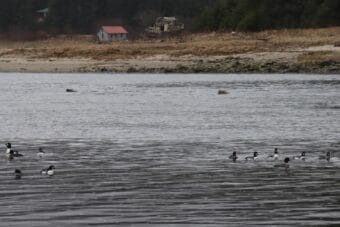
The Baby Brown and Glacier Side timber areas, left, are south of Glacier Creek, a main tributary to the Klehini River.
The Baby Brown and Glacier Side timber areas, left, are south of Glacier Creek, a main tributary to the Klehini River. (Courtesy of Derek Poinsette)

The state Department of Natural Resources is moving forward with its effort to overhaul the longstanding plan that dictates how it manages one of Alaska’s three state forests.

Agency staff are in Haines this week to meet with a range of local groups to solicit input for the new roadmap, which would open the entire Haines State Forest to logging — a major departure from the plan that’s been in place since 2002.

The effort began in 2024 after Gov. Mike Dunleavy directed the state Division of Forestry to boost the timber industry in Southeast Alaska – particularly in the Haines State Forest. The new version of the plan would also need to accommodate another Dunleavy policy: the sale of carbon credits.

But the major change is that the new management plan would allow for timber harvest in the entire forest, as opposed to about half of it.

“Prior to that it was 42,000 acres” available for harvest,” State Forester Greg Palmieri said in an interview earlier this week. “Well, now there’s 74,360 acres available for access for that type of resource management.”

A draft plan is in the works, but it hasn’t been released to the public yet. First, the agency will meet with local groups – including tribes, the Haines Borough and various advisory committees.

State Forester Greg Palmieri said those meetings will inform the draft, which should be released for public comment this spring.

“If we’re going to do this here, what do you think is the most appropriate way to do it, to protect the interest that you represent?” Palmieri said. “That’s the meaningful contribution that we’re trying to acquire at this time.”

Take the state forest land around Chilkoot Lake, which previously was not available for timber harvest. Palmieri said that the new plan could specify, for instance, that even though some timber harvest in that area may be on the table, clear cutting is not.

But at two local meetings this week that addressed the plan, participants focused more on the state’s process and its goal to boost logging than they did on any specific forestry recommendations.

One of those meetings happened Wednesday morning. Forestry officials met with a group that advises the state on how to manage the Alaska Chilkat Bald Eagle Preserve. Some, including Bill Thomas, seemed supportive of the effort.

“People forget, if it wasn’t for the logging industry, you wouldn’t have access out here anywhere,” he said.

Others, including Haines Mayor Tom Morphet, questioned the intent of the plan revision and potential outcome for local people.

“The state I think is going to have to make a lot better job explaining why it wants to start logging on recreation lands,” he said. “What’s the benefit to the community?”

People also voiced confusion over the process – and how they were supposed to weigh in on the issue without seeing the current draft or specific questions from the state.

That sentiment also arose on Monday, during a meeting of the area Fish and Game Advisory Committee. The group had yet to meet with DNR about the plan, but members spent the bulk of its regular meeting discussing it.

“They want us to comment when we have absolutely no idea of what their specific intentions are in any of these areas,” said committee member Kip Kermoian. “We have more meetings, but I think we need to insist on, if they want us to make informed decisions, we need more information.”

The group had yet to schedule a meeting with the state agency, but it voted to send a letter noting that the state is required by law to consult with them on such matters – and that the group’s members don’t think that what’s happened so far amounts to good-faith consultation.

Both committees indicated they planned to provide more specific, forestry-related feedback in the coming weeks.

Murkowski wants to reassure Denmark, but it’s not clear Congress is with her

A group of dignitaries face a gaggle of reporters
Danish Foreign Minister Lars Løkke Rasmussen, center, and U.S. senators spoke to reporters at the Hart Senate Office Building on Jan. 14, 2026. (Liz Ruskin/Alaska Public Media)

WASHINGTON — Sen. Lisa Murkowski was among a group of senators who met with the foreign ministers of Denmark and Greenland Wednesday, trying to provide an assurance that they couldn’t get from the White House: That Greenland is safe from a U.S. military incursion.

“I think it’s important to send the message that here in the Congress, we recognize and support the sovereignty of the people of Greenland,” Murkowski, the sole Republican in the meeting, told reporters afterward.

President Trump continues to say that the United States must take Greenland, for strategic purposes.

Murkowski and Sen. Jeanne Shaheen, D-N.H., co-sponsored a bill this week to prohibit the administration from spending any funds to “blockade, occupy, annex or otherwise assert control” over Greenland or the territory of any NATO ally.

“This is a message that I think it’s very clear, and very strong,” Murkowski said. “And, quite honestly, one that I never thought I would have to author and introduce into the United States Congress.”

Murkowski didn’t say whether any other Republicans agreed to support the bill, though Sen. Mitch McConnell, R-Ky., gave a speech on the Senate floor Wednesday saying an aggressive move on Greenland would be a calamity and gain the United States nothing.

He, like Murkowski, say seizing Greenland would shatter the NATO alliance.

Murkowski said it’d be better if the president changes his rhetoric on his own, without Congress having to pass her bill.

“I hope it’s ultimately not necessary,” she said. “But we are operating in times where we’re having conversations about things that we never thought even possible.”

Whether Congress has any appetite to rein in the president is unclear.

Sen. Angus King, I-Maine, said the legislative branch isn’t living up to its constitutional duty to check and balance presidential authority.

“Congress has abdicated its power, largely,” King said. “I’d say it’s the seventh inning. We’re behind four to three, but the game isn’t over.”

Minutes after he said that, the Senate voted to reject a resolution that would have curtailed Trump’s future use of military force in Venezuela.

Alaska’s senators, as expected, split on the issue. Murkowski, like King and all the Senate Democrats, supported the resolution, which would have required Trump to seek Congressional approval for further military action. Sen. Dan Sullivan opposed it.

The vote in the Senate on whether to block the measure was 50-50, requiring Vice President J.D. Vance to cast the tie-breaker.

Tlingit and Haida tribal members concerned by tribal government corporation presence in Guantánamo Bay

Migrants detained in the Trump administration’s immigration crackdown are led to a plane bound for Guantnamo Bay, Cuba. (U.S. Department of Homeland Security)

The business arm of Southeast Alaska’s largest tribe has earned nearly $40 million from U.S. Navy contracts in Guantánamo Bay, Cuba – money some tribal members are concerned comes from supporting immigrant detention. 

While tribal corporation leadership says their operations are separate from the detention center on the military base, what’s happening on the ground may tell a different story.

Guantánamo Bay is the site of an active U.S. Navy base with about 6,000 military personnel living and working there. It also houses a detention facility. That facility’s main purpose was to detain people accused of orchestrating the Sept. 11 terrorist attacks. 

The Trump administration has been using the detention facility to detain migrants as part of its aggressive deportation policies that many deem inhumane and unconstitutional.

Tlingit Haida Tribal Business Corporation is the business arm of the Southeast Alaska tribal  government — the Central Council of the Tlingit and Haida Indian Tribes of Alaska. The corporation currently has a contract in Guantánamo Bay.

In 2018, the corporation’s subsidiary, KIRA, announced a contract with the U.S. Navy to provide maintenance services, port operations and waterfront administration for the base. That contract lasted until 2022. According to a government website that tracks contracts, a similar contract started two months before it ended and is set to last until February 2028. The value of the two contracts together has so far reached just under $40 million.

Tlingit and Haida said the corporation’s contract provides services to the Navy base; it does not support detention operations at the base. But some tribal members, like Clarice Johnson, have doubts about that.

Tribal involvement in Trump’s detention operations

Johnson said she’s been concerned about the contract since it began seven years ago. But when the Trump administration vowed to hold thousands of immigrants in Guantánamo, it brought new urgency to her concerns.

“It makes me ill to think of Tlingit and Haida making money off the abuse of other people,” Johnson said. “Especially those who are just looking for a better life.” 

Guantánamo Bay’s detention center has been known for human rights violations for decades. It’s also notoriously secretive.

In 2023, a United Nations investigator researched the facility and reported “ongoing cruel, inhuman, and degrading treatment.” The report suggested that the facility be closed. But two years later, the second Trump administration pledged to use it for migrant detention. 

In other parts of the state, Alaska Native tribal members have protested their corporations’ investments in immigration detention centers. NANA Regional Corporation’s subsidiary, Akima, has been directly investing in ICE detention operations, including in Guantánamo Bay, for years. 

In the rest of the United States, Indigenous people are questioning their own tribal governments’ involvement in detention centers.

When stories about inhumane conditions at Akima-run detention centers surfaced this fall, Johnson said she started posting in a Facebook group called “Shareholders of Sealaska,” to make sure tribal members like her knew Tlingit and Haida also had connections to Guantánamo Bay. 

“I didn’t want people to forget that whenever they’re criticizing other corporations for doing this, that our own tribe was also participating,” she said.

Her posts garnered discussion with other tribal members, who posted their own concerns. In response to public criticism, Tlingit and Haida posted a statement in early December saying the contract is “strictly limited to the operation and maintenance of multiple watercraft and port facilities,” and that the corporation is obligated to continue the work until the contract ends. 

What Tlingit Haida Tribal Business Corporation is doing in Guantánamo Bay

But Johnson is worried that some of those watercraft transport migrants to the detention center in Guantánamo Bay.

Richard Rinehart is the CEO of Tlingit Haida Tribal Business Corporation. He said it’s against taking on contracts that assist in immigration detention. 

“We don’t have anything to do with that,” Rinehart said.

Instead, the corporation contract relates to vessel operation and maintenance, he said. 

“We run a ferry that goes from the leeward side, which is where the airport is, to the windward side, which is where the naval base is,” he said. “Goes back and forth.”

However, Rinehart said he’s heard that the ferry the corporation operates is used to transport detainees. But, he said, he and his staff aren’t involved with that process. 

“There are times — I hear, I’ve not seen this — but my manager there tells me that they do come across and they’ll put somebody on the ferry. It’s usually late at night, and it’s all just their vehicles, all their staff,” he said. “They move across and they go to the airport, but we have the only ferry going from the airport to the windward side, where everything is.” 

At least 700 migrants were detained at Guantánamo Bay in the past year, and were initially flown there, according to previous reporting by NPR and the New York Times. 

In an email to KTOO in response to follow-up questions, Rinehart said he could not speak to how many migrants have been transported via the ferry the tribal corporation maintains and operates. 

KTOO could not confirm whether or not there is another way migrant detainees are transported from the airport to the facilities they are held in. 

From the corporation’s perspective, he said involvement in migrant transport is “outside our visibility and control and is not tracked, directed, or managed by [Tlingit Haida Tribal Business Corporation] as part of our contractual duties.” 

Though Guantánamo Bay is often linked with the detention facility, Rinehart says he doesn’t think a lot of people realize it’s primarily a naval base with about 6,000 military personnel. And that’s who Rinehart said the contract serves. 

Johnson said even incidental involvement in migrant detention is still too close for her comfort. 

“I understand why they want to claim six degrees of separation from ICE,” she said. “But I think that their actions at Guantánamo Bay place them in much closer proximity than many tribal citizens realize.”

And she wants to know if the tribal corporation will take a stance on migrant detention as more opportunities to profit from it arise. 

“Will Tlingit and Haida jump on the money train?” Johnson said. “Or will they actually have guidelines on which contracts they will bid on, as some corporations have?”

Rinehart said most Tlingit Haida Tribal Business contracts are with the U.S. military. And those contracts, he said, support the corporation’s mission: create more funding for the tribe. 


Clarification: This story has been updated to reflect that Tlingit Haida Tribal Business Corporation has earned nearly $40 million from U.S. Navy contracts in Guantánamo Bay. 

Newly proposed legislation aims to curb Alaska bycatch

A crewmember on the fishing vessel Progress wraps up the 2025 pollock season in Unalaska. A storm caused millions of dollars in damage to the 130-foot trawler during the 2018 fishing season. Those kinds of incidents are rare, thanks in part to NOAA's marine forecast service.
The proposed legislation would establish a fund for fishermen to purchase updated technology and trawl gear to limit seafloor contact and bycatch. (Theo Greenly/KUCB)

Alaska’s congressional delegation introduced legislation Wednesday that aims to reduce bycatch in parts of southwest Alaska using better marine data, technology and gear.

The Bycatch Reduction and Research Act, introduced by U.S. Sens. Dan Sullivan, Lisa Murkowski and Congressman Nick Begich, would address research gaps in environmental data and improve monitoring of fisheries in the Bering Sea, Aleutian Islands and Gulf of Alaska. It would also establish a fund for fishermen to purchase updated technology and trawl gear to limit seafloor contact and bycatch. That’s when harvesters accidentally catch species they’re not targeting.

The proposed legislation builds on recommendations from the federal Alaska Salmon Research Task Force, which concluded in 2024 and aimed to better understand how humans cause declines in fish and crab species, including through factors like bycatch.

The legislation would revive the salmon task force under the new name of the Bycatch Reduction and Research Task Force. The group would review National Oceanic and Atmospheric Administration research on Alaska salmon and trawl gear impacts on the seafloor, and provide recommendations for future research.

“In recent years, Alaskans have witnessed unprecedented declines among some fish and crab species in parts of the state while, in other parts, runs have been strong and historic,” Sullivan said in a press release. “We need to get to the bottom of all potential causes of this increased variability, including concerns about bycatch and trawl gear habitat impacts, to strengthen the sustainability of our fisheries.”

For years, fisheries stakeholders have debated if and how fishing gear types, especially trawl gear, impacts marine species and seafloor habitats. Conservation and tribal groups and various stakeholders have pushed fisheries managers to take stronger action on limiting both bycatch and seafloor contact in trawling.

Representatives in the trawl industry have supported stricter regulations around bycatch, but also cautioned that more extreme limitations could be burdensome to the massive pollock industry, which is a major economic driver to some Western Alaska communities, including Unalaska.

The regional council that manages Alaska’s federal fisheries will discuss chum salmon bycatch management at its upcoming meeting in early February.

The proposed legislation still has to pass both the Senate and House before it would go to the president to be signed into law.

The freshmen: Two new Mat-Su Republicans prepare for their first session

 two men smiling in front of state seal
Republican Reps. Garret Nelson, left, and Steve St. Clair pose for a photograph during a swearing-in ceremony in Anchorage on Dec. 30, 2025. (Alaska House Republicans)

The Alaska House of Representatives will have two new faces when lawmakers return next week for the start of the legislative session. Gov. Mike Dunleavy appointed Mat-Su Republicans Steve St. Clair and Garret Nelson to fill two open seats in the state House.

So, who are these two new lawmakers, and what do they hope to accomplish in their first year as a budget crunch looms?

The newcomer: Rep. Garret Nelson, R-Sutton

Newly minted Rep. Garret Nelson says he’s doing his best to get up to speed with the session fast approaching.

“I’ve never been up until 2 o’clock in the morning so many days in a week in my life as I have been this week, trying to figure this stuff out,” Nelson said in an interview.

Nelson grew up on a family cattle ranch in Mackay, Idaho, and has spent most of his life in the private sector. He spent some of his early career as a welder, later moving into sales at the financial services firm Gravity Payments. He, his wife and nine children moved to the Mat-Su community of Sutton in 2016, where he served as chair of the local community council.

Nelson is steeling himself for what could be a tough first year. He called the world of politics a “cesspool.”

“My expectations are, like, to hold to principles as much as I can,” he said. “I just expect to go down and get my teeth kicked in.”

Nelson has already found himself in something of a spat with a senior Republican senator, Anchorage Sen. Cathy Giessel, who suggested in a newsletter that his large family could compromise his ability to act in the state’s best interest when voting on the Permanent Fund dividend.

“At what point does a vote for a ‘full dividend’ comprise a conflict of interest, or even a breach of ethics? Legislators have gone to jail in the past for accepting money in payment for their votes,” Giessel wrote in a newsletter to constituents.

Nelson said the comment was “grossly inappropriate” and “weird.”

In a text message, Giessel stood by the comment and said she had raised a legitimate question. Giessel said any suggestion that she had insulted Nelson’s family was “absurd.”

Nelson calls himself an “unashamed conservative” and often references his Christian faith and devotion to family. He says he’s in favor of paying large Permanent Fund dividends in line with a formula outlined in state law, about $3,800 this year. Gov. Mike Dunleavy’s budget proposal would do exactly that by taking $1.8 billion from the state’s main savings account.

At the same time, though, Nelson said that drawing from savings might not be the right move. The state shouldn’t just try to live off its savings and put off harder questions for another day, he said, just as a family shouldn’t spend more than it brings in.

“We could raid the Permanent Fund and pay all our bills this year, piece of cake, you know what I’m saying? We could pay all the bills and give everyone a full PFD, and everyone’s going to be happy, but that’s not a good long term solution.”

Nelson says he hasn’t quite figured out the right approach — he says he’s still boning up on the ins and outs of the myriad issues facing the Legislature.

But Nelson says he’s planning to bring with him a built-in support system. Nelson says the whole family will join him in Juneau for the session.

“The way that we’re doing it is, like, it’s a family adventure,” he said. “We are all in this together.”

The veteran: Rep. Steve St. Clair, R-Wasilla

Joining Nelson in the House is Rep. Steve St. Clair, a longtime staffer for former House speaker and now-Sen. Cathy Tilton, a Wasilla Republican. St. Clair spent two decades as a military policeman, including a stint at Fort Wainwright in the early 2000s, before moving into conservative politics.

Like Nelson, St. Clair said in an interview that he, too, is spending long nights preparing for his first session. But with seven years of experience in the Capitol, plus an MBA, he said he thinks he’ll be able to hit the ground running.

“I’m a budget guy,” he said, “but I’m also very familiar with all the other departments, their budgets. I’ve worked on amendments. I’ve worked on bills.”

That means he’s coming into the session with some ideas for how to shrink the state’s budget gap — for example, freezing state workers’ pay, and gradually reducing so-called optional Medicaid services offered by the state. Those include things like dental and vision care and prescription drugs.

“They’re not required by law. Basically, it’s the Cadillac version instead of the (Ford) Pinto version,” he said. “I think we need to pare that down.”

St. Clair said he’s also concerned about proposals to restructure the Permanent Fund to function more like a university endowment, one area he expects the bipartisan House and Senate majorities to focus on this year.

But on most fronts, St. Clair acknowledged he might not get his way, given that he’s in the minority for his first year in office.

St. Clair said he’s not expecting lawmakers to solve the state’s budget issues in the four months of the session, given that it’s an election year, but St. Clair says he’ll do his best to contribute.

“I’m humbled to be here and (I’m) going to do the best I can for my district and Alaskans,” he said.

Alaska pollock processors drop foreign worker program, citing uncertainty

The UniSea processing plant in Unalaska in Jan. 2019. (Berett Wilber/KUCB)

Some of Alaska’s largest pollock processors are abandoning a foreign worker visa program that once supplied up to half their workforce, citing rising costs and uncertainty under stricter immigration policies.

Tom Enlow is the president and CEO of UniSea Seafoods, Unalaska’s largest seafood processor. He said the company is moving away from the H-2B visas to save money on an inconsistent system.

“The H-2B program, I think was good for Alaska at a time when we really needed them, you know, during the pandemic, and little bit pre-pandemic, but really it’s cost prohibitive to bring workers all the way from Eastern Europe to Alaska,” Enlow said.

The H-2B visa program allows employers to bring foreign workers to the U.S. to fill temporary non-agricultural jobs during shortages. The visas can be difficult to obtain. Companies have to first show they can’t fill the jobs, then they have to apply, and then the U.S. Department of Homeland Security and the U.S. Department of Labor issue the visas through a lottery system.

Enlow said the processing plant moved back to a 100% domestic workforce this summer and will do the same for the upcoming “A” season — a major pollock season that starts later this month and brings thousands of workers to Dutch Harbor.

The main reason for that is cost. He said the Trump administration’s approach to hiring foreign workers has also made a difficult and expensive process even more complicated.

“It doesn’t make for good planning for processors, when you are bringing 200 or 300 people in from Eastern Europe and you don’t know for sure if you’re going to get supplemental visas, if [they’re] going to get approved in time, if they’re going to be in Alaska when you need them, when the season’s started,” he said.

UniSea started participating in the H-2B program in 2019, and prior to that, the company employed 100% U.S. domestic workers, according to Enlow. Some of those were green card holders or permanent residents, living in the U.S. — most from the Philippines.

When the company was actively using the special visas, as many as half of UniSea’s workers were foreign.

The company still employs a handful of Ukrainian employees who were hired through a special program designed to help those who were displaced from the Russian invasion, and will continue to work for the processor, Enlow said.

“They’re not bound by some of the rules and restrictions of the H-2B program,” he said. “They can stay extended periods of time. They can work full time, year round, they don’t have to be necessarily processors. They can work in other jobs, in other areas.”

UniSea isn’t the only regional processor filling jobs with American workers. Trident Seafoods — one of the largest seafood processors in the nation — said it employs almost an exclusively domestic workforce.

A spokesperson for the company said the processor — which has facilities across Alaska, from the Aleutians to Southeast and Bristol Bay — has been moving away from the H-2B program since 2023, in an attempt to strengthen long-term, local employment.

Westward Seafoods, another shore-based processor in Unalaska, would not provide information on employment data.

Alaska: the ‘poster child for foreign labor’

Brian Gannon is the vice president of global partnerships for LaborMex, a Texas-based company that helps connect U.S. businesses with foreign nationals for temporary or seasonal work. He said when it comes to handling and packaging Alaska’s massive seafood exports, especially for cod and pollock, the state has a very small local employment pool to work with.

“For 100 years, people have been coming from somewhere else to process fish in Alaska,” Gannon said.

Processing fish involves long hours, and often tough, repetitive and pungent work. Considering there is an entire area of plants often referred to as the “slimeline,” it can be difficult to fill those jobs.

Gannon, who started his career as a guest worker from Montana at a processing plant in Chignik in 1990, said despite the lackluster appeal of processing work, Alaska has done a good job attracting seasonal workers from afar.

“Alaska is really a poster child for foreign labor, in as much as the oil industry and forestry and mineral extraction and seafood production, etc., in Alaska for 150 years, [has] been built on a small amount of available local labor and a large amount of labor coming from somewhere else,” he said.

The Alaska Department of Labor found that in 2023 the state’s seafood industry employed nearly 22,000 workers, roughly 83% of which were nonresidents of the state. That year, the Alaska pollock industry directly employed over 8,000 workers, according to a report from Northern Economics on the contributions of the state’s pollock industry. Most were workers from the U.S., roughly 31% from Alaska, and about 12% were residents of other countries.

H-2B visa program helps fill employment gaps

Gannon said about 10 years ago, the seafood industry’s domestic workforce started to run dry. The industry’s pool of seasonal workers wasn’t replenishing. And that was especially challenging for cod and pollock processing, which unlike salmon, for example, don’t have peak seasons in the summer. He said salmon can have an advantage because it’s a summer fishery, and people sometimes have that season off. Ultimately, Gannon said companies just couldn’t match the shortfalls.

“And that’s where that H-2B visa came in quite handy,” he said.

The H-2B visas weren’t really used in Alaska’s seafood industry until about 12 years ago, according to Gannon. Congress currently doles out 66,000 for the entire fiscal year, and Gannon said they can get about 250,000 requests. Congress sometimes approves special increases for those visas.

Within the pollock processing industry, the program has been used among all sectors of processors. However, the catcher-processor fleet — that processes at sea — is required by law to employ 75% American citizens and green card holders. According to officials in the industry, they’ve never made any significant use of the H-2B program.

For a while the visas, while complicated to obtain, worked well. But Gannon said over the past several years a lot has changed in the pollock industry.

Changes in the industry spark a return to domestic labor 

“So many things have upended the apple cart, and the pollock processors are not necessarily producing as much,” he said.

Gannon said things like the COVID-19 pandemic, the war in Ukraine, changes in the nation’s political dynamics and competition from China and Russia have made it hard for pollock processors to make ends meet.

Gannon said Alaska seafood companies also likely had trouble matching the prevailing wage requirements for H-2B visa holders, which he said had surpassed Alaska’s minimum wage at one point. He said the Department of Labor sets those wages, and they have to be matched or exceeded for all processors at the plant.

The seafood industry in general has also seen increases in processing costs, wages, energy prices, as well as drops in sale prices for every major species group in 2023, according to the National Oceanic and Atmospheric Administration.

Enlow said UniSea won’t be saving much, if any, money right away by switching back to an American workforce, because he’s expecting a high attrition rate.

“And so you’re going to need to hire more and bring up more people than you actually would need over time, because you’re going to lose some of those workers,” he said.

But Enlow said that should eventually be offset by avoiding uncertainties around international travel and immigration concerns.

Site notifications
Update notification options
Subscribe to notifications