Government

Juneau’s City Hall move will cost millions more than expected

The Michael J. Burns Building, which houses the Permanent Fund offices on 10th Street, on Monday, Feb. 24, 2025. (Photo by Clarise Larson/KTOO)

The cost to move Juneau’s City Hall is coming in millions of dollars higher than expected.

According to the city administration, it’s expected to cost $20.5 million to purchase, renovate and move into two floors of the Michael J. Burns building, which houses the Alaska Permanent Fund Corporation downtown. The floors are slated to become Juneau’s new City Hall location. 

In September, the Juneau Assembly greenlit the purchase of the floors from the Alaska Permanent Fund Corporation. At the time, the cost estimate was less than $18 million. 

Mayor Beth Weldon said the move to the Burns building is the best option for both city staff and citizens. 

“We have to find a solution. We have looked under every rock to find a cheaper solution. There is no cheaper solution,” she said. 

Those rocks include trying to build a new City Hall, and looking at existing buildings like the former Walmart in Lemon Creek, the Marie Drake building and the Floyd Dryden campus. 

The $20.5 million price tag is millions of dollars higher than city officials anticipated it would be just a few months ago. That cost is to cover moving expenses and a partial remodel of the floors — including things such as new paint, carpet and cubicles. 

And, while the Assembly has already put aside about $14.5 million for a City Hall project during recent budget cycles, they still needed to find another $6 million.

So at a meeting Monday night, Assembly members agreed to pay for the shortfall by pulling that amount from a hodgepodge of other proposed city projects, including the Capital Civic Center, the Lemon Creek Multimodal Path and a waterfront museum. 

But not everyone was in favor of the plan. New Assembly member Nano Brooks voted against the transfer of funds, arguing it was too much money. 

“The amount of $20 million is just, I can’t support that in good conscience,” he said. “It’s not what the taxpayers voted for, and even the funds that were initially set aside has left a lot of the community feeling very disparaged and unheard.”

The Assembly’s vote comes after multiple years of push and pull between city administration and Juneau voters. The city asked voters twice during recent municipal elections to approve bond debt. They said no both times. 

Juneau’s current City Hall near Marine Park fits less than half of the city’s employees and it needs millions of dollars in maintenance and repairs. The new location would consolidate several departments that are now in separate buildings.

Assembly member Alicia Hughes-Skandijs said the plan isn’t perfect, but she’ll support it. 

“There is no workable alternative that I have heard,” she said, “So we need to find the solution, and this is frequently where we find ourselves, which is just choosing the best of our least favorite choices.”

According to the city administration, the renovations and the move to the new location are expected to take at least a year to complete. 

U.S. Supreme Court declines to hear case that could have upended Alaska subsistence fishing

The Kuskokwim River is seen in this image captured by scientists working on NASA's Arctic Boreal Vulnerability Experiment, or ABoVE.
The Kuskokwim River is seen in this image captured by scientists working on NASA’s Arctic Boreal Vulnerability Experiment, or ABoVE. (Peter Griffith/NASA)

The U.S. Supreme Court has rejected the state of Alaska’s latest attempt to alter Alaska’s decades-old system of subsistence fishing management.

In a one-sentence order Monday, the court said it will not review a decision by the 9th U.S. Circuit Court of Appeals, which ruled in August that Alaska cannot manage fishing on a stretch of the Kuskokwim River that flows through the Yukon Delta National Wildlife Refuge.

If the Supreme Court had taken up the case, it could have redefined Alaska’s unique system of hunting and fishing management, which allows the federal government to restrict subsistence hunting and fishing on federal land to rural Alaskans. The state is forbidden by the Alaska Constitution from offering the same preference.

Alaska Native organizations, including the Alaska Federation of Natives, praised the court’s decision, but the commissioner of the Alaska Department of Fish and Game said by email that it would continue to work with the federal government on the issue.

Monday’s Supreme Court decision ends a five-year dispute that began during a salmon shortage on the Kuskokwim River in 2021. The state of Alaska issued orders to open fishing that contradicted federal fisheries managers’ decision to keep it closed.

Salmon fishing is a critical aspect of Alaska Native culture, tradition and survival. Salmon returns have plummeted in recent years, straining managers who must balance the wants and needs of Alaskans and Yukoners pursuing the same fish.

On the Kuskokwim, the state claimed it was simply interpreting a U.S. Supreme Court ruling from 2019, but the federal government disagreed with the state’s interpretation and sued the following year.

Alaska Native groups sided with the federal government, and Alaska District Court Judge Sharon Gleason ruled in favor of the federal government in 2024.

The state appealed to the 9th Circuit, which again ruled in favor of the federal government. That prompted the state to appeal to the U.S. Supreme Court.

The Kuskokwim River Intertribal Fish Commission was one of the lead groups standing with the federal government.

“Our Fish Commission is very pleased with this historic victory in favor of the people of the Kuskokwim River. The victory not only upholds rural subsistence rights in Alaska, but upholds the participation of local people, elected by the Tribes, in the co-management of Kuskokwim salmon,” said the group’s chair, Martin Andrew, in a written statement.

Attorney Erin Dougherty Lynch worked on the case for the Native American Rights Fund, which represented the Association of Village Council Presidents.

By phone, she noted that even though this case is over, the Bureau of Land Management is considering changes to the subsistence program.

“What the state is seeking to accomplish now is basically the same thing through administrative processes. They’re definitely still going after subsistence. This won’t be the end, unfortunately, of their efforts to restrict subsistence,” she said.

Safari Club International, which petitioned BLM for regulatory changes, backed the state in the appeal that was rejected Monday.

In a written statement after Monday’s decision by the U.S. Supreme Court, the group said it believes the federal government “has increasingly superseded Alaska’s wildlife authority” and that the state and federal government should continue to work on the issue.

By email, Alaska Department of Fish and Game Commissioner Doug Vincent-Lang offered a similar comment and referred to the 1980 compromises between state and federal interests in the Alaska National Interest Lands Conservation Act.

“We will respect the decision of the U.S. Supreme Court to not address the legal issues regarding fish and game management authorities over navigable waters belonging to the State of Alaska,” he said. “This said, we will continue to work with the Secretaries of Interior and Agriculture to ensure the rights Alaska was given under its statehood compact and envisioned under ANILCA are safeguarded.”

Alaska offers free rocks and dirt, helping big state-backed construction projects

A motorcyclist descends a hill as he approaches Coldfoot, Alaska on the Dalton Highway in 2014.
A motorcyclist descends a hill as he approaches Coldfoot, Alaska on the Dalton Highway in 2014. (Bob Wick/Bureau of Land Management)

The state of Alaska is preparing to give away millions of dollars worth of gravel to public corporations, a move that would amount to millions of dollars in assistance to some of the state’s biggest construction projects.

According to a Q&A posted by the Alaska Department of Natural Resources, the beneficiaries could include the proposed Ambler Access Project and the proposed trans-Alaska natural gas pipeline.

The state’s plans were disclosed the day before Thanksgiving in a public notice stating that DNR is planning “regulation changes on material sales and conveyances to state agencies.”

The Department of Natural Resources oversees mining on state lands in Alaska, including the extraction of gravel and fill dirt for use in construction.

While humble, gravel can be serious business — in November, DNR commissioner-designee John Crowther signed an order that prohibits gold, silver and other kinds of mining near gravel quarries along the Dalton Highway, which links Fairbanks to Prudhoe Bay.

For state maintenance crews that need to keep the highway open, gravel is more important than rare minerals.

In 2024, High Country News reported that for construction projects on the North Slope, gravel is a “precious commodity” because of its scarcity.

One of DNR’s proposed changes to its gravel rules declares “that the department convey material to a state agency or public corporation at a base price of $0.00 per cubic yard and without retaining a reversionary interest.”

Currently posted price charts show the state selling gravel for $3 per cubic yard in Interior Alaska.

State law prescribes that any time DNR wants to sell land or public resources for less than market value, the commissioner must declare that the sales “serve a public purpose and are in the public interest.”

The upcoming regulation change states that transfer to a state agency or state corporation is automatically consistent with that requirement.

That would allow the Alaska Department of Transportation and Public Facilities to get gravel from state land for free, excepting the cost of processing and transportation.

In a question and answer notice published Dec. 26, DNR said the change is intended to allow “for maximum use of state land consistent with the public interest.”

“Examples of a public purpose would be a state agency or public corporation using gravel to construct a gravel pad on a state leased site for infrastructure development; to construct a new state highway right-of-way or expand an existing state right-of-way; or to build an embankment along a river; or gravel needed for the development of a gas line right-of-way,” it wrote.

The free gravel and dirt would also be available to state-owned corporations, which is likely to affect some of the state’s biggest development projects.

The Alaska Industrial Development and Export Authority is developing a 211-mile road between the Dalton Highway and mine sites in northwest Alaska and would be eligible for the free rock and dirt. So would the Alaska Gasline Development Corp., which is now a junior partner in the development of the proposed trans-Alaska natural gas pipeline.

A spokesperson for Glenfarne, the pipeline’s lead developer, said the firm did not request the regulation change.

In 2024, the Bureau of Land Management estimated that the proposed Ambler Road would need between 15 million and 22 million cubic yards of gravel, plus an additional 220,000 to 347,000 yards annually for maintenance.

If the state of Alaska provides that gravel for free, it would be a revenue loss of between $45 million and $66 million for construction alone.

The public comment period on the change expired on Jan. 2, and it was not immediately clear when the change would take effect.

Lorraine Henry, director of communications for DNR, said by email that it isn’t yet clear how much gravel might be affected by the regulation change, and that the agency didn’t intend to benefit any specific project.

“DNR cannot speculate on the volume of gravel that may be involved, as each application from State of Alaska agencies will be evaluated on its merits – and will include a public process and follow statutory authorities,” she said.

Mary Peltola enters Alaska U.S. Senate race

a woman talks into a microphone at a podium on stage
Mary Peltola, then Alaska’s U.S. representative, at the Alaska Federation of Natives convention in Anchorage in 2023. (Matt Faubion/Alaska Public Media)

WASHINGTON — Democrat Mary Peltola announced Monday that she’s running for U.S. Senate, taking on Republican incumbent Sen. Dan Sullivan.

Peltola served one partial and one full term in the U.S. House, becoming the first Alaska Native person elected to Congress. She then narrowly lost her seat in 2024.

Her announcement Monday came with a video portraying her salmon-centered family life on the Kuskokwim River. She repeats her previous campaign slogan: “Fish, family, freedom.” She also hearkens back to Alaska senators who served in less partisan times.

“Ted Stevens often said, ‘To hell with politics. Put Alaska first,'” Peltola says on the video. “It’s about time Alaskans teach the rest of the country what Alaska first and, really, America first looks like.”

(Peltola modified Stevens’s oft-repeated quote. The late senator’s catchphrase was actually “To hell with politics. Just do what’s right for Alaska.”)

Nationally, Democrats believe that with Peltola on the ballot, Alaska presents one of their best hopes of flipping a seat. Political analyst and statistician Nate Silver said in a social media post last week that Democrats still have an uphill battle to win back the Senate majority but that Peltola’s candidacy moves their chances in Alaska from a long-shot to plausible.

Sullivan has already raised $6 million this election cycle. He has President Trump’s endorsement and maintains a strong alignment with Trump.

But, in what Democrats took to be a sign that he’s feeling the political heat, Sullivan last month unexpectedly voted to extend health insurance subsidies. He’s also touting a new bill that targets one of Peltola’s primary issues: Bycatch, or the accidental catch of salmon by the pollock fleet.

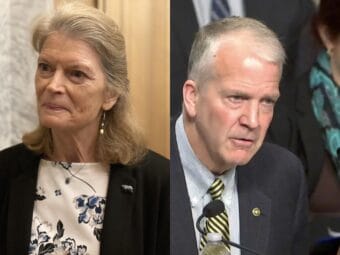
For U.S. Sen. Lisa Murkowski, Peltola’s candidacy presents a dilemma. They’re both moderates, and Murkowski endorsed Peltola in the past, despite their party differences. The senator declined to pick a side when a reporter asked before Christmas. But Thursday Murkowski said she’d made a decision: She’s endorsing her Republican colleague.

“We’ve had a pretty solid team here in the Senate for the past 12 years, so we want to figure out how we’re going to keep in the majority,” she said. “And Dan delivers that.”

Both sides are expected to pour tens of millions of dollars into the race.

Sullivan’s last race in 2020 was one of the most expensive elections in state history, with spending by the campaigns and outside groups totaling more than $57 million.

Sullivan was outspent but beat independent candidate Al Gross by a substantial margin.

Peltola lost her House seat to Republican Nick Begich. After ranked ballots were tallied in 2024, she had almost 49% of the vote to his 51%. (The rankings had little impact on the final result in that race. Before voters’ second- and third- choices were counted, Begich’s lead was slightly smaller.)

Sullivan and Peltola will face off first in a nonpartisan primary in August. The top four candidates will advance to a ranked-choice ballot in November.

Alaska’s Rep. Nick Begich votes against 3-year extension of federal health care subsidies

Rep. Nick Begich, R-Alaska, speaks during the commissioning ceremony for the Coast Guard icebreaker Storis on Sunday, Aug. 10, 2025, in Juneau, Alaska.
Rep. Nick Begich, R-Alaska, speaks during the commissioning ceremony for the Coast Guard icebreaker Storis on Sunday, Aug. 10, 2025, in Juneau, Alaska. (James Brooks/Alaska Beacon)

The U.S. House of Representatives voted 230-196 on Thursday to extend Affordable Care Act subsidies for three years and reverse massive cost increases that went into effect with the new year.

The reversal must still be approved by the U.S. Senate and President Donald Trump before becoming effective.

Alaska’s lone member of the House, Republican Rep. Nick Begich III, voted against the extension, as did 195 other Republicans.

Seventeen Republicans voted for the extension of subsidies that were enacted during the COVID-19 pandemic emergency, joining all of the chamber’s Democrats.

The House’s Republican leaders opposed the extension, but a handful of Republicans signed a petition in December to force a vote.

Begich did not sign that petition, and on Wednesday, he joined other Republicans in an unsuccessful procedural vote intended to block Thursday’s decision.

In a written statement explaining his vote on Thursday, Begich said extending subsidies would not fix the problems he sees with the Affordable Care Act, commonly known as Obamacare. “The health insurance system created by Democrats under Obamacare has proven completely unaffordable for the American healthcare customer,” the statement said. “An extension of Obamacare COVID subsidies does not fix what is broken.”

He said he would like to see reforms to the Affordable Care Act, without which he said the extension “has no credible pathway forward in the Senate.”

In December, Begich voted in favor of a Republican-proposed alternative to the extension. That alternative, which focuses on drug costs, would not stop or reverse the new cost increases and has thus far been rejected by the Senate.

The Congressional Budget Office reported that the alternative would reduce health insurance premiums for insured Americans but would also reduce the number of Americans who are insured.

“I remain committed to working on reforms that lower costs, expand access, and improve outcomes for all Americans,” Begich said in his statement. “Temporary extensions without meaningful reform are not the solution. Real reform that puts patients first is.”

In December, Alaska’s two U.S. Senators, Lisa Murkowski and Dan Sullivan — both Republicans — joined Senate Democrats in an unsuccessful attempt to advance a condition-free extension similar to the one passed by the House on Thursday.

That was a change in position for Sullivan, who had previously opposed extensions that were not coupled with changes to the Affordable Care Act.

Begich and Sullivan are each up for election this fall. Sullivan does not have a Democratic Party-backed opponent yet, but former U.S. House Rep. Mary Peltola is widely expected to enter the race this month.

Begich is being opposed by Anchorage pastor Matt Schultz. Alaska Democratic Party Chair Eric Croft said by email that Thursday’s vote will be a campaign issue in the fall.

“After allowing lifesaving ACA tax credits to expire on December 31, Nick Begich doubled down on his betrayal of Alaska families and blocked the extension of these credits,” he wrote. “We cannot afford these health care price hikes, and we won’t forget about Nick Begich’s betrayal this November.”

Public comment period for proposed Cascade Point Ferry Terminal closes Friday

An aerial view of Berners Bay, where the state is proposing to build the Cascade Point Ferry Terminal. (Photo by Alix Soliman/KTOO)

The public comment period for phase 1 of the controversial Cascade Point Ferry Terminal in Juneau closes tomorrow, Jan. 9. 

The state’s proposed ferry terminal would be located about 30 miles north of the Auke Bay ferry terminal, on land owned by Goldbelt Incorporated, an Alaska Native Corporation. The project is slated to cost tens of millions of dollars.

Phase 1 of the project involves site preparation. The Alaska Department of Transportation already approved a $28.5 million contract for phase 1 construction to begin this summer. In December, the state signed a $1.3 million contract with Juneau Hydropower for equipment to electrify the proposed dock. 

The state has been pushing for the new terminal for several years, saying it would benefit travelers by reducing operating costs and travel time between Juneau, Haines and Skagway. 

The project stands to benefit the proposed New Amalga gold mine in Juneau, which would be established near the face of Herbert Glacier. In a press release last month, the Canadian company that proposed the mine, Grande Portage Resources, announced that it is working with Goldbelt to design an ore barge dock alongside Cascade Point.

Leaders in Skagway and Haines oppose the project. Members of the Alaska Marine Highway Operations Board have questioned the motives behind it. Some organizations, like the Southeast Alaska Conservation Council, have called it a bad idea when the money could be spent on improving the ferry system for riders. The Juneau Assembly hasn’t taken a stance on it.

The state’s comment period was initially set to end on Nov. 28 but was extended through Jan. 9. Comments can be submitted via email to gjc@mlfaalaska.com or through DOT’s Cascade Point webpage form.   

The state plans to open another comment period for phase 2 of the project, which will involve construction of the ferry terminal itself. 

Site notifications
Update notification options
Subscribe to notifications