Alcohol & Substance Abuse

Should the state subsidize a beer festival?

Nationwide, craft brewing is on the rise, and Alaska is no exception: 3,947,554 gallons of beer were brewed in state in 2015.

On Saturday, downtown Anchorage hosted the first ever tasting festival made up exclusively of small brewing and distilling companies based in Alaska. The small industry is thriving for a variety of reasons, including a recent appropriation through the state’s Department of Commerce, Community, and Economic Development.

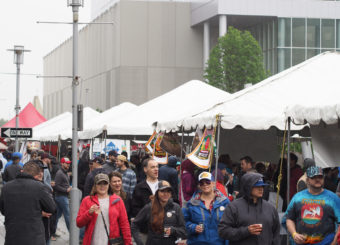
Alaska Crafted festival 2016 Anchorage
Local brewers served beer from tents at the Alaska Crafted festival on May 21 in Anchorage. (Photo by Zachariah Hughes/Alaska Public Media)

But taxpayer-funded support for the burgeoning alcohol sector doesn’t sit well with everyone.

It was gray and drizzling on a fenced-in section of F Street as a few hundred people roamed from tent to tent filling small tasting glasses with beer, part of the Alaska Crafted festival.

“Besides the weather it’s been good,” laughed Brian Swanson, one of the three owners of Odd Man Rush. The brew-pub opened last September in Eagle River, where Swanson grew up.

Like a lot of brewers, Swanson started off making beer as a side project. Now, he describes it as a “hobby on steroids.”

“It’s a scary thing to invest your own time and money,” Swanson said of the decision to make brewing his occupation.

“Your families have to embrace it,” he went on. “It’s just been kind of humbling to see it happen.”

It’s not an easy line of work. Starting a brewing business combines the low-profit financial risk of a restaurant with the labyrinth of state and local regulations governing alcohol licensing. Which makes it puzzling why local breweries continue opening and expanding across the state, up and down the Railbelt, all the way to Hoonah and other Southeast communities off the road system. The exception is western Alaska, where transport and energy costs are high, and the majority of communities are damp or dry.

Locally made beer is moving from a novelty to an economic fixture in Alaska. There are 1,436 full-time jobs connected to brewing, which doesn’t include the handful of companies distilling hard alcohol. A recent report by Southeast Strategies estimates the industry has a direct impact of $83,975,524 in Alaska, although only 25 percent of that is retained in state, due in part to brewers having to import key ingredients like hops and glass bottles from the Lower 48.

One reason these figures exist is because as an industry, independent craft brewing has matured to the point of hiring a lobbyist.

Ryan Makinster is the executive director of Brewers Guild of Alaska. Though in the past he served as a legislative staffer in Juneau, Makinster’s current job with the Brewers Guild involves providing expertise to new businesses and ensuring the small industry has a voice in regulations and policymaking.

He sees the festival as a big deal because it’s the first time a major beer and spirits tasting is made up solely of Alaska suppliers.

“The lift on creating something like this is pretty time intensive, and actually there’s a cost involved in it,” Makinster said during an interview a few days before the event.

Support for the festival came in a lot of different forms, like donated goods and volunteer hours.

But it also came from a $200,000 appropriation from the state to organize and pay for the festival’s upfront expenses.

“It’s basically their event currently,” Makinster said, “We’re just participants in it and sponsors.”

Because most brewing businesses are small without much spare capital or capacity, the state’s forward funding of the festival was crucial, according to Makinster.

“It’s gotten us to this point,” he said. “I don’t think we could have done this without the state support.”

The money is a piece of a $1.77 million economic assistance program approved by lawmakers for fiscal year 2013. According to a capital project summary, the appropriation’s aim is long-term economic growth by promoting industries like “minerals, forest products and transportation logistics.”

Craft brewing is one of the state’s few growing manufacturing sectors, and a rare bright spot in Alaska’s current economy.

“It’s something that uses local materials, adds value, and then is something that we can actually export out of Alaska,” explained Gretchen Fauske, business development officer for the state’s Division of Economic Development, the state entity involved in the festival.

The division sees the festival as an attempt to cultivate an export market by raising the profile of Alaska’s brewers and distillers. To do that, they signed a contract with marketing firm Brilliant Media Strategies to handle the event’s logistics, promotion and public relations.

The contract lays out that the “cost of the event is to be refunded with ticket sales,” which at $75 a piece works out to 2,667 in ticket sales. Exact receipts were still being counted, Fauske wrote in a midweek email.

Part of the promotional work spelled out in the contract was local advertising. Another piece was fostering recognition beyond Alaska, which included a press tour arranged for five freelance writers and bloggers over the weekend, valued at $30,000.

“I think national attention to the event would be a huge success for us,” Fauske said in an interview ahead of the event. “We want people outside of Alaska to know about the products that are being made here. One, because they are such high quality. And two, because it can ease our way into those markets and attract people to visit Alaska and taste the products for themselves.”

But not everyone thinks it’s a worthwhile investment.

“I don’t see why the state would want to forward fund a festival built around consumption of alcohol,” said Jeff Jessee, CEO of the Alaska Mental Health Trust Authority, which combats substance abuse across the state.

Sitting in his office, Jessee said that while it’s fine for the industry to host a celebration and try to expand its reach, he doesn’t believe a street festival with live bands, a cocktail contest and 40 drink tickets per attendee does much to cultivate an export market. Nor does he think the state has any business contributing funds toward alcohol, which cost taxpayers $42 million in just prevention and treatment services across Alaska last year.

“It’s not a moral dilemma, it’s a public health, public safety and budgetary problem,” Jessee said.

In years to come, the Alaska Crafted festival is expected to be paid for solely by the brewers and distillers guilds.

The Division of Economic Development’s full contract with Brilliant Media Strategies is worth $375,000, which includes services unrelated to the Alaska Crafted festival. The full value of the contract with renewal options is $1,125,000 through 2019.

States Require Opioid Prescribers to Check for ‘Doctor Shopping’

Pharmacist Sarah Burke checks a prescription drug database in Columbus, Ohio, to see whether the patient may be taking any controlled substances. Ohio is one of 16 states that have recently required physicians and other prescribers to run the same type of query before prescribing opioid pain medications. AP

For more than a decade, doctors, dentists and nurse practitioners have liberally prescribed opioid painkillers despite mounting evidence that people were becoming addicted and overdosing on the powerful pain medications.

Now, in the face of a drug overdose epidemic that killed more than 28,000 people in 2014, a handful of states are insisting that health professionals do a little research before they write another prescription for highly addictive drugs like Percocet, Vicodin and OxyContin.

“We in the health care profession had a lot of years to police ourselves and clean this up, and we didn’t do it,” Kentucky physician Greg Jones, an anti-addiction specialist, said in an online training course he gives doctors in his state. “So the public got fed up with people dying from prescription drug abuse and they got together and they passed some laws and put some rules in place.”

By tapping into a database of opioid painkillers and other federally controlled substances dispensed in the state, physicians can check patients’ opioid medication history, as well as their use of other combinations of potentially harmful drugs, such as sedatives and muscle relaxants, to determine whether they are at risk of addiction or overdose death.

Prescribers also can determine whether patients are already receiving painkillers or other controlled substances from other sources, a practice known as doctor shopping. Patients with this type of history are at high risk for addiction and overdose and may be selling drugs illicitly.

In 2012, Kentucky became the first state to require doctors and other prescribers to search patients’ prescription drug histories on an electronic database called a prescription drug monitoring program (PDMP) before prescribing opioid painkillers, sedatives or other potentially harmful and addictive drugs.

Sixteen states have enacted similar laws, and experts, including the U.S. Centers for Disease Control and Prevention and the White House Office of National Drug Control Policy, are encouraging other states to do the same thing.

Maryland Gov. Larry Hogan, a Republican, signed a law in April that requires certain prescribers to use the state’s monitoring system, and a similar bill is moving through the Legislature in California.

States Require Opioid Prescribers to Check for 'Doctor Shopping'Prescribers can be required to check PDMP databases in 29 states, depending on conditions that vary from state to state, according to the National Alliance for Model State Drug Laws.

Although the American Medical Association supports physician use of drug tracking systems to identify potential addiction and drug diversion to the black market, state medical societies have argued against mandatory requirements they say interfere with the practice of medicine. Patients’ privacy and legitimate pain needs, they say, could be jeopardized by requiring busy physicians to investigate potential patient abuse of pain medications.

Despite these objections from some in the medical profession, more states are imposing the requirements. “Comprehensive mandates are the single most effective thing states have done to curb opioid prescribing, and it seems to have an almost instantaneous effect,” said John Eadie, who has evaluated state programs at Brandeis University’s Prescription Drug Monitoring Program Center of Excellence in Massachusetts.

In states where physicians are required to use monitoring systems, overall opioid prescribing has plummeted, as have drug-related hospitalizations and overdose deaths, Eadie said. States also are seeing a rise in addiction treatment as more doctors refer patients to treatment after discovering they are taking painkillers from multiple sources and are likely addicted to them.

In Kentucky, hydrocodone (Vicodin) prescribing dropped 13 percent, oxycodone (Percocet) dropped 12 percent, oxymorphone (Opana) dropped 36 percent and tramadol (Ultram) dropped 12 percent between 2012 and 2013, the first year the law was implemented, according to an analysis by the University of Kentucky’s College of Pharmacy.

Since the law was passed, overdose hospitalizations declined 26 percent, and prescription opioid deaths dropped 25 percent, the first reduction in nearly a decade, according to a March 2016 report by Shatterproof, a national advocacy organization that promotes prevention and treatment of drug addiction.

In another effort to stem overprescribing of opioid painkillers, which is widely blamed for the current epidemic, the CDC in March took the unprecedented step of issuing national opioid prescribing guidelines. Along with patient education, urine drug testing, and abuse-deterrent formulations of pain pills, the federal agency recommended prescribers check prescription databases before prescribing to reduce the risk of opioid overdose and addiction.

Vastly Underused

Prescription drug monitoring systems have existed in paper form since the 1930s, and every state except Missouri has some type of system. But the rules governing who has access, how quickly pharmacies must enter dispensing data, and which medications are included vary widely from state to state.

(The creation of a prescription drug monitoring system in Missouri has been blocked by a small group of legislators, led by state Sen. Rob Schaaf, a Republican and a doctor, who argue that allowing the government to keep prescription records violates patient privacy rights. In March, the opioid-plagued county of St. Louis adopted an ordinance to create a monitoring system, and advocates and some lawmakers continue to press for a statewide program.)

In general, state databases have been used effectively by law enforcement to track down so-called pill mills, where doctors indiscriminately prescribe opioid medications for cash. And a substantial number of pharmacists have consulted them before filling a prescription. But a relatively small percentage of medical professionals are signing on to the systems to detect patients who are at risk for addiction or overdose.

In most states, health care professionals who prescribe at least one controlled medication are encouraged to use PDMPs, but only on a voluntary basis. As a result, the typical state program in 2012 had only 35 percent of doctors signed up for access, according to the center at Brandeis. In 2014, 53 percent of doctors were signed up to one of the programs, according to a survey by Lainie Rutkow, an associate professor of public health at Johns Hopkins.

Most states require prescribers to obtain access to PDMPs and use them at their discretion when they suspect a patient is at high risk for addiction, drug diversion or overdose, according to the National Alliance for Model State Drug Laws.

The problem with that, said Van Ingram, Kentucky’s director of drug control policy, is “people think doctors can just look at a patient and recognize this disease of addiction, and it’s not that simple.”

“People with addictions can fool their spouses, their children and their employers. They can definitely conceal the disease from their physician in a 15-minute visit.”

A Diagnostic Tool

In Kentucky, doctors and some patients complained about the requirement when it was first adopted, Ingram said. But these days, he said, he mostly hears doctors saying, “Wow, I treated that patient for 20 years and had no idea he had a drug problem.

“If there’s a tool out there that takes 15 seconds to use and can diagnose a disease, why wouldn’t you want to use it? To me it’s a no brainer,” Ingram said.

Before Kentucky physicians were required to check the database, patients commonly visited multiple doctors to get prescriptions for opioid painkillers, the sedative Xanax, and the muscle relaxant Soma, according to the state’s PDMP director, David Hopkins. “The cocktail,” as it’s known in Kentucky, produces a high that is similar to heroin and just as deadly. It has become much less prevalent since the law was enacted.

“We cracked down on that big time,” Hopkins said. The number of people receiving the cocktail has dropped 30 percent since the law took effect and the number of doctor shoppers has dropped 52 percent, he said.

Kentucky is also trying to curtail dangerously high doses of prescribed painkillers by flagging the database when a patient is taking medications from multiple sources that add up to the equivalent of 100 milligrams or more of morphine per day. Last year, a calculator was added to the system so doctors wouldn’t have to add up the morphine equivalents on their own.

Hopkins said the state listened to doctors’ complaints and added some commonsense exceptions after the initial rules came out. Prescribers are no longer required to check the database in emergencies or for patients in hospice, long-term care or cancer treatment. They can also skip the step if a patient was originally prescribed a pain medication by a fellow doctor in their practice and needs a refill or a different pain medicine.

Kentucky’s prescriber rules, which were developed by the state Board of Medical Licensure, allow doctors to appoint a delegate to access the drug monitoring system and review patients’ drug profiles. Doctors typically ask their assistants to run prescription drug histories on all the patients they will see the next day and add the information to their electronic medical records, said Michael Rodman, director of Kentucky’s licensure board.

If a potential drug problem is detected, prescribers can query the database to determine how other physicians in the state are addressing the pain needs of similar patients and they can discuss an individual patient’s drug history with another prescriber, something that was forbidden under previous state privacy laws.

Another part of Kentucky’s 2012 opioid law requires prescribers to attend a certain number of free training sessions each year on addiction, pain management and use of the state’s prescription monitoring system. (Jones conducts some of those training programs.)

To increase the effectiveness of drug monitoring programs, Kentucky and other states use reciprocal agreements to allow interstate sharing of drug dispensing information for pharmacists, law enforcement and physicians in nearby states. Kentucky has agreements with at least 20 other states. New Jersey Gov. Chris Christie, a Republican, announced in April that New York had joined his state in sharing PDMP information, along with Connecticut, Delaware, Minnesota, Rhode Island, South Carolina and Virginia.

As for what happens when a physician discovers a patient is doctor shopping, Rodman said, they often dismiss patients and no longer treat them.

But Jones, who heads the Kentucky Physicians Health Foundation, which supports doctors who suffer from substance use disorders, tells doctors not to do that to patients.

“Maybe you don’t keep prescribing them 90 OxyContins with five refills,” he said, “but don’t throw them out. If you do, you’re missing an important opportunity to save a life.”


Dillingham woman charged with forging checks, stealing $3,540 from grandmother

A man fills out a deposit slip at the bank.
Dillingham police say elders are increasingly at risk for theft by drug users. (Creative Commons photo by David Goehring)

A Dillingham woman has been charged with forging her grandmother’s checks, stealing some $3,500 over a two month period. Police believe this is another example of the elderly being ripped off for drug money.

According to DPD, Brianna M. Brandon, 26, took 16 checks and wrote them out for different amounts and occasionally to different people.

The branch manager at Wells Fargo became suspicious by the behavior of those cashing the checks and called the account owner Mrs. Mable Brandon to ask about those payments. According to police, the elder Brandon said she had not written those checks or given her granddaughter any money. She then notified police, and told them she had recently kicked her granddaughter’s boyfriend out of the house for his drug use, and suspected Brianna had gone with him and taken the check book.

Questioned at the station, police say Brianna Brandon admitted to forging all of the checks and stealing from her grandmother. She’s facing 17 felony charges: 16 for forgery and one for theft.

Last week police charged two women with scamming an elderly man out of close to a $1000 after they claimed to be his new fuel distributor.

Police believe there is a pattern of elders being scammed or stolen from to support expensive drug habits, which can cost a user $100 a day or more to sustain.

Bethel alcohol sales spill over into nearby villages

In an Illinois railyard, train cars carrying beers such as Corona and Pacifico are at risk of spoiling their cargo if freezing temperatures take hold. Scott Olson/Getty Images
Bethel recently made alcohol sales legal after nearly 40 years of prohibition. Scott Olson/Getty Images

Kuskokwim villages say they’re feeling the effects of Bethel’s new liquor store. The shop opened last week in the Kuskokwim’s hub after decades of banned sales.

In Akiak, Tribal Police Officer Cynthia Ivan has been keeping a call log to compare how alcohol sales in Bethel have increased the amount of emergency calls in her village.
“Assault four domestic violence, I got four of those, suicide threats, public intoxication, and intoxicated children,” Ivan said.

Ivan has been keeping the log for weeks and says the number of calls she received this week has been “insane.”

She says keeping alcohol out has shifted from difficult to impossible. And bootlegging has spiked among people who didn’t do it before.

“And only because the liquor store was open, and it was right there in front of her. It was available. It’s cheap. She bought it; she brought it back to the village; and she sold it,” Ivan said about a woman she recently caught reselling large amounts of alcohol purchased Bethel.

In Napaskiak, a 20-minute boat ride downriver from Bethel, the people are also feeling the impacts of Bethel’s legal alcohol sales.

“It’s been a very rough week since the liquor store opened,” said Brenda Carmichael, Napaskiak Mayor, who says she’s seeing an unusually high amount of inebriated people in the street this week.

Napaskiak is a dry village, like most of the villages immediately surrounding Bethel. But Carmichael says now that Bethel has a liquor store, so does Napasiak.

Carmichael’s main concern is that her city’s small police force won’t be able to handle the crime caused by increased intoxication.

“I’d be surprised if they lasted any longer,” the Mayor said.

Pete Suskuk, Kwethluk Tribal Police Chief, shares this concern.

“We usually have jail guards, and right now we don’t have any jail guards because of budget cuts,” Suskuk said. He says that the department was managing before alcohol sales started but now it’s having trouble.

“Now the officer is going to have sit here all night long until someone is able to come in and relieve him or her and will have to stay in the building. We can’t leave the building, even though we got another call,” Suskuk said.

This means that if they get a domestic violence call or hear of gunshots being fired their lack of staff will leave it unanswered.

All of these officials say they’ve failed to prevent the booze coming into their communities. As for how to fix the problem, none of them has been able to come up with a plan to keep their dry towns from getting soaked.

Synthetic Drugs Send States Scrambling

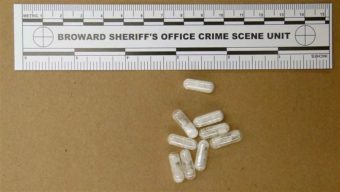
Vials of a confiscated synthetic amphetamine called flakka that killed 61 people in Broward County in a little more than a year. States have been reworking drug laws to make it easier to classify synthetic drugs as illegal. AP

It’s been four months since anyone in Broward County, Florida, has died from an overdose of alpha-PVP, known as flakka, a crystal-like synthetic drug meant to imitate cocaine or methamphetamine. But the drug has already taken a deadly toll, and left health and law enforcement officials scrambling to stem a new public health crisis.

In small doses, flakka elicits euphoria. But just a little too much sends body temperatures rocketing to 105 degrees, causing a sense of delirium that often leads users to strip down and flee from paranoid hallucinations as their innards, quite literally, melt. If someone survives an overdose, they are often left with kidney failure and a life of dialysis.

Flakka is among a growing number of addictive and dangerous synthetic drugs being produced easily and cheaply with man-made chemicals in clandestine labs in China. But because the drugs were largely unregulated when they first hit the market, some states have struggled to combat them. Now legislators, health professionals and police are trying to eradicate the drugs by making it easier to qualify them as illegal and ramping up the criminal penalties for selling them.

Since 2010, when synthetic drugs started becoming popular in the U.S., 32 states have passed laws to make it easier to classify synthetic drugs as illegal. This year, the District of Columbia and Florida passed similar measures, and in at least 10 other states, changes to controlled substance laws took effect, according to the National Alliance for Model State Drug Laws (NAMSDL).

Among the most popular synthetic drugs in the U.S. are synthetic cathinones, known commonly as bath salts, and synthetic cannabinoids, essentially smokable imitation marijuana products, which are sold in stores using kid-friendly branding like Scooby Snax.

It had been difficult for states to classify synthetic drugs as illegal, a process known as scheduling, because drugs are typically banned based on the compounds they contain. Under that system, manufacturers can change a molecule of an illegal synthetic drug, essentially rendering it legal.

“It does seem to some extent that everybody’s a step behind what’s being produced,” said Jonathan Woodruff, an attorney with NAMSDL.

While the federal Drug Enforcement Administration is working to permanently add 10 synthetic cathinones, including alpha-PVP, to its list of scheduled drugs, some states have also been moving to modify how they schedule drugs.

This year, Florida and the District of Columbia enacted laws that change the way they schedule synthetic drugs. Rather than making the drugs unlawful based on their chemical makeup, the new laws classify drugs based on the type of drug and the reaction it causes.

The approach means that any drug that mimics an already illicit substance will automatically be illegal. The change will enable Florida to quickly prosecute drug cases and stomp outbreaks of new drugs, said James Hall, an epidemiologist with Nova Southeastern University.

“It bans substances before they appear or before we even know about them,” Hall said. “So it breaks this vicious cycle of a new drug appearing, finally getting it scheduled or banned and then another one rushing in to takes its place.”

These laws alone won’t stop the spread of synthetic drugs. But public health advocates are hopeful the Florida law will help prevent another flakka, from which 61 people in Broward County died between September 2014 and mid-December 2015.

In the District of Columbia, where in September 603 people were taken to the hospital after ingesting synthetic cannabinoids, the new law, which went into effect this month, is also expected to make it easier for police and prosecutors to charge and convict drug dealers.

Chasing Synthetics

In DeKalb, Illinois, one of the first places to adopt a similar law in 2012, City Attorney Dean Frieders said flakka and other synthetic cathinones like bath salts haven’t taken hold there. (A statewide law in the same vein was passed in 2015.)

But the city of almost 44,000 people, which is home to Northern Illinois University, did face a growing problem with retail sales of synthetic marijuana products, which are said to elevate mood and relax the user but have also been known to cause extreme anxiety, paranoia and hallucinations, as well as rapid heart rate, vomiting and violent behavior.

The ordinance not only banned the synthetic substances, but allowed city officials to suspend or revoke the tobacco and liquor licenses of businesses that sold the drugs, which Frieders said was effective.

“A business just can’t relocate to a different corner,” he said.

States are also sanctioning businesses for the sale of synthetic drugs to cut down on sales and adverse health reactions, Woodruff said.

The District of Columbia has shut down four stores that sold the fake marijuana products, which has led to a substantial decline in people needing medical attention after injecting them, said Robert Marcus, communications director for the District attorney general. The number of people transported to hospitals in the city after consuming synthetic marijuana dropped to 110 in February, down 82 percent in five months.

What’s Next?

Broward County officials say they expect the new scheduling of synthetic drugs to be helpful, but they relied on a different approach to largely eliminate flakka: working with the DEA to pressure the Chinese government, which last fall made it illegal to produce it and 115 other synthetic substances.

Heather Davidson, a prevention specialist for the United Way in Broward County, said officials in South Florida are at a “resting point” with flakka-related emergencies. But, she said, some dealers are passing off real methamphetamine and cocaine as the synthetic drug, even though those drugs are more expensive and have been around longer, because flakka has become so popular.

Broward’s flakka problem came to a head last year when county hospitals saw 360 cases related to the drug in one month. By December that number had dropped to 54, an 85 percent drop in five months.

“We still hear anecdotally that people are searching for flakka, that users are still wanting to find it,” Davidson said. “And I believe that another synthetic drug or synthetic compound will take its place.”

One of those compounds might be synthetic opioids, which are gaining popularity as it becomes more difficult to get prescription opioids like oxycodone and morphine in the wake of the nation’s painkiller- and heroin-addiction crisis. Those drugs, largely produced in Mexican labs, are made with fentanyl, a synthetic drug that is a hundred times more powerful than morphine and 50 times stronger than heroin. Davidson and others worry they will be behind the next epidemic.

Already nine people have died from fentanyl-based drugs this year in Pinellas County, Florida.

“Heroin you need to cultivate. You need fields, you need workers, you need labor,” Davidson said. “With something like a synthetic drug, you just need a laboratory and chemical compound and a base and you’re able to create it very cheaply.”

Read original article
Synthetic Drugs Send States Scrambling

Senate sends crime bill to Gov. Walker’s desk

John Coghill State of the State response
Sen. John Coghill, R-North Pole, speaks in January. (Photo by Skip Gray/360 Nort

The Senate voted 14 -5 Friday to approve a sweeping overhaul of Alaska’s criminal justice system. The action sends the bill to Gov. Bill Walker’s desk.

Senate Bill 91 would allow some low-risk nonviolent offenders to avoid jail time. It also would establish a new pretrial services program with a goal of reducing recidivism. And it would allow those in treatment programs to receive credit for time served instead of imprisonment.

Bill sponsor Sen. John Coghill, R-North Pole, said the bill was driven by a consensus among members of the Alaska Criminal Justice Commission. He also said it draws on social science research. And Coghill said legislators will continue to make changes to the system.

Walker says he’s eager to review the bill.

Site notifications
Update notification options
Subscribe to notifications