House members will debate Monday whether to overhaul the state’s criminal sentencing laws. Supporters say the legislation will lower the risk of offenders returning to crime, but others are concerned that the bill goes too far in reducing penalties.
Senate Bill 91 is one of the most hotly debated bills of the session. It would allow law enforcement officers to cite low level, nonviolent offenders instead of arresting them. It also would focus prison beds on more serious and violent offenders and create a re-entry program within the Department of Corrections. But the House Finance Committee scaled back some of these changes. Committee members cited concerns from some victims’ rights advocates, who say the bill isn’t tough enough on offenders.
Sen. John Coghill, R-North Pole, in March. (Photo by Skip Gray/360 North)
Bill sponsor Sen. John Coghill, R-North Pole, said he remains hopeful the bill will become law. He emphasized the benefits of a pretrial program that would divert low-risk prisoners away from jail.
“We’re going to do risk-based assessments for the first time ever in pretrial. It’s still there,” after the committee changes, he said. “We’re going to allow them (to enter) diversion to programs for the first time ever, the way we’re doing it under a risk-based system.”
Coghill based the original bill on the recommendations of the Alaska Criminal Justice Commission. For example, the commission recommended raising the value of items that are stolen that require criminal charges, from $750 to $2,000. The House Finance Committee settled on raising the limit to $1,000.
But Finance Committee co-chairman Rep. Mark Neuman, R-Big Lake, was troubled by the possibility of letting thieves go because they stole less than $1,000 of valuables.
“It seems to me like we’re trying to make it so … a crook has a lighter sentence or gets off easier here, because of inflation. And I don’t like that,” Neuman said. “A crook is a crook.”
Alaska Public Defender Quinlan Steiner said that while the amended House and Senate bills would save less than the original legislation, the effects would still be positive.
“The bill, as I see it, will likely still result in significant savings that can be used to reinvest in programs that will reduce recidivism,” Steiner said.
Coghill said his original bill would have cut the state’s prison population by 21 percent, saving more than $400 million a year. He said the House Finance Committee substitute would reduce the prison population by roughly 8 to 10 percent.
The House is scheduled to debate and potentially vote on whether to pass or amend the measure on Monday. Coghill said he expects a debate over whether to require jail time for lower-level crimes. Another debate will likely focus on how much credit people in pretrial programs should receive, to reduce jail time.
Coghill said he welcomes the legislative debate over the bill.
“It just goes to show that when we’re making law, it gets down to specifics, and it’s not consensus-driven – it’s vote-driven,” he said.
The crime bill is the most significant bill left on the legislature’s agenda that’s not primarily focused on the budget.
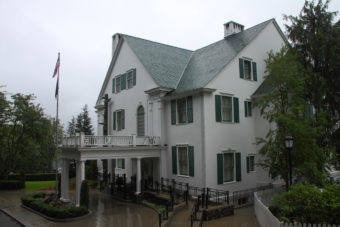
The Alaska Governor’s Mansion, Aug. 16, 2009. (Creative Commons photo by ~dgies)
Juneau police arrested a man late Thursday night for driving while intoxicated after finding him and a dog in a vehicle stuck in construction fencing at the Capitol.
The Juneau Police Department described what happened in a press release.
“Officers responded and arrested 49-year-old Alexander Oliphant of Juneau for driving while intoxicated. He was also later charged with refusal to take a breath test. A dog that was in the vehicle was not injured in the collision and was turned over to animal control.”
Police say that Oliphant “volunteered” that he had run into the Governor’s Mansion, as well. Video surveillance showed a car ramming the garage door, which was damaged.
The investigation is ongoing and additional charges are pending.
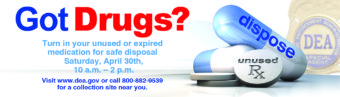
A promotional image the DEA distributed for its prescription drug roundup.
On Saturday, the Drug Enforcement Agency is holding a national drive to collect unused and unwanted prescription drugs, but no one in Juneau appears to be participating.
The DEA lists 15 locations across the state from Aniak to Anchorage participating, but none here. The local partners on the list are mostly law enforcement agencies and Fred Meyer stores. The Alaska State Troopers, Bartlett Regional Hospital and the Juneau office of the National Council on Alcoholism and Drug Dependency said Thursday they are not planning local events.
The prescription drug drop box is located in the lobby of the Juneau Police Department. Prescription medication is welcome. Needles and liquids are not. (Photo by Elizabeth Jenkins/KTOO)
Since the DEA began the initiative in 2010, it’s collected more than 5.5 million pounds of drugs. The events are intended to combat prescription drug abuse, and to prevent improperly disposed drugs from polluting waterways and drinking water supplies.
Amy Skilbred is the executive director of the Juneau Community Foundation. (Photo by Jeremy Hsieh/KTOO)
The Juneau Community Foundation announced Tuesday about $1.9 million in grants to local organizations, much of which will go to programs addressing homelessness, substance abuse and suicide prevention.
I sat down with foundation Executive Director Amy Skilbred and board member Reed Stoops, who heads the grants committee, and recorded this interview Wednesday. It’s been edited for length and clarity.
Here are some highlights:
Housing programs received the most grant money, followed by substance abuse programs.
New programs being funded include the Housing First development that is slated to break ground next month, a substance abuse navigator in the local office of the National Council on Alcoholism and Drug Dependence, and transitional housing through Gastineau Human Services.
The foundation’s community giving has ramped up about 16 fold since it began in 2008. This year’s grants are funded by a combination of the Hope Endowment Fund and community development block grants the City & Borough of Juneau entrusted the foundation with distributing.
The foundation’s Hope Endowment Fund will spin off about $1 million a year in grants. That endowment was created in 2014, the year Bill Corbus sold AEL&P and donated a huge share of the proceeds to the foundation.
This is the full list of the grantees and their projects.
Editor’s note: The Juneau Community Foundation maintains the KTOO Legacy Foundation fund.
Sen. Pete Micciche sponsored the bill that would remove misdemeanors from underage alcohol consumers. (Photo by Skip Gray/360 North)
Underage children caught drinking alcohol won’t rack up a permanent charge on their record under a bill that passed the legislature last week.
Imagine a high school party. All the children are underage — some are drinking. When police bust the party, they issue citations- even to children who haven’t had a drop of alcohol.
In Alaska, 75 percent of alcohol related charges are for minors consuming alcohol. That makes it the No. 1 alcohol charge statewide — affecting about 3,000 young people each year.
Sen. Peter Micciche, R-Soldotna, sponsored Senate Bill 165. He says the punishment can stay with children forever.
“What we were doing before is a misdemeanor criminal offense that went on court view and compromised not only their success throughout the rest of high school, but when it became time for scholarships or applying for a job even after coming back from the university. They essentially had a life-long record.”
According to The Justice Center at the University of Alaska Anchorage, the majority of those charged are convicted.
Under the new bill, instead of a misdemeanor charge, those under the age of 21 caught drinking will face a $500 fine that could be reduced if they complete an alcohol safety action course.
Zara Smelcer runs the Anchorage Juvenile Alcohol Safety Program and works closely with children charged with MCA’s.
She thinks the change is important, but wishes the legislation had gone a step further
“I feel like the educational component being mandatory is actually more important than any fine being paid directly to the court. Because they’re getting the education and treatment to help them make the decision not to do it again until they’re of legal age.”
Before this bill can become law, it must be signed by Gov. Bill Walker
Michelle Pattengill, a technician at L&S Pharmacy in Charleston, Missouri, holds a bottle of oxycodone. (Bram Sable-Smith/Side Effects Public Media/KBIA)
At Richard Logan’s pharmacy in Charleston, Missouri, prescription opioid painkillers are locked away in a cabinet.
Missouri law requires pharmacies to keep schedule II controlled substances — drugs like oxycodone and fentanyl with a high addiction potential — locked up at all times.
Logan goes further than the law requires.
He’s been a pharmacist for 40 years. For the last 20, he has also been a reserve deputy with two local sheriff’s departments, investigating prescription drug abuse. That puts him on edge in his day job.
After his technicians count out a prescription for controlled narcotics by hand, Logan has them place the pills on a machine that resembles an overhead projector lit from the top instead of the bottom.
“There’s a camera up there,” Logan said. “It actually photographs each pill that we dispense.”
When he has probable cause to suspect that a customer is trying to get opioids with a forged or fraudulent prescription, Logan will arrest them on the spot. When he only has a strong hunch and they’re from out-of-state, he’ll escort them out of the pharmacy and direct them to the nearest bridge out of Missouri, about 9 miles away.
These run-ins with drug-seekers make Logan anxious to see the state enact a prescription drug monitoring program. A PDMP would be a statewide database tracking narcotics prescriptions, which doctors and pharmacists can check to catch signs of abuse or addiction and to intervene if necessary.
In the battle against America’s surging opioid drug addiction, 49 states, the District of Columbia and even Guam have all implemented some kind of PMDP. Missouri is the only state that hasn’t. A protracted political battle has kept the state from passing a law to establish one. That leaves pharmacists like Logan with few options.
He can only check the prescription history of patients on Medicaid, which tracks such data. But when a patient pays cash — a red flag for Logan — there is no record to check leaving pharmacists to guess whether the patient is in genuine pain, feeding an addiction or maybe looking for pills to sell.
“We want to take the best care of everybody that we can, and without a PDMP we are absolutely flying blind,” he said.
Restrictions Versus Privacy
State Rep. Holly Rehder, whose district includes Charleston, has championed establishing a database ever since joining the legislature in 2013.
“I’ve been working on this since my feet hit the floor,” she said.
It’s an issue close to her heart. Her cousin died of a drug overdose. Her mother was addicted to prescription medications. Her sister used heroin. And for 13 years, her own daughter has struggled with drug abuse — an addiction that began with a legal prescription for Lorcet.
“I’m very candid about it,” Rehder said. “I don’t believe God gave me a microphone to keep my mouth shut.”
She cites these databases’ success in limiting drug abuse in other states. They make it harder for pill-seekers to “doctor shop,” meaning go from doctor to doctor getting multiple, simultaneous prescriptions for the same drug.
One year after New York required its prescribers to check the state’s PDMP before writing a prescription, for example, doctor shopping dropped by an estimated 75 percent.
Doctors surveyed in many states, including Connecticut and Rhode Island, say prescription drug monitoring programs have helped them identify opioid drug abuse and intervene with patients who need help. Those are reasons the federal government strongly recommends the databases.
For the third straight year, Rehder’s bill has passed the Missouri House and moved on to the Senate. There, each year, it’s been blocked by her main opponent on this issue, Sen. Rob Schaaf, a fellow Republican.
“It’s just the heavy hand of government taking away your liberty,” he said. In 2012, before Rehder joined the legislature, Schaaf led an eight-hour filibuster of PDMP legislation, an act that has loomed over subsequent attempts to pass a similar bill. This year Schaaf has called the bill “dead on arrival.”
The bill is currently in committee where a hearing on it has yet to be scheduled — and it likely won’t be taken up by the full senate before the legislative session ends May 13.
Schaaf is a physician by training. To some, that background makes him a surprising opponent to prescription drug monitoring, which is supported by the Missouri Academy of Family Physicians, the Missouri American College of Physicians and the Missouri State Medical Association, among others.
He argues that drug monitoring may inhibit doctors from prescribing medications that patients really need. His main objection, though, is about privacy.
“The monitoring program would put every citizen’s private drug information on a government database accessible to 30,000 people with usernames and passwords,” he said. “That’s just an outrage.”
Rehder doesn’t buy that argument. The database is electronic medical information, she said, so it would be protected by the same privacy laws protecting all electronic medical records. “It’s not like anyone can go on a phishing expedition in this data.”
“There is no data that is secure,” Schaaf countered, citing hacks against the IRS and the Department of Veteran Affairs, and even Hillary Clinton’s email imbroglio.
Rehder argues that 49 other states have faced these same questions about security and Missouri would be able to follow the best practices they’ve developed.
Schaaf said he isn’t entirely opposed to prescription drug monitoring. He said he would allow Rehder’s bill to pass the Senate if it included a provision that final approval for the database would be put before the voters — a test he doubts the bill could pass.
For the past three years, he has proposed his own monitoring legislation that would limit access to the database to Missouri’s Bureau of Narcotics and Dangerous Drugs, which would then communicate concerns to providers.
Rehder said she can’t support his bill because it would be cumbersome and impractical to implement, and that it’s doctors who should be making decisions with the data.
“Missouri is the only state that doesn’t have this. It’s very shameful,” Rehder said. “It’s hurting our population so much.”
In March, St. Louis County, which has one of the state’s highest drug overdose death rates, passed its own PDMP. Other counties have signaled they would consider doing the same.
Rehder said this is better than nothing, though she prefers a statewide database over a patchwork of county systems.
“We have got to start realizing that this isn’t something we can close our eyes and turn our heads to because it’s not going to affect us. It’s affecting us,” she said. “Our families are being torn apart, lives are being destroyed.”
Twenty miles down the road from Logan’s pharmacy and also in Rehder’s district, 33-year-old Jason Lynch is close to completing a 120-day stay at Mission Missouri, an addiction treatment facility.
Lynch was given his first prescription painkiller by an older student on the school bus when he was just 11 years old.
“I think right from the get-go I was hooked because the next day I was trying to get some extra lunch money to buy some more,” Lynch said.
He’s battled opioid use for 22 years, feeding his addiction with pills prescribed to him by doctors. “I would research [symptoms] on the Internet and say, ‘This is what’s going on with my back.’ ”
Usually, Lynch said, the doctor would write him a prescription.
“It’s nobody’s fault but my own,” Lynch said of his addiction, but, he added, getting the pills “should have been a lot harder.”
“You just think about what if those drugs weren’t so available to him,” Rehder said. “How could his life have been different?”