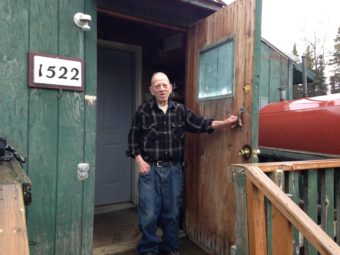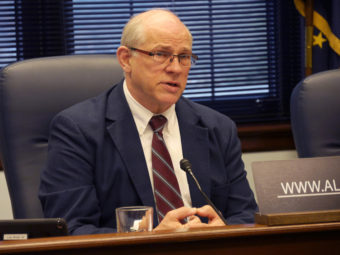
Patrick Durbin, 83, lives alone at a tidy place on Nerka Loop. Police believe he was scammed by three people seeking money to fund drug habits. (Photo by Dave Bendinger/KDLG)
Dillingham police are investigating three cases of elderly residents being robbed or scammed for drug money, and chief Dan Pasquariello believes more have occurred.

“There’s been a pattern recently, and it’s pretty much the same crowd of people, part of what we call the ‘milieu’, that are taking money from elderly people mostly likely to purchase controlled substances,” he said.
The cases involve theft using ATM cards or forged checks, and “flat out scamming” the elderly, said the chief.
“We’ve charged two individuals with theft where they approached an elder man, represented themselves as from a fuel company, and had the elder write them checks,” he said.
Sydnie Dawn Schlosser, 26, and Pearl Lucille Harless Lyle, 22, were charged with one count of third-degree theft each. Police believe John Filipek, 27, was behind the scam, but because he doesn’t have a checking account, the evidence pointed only to his two alleged female accomplices.
The man these three targeted in their alleged fuel selling scam was Patrick Durbin, the retired city harbormaster. Durbin keeps a tidy house on Nerka Loop where he lives alone. Discussing the matter Wednesday evening, he often chuckled about being duped.
“It’s a life lesson,” said the 83-year-old.
Durbin began his story with an incident from three years ago, when he injured himself lifting a heavy stump in the yard. He finally sought medical care in Anchorage, spent three months there, and came home with medication to take.
“So I’m still on medication, and not thinking straight, and I got conned into giving money out, you know? And trouble of it is, I’m sitting there wondering about it, but I still went along with it,” he said, laughing a bit.
When the young adults he didn’t know approached him, they claimed to be his new fuel delivery company and were there to collect payment.
“I specifically asked, I said ‘I got that Delta Western, I’ve had ‘em for years.’ ‘Well, they’re going out of business.’ They specifically said they were going out. ‘We’re taking over,’ direct statement. Well, I said ‘how come they never sent me a notice?’ Little things like that I remember saying. So I questioned it. But somehow in the conversation, they got me talked into it.”
Durbin believes they stole his money three times. Once he gave them cash, and twice he wrote checks for over $300.
“Yeah. Two of ‘em was on the same conversation, one after the other,” he said laughing. “That should’ve been a send-off to me right away, but the way I was thinking, you know.”
He checked his fuel tank regularly and realized no deliveries had been made, and eventually contacted Bristol Alliance Fuels to ask why they hadn’t delivered yet. The company helped Durbin realize he may have been scammed, and he contacted the police and his bank to see what could be done.
Having succeeded a few times, did his scammers try other ways to rob Durbin? He’s not sure, but he laughed as he described coming home one day and interrupting what he does think was a theft of his fuel in progress.
“I think I did, you know, but you’re never for sure about these con games. They can catch me at my very gullible time. I’m only 83, but … what can they give me if I beat ‘em up? Twenty years? So that gives … 103? With room and board? That’s the way I’m looking at things now. Otherwise, I just don’t give a … I’m gonna do what I’m gonna do when things happen. If I can catch it, with my mind. And I’m pretty good, most of the time.”
KDLG has reported other instances of crime tied to drug habits, including last month when several on the front lines of Dillingham’s drug abuse issues discussed the theft and even sex trafficking they see happening. Last year a Dillingham man was convicted of stealing from a dying man who had hired him to work around his house, admitting he needed the money to fund an addiction. And in recent conversations with village leadership in Togiak, including as reported when the tribe banished a Dillingham man from town, they say elders there are being frequently robbed of money and goods to support drug habits.
“There’s always been thefts here,” said DPD’s Pasquariello. “Years ago, when I first started, people stole money to buy alcohol. The thief could get their daily dose of alcohol for, say, $20. If you’re a heroin addict, it’s going to cost you at least $100 a day to get your daily dose of heroin, maybe more.”
Pasquariello said more charges will likely be coming, but he suspects authorities will only see the tip of the iceberg of similar activity. Some elders may never know they’ve been robbed or scammed, and some may be ashamed to admit it or report their relatives.
“We’re talking about it so people can be wary, and perhaps not to be as trusting as they once have been in our small community,” said the chief.
The House voted 28-11 on Thursday to adopt one of the largest overhauls ever to Alaska’s criminal justice system.
It would allow some low-risk nonviolent offenders to avoid jail time. It also would establish a new pretrial services program with a goal of reducing recidivism. And it would allow those in treatment programs to receive credit for time served instead of imprisonment.
Both sides displayed passion over four days of debate on Senate Bill 91. Anchorage Republican Rep. Gabrielle LeDoux said it’s time for a different approach to criminal justice. She noted that nearly two-thirds of inmates re-offend within three years.
“So it’s not helping them and it’s not helping the public, because they’re returning and they’re committing crimes,” LeDoux said. “We’re not getting a good return on our investment.”
But Rep. Charisse Millett, another Anchorage Republican, said the bill should do more to target drug and alcohol abuse. She cited the cases of four local residents who died as a result of substance abuse.
“People decided that they needed to drink, they needed to take drugs, they needed to do all these things … and killed my constituents,” she said.
The bill draws on recommendations from the Alaska Criminal Justice Commission. They include putting in place a new system to assess the risk posed by offenders and allowing low-risk offenders to avoid jail time.
Juneau Republican Cathy Muñoz recalled the example of her friend Mark Canul, who she said wasn’t dangerous when he was arrested. He was attacked in jail and died. Muñoz said he would have benefited from the risk assessments in the bill.
“If SB 91 were in place, Mark would have had a risk assessment right after being arrested. And I’m 100 percent sure that he would not have been held in prison,” she said. “And he would be alive today.”
The debate reflected the challenge of balancing the goal of lowering the number of repeat offenders with concerns raised by some victims’ rights advocates and law enforcement. It’s this reduction in the number of prisoners that drew the most concern from bill critics.
Big Lake Republican Rep. Mark Neuman said reducing jail time requires more drug treatment – but the bill doesn’t provide money for it.
“I can’t get past the fact that we’re going to be letting more people out on the street and arresting less people, unless there’s money for treatment,” Neuman said.
While bill supporters say their primary goal is to reduce crime, they also point to the potential for savings. Without reducing the number of prisoners, the state will likely have to build another prison.
Anchorage Democratic Rep. Matt Claman said it’s time for the state to try a new approach.
“What we know today is what we’re doing today is not working,” Claman said. “We cannot imprison our way to improve public safety.”
The House and Senate will likely form a conference committee to resolve the differences between the chambers’ different versions of the bill.

Opening day of the AC Quickstop liquor store in Bethel on Tuesday. (Photo by Geraldine Brink/KYUK)
AC Quickstop opened Bethel’s first liquor store since the city banned alcohol sales in 1977.
The store opened at 11 a.m. Tuesday. At a quarter till, a line of about 10 people were waiting for the historic doors to open.
“I want to be the first customer that walked into the liquor store in Bethel after 40 years. I’m going to hold onto the receipt as well. I’ll plaque it. And say, hey, ‘This is to lifted prohibition,’” said Corey Stelmach.
Stelmach is turning 40 this month, and this is the first time he could legally buy spirits in Bethel. Once the doors opened, he had competition from Mike McIntyre to be the first customer.
“I’m buying Alaskan Amber, trying to beat Corey here to be the first one,” McIntyre said.
McIntyre is at one cash register, Stelmach is at the other.
“We’ll consider ourselves the first ones,” Stelmach said.
They pull out receipts to compare times; they both say 11:01.
“I bought one bottle of Jameson, one bottle of Crown Royal, and two six packs of Corona. And I’m going to go enjoy them right now,” said Stelmach.
Toni Tony is right behind them, buying a box of wine. She’s with her wife Christine Nick.
They won’t be enjoying the wine together.
“I am glad to say I’m happily sober,” Nick said. “I’ve been sober more than seven to eight years.”
The liquor store opening made her mad at first.
“But I can’t do anything about it. I’m always there for her,” Nick said.
James Kelly came with the couple. He’s Tony’s cousin and is hopeful that the liquor store will be a good thing for the community.
“It’ll deter bootleggers to bootleg,” Kelly said.
The store’s already helped Jeremy Lee, one of the new security personnel. Lee had spent seven months applying for jobs before getting hired.
“I’m happy where I am,” Lee said. “Cause now I can feed my kids more, and I can support my family. I’m looking at it as a family man.”
Lee said Bethel is in a new era. Those old times over 40 years ago when things got so bad that Bethel banned alcohol sales — he calls those the immature years.
But not everyone is so sure. Ignace Matthies bought a six-pack of Alaskan Amber, but said he’s torn about what legal sales mean for Bethel.
“It’s kinda really uncomfortable. It’s going to be hard for the community,” Matties said.
Bethel lifted its ban on alcohol sales seven years ago. The public was also conflicted, citing fatigue with the stiff penalties of restricted sales but not really embracing legal sales. A community vote in 2010 showed a majority of people opposed legal alcohol sales. But that trend reversed last year when another vote showed a majority supported sales, but only for a package store like AC. The Quickstop received its license a month later.
The liquor store is a small white box, a former storage area. Wine, beer and spirits line the few shelves behind the service counter. Walter Pickett, AC general manger, said the selection is a fifth of what it’ll be in the fall when the store completes its more than $1 million renovation and expansion. For now, he said it’s mostly bestsellers from their other stores.
“Spirits? R&R is the best seller. The best seller on the beer is Budweiser by far. Coors Lite is second there. And then our customers do like box wine, because it’s portable,” Pickett said.
There were three people behind the counter, two people ready to grab stock, two security guys, and a host of four managers, plus Pickett. He said he had so many personnel out of caution.
Reno Moore pulling stock on opening day of the AC Quickstop liquor store. (Photo by Geraldine Brink/KYUK)
“Making sure we had enough people to ensure the transactions were orderly and that it didn’t get overwhelmed in here,” he said.
Pickett said the opening wasn’t exactly the mad rush they were preparing for. Others in town are also bracing for possible impacts. Both the Bethel police and fire chiefs expect call volume will increase with the store’s opening. Facebook comments predict inevitable death and abuse. But no one knows what’s going to happen.
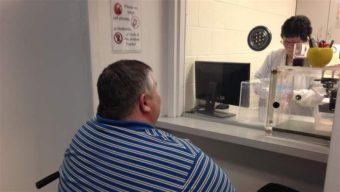
One of the first customers, John McIntyre, who bought a six-pack of Blue Moon and a bottle of rum, said whatever does happen will say a lot about Bethel.
“I do think it’s time we grew up. There’s legal booze sales in Dillingham, McGrath, Nome, Kotzebue. If it doesn’t work here it’s us, not the booze,” McIntyre said.
The store earned about $1,350 in the first hour and served more than 500 customers throughout the day.
A patient gets a dose of the anti-addiction medicine buprenorphine at the Broadway Center for Addiction in Baltimore, whose treatment methods for opioid addiction are viewed as a model for other clinics. (Photo courtesy of Pew Charitable Trusts)
BALTIMORE — Dr. Kenneth Stoller held court on the sidewalk outside the Broadway Center for Addiction on a sunny afternoon last week, chatting with a troop of lingering patients. He beamed as he patted a young man on the shoulder and said he’d see him tomorrow.
“It’s important for patients to see this as a place that’s safe and accepting,” he said. “For some, it’s the first place they’ve gotten positive reinforcement in their lives.”
Operated by Johns Hopkins Hospital and located two blocks from its main campus, the Broadway Center — or “911” as it’s called because of its address at 911 N. Broadway — has provided methadone maintenance therapy for people with opioid addiction for more than two decades.
But unlike most of the roughly 1,400 methadone clinics across the country, the Broadway Center offers not only methadone, but the two other federally approved addiction medications, buprenorphine and naltrexone, and a full complement of mandatory addiction counseling and group classes. In most other places, addiction treatment is fragmented, leaving patients to shop around for the care they need or settle for whatever is offered at their local opioid treatment clinic.

“If you went to a doctor for any other disease, you’d expect to be offered all available treatment options,” said Dr. David Gastfriend, scientific adviser at the Philadelphia-based Treatment Research Institute, which studies substance abuse treatment. “Addiction treatment should be no different.”
The Broadway Center also collaborates with more than 30 office-based physicians inBaltimore who are licensed to prescribe buprenorphine. Local doctors refer their patients with addiction to the center, which in turn refers its addiction patients to local doctors for physical health care.
Doctors and researchers agree that addiction medications are the most effective weapons available to combat the country’s worsening opioid epidemic. But those medicines are reaching only a fraction of the people who need them.
The center, which operates as a hub for all services for addicts in the city, including housing, transportation and job training, was recognized last year by the U.S. Office of National Drug Control Policy as a model for improving the quality of and access to much-needed opioid addiction services.
Under a grant from the U.S. Substance Abuse and Mental Health Services Administration, Stoller is sharing the details of the program and its outcomes with states beyond Maryland.
So far, Oregon and Washington state have emulated the so-called collaborative opioid prescribing program at some of their existing methadone clinics. Rhode Island is gearing up to launch similar programs at every methadone maintenance center in the state.
Georgia and New Mexico are attempting to recreate the collaborative program, but have so far been unable to convince local physicians to sign up, Stoller said.
Key to the Broadway Center’s success is Maryland’s expansion of Medicaid to low-income adults under the Affordable Care Act and its coverage of methadone at opioid treatment programs.
According to a survey by the American Society of Addiction Medicine, Medicaid programs in 20 states — Alaska, Arkansas, Colorado, Idaho, Illinois, Indiana, Iowa, Kansas, Kentucky, Louisiana, Mississippi, Montana, Nebraska, North Dakota, Oklahoma, South Carolina, South Dakota, Tennessee, West Virginia and Wyoming — do not cover methadone. States also vary in their Medicaid coverage of the other two addiction medications, buprenorphine and Vivitrol, which is a long-acting, injectable form of naltrexone.
Two states — North Dakota and Wyoming — have no methadone clinics; a third — Mississippi — has just one.
Decades of Bias
After research in 1964 showed that the synthetic opioid methadone was highly effective at reducing drug cravings and preventing relapses among heroin addicts, methadone clinics began cropping up across the country, mainly in urban areas most affected by drug use. Their services are typically limited to giving addicts daily doses of methadone, testing urine for drugs, and, to varying degrees, counseling.
From the beginning, methadone clinics were stigmatized by the belief that maintenance treatment merely substituted one drug for another, a bias that persists today. And despite tight regulation by the federal government, critics complain that methadone is diverted to the black market.
As a result, methadone clinics have generally operated outside mainstream medicine, and with little connection to other public health and social services. The Broadway Center is an exception.
When buprenorphine, an opioid similar to methadone but safer, was approved by the U.S. Food and Drug Administration in 2002, the Broadway Center immediately began dispensing it. And when Vivitrol, which blocks opioids and reduces cravings but is not itself an opioid, was approved in 2007, it was added to the center’s roster of medication options. Over the years, the center also has created a robust set of behavioral and general health classes, as well as individual counseling.
But it wasn’t until 2009, when Stoller became director, that the center began collaborating with outside medical centers.
“It was fortuitous,” he said. “We lost our block grant so we needed new patients with insurance. I visited primary care and psychiatric sites to get referrals from physicians who wanted their patients to receive treatment for substance use disorders.”
In doing so, he said, he realized opioid treatment programs like his were missing an opportunity to provide services to the medical community at a time they were most needed.
More than 2.2 million people are suffering from addiction to prescription painkillers or heroin and fewer than half are able to get treatment, said Sylvia Burwell, the secretary of U.S. Health and Human Services, at a February news conference. That’s in part because too few primary care doctors have added addiction medication to the services they provide.
More than 900,000 U.S. physicians can write prescriptions for highly addictive opioid painkillers, yet fewer than 33,000 have signed up for a federal license that is required to prescribe buprenorphine to people who become addicted to them. The vast majority of doctors with federal permission to prescribe the addiction medication rarely, if ever, use it.
That’s despite a spiraling epidemic of addiction to opioid painkillers and heroin. The U.S. Centers for Disease Control and Prevention reported that in 2014, more than 47,000 people died of a drug overdose. Sixty percent of those deaths were a result of opioids. Opioid deaths increased 14 percent over 2013, the biggest surge in deaths yet since the current opioid epidemic began, in the early 2000s.
Many Paths
A hallmark of the Broadway Center’s program is its ability to pivot from one level of addiction treatment to another, depending on a patient’s needs.
“It’s about the right treatment for the right person at the right time, using combinations of medications and counseling,” Stoller said. “Just like any other medical condition, we use all available tools to achieve the best outcomes for our patients.”
Gene, a 45-year-old Baltimore native who didn’t want his last name used because of the stigma connected with addiction, said the center’s willingness to provide treatment tailored to his needs has “opened up a whole new world” for him.
He came to the Broadway Center for the first time in March 2015, after a nearly decadelong battle with heroin addiction that began after he received prescription painkillers for injuries sustained during his semi-pro football career.
He wound up losing his job, his family and his home, and was living in a nearby halfway house. “I looked in the mirror one day and didn’t know who I was,” he said.
That’s when Gene attempted suicide by taking 80 pills of a sedative called Ativan that is known to be deadly when combined with heroin. He ended up at Johns Hopkins Bayview Medical Center, where he received psychiatric treatment and detoxification from heroin. From there he was referred to the Broadway Center.
His first step toward recovery was in an intensive outpatient program with daily doses of buprenorphine and housing provided at the Helping Up Mission, where the Broadway Center has purchased 48 beds. He attended eight mandatory classes a week and at least one individual counseling session, usually eating lunch in the center’s dining hall. He also received a weekly urinalysis to determine whether he was using any illicit drugs.
Because of his injuries and pain, Gene also received occupational therapy and made regular visits to a primary care physician.
“Our reputation is that we’re one of the most structured programs around,” Stoller said. “Some call it strict.” For patients who want a methadone clinic where they take their meds and voluntarily go to counseling, the Broadway Center may not be what they’re looking for.
“We only schedule as many classes as we think they need,” Stoller said. “But our expectations are high and that translates to a sense of hope for patients. If we expect them to achieve high goals, they start to believe they can do it.”
If a patient starts to backslide, Stoller said, “We assign more classes or more counseling. It’s not punishment. We tell them we think they need a little more help to get to their goal.”
Gene didn’t slip up, and he graduated to standard outpatient care in six weeks. After that, he started coming to the center only two days a week and got a take-home prescription for buprenorphine from one of the center’s collaborating primary care doctors. He was continuing to work on pain management and was confident he had his addiction licked.
In September, he left Baltimore to live with his sister in rural Virginia. Removed from his support network here, he was unable to continue counseling and group sessions. None were available nearby.
“I found a group an hour away, but other than that, I was disconnected. That led me back to Baltimore with no armor on at all,” Gene said. After relapsing on March 2 of this year, Gene was re-admitted to the Broadway Center March 24.
“It’s easy to return to treatment because you know what to expect,” he said. “But there’s a certain humility you have to deal with. I didn’t come here right away. I had to man up to do it.”
For Gene, the next chapter will be another intensive outpatient program. He’s also looking forward to double hip replacement and back surgery that he hopes will allow him to get out of his wheelchair.
As for his heroin addiction, Gene said he’s confident his treatment will work. “I know it works. I’m living proof that it works. If you do what you’re supposed to do, there’s no reason you can’t make it work.”
The Alaska Republican Party wants to require drug testing for welfare recipients. That’s one of the new planks it added to the party platform at its convention in Fairbanks over the weekend.
The party wants drug screening for applicants, as well as random testing for recipients. The statement passed with overwhelming support.
Jeff Landfield, a state Senate candidate from south Anchorage, was a lonely voice against the drug screening plank, and even he says he understands the appeal.
“Because nobody wants somebody who’s a drug addict getting welfare,” Landfield said. “But the reality is I don’t think it’s very many people who are doing it. But the real problem is it costs so much money.”
The National Conference of State Legislatures says 15 states have passed laws on drug testing for people seeking public assistance. It’s not clear the laws save money, in part because testing catches few drug users, according to a 2011 federal report. Laws in Michigan and Florida that required universal testing of applicants were struck down in court.
From the start of Maia Szalavitz’s englightening, insightful and informative new book on addiction titled Unbroken Brain, I had the feeling that I was being reminded of truths that I’d once known but that I and others, as if through a kind of collective amnesia, had somehow forgotten.
Thinking about addiction tends to cluster around two extremes.
On the one hand, there’s moralism. Addicts, so the moralist says, are people who won’t say no. They consume beyond restraint and recklessly indulge their pleasures. This is a bad way to live. Addicts are bad.
The moralist gets something right, I believe. The moralist is right, for example, that the addict’s life is seriously and even morally messed up. Addicts are closed and shutdown. This is bad. This is a bad and painful and sad way to be.
But the moralist is wrong to think this is somehow a moral failing of the addict. Addicts are not bad.
The moralist is right about something else, too, and this deserves emphasis. Addicts are not aliens. They struggle to balance the pleasures and rewards of consumption against the costs of excessive indulgence. This is a struggle that every person faces.
On the other hand, there is the medical view: Addiction is a disease — specifically, a disease of the brain. Like the moralistic stance, this view gets something right. It gets right precisely the fact that, in contrast with what the moralist says, addicts are not like the rest of us, with the single difference that they won’t say no to pleasure. Addicts can’t say no, and pleasure in the end has little to do with it. An addict’s life can be full of anxiety, suffering, painful longing and, above all, compulsion. There is something wrong with the addict. The idea that addiction is a disease does a better job of capturing the abnormality and negative character of the addict’s condition. Moreover, as is widely known, there are fairly well-understood biochemical processes underlying addiction; addiction has roots in neurophysiology.
But the disease model, no less than its moralistic counterpart, goes overboard, according to Szalavitz’s book. Addiction may be tied to the brain, but it is hardly a disease of the brain the way Alzheimer’s is. And if it is a sickness, it isn’t a sickness the way cancer is. Addiction isn’t tied to a body part or a physical system in that way. If we insist on calling it a disease, then we should say that it is a disease of the whole person or something like a sickness in the way we live. It is tied up, of its very nature, with action and the will, with feelings, and with relationships.
There are so many myths about addiction, the book reminds us. For example, there is the idea that once an addict, always an addict. And then there is the idea that mere exposure to a drug or behavior causes addiction.
The facts are: The substantial majority of people who try drugs or potentially addictive activities (such as gambling) do not become addicts. And the bulk of those who do will eventually give up their addictions.
Addiction, Szalavitz notices, is, predominantly, a problem of youth. Most addicts get started when they’re still kids. And, remarkably, most addicts give up their addiction by the time they reach their 30s. In effect, they age out of their addiction.
Armed with these facts, Szalavitz makes a novel and even beautiful proposal. Addiction, she hypothesizes, is a developmental disorder. Specifically, it is a learning disorder, by which she means, in the first instance, that people, kids mostly, learn to be addicts. That is, they develop the habits of pleasure, action, reaction, etc., that is what their being addicted consists in.
And, of course, they don’t do so in a vacuum. Which brings us to the final piece of the puzzle. The vast majority of addicts have suffered great trauma early on in life. Sexual abuse or other forms of violence, the loss of a parent, divorce are not uncommon antecedents of addiction. The cliche that addiction begins as a form of self-medication is probably right. The future addict learns to use the drug as part of an economy of feeling and action. It’s not the drug, or the behavior, that is the source of the addiction. The substance is a tool or a technique for an ultimately inadequate self-mastery and control.
Szalavitz’s view helps us integrate the insights of the two extremist views I mentioned at the outset. Addiction, as the medicalist would have it, is a disease, not like Alzheimer’s or cancer, but like ADHD. It is a learning disorder, that is, one that occurs along a spectrum. And, so, her view also lets us see how the moralist is right, that we “normal ones” ourselves occupy a place on that very same spectrum. And, moreover, the moralist is right that the addict’s disorder is a morally significant one. Not because addicts will cheat and lie to get what they need. But because the addict is in the grip of a kind of false consciousness. They think the next fix matters, when it doesn’t matter, not at all.
I have only touched on a very small part of what Maia Szalavitz discusses in Unbroken Brain. She explores problems with the criminalization of drugs, the place of racism in our culture’s treatment of drugs and addiction, and she looks closely and illuminatingly at different treatment methods. There’s a lot of news you can use in this book if you or someone you love is an addict.
If I understand Szalavitz correctly, addiction is a learning disorder in a second sense as well. It is not only the case that we learn to be addicts, according to Szalavitz; it is also the case that learning is the key to overcoming addiction.
There is no one-size-fits-all answer to the question of what it is that the addict needs to learn. Szalavitz argues that only a compassionate and ideology-free attitude toward the addict can help us understand what it is that he or she needs to learn to be more at peace.
Alva Noë is a philosopher at the University of California, Berkeley, where he writes and teaches about perception, consciousness and art. He is the author of several books, including his latest, Strange Tools: Art and Human Nature (Farrar Straus and Giroux, 2015). You can keep up with more of what Alva is thinking on Facebookand on Twitter: @alvanoe
Copyright 2016 NPR. To see more, visit http://www.npr.org/.
Close
Update notification options
Subscribe to notifications
Subscribe
Get notifications about news related to the topics you care about. You can unsubscribe anytime.