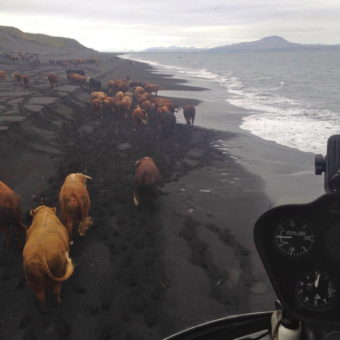
Herding cattle by helicopter in the Aleutians. (Photo courtesy of Curtis Norman)
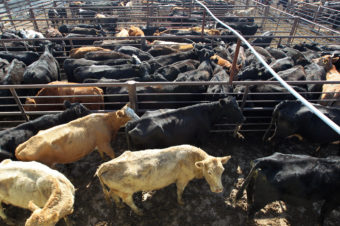
For the first time in five years, helicopters and cowboys are rounding up cattle by the hundreds on Umnak and Unalaska islands. The Bering Pacific Ranches at Fort Glenn on Umnak Island are herding their tundra-roaming cattle to take them to market.
Alaska agriculture officials say the Bering Pacific is the state’s biggest cattle operation. It’s also the only one with cowboys herding by helicopter.
“Helicopters started working from Nikolski toward Ft. Glenn, pushing the cattle every moment they can that the weather would allow,” Julianne Tucker with Bering Pacific Ranches said.
Tucker said, this time of year, the weather’s “pretty sketchy” for herding by helicopter. But herding has to wait until calves are old enough to endure being separated from their mothers.
“With the wind and everything, sometimes helicopters can’t fly, but they are the most efficient for the terrain that we are working with,” she said. “The steep hills and the swamps.”
Tucker said the helicopters and the ranches’ five cowboys have rounded up about 550 cattle so far, with another 1,400 or more to go. She estimated the total cattle population at about 6,000.
After the roundup, the bulls will get put on a landing craft and taken across Umnak Pass to Chernofski Harbor on Unalaska Island. There, they’ll be transferred to the livestock carrier Falconia–a big white ship that’s been anchored across from the Unalaska Safeway this week. The Falconia is managed by a Danish company and flagged in Panama.
Oregon Tilth certified Bering Pacific Ranches as organic on Sept. 22.
Tucker said it’s been hard to find an organic slaughterhouse for their organic, free-range beef.
“Some people can only process 5 to 10 or maybe up to 20 cattle a day,” she said. “Well, we’ve got 2,000.”
The bulls will be taken to a certified-organic slaughterhouse in British Columbia. Tucker said she doesn’t know yet where beef will be sold from there.
“It seems too bad that here we have a resource out there on Umnak Island and we take all that beef and bring it down to Canada,” Danny Consenstine with the USDA’s Farm Services Agency in Palmer said. “I’m sure there’s Alaskans that would love to purchase that home-grown, high-quality Alaskan beef.”
“We need to produce more of our own food and not rely so heavily on food that’s flown up here or shipped up here,” he said.
Tucker said once the cattle go to the Canadian slaughterhouse, they become Canada’s product. She said they only learned this week that they can’t ship straight from Alaska to the Lower 48 with a foreign-flagged ship like the Falconia without violating the Jones Act.
But she said Bering Pacific is looking for ways to sell its product in Alaska in the future. She also said the Discovery Channel is interested in doing a show on the ranch.
Alaska’s only certified organic cattle operation in the USDA database for 2014 was the Sitkinak ranch near Kodiak. That ranch sells ground beef online for about $3 a pound.
Retailers in Berkeley, California, are passing about 70 percent of the extra cost from the 1-cent-per-ounce tax on to consumers, a study finds. (Wikimedia Commons photo by Marlith)
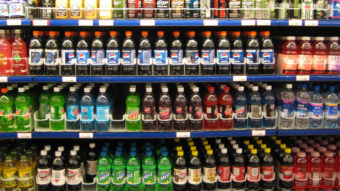
Public health advocates have argued that one of the best ways to fight obesity would be to tax the sugary drinks that science has implicated as a big part of the problem.
While many states and cities have tried to find ways to tax sodas and other sugar-sweetened beverages, only Berkeley, California, has succeeded. A grass-roots coalition, funded in part by Bloomberg Philanthropies, managed to get 76 percent of voters to support a soda tax, which passed in November 2014 and was the first of its kind in the U.S.
Now, researchers say the tax seems to be working in one important way: From May through June — the first three months of its implementation — soda prices in Berkeley increased seven-tenths of a cent per ounce more than in other cities, the researchers at the University of California, Berkeley found. That means that retailers are passing about 70 percent of the extra cost from the 1-cent-per-ounce tax on to consumers who buy soda. For all the sugary beverages, they’re passing on just under half of the tax on average.
That’s the way excise taxes are supposed to work — they make it more likely that consumers will see and feel the extra cost for a specific product. But the researchers say their findings, which appeared Wednesday in the American Journal of Public Health, provide the first evidence that that’s actually happening.
According to the researchers, the fact that consumers will now have to confront the tax with their own pocketbooks represents a “meaningful step” toward reducing consumption of sugar-sweetened beverages. At the same time, they admit they don’t yet know if it’s having any of the desired impact on health. (They acknowledge other limitations to their study, including an inability to assess whether retailers were shifting added costs from the soda tax on to other products.)
If Mexico, which passed its own nationwide soda tax in 2014, is any example, Berkeley’s tax could very well affect consumer behavior. A preliminary study by the Mexican National Institute of Public Health and the Carolina Population Center at the University of North Carolina, Chapel Hill found that purchases of sugary beverages in Mexico dropped 6 percent on average in 2014, compared with pretax trends.
Soda taxes on the whole, though, remain highly contentious, both politically and economically, in the U.S. The beverage industry has consistently maintained that taxes won’t help solve public health issues like obesity. And as author and nutrition scholar Marion Nestle writes in her latest book, Soda Politics: Taking On Big Soda (And Winning), the American Beverage Association spent $114 million between 2009 and 2014 to fight soda taxes.
Copyright 2015 NPR. To see more, visit http://www.npr.org/.
Read Original Article – Published OCTOBER 08, 2015 3:53 PM ET
After harvesting potatoes from a portion of his garden that has good sun and is well drained, Buyarski said he immediately fertilized and turned the plot of rich soil.
“Garlic is a heavy feeder,” Buyarski said.
He planted the largest cloves of hardneck garlic — not softneck garlic typically found in a grocery stores’ produce section — about 2 inches down and about 6 inches apart. He then placed a thin layer of compost or seaweed over the top, and covered the entire planting bed with clear plastic to keep the soil cool and prevent rainfall saturation of the soil.
Listen to the Oct. 8 edition of Gardentalk about planting garlic bulbs that aired on KTOO’s Morning Edition:
The 2nd Annual Garlic Lovers’ Potluck, hosted by the Juneau Garden Club, will be held Saturday, Oct. 17, from 4:30 to 6:30 p.m. at The Canvas, 223 Seward Street.
Buyarski, Joe Orsi and David Love will discuss cultivation, harvest and storage, and offer varietal taste tests. Bring your favorite garlic dish; garlic breads will be featured.
All are welcome to participate in the free Juneau Garden Club event.
The debate about sustainable diets has focused on meat production, which requires lots of land and water to grow grain to feed livestock. It also contributes to methane emissions. But the cabinet secretaries with final authority say the 2015 dietary guidelines won’t include sustainability goals. David McNew/Getty Images
When it comes to eating well, should we consider both the health of our bodies and of the planet?
Earlier this year, as we reported, the Dietary Guidelines Advisory Committee concluded that a diet rich in plant-based foods promotes good health — and is also more environmentally sustainable. And, for the first time, the panel recommended that food system sustainability be incorporated into the federal government’s dietary advice.
But, it turns out, the idea of marrying sustainability guidance with nutrition advice proved to be very controversial.
And now, President Obama’s two cabinet secretaries who will oversee the writing of the guidelines say they will not include the goal of sustainability.
“We will remain within the scope of our mandate … which is to provide nutritional and dietary information,” write U.S. Department of Agriculture Secretary Tom Vilsack and Sylvia Burwell, secretary of Health and Human Services, in a joint statement.
The two secretaries went on to say that “we do not believe that the 2015 DGA (Dietary Guidelines for Americans) are the appropriate vehicle for this important policy conversation about sustainability.”
The statement came just one day in advance of a much anticipated congressional hearing. Secretaries Vilsack and Burwell are scheduled to testify before the House Agriculture Committee Wednesday morning on the topic of the dietary guidelines.
Advocates have been pushing for inclusion of sustainability goals. The consulting group Food Minds analyzed 26,643 written, public comments submitted to the federal government on the topic of the dietary guidelines. They found that write-in campaigns by the advocacy groups Friends of the Earth, Food Democracy Now and My Plate, My Planet were the top three sources of comments.
Last week, in an editorial published in Science magazine, Kathleen Merrigan of George Washington University and a group of co-authors wrote that adopting a reference to sustainability in the dietary guidelines would “sanction and elevate the discussion of sustainable diets.”
Merrigan argues that “by acknowledging benefits of sustainability, the government would open itself up to greater demand for sustainability investments and would signal to consumers that such foods are preferred.”
The debate about sustainable diets has focused on meat production. As we’ve reported, meat production uses lots of land and water to grow grain to feed livestock. It also contributes to methane emissions.
“There are a lot of complex issues around livestock production that suggest –quite strongly — that we need to reduce meat consumption for sustainability reasons,”Merrigan told us.
And other foods also have an environmental footprint that we should not ignore. Take, for instance, almonds.
“It takes up to 2.8 liters of water to produce a single ‘heart-healthy’ almond,” Merrigan and company write in the editorial.
“With 80 percent of the world’s almonds growing in drought-stricken California, should consumers be advised to limit almond consumption and consider alternatives that consume fewer resources?” Merrigan and her co-authors ask.
The meat industry has opposed the idea of including sustainability in the dietary guidelines. “In our view, this is clearly out of scope,” Janet Riley of the North American Meat Institute told us.
She says experts need a more complete understanding of how food production impacts the environment.
“If you compare 10 pounds of apples and 10 pounds of meat, the meat surely has the larger carbon footprint, but it also delivers more nutrition, it nourishes more people longer” in terms of calories and protein, says Riley.
She says, going forward, if sustainability is going to be included in the dietary guidelines, there needs to be more data and more experts at the table.
In a statement, the meat institute’s president and CEO, Barry Carpenter, praised the secretaries’ decision. He called sustainability “an important food issue,” but one “outside of the Dietary Guidelines Advisory Committee’s scope and expertise.”
The dietary guidelines are updated every five years, so it’s possible that this debate will continue.
“The compelling science around the need to adjust dietary patterns to ensure long-term food security cannot be ignored,” Merrigan told me after the secretaries issued their statement. “If not [in] the 2015 DGA [Dietary Guidelines for Americans], then maybe the 2020 DGAs.”
Copyright 2015 NPR. To see more, visit http://www.npr.org/.
Read Original Article – Published OCTOBER 06, 2015 6:16 PM ET
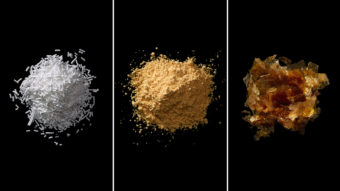
From left: Sodium benzoate, azodicarbonamide, shellac. The images are from Ingredients: A Visual Exploration of 75 Additives & 25 Food Products. (Dwight Eschliman/Regan Arts)
We may eat a lot of food additives, but most consumers know very little about them. These often misunderstood substances go by unwieldy names like “diacetyl” or “azodicarbonamide.” They are in everything from salad dressings to Twinkies. But how many of us actually know what they look like or, more important, what they’re doing in our food?
Ingredients, a new book by photographer Dwight Eschliman and writer Steve Ettlinger, seeks to demystify 75 common food additives, from acesulfame potassium to xanthan gum, by providing an easy-to-read encyclopedia of sorts of various food additives, their uses and their history.
Eschliman, who had to source each additive before he could photograph it, says that he was surprised by “just how thoroughly this world is full of white powders and clear liquids.”
While we think of these additives as foreign, belonging to the realm of food scientists, Eschliman says most of them weren’t hard to track down for purchase. (Roughly 60 percent of them, he adds, came from chemical supply companies who got their additives from China.)
He did run into one additive that was impossible to get: high fructose corn syrup. He says multiple manufacturers refused to send a sample either to Eschliman or to a “completely legit” friend of his who works in the food industry. It was the only moment in the process of creating the book that gave him pause.
“If they’re running TV spots talking about how great high fructose corn syrup is, why won’t they give me any?” he says. He ended up having to reuse some from an earlier project, sent to him before critics started zeroing in on it as a major culprit in America’s obesity epidemic. Because it’s a cheap sugar, it ends up in lots of processed foods, especially beverages.
High fructose corn syrup. (Dwight Eschliman/Regan Arts)
While both authors say they’re firmly in the “eat more fruits and veggies, cut down on the processed foods” camp, this book is not an expose about dangerous additives.
“Everybody wanted us to align very much with those on the soapbox talking about how bad the food was,” Eschliman says. “I wanted to take some measures to prevent that.”
His first step was specifically choosing additives that he could organize into three categories — neutral, negative and positive — to make sure the book didn’t lean too heavily in one direction. “It’s easy to talk about the ‘bad’ ones,” he says, “but no one is talking about chlorophyll or beta carotene.”
Eschliman admits that he had initially placed monosodium glutamate –better known as MSG — in the “negative” pile. For decades the additive, popular in Asian cooking and other cuisines, has had a reputation for causing “Chinese restaurant syndrome” — health woes including heart palpitations and other allergic reactions. But today, most scientists agree that this reputation is entirely unfounded. Or, as Eschliman put it, “it doesn’t cause every one of my headaches.”
Glutamate is a naturally occurring amino acid, and the same flavor enhancer that makes Parmesan cheese or tomato sauce so delicious. In the form of MSG, it’s just one of many white powders and clear liquids that have gotten a bad reputation because of a poor understanding of chemistry and public mistrust. Fueling that mistrust are concerns that the Food and Drug Administration exercises too little oversight over the process by which companies add additives to food.
Though it’s technically a yellow powder, azodicarbonamide, or ADA, became famous last year after Vani Hari, the blogger and activist better known as Food Babe, petitioned Subway to remove the “yoga mat chemical” from its bread. The production of ADA may cause asthmatic symptoms or skin irritation for the factory workers who make it, but as The Salt has reported, there’s no evidence ADA poses any risk to consumers who eat it.
While it sounds a bit scary that the same additives that show up in rocket fuel, yoga mats, fertilizers, fire retardants and rust dissolver could be in our chips and sandwiches, it doesn’t mean we are eating any of those things. Salt is made from sodium and chlorine and, as Ettlinger writes, “has an estimated 14,000 industrial uses.” Dihydrogen monoxide, also known as the nonthreatening water, has even more industrial applications. Yet no one has called water the “paint thinner chemical.”
But not all outcries against food additives are without merit. Sodium benzoate is one of the most commonly used preservatives in history — found in everything from foods to pharmaceuticals to “whistling fireworks.” But, Ettlinger writes, “One place you will not find it is in Coke and Pepsi.” It used to be on the list of ingredients in both sodas until consumers discovered that when sodium benzoate combines with ascorbic acid it creates benzene, a known carcinogen. The FDA has said that the levels of benzene detected in sodas do not pose a safety concern. But, as Ettlinger writes, “the outcry was convincing enough for the manufacturers to switch to alternatives.”
Ettlinger and Eschliman’s curiosity about additives comes through on every page. Each photo gives a rich sense of the additive’s color and texture, and the text regularly throws in additive trivia. Did you know that a lot of baking soda ends up in cattle feedlots to act as an antacid for grain-fed stomachs? Or that many fruits and vegetables are covered in a waxy preservative, shellac, that comes from an insect known as the “lac beetle”?
It’s easy to be scared of these additives when we know so little about them. “As it happens, it doesn’t take much to understand,” Ettlinger says.
The ingredients found in Campbell’s Chunky Classic Chicken Noodle Soup. (Dwight Eschliman/Regan Arts)
Copyright 2015 NPR. To see more, visit http://www.npr.org/.
Read Original Article – Published SEPTEMBER 25, 201512:09 PM ET
Tasting glasses for Capital Brewfest 2015.(Photo by Jeremy Hsieh/KTOO)
Juneau Rotary held its fourth annual Capital Brewfest on Saturday. The annual event showcases dozens of specialty and craft beers from around the state and beyond.
This year, it’s estimated it will raise about $25,000 after expenses for the club and its charity partner United Way.
Take a listen to this audio postcard from the event.
Ann Metcalfe headed up Juneau Rotary‘s Brewfest organizing committee. She said all 900 tickets sold out this year.
“You know, people were really anxious and hungry to have a beerfest here, so it sells out every year. We sold out this year on Wednesday before the event,” she said.
Metcalfe was eager to try Alaskan Brewing Company’s new pilot series coffee brown ale.
“And HooDoo has a nice Kolsch, um gosh, and the Homer folks, I’m hoping to get a little taste of that because we can’t get it down here. They have beautiful ales,” she said.
The Haines Brewing Company booth at Capital Brewfest 2015. (Photo by Jeremy Hsieh/KTOO)
Sean McLaughlin is part of Alaskan’s brew crew. He explained what went into the new coffee brown.
“A pilot series, it’s a chance for us to showcase some unique beers, something special, something different. They’re a little more involved, a little more special ingredients. In this case it’s the special coffee extract cold press from Heritage Coffee,” McLaughlin said.
“We teamed up with Heritage Coffee, our local coffee roaster here in town, it was a kind of collaboration brew with them. We wanted to showcase two different styles. We’re using a English brown ale along with a Brazilian coffee. So it’s just a traditional based English brown, it’s about 7 percent alcohol, but infused with Brazilian cold coffee pressed extract. … And then we added that to the brew. We also took some of our malts, and we ran them through their coffee roaster, so we were able to pick up some of the oils and characteristics of the coffee roaster onto the malts, and then we ground them and used that into the brew.”
Morgan Petersen-Park shows off the hands-free utility of her umbrella hat. (Photo by Jeremy Hsieh/KTOO)
Morgan Petersen-Park stood out among the attendees.
“Well, an umbrella hat is actually a umbrella you wear on your head instead of holding it in your hand, so your hands are free, one, to eat, and two, mostly to drink beer,” she said. “Yeah, and honestly, for Brewfest, it is necessary. Especially when you have two glasses and only two hands. How do you deal if you have an umbrella? Well, you have an umbrella hat.”
Editor’s note: KTOO is a sponsor of Capital Brewfest.
Close
Update notification options
Subscribe to notifications
Subscribe
Get notifications about news related to the topics you care about. You can unsubscribe anytime.