Food

One year after opening, Haines distillery tasting room serves up something for everyone

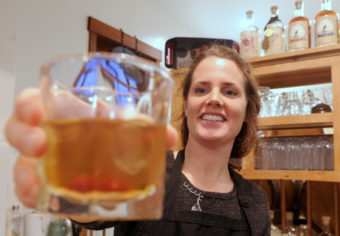
Macky Cassidy at Port Chilkoot Distillery
Port Chilkoot Distillery tasting room manager Macky Cassidy. (Photo by Jillian Rogers/KHNS)

The tasting room at the Port Chilkoot Distillery celebrated its one-year anniversary on Halloween. Co-owner Heather Shade helped lead the effort to allow distilleries in the state to operate tasting rooms. The distillery’s specialty cocktails use a wide array of regional ingredients to complement the locally blended and distilled spirits. The tasting room has added to the distillery’s popularity and helped double their business.

On a recent afternoon, tasting room manager Macky Cassidy is mixing cocktails.

“I like all old fashions because they’re stirred, and stirred drinks are kind of relaxing to make, kind of mesmerizing,” Cassidy says.

Cassidy stirs and shakes an array of craft concoctions for locals and visitors year round.

“I really like making the Absinthe-Minded, which is actually a cocktail that Melina Shields came up with when she was bartending here and it’s just a nice, well balanced drink that’s a pretty color and people are usually happy when they get it,” Cassidy says.

The creations are devised by Cassidy and the owners of the distillery and include a lot of traditional drinks with a Haines twist. But sometimes customers request mixtures that sound too tempting not to try.

“Some people have been asking for a collaboration with the brewing company to do a beer cocktail, that’s something we haven’t done yet that I’d like to explore. And then barrel-aged cocktails is another avenue that we haven’t gone down yet,” she says.

The distillery itself is the only one in Southeast, and has been open for about two years. Co-owner Shade says she thought it would take a lot longer to open the tasting room because of a state law that prohibited on-site sales. But after months of lobbying and testifying, Shade was instrumental in getting a bill passed in the legislature that allowed distilleries to serve limited amounts of their wares, just like breweries and wineries. A year after the distillery opened its doors, the tasting room was unveiled to the public.
“Well, we really didn’t know what to expect,” says co-owner Shade. “I remember when I asked Macky to come on board as our tasting room manager I said, ‘We don’t really know what this is going to be like. I think people will want to come, but they might not.’ And it turned out people really liked it. The tasting room itself kind of seems to mean different things and serves different purposes at different times of the year.”

She says for locals, it’s a spot to catch up with friends, sip a craft cocktail and learn about different drinks they can make at home with their favorite Port Chilkoot spirit. It’s also a chance to get a little marketing in for those out-of-towners.

Port Chilkoot Distillery menu
The Port Chilkoot Distillery menu. (Photo by Jillian Rogers/KHNS)

“Our tasting menu reflects our community and their taste, pretty much – sometimes weird, sometimes diverse, some of them have made it onto the long-term menu,” Shade said.

A year ago, the products were limited to Icy Straight Vodka, 50 Fathoms Gin and 12 Volts Moonshine, but over the last 12 months, they’ve added absinthe and two types of whiskey to the menu. The cocktails served up in the tasting room also include a host of local ingredients. Haines-produced Moxie Bitters, cranberry syrup, spruce tips, rose hips, and other regional fruits and flowers are added to spice up the blends.

The whiskey – both bourbon and rye – were revealed earlier this fall and have been wildly popular. Those whiskies are the first made in Alaska, and while they’re young, just two years in the barrels, the reviews are encouraging. The bourbon and rye will hit shelves around the state this month.

The distillery was given a boost earlier this year when they won a regional small-business competition called Path to Prosperity. Shade says the success of both of the wholesale market and the tasting room, means the business will stay open through the winter.

“Having the tasting room and being able to invite visitors in has been huge for us. I think it’s what is allowing us to grow our business.”

She says that the addition of the tasting room has nearly doubled their business. And adjacent to the bar area, in plain view, is the operation itself, with Shade, her husband and partner Sean Copeland, and other helpers blending and pouring and pumping the award-winning spirits in giant tanks.

As for what the future holds, Shade says the growth is calculated. They don’t want to grow too fast, but instead are looking to continue expanding without compromising the process or end result.

“We really like the size we’re at,” she says. “We really like the size of our team and there’s still room for growth at this size with these people in this space. Although, we are running out of places to put barrels so we’ll need to build or find something soon. We’re trying to keep our growth slow and controlled because that’s our style.”

The tasting room is open Monday through Friday 4 p.m. to 8 p.m. Bring a thirst for fine spirits and a sense of adventure.

Rising Temperatures Kick-Start Subarctic Farming In Alaska

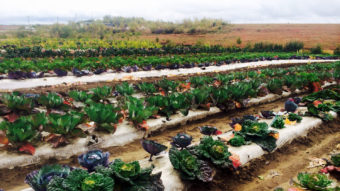
A field near harvest time at Meyers Farm in Bethel, Alaska, can now grow crops like cabbage outside in the ground, due to rising temperatures. Daysha Eaton/KYUK
A field near harvest time at Meyers Farm in Bethel, Alaska, can now grow crops like cabbage outside in the ground, due to rising temperatures.
Daysha Eaton/KYUK

We’ve heard a lot about the negative effects of climate change in the arctic and subarctic. But some Alaskans, like farmer Tim Meyers, are seeing warming temperatures as an opportunity.

Now that potato harvest is underway at his Bethel farm, Meyers uses a giant potato washer, like a washing machine for root vegetables, to clean California white potatoes.

They’re some of the only commercially-produced vegetables in this southwestern Alaska region, about the size of Oregon.

Meyers says the warming summers are a big part of his success.

“I hate to say that but I guess I’m taking advantage of the fact that it is getting warmer,” he says.

He says working the tundra — plowing swampy bogs full of silty soil — is tough. But he’s adapted to farming in the sub-arctic, even making his own homemade, fermented fish fertilizer.

At the 15-acre organic farm, which has been operating for more than a decade, Meyers is growing crops like strawberries in greenhouses. But he says as temperatures warm due to climate change, it’s easier to grow things like potatoes, cabbages and kale right in the ground, outside.

“Years ago, it was hard freeze and below zero up to the third week in May,” he says. “We haven’t had any of that this winter.”

Tim Meyers owns and operates Meyers Farm in Bethel, Alaska, where he says climate change seems to be providing a more hospitable environment for growing vegetables. Daysha Eaton/KYUK
Tim Meyers owns and operates Meyers Farm in Bethel, Alaska, where he says climate change seems to be providing a more hospitable environment for growing vegetables.
Daysha Eaton/KYUK

In fact, 2014 ranked as the warmest year on record in Alaska. Rick Thoman, a climatologist with the National Weather Service, says that’s not just a fluke, it’s a trend.

“What the last century of weather observations and climate observations in Alaska are telling us is that over the last couple of decades it’s been significantly warmer over most of Alaska than it was during the middle and later part of the 20th Century,” Thoman says.

He says the long-term average temperature for Bethel for an entire year had been 29 degrees, but in 2014 it was nearly 35 degrees. That’s only six degrees difference, but it’s significant because now it’s right above freezing, which allows more things to grow outside.

Most food is flown into in this town of about 6,000, and it can be expensive. At the grocery store here, a bag of russet potatoes can cost twice as much as outside Alaska.

Food security is real issue here. The region has traditionally relied on subsistence hunting and gathering. But residents are becoming increasingly dependent on expensive imports.

“So that’s gonna be kinda cost prohibitive for people with lower incomes to get good nutrition,” says medical resident Peter Abraham.

Abraham works at the local hospital and specializes in nutrition. He also spends time volunteering at Meyers Farm and says it eliminates the biggest barrier to getting fresh produce onto local dinner tables: transport.

“Things that are shipped from far away are not gonna be fresh when they arrive,” he says.

So he hopes cheaper and fresher produce will be more attractive to residents.

At the Meyers Farm stand, customer and long-time resident Josh Craven, is happy with both the price and the quality.

“It seems like we walk out with more for less, and it’s usually better, it’s fresher” Craven says.

He likes to bring his two young daughters shopping with him, so they can understand where their food comes from.

And farmer Tim Meyers is glad that at least some of the food in Bethel doesn’t have to be flown in from Mexico or elsewhere.

“In my mind, there’s no end to the potential,” he says. “I mean it’s obvious we can grow a tremendous amount of food.”

Meyers says he grew about 100,000 pounds of produce this year. Next year he hopes to double that.

Copyright 2015 KYUK-AM. To see more, visit http://kyuk.org/category/radio/.
Read OriginalArticle – Published NOVEMBER 01, 2015 7:51 AM ET


Nome reindeer ranch fundraises for mobile slaughter units, looking to sell local meat

A reindeer at the Midnite Sun Reindeer Ranch in Nome. (Photo by Mitch Borden/KNOM)

After five years of rebuilding their herd and corral, the Midnite Sun Reindeer Ranch is ready to take the next step — fundraising for two mobile slaughter units that would let them process and sell the meat from their business just outside of Nome.
“We need a USDA-certified processing and slaughter facility, and we’ve been seeing all these crowdfunding campaigns,” said Bonnie Davis. “We thought, ‘Well, we should give it a try. Why not?’”

Davis is part of the family reindeer herding business founded in 2010 by her parents, Bruce and Ann. The Davis Family has started their own fundraiser on Indiegogo, a crowdfunding website where anyone can contribute toward their goal of $200,000 — a sum that would pay for two slaughter units outfitted with extra winter insulation.

Without the equipment, Davis said the ranch is limited right now. U.S. Department of Agriculture (USDA) regulations restrict butchering to frozen ground only, which keeps them from processing for part of the year. And even then, USDA rules only allow sales to other processors and local people, meaning most commercial business is out of the question.

But with slaughter units certified by the USDA, Midnite Sun could process their meat more efficiently — without having to wait for the right weather or shipping meat to bigger facilities across the state. Lena Danner works for the Kawerak Reindeer Herders Association, and she said USDA approval would also open up their business to more buyers.

“If they had the mobile slaughter units, they’d be able to get the USDA stamp, and that broadens their market,” said Danner. “They’re able to sell to more people. More people would be accepting of it. So having the mobile slaughter unit and the USDA approval that opens so many more doors for them.”

And Davis says the demand is there. The ranch has heard from local schools and the XYZ Senior Center — both looking to add reindeer meat to their lunch menus — as well as chefs from Anchorage and restaurants around the state.

“We get a lot of inquiries once people find out that we have reindeer,” Davis said. “They’re like, ‘Oh, do you have any meat to sell?’ or ‘Oh, do you have any skins or fur or antlers for projects and traditional and cultural applications?’”

Considering there aren’t any herders in the region processing at a USDA-approved facility, Danner said Midnite Sun meat could be in especially high demand if they do find funding.

“Everyone in the region loves reindeer meat. And it’s not just in the region,” Danner said. “If they could get that USDA stamp, not only does it open them to being able to sell here in Alaska — it opens doors for them to be able to sell in the Lower 48, where people are always wanting to eat organic or free-grazing meat.”

And while Midnite Sun is looking forward to boosting their own business, Davis said they’re also excited about what mobile slaughter units could mean for the region, where the majority of groceries are shipped in from afar.

“We would be able to offer really fresh meat — super local — without having to wait for it to come up on the plane or the barge,” she said.

The ranch has only received two donations so far, but there are two weeks left in the online fundraiser. Davis said her family is also looking into grants if they don’t raise enough.

For more information on the Midnite Sun Reindeer Ranch, visit their fundraising campaign page.


As Schools Buy More Local Food, Kids Throw Less Food In The Trash

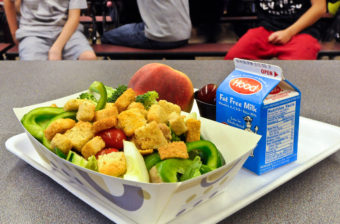
While schools are spending more on local food, it still makes up only a small portion of the average school meal. Here, a chicken salad at the cafeteria at Draper Middle School in Rotterdam, N.Y., in 2012. Hans Pennink/AP
While schools are spending more on local food, it still makes up only a small portion of the average school meal. Here, a chicken salad at the cafeteria at Draper Middle School in Rotterdam, N.Y., in 2012.
Hans Pennink/AP

More and more schools are trying to serve meals with food that was grown nearby. The U.S. Department of Agriculture just released some statistics documenting the trend.

According to this “census” of farm-to-school programs, at least 42,000 schools spent almost $600 million on local food during the 2013-2014 school year. That’s up almost 50 percent from the previous census, conducted two years earlier. (Both “censuses” were actually a questionnaire that the USDA sent to schools.)

The schools reported that when they served local food, their kids ate more healthful meals and threw less food in the trash.

Washington, D.C., is one of the school districts that has been promoting local food. That’s one reason why, at 9 a.m. Tuesday, a truck arrived at DC Central Kitchen, a nonprofit organization that supplies meals to 10 schools in the city.

Amy Bachman, the organization’s manager of procurement and sustainability, points to cases of broccoli, kale and sweet potatoes stacked in DCCK’s cold room. The name “Kirby Farms” is stamped on each cardboard case. Kirby Farms is located in Mechanicsville, Va. It’s two hours away, but that’s close enough to be called “local.”

Bachman has organized this shipment partly because there’s a D.C. law that requires them to serve some local food, to support local businesses. But her organization also wants to do it.

“For us, it’s also about getting kids to eat more, to get them to try food and get them interested in food,” she says. And it helps to create a connection to food, she says, when they can tell a story about that meal: “Those sweet potatoes came from Kirby Farms! This was just down the road in Virginia!”

Fresh vegetable cups prepared for the National School Lunch Program at Washington-Lee High School in Arlington, Va. Bob Nichols/Flickr/USDA
Fresh vegetable cups prepared for the National School Lunch Program at Washington-Lee High School in Arlington, Va.
Bob Nichols/Flickr/USDA

All across the country, you can find school districts doing similar things, for similar reasons.

“There’s universal interest in this, and that’s why we’ve seen dramatic increases in sales, and why we think there’s still a lot of upside potential to this,” Secretary of Agriculture Tom Vilsack said in an interview.

Bachman, at DCCK, says that in her experience, buying local food doesn’t take more money, but it does take more time. “We’re not buying just from one vendor,” she says. “We work with 20 or 25 different farms.”

Managing delivery schedules and matching growing seasons with menus takes a lot of planning and coordination.

This may be why local food still makes up only a small part (less than 20 percent) of the average school meal. Fewer than half of the school districts that responded to the USDA survey had any kind of local food program. (For more on why many schools struggle to source food locally, read Tracie McMillan’s post from March.)

Even those in the new census that did promote local food spent, on average, only 20 percent of their dollars on produce that grew close by.

Copyright 2015 NPR. To see more, visit http://www.npr.org/.
Read Original Article – Published OCTOBER 20, 2015 3:32 PM ET


Alaska berry-picking survey shows increasing variability in harvests

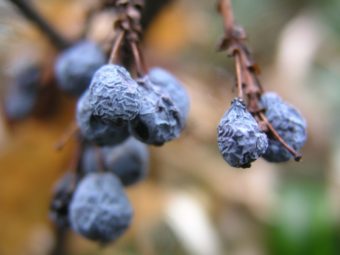
shriveled blueberries
(Creative Commons photo by Edward Moore)

Galena school teacher Freda Beasley and her husband Howard are fairly prolific berry pickers, sometimes gathering as much as 20 gallons of blueberries and low bush cranberries in a good year.  But to Freda, it seems like the good years are getting fewer and farther between.

“This year and last year, there were no blueberries,” Beasley said.

It turns out that Freda’s not alone when it came to fruitless blueberry searches recently.

“Almost 50 percent of the people that responded said (blueberries) had become more variable – there were bigger swings from one year to the next,” said research wildlife biologist Jerry Hupp with the U.S. Geologic Survey in Anchorage.

Hupp is an author of a new wild berry survey published in the International Journal of Circumpolar Health.

“That’s a fairly strong response.  The number of people that responded that berries had become more variable was almost twice as high as any other response.  So it suggests that, yeah, something may be going on there,” Hupp said.

Along with researchers from the Alaska Native Tribal Health Consortium and the University of Alaska Anchorage, Hupp put out a survey to environmental program managers at tribal groups, asking respondents to identify the berries that are commonly harvested in their area, and indicate whether berry harvests seem to be getting larger, smaller, more unpredictable, or staying the same.

Hupp cautions that the survey does not try to shed light on why berry populations might be rising or falling, but only to document the perceptions of experienced berry pickers.

“Our goal was not so much to understand how climate may be influencing berries–how changes in snow cover or changes in precipitation may be changing berry abundance,” said Hupp. “It was more to simply ask people, ‘Are you seeing changes? Are there things happening on the ground that might indicate that things are different now than they were in previous decades?’”

Ninety-six people from 73 Alaska communities responded. They were specifically asked to compare the berry picking experience of the past 10 years with berry picking before that.

berry survey graphs
Data from the wild berry survey in the September 2015 edition of the International Journal of Circumpolar Health.

Two berries stand out as both commonly harvested and increasingly variable: low bush blueberries and cloudberries.

The perceived decline of blueberries is most pronounced along the western and northern coasts of Alaska, where 76 percent of respondents experienced lower blueberry harvests or more variability in harvests from year to year. That view was shared by around 50 percent of blueberry pickers in the maritime region of Alaska–ranging from the Aleutians to Southeast–and 40 percent in the Interior.

High bush cranberries and crowberries, on the other hand, stand out as more consistent in their availability.

For each of the 12 berry species included in the survey, only a handful of respondents perceived an increase in berry numbers.

Hupp says that other researchers could build on the survey to learn more about the science behind berry productivity, and get a better sense of how changes in climate might affect berry populations into the future.

“Monitoring studies that would examine relationships between environmental variables and berry productions, or experimental studies that might alter things like snow cover, precipitation, and measure the response of berry species to that,” Hupp said.

Cookbook aims to get Alaska school cooks to “Make it Local”

Danielle Flaherty
Chef Danielle Flaherty prepares some Brussels sprouts at a recent cooking demonstration.

A new cookbook intended for Alaska schools and other institutional kitchens is coming out soon.

“Make it Local: Recipes for Alaska’s Children” is a collaborative project involving the state departments of education and natural resources, and the UAF Cooperative Extension Service.

Cooperative Extension Research and Development Chef Danielle Flaherty developed the recipes for the new cookbook. She said most institutional chefs are limited in their time and resources, so the recipes try to make it as easy as possible to cook from scratch with healthy, local ingredients.

“There’s a fish stick recipe that really simplifies the process of breading fish. Instead of a very laborious process in which you have to touch every single piece of fish four or five times, this is more of a ‘dump’ type recipe,” she said. “Or there are some recipes that use kale, for example, which use a food processor. You just run it through with a slicing blade and it shreds it really fine. You don’t have to get it very well stemmed. So we have tried to think about the process of production cooking.”

Chef Flaherty also wants to see Alaska fruits and vegetables used in new ways, which might extend their usage into the winter. For example, locally-grown zucchini can be shredded and frozen, and then added to a variety of dishes throughout the year, ranging from tacos to muffins.

Using local meat and seafood donations in Alaska schools is a popular idea, but it complicates the reimbursement process for schools serving school lunches.

“There are some technicalities that make it challenging to get reimbursed for meats caught with a game permit or a subsistence permit.”

The “Make It Local” cookbook is being printed now, and is due to be distributed at the School Health and Wellness Institute in Anchorage at the end of the month.

All school districts that participate in the National School Lunch Program will get copies, in addition to Head Start agencies and child care centers participating in the USDA Child and Adult Care Food Program.

The project was funded by a USDA grant, with a goal of getting more locally produced vegetables and proteins onto school menus.

Site notifications
Update notification options
Subscribe to notifications