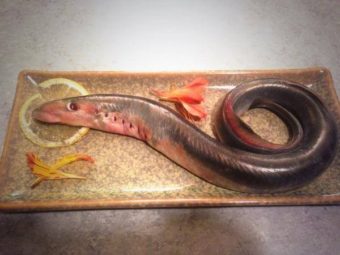
The annual run of lamprey is headed up the Yukon River. Diverse commercial markets for the snake-like creature have opened up over the past few years but catching them can be tricky.
To catch a Yukon River lamprey, you need good, solid river ice, and perfect timing.
For almost 15 years, Kwik’pak Fisheries has tried to operate a commercial lamprey fishery on lower Yukon sometime around Thanksgiving, but general manager Jack Schultheis says more than other fisheries, this one is hit or miss.
“It’s not a run like salmon that goes on for days or weeks. The lamprey run goes on for hours, and then that’s it,” he said.
Lamprey swim upriver to spawn. But unlike salmon, lamprey bunch together in one big horde as they move upriver, and run under the cover of ice.
Fishermen at Mountain Village started the commercial lamprey harvest on Nov. 17, when a few thousand pounds of lamprey were taken. That harvest was curtailed by a lack of adequate river ice to give fishermen access to the main channel, according to Schultheis.
Kwik’pak is expecting a stronger harvest of lamprey from the village of Grayling sometime in the next few days.
The unpredictable nature of the lamprey harvest makes it hard to commercialize, according to Schultheis, because buyers want a steady supply year after year. Nevertheless, Yukon River lamprey gets shipped far and wide for a variety of purposes.
“Some of them go to Europe, some of them go to Asia, and some of them go into the bait market in the lower 48,” Schultheis said. “And that all hinges on how much volume we get. When we get a lot of lamprey, then it is feasible to ship overseas – that’s in 20,000 pound increments. It’s gotta be a really good year to get that kind of volume.”
By those standards, 2014 was a very good year, with just over 40,000 pounds of lamprey sold commercially.
The parasitic creatures are typically caught with long handled dip nets, or impaled on long poles fixed with spikes.
Lamprey also have a long history of subsistence use in certain villages, where they are commonly referred to as eels. Nearly half of their body mass is fat, making them a good high-energy food for sled dogs. As human food, they are often smoked and jarred. And their skins can be used to make bags or even parkas.
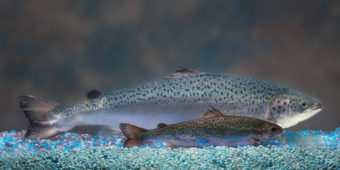
The biotech company AquaBounty reported a net loss in the first half of 2015. The company is working to expand the market for genetically engineered fish. (Image courtesy of AquaBounty Technologies)
Now that the FDA has approved a genetically engineered salmon for human consumption, Costco is joining Safeway and other retailers in a commitment not to sell it.

The warehouse retailer issued a statement last week saying that it does not intend to sell transgenic salmon “at this time.”
“This is a major step forward from the weak statement which Costco previously made over the summer,” says Dana Perls, who works for Friends of the Earth. That’s one of the groups that’s led a massive consumer campaign urging Costco to reject the AquAdvantage salmon. Perls, though, says she’s not sure of the extent of Costco’s new commitment.
“We are currently in dialogue to understand more about their statement,” she said.
Costco did not respond to a request for an interview Monday.
It may be a while before AquAdvantage is for sale anywhere in the United States. The CEO of the company that makes it told the New York Times it will take about two years for the fast-growing salmon to reach market size. The only FDA-approved facility for growing them is in Panama, and it can only produce about 100 tons of salmon per year. The company hopes to eventually farm its fish in the U.S.
Alaska’s Congressional delegation has fought to stop the so-called “Frankenfish” for years, and Sen. Lisa Murkowski says the fight is not over.
“I’m not sure if we can get the FDA to reverse this. I’m going to keep working on it,” she said on the Senate floor Friday. “But at a bare minimum, people around this country need to know what they’re serving their families when it comes to seafood.”
Murkowski says she’ll seek a labeling requirement for genetically engineered fish. She also announced that she’ll block Senate confirmation of the nominee for FDA commissioner.
Charges against three Southeast subsistence fishermen — including former Sen. Albert Kookesh — have once again been dismissed. In an opinion issued Friday, the Alaska Supreme Court found that because the regulation used to cite the men was not created lawfully, it’s unenforceable. The decision could have a major impact on Department of Fish and Game bag limits across the state.
Estrada v. the State of Alaska concerned three men accused of taking more fish than their permits allowed. A fourth man, Scott Hunter, eventually pled guilty to an amended charge of fishing without a permit.
Hunter, Rocky Estrada, Stanley Johnson and former Angoon Sen. Albert Kookesh were cited in July 2009 for harvesting 148 fish; their permits only allowed for 15 sockeye salmon harvested per family from Kanalku Bay near Angoon. Kookesh — who’s served in both bodies of Alaska’s Legislature and as chairman of Sealaska — says he wasn’t even fishing that day.
“When I saw Fish and Game come in and start giving them citations, I was looking for something that would challenge the bag limit,” Kookesh said. At the time of the citations, he was representing Senate District C, which included a number of Southeast villages. “When I saw them giving my brothers a citation, I went over and said, ‘Here’s my permit; I want to get a citation, too.’”
The charges were dismissed by a judge at first, but the state appealed.
The fishermen saw the citations as unfair. Kookesh said no one in Angoon recalled the Department of Fish and Game consulting with locals informally — which the department claims it did — let alone officially. If they had, Kookesh says the resulting regulation that set the bag limit may have been more agreeable to locals. He says the department erred in not establishing a definition for “family” or explaining how they decided on 15 fish.
“Less than a mile away from where we got cited, commercial fishermen were fishing, catching all the fish they wanted,” he said.
In 2013, the Alaska Court of Appeals reinstated the charges. Their reasoning was that because the Legislature knew the Board of Fisheries was enacting this kind of regulation, their inaction to amend or clarify the board’s power indicated that they believed the board acted within its authority.
That’s a conclusion the Supreme Court found to be beside the point.
For the justices, the question wasn’t about the authority to create regulations; it was about whether those regulations were established according to the Administrative Procedures Act — a law that defines the process for creating a regulation.
How extensively this decision will affect bag limits across the state is still unknown.
“This may not just be for the bag limit in Angoon. There are bag limits for everything in the state — for moose, for deer, for everything. And we don’t think that this is going to be such a small Angoon case; it’s going to be an Alaska case,” Kookesh said.
Fish and Game Deputy Commissioner Kevin Brooks says the department is also trying to figure out what the decision means for their subsistence management regime.
“We’re going to pull together our directors on Monday morning and with the Department of Law just walk through it,” Brooks said. “It has resource management implications and they’re pretty varied. It’s commercial, sport, subsistence and wildlife. We’ve got to spend some time and figure it out.”
A spokeswoman for the governor said the Walker administration is still reviewing the case.
Kookesh says this is just one of many issues surrounding subsistence management in the state that will be challenged over the coming years. He says this case was really about making the department consult with people in rural Alaska.
“We intended to fight this,” he said. “We intended to challenge it and we did. And today after all those years and all that heartache and all that stress, we finally got a result that we think is right.”
Correction: The Alaska Supreme Court opinion issued Friday states that the fishermen were arrested at the time of their citations. A previous version of this story included that detail, which is not true.
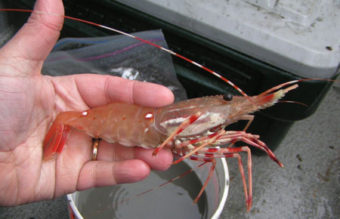
A new study says levels of toxins responsible for paralytic shellfish poisoning are well above the Food and Drug Administration’s limit in the Haines area. One researcher says further testing of commercial crab and shrimp from the area could kill the region’s fisheries.
Bruce Wright, a senior scientist with the Aleutian Pribilof Islands Association, said the PSP situation has been dire in Alaska for years, but the new findings suggest it’s getting worse. Wright said levels of the toxin that causes PSP are higher and more prevalent than ever before.
According to the study, samples were collected in May and June of this year in Chilkoot Inlet, Taiyasanka Harbor and Viking Cove. All species tested exceeded the FDA limit of 80 micrograms, per 100 grams. Dungeness crab from Taiyasanka Harbor tested the highest for PSP at 810 µg/100g.
“Some of the animals concentrate the toxins, and one pathway is through bivalves: clams, mussels, scallops, oysters,” Wright said.
But crabs are a little different. The toxins, which originate in algae, concentrate in the guts or viscera, not the meat. Shellfish affected by the poison don’t look, smell or taste any different from healthy ones. Once ingested, it can be deadly to both humans and wildlife. Symptoms include tingling in the lips, mouth and extremities and can progress to dizziness and shortness of breath. According to the state, death can occur in as little as two hours in severe cases. Cooking or freezing shellfish does not get rid of PSP.
In the Dungeness crab and shrimp Wright tested, high levels of PSP were found in the guts, which people mostly don’t eat, he said. If the crab or shrimp are cleaned before consumption, the meat is safe to eat. On the commercial end, live crab is not tested for PSP in Alaska before it is sold. Wright said if it was tested, the live crab fishery in northern Southeast Alaska would cease to exist.
“They should be tested,” Wright said. “These hotspots should be tested, or they should have non-live crab fishery. That’s what the regulations should require.”
Longtime Haines crabber Terry Pardee disagrees. Pardee said some of his customers cook the crab whole and eat everything, including the guts.
“And as far as I know everyone is still alive,” he said.
Pardee isn’t denying that PSP exists, but says, “There’s been no evidence whatsoever linking anybody that afflicted by, or died (from), PSP from eating Dungeness crab.”
George Scanlan is the shellfish permit coordinator for Food Safety and Sanitation in the Department of Environmental Conservation. He said the department does test live Dungeness crab, but only the processed ones that have been eviscerated. Scanlan said when it comes to live commercial crab, it’s a case of consumer beware because the department doesn’t have regulatory oversight.
“Our guidance basically to folks is that if they are to consume Dungeness crabs that are not tested, we strongly recommend that they clean out the butter,” Scanlan said.
Many factors contribute to whether the toxin makes an appearance or not, and so knowing when and where the shellfish will have toxins, if at all, is impossible to predict.
But Wright maintained that there is no stopping PSP. Monitoring is one answer to curbing the number of people who get sick, as well as taking stock of when and how bivalves are harvested.
He suggests more monitoring of algae blooms that harbor PSP would be a good start for protecting the public. But people who harvest bivalves to eat fresh do so at their own risk.
“Free-range” turkeys at Maple Lawn Farms in Fulton, Md., in November 2014. In some cases, turkeys labeled “free-range” roam freely on a farm. But in the vast majority spend most of their time in crowded houses, consumer advocates say. Jim Watson/AFP/Getty Images
You’re at the grocery store, shopping for Thanksgiving dinner. You’ve grabbed sweet potatoes, Brussels sprouts and cans of pumpkin. If you’re from the Midwest like I am, you’re also gearing up for green bean casserole.
But when you approach a refrigerated section of the store piled high with turkeys, you’re suddenly inundated with labels: natural, fresh, no hormones, young, premium and so on. Pretty soon, your head is spinning, so you grab the nearest one. As you head to the checkout line, you wonder if you’ve just made an ethical choice or been duped.
This scenario has become part of the Thanksgiving experience for many shoppers. If you’re like me, you may have told yourself that, someday, you’ll learn what all those labels actually mean. Well, today is that day. Because this is your guide to the utterly confusing world of turkey labels — a glossary for the wannabe informed Thanksgiving shopper.
Fresh
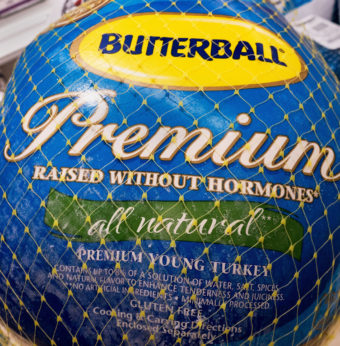
A Butterball turkey for sale in November 2014, in Centreville, Va. Terms like “premium” and “raised without hormones” tell you little about the quality of the turkey or how it was raised. Paul J. Richards/AFP/Getty Images
What you might think it means: The turkey was slaughtered this morning (or maybe yesterday) and was rushed to my local grocery store, where consumers like me will taste the difference!
What it actually means: “Fresh” has nothing to do with the time between slaughter and sale. Instead, it means that the turkey has not been cooled to below 26 degrees Fahrenheit. In other words, it was never frozen. Above 26 degrees Fahrenheit, the meat can remain pliant — you can press it in with your thumb.
Young
What you might think it means: This bird was killed at a younger age than most turkeys and is therefore more tender and delicious. Maybe it also suffered less.
What it actually means: The bird was likely killed at the same age as most other turkeys. According to Daisy Freund, an animal welfare certification expert at the American Society for the Prevention of Cruelty to Animals, most commercial turkeys are slaughtered at 16 to 18 weeks, compared to the roughly 10 years turkeys live in the wild. The U.S. Department of Agriculture does not define “young” for turkeys, but it requires that turkeys that lived more than a year be labeled as “yearling” or “mature.”
Natural
What you might think it means: The turkeys have been raised in a “natural” environment, wandering around in the woods or on a farm, scavenging food and gobble-gobbling their cares away.
What it actually means: According to the U.S. Department of Agriculture, it means no artificial ingredients have been added to the turkey meat, and the meat is only minimally processed. But Urvashi Rangan, director of consumer safety and sustainability for Consumer Reports, says the term isn’t helpful at all. “It has nothing to do with whether the turkeys got antibiotics every day, were living in filthy conditions or were confined indoors,” she says. Her organization is campaigning against the use of the term, which they feel misleads consumers. The Food and Drug Administration also has admitted it’s a challenge to define the term and just asked the public for help.
On that note, let’s pause for a minute to answer a basic question — how exactly are most turkeys in the U.S. raised?
“The vast majority of turkeys are living in crowded houses — football field-sized sheds that are entirely enclosed — by the tens of thousands,” says the ASPCA’s Freund. She says the 30-pound birds typically have their beaks cut to prevent them from injuring or killing one another, and are allotted an average of two square feet of space. “It’s like living your entire life in Times Square on New Year’s Eve,” she says.
Meanwhile, Freund says, manure often piles up beneath the birds, and ammonia hangs thick in the air. Many turkeys are routinely given antibiotics to prevent them from getting sick. Plus, modern turkeys have been selectively bred to mature quickly and have extremely large breasts (for more white meat). Many have trouble standing and are incapable of having sex — their large chests get in the way, Freund says.
To be clear, turkey producers must still meet basic safety standards and the meat should be safe. But terms like “natural” may be misleading consumers about how the birds are actually raised.
Let’s look at a few more dubious labels.
Free-Range
What you might think it means: These turkeys roam freely on a farm, pecking at the lush grass and getting more exercise than I do.
What it actually means: In some cases (on some small farms), it does mean what you’re picturing. But Rangan says in the vast majority of cases, “free-range” turkeys are raised in the standard, crowded houses. The only difference, she says, is that these birds must have “access to the outdoors.”
But the word “access” is broadly used. “If the animal never even went outdoors, but you sort of opened and closed the door every day, that would suffice to label the bird as ‘free-range,’ ” she says.
Cage-Free
What you might think it means: This turkey had a better life than most, because at least it wasn’t stuffed into a tiny cage.
What it actually means: This turkey’s life was probably the same as most, because turkeys are not raised in cages. The conventional practice — which accounts for well over 95 percent of all commercial turkeys, according to ASPCA — is to raise them in open houses. So, calling a turkey cage-free is sort of like calling a cantaloupe cage-free.
Premium
What you might think it means: This turkey is a higher grade of meat, and is more delicious and healthy.
What it actually means: Basically, nothing. The USDA grades beef cuts with words like “prime,” “choice” and “select,” but premium is not one of their designations and these graded terms are not used for poultry anyway. A company can label any kind of turkey as “premium.”
No Hormones Added
What you might think it means: This bird is healthier than most because it wasn’t pumped full of the hormones that turn some turkeys into the Incredible Hulk.
What it actually means: Once again, this term is misleading. By USDA law, turkeys (and other poultry) are not allowed to be given growth hormones.
Humane/Non-Certified Humane
What you might think it means: Finally, a bird that has been raised according to an ethical set of principles. It was probably treated fairly and lived a decent life. Maybe it even got to kiss its loved ones goodbye.
What it actually means: If there is no certifying agency, which there isn’t for this term, the label is probably meaningless, says Rangan from Consumer Reports. That’s because the USDA allows companies to come up with their own definition of “humane” and it gives its seal of approval if the company meets its own standards. In these cases, “it probably just means they met the conventional baseline,” says Rangan.
That’s most of the virtually meaningless terms. Let’s move on to some labels that have at least some significance.
Kosher
What you might think it means: The turkey was raised according to a stricter set of hygiene standards. It was probably kept cleaner and healthier.
What it actually means: The turkey was probably raised in the same crowded house conditions as most turkeys. The only difference is that it was slaughtered according to a set of kosher principles.
Vegetarian-Fed/Grain-Fed
What you might think it means: This turkey enjoyed a lush supply of greens and grains, replicating its natural diet.
What it actually means: The bird probably ate what most turkeys eat: corn. But these birds have not had their diets supplemented with animal byproducts, which does happen in some settings. The irony, though, is that turkeys are not natural vegetarians. In the wild, they eat a variety of bugs and worms, along with grass and other plants.
Raised Without Antibiotics/No Antibiotics Administered
What you might think it means: These birds were never given any antibiotics of any kind.
What it actually means: These birds were given drugs only if they were sick, but not for growth promotion, feed efficiency or to prevent disease. That means their producers are contributing less to the risk of antibiotic resistance and to “superbugs”— a serious health concern. However, Rangan suggests that consumers look for the USDA label with this term, to verify that the companies have been inspected. And she points out that the label does not mean the birds were raised in more sanitary conditions — only that they were not given routine antibiotics.
Organic
What you might think it means: These turkeys were raised on a steady diet of organic vegetables, green smoothies and Bikram yoga.
What it actually means: To meet the requirements for the USDA’s Certified Organic program, animals must have some access to the outdoors (though there’s debate about whether or not most organic turkeys actually go outdoors), be fed only organic feed (non-GMO and grown without chemical pesticides) and must not be given antibiotic drugs on a routine basis. Rangan says organic conditions are “significantly different” from conventional conditions. And yet, she says, organic lags behind the conditions enjoyed by humanely raised birds.
Which brings us to the final section.
There are three main organizations that have publicly available standards for “humane” treatment. Birds bearing these labels typically are granted real access to the outdoors, eat a diverse diet and have the opportunity to behave as they would in the wild. You can read more about the specific criteria by clicking on each name.
Turkeys with this label come from farms that have been audited at least once a year, and have met criteria for animal welfare, environmental protection and community well-being. According to its website, “Provisions are made to ensure [the animals’] social interaction, comfort, and physical and psychological well-being.”
This is also a label with clearly defined parameters for animal and environmental care. Its website says, “The goal of the program is to improve the lives of farm animals by driving consumer demand for kinder and more responsible farm animal practices.”
This is a rating system with six different levels, ranging from less crowding (level one) to animals without clipped beaks spending their entire life on the same farm, with enhanced access to the outdoors (level five-plus).
To summarize, here’s a cheat sheet:
Labels that mean very little: Fresh, Young, Natural, Premium, Cage-Free, Free-Range, No Hormones Added, Humane (not certified or USDA certified)
Labels that mean something specific: Kosher, Raised Without Antibiotics/No Antibiotics Administered, Vegetarian-Fed/Grain-Fed, Organic
Labels that mean the birds were raised humanely: Animal Welfare Approved, Certified Humane, GAP
If you have a daily coffee habit, here’s something to buzz about: A new study finds those cups of joe may help boost longevity.
“In our study, we found people who drank three to five cups of coffee per day had about a 15 percent lower (risk of premature) mortality compared to people who didn’t drink coffee,” says one of the study authors, nutrition researcher Walter Willett of the Harvard School of Public Health. Decaf drinkers also saw benefits.
The findings, published in the journal Circulation, build on a body of evidence linking a coffee habit to potential health benefits.
As we’ve reported, previous research has pointed to a decreased risk of stroke. And, there’s some evidence that a coffee habit cuts the risk of Type 2 diabetes, too.
Now, of course, it’s possible to over do it with caffeine. Research has shown that consuming more than 400 milligrams of caffeine can interfere with sleep and create feelings of unease. And some of us are even more sensitive. (I feel jittery if I have more than one strong cup!)
One study found that 200 milligrams of caffeine (the equivalent of about two cups of coffee) is an optimal amount to enhance cognitive function and mood among sleep-deprived people. But all of us don’t metabolize caffeine the same way.
As we’ve reported, the caffeine amounts in coffee vary wildly. One analysis, conducted by Bruce Goldberger, found a 16-ounce cup of caffeinated coffee from Starbucks could contain anywhere from 250 milligrams to more than 500 milligrams of caffeine.
“Not everyone reacts to coffee in the same way,” says Andrew Maynard, who studies risk assessment at Arizona State University. He summarizes the benefits documented in this study as “small.”
He says this study does not prove cause and effect between drinking coffee and living longer. Rather, it points to an association. “There are a lot of unknowns as to what (may explain) the increase in life expectancy,” Maynard says.
Got more questions? So did we. Here’s our conversation about the findings with study co-author Walter Willett, edited for length and clarity.
So, what do you think might explain this association? In the study, you point to compounds in coffee — such as lignans, quinides and magnesium — that may help reduce insulin resistance and inflammation. Prior studies have pointed to these as well.
We’re not sure exactly how coffee is (linked) to all these benefits. The coffee bean itself is loaded with many different nutrients and phytochemicals. And my guess is that they’re working together to have some of these benefits.
We (see) similar benefits from caffeinated and decaffeinated coffee. That’s important, because it suggests that caffeine is not responsible for (the benefit.)
So this may be welcome news to people who drink decaf?
Yes, because too much (caffeinated) coffee can cause insomnia and loss of sleep, and that’s not a good thing!
The reduced risk of death was not seen among the coffee drinkers in your study who were smokers or former smokers.
Definitely. It’s extremely important to disentangle the effects of coffee from the effects of cigarette smoking.
So, what’s the take-home here? Is is that coffee can be part of a healthy lifestyle?
I think if people like coffee, it’s fine to include it (as part of your daily habit). So, certainly, (people) should not feel guilty about moderate coffee consumption. It definitely can be part of a healthy lifestyle.
I wouldn’t suggest that someone who doesn’t like coffee go out and drink it.
Are you a coffee drinker? Are these findings likely to influence your own behaviors?
Well, I really like a good cup of coffee. But if I have more than two cups a day, I really don’t sleep as well. So, I’ve been switching more toward decaf or half decaf/half regular.
In this study, you also analyzed how coffee influenced the risk of specific diseases — or categories of diseases. What did you find?
We went beyond total mortality and looked at specific causes of death. And we found that people who drink moderate amounts of coffee have lower risk of (death) from cardiovascular disease, diabetes, neurologic disease (such as Parkinson’s) and suicide.
As you point out, the participants in these studies are about 95 percent white, largely middle-class and well educated. Can you extrapolate to other populations?
Yes, I’m quite sure these findings would apply to other populations. This is a biological relationship. And we basically have a common biology.
Copyright 2015 NPR. To see more, visit http://www.npr.org/.
Read Original Article – November 16, 2015 5:20 PM ET