The Super Food Express bus travels to schools in Mobile County, Ala., to ensure children are fed healthy meals when school is out of session. The bus is part of the USDA’s summer food program, which President Obama says needs additional funding. USDA/Flickr
It’s a challenge making sure that low-income children who get free- and reduced-priced meals during the school year continue to get fed during the summer.
Government meal programs served 3.8 million children on an average summer day last year — far fewer than the 22 million children who got subsidized meals during the school year.
Now, the Obama administration wants to change that. The president will propose in his 2017 budget next month that families who qualify for subsidized school meals be given a special electronic benefits card that will allow them to buy an additional $45 in groceries per child each month when school is out.

“The reality is, obviously, we still have millions of kids that are not getting the help and assistance they need,” says Agriculture Secretary Tom Vilsack, who oversees the program.
Vilsack says there are many reasons for the summertime drop-off in participation. It’s hard to find sites where kids can be fed during the summer, when they’re home and schools are closed. This is especially difficult in rural areas, where children live far from any church or public space where meals can be served. They often lack the transportation needed to get there.
The USDA, states and nonprofit groups have been trying for several years now to figure out how to boost participation in a summer feeding program. They’ve experimented with offering free meals at camps and libraries, where children are likely to show up. And they’re using food trucks to deliver meals to more remote areas.
Some states have also tried electronic benefit transfer, or EBT, cards to give families extra money for food in the summertime. It’s this pilot program that the administration would like to expand to every state over the next 10 years.
“The president is suggesting the time has come to make a longer term, permanent commitment to making sure that all kids have access to meals during the summer,” says Vilsack.
But that commitment would be costly — an estimated $12 billion over the next 10 years. That’s unlikely to attract much support in the Republican-led Congress, which has been trying to cut back on such spending in recent years.
In fact, leading Republicans, such as House Speaker Paul Ryan and several presidential candidates, say they’d like to combine food aid and other safety net programs into block grants, and give states more flexibility over how to spend the money. They say the current programs discourage people from working and getting off government aid.
“I’d combine a lot of them and send that money back to the states for better poverty-fighting solutions: Require everyone who can to work. Let states and communities try different ideas. And then test the results,” Ryan said in a speech last month.
Still, historically, there’s been bipartisan support for programs to feed needy children. The Senate Agriculture Committee approved a more limited version of the EBT plan this month, at an estimated cost of about $50 million a year. The House has yet to weigh in.
Vilsack also announced that the administration is doing something else to boost participation in the free and reduced-price lunch program. It plans to allow states to start using Medicaid data to automatically enroll qualified low-income children into the program. The idea is to reduce some of the administrative paperwork in signing kids up for food aid, and to identify those who are qualified for subsidized meals, but for one reason or another haven’t been getting them.
Copyright 2016 NPR. To see more, visit http://www.npr.org/.
Read original article – January 27, 2016 6:00 AM ET
Loose-leaf green tea of the modern variety. Archaeologists have discovered ancient tea in the tomb of a Chinese emperor who died in 141 B.C. It’s the oldest known physical evidence of tea. But scientists aren’t sure if the emperor was drinking tea as we know it or using it as medicine. iStockphoto
Tea is often referred to one of the world’s oldest beverages. But just how old is it?
A Chinese document from 59 B.C. refers to a drink that might be tea, but scholars cannot be certain. Now, a new analysis proves that plant remains found in tombs 2,100 years old – about 100 years before that document – definitely are tea, the oldest physical evidence for the drink. And the buried tea was high-quality stuff, fit for an emperor.
That’s no surprise, because one of the tombs, the Han Yangling Mausoleum in Xi’an in western China, was built for the Jing Emperor Liu Qi, who died in 141 B.C. The other tomb is the slightly younger Gurgyam Cemetery (maybe A.D. 200) in Ngari district, western Tibet. In both, archeologists found remains of millets, rice and a kind of spinach. They also found tiny leaf buds that bore an uncanny resemblance to the finest tea.
The 2,100-year-old tea leaves were found in the tomb of the Jing Emperor Liu Qi, who died in 141 B.C. His portrait hangs in the Han Yangling museum in Xianyang, China. Brücke-Osteuropa/Wikimedia Commons
While those buds did look like tea, there was a chance they could be some other plant. To confirm their suspicions, the researchers compared the chemistry of the leaves with modern samples of tea. The ancient leaves contained unmistakable traces of caffeine, present in tea and also in a few other plants. The clincher was equally unmistakable traces of theanine, a chemical found only in plants of the tea family, with especially high levels in tea itself. Crystals found on the surface of the leaves also matched crystals on modern tea leaves.
Tea does not grow in the area of the tombs, so the evidence shows not only that it was present and valued enough to be buried with important people, but also that it was being imported to Xi’an at least 141 years B.C., and westwards into Tibet by the second century.
Gurgyam Cemetery also yielded woven silk cloth, metal bowls and a gold mask, further supporting the idea that luxury goods were already moving along early tracks of the Silk Road 2,000 years ago. It was Emperor Jing’s son, Emperor Wu, who really promoted the development of trade along what became the Silk Road.
Dorian Fuller, professor of archaeobotany at University College, London, and a member of the research team, says he’s pleased that modern science is able to provide details of ancient Chinese culture.
“The identification of the tea found in the emperor’s tomb complex gives us a rare glimpse into very ancient traditions which shed light on the origins of one of the world’s favorite beverages,” he tells us.
Other scholars wonder whether the emperor was drinking tea as we know it, despite the apparent high-quality buds.
James Benn, professor of Buddhism and East Asian religions at McMaster University in Canada and author of the recent book Tea in China: A Religious and Cultural History, agrees that tea was consumed “in some form” 2,100 years ago.
“But,” he adds, “I’m not convinced that this is a discovery of ‘tea drinking’ as it was later understood. It could have been used along with other ingredients in a medicinal soup, for example.”
The remains from Gurgyam Cemetery in Tibet may support this view. They contained barley and other plants mixed with the tea. As the researchers write in the online Nature journal Scientific Reports, this offers the intriguing possibility that the plants “were consumed in a form similar to traditionally prepared butter tea, in which tea is mixed with salt, tsampa (roasted barley flour) and/or ginger in the cold mountain areas of central Asia.”
No matter how it was being used, this research pushes back the verified history of tea in China and Tibet. Tradition says that tea came to Tibet as part of the Chinese princess Wencheng’s dowry on her betrothal to the Tibetan Songtsen Gambo, around 640 A.D. The tea found in Gurgyam Cemetery is some 450 years older than that.
Tea Tuesdaysis an occasional series exploring the science, history, culture and economics of this ancient brewed beverage.
Jeremy Cherfas is a biologist and science journalist based in Rome.
Copyright 2016 NPR. To see more, visit http://www.npr.org/.
Read original article – January 26, 2016 2:14 PM ET
Johnny Waller Jr. cooks lunch with his 8-year-old daughter, Alexandria, in his apartment in Kansas City, Missouri. Because of his felony drug conviction, Waller was barred from receiving food stamps when he was out of work caring for his son Jordyn, who had cancer. (Brian Turner)
Johnny Waller Jr.’s 1998 felony drug conviction has haunted him since the day he left a Nebraska prison in 2001.
Waller, now 38, applied for 175 jobs without getting one. He had trouble getting a federal loan for college because of his drug conviction, so he started his own janitorial business, in Kansas City, Missouri. And when his toddler son, Jordyn, was diagnosed with stomach cancer and needed full-time care, Waller’s record disqualified him from receiving food stamps.
“I really needed assistance there,” Waller said of the time in 2007 he had to give up his job to care for Jordyn. But he couldn’t get it, he said, because of a conviction “when I was 18 years old that didn’t have anything to do with my son.”
Hundreds of thousands of Americans are serving time for drug offenses — nearly a half-million according to the latest numbers available, from 2013. For many like Waller, leaving prison with a felony conviction on their record adds to the hurdles they face re-entering society. A 1996 federal law blocks felons with drug convictions from receiving welfare or food stamps unless states choose to waive the restrictions.
The bans, which don’t apply to convictions for any other crimes, were put in place as part of a sweeping reform of the nation’s welfare system, and at the height of the war on drugs. Now many states are rethinking how to help felons become productive citizens and reduce the likelihood they will return to prison.
Since 1996, 20 states have lifted restrictions on food stamps, known as the Supplemental Nutrition Assistance Program, and 24 allow people with certain types of drug felonies to get those benefits — leaving six states where a felony drug record disqualifies a person from receiving them.
States have been more restrictive when it comes to extending welfare benefits through Temporary Assistance to Needy Families: 14 have lifted the restriction, 24 have some restrictions and 12 have full restrictions barring felons with a drug conviction from receiving cash assistance.
Marc Mauer, director of The Sentencing Project, which advocates reforming the laws, said banning people from getting food stamps runs contrary to policies designed to ease inmates’ re-entry to society and to curb recidivism.
“This increases the odds they will commit new crimes by virtue of the fact that you’re creating a significant financial obstacle,” Mauer said.
State Assistance
This year, Utah, Texas and Alabama became the latest states to lift blanket bans on receiving food stamps.
“If we want people to stay out of trouble we’ve got to give them a hand up, not a foot down,” said state Rep. Senfronia Thompson, a Democrat who pushed for the repeal in Texas. She said providing help is much less expensive for the state than paying for repeated incarcerations.
While Texas’ food stamp program is now open to anyone convicted of using or selling drugs, those who violate their probation or parole are ineligible for benefits for two years. If they are convicted of another felony, drug-related or otherwise, they are barred for life.
Alabama scrapped its ban on food stamps and cash assistance.
Carol Gundlach, a policy analyst for Alabama Arise, which lobbied in favor of the change, said it is especially important for formerly incarcerated mothers, who often struggle to feed their families when they return home.
But even as many states have scaled back their bans, others have considered re-establishing them.
A Pennsylvania bill would deny welfare benefits to anyone who served more than 10 years for a drug offense. State Rep. Mike Regan, the Republican sponsor of the bill, said it would target major drug dealers and save finite state resources for those who are more deserving of help. Regan, a retired U.S. Marshal, said that during his time in law enforcement he saw many dealers who were receiving food stamps. He sees his measure as a deterrent and a way to curb abuse of the system.
Education and Housing
While states can make changes to welfare and food stamp policy, it’s up to the federal government to remove the stumbling blocks that released drug felons face in receiving education and housing assistance.
In 2006, the federal government opened college grants and loans to those convicted of a drug felony, reversing a 1998 policy. However, those convicted of a drug crime while receiving aid will lose it until they complete treatment or prove sobriety.
All current inmates also are ineligible for federal Pell Grants (which are for lower-income people and do not have to be repaid) to help pay for college courses while they are in prison. However, U.S. Education Secretary Arne Duncan said this week that the Obama administration wants to change that, and will propose a pilot program that would allow prisoners to access nearly $6,000 a year.
The U.S. Department of Housing and Urban Development places a lifetime public housing ban on those who have been convicted of making methamphetamine in subsidized housing. It also imposes a three-year ban from public housing on those evicted from public housing for drug-related activity.
The department has encouraged local housing authorities to consider how long it has been since the conviction and whether applicants have gone through drug treatment programs when weighing public housing applications from felons. But local housing authorities have wide discretion in whether to accept someone with a record, particularly when there has been a pattern of drug use.
Felons also face discrimination in seeking housing on the open market, though some states are moving to ease that, too.
In Texas, for instance, the Legislature this year passed a law that gives landlords liability protection from negligence suits for renting to known convicts who then commit crimes in their apartments.
Texas Rep. Thompson said the law gives landlords peace of mind while helping ease discrimination on anyone who has returned from prison, whether they were recently released or they are looking for housing years later.
‘Too Late’ for Jordyn
Waller has experienced all of these roadblocks at one time or another since leaving prison. And changes in the laws often came too late to help him.
Initially unable to finance school or get a job, Waller moved in with his mother in Kansas City, though his presence was tough on her financially. She asked him to apply for food stamps to help out, but the food stamp office told Waller he’d be denied.
Waller said the restrictions put him on the brink of a breakdown, and he considered whether he might be better off returning to prison, which was a world that made sense to him. Then he had Jordyn, and he decided he was done with crime and prison.
“I’d been a gang member, I’d been shot in the head, and I’d gone to prison. There wasn’t anything else out of that lifestyle to get,” he said.
So over the next few years, he started his own janitorial service and eventually hired seven people. He made good money, drove a nice car and felt like he had gotten his life together.
But in 2007, he learned Jordyn, then two-and-a-half, had stomach cancer, which required multiple rounds of chemotherapy and then round-the-clock care. Jordyn was initially treated in Kansas City, but Waller thought Jordyn’s chances would be better at St. Jude’s Children’s Research Hospital in Memphis, Tennessee.
So the single father closed his business, packed his car and headed to Memphis. But with no income, Waller soon ran through his savings. His bills piled up and his car was repossessed. He needed help with food, as doctors required him to make fresh food for Jordyn every meal to avoid bacteria. But his past kept him ineligible for food stamps both in Tennessee and Missouri, where Waller and his son eventually returned.
Missouri changed its law last year to allow people like Waller to qualify for food stamps as long as they complete a treatment program or prove their sobriety with a urine test, which they have to pay for.
Missouri’s change of heart didn’t come soon enough for Jordyn, however. He died in 2008 while waiting for a bone marrow transplant, just days before his fourth birthday.
Since burying his son, Waller has continued to raise his other two children — daughter Alexandria, 8, and son Kendall, 7 — on his own. It hasn’t been easy, but he’s slowly made progress.
After returning to Kansas City from Memphis, he moved in with his mother because his criminal record kept him from renting an apartment, though he tried several times. After Waller had lived six years with his mother, her building’s landlord gave Waller a trial run, giving him a short lease on another unit. This year, he was finally able to sign a yearlong lease.
Once federal education finance laws changed, Waller enrolled at Rockhurst University in Kansas City and earned a bachelor’s degree in business management. In 2011 he was pardoned for his drug crime by former Republican Gov. Dave Heineman of Nebraska, which helped him get a job with a medical equipment company that doesn’t review pardoned crimes as part of its background check.
But Waller said he’s gotten used to watching others go through life without the same barriers, and he has learned to accept there are some things he’ll never be able to do.
“I want to change apartments to a nicer place in a better school district,” he said. “I live on the fringe of just being able to live a normal life. I’m right up against the glass.”
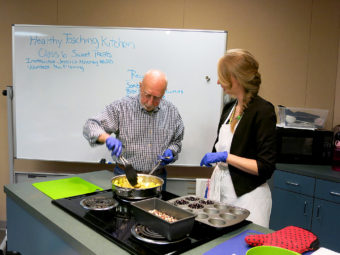
Ray Spaulding cooks apples in front of a class on cooking healthful desserts at the Portland VA withJessica Mooney, right, a clinical dietitian. About 80 percent of veterans are overweight and obese and another quarter have diabetes, according to the Department of Veterans Affairs. Conrad Wilson/OPB
At the Portland VA in Oregon, Ray Spaulding stands over a frying pan full of sliced green apples at a cooking class,
“I feel like I’m on the Martha Stewart show,” says the 85-year-old Air Force veteran. “This is caramelizing!”
Today’s class is about ways to make healthier desserts, like brownies made with cocoa, Splenda and pureed black beans rather than flour and sugar. Spaulding is making cooked apples sprinkled with a little bit of cinnamon.
Jessica Mooney, a clinical dietitian at the Portland VA, says this class is part of a series. Veterans learned to cook healthier breakfasts, dinners and snacks. She says they also learned about portion control and how to read nutritional labels.
“The majority of our veterans have some type of health issue that could be managed through, or improved through, diet and exercise,” she says.
About 25 percent of veterans who use Department of Veterans Affairs services have diabetes and 80 percent who use the services are overweight or obese, according to the agency. Those figures are higher for vets than the general population.
Spaulding says he’s taking the course because he was hospitalized several times in the last few years before finally being diagnosed with diabetes. He says the class has given him a better understanding about what’s going into the food he’s eating and cooking.
“I will be able to control things like my blood sugar, which is a real trial for me because I like sweets,” Spaulding says.
Another veteran in the class, Deeann Croteau, served in the Army during the mid-1980s.
“I have diabetes and I also have a sciatic nerve pinch in my back, and they keep telling me to lose weight,” she says. “In this past 12 weeks, I’ve lost almost 10 pounds.”
Michele Goldschmidt, who heads up health promotion efforts at the Portland VA, says some veterans face significant challenges after their military experience, like homelessness, job challenges, PTSD and other things related to war experiences.
Veteran Deeann Croteau says she took the cooking class at the Portland VA in part to lose weight and learn how to better manage her diabetes. Conrad Wilson/OPB
Some of them turn to food as an outlet.
When they were in the service, most vets had the cooking done for them, and so they never learned how to do it for themselves. And many of those who can cook are used to cooking for hundreds or thousands of people.
Back in the cooking class, Spaulding reaches his hand into the pan of simmering apples, fishes one out and pops it in his mouth.
“These apples are really amazing!” he says.
Since 2013, about 150 veterans have taken the cooking class. That’s small compared to the 96,000 vets served by the Portland VA this year alone.
But compared to other medical procedures and treatments, cooking classes and promoting exercise are less invasive and expensive ways to fight obesity and diabetes.
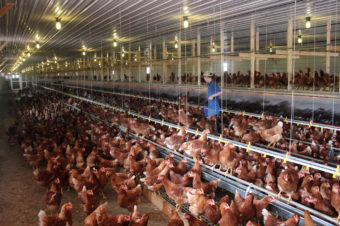
Cage-free chickens in a barn near Hershey, Pa., get to roam and perch on steel rods (but they don’t go outside). In September, McDonald’s said it would buy only cage-free eggs, inspiring several other food companies to follow suit. Dan Charles/NPR
Animal welfare advocates got major traction this year pushing for cage-free eggs.
In September, McDonald’s pledged it would move to 100-percent cage-free eggs in its supply chain. And while the movement was already underway, this announcement seemed to really set off a domino effect.
Some of the biggest egg producers in the U.S., including Rembrandt Foods, pledged allegiance to cage-free. Packaged good behemoths like Nestle and fast food chains like Subway did as well. (See the list of companies below.)
“I can’t think of a social issue that food companies rallied around more in 2015 than chicken confinement,” says Matthew Prescott, food policy director for the Humane Society of the United States, which has long been egging on producers and buyers to go cage-free.
“I think what happened was that for so many companies, the cage-free issue had been on their docket for 10 to 12 years,” says Prescott. But he says until McDonald’s announcement, there hadn’t been a commitment from a major player.
What “cage-free” means on the farm can differ somewhat, but as Dan Charles has reported, “enriched colony cages” that give chickens more room and nests to lay their eggs are currently the most popular alternative to traditional cages among farmers.
“They’re finding out that those cage-free systems aren’t as scary as they once feared,” Chad Gregory, president of the United Egg Producers, the main industry association, told Charles in September.
Prescott helped us compile this list of companies that committed in 2015 to buying entirely cage-free eggs (on a variety of different timelines). It’s by no means complete, but includes most of the biggest players.
Notice who’s missing? With the exception of Costco, there are no grocery retailers: no Target, no Safeway, no Walmart. “They are the final frontier on this issue,” says Prescott.
But, he says, they don’t have much of an excuse anymore — the biggest egg producers in the country are all eliminating cages, so cage-free eggs won’t be difficult to source in the coming years.
“We don’t know of any producer in country unwilling to meet cage-free demand,” he says. So it may only be a matter of time until retailers are no longer the eggception to the rule.
Copyright 2015 NPR. To see more, visit http://www.npr.org/.
Read Original Article – December 30, 2015 5:04 PM ET
Beau Schooler makes ricotta gnocchi in the kitchen of Panhandle Provisions. (Photo by Lisa Phu/KTOO)
Another Juneau restaurant empire is taking form with the opening of an Italian restaurant next month in the space recently known as the Silverbow Bakery. In Bocca Al Lupo will be the newest restaurant venture by the people who run The Rookery Café, Panhandle Provisions and The Taqueria.
In the kitchen of Panhandle Provisions on Seward Street, Beau Schooler cracks a few eggs in a big metal bowl. He’s making ricotta gnocchi.
“A cheese-based form of gnocchi, which is an Italian dumpling,” Schooler says.
He stirs up the eggs, whole milk ricotta and some salt, and then grates in some Grana Padano, which is similar to Parmigiano-Reggiano. It’s like “like parmesan’s younger cousin.”
The flour comes next. Gnocchi is usually made with potatoes, but it can be made with other ingredients, like spinach or sweet potato. It’s treated just like pasta – boiled till done and tossed with a sauce. The Rookery Café currently offers the ricotta gnocchi with a ragout made with pork from the Matanuska-Susitna Valley.
“When we get the Italian place open, we’ll always have one kind of gnocchi on the menu,” Schooler says.
Schooler went to Calabria, Italy in 2008 to learn the basics of Italian cuisine.
“So you get there and it’s basically like six days a week, 12 hours a day, you just eat, sleep, breathe Italian food. That’s all you do,” he says.
In Bocca Al Lupo will always feature a kind of gnocchi on the menu. (Photo by Lisa Phu/KTOO)
For the restaurant, Schooler will stay true to the roots of Italian cooking while also incorporating Alaskan ingredients. He’s working with friends who produce traditional-style fermented Italian cheese curds.
“The mozzarella that you can make with their curds is, I call it, life changing. It blows you away,” Schooler says. “So we’ll probably have a traditional Margherita-style pizza with the San Marzano tomatoes and the fresh-made mozzarella with this fermented curd and the Alaska sea salt and thin garlic. And we might play around with smoked salmon on a pizza just because it’s Alaska and you got to do something like that.”
“In bocca al lupo” is Italian for “break a leg,” though it literally translates to “in the wolf’s mouth.” The restaurant will feature handmade pasta and wood-fired pizzas ranging in price from $12-20, with entrees like roast chicken or duck costing more. The restaurant will also serve beer and wine.
Travis Smith first opened The Rookery Café in November 2010. In Bocca Al Lupo will be his third restaurant. (Photo by Lisa Phu/KTOO)
This will be the third restaurant opening for Travis Smith. Many of Juneau’s favorite restaurants are owned and operated by the same groups of people. Twisted Fish, Hangar on the Wharf and Pizzeria Roma all have at least one common owner. As do Tracy’s Crab Shack, Saffron, Salt and McGivney’s.
Smith started The Rookery Café in November 2010. Schooler joined the restaurant a couple of years later. They opened the deli Panhandle Provisions in June 2014, which they plan to move into the Italian restaurant location. The Taqueria opened February 2015.
Once you have the mechanics down for one restaurant, Smith said, it’s possible to open more.
“We couldn’t operate The Taqueria if we didn’t have another location where we could store their product off-site and have some prep work done because they just don’t have the space. Similarly, we couldn’t do what we’re doing in The Rookery if I hadn’t moved the bakery to a different location in 2013,” he said.
In the past couple of years, the restaurant group has gone from 12 to about 50 employees. But not everything Smith and Schooler touch turns to gold.
“We did have a little food cart operation that we shut down after a month that took us a year and a half to open. It was called the Chowder Shack, and we were just going to be selling our halibut chowder, but it turns out that that’s not something that people just wanted to buy and walk around and eat,” Smith said.
Smith is confident they have the staff and ability to run In Bocca Al Lupo, and he doesn’t plan to open any more restaurants.
“We’re going to stop at three. Essentially, our three children. The family is done,” Smith said.
Fresh gnocchi takes about three minutes to cook in boiling water. (Photo by Lisa Phu/KTOO)
Back at the kitchen, Schooler cooks the gnocchi in a small pot of boiling salted water for just a few minutes.
“Once they’re floating at the top, then they’re done. The key to these, really, is to pull them as soon as they start floating,” Schooler says.
He ladles some into a small bowl and grates some cheese.
“So that’s just pasta water, butter and then Grana Padano, and that’s kind of like how they do it over there,” Schooler says.
I plunge a fork into the bowl. Schooler’s gnocchi is sublime. Each one is a soft pillow in my mouth – a couple bites and then it melts.
Close
Update notification options
Subscribe to notifications
Subscribe
Get notifications about news related to the topics you care about. You can unsubscribe anytime.