Food

Is There Wood Pulp In That Parmesan? How Scientists Sniff Out Food Fraud

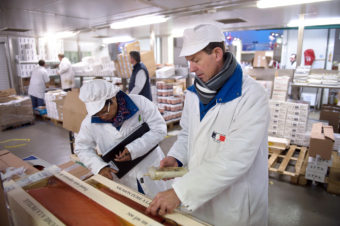
Food fraud is a common issue all over the world. Inspectors of veterinary services and fraud inspect seafood products at the Rungis international market, located near Paris. Martin Bureau/AFP/Getty Images
Food fraud is a common issue all over the world. Inspectors of veterinary services and fraud inspect seafood products at the Rungis international market, located near Paris.
Martin Bureau/AFP/Getty Images

If you’ve been following any of the big news stories on food fraud lately — you’ll know that it’s tough to know what exactly is in our food — and where it’s been before it makes onto our dinner plates.

Earlier this year, Wal-Mart was sued for stocking tubs of Parmesan cheese that contained wood pulp filler. Olive oil is often mixed with sunflower oil and sold as “extra virgin.” And you might recall the great European horse meat scandal of 2014: Traces of horse meat were found in Ikea meatballs and Burger King beef patties, in cottage pies sold at schools in Lancashire, England, and in frozen lasagna sold all over Europe.

And that’s “just the tip of the iceberg,” says Chris Elliott, the founder of the Institute for Global Food Security, a laboratory in Northern Ireland that tests food from all over the world in order to uncover fraud.

“Many, many forms of food fraud manifest themselves in different parts of the world virtually every day of the week,” he says. Globalization, and complex supply chains provide fraudsters with ample opportunity mess with food products.

NPR’s Rachel Martin asked Elliott how his lab goes about tackling this daunting problem.

So are people deliberately cheating the global food supply chain?

It’s absolutely cheating. But it goes beyond cheating — this is criminal activity, very well organized criminal activity, with people making a huge amount of money out of fraud in food systems

How much money are we talking about here?

Nobody really knows, but the world trade in groceries is about $11 trillion. And the level of fraud is somewhere between 5 and 10 percent of that.

How do you decide when and what you should be testing?

There are a number of factors that we look for. The first is if we see that there’s a massive fluctuation in the price of commodities. That can often be because demand outstripped supply. Often that can be because of crop failures that happen somewhere in the world.

In Madagascar very recently the vanilla crop failed — so there’s a massive increase in the price there. So that suddenly puts vanilla on our radar screen as a potential candidate for fraud.

And then what do you do?

So we know what the [molecular] fingerprint of vanilla should look like. We know what vanilla looks like in different parts of the world, actually. And we will compare those reference fingerprints with the samples that arrive in our laboratory.

Are there kinds of products that are easier to fake than others?

The more that the food is processed, the more difficult it is to figure out what it is and where it comes from. So things that come from very complex supply chains… will be much more vulnerable [to fraud] than locally produced things.

What happens to companies that are found guilty of food fraud?

Quite often, the person who is caught is the retailer. And they aren’t always the fraudsters — often they have been cheated themselves. But what happens is whenever they are caught, the reputation that goes with that is quite enormous. And many, many companies that have been involved or implicated in food fraud have seen their profits drop dramatically.

So what does this mean for consumers?

It’s extremely difficult for consumers to decide what’s genuine and what’s fake — because I’ll tell you the fakes are very, very good. We as consumers are reliant on the government, and on the food industry to protect us from fraud.

My advice to people is always buy your food from bonafide sources. If you buy your stuff from the back of vans and so forth, you can expect what you’ll get. And the second thing is if you buy something that’s too good to be true price-wise, it probably is.

Copyright 2016 NPR. To see more, visit http://www.npr.org/.

Virtual farmers markets coming to Kenai Peninsula

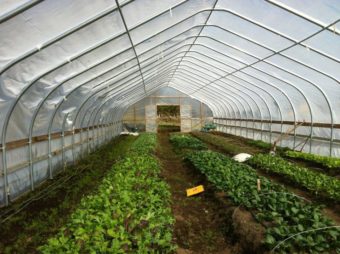
Emily Garrity peeks out from the door of her greenhouse at Twitter Creek Gardens on Ohlson Mountain outside Homer. (Photo by Daysha Eaton/KBBI)
Emily Garrity peeks out from the door of her greenhouse at Twitter Creek Gardens on Ohlson Mountain outside Homer.
(Photo by Daysha Eaton/KBBI)

Farmers markets are going virtual. Soon Kenai Peninsula residents will be able to buy locally grown food online. The new marketplaces are called “Food Hubs.”

There’s still snow outside, but Emily Garrity is prepping for the growing season inside her passive solar greenhouse on her small farm at the top of Ohlson Mountain just outside Homer.

She’s made her own potting soil and she’s dropping seeds into wooden trays.

“Here I have all my seed organized by variety and there’s some King Richard leeks and I’ll just drop one or two seeds in every hole,” said Garrity.

For the past eight years, she’s sold her produce through a community supported agriculture subscription, or CSA –where people pay a set amount for a box of food from her on a regular basis. She also has a stand at the Homer Farmers Market. But this year she’s trying something new, the Homer Food Hub.

“You can think of the food hub as an online farmers market,” said Robbi Mixon, the Local Foods Coordinator for Cook Inletkeeper, which is hosting the website.

Mixon knows a lot about farmers markets – she has run the one in Homer for five years. Now she’s helping set up the Food Hub website.

“[We will have] Producers from growing produce to fish, we hope to include some crafts and possibly even some cottage food products like kimchi and bread,” said Mixon.

Here’s how it works: producers will list what they have available for the week. Customers can then place orders and pay through the website. Then they can pick up their order at a fixed location on a set day and time. Mixon says communities on the peninsula have been kicking around the idea of an online farmers market for a few years, but after Cook Inletkeeper won a grant of around $89-thousand dollars from the U.S. Department of Agriculture to get it started, everything seemed to come together.

Rachel Lord who also works for Cook Inletkeeper as their Clean Water program director wrote the grant that’s funding the project. The nonprofit is usually focused on protecting the Cook Inlet watershed, not running a market, but Lord says the project is in line with the organization’s values. Lord says that creating a ‘Food Hub’ fits with Cook Inletkeeper’s larger vision of a sustainable future for the region.

“Most of our food is coming in from outside. It’s coming in through shipping channels and we’re pretty vulnerable. We also expend a lot of carbon in getting our food here.” said Lord.

The Food Hub isn’t just going to be about fruits and vegetables.

Hannah Heimbuch is a commercial fisherman. “I fish for halibut and salmon,” said Heimbuch.

She’s also the Community Fisheries Organizer for the Alaska Marine Conservation Council. She says there are some challenges for fishermen to participate in the Hub She’s not sure how they’ll get their fish to customers. But she has ideas that may work.

“Maybe it will be that they’re able to offer a gilled and gutted whole fish from the deck of the vessel down at the harbor. Maybe we can connect customers through the food hub to that product. Some fishermen are able to go ahead and process and vacuum seal their fish and that’s another option that we could have available on the food hub,” said Heimbuch.

Heimbuch says rockfish would make a great product along with salmon and halibut. In addition, she’s already working with local shellfish producers to bring oysters to the Hub.

There will be one food hub for the Homer area and, Lord says, the central peninsula will also get one.

A high tunnel at Twitter Creek Farms. (Photo courtesy of Kurtis Schoenberg)

Stephen Dahl runs Eagle Glade Farm near Kenai where he and his wife grow specialty garlic and onions among other things. He usually sells produce at local farmers markets. But now he’s prepping to sell through the central peninsula Food Hub. He thinks the hub will be more affordable for shoppers and socially responsible.

“In a way it will be more economical because it will be here. Instead of paying for food that was grown at some place with cheap labor and then paying for the shipping to send it all the way to some other place,” said Dahl.

Back in Homer, Garrity agrees. She says she’s excited about the opportunity to capture a wider market for her products too.

“I think in this day and age people are really used to online shopping and I think it’s a progressive way to get more people involved and make it easier get local foods and local products in peoples’ homes and on their tables,” said Garrity.

She says she’s planting about 50 percent more this season to provide produce for the Homer Food Hub.

Cook Inletkeeper officials say the Food Hub websites for both Homer and the Kenai/Soldotna area should be up in May.

Alaska nursing home asks to serve seal oil to Native clients

State regulators in Alaska are working with a Native organization that wants to serve its nursing home residents seal oil, a traditional staple that’s banned in public settings because of its high risk for botulism.

The Alaska Department of Environmental Conservation says it would grant an exemption to the Kotzebue-based Maniilaq Association if it can demonstrate a safe method for rendering the oil.

Alaska consistently has among the highest rates of foodborne botulism, which can lead to temporary paralysis.

Maniilaq hopes it can add seal oil to the list of traditional foods that can legally be donated to facilities such as its Kotzebue nursing home, which serves elderly Inupiat Eskimos. The organization, a regional tribal health care nonprofit, has also recently begun to incorporate other traditional foods on the menu.

Push to label GE food, including salmon, has staunch opponents

United States Capitol Building in Washington, DC. (Creative Commons photo by David Maiolo)

Since the Food and Drug Administration approved AquAdvantage, a genetically altered salmon, as safe to eat last fall, Sen. Lisa Murkowski has been working on a labeling mandate that would inform consumers the fish is genetically engineered.

The U.S. Senate considered a bill Wednesday morning that would make that impossible. The bill didn’t get enough votes to advance, but the debate shows the forces Murkowski is up against when it comes to labeling genetically modified organisms.

Food manufacturers and agribusiness fiercely oppose labeling laws for genetically modified food. They say the label would suggest the food is unsafe. But Senate Republican leader Mitch McConnell doesn’t mention the industry in describing the purpose of the bill.
“(It’s) aimed at protecting middle-class families from unfair higher food prices,” says McConnell, R-Kentucky.

The bill would nullify state laws requiring GMO labeling, like the fish-labeling law the Alaska Legislature passed a decade ago. More urgently for the bill’s proponents, it would block a Vermont law that would require labeling of all GMO foods, starting in July.

Sen. Pat Roberts, R-Kansas, told his colleagues that if they don’t pass his bill, the states will enact a patchwork of laws, requiring GMO food to carry what he described as ”demonizing” labels.

“Without Senate action, this country will be hit with a wrecking ball … that will disrupt the entire food chain,” he said.

Roberts, chairman of the Senate Agriculture Committee, warns that failure to pass the bill will cost each family more than $1,000 a year in higher prices, and he says the hardship will be widespread.

“From the farmer who will have to plant fence row to fence row of a crop that is less efficient, to the grain elevator that will have to adjust storage options to separate types of grain, to the manufacturer who will need different labels for different states, to the distributor who will need expanded options for storage. And,” he said, “to the retailer who may be unable to afford (to offer) low-cost private label products.”

The bill would allow voluntary labeling, and possibly later require manufacturers to include phone numbers or bar codes the consumer can scan with a smart phone. Sen. Barbara Boxer, D-Calif., called it an anti-labeling law and a sham. She imagined a busy dad in a supermarket, holding his phone up to a QR code, scrolling through information on a company website.

“Or he’s going to have to call a 1-800 number,” Boxer said, in a tone of incredulity. “Can you believe this? The man is going through the grocery store. He’s got 50 products in his cart. He’s going, ‘Wait a minute, kids. Just a minute.’”

Sen. Lisa Murkowski tried to draw a distinction between mandatory labeling of genetically modified crops, which has substantial opposition in Congress, and labeling of GMO fish. She described her opposition to the legislation as limited.

“It’s not opposition to the overall bill or its underpinnings,” she said. “Where my concern remains is mistakenly allowing genetically engineered salmon into our homes, mislabeled as salmon.”

The bill got only 48 of the 60 votes it needed to advance, but its advocates say they’re not giving up.

Bill Blocking GMO Labels Stalls In Senate, But Battle Is Far From Over

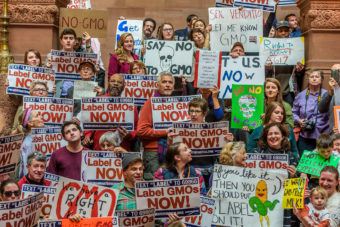
Protesters gathered at the New York state Capitol in Albany earlier this month to lobby their legislators to make GMO labels on foods mandatory in the state. Erik McGregor/Pacific Press/LightRocket via Getty Images
Protesters gathered at the New York state Capitol in Albany earlier this month to lobby their legislators to make GMO labels on foods mandatory in the state.
Erik McGregor/Pacific Press/LightRocket via Getty Images

It’s been called “perhaps the most contentious issue in the food industry”: Should food products be labeled to indicate they contain genetically modified ingredients?

Leading Republicans in the Senate tried to answer that question on Wednesday with a clear “no,” but failed. The Senate rejected a bill that would have prevented any state from requiring GMO labels on food. The bill, sponsored by Kansas Republican Sen. Pat Roberts, would have created a voluntary national labeling standard for foods containing GMOs, but it would have blocked Vermont from implementing its first-in-the-nation mandatory GMO labeling law, currently set to take effect on July 1.

The Roberts bill failed to get the 60 votes needed to move forward. The cloture motion failed 48-49. Now, a compromise will almost certainly have to be crafted.

Before the vote, Debbie Stabenow of Michigan, the Senate agriculture committee’s ranking Democrat, said negotiations would carry on, and she hoped a deal on a national GMO labeling standard could still be worked out before the end of the week, according to AgriPulse.

Among those opposing the Roberts measure was Just Label It, a coalition of businesses and organizations supporting mandatory GMO labels on food.

“This is the most hotly debated issue in food right now,” says Scott Faber, the group’s executive director.

“Consumers should have the right to choose,” Faber says. “They should have the right to know what’s in their food and be trusted to make their own choices.”

That argument — consumers’ right to know — holds sway among many legislators. Earlier this month, during debate on the Roberts bill in the Senate agriculture committee, many lawmakers pointed to polls that show a majority of Americans support labeling genetically modified ingredients in foods. (However, Grist’s Nathanael Johnson has pointed out that “[b]ig majorities of survey respondents also say, nonsensically, that they’d like mandatory labels for food containing DNA.”)

On the other side of the debate are those who argue that labels would inherently suggest something is wrong with foods containing GMOs, even though major scientific bodies — from the American Association for the Advancement of Science to the World Health Organization to the American Medical Association — insist genetically modified foods are safe to eat.

Opponents say that having to comply with a patchwork of state labeling requirements would be costly, because many food companies would likely reformulate their products to avoid a label, resulting in higher prices. Ultimately, that would raise grocery bills for the average American family by more than $1,000 a year, according to estimates released this month by the Corn Refiners Association.

Chip Bowling, president of the National Corn Growers Association, said he was “disappointed” with the outcome of Wednesday’s vote. “Farmers are committed to creating greater transparency in the food system, but we also need Congress to set clear, commonsense guidelines that are based in science and keep food affordable for American families,” he said in a statement.

Still, reformulating and labeling might ultimately be good business, says Jack Russo, a senior analyst of consumer staples industries at Edward Jones. He says that consumers — particularly middle- and high-income ones — increasingly “want to know what they’re putting in their bodies.” That’s true across generations, he says, but it’s especially true of millennials.

“I think the food companies really have to pay attention, because their future customers are the millennials,” he tells us — and costly changes now “in the long run will pay off for them.”

The labeling battle has made for strange bedfellows, with some Republicans – who usually embrace states’ rights – supporting preempting state labeling measures.

However, Senate Majority Leader Mitch McConnell, a Kentucky Republican, on Wednesday voted against the measure – a tactic that would allow him to bring the bill back up for a vote later if an agreement is reached.

One compromise proposal from Sen. Jeff Merkley, an Oregon Democrat, would give manufacturers a choice of four ways to label GMOs. As The Hill reports:

“[Manufacturers] could choose to put the words ‘genetically engineered’ in parentheses next to a relevant ingredient; identify GM ingredients with an asterisk and provide an explanation for the asterisk at the bottom of the ingredients list; apply a catch-all statement at the end of the ingredient list stating the product was ‘produced with genetic engineering’ ingredients; or use a symbol on the label, designed by the Agriculture Secretary, to disclosure the presence of GMOs.”

But a spokesman for Roberts, who chairs the Senate agriculture committee, tells NPR that the senator would not support the Merkley measure.

With additional reporting by NPR’s Allison Aubrey and Peggy Lowe of Harvest Public Media.

Copyright 2016 NPR. To see more, visit http://www.npr.org/.

Pre-Peeled Oranges: What Some Call ‘Lazy’ Others Call A ‘Lifesaver’

Last week, the Twitterverse became enraged after advertising copywriter Nathalie Gordon posted a photo of pre-peeled, plastic-packaged oranges.

“If only nature would find a way to cover these oranges so we didn’t need to waste so much plastic on them,” tweeted Gordon in a post that soon went viral. To make matters worse, these decidedly unwhole fruits were being sold by the grocery chain Whole Foods.

As American consumption of fruits and vegetables continues to lag behind recommended amounts, companies selling prepared produce are hoping that skipping steps like peeling, cutting or chopping will make people more likely to buy their products.

Twitter users accused people of being too lazy to peel their own darn oranges.

But for a whole segment of people with mobility issues, pre-prepared foods are a lifesaver, says Jennifer Hacker, a woman with peripheral neuropathy and poor grip strength. “I have stopped cooking anything I have to chop or slice first,” she says, because the pain is so bad.

Without pre-prepared fresh foods, Hacker says she’s relegated to the frozen foods aisle for her grocery shopping. She could also choose the syrupy, sweet canned citrus or overcooked, tinny green beans.

Pre-prepared foods do cause waste, both in making them and packaging them for sale. The uncomfortable question these products raise is whether a disabled person’s access to fresh foods can be reconciled with reducing environmental waste.

Hacker understands the knee-jerk reaction of able-bodied people to the peeled oranges, but she says she became angry when Internet users began to attack people with disabilities for wanting prepared foods.

“I had people on Twitter tell me that I had gotten along without peeled oranges before,” Hacker says, and that she should be able to continue to do without. “I had another person tell me that I should just ask someone else to peel an orange for me.” Hacker says she can hardly call a friend to come over and peel fruit when she gets the midnight munchies.

Just hours after the orange photo went viral, Whole Foods tweeted that the product was a mistake and pulled it from the shelves: “We hear you, and we will leave them in their natural packaging: the peel.” (Though the next day the chain shared a punny photo of peeled oranges in Mason jars, making the product’s ultimate fate unclear.)

The humble orange may seem like a strange candidate for pre-peeling but, as Hacker points out, it’s no different from bagged salads, shelled seeds or baby carrots.

Kim Sauder, who is a Ph.D. candidate in disability studies, has limited hand dexterity.

In her blog, “Crippled Scholar,” she writes that “Preparing food with limited mobility is both hugely time consuming and potentially dangerous.”

It’s irrelevant whether the product was actually designed for disabled people, Sauder says, because “things that are accidentally accessible are marketed and available to everyone and are thus likely to be more easily available.”

As for the cost of pre-prepared foods, Sauder writes that “it is easier to budget for the extra dollar or two that prepared fruits and vegetables are going to cost every couple weeks than the dozens or hundreds of dollars buying adapted cooking equipment will cost upfront.”

She says she doesn’t want to see “people throwing disabled people under the bus because they’d rather get rid of a product than figure out a way to deliver it sustainably.”

Copyright 2016 NPR. To see more, visit http://www.npr.org/.
Read original article – March 7, 2016 2:14 PM ET
Site notifications
Update notification options
Subscribe to notifications