Food

50 Shades Of Shakespeare: How The Bard Used Food As Racy Code

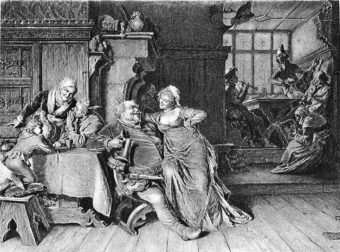
The libertine Falstaff sits with a woman on his lap and a tankard in his hand in an illustrated scene from one of William Shakespeare's Henry IV plays. Kean Collection/Getty Images
The libertine Falstaff sits with a woman on his lap and a tankard in his hand in an illustrated scene from one of William Shakespeare’s Henry IV plays.
Kean Collection/Getty Images

Editor’s note: This week, to mark the 400th anniversary of William Shakespeare’s death, we will be running a series of stories examining the links between food and the Bard. Oh, and in case the headline didn’t clue you in, this post contains sexually explicit language.

The eggplant and peach emoji are standard code for racy thoughts these days, but people have been using food as sexual innuendo for centuries. Shakespeare was a pro at the gastronomic double entendre [insert blushing face emoji here]. We asked Héloïse Sénéchal, chief associate editor of the RSC Shakespeare edition, to help us decode some of the bard’s bawdy food jokes.

“There appear to be a greater number of food-related terms for the vagina (fruit dish, fig’s end, nut, medlar) than for the penis (beef, root, carrot), ” Sénéchal explains via email.


In Henry IV Part II, Act 2 scene 1, it’s all about the pie.

The Scene

Mistress Quickly is the hostess of The Boar’s Head, a tavern in London’s Eastcheap, where the libertine Falstaff and his cronies hang. She bemoans Falstaff’s ever-swelling unpaid bar tab – and a little bit more.

The Quote

MISTRESS QUICKLY: I am undone with his going. I warrant he is an infinitive thing upon my score. Good Master Fang, hold him sure: good Master Snare, let him not ‘scape. He comes continuanly to Pie-corner —saving your manhoods — to buy a saddle…

The Meat Of The Matter

Pie-corner was an area in London near the Smithfield horse market, located on the corner of the significantly named Cock Lane (of course, it might just be a rooster, too). The area was known for cooks’ shops, saddlers and brothels (“pie” and “corner” were both slang terms for lady parts). The saddle is a triple entendre: It’s what you put on a horse, of course, but a saddle can also refer to a “saddle of mutton” – a meat cut taken from the loin, plus the hips – and it was common slang for a prostitute. Manhoods … you can figure this one out on your own.


“The instant, easy carnality of carrots, parsnips” and other phallic vegetables “has been used since time immemorial for innuendo and symbolism,” explains Sénéchal. Shakespeare pokes fun with this classic metaphor in The Merry Wives of Windsor, Act 4, Scene 1.

The Scene

Mistress Quickly returns in this play — this time as a housekeeper. The Welsh parson, Evans, quizzes the schoolboy Page on his knowledge of Latin, but Quickly can’t hold back her experienced interjections.

The Quote

EVANS: … What is the focative case, William?

WILLIAM PAGE: O, – vocative, O.

EVANS: Remember, William, focative is caret.

QUICKLY: And that’s a good root.

The Meat Of The Matter

Evans is a typical bumbling Shakespeare character and definitely no grammar wiz. He accidently stumbles into the “f-word” by turning “vocative” into “focative.” The O is suggestive of … well … a fig, a nut, a medlar… . The pedant Evans uses the Latin for “missing” (caret), but Quickly hears “carrot,” which, along with “root,” is slang for, ahem, the male member.


In Shakespeare, “prostitutes are often imaged as food,” says Sénéchal. Think mutton, meat, fish, flesh — or here, in Romeo and Juliet, Act 2 scene 4, goose.

The Scene

Romeo and his friend, Mercutio, are two Italian teenagers trying to one up each other with their sexual experience.

The Quote

MERCUTIO: Thy wit is a very bitter sweeting: it is a most sharp sauce.

ROMEO: And is it not then well served into a sweet goose?

MERCUTIO: O here’s a wit of cheverel, that stretches from an inch narrow to an ell broad!

The Meat Of The Matter

Straight up, the sweeting is a sweet apple, and the sharp sauce is bitter (as well as a cutting remark). But Romeo’s response alludes to the proverb “sweet meat must have sour sauce.” Except he gives it a vulgar spin – he interprets “sauce” as an allusion to semen, uses “goose” as slang for prostitute, and makes “served” something for a bed rather than a table (or not, depending on your tastes). Mercutio then ups the ante as he imagines his brains in his codpiece: “Wit” plays on the sense of “penis.” Cheverel is easily stretched leather, which the teenager brags is as long as an ell (45 inches).

“Food and drink … provide ripe opportunities for sexual metaphor,” says Sénéchal. The symbolism –as well as the “sipping, swilling, tasting, biting, swallowing, devouring” — offer the poet plenty of sauce for the proverbial goose.


Anne Bramley wrote on food in early modern literature while a Ph.D. student at the University of Chicago and taught Shakespeare at Duke University. She is the author of Eat Feed Autumn Winter.

Copyright 2016 NPR. To see more, visit http://www.npr.org/.

The Full-Fat Paradox: Dairy Fat Linked To Lower Diabetes Risk

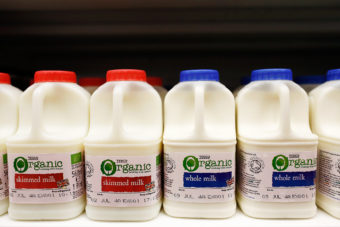
There's a growing body of evidence challenging the notion that low-fat dairy is best. Simon Dawson/Bloomberg via Getty Images
There’s a growing body of evidence challenging the notion that low-fat dairy is best.
Simon Dawson/Bloomberg via Getty Images

If you melt at the creaminess of full-fat yogurt, read on.

A new study finds the dairy fats found in milk, yogurt and cheese may help protect against Type 2 diabetes.

The research, published in the journal Circulation, included 3,333 adults. Beginning in the late 1980s, researchers took blood samples from the participants and measured circulating levels of biomarkers of dairy fat in their blood. Then, over the next two decades, the researchers tracked who among the participants developed diabetes.

“People who had the most dairy fat in their diet had about a 50 percent lower risk of diabetes” compared with people who consumed the least dairy fat, says Dariush Mozaffarian, dean of the Friedman School of Nutrition Science and Policy at Tufts University, who is also an author of the study.

The study does not prove a cause and effect, but it builds on a body of evidence suggesting that dairy fat may have protective effects, both in cutting the risk of diabetes and in helping people control body weight.
“For a long time we’ve had this notion that saturated fat [the kind found in dairy products] is always bad for you,” says Mark DeBoer, a pediatrician at the University of Virginia.

But this assumption is being questioned. As we’ve previously reported, DeBoer has studied the connection between dairy fat and children’s body weight. And he published a surprising finding.

“It appears that children who have a higher intake of whole milk or 2 percent milk gain less weight over time” compared with kids who consume skim or nonfat dairy products, explains DeBoer.

And there’s some evidence that dairy fat may help adults manage weight as well. As we’ve reported, researchers in Sweden found that middle-aged men who consumed high-fat milk, butter and cream were significantly less likely to become obese over a period of 12 years compared with men who never or rarely ate high-fat dairy.

So, in other words, the butter and whole-milk eaters did better at keeping the pounds off. In addition, a meta-analysis which included data from 16 observational studies — also found evidence that high-fat dairy was associated with a lower risk of obesity.

Researchers can’t fully explain these counterintuitive findings.

It’s possible that “the fat in dairy makes you less hungry to eat some other foods,” says DeBoer.

And there’s evidence that “when people consume more low-fat dairy, they eat more carbohydrates” as a way of compensating, says Mozaffarian.

Many high-carb foods such as cereals, breads and snacks that contain highly refined grains are less satiating and can prompt people to eat more calories.

With all the new evidence that challenges the low-fat-is-best orthodoxy, Mozaffarian says it may be time to reconsider the National School Lunch Program rules, which allow only skim and low-fat milk.

“Our research indicates that the national policy should be neutral about dairy fat, until we learn more,” says Mozaffarian.

Copyright 2016 NPR. To see more, visit http://www.npr.org/.

Gardentalk – Easy peas and challenging beans

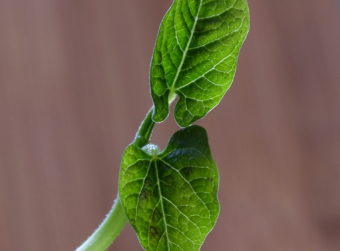
Pole bean seedling
Close up view of pole bean seedling. (Photo by Matt Miller/KTOO)

Master gardener Ed Buyarski says gardeners can start planting pea varieties now, while most bean varieties should only be started when it gets hotter and the soil warms up more.

Until they establish themselves, Buyarski recommends covering snow and snap pea seedlings with plant fabric for warmth and protection.

“When they start to emerge, they swell and push up to the surface the seed and all,” Buyarski said. “Crow, ravens, and jays all tend to like those tasty little tidbits.”

Buyarski also recommends supporting the pea plants with poles, sticks, webbing or netting after they grow taller than an inch.

Gardeners can also put lettuce, cabbage, swiss chard, and cauliflower into the ground at this point in the season.

Master gardener Ed Buyarski explains how to start peas, beans, and leafy vegetables like lettuce:


Previous Gardentalk segments from this season:

Gardentalk – Get digging
Gardentalk – Pruning and frost protection
Gardentalk – Seed starting

Archived segments from previous seasons can be found here.

Savoonga harvests second whale of the season

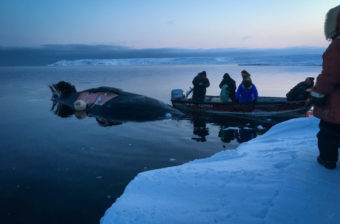
Savoonga’s second whale of the season, harpooned by whaling captain Carl Pelowook Jr. (Photo courtesy of Brianne Gologergen)

A whaling crew from Savoonga landed its second bowhead of the season recently. The St. Lawrence Island community has been working nonstop to haul the whale out of the icy waters, harvest its meat, and distribute it around the village.
For the past few weeks, whaling crews have been camped out on the southwest side of St. Lawrence Island. Elvin Noongwook was on the crew that landed Savoonga’s first whale in 1972.

Sitting around his kitchen table, the elder said they’ve been going to the same spot ever since.

“We call the whaling camp ‘Powooliak.’” Noongwook explained. “That’s where we’re doing whaling now in (the) springtime.”

Whale being separated out to distribute throughout the community of Savoonga. (Photo courtesy of Brianne Gologergen)

On March 27 of this year, Carl Pelowook, Jr., landed the first whale of the season and the earliest in Savoonga’s whaling history. Warmer ocean temperatures and stronger winds from the north make it easier for whalers to start their hunts earlier.

On April 5, Pelowook and his crew, which includes Michael Kralik and Nathaniel O’Connor, harpooned their second bowhead. With the help of eight other boats, they hauled the whale up to shore and got to work.

Elvin Noongwook says nothing goes to waste.

“We take everything from the head to the flukes, baleen and the meat.”

The work is nonstop. A steady stream of snowmachiners travel back and forth between camp for days, delivering processed whale and swapping out tired workers with well-rested ones.

Brianne Gologergen is a health aide at Savoonga’s clinic. She made the trip out to camp to watch it all unfold.

Gologergen said along with the days it takes to harvest a whale, it’s also pretty costly for the community to travel the 38 miles to camp.

“There’s the fuel for the boat, grub for camp for a couple of weeks, (and) fuel for your snow machine,” Gologergen explained.

But, she said, the taste of the fresh whale makes it all worth it.

“It was so yummy,” Gologergen said.

Even after the meat makes it into people’s mouths, the work doesn’t let up. George Noongwook is Elvin Noongwook’s cousin. He was also on Savoonga’s first whaling crew and now acts as the community’s commissioner on the Alaska Eskimo Whaling Commission.

He says prep for the whaling season starts thousands of miles from home.

“In order for us to go whaling, we first need to go to Washington, D.C.,” Noongwook explained.

Noongwook said there’s a lot of politicking needed to make sure Alaska’s 11 whaling communities can feed themselves throughout the year.

People pulling the whale out of the icy waters on the south side of St. Lawrence Island. (Photo courtesy of Brianne Gologergen)

“It takes a lot of coordination,” he said, adding “it takes a lot of people to work together to achieve that goal… it’s a lot of work, a lot of legwork.”

The Alaska Eskimo Whaling Commission meets four times each year. Their work helps inform the International Whaling Commission, or IWC, which meets every six years to set worldwide whaling quotas.

Noongwook said it’s a complicated process and not without its problems.

“Oftentimes, our quota is used as a political football for whaling nations and non-whaling nations,” Noongwook explained.

That’s exactly what happened in 1978 when the IWC failed to pass a whaling quota. Noongwook says those were dark days for Savoonga.

So after the IWC re-established the quota, he said he makes sure the community follows all IWC protocols and fills out all the right paperwork.

“We just have to keep plugging away if we want to survive,” Noongwook said.

Like the whale harvest itself, Noongwook said his work as a commissioner it’s tiring and time-consuming, but he said he’ll keep at it to keep the tradition alive.

Philly Wants To Tax Soda To Raise Money For Schools

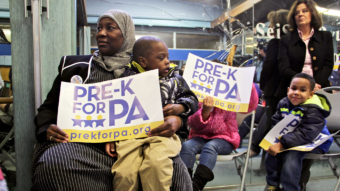
Khadija Sabir of Lovie Lee's Stars of Tomorrow preschool in Philadelphia attends a soda tax rally with three of her charges. The proposed tax promises to pay for public preschools, parks and recreation centers. Emma Lee/WHYY
Khadija Sabir of Lovie Lee’s Stars of Tomorrow preschool in Philadelphia attends a soda tax rally with three of her charges. The proposed tax promises to pay for public preschools, parks and recreation centers.
Emma Lee/WHYY

Philadelphia’s new mayor wants to do something few American cities have done: pass a tax on soda and other sugary drinks.

So far, Berkeley, Calif., has been the only U.S. city to approve such a tax. That measure was aimed at reducing soda consumption (and the negative health effects that go along with drinking too much of it).

But in Philly, the tax isn’t being promoted as a scheme to bring down the city’s high rates of obesity or diabetes. Mayor Jim Kenney says he wants to use the revenue for projects that benefit residents in a city with a 26 percent poverty rate, the highest of America’s largest cities. He argues soda companies make big money and often market their products to low-income people.

“What we’re looking to do is to take some of that profit, to put it back into the neighborhoods that have been their biggest customers, to improve the lives and opportunities for the people who live there,” he said at a rally promoting the tax last month.

Kenney claims a tax of 3 cents per ounce of soda, iced-tea and other sugary drinks — levied on beverage distributors — would generate more than $400 million over the next five years. The money would help fund a plan for universal pre-K and community schools that offer services like health care, as well as major renovations to parks, recreation centers and libraries.

So far, no one is complaining about Kenney’s intentions, but Daniel Grace, who heads up the local Teamsters Union, says there has to be a better way to raise money. The union represents about 2,000 people who work in bottling plants and drive delivery trucks.

His argument against the tax boils down to this: It would likely drive up the price of soda (just as the Berkeley tax has done), which, in turn, will reduce the consumption of sugary drinks. “When the demand goes down, they don’t need as many [workers] as they have today,” he says.

The Teamsters Union has printed hundreds of “No soda tax” buttons and T-shirts and has been handing out leaflets.

And right after Kenney proposed the measure, the American Beverage Association — a national trade group that previously shelled out more than $9 million fighting Berkeley’s soda tax — launched a social media campaign against the Philadelphia proposal and started running ads on local radio stations calling it a “grocery tax on the kind of drinks we buy for our family.”

But while the association’s campaigns target Philadelphia residents, the fate of the soda tax ultimately lies in the hands of the city council, which will make its final decision in June. Council president Darrell Clarke has not taken a side yet, but he’s concerned the burden would fall hardest on those Kenney is trying to help: the poor. “It doesn’t take a whole lot of analysis to determine where those sugary drinks are being sold,” he says. “So the question is, is that fair?”

The Rev. Adan Mairena, who is part of a group supporting the tax, estimates 80 percent of his congregation in North Philadelphia lives below the poverty line and admits that some of them are worried about paying more for these drinks. He’s urging skeptics to take the long view.

“If we pass this, it’s going to provide more opportunities in the long run and it’s going to make us a better people, a better community,” he says.

At a supermarket just a few miles away, Maribel Alago says she disagrees. She points out the city raised property taxes last year. Plus, there’s a $2-per-pack tax on cigarettes to help the cash-strapped school district.

“People cannot barely afford anything nowadays,” Alago says. “Now they going to tax soda, too.”

Mayor Kenney says if the city council doesn’t approve the tax, there’s no other way to pay for expanded pre-K or revamped rec centers. Plan B is going without those things.

Copyright 2016 NPR. To see more, visit http://www.npr.org/.

When Is It OK To Profit From Cooking Other Cultures’ Food? You Weighed In

kana_hata/Getty Images

Recently, we started a conversation about food and race. Specifically, we wondered out loud, who gets to cook — and become the face of — a culture’s cuisine?

Our question was prompted by a recent Sporkful interview with Rick Bayless, who has faced criticism over his long career. Although he is an Oklahoman with no Mexican ancestry, he has become one of the most prominent ambassadors for Mexican cuisine in America.

To be clear, this isn’t about Bayless. (Though the acclaimed chef did hop into the comments section to weigh in.) The question of who gets credit for a cuisine — and how they are compensated and feted — is one that comes up again and again in the food world. We asked readers to weigh in with their feelings about this squishy topic.

As with many things involving race and class in America, there are no easy answers — and we’re not expecting to find any clear-cut ones. We’re more interested in starting a conversation.

Here’s some of what we heard from you.

On one hand, many of you pointed out that cooking the cuisine of other cultures is a tangible way to connect. That’s part of what makes America a literal as well as figurative melting pot.

https://twitter.com/iamkevinvaughn/status/712789781688619009?ref_src=twsrc%5Etfw

https://twitter.com/thishonestfood/status/712344588019744769?ref_src=twsrc%5Etfw


At its heart, food is about identity — about where we came from — which is why the topic of cuisine and who cooks it can be so personal and complicated for some.

https://twitter.com/multiahjussi/status/712412949688619009?ref_src=twsrc%5Etfw

Many of you stressed the importance of approaching the cuisine of others with respect. And that means highlighting not just the ingredients, but also the culture behind a dish.

https://twitter.com/HiPhaedra/status/712317849881202689?ref_src=twsrc%5Etfw


Some of you said what’s bothersome isn’t so much whether a person of one race or ethnicity is cooking the food of another culture. That can be done respectfully. The question, then, is more about opportunity — who has a chance to profit from making a cuisine?

https://twitter.com/ThisIsShani/status/712342000469741573?ref_src=twsrc%5Etfw

We’re just kicking off this discussion. Over the coming weeks, we plan to keep digging into these ideas of where food, race and culture overlap — and we want to hear from you. Let us know what questions are on your radars. We’re at @mgodoyh and @katchow.

Copyright 2016 NPR. To see more, visit http://www.npr.org/.
Site notifications
Update notification options
Subscribe to notifications