Food

17 breweries you’ll find at the 2016 Haines Beer Fest

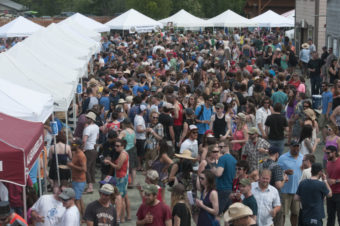
Twenty brewers will be at the 24th annual Alaska Craft Beer and Home Brew Fest. (Photo courtesy of Southeast Alaska State Fair)

Beer drinkers will take a flavorful tour of Alaska and the Yukon at the upcoming 24th annual Great Alaska Craft Beer and Home Brew Fest. More than 20 brewers will share their concoctions with nearly 2,000 attendees.

Haines Brewing Company owner Paul Wheeler says the local festival was a major motivation for him to start his brewery.

“Having a beer festival in Haines without having a brewery in Haines just seemed kind of ridiculous, so I got working on building the brewery,” he says.

The Haines Brewery’s Spruce Tip Ale, Ripinski Porter and more will be joined by beer from around 20 Alaska and Yukon Breweries. Jessica Edwards is director of the Southeast Alaska State Fair, which organizes the beer festival.

“New beer this year at the festival will be from Kodiak Brewing,” Edwards says. “We’ll have several from Anchorage, a couple from Fairbanks. Southeast Alaska will be represented again. Yukon of course, we’ve got two now from the Yukon, we’ve got Winterlong and Yukon Brewing.”

As people drink, they can listen to music at two stages on the Fairgrounds, and sample food from eight vendors, including one devoted to bacon.

The festival is made up of a few events. On Friday, May 27, is the homebrew contest that tends to attract around 100 entries each year. The main beer tasting is Saturday, May 28 from 1 to 5 p.m.

For 200 people who want to have more time personal time with the brewers, organizers added an hourlong Connoisseur’s Tasting right before the regular event. Wheeler says he thinks it’s a great idea.

“There’s a want for this opportunity to be able to talk to the brewer who is at the table pouring the beer,” he says. “And it’s really hard to do that in a big crowd. And so this is an opportunity for the brewers to talk about their product with the people interested in it.”

The Friday night before the festival, Seattle-based restaurateur Travis Kukull will chef the Gourmet Brewers Dinner for the fourth year.

“Travis really likes locally sourced foods and he has done a great job refining the menu as he learns what he can get locally here in Haines,” says Edwards.

She adds that U.S. Senator Lisa Murkowski plans to attend the dinner.

The festival sold out in record time this year, but Edwards says there’s been some worry about how a new event could impact Beer Fest. Alaska Crafted is an Anchorage festival to showcase state brewers and distillers. It’s scheduled the weekend before Beer Fest, which could pose a problem for smaller breweries that don’t have the staff to travel two weekends in a row.

“I think it won’t have a huge competing effect in terms of Beer Fest vendors for us this year. And I’m hoping just with some thoughtful discussion of dates we can avoid potential conflict next year.”

Edwards says the hint of competition with Alaska Crafted has shown how supportive many brewers are of the Haines festival.

“It has been an opportunity for people to say how much they love this festival, and how it feels like their festival.”

Tourism Director Leslie Ross says accommodations around town are booking up fast for the last weekend in May. The borough allows overflow camping at Tlingit Park and Port Chilkoot Beach during the festival. It also has extra staff working to keep things clean. Ross says the borough will meet with organizers this week to plan for the summer’s first major influx of visitors.

Information about Beer Fest can be found on seakfair.org.

Here are most of the breweries that will have their beer at the festival:

Denali Brewing Company, Talkeetna
King Street Brewing Company, Anchorage
Mollusk Brewery and Restaurant, Seattle
Skagway Brewing Company
Sierra Nevada Brewing Company, California
Midnight Sun Brewing, Anchorage
Arkose Brewery, Palmer
Alaskan Brewing Company, Juneau
Yukon Brewing, Whitehorse
Silver Gulch Brewing and Bottling Company, Fox
Hoo Doo Brewing Company, Fairbanks
Baranof Island Brewing Company, Sitka
Haines Brewing Company
Broken Tooth Brewing, Anchorage
Winterlong Brewing Company, Whitehorse
Kenai River Brewing Company
Kodiak Island Brewery

Gardentalk – Potato planting

Sprouting potatoes
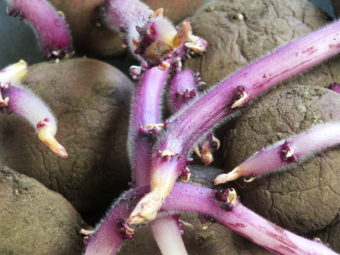
Close up view of potatoes which have started spouting. (Photo by Matt Miller/KTOO)

Master Gardener Ed Buyarski presents his annual list of helpful hints for those planting potatoes.

He recommends avoiding disease build-up by rotating crops. For example, use a different planter or bed for potatoes this season to avoid perpetuating any potato scab disease from last year.

Use whole seed potatoes that are about the size of a pingpong ball or a hen’s egg. Bigger potatoes can be sliced up so they have at least one eye for each piece.

Dig a trench about 6 to 8 inches deep and move the extra soil to the sides. Sprinkle a little fertilizer into the bottom of the trench and place each seed potato about a foot apart with the eye or sprout facing up. Just barely cover the seed potatoes with soil, and then cover with clear plastic to warm up the planting bed.

Buyarski recommends hilling your potatoes twice during the spring.

“When the potatoes get to be about 3 inches tall or so, then it’s time bring some of the soil from the sides and start filling them back in,” Buyarski said. “That’s the hilling process for the potatoes.”

Listen to this week’s edition of Gardentalk:


First wood bison calves spotted near Bethel

Wood bison calf
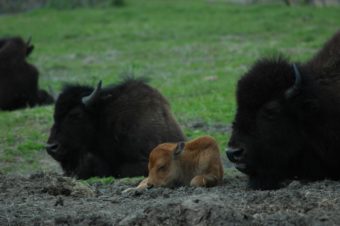
A wood bison calf elsewhere in Alaska in June 2007. (Creative Commons photo by pbarbosa)

Wood bison, recently reintroduced by the Alaska Department of Fish and Game into western Alaska, have been begun to roam throughout the region and spotted near Bethel.

The first sighting of wood bison calves born in the wild could mean big changes in the ecosystem of western Alaska.
The sighting last week of the newborn animals comes after Fish and Game released about 130 wood bison in 2015, an effort Fish and Game biologist Tom Seaton said has been in the works for more than 25 years.

Since the reintroduction, the herd has had its ups and downs. Though 19 of the bison born in captivity died once released, “The bison are completely functioning as wild animals and being successful at it,” Seaton said.

The true test of how well the creatures can adapt is in the survival of the calves, Seaton said.

“Most of the animals out there now spent most of their life in captivity, and they’re doing a great job of being wild bison. But they’ll never be as good as these animals that were bred and born in the wild,” Seaton said.

The deaths of the 19 bison has not been the only challenge. The bison born in captivity sometimes have trouble being independent from humans.

“First it was kind of a thrill to see them,” said Chief Ivan Demientieff of Grayling, who came home one day to find six wood bison in his yard.

“I made jokes saying that I don’t need no grass cutter anymore,” Demientieff said.

But things changed when one bison began to cause trouble.

“It got to the point where it wouldn’t leave, and I had to chase it out of the yard. Then it started living in my shop,” Demientieff said.

Eventually authorities removed the bison. But Seaton said he’s not concerned about this behavior, because the next generation of bison will most likely be more afraid of humans and able to seek out food in the wilderness instead of people’s yards.

When people start hunting the wood bison, which Seaton said will happen when and if the herd more than doubles in size, that will be the final push into the wild to make the animals feel less domestic.

The opportunity for Alaska Natives to hunt the wood bison is a big selling point, said Seaton. He hopes the bison’s progression will resemble another animal that’s become a staple food in western Alaska.

“Moose didn’t occur in western Alaska until about a 100 years ago,” Seaton said.

The animals migrated from eastern Alaska in the early 1900s.

“But today moose are a big part of the culture and food supply of people in western Alaska,” Seaton said. “And if we look 100 years in the future, it’s possible that wood bison could also be a part of the culture and food supply of people in Alaska.”

One more hurdle to clear for Skagway Spirits distillery

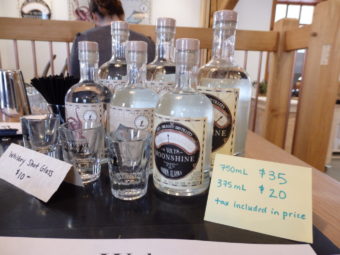
Haines’ Port Chilkoot Distillery spirits on display. Port Chilkoot could be joined by another Upper Lynn Canal distillery soon, in Skagway. (Photo by Emily Files/KHNS)

Aspiring distillers in Skagway say they have one more hurdle to clear before they start making vodka and gin. Gary Heger hopes to start a family-run distillery called Skagway Spirits.

“We’re very close, we’re just waiting on the feds at this point,” Heger said.

His new business venture Skagway Spirits was on the agenda at an Alaska Alcohol Beverage Control Board meeting earlier this week. Heger said the ABC board is close to green lighting their distillery license. He said all they need is federal license approval, which could take up to four months. No one from the ABC board returned requests for comment.

“You know, it’s been a slow process, far more involved than we ever anticipated. But when you’re dealing with this subject matter — alcohol — it’s understandable I guess.”

Heger said he’s been interested in the craft of distilling for a while. But it wasn’t until recently that he, his wife Janilyn and his adult son Lucas decided to take the leap. He said it had to do with a number of things, including finding the right space at Alaska Street and Ninth Avenue. He said the thriving Port Chilkoot Distillery in Haines also was a factor.

“Visiting there, that kind of sparked the interest again,” he said.

Although, Heger said he’s learned from the Haines distillery owners that it’s not an easy business.

“It’s kind of a bittersweet experience in that going into it, it’s going to take time before it’s profitable. Kind of a labor of love,” he said.

Heger is 68 years old. He’s worked as a general contractor for years. But now, he’s planning to put his efforts into gin and whiskey instead of roofing and construction.

“Me, I’m on my way out,” he said. “So while I have an interest in doing this, I feel Luke’s got a good grasp on (distilling). And it’s something we’ll all get to set up together and then he can just carry the torch on.”

The Heger family participated in a distilling workshop in Washington last month. They’ve joined the Distillers Guild of Alaska.

Heger envisions a distillery possibly open year-round with a tasting room. They would start out with vodka and gin and move into whiskey and maybe other spirits.

The Hegers aren’t the only ones who want to open a Skagway distillery. Haines residents Dan and Christine Turner have also applied for a distillery liquor license in the Gateway to the Klondike. But right now, only one distillery is allowed per 3,000 people in Alaska towns and cities.

Joel Probst is the project manager for the Turners’ proposed distillery, called Alaska Stillman. He said in an interview last month that the Turners understood Heger gets precedence since he applied first. But he thinks there’s a chance that population limits on distillery licenses could be changed with legislation.

“We are very aware of the Heger situation, the Skagway Spirits situation,” Probst said. “In the event that that does go forward we wish them all the luck in the world and of course we’ll be standing there to do our best lobbying efforts in Juneau to try to get those population limits lifted and have another distillery in town. Competition’s always good.”

“I’m kind of of the mind the more the merrier,” Heger said. “That wouldn’t give me any heartburn if there was another distillery here.”

Heger said it’s up to the state. If there were two, he thinks some kind of Skagway distillery tour would be a good idea to draw the cruise ship visitors to both places.

If its license is granted, Heger said Skagway Spirits would be the sixth distillery in the state. There are others in the works in Juneau, Fairbanks and Homer.

Heger said as soon as they get the go-ahead, they’ll start distilling. He hopes to open the doors to some degree this year, and to be bottling and fully open for business by next summer.
Beneath An Ugly Outside, Marred Fruit May Pack More Nutrition

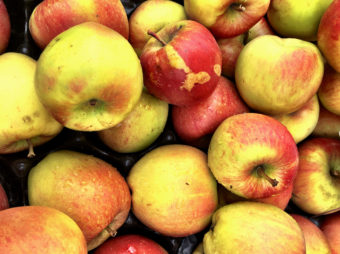
Unsightly scars on the outside of fruit might reflect higher nutrition within. Daniela White Images/Getty Images
Unsightly scars on the outside of fruit might reflect higher nutrition within.
Daniela White Images/Getty Images

When orchardist Eliza Greenman walks through a field of apple trees and gazes upon a pocked array of blemished and buckled fruits — scarred from fighting fungus, heat and pests — she feels a little thrill of joy. “I’m absolutely infatuated with the idea of stress in an orchard,” says Greenman, who custom grafts and grows pesticide-free hard cider apples in Hamilton, Va. These forlorn, scabbed apples, says Greenman, may actually be sweeter.

In an unofficial experiment, Greenman tested scabbed and unscabbed Parma apples, a high-sugar variety native to southwestern Virginia, and found the scarred apples had a 2 to 5 percent higher sugar content than unmarred apples from the same tree. More sugar means a higher alcohol content once fermented, producing a tastier hard cider.

But she loves these ugly apples for another reason: They may be more nutritious and have a higher antioxidant content. Says Greenman: “I believe stress can help create a super fruit.”

Ugly fruits and vegetables are today’s pocked and scaly, dimpled, misshapen darlings — and there is a growing movement to sell such produce, not dump it into municipal landfills. As The Salt has reported, we toss out enough food to fill 44 skyscrapers each year. Why waste perfectly good food? This April a handful of Whole Foods stores in California will sell the cosmetically marred but nutritious produce for the first time.

But does some blemished produce pack an unexpected nutritional punch — courtesy of its own battles to survive?

We already suspect this is the case with organic fruits and vegetables. A 2014 review of 343 studies found that organic produce had lower pesticide residue and a 20 to 40 percent higher antioxidant content than conventional produce. Those antioxidants include compounds such as flavonoids, phenolic acids, anthocyanins and carotenoids, all produced by plants as defense mechanisms when they are stressed by pests. The study authors suggested that organic crops may be subject to more stress because they may receive fewer pesticides, in lower doses, and with less potent killing effects.

Another study of both conventional and organic apple varieties found higher antioxidant phenols and fruit acids in organic apples. The study authors noted,The regular consumption of fruit acids is helpful in preventing illness and metabolic disorders. We recommend the consumption of regional organically grown varieties rather than of cultivars from integrated cultivation.”

Ugly fruits actually bear the visible scars of their successful battles — dimpled or scarred where they fought off a biting or gnawing insect or surface infection. Greenman’s ideal is a truly wild apple, one left to its own defenses in nature — with the cosmetic imperfections to prove it. Though not all pests and diseases are benign, she notes, a few common apple infestations are the result of harmless fungi that result in sooty “blotch” (dark patches) and fly speck (black dots), but do not harm taste or texture nor infect humans. These blotches are a result of the plant fighting off environmental insults — relying on its antioxidant defenses to do so. Greenman suspects those unsightly scars may reflect higher nutrition.

She may be right. One study showed that an apple covered in scab has more healthy, antioxidant phenolic compounds, called phenylpropanoids, than a scab-free apple peel. Another study showed that apple leaves infected with scab have 10 to 20 percent more phenolic compounds. Similar research has found high levels of resveratrol in grape leaves infected with fungi or simply exposed to the stress of ultraviolet light. A study of Japanese knotweed, a plant with a long tradition of use in Chinese and Japanese herbal medicine, found that infection with common fungi boosted its resveratrol content as well. Resveratrol is an antioxidant that’s been well-studied for its potential cardio-protective action. All these antioxidants protect both plants, and probably the humans who eat them.

This does not mean that we should turn away from conventional agriculture, or make hard and fast assumptions about crops, says environmental biologist Brian Ward, of Clemson University in Columbia, S.C. “There are so many factors contributing to antioxidant content,” says Ward, who oversees research in both conventional and organic agriculture. “The most important factor is the plant itself — and the variety. That’s genetic. Then there is the soil, its mineral content, and whether conventional or organic fertilizer is used. But yes, there is some interesting data that when plants are stressed by insects or disease, they produce metabolites that are good for us.”

Greenman’s insight intrigues microbiologist Martin L. Pall, professor emeritus at Washington State University. Pall says that our own innate, potent protective mechanisms can be activated by compounds in fruits and vegetables. In fact, he suggests in a recent research paper, those antioxidants may serve as mild stressors that kick our repair mechanisms into high gear. They activate a molecule in our cells known as Nrf2, which itself can trigger the activity of over 500 genes, most of which have cell-protective functions.

“This is certainly true of compounds like resveratrol,” he says. “That part of the story is pretty clear.” He says there’s intriguing evidence that other plant compounds that increase under stress may be good for our health, too, but those benefits are not as well-documented.

Pall contends that we have co-evolved for eons with plants whose compounds benefit us. He points out that known longevity diets — such as the traditional Mediterranean and Okinawan cuisine — are rich in exactly these compounds and antioxidants.

So, backyard organic gardeners, rejoice: Your imperfect produce may be more perfect than you thought. Next time you hesitate over a flawed fruit, remember that it may be a hardy survivor bearing hidden nutritive gifts.


Jill Neimark is an Atlanta-based writer whose work has been featured in Discover, Scientific American, Science, Nautilus, Aeon, Psychology Today and The New York Times.

Copyright 2016 NPR. To see more, visit http://www.npr.org/.

Sitka Tribe opens biotoxin lab to monitor PSP

Lab manager Michael Jamros stands with Chris Whitehead, founder of the Southeast Alaska Tribal Ocean Research group. The lab hopes to be regional testing hub for commercial and casual shellfish harvesters alike. (Photo by Emily Kwong/KCAW)

With warming ocean temperatures, the risk of paralytic shellfish poisoning can linger all year-round, and Alaska has only one Food and Drug Administration certified laboratory to test shellfish. There are no labs to protect those digging for their dinner, but that may soon change.

At the end of the month, the Sitka Tribe of Alaska will open an environmental research laboratory and – with all hope – take a bite out of the testing market.

This time last year, the room in the corner of Sitka Tribe of Alaska’s (STA) Resource Protection Department was bare. And now, it’s got a fume hood, test tubes in every color, and a $49,000 machine.

Michael Jamros is the lab’s new manager. And the “robot” in question is a plate reader, one of several machines that can analyze toxins in shellfish. After the shellfish arrive, Jamros shucks all the meat out and puts it in a blender to homogenize it. He then extracts the toxins and removes the solids using a centrifuge.

Using a pipette, Jamros will dispense the solution in 96 tiny wells on one plastic plate. Imagine filling a tray with batter for 96 muffins, but instead of putting it in an oven, he feeds it into a plate reader.

Jamros is running an ELISA assay, measuring the toxicity of each well. The results appear on his laptop. “From here we have our data that we can calculate from and figure out how much toxin is in our samples,” he said.

You hear that? Data. Cold, hard numbers that take the guesswork out of eating butter clams or blue mussels. In Southeast, there’s never been a way for subsistence harvesters to assess the risk of paralytic shellfish poisoning or measure harmful algal blooms, or HABs, which load shellfish with toxins until now.

Chris Whitehead is STA’s environmental program manager and the driving force behind the lab, set to open in May. “Native people have been harvesting clams for thousands of year. A lot of the elders I talk to don’t do it anymore because they just don’t know. So, to be able to bring that back and be able to utilize that resource is huge,” Whitehead said.

When he came to Sitka in 2013, Whitehead wanted to create a warning system for clam diggers, like in Washington state. “The Washington Department of Health has a great website so you can see what beaches are open or closed. And when I got to Alaska there wasn’t anything.”

Whitehead called up Alaska’s Department of Environmental Conservation, which tests all commercial shellfish for the state. He discovered, however, there would be a time lag to ship shellfish to Anchorage and await results. “The turnaround time for the (DEC) data – to actually be usable for us and to prevent human health issues – wasn’t going to work,” he said.

Given this, Whitehead decided to pursue a local solution by creating his own marine biotoxin program right here in Southeast. He locked in $1 million in grant funding for the next three years. He formed Southeast Alaska Tribal Toxins (SEATT), a coalition of 13 other tribes in the region and organized trainings for them with state and federal agencies, like NOAA, to be “eyes in the water,” monitoring local beaches for toxic blooms.

“So those sites will be monitored at the expense of the tribe and the resources that the tribes have every other week. So every tide cycle pretty much,” Whitehead said.

The lab uses new technology, including the ELISA and receptor binding assay (RBA), to test for the presence of toxins in shellfish, without resorting to live mice. (Emily Kwong/KCAW)

Jerry Borchert was in Sitka to lead one of those trainings. Borchert coordinates marine biotoxin management for the state of Washington.

In speaking with KCAW, he said, “My first time here was a year ago in September. It was a smaller group. I think there were six tribes at the time and for a lot of these folks, this was brand-new to them. Looking at plankton, trying to identify what a harmful species looks like, how to record it, how to share this information, and it’s those same tribes in the beginning that are now the teachers and the program is expanding. This is amazing.”

With the new laboratory, subsistence harvesters can hopefully send their shellfish to Sitka and get test results back in one business day. Eventually, the lab hopes to run tests for commercial entities – like shellfish growers and processors.

But some hurdles remain. The lab needs the blessing of an alphabet soup of agencies, like the FDA, to become a full-fledged regulatory lab, on par with the one on Anchorage. Borchert said, “Long term stability is something I’m a little concerned with. The state regulatory folks are finally coming to these workshops and I’m hoping they can recognize what can happen.”

For his part, Whitehead is taking it one step at a time. The lab is running test samples all this month and sending their results to NOAA in Seattle, for verification. If those check out, the lab will begin accepting subsistence shellfish as early as May.

Site notifications
Update notification options
Subscribe to notifications