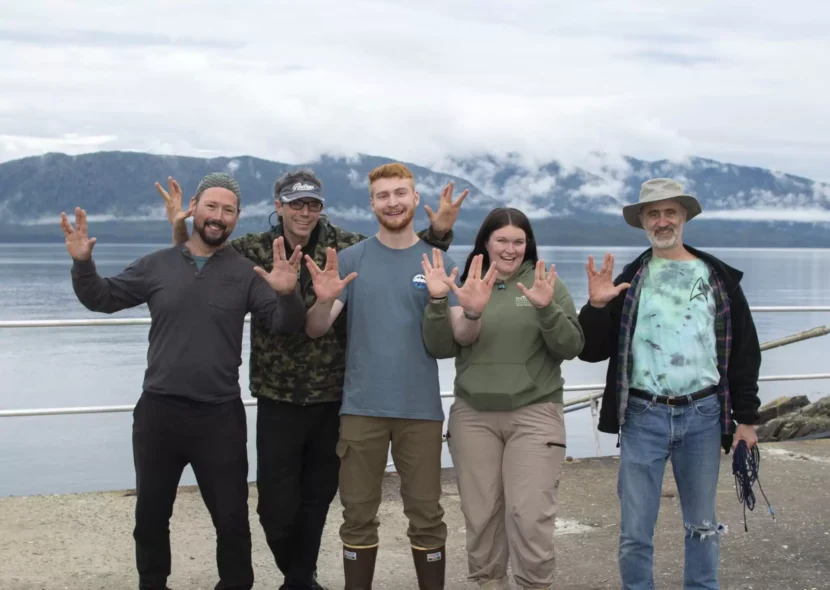
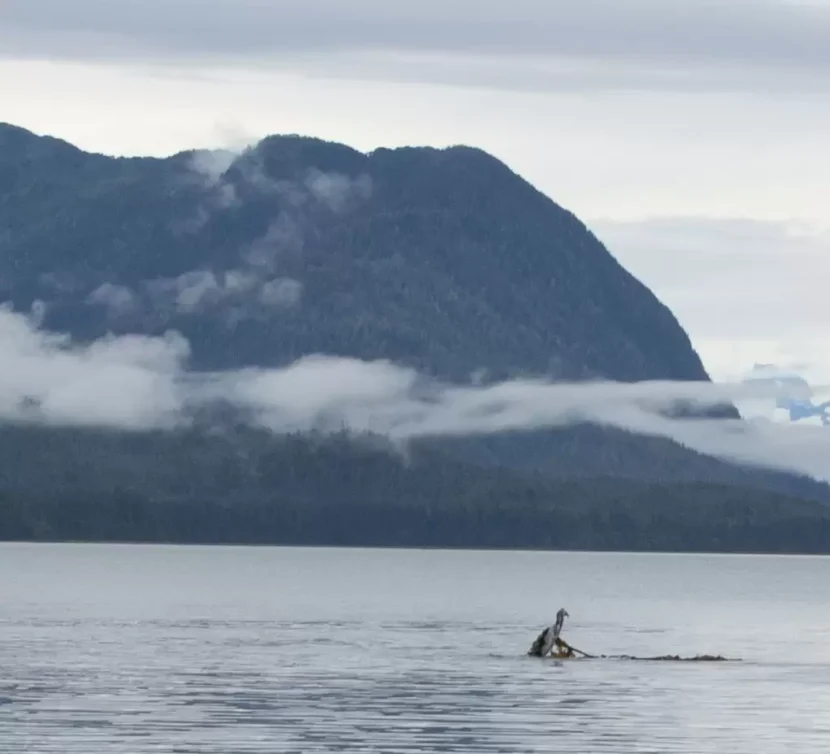
From left to right, Josef Quitslund and Whale-SETI affiliates Fred Sharpe, Jack Mezzone, Rachel Meade and Joe Olson throw up the Vulcan Salute at Five Finger Lighthouse on July 24, 2024. (Photo by Shelby Herbert/KFSK)
Researchers from an organization that seeks out extraterrestrial life camped out at a remote lighthouse in Southeast Alaska for the better part of the summer, but they weren’t out there looking for little green men.
They were there to look for — and listen to — the humpback whales that swarm the waters of Frederick Sound.
On a July voyage to Five Finger Lighthouse, skipper Josef Quitslund noticed something moving in the distance. He slowed down and cut the engine, then tossed a contraption that looks something like a baby monitor into the water.
The device — something called a hydrophone — picks up humpback whale sounds. Almost out of nowhere, several adult humpbacks rushed to the surface, mouths agape, scooping up a school of herring.
They were bubble-net feeding, a kind of cooperative hunting strategy where groups of whales get together to blow complex configurations of bubbles that allow them to trap their prey.
Quitslund’s wife, biologist Stephanie Hayes, pointed out a calf hanging back — rolling back and forth in a patch of kelp.
“He’s playing with kelp!” Hayes said, gesturing at the calf. “He’s giving himself a kelp bath!”
The whales finished their breakfast and the whale researchers continued on to the lighthouse, where premier whale behavioral scientist Fred Sharpe was helping coordinate Whale-SETI, a 15-year project spearheaded by the Search for Extraterrestrial Intelligence Institute.
“Frederick Sound is this incredible solar-powered krill factory,” said Sharpe. “It brings whales — in some years, by the hundreds. And we’re a couple mountain ranges back from the open ocean, so we’re shielded from the ship noises.”
The team needs that relative quiet so they can listen carefully to the whales in the surrounding waters.
A humpback whale calf “plays” with kelp wrapped around its flipper on July 24, 2024. (Photo by Shelby Herbert/KFSK)
Sharpe and his team have been trying to crack the code of humpback whale communication for many years now, and he thinks they’re getting close. He’s part of a research group that “talked” to a female humpback whale named Twain by playing whale noises back to her with an underwater speaker.
“We had an event where we described a 20 minute interaction with a whale right up by the lighthouse, where we exchanged 36 signals back and forth: one of these ‘throp’ calls. Throp call is one of their basic social sounds that the humpback whales give,” Sharpe said. “The social sounds are kind of like … sort of social chatter — a diverse set of social chatter, but shows some stability over time and space.”
Acoustic engineer Joe Olson was wearing an on-the-nose Star Trek sweatshirt.
He said encounters like the one with Twain might inch us closer to understanding extraterrestrial intelligence. But he said they can’t approach the experiment like they’re trying to learn a language on human terms.
“We only see what we’re looking for,” said Olson. “And so, with the communication of the humpbacks, we’re only going to figure out what it is that we’re looking for, right? It’s the same with aliens. For all we know, there’s aliens sending neutrino signals. But… we have no way to manipulate neutrinos. And they may have been beaming things out as saying: ‘Hey, look, look, look!’”
Another group of SETI researchers were scheduled to arrive at the lighthouse in just a couple of days, and Sharpe’s team had much to do to prepare.
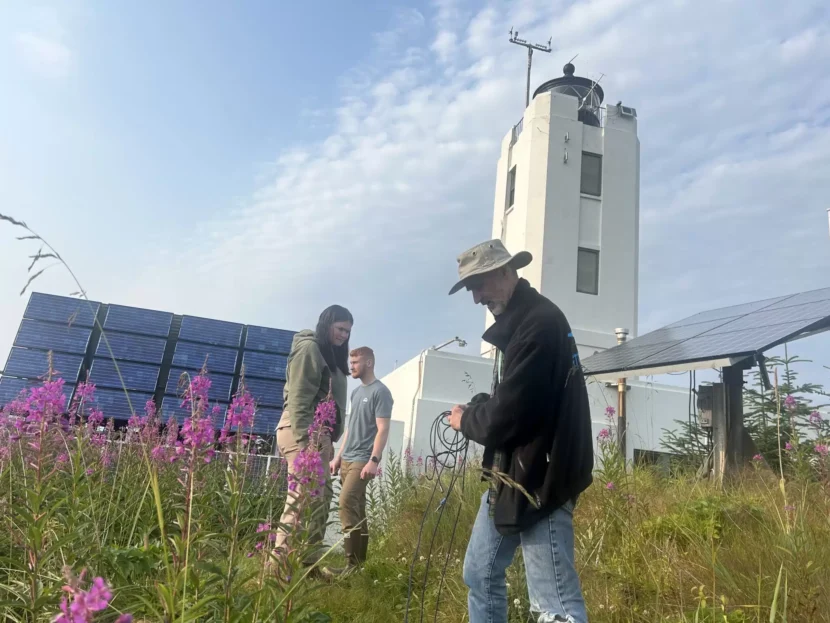
Rachel Meade, Jack Mezzone and Joe Olson set up hydrophones on Five Finger Island on July 24, 2024. (Photo by Shelby Herbert/KFSK)
They set up hydrophones on almost every corner of the island. But those devices weren’t just picking up whale noises, as Olson explained on a cliff where he had installed a hydrophone.
“We’re just hearing bivalves over here. Stuff that’s stuck to the walls … barnacles, mussels, whatever,” Olson said, before giving his best bivalve imitation.
Lighthouse keeper Don Merrill has watched this team of scientists scurry around his home with strange equipment for several days now. On the alien question: he’s got his doubts.
“Do you want it from a religious standpoint, or from a metaphysical standpoint?” asked Merrill. “When you’re bringing up aliens, I am quite a skeptic.”
But his face lit up when asked how he feels about the hydrophone speakers strewn across his house.
“That’s cool,” said Merrill. “I come out here sometimes and I’ll just turn the sound up, just because I want to know what’s going on. I grew up on the ocean, [as a] fishermen. I had no idea that was that much sound down there. That is a wild place! … It’s really opened my eyes.”
Inspiring that kind of excitement is part of what the group is aiming for with this project. Olson said by holding up the possibility of communicating with animals, they can get people to care about them.
“When we see something that we understand or we love or we connect with, we’re more likely to try to protect them or to respect them,” he said. “And who knows, maybe we’ll crack the code, right? If there’s a code to be cracked, maybe Fred will be the one to crack that code.”
They’re not quite there yet. But at the end of the summer research session, Sharpe said he’s happy with the diversity of noises and behaviors they added to their repertoire. He said he’s excited to continue attempting to translate humpback whale language to make us feel a little less alone on the planet — if not the universe.
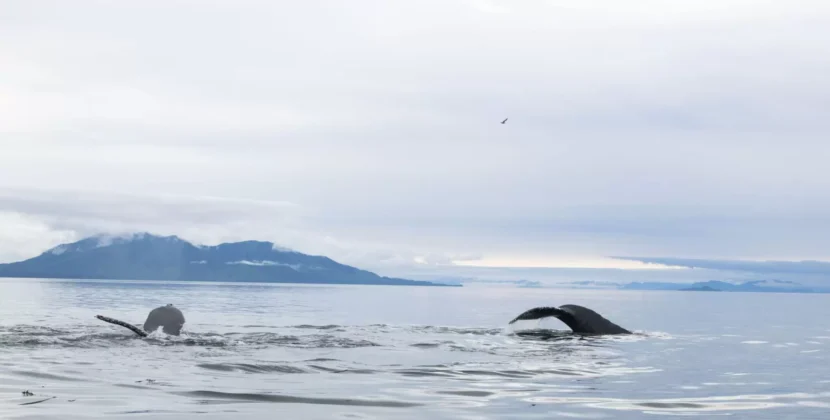
Humpback whales plunge into the depths of the Frederick Sound after feeding on July 24, 2024. (Photo by Shelby Herbert/KFSK)
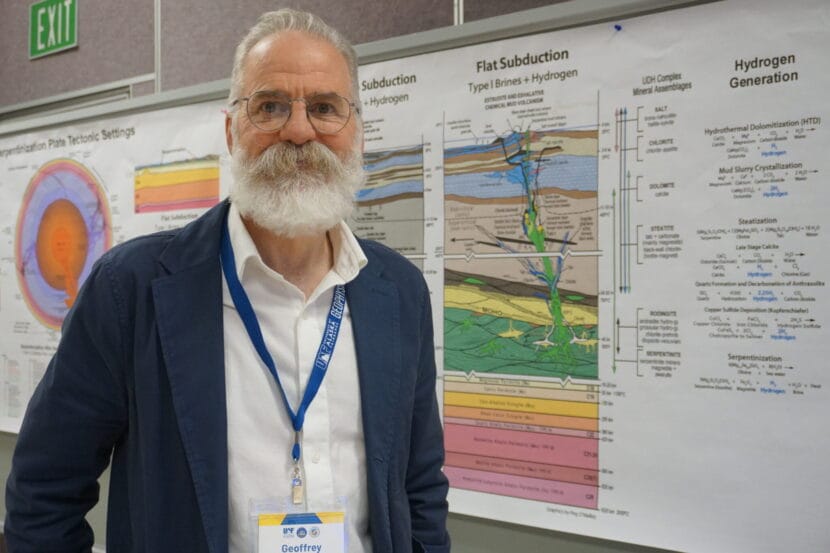
U.S. Geological Survey geologist Geoffrey Ellis stands on Oct. 29 by a poster diplayed at the University of Alaska Fairbanks that explains how pure hydrogen can be pooled in underground formations. Ellis is the leading USGS expert on geologic hydrogen. He was a featured presenter at a three-day workshop on geologic hydrogen that was held at UAF. (Photo by Yereth Rosen/Alaska Beacon)
The key to decarbonization may be all around us.
Hydrogen, the most abundant element in the universe, is in the ocean, in the sky, in the stars, in the bodies of living beings and – of particular importance to energy developers – in the ground.
And it is getting increasing attention globally.
Governments, industry and scientific institutions are now investigating how they might be able to switch from drilling for petroleum, which produces planet-warming carbon dioxide when burned, to drilling for zero-emissions hydrogen.
There are good reasons for that, said Geoffrey Ellis, the U.S. Geological Survey’s geologic hydrogen research leader.
Ellis, who said he was once “in the wilderness” on the subject but who is now leading a wide-ranging research group, was one of the main speakers at a geologic hydrogen workshop held in late October the University of Alaska Fairbanks. The event was hosted by the U.S. Arctic Research Commission and the University of Alaska Fairbanks Geophysical Institute and co-sponsored by the Office of the Ambassador at Large for Arctic Affairs, Mike Sfraga.
Shifting to renewable sources like solar, wind and geothermal energy is crucial to addressing climate change, but there is no way those types of energy can power big industrial users like manufacturers and agriculture, Ellis told the workshop attendees.
In the future, Ellis said, there will likely be a need for 400 million tons of hydrogen, compared to the approximately 100 million tons currently used. And the hydrogen currently used is not the type that is pulled from the ground. Rather, it is produced through an energy-consuming process that pulls the element out of other compounds, separating it from methane in natural gas or using electricity to separate it from oxygen in water.
In contrast, the hydrogen in the ground accumulates when water encounters iron or radiation. Through a process known as serpentinization, the reaction with those other elements in the earth separates the water’s hydrogen from its oxygen – without human intervention. In contrast with oil and natural gas, which take millions of years to form, geologic hydrogen forms quickly. It can even be stimulated through injection of water.
Initial estimates, Ellis said, are that the earth could hold about 5 million megatons of geologic hydrogen, or 5 billion tons. While much of that is in impossible-to-reach sites like the deep ocean, accessing just 2% of that would meet the anticipated global hydrogen demand for more than 200 years, he told the workshop attendees.
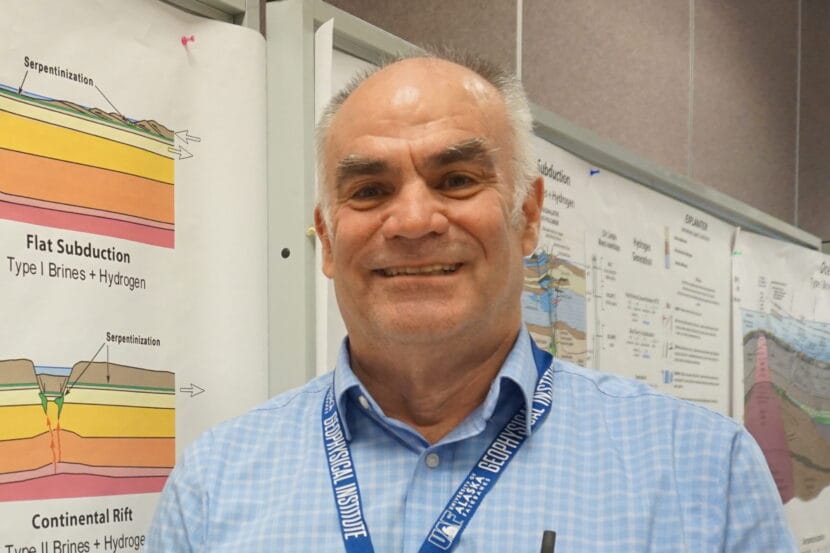
Mark Myers, a member of the U.S. Arctic Research Commission, stands on Oct. by posters explaining how hydrogen can be pooled in underground formations. Myers and others organized a three-day workshop on geologic hydrogen that was held at the University of Alaska Fairbanks. (Photo by Yereth Rosen/Alaska Beacon)
“It’s likely that there are large amounts of hydrogen in the subsurface. And so, the question is not: ‘Is it down there.’ But it’s: ‘Is it in places where we can find and produce it?’” Ellis said.
For Alaska, where traditional fossil fuels can be expensive as well as environmentally burdensome, hydrogen energy could underpin development of other non-fossil-fuel energy. Geologic hydrogen could be an important part of the solution, said Mark Myers, a geologist and member of the U.S. Arctic Research Commission.
“It’s a new resource that could be combined with renewables, but superior in many ways,” said Myers, who served in the past as the commissioner of the Alaska Department of Natural Resources, as director of the USGS and as vice chancellor for research at UAF, among other positions.
As he explains it, the physical characteristics that make Alaska prone to earthquakes and volcanic eruptions and rich with mineral deposits also signal potential for reserves of valuable hydrogen in the ground. There is already one company, for example, that is investigating the potential for hydrogen in the same Southeast Alaska geologic belt that holds the better-known Bokan critical minerals deposits currently being explored.
Alaska is far from the only prospective region. Any spot on the earth where the ocean floors have been pulled apart has the potential to hold geologic hydrogen, Myers said.
One region of keen interest is the Midcontinent Rift, a geologic feature that runs from Lake Superior to Kansas in the U.S. Midwest. Exploratory drilling there has already begun.
Still, Alaska has some characteristics that could make it a key area for hydrogen research and development, Myers said.
Alaska, unlike other parts of the nation and the world that are connected to power grids, has some acute energy needs, he said. And it has permafrost, which could be an advantage because microbes that consume hydrogen are less active in cold environments, he said.
There are myriad challenges to geologic hydrogen beyond finding the resource, said experts at the UAF workshop. One is that hydrogen molecules are small, meaning they are not easily trapped in the pores of underground rocks. Another is that hydrogen molecules tend to attach quickly to those of other elements, potentially making separation ephemeral.
For now, there is only one place in the world being powered by geologic hydrogen: Bourakebougou, a small village in Mali. There, hydrogen was discovered in 2011, at a site where in 1987 an errant cigarette touched off an explosion at what was intended to be a water well.
Since then, there have been about two dozen hydrogen wells drilled, and the village’s electricity runs off the hydrogen produced from those wells.
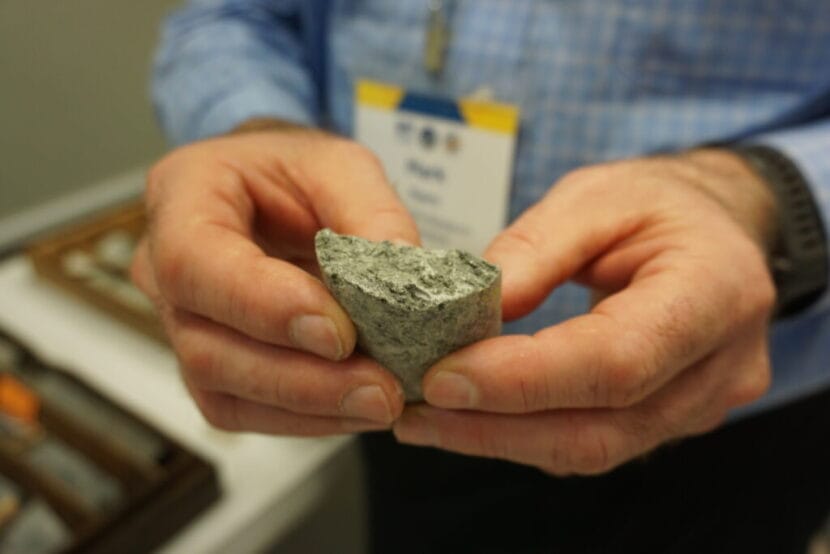
U.S. Arctic Research Commission member Mark Myers on Oct. 29 holds a sample of metallic rock from the Bokan formation that could be instrumental in forming geologic hydrogen. The rock samples were displayed at a three-day geologic hydrogen workshop, organized by Myers and others, that was held at the University of Alaska Fairbanks. (Photo by Yereth Rosen/Alaska Beacon)
The idea of replicating anything like that in Alaska is enticing, said a state lawmaker who has been following the subject closely.
Senate Majority Leader Cathy Giessel, R-Anchorage, has immersed herself in the subject of hydrogen. For example, she has been participating in meetings held by the Alaska Hydrogen Working Group, founded in 2022 by UAF’s Alaska Center for Energy and Power and the Department of Energy’s Arctic Energy Office.
Geologic hydrogen could be a new source of state revenue, she said. It could provide energy for communities and economic development, she said. If it is found within Native-owned lands, it can enrich Native corporations around the state through the revenue-sharing provisions in the Alaska Native Claims Settlement Act, she said.
But for now, no one should expect any legislation on it, other than potentially some insertions of the word “hydrogen” into existing resource-related statutes if applicable, Giessel said. The subject is too new and there are too many unknowns, she said.
“I don’t envision the need for legislation at this point, until we know what the potential resource is,” she said.
She does intend to hold at least one informational hearing to help her colleagues and the public get more familiar with the subject, she said.
Providing information is the most important thing the state can do to promote development of geologic hydrogen, Giessel said.
“Probably our biggest help to any industry is if we go out and map what the resource availability is. We are an under-mapped state,” she said,
Other information could come from the state’s Geologic Materials Center, the collection of cores and other geologic samples that are available for the public to peruse and study, she said. The center, located in Anchorage, is operated by the state Division of Geological and Geophysical Surveys.
Myers, speaking to the experts gathered at the workshop, also emphasized the need to build knowledge – and to do so quickly. That will take a new way of doing science, likely a whole new structure involving government, industry and academia.
“The challenge is great. But it’s going to be fun. And you’re on the edge of discovery,” he told the group.
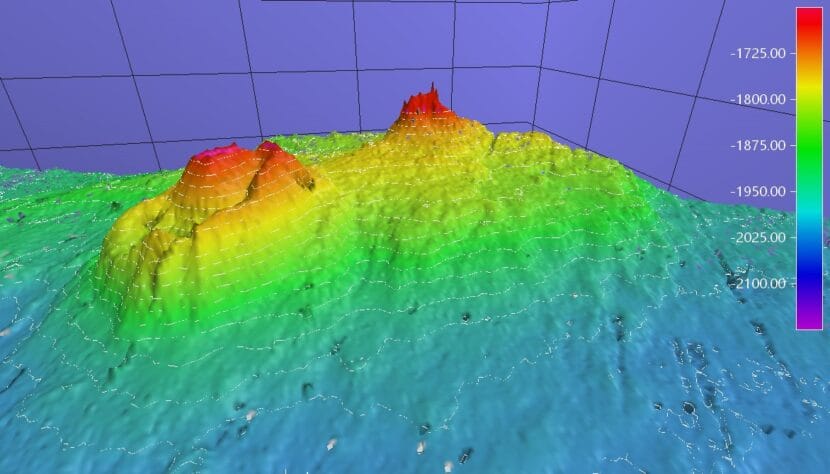
New data is used to map a volcano-like feature discovered this fall by science teams aboard the U.S. Coast Guard Cutter Healy, a polar-class icebreaker used for Arctic research. The scientists found the structure on the continental slope off northern Alaska. (Image provided by the National Oceanic and Atmospheric Administration)
Scientists aboard a U.S. Coast Guard icebreaker have discovered something unusual in the Arctic Ocean off northern Alaska: a volcano-like structure rising more than 500 meters from the seafloor and possibly emitting gas.
The discovery came as scientists from different organizations were aboard the Healy, one of two polar-class Coast Guard icebreaking cutters, were working on a mission to better understand uncharted waters in the Chukchi and Beaufort seas north of Alaska.
Although the structure rises well above the seabed, it tops out at about 1,600 meters below the water’s surface, so it is too deep to pose any risks to navigation, the Coast Guard said in a statement. However, there appears to be a plume of gas rising from the structure that nearly reaches the water’s surface, the Coast Guard said.
The discovery is part of a project called the Alaskan Arctic Coast Port Access Route Study. The project is surveying what have been uncharted waters and collecting depth data along a corridor that the Coast Guard has proposed to be a preferred vessel route between Utqiagvik, the nation’s northernmost community, and the U.S.-Canada border. The project is making use of equipment aboard the Healy to gather data and create detailed images of the seafloor and objects along the proposed Utqiagvik-to-Canada corridor.
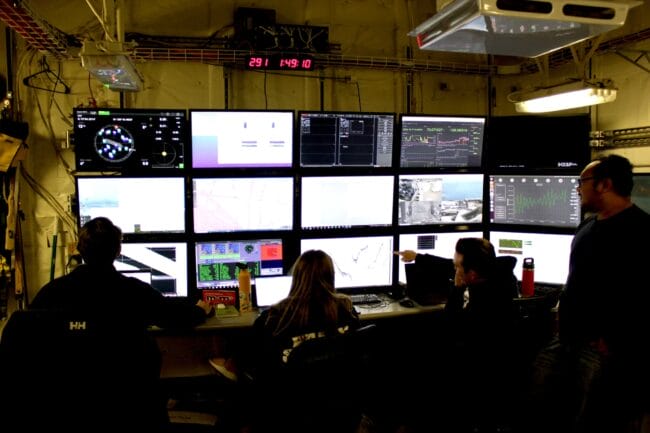
Researchers from the National Oceanic and Atmospheric Administration Ship Fairweather and the University of New Hampshire analyze mapping data in the U.S. Coast Guard Cutter Healy’s computer lab while the cutter transits the Beaufort Sea on Oct. 16. (Photo by Lt. j.g. Haley Howard/U.S. Coast Guard)
Multiple organizations are collaborating on the project, which is in its first phase: the U.S. National Science Foundation, the National Oceanic and Atmospheric Administration, and the University of New Hampshire, along with the Coast Guard.
Capt. Meghan McGovern, the commanding officer of the NOAA Ship Fairweather, is part of the Healy mapping team and commented on the discovery.
“Although data analysis is ongoing, these findings are exciting and offer insight into what may exist beneath the ocean’s surface, much of which is unknown in this region,” McGovern said in a Coast Guard statement. “The coordination and partnerships during this mission fill critical gaps in the region for all waterway users and provide a foundation for safe navigation in the Arctic.”
The port access route study accomplishments came despite some difficulties endured earlier in the year by the Healy, its crew and its visiting scientists.
The Healy is the only Coast Guard icebreaker designed to support scientific research. This year, it hosted 20 early career scientists, along with their mentors, to help them gain Arctic research experience and skills.
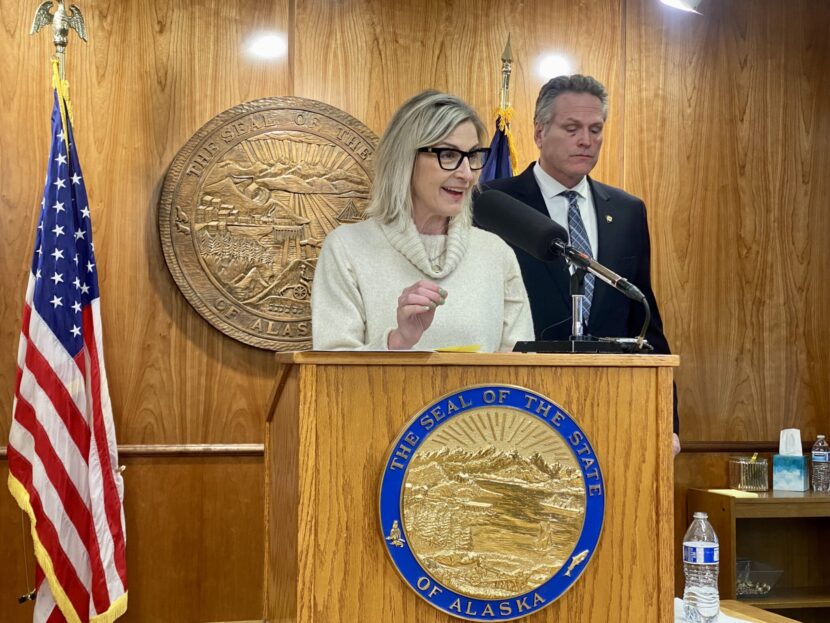
Deena Bishop, commissioner of the Alaska Department of Education and Early Development, speaks at a news conference on March 15, 2024, with Gov. Mike Dunleavy. (Photo by Claire Stremple/Alaska Beacon)
The state’s top education official relied on generative artificial intelligence to draft a proposed policy on cellphone use in Alaska schools, which resulted in a state document citing supposed academic studies that don’t exist.
The document did not disclose that AI had been used in its conception. At least some of that AI-generated false information ended up in front of state Board of Education and Early Development members.
Policymakers in education and elsewhere in government rely on well-supported research. The commissioner’s use of false AI generated content points to a lack of state policy around the use of AI tools, when public trust depends on knowing that the sources used to inform government decisions are not only right, but real.
A department spokesperson first called the false sources “placeholders.” They were cited throughout the body of a resolution posted on the department’s website in advance of a state board of education meeting, which was held in the Matanuska-Susitna Borough this month.
Later, state Education Commissioner Deena Bishop said they were part of a first draft, and that she used generative AI to create the citations. She said she realized her error before the meeting and sent correct citations to board members. The board adopted the resolution.
However, mistaken references and other vestiges of what’s known as “AI hallucination” exist in the corrected document later distributed by the department and which Bishop said was voted on by the board.
The resolution directs DEED to craft a model policy for cellphone restrictions. The resolution published on the state’s website cited supposed scholarly articles that cannot be found at the web addresses listed and whose titles did not show up in broader online searches.
Four of the document’s six citations appear to be studies published in scientific journals, but were false. The journals the state cited do exist, but the titles the department referenced are not printed in the issues listed. Instead, work on different subjects is posted on the listed links.
Ellie Pavlick, an assistant professor of computer science and linguistics at Brown University and a research scientist for Google Deepmind, reviewed the citations and said they look like other fake citations she has seen AI generate.
“That is exactly the type of pattern that one sees with AI-hallucinated citations,” she said.
A hallucination is the term used when an AI system generates misleading or false information, usually because the model doesn’t have enough data or makes incorrect assumptions.
“It’s just very typical that you would see these fake citations that would have a real journal, sometimes even a real personal person, a plausible name, but not correspond to a real thing,” she said. “That’s just like the pattern of citations you would expect of a language model — at least, we’ve seen them do something like that.”
The document’s reference section includes URLs, which led to scholarly articles on different subjects. Instead of “Banning mobile phones improves student performance: Evidence from a quasi-experiment” in the journal Computers in Human Behavior, the state’s URL led to the article “Sexualized Behaviors on Facebook,” a different article in the publication. A search for the correct title did not yield any results. The same was true for two studies the state said were to be found in the Journal of Educational Psychology.
After the Alaska Beacon asked the department to produce the false studies, officials updated the online document. When asked if the department used AI, spokesperson Bryan Zadalis said the citations were simply there as filler until correct information would be inserted.
“Many of the sources listed were placeholders during the drafting process used while final sources were critiqued, compared and under review. This is a process many of us have grown accustomed to working with,” he wrote in a Friday email.
Zadalis wrote the draft resolution and Bishop “then put it into a generative AI platform just to see if it could be helpful in finding additional sources,” Zadalis said in an email on Monday. They found that it was ultimately not helpful.
Bishop later said it was a first draft that had been posted in error, and that it was later corrected.
But vestiges of the AI generated document are still found throughout the document Bishop said the board reviewed and voted on.
For example, the department’s updated document still refers readers to a fictitious 2019 study in the American Psychological Association to support the resolution’s claim that “students in schools with cellphone restrictions showed lower levels of stress and higher levels of academic achievement.” The new citation leads to a study that looks at mental health rather than academic outcomes. Anecdotally, that study did not find a direct correlation between cellphone use and depression or loneliness.
While that claim is not correctly sourced in the document, there is a study that shows smartphones have an effect on course comprehension and well-being – but among college students rather than adolescents. Melissa DiMartino, the researcher and professor at New York Tech who published that study, said that even though she has not studied the effects of cellphones on adolescents, she thinks her findings would only be amplified in that population
“Their brains are still developing. They’re very malleable. And if you look at the research around smartphones, a lot of it is mirroring that of a substance addiction or any other type of addictive behavior,” she said.
She said the tricky part about actually studying adolescents, like the titles of the false studies from the state suggest, is that researchers must get permission from schools to research their students.
The department updated the document online on Friday, after multiple inquiries from the Alaska Beacon about the origin of the sources. The updated reference list replaced the citation of a nonexistent article in the more-than-100-year-old Journal of Educational Psychology, with a real article from the Malaysian Online Journal of Educational Technology.
Bishop said there was “nothing nefarious” at play with the mistakes and no discernable harm came from the incident.
The false citations do point to how AI misinformation can influence state policy, however — especially if high-level state officials use the technology as a drafting shorthand that causes mistakes that end up in public documents and official resolutions.
The statement from the education department spokesperson suggests the use of such “placeholders” is not unusual in the department. This kind of mistake could easily be repeated if those placeholders are typically AI-generated content.
Once it comes out a few times that information is fake, whether intentionally or not, then it becomes easy to dismiss anything as fake.
– Ellie Pavlick, assistant professor of computer science and linguistics, Brown University, and research scientist, Google Deepmind
Pavlick, the AI expert, said that the situation points to broader reckonings with where people get their information and the circulation of misinformation.
“I think there’s also a real concern, especially when people in positions of authority use this, because of this kind of degrading of trust that’s already there, right?” she said. “Once it comes out a few times that information is fake, whether intentionally or not, then it becomes easy to dismiss anything as fake.”
In this example, scientific articles — long accepted forms of validating an argument with research, data and facts — are in question, which could undermine the degree to which they remain a trusted resource.
“I think for a lot of people, they think of AI as the substitute for search in the same way, because in some ways it feels similar. Like, they’re at their computer, they’re typing into a text box, and they’re getting these answers,” she said.
She pointed to a legal case last year, where an attorney used an AI chatbot to write a filing. The chatbot cited fake cases that the lawyer then used in court, which led the judge to consider punishing the attorney. Pavlick said those errors there remind her of what happened in the DEED document.
She said it is concerning that the technology has become so widely used without a corresponding increase in public understanding of how it works.
“I don’t know whose responsibility this really is — it probably falls more on us, the AI community, right, to educate better, because it’s kind of hard to fault people for not understanding, for not realizing that they need to treat this different than other other search tools, other technology,” she said.
She said boosting AI literacy is one way to avoid misuse of the technology, but there aren’t universally acknowledged best practices for how that should happen.
“I think a few examples of stuff like this, hopefully will escalate so that the whole country, the world, gets a little more interested in the outcomes of this,” she said.
Editor’s note: This article has been updated to note that Zadalis wrote the resolution.
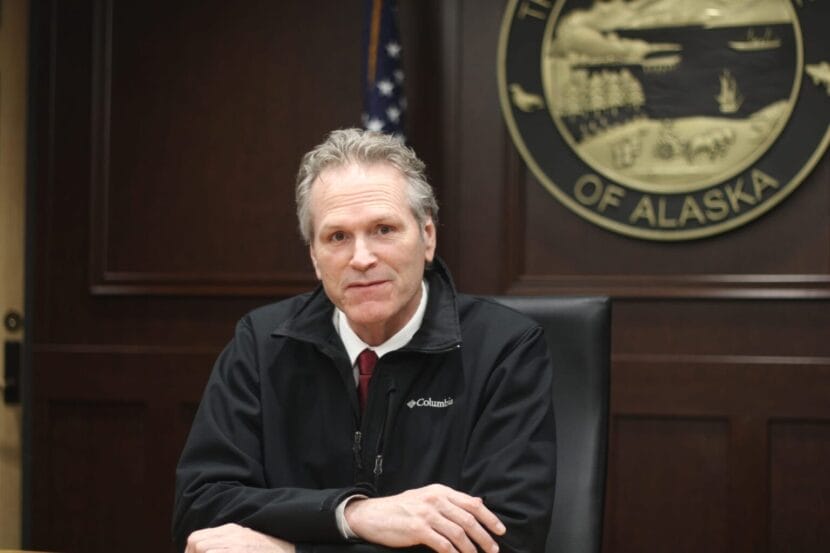
Alaska Republican Gov. Mike Dunleavy sits in the Cabinet Room at his Anchorage office Tuesday. (Photo by Nathaniel Herz/Northern Journal)
Amid a growing backlash to the factory-sized data centers that power the global internet, Republican Gov. Mike Dunleavy has started pitching his state as a new home for the industry — citing Alaska’s cool temperatures and abundant land and water.
In the past few weeks, Dunleavy has formally invited more than a dozen tech businesses to build “data farms” in Alaska, including affiliates of Microsoft, Facebook and Amazon. He also personally accompanied executives from a major data firm, Las Vegas-based Switch, on driving tours of potential sites in the Fairbanks and Anchorage areas.
In an interview, Dunleavy described Alaska as having an abundance of the natural resources that data firms are increasingly under fire for consuming in the Lower 48.
He also said that demand for electricity from new data centers would strengthen the economic case to build a multibillion-dollar natural gas pipeline to urban Alaska from the North Slope oil fields — a project long sought by the state that’s so far been thwarted by insufficient demand.
“We just need an anchor tenant or so, and that’s it,” Dunleavy said.
Companies have eyed Alaska as a site for data centers for more than two decades, dating back to 2001, when a firm called Netricity was studying a project on the North Slope.
Dunleavy’s new push comes as the industry — and its sharply increasing use of power and water — faces growing skepticism across the rest of the country, where some 5,000 facilities have been built.
Forecasts say the growth of artificial intelligence will supercharge demand. One executive has warned that without more efficient operations, data facilities supporting AI could use up to 25% of power in the U.S. by 2030 — more than six times what they use now.
A satellite view of one of Google’s data centers in Oregon, on the banks of the Columbia River. (Google Maps, data from Google, Airbus, CNES/Airbus, Maxar Technologies, USDA/FPAC/GEO)
Texas Republican Lt. Gov. Dan Patrick recently said that the industry produces few jobs relative to the “incredible demands” it places on the power grid. “Texans will ultimately pay the price,” he added.
Residents in Northern Virginia are suing to block one complex, saying data centers are driving up the price of land. Atlanta’’s city government last month banned the facilities in certain areas, citing the potential for them to crowd out housing and pedestrian access.
Dunleavy said Alaska doesn’t face the resource scarcity driving some of the opposition, and that its cold temperatures would reduce the need for cooling.
“We have more available fresh water than just about every other state,” he said. “We have copious amounts of land.”
What the state doesn’t currently have, he added, is extra power.
Alaska’s urban electric utilities currently face an impending shortage of the natural gas they use to generate most of their power — but they also don’t collectively consume enough fuel to attract investors in the proposed gas line.
Data centers would boost consumption, Dunleavy said. They could also tap into Alaska’s significant potential to generate electricity from renewable sources like wind and water, Dunleavy added, as tech businesses are increasingly trying to power their data hubs with green energy.
Microsoft, for example, has pledged to be carbon negative by 2030; it’s working with another company to revive the shuttered Three Mile Island nuclear power plant in Pennsylvania to power its AI and cloud computing centers.
Dunleavy is an enthusiastic user of artificial intelligence technology — he’s been known to pull out his phone during meetings to interrogate ChatGPT, the chatbot developed by OpenAI.
His bid to boost the data industry in Alaska prompted mixed reactions among those tracking the Alaska energy and technology industries.
A representative of the Alaska Public Interest Research Group, a nonprofit that advocates for equitable, affordable, and reliable energy in the state, said the group “welcomes industry in Alaska that does not cause harm.”
But she also suggested that data centers in Alaska would not be enough to make the proposed gas pipeline pencil out.
“Courting new industry to legitimize economically unjustifiable energy projects is a misuse of public time and money that distracts from viable energy solutions,” Natalie Kiley-Bergen, the group’s energy lead, said in an email.
Another energy expert, Antony Scott, said he thinks the most logical concept for industry is to build data centers adjacent to the North Slope oil fields. There, they could tap into abundant natural gas without the need for a pipeline to urban Alaska that would run hundreds of miles and cost billions of dollars.
Carbon emitted from the power plants running North Slope data centers could potentially be deposited back into depleted pockets of the oil fields. That could in turn capture federal tax incentives, said Scott, who spent more than a decade working for the state trying to secure gas contracts to support construction of the pipeline.
“It’s the only sensible location. I actually think it’s a pretty good idea,” said Scott, now an analyst with Renewable Energy Alaska Project, another advocacy group. “Not a lot of downside if someone else will put up the money for the new generators needed to run the server farms and the new carbon capture technology — which is not a small lift.”
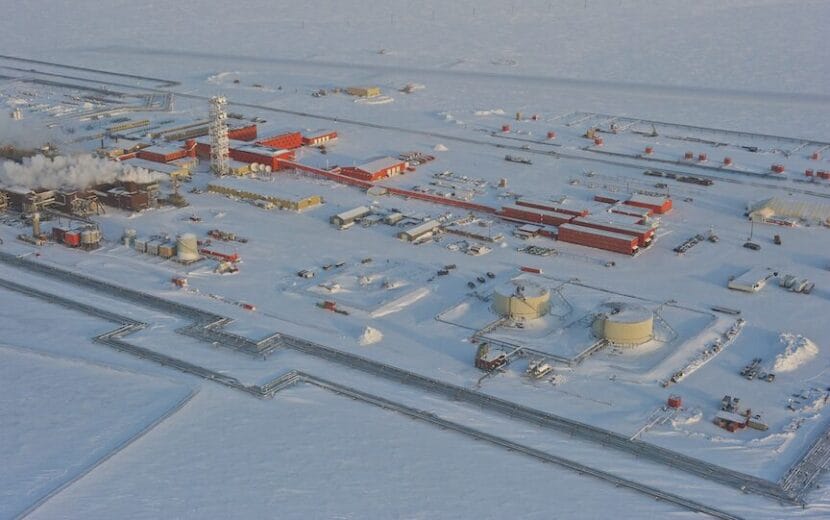
One expert says that Alaska’s North Slope oil fields, pictured here, could support development of data centers. (ConocoPhillips photo)
Dunleavy said he’d like to see data centers developed in both urban Alaska and on the North Slope, with the urban locations supporting jobs and potentially adding students to the state’s shrinking school system. “What we’re hearing is that depending on the outfit, it will vary,” he said.
One obstacle in both areas is ensuring reliable connections to the rest of the world, said Ethan Berkowitz, a former Anchorage mayor. He’s now working with a company, Far North Fiber, that hopes to build a subsea cable linking Europe to Japan while passing along the Alaska coast.
Some of the cables currently linking the North Slope with urban Alaska, and connecting urban Alaska to the rest of the U.S., are aging and would need to be replaced to support modern data centers, Berkowitz said.
But otherwise, the concept makes sense for Alaska’s economy, he added.
“This would put us on the cutting edge again,” he said.
Nathaniel Herz welcomes tips at natherz@gmail.com or (907) 793-0312. This article was originally published in Northern Journal, a newsletter from Herz. Subscribe at this link.
Editor’s note: This story has been updated to remove an assertion that Alaska’s existing fiber optic cables lack redundancy.
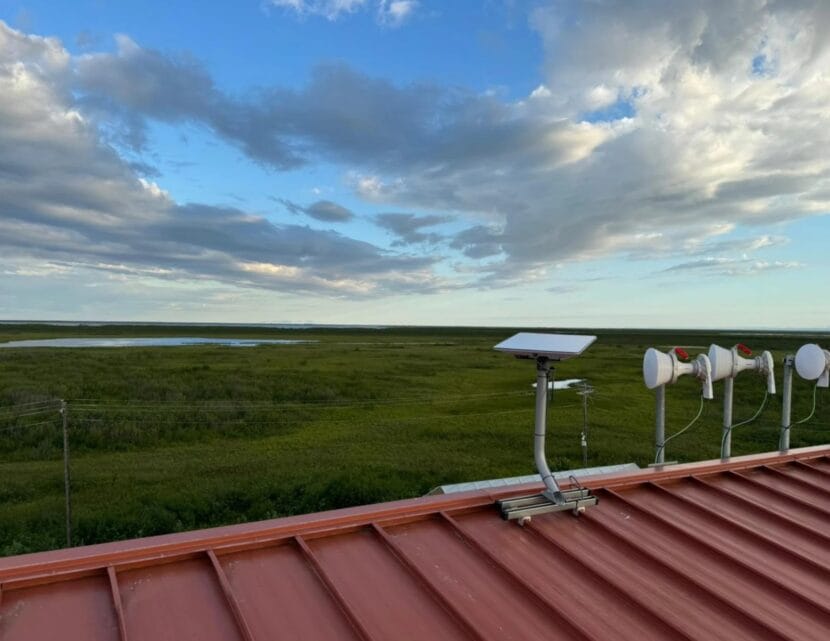
A Starlink unit is seen mounted alongside other networking equipment on top of the Alakanuk School in the Lower Yukon School District in summer 2024. (From Lower Yukon School District)
With the rise of satellite internet and the unspooling of fiber optic cables, rural Alaska is in the midst of huge changes in broadband connectivity. For school districts increasingly reliant on the internet to deliver education, these changes couldn’t come sooner.
But finding the most affordable option, and turning away from established providers in favor of services like Starlink, is easier said than done for many rural school districts. It means navigating the complex and ever-growing systems of state and federal subsidies these districts have long relied on, and that critics say should be given more scrutiny.
It remains unclear how far into the future a school internet system propped up by hundreds of millions of dollars in subsidies can last. Which internet service providers are able to come out on top securing these lucrative contracts, and whether satellite internet like Starlink proves to be a pie in the sky approach, is still up in the air.
Switching to Starlink
With kids back in school across the state, one district in Western Alaska is in the first year of a major change. It’s switching from GCI to Starlink satellite internet to serve its approximately 2,000 students living hundreds of miles off the road system. The switch is only one of the difficult moves that the Lower Yukon School District has made in response to years of virtually flat per-student funding from the state.
“We were staring down the barrel of a big deficit,” said Joshua Walton, the district’s technology director. “And we were saying, ‘How do we mitigate some of the fallout of this?’ One of the biggest things that we looked at was internet. After a lot of calls and a lot of research, we made the plunge.”
Walton said that the decision to switch to Starlink wasn’t an easy one. But he said that the highest internet speeds the district could afford from long-time provider GCI were falling short of the mark.
“You run into a lot of issues with testing. Any kind of online curriculum, classes struggled to use it just because the bandwidth isn’t there,” Walton said.
In 2023, download speeds for all but one of the district’s 11 schools were limited to 25 megabits per second. That’s what the Federal Communications Commission considered, until recently, to be adequate for the internet needs of a small household. At its Emmonak school, the district was relying on that connection to serve more than 250 students and faculty.
With Starlink, Walton said that the district should be able to tap into download speeds as much as 10 times faster, and at a price many times cheaper. He said that upfront costs for the switch were around $100,000, but that the decrease in annual costs after federal subsidies is considerable.
“Out of pocket, we’re looking at, like, somewhere around ($40,000), which is just substantial savings when you look at where we were before,” Walton said. “From close to a million dollars out of pocket with GCI, (it) was an easy decision to make.”
Walton stressed that the district’s first year on Starlink is really a test run, and that there is no true backup if the low-Earth orbit satellite internet service fails.
Next year, after a one-year contract with an Anchorage-based Starlink reseller Microcom expires, the Lower Yukon School District will be free to choose whichever provider it believes can meet its needs through a competitive bidding process. Walton said that he hopes that the complete network overhaul that he helped to complete in time for the school year is more than a flash in the pan.
“I am on the edge of my seat, kind of just making sure that everything is going to work out because we’re betting big on Starlink right now,” Walton said.
The Lower Yukon School District is the largest district in the state to take the plunge with satellite internet, but it’s not the first. A handful of smaller districts spread across the state are headed into their second year using satellite internet.
“At the forefront”
More than 1,100 miles away from the lower Yukon, the tiny Southeast Island School District has fewer than 150 students spread across seven remote schools on Prince of Wales and Baranof Islands in Southeast Alaska.
Until recently, it was paying GCI around $1.2 million a year for 25-megabit internet at all but one of its schools. After state and federal subsidies, the district was still on the hook for nearly $50,000 in annual out-of-pocket costs.
That’s according to Everett Cook, the district’s technology director. As tech assistant in 2022, he said that he saw an opportunity to break away from the norm when the district’s remote Port Alexander school was facing chronic internet outages.
“It was right when Starlink was coming out, and I said, ‘We could be at the forefront of this and it would completely benefit all the schools,’” Cook said.
Within a short time, the district’s first Starlink unit was installed at Port Alexander, which Cook said kept roughly a dozen students connected that year. Over the coming months, additional schools in the Southeast Island district got Starlink, something Cook said that the district was fortunate to be able to phase in while still receiving services from GCI.
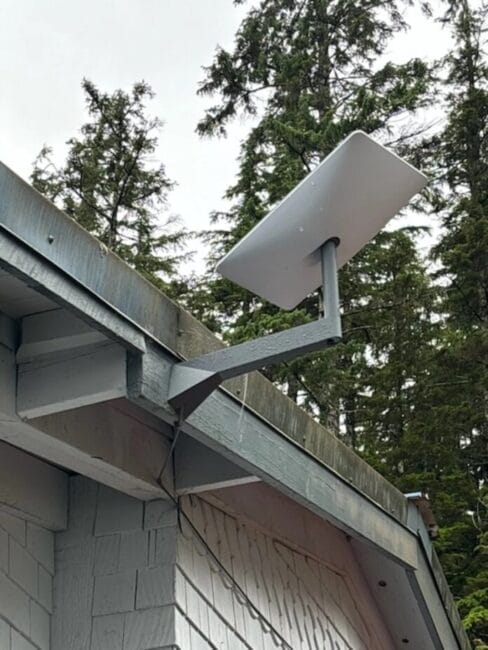
A Starlink unit is seen mounted on the Berry Craig Stewart Kasaan School on Prince of Wales Island, one of seven schools in the Southeast Island School District. (From Southeast Island School District)
“It was really on a testing (basis) like, ‘Let’s see how this is going to work,’” Cook said.
When its contract with GCI ended in 2023, Cook said that all seven schools were poised to make the switch. And in contrast to the Lower Yukon School District, there would be backups in place for all but two of the schools: 50 megabits per second connections through Alaska Power and Telephone or AP&T, another regional internet provider in Southeast.
Cook said that total internet costs for the district have been chipped down to just over $18,000 a year through the changeover to Starlink and AP&T, and that download speeds have increased multiple times over. He said that’s in part because the state program meant to help the Southeast Island School District afford internet connectivity also limited the speeds it could tap into.
So when the district turned away from its million-dollar contract with GCI last year, the stakes were high. By implementing faster internet, they were also turning away from more than $200,000 from a state broadband assistance program called the Alaska School Broadband Assistance Grant or BAG, which placed a cap on internet speeds eligible for support.
“You’re using this government money to purchase an internet connection, and then you’re using more government money to slow it down in order to help pay for it. Like, what the heck?” Cook said.
As for federal subsidies, Cook said that the district has decided to forego them altogether. He said that it was costing around $10,000 a year to hire someone just to handle the necessary paperwork. For now, the Southeast Island School District has achieved major savings and a level of broadband independence that is rare in Alaska school districts.
But the much larger Lower Yukon School District doesn’t have that luxury. This year, the district is asking for more than $600,000 in federal subsidies to pay for its Starlink-based network, according to federal records.
In Southeast, Cook said that so far he sees the switchover as a success. Nevertheless, there are risks and unknowns with the new setup, including a lack of guaranteed bandwidth or dedicated support staff in case something goes wrong, both services that GCI is able to offer. But Cook said that he’s up for the challenge.
“It seems to me that a lot of the schools prefer to have the management services and they don’t have the headache of it. They’d rather just deal with the other things that they have to deal with,” Cook said. “Whereas I had fun doing it.”
“The big money”: E-rate
While the switch in internet providers is an experiment for the Lower Yukon School District, it’s still relying on the same massive federal subsidies to cover its internet costs.
That money is distributed through the Schools and Libraries Universal Service Support Program, known as the E-Rate program, aimed at achieving equal access to telecommunications across the country. In 2023 it provided roughly $115 million in broadband subsidies to Alaska school districts. The number is expected to double in 2024, according to federal E-Rate records.
“That’s where all the big money is,” said Valerie Oliver.
Until last year, Oliver served as the state’s E-Rate consultant under the Alaska State Library, a position she held for two decades. As she explained, federal broadband subsidies are tied to poverty levels.
“The number of kiddos you’ve got that are eligible for free or reduced lunch, that determines the discount that you’re going to get in the E-Rate program,” Oliver said.
In rural Alaska, that discount is generally 80% to 90%. The remainder of what districts owe each year to cover their internet cost is where the state comes in, through the BAG program.
BAG
BAG was first launched in 2014 to assist schools in Alaska with reaching internet download speeds of 10 megabits per second, considered laughably slow today.
Oliver helped write the first and second versions of the regulations that guide how BAG is administered. She said that she and the director of the BAG program at the time didn’t have the benefit of a team of experts to guide the process.
“It was two librarians working with an attorney who didn’t know anything about BAG, or E-Rate, or anything,” Oliver said.
For years, BAG capped eligible internet download speeds at 10 megabits per second, and then at 25 megabits per second. In the last legislative session, it quadrupled the cap to 100 megabits per second, enabled by fast-track passage of House Bill 193.
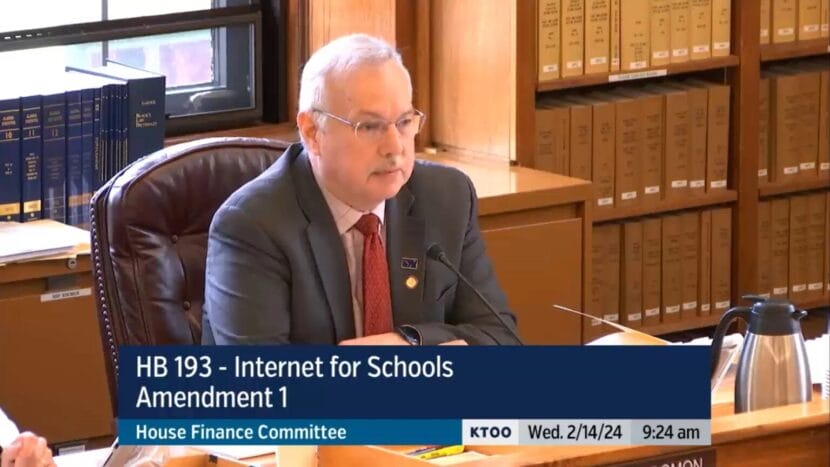
Rep. Bryce Edgmon (I-Dillingham), who sponsored the bill, which was originally introduced as Senate Bill 140 by Bethel Democrat Lyman Hoffman, urged quick passage of HB 193.
In a House Finance hearing in February 2024, Edgmon highlighted the looming deadline to apply for E-Rate subsidies at the 100 megabits per second benchmark, enabling eligible school districts to then secure the remainder of the necessary funding through the BAG program.
In the hearing, Edgmon said that he was hopeful that federal broadband funding, including more than $1 billion allocated for Alaska through the Broadband Equity and Development Program or BEAD, would eventually remove the need for the BAG program altogether.
“There is a sort of an imperfect nature of this as it was when it got introduced in 2014, amended in 2020, and here we are in 2024 upping it, hoping that these billions of dollars of federal money that are coming through primarily the BEAD program can help offset or make this bill not applicable,” Edgmon said.
Rep. Bryce Edgmon (I-Dillingham) urges quick passage of House Bill 193 in a House Finance hearing at the Alaska State Legislature building in Juneau on Feb. 14, 2024. (From Gavel Alaska)
Estimating the annual budget for the state’s BAG program is tricky. This is because Alaska’s commitment is determined by the level of E-Rate subsidies awarded to school districts. These begin flowing in after the state’s number is already set.
For the new law passed this year, the Legislature requested around $25 million, a rough estimate of the costs if every eligible district receives state funding to achieve the 100 megabits per second increase. And while the recently announced BAG award totals came in under budget, the new total is a three-fold increase from last year’s funding. It’s an expense that critics say the state should be leery of.
Fairbanks Republican Rep. Will Stapp was one of just a handful of lawmakers to vote no on HB 193. He said that he was shocked to see how much districts were paying out of pocket, despite receiving the maximum amount of federal and state subsidies.
“At the end of the day, these are considerable price increases, and you just have to ask yourself the question, ‘Hey, is this the actual cost of providing the service in the location?’ Some of these billings are pretty astronomical,” Stapp said.
An apparent windfall
When the Lower Yukon School District made the switch to Starlink, internet provider GCI lost its second-largest drawer of federal subsidies among the more than 30 districts it serves in Alaska.
But things have played out differently for GCI in the district it serves that draws the greatest subsidies: the much larger Lower Kuskokwim School District. In April, the district’s school board approved a contract with GCI for more than $101 million a year. The price tag for a high-speed connection at the district office in Bethel alone is currently $1.4 million per month.
After BAG and E-rate subsidies, the district is on the hook for around $3 million of this contract annually, according to a school board memo.
For GCI, the 100 megabits per second change to state BAG regulations has resulted in an apparent windfall, far beyond what the next largest Alaska providers have achieved in terms of overall subsidies. With the state support to increase speeds, districts GCI serves have roughly doubled their E-Rate subsidies to more than $200 million since the change, according to federal records. The Lower Kuskokwim district alone has applied for more than half of these federal subsidies. As for BAG subsidies, roughly $7.2 million is being awarded this year to bring its schools to 100 megabits per second.
In an emailed response, GCI declined to discuss details of its contract with the Lower Kuskokwim School District, but said that the price of internet services in rural Alaska were generally high due to the high costs of building, upgrading, operating, and maintaining networks.
The email went on to say that the company is very excited about bringing fiber internet to Bethel and other rural communities over the coming years through its AIRRAQ project – a collaboration between GCI and Bethel Native Corporation funded by over $100 million of tribalbroadband connectivity grants. However, it did not say whether this project had any bearing on the current pricing for the Lower Kuskokwim School District.
The district’s new superintendent, Andrew “Hannibal” Anderson, said that it was satisfied with the current arrangement with GCI, but also declined to discuss details.
The future of BAG
This year, the state of Alaska can afford to fill in the gap between the millions of federal subsidy dollars and the internet needs of rural school districts. But that may not always be the case. Oliver, the state’s former E-Rate consultant, said that people should pay attention to the implications of steadily increasing costs for the BAG program.
“If we’re not careful and let the service providers jack up the cost of things too high, then we’ll never be able to pay our non-discounted share, our 10%, because they will knock things out of the ballpark, which is exactly what they’ve done with (the Lower Kuskokwim district),” Oliver said.
Oliver said that there’s a real risk that districts could have to make do with reduced subsidies.
“If we’re not already there, we will soon be at proration, and that is going to impact all districts that apply, including those that were good fiscal stewards of selecting a cost effective connection in the first place,” Oliver said.
Oliver said that she still believes in the importance of the program for helping address disparities in internet access across the state, and that there is still a chance to protect the future of the program.
“Can we improve upon something that started out as good? We absolutely can. And we should, because we are spending millions of dollars when we as a state don’t have a lot to spare,” Oliver said.
The Alaska Department of Education and Early Development declined to comment on the long-term sustainability of the BAG program.
The state Online Public Notices website was accepting written comments until Tuesday. It has details for providing oral comments via telephone on Oct. 9.
Close
Update notification options
Subscribe to notifications
Subscribe
Get notifications about news related to the topics you care about. You can unsubscribe anytime.