Science & Tech

Why Sitka lost almost everything else when it lost the internet

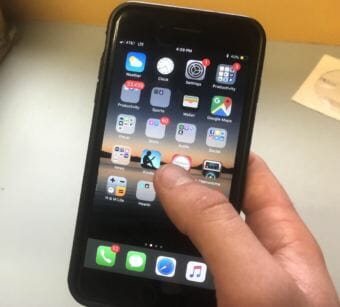
smartphone
An iPhone. (Photo by Renee Gross/KBBI)

The last time Sitka’s undersea fiber optic cable broke in 2017, the resulting outage lasted 12 days, but didn’t seem nearly as apocalyptic as the latest event.

We didn’t see stories about the social and psychological impact of the outage in 2016; business leaders didn’t put out a survey on its economic impact.

That’s because it wasn’t an outage in 2017 – it was a partial outage. The undersea fiber optic cable to Sitka was somewhat novel eight years ago, and the technological infrastructure it would replace was still in play. Everything worked, albeit a bit more slowly.

Not so when Sitka’s fiber optic link broke this time. At 11 a.m. on Aug. 29, Sitkans found themselves without internet, cell service or texting and unable to use credit cards. Even some landlines – depending on the type of phone – didn’t work.
“It’s a consequence of the fact that everything is sort of reliant on the internet these days,” said Joe Kane, director of Broadband and Spectrum Policy for the Information Technology and Innovation Foundation. “Your wireless phone services. Those are getting signals from towers. But then the towers themselves are connected via wired backhaul into the backbone of the internet. Not just these undersea cables, like the one in Sitka, but also the ones that go all the way across the oceans, all around the world. And so any sort of weak link in that chain getting cut means that you lose sort of everything on the other side of it.”

The Information Technology and Innovation Foundation is a nonprofit think tank in Washington, D.C. It has a staff of about 40 people who, among other things, track the massive federal investment in delivering broadband to everyone in the country.

Kane suggested there are things we could learn from Sitka’s outage.

“Sitka experienced a microcosm of the overall vulnerabilities that we could see with undersea cables if there were more widespread outages,” he said. “So I do think it’s maybe highlighting the importance of securing them.”

Kane described a tension between fiber optic cable and satellite technology. Fiber optic can be significantly faster than satellites, but that’s changing. An earlier generation of communications satellites were in high Earth orbit, had limited bandwidth, and were slower. Now, Starlink has put thousands of satellites in low-Earth orbit, and as Sitkans quickly discovered, the speed difference was noticeable, but by no means a deal-breaker.

Kane believes that the best policy is to maintain both systems.

“There are satellite options now, and there are alternative cable options so that you don’t end up with only one point of failure,” said Kane. “But I do think that’s something where we should be looking:  towards more resiliency and maybe more redundancy. A lot of times people talk about fiber as being future proof, but I think maybe we’re learning that it’s not Alaska proof.”

GCI is heavily invested in undersea cable, and is well toward completion of an 800 mile cable linking the communities of the Aleutian chain. In a response to an email from KCAW, GCI corporate communications manager Josh Edge wrote, “Like all telecommunications networks, fiber is subject to outages, but it has long since proven itself as the most reliable middle-mile network technology available.”

According to Edge, fiber optic has been the backbone of GCI’s network for 25 years.

“Fiber is unique in its ability to deliver orders of magnitude more capacity as technology and customer needs evolve,” he wrote in the email.

The United States is spending $42 billion on universal broadband for its citizens, with much likely to be dedicated to terrestrial infrastructure like fiber optic cable – even though GCI relied on a combination of microwave and satellite technology to maintain a minimal level of service while the cable was repaired.

Kane has no argument with universal broadband as policy, but as a practical matter, Sitka’s experience demonstrates that fiber optic cable doesn’t make sense everywhere.

“I did a back of the envelope calculation the other day,” said Kane. “If you took all the federal money that had been spent on trying to build broadband to Alaska, you could buy every household in the state a Starlink terminal and give them free service on it for multiple years.”

Repair ship working to mend cable break that took Sitka offline

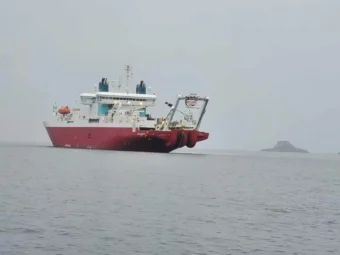
The Cable Innovator at work in Salisbury Sound 25 miles north of Sitka Monday morning. (Martin Becker photo)

A cable repair ship is mending a broken fiber optic cable that took Sitka offline in late August, but it could be close to a week until repairs are finished.

The British-flagged Cable Innovator arrived at the site of the break over the weekend.

“So when a break like this occurs, GCI is part of a professional service group that allows for these repair ships to become available in the rare event that we have a break,” said Jenifer Nelson in an interview with KCAW on Monday (9-9-24). Nelson is the senior director of rural affairs for GCI, Sitka’s primary internet and cellular service provider.

“The fiber repair shift then mobilized to get to Sitka and it arrived on site over the weekend,” Nelson said. “The crew aboard the Cable Innovator is actively engaged in efforts to repair the damaged fiber optic cable right now, so they are on site, actively working.”

The break occurred in a stretch of fiber optic cable between Sitka and Angoon in Salisbury Sound. Rumors that a cruise ship was involved in the break remain unsubstantiated. Nelson said the cause of the problem is still unknown.

“It’s rare for a fiber optic cable to break. There can be lots of reasons that this can happen, and we are just unsure at this time as to what the exact cause of the break was,” Nelson said.

Nelson said the repairs should be completed by the end of the week. Meanwhile, the company has restored basic internet and cell service using what Nelson describes as a combination of satellite and microwave technology, though Sitkans continue to report mixed results.

Nelson says GCI is offering a month of free credit to all customers affected, and apologizes for the inconvenience that limited internet has caused Sitkans. The credit will be automatically applied to customers’ bills.

In internet-less Sitka, it’s both ‘mayhem’ and a ‘golden moment’

A visitor relaxes at the Sitka Sound Cruise Terminal. (Jeb Sharp/KCAW)

In the Southeast Alaska town of Sitka, some hospital surgeries are on hold.

Many shops and restaurants are operating on a cash-only basis. Contact with the outside world comes mostly through satellites.

For the past week, a break in the sole cable that provides Sitka’s internet and phone service has wreaked havoc on residents and businesses — and, at the same time, effectively launched a massive social and economic experiment: What happens for 8,000 people who have deeply integrated the internet into their lives, when the switch gets flipped off?

On the one hand: It’s an enormous pain.

“It’s mayhem,” said Rebecca Himschoot, the independent lawmaker who represents Sitka in the Alaska House. “It’s just been shocking how dependent we are on the internet and how hard it is to do daily functions without it.”

On the other hand: It’s a blissful reprieve from modernity.

“All over town, you see people walking around more, going to people’s homes, hanging out and talking,” said Jessica Ieremia, the director of Sitka’s library, which has a satellite unit that’s made it a hub for residents seeking internet. “We’ve been hearing that constantly from people, how nice it is. They’re like, ‘If I could just figure out the finances part.’”

The Great Sitka Outage of 2024 began late in the last week of August, when telecommunications firm GCI detected a break in the sole fiber optic cable connecting the town, on the outer coast of Baranof Island, to the outside world. Cell service, texting and internet all went down.

Kari Cravens, of Ashmo’s food truck in Sitka, takes cash from Jacil Lee, a cruise ship passenger stopping in town last week. Many business owners in Sitka are unable to accept credit and debit cards amid an outage in most phone and internet communications. (Sitka Sentinel, republished with permission)

Since then, GCI says it has restored a bare minimum of voice and texting capacity using microwave and satellite services. But residents say service remains sporadic and dysfunctional.

Rumors have proliferated about the cause of the break, which, according to GCI, was somewhere between Sitka and Angoon, an Indigenous village to the northeast, toward Juneau.

But details won’t be available until, at the earliest, a ship hired by the company has arrived and begun repairs. The work could take up to six days, said Jenifer Nelson, a GCI spokeswoman.

She added, chuckling, that company officials have not considered the possibility that Elon Musk was responsible for the break.

Nonetheless, the tech mogul’s satellite internet company, Starlink, appears to be a prime beneficiary. Starlink’s sleek satellite receivers have been proliferating in Sitka over the past week.

A Juneau-based regional tribal government, the Central Council of Tlingit and Haida, sent about 15 Starlink units to Sitka the day after the outage, the Sitka Sentinel newspaper reported.

They were distributed to hospitals, schools, city government and rescue services, the council said in a statement. Others went to the local public radio station, KCAW, and to the Sentinel.

Those weren’t the only Starlink units to land in Sitka after the break.

While some businesses and residents already had Starlink before the outage, others went to great lengths to acquire them afterward.

With no systems available to purchase in Sitka, Keith Grenier hopped on a jet to Seattle. He and his business partner at a mechanical contracting business bought eight Starlink units there before flying home and “handing them out to all of the people who were behind.”

Even getting on the plane in Sitka, however, was challenging. Grenier said he drove out to a remote part of town where his phone could receive data, pulled up his boarding pass on the Alaska Airlines app and took a screenshot that he could use to get past security.

Sitkans congregate outside the town library to tap into free Starlink-based internet. (Photo by James Poulson/Sitka Sentinel, republished with permission)

“It was, like, three hours of trying to navigate this stuff just to leave the island,” he said. “There were rumors about having to have a paper boarding pass.”

Grenier’s home, and driveway, are now hotspots for friends and family in need of cell and internet service.

Other residents are holding out as conscientious Starlink objectors, refusing to send money to a company owned by Musk — a billionaire who’s increasingly aligned his politics with Donald Trump’s.

For those without access to Starlink units, however, keeping up normal business can be a huge hassle.

Numerous companies are accepting only cash, while others collect customers’ credit card information, then bring their payment processing devices to Starlink hotspots every hour or day to run the transactions. Himschoot said she heard from a business owner who had one of those purchases declined.

“It’s one bagel sandwich,” she said. “But that’s a real hit when your margin’s really slim.”

There are long lines for cash at the bank, Himschoot added. She’s also worried about constituents who may miss deadlines to apply for or renew state benefits and services. And, she added: How do elders connect to the van service to get to health care?

Certain elective procedures at Sitka’s hospital, run by the SouthEast Alaska Regional Health Consortium, are also still on hold, especially for “patients with complex medical needs that require telemedicine support,” according to a consortium spokesman.

It’s important for people outside Sitka to know “that this is a really, really big deal,” Himschoot said. “It has been really hard on the community.”

Nelson, from GCI, said the company understands the outage is “super, super frustrating.”

“We really do appreciate the community’s and our customers’ patience as we are working to fully restore this as quickly as we can,” she said.

GCI is providing its customers with a free month of service, she said. The company is also offering people what Nelson called “alternative entertainment,” since they “don’t have access to their technology.” It’s providing free admission one day this weekend to Sitka’s athletic and wellness center, as well as to a dance performance the weekend after.

The library, meanwhile, has become the local watering hole, attracting scores of visitors with its free, Starlink-based internet.

“People are hanging around our building 24 hours a day,” said Ieremia, the director. “They’re parking out on the street; the parking lot is full.”

Between last Thursday and Sunday, nearly 900 people updated their library cards, she added, and DVDs and books have been flying off shelves.

“People were hustling all over town to find a DVD player,” Ieremia said.

While the communications blackout has been “devastating” for residents who work from home, she said, it’s also brought people together, with the library full of visitors “talking and sharing stories and giving advice.”

“For three minutes of texting, you end up with an hour of conversation with people you haven’t seen for a while — they’re all there,” Himschoot said. “People are just spending a lot more time doing what we used to do without the internet.”

The outage has gotten Sitkans thinking — about tighter cell phone restrictions in school, even about whether there could be one day a week of community wide internet disconnection or abstention. That kind of idea might be a political nonstarter, Himschoot said, but for now, she added: “It’s kind of a golden moment, in some ways.”

Read local coverage of the outage at the Sitka Sentinel and KCAW.

Nathaniel Herz welcomes tips at natherz@gmail.com or (907) 793-0312This article was originally published in Northern Journal, a newsletter from Herz. Subscribe at this link.

How an underwater anthropologist explores Southeast’s fluid landscape

A team of scientists and Alaska Native community members use an autonomous underwater vehicle to explore the continental shelf west of Prince of Wales Island in southeast Alaska, seeking submerged caves and rock shelters that would have been accessible to early inhabitants of the region. (Photo courtesy of NOAA)

Dr. Kelly Monteleone is an underwater anthropologist at Sealaska Heritage Institute and an assistant professor at the University of Calgary.

She’s kicking off SHI’s fall lecture series Wednesday with a talk titled “Our Submerged Past: Exploring Inundated Late Pleistocene (10,500-17,000 years ago) Caves in Southeast Alaska.” She’ll be joined by Kristof Richmond, Ph.D., Chief Technology Officer at Sunfish, Inc., a robotics company specializing in undersea exploration and inspection.

Dr. Monteleone sat down with KTOO’s Anna Canny to talk about her adventures underwater.

This interview has been edited for length and clarity.

Anna Canny: So, tell me a little bit about what an underwater anthropologist is — it’s not a field I’ve heard much about before.

Kelly Monteleone: You’re not going to find another one of us around the world. I am unique, but I’m looking for the same kind of sites that archeologists are on the land, places people have lived, places people were hunting, that we can find evidence of butchering or things like that.

Anna Canny: So to find human artifacts underwater, that means, presumably, that there was a time in the past when they weren’t underwater. Could you tell me a little bit about what Southeast Alaska looked like in that  past, when sea levels were lower?

Kelly Monteleone: I really wish I could tell you more about what was happening in different areas, in areas that are now underwater or not underwater. The sea level history throughout Southeast Alaska is so complex. Most of my research has focused on the west side of Prince of Wales Island, and there we see sea level as low as 165 meters. I’m sorry, you’re gonna have to convert that yourself. But then if you just move a little bit to the east, over to Ketchikan, sea levels around the same time, we’re 200 meters above. So we’re talking about a very fluid landscape. We don’t think of the Earth’s crust as morphing and moving that much, but with the glaciers receding and the weight of the glaciers moving in different ways. You can almost think of the landscape at that time as being like the surface of a balloon, where you press in one spot and it goes up in one and depresses in another, and it causes these interesting formations. When you look at these sea level histories, the sea level was changing so freaking fast. I calculated from around that time that it’s around five centimeters a year of sea level change. Right now, globally, it’s moving at three millimeters. So that’s a magnitude difference.

Anna Canny: Wow. So I wanted to ask about one of your big discoveries, which was a fish weir that you found submerged off of Prince of Wales Island back in 2022. What does a discovery like that reveal?

Kelly Monteleone: It pushes back the knowledge in that region, and it’s about 1,000 years earlier than Shuká Káa, but it’s in the same area. I kind of wonder if, like, Shuká Káa was the human remains were found on the northwest corner of Prince of Wales Island. The other name that was known was “on your knees cave.” And so that individual would have lived in a community, and I kind of wonder, if it was in Shakan Bay, it would be a logical place that that would be within their hunting ground, and they believe Shuká Káa was just, you know, hunting for a bear and didn’t win.

Anna Canny: And you’re still exploring some of those same submerged area and looking for more things. What’s a dream artifact for you?

Kelly Moteleone: I would like to find a canoe with animal remains — because human remains trigger other things — that have evidence of butcher marks. So I can source the wood on the canoe, and I can date both the wood and the animal remains. Doesn’t that sound like the perfect find? That’s my dream find. And my goal would be that it’s actually an early enough canoe that the wood is not from Southeast Alaska. A canoe, a, you know, a vessel of some kind that was actually made further back along that kelp highway. You know? The coastal migration theory. And the kelp highway runs basically from Japan all the way down to California, where you can find these kelp forests and find similar resources to hunt, gather fish, etc.

Anna Canny: Right, so figuring when people arrived here and revealing more about just how far back time immemorial stretches. What is most exciting for you about doing that kind of work?

Kelly Monteleone: I love working with the Lingít people of Southeast Alaska and the Haida and Tsimshian too, but the Lingít are the ones we know. We’ve been here since time immemorial, and the Lingít people really are interested in learning about their ancestors. They proved that very well with Shuká Káa, and that’s what I love about doing this work here, is I actually can work with people who see an affiliation to the work I’m doing to understand their past. I always try to link what I’m doing also to climate change, because when I’m talking about five centimeters of sea level rise, we can’t comprehend that, that’s something that could happen, as we’re talking about glaciers hitting tipping points and things like that. And so understanding how people survived on that landscape as the sea level was rising, how did people adapt? That could help us moving forward as sea levels keep rising. I hope we never hit five centimeters of sea level rise a year again. But knowing that people survived that in that region, I think, is a glimmer of hope also. But part of it is that I love history and I love science, and this lets me do both.

Watch Dr. Monteleone’s lecture at noon Wednesday in-person at the Walter Soboleff Building or via livestream on SHI’s YouTube Channel.

Correction: This post has been updated to reflect that the lecture is Wednesday, not Tuesday. 

A 3D reconstruction of the woolly mammoth genome might help revive the extinct species

Valerii Plotnikov (left) from the Academy of Sciences of the Republic of Sakha, Yakutsk, Russia, and Daniel Fisher of the University of Michigan examine a woolly mammoth unearthed during a 2018 expedition.
Valerii Plotnikov (left) from the Academy of Sciences of the Republic of Sakha, Yakutsk, Russia, and Daniel Fisher of the University of Michigan examine a woolly mammoth unearthed during a 2018 expedition. (Love Dalén)

Scientists have recreated the three-dimensional structure of the woolly mammoth’s genetic blueprint.

The accomplishment, described Thursday in the journal Cell, marks what is believed to be the first time scientists have been able to produce a multidimensional version of the genome of a complex extinct species.

The advance should provide important new insights into the biology of a creature that has long sparked fascination. In addition, the work could aid efforts to breed a living version of the animal, the researchers and others said.

“It’s exciting,” says Erez Lieberman Aiden, a professor of of molecular and human genetics and director of the Center for Genome Architecture at the Baylor College of Medicine in Houston. “We think it’s going to be very valuable.”

For years, scientists have been able to peer back in time by analyzing fragments of ancient DNA recovered from bones, fossilized teeth, mummies and even strands of hair.

“In biology, one of the most powerful tools for understanding the history of life on this planet is ancient DNA,” Aiden says. “It’s an incredibly powerful tool for understanding the history of life.”

But there’s only so much scientists could learn from snippets of DNA. So Aiden and his colleagues launched an international effort to try to recreate the three-dimensional structure of the DNA, including the chromosomes, of an extinct creature.

“In so doing, you would be able to see exactly how that chromosome was shaped in a living cell, and you’d be able to both get a deeper understanding of the genomes of ancient and extinct species and how those genomes worked – which genes were on and off in particular tissues,” Aiden says.

Searching for mammoth samples on eBay

The scientists focused on the wooly mammoth, a big, shaggy species of elephant that roamed the tundra thousands of years ago.

“Initially we had embarrassingly bad ideas. I’m a little ashamed to admit it,” Aiden told NPR. “We said, ‘Oh, you know, that looks like a good-looking piece of mammoth on eBay. Let’s try that.’ It’s kind of a little cringe, right, to tell you that. Ebay is a bad place to get your mammoth samples.”

After searching for five years, the team finally found a well-preserved mammoth sample: skin from behind the ear of a 52,000-year-old female that was discovered freeze-dried in Siberia in 2018.

“It was a piece of a mammoth skin that was, you know, wooly. True to the name — it was indeed woolly mammoth skin,” says Olga Dudchenko, an assistant professor at the Baylor Center for Genome Architecture who worked on the research. “And that’s actually not as trivial as it sounds because very often the hair would be lost. So this one was hairy. And that actually is an interesting indicator in and of itself that this is a sample of substantial quality. And that immediately piqued our attention.”

Scientists can look at individual mammoth genes

In fact, the quality of the sample enabled the team to extract DNA and use a technique known as Hi-C to reconstruct the three-dimensional structure of all 28 of the mammoth’s chromosomes — the extinct creature’s entire genome, the researchers reported.

“We were able to assemble the genome of a woolly mammoth just as 25 years ago humans were excited for the first time to assemble our own genomes,” Aiden says. “Now we can do that for animals that were long extinct. That’s obviously a milestone.”

Not only that, the team has been able to peer into the genome to start learning what individual genes did.

“And that’s really exciting to be able to look at an extinct creature and be able to say, ‘Oh, yes. I can see this gene was on. That gene was on. This gene was off. Oh, isn’t that surprising?’” Aiden says. “To be able to do all these specific things in a woolly mammoth is exciting.”

In fact, by comparing the mammoth genome to DNA from modern elephants, the scientists have already discovered clues to what made the woolly mammoth woolly.

“We’ve been internally discussing whether we should start Hair Club for mammoths?” Dudchekno jokes.

Genetic findings could aid efforts to bring back mammoths

But seriously, that insight could help efforts that are already underway to try to bring a version of the mammoth back from extinction — by endowing modern-day Asian elephants with mammoth traits, such as their hairiness, and perhaps even release them to graze the tundra again.

“I do think that this can be helpful for de-extinction,” Aiden says.

Other scientists praised the work.

“I think it’s pretty cool,” says Vincent Lynch, an associate professor of biological sciences at the University at Buffalo who was not involved in the research.

But Lynch isn’t a fan of trying to bring back the mammoth. The unintended consequences of that could be disastrous, he says. And the money for such a project would be much better spent trying to save the elephants that still roam the planet today.

“There’s an huge potential for unintended consequences,” Lynch says. “Just think about all the other invasive species that are in the world. You don’t really know the effect that species is going to have in the environment until it gets there.”

And Karl Flessa, a professor of geosciences at the University of Arizona agrees on the scientific accomplishment and the foolishness of trying to bring back the extinct pachyderm.

“The preservation of genetic architectures from the woolly mammoth is really remarkable,” Flessa says. “But just because you can do it, doesn’t mean that it should be done. A genetically modified Asian elephant is not a wooly mammoth. And releasing such an animal into the wild would be arrogant and irresponsible.”

Others disagree.

“It’s exciting to see that 3D architecture can be preserved in ancient samples. This will help move toward a complete de novo assembled mammoth genome, which could reveal features of the genome that might be relevant to mammoth de-extinction,” Eriona Hysolli, who leads a project to create an Asian elephant with mammoth traits at Colossal Laboratories & Biosciences in Dallas, wrote NPR in an email.

Still, Robert Fleischer, a senior scientist for the Center for Conservation Genomics at the Smithsonian’s National Zoo & Conservation Institute in Washington, says that prospect is exciting.

“If I was a 12-year-old in my science class in junior high school I’d probably think this was pretty cool,” Fleischer says. “And I still think it’s pretty cool.”

A Juneau inventor wants to bring ocean energy to your outlets

Lance McMullan tests an early prototype of his tidal generator in Juneau in October 2023. (Photo by Anna Canny/KTOO)

Inventor Lance McMullan has a beautiful house on Douglas Island. But he spends almost all of his time in the garage. 

On one side of the room there’s camping gear, a set of winter tires and a small couch. On the other, an enormous 3D printer and dozens of boxes and garbage bags filled with pieces of bright yellow plastic. 

He reached into one of the bags and pulled out a cracked triangular fin. 

“Every part has failed at some point or another,” McMullan said. “I just stay in this room working for days.”

All that time and discarded plastic is a testament to the device hanging from a rope in the center of the room — a sleek tube with a large rotor on one end. It turns powerful ocean currents into renewable electricity. 

The Chinook 3.0 tidal generator mounted on a rope in McMullan’s workshop. (Photo by Anna Canny/KTOO)

“Anyone who has met me in the last 14 years, this is all they have heard about. It’s all I can think about,” McMullan said. “Like, I can’t look at the moon without thinking about another tidal cycle passing.”

McMullan isn’t the only one who’s excited. Tidal power could be an alternative to burning fossil fuels like diesel and natural gas, which is driving human-caused climate change. 

And the prospect of tapping into ocean energy has received a lot of buzz and a lot of federal money in Alaska. Especially in Cook Inlet, where proposed large scale tidal projects could eventually power thousands of homes. 

McMullan is starting smaller. His company, Sitkana, makes small tidal generators that are perfect for individual fishing boats and liveaboards. He hopes they can revolutionize ocean power the way rooftop panels revolutionized solar power.

“It’s just so much power, and it’s not being touched,” McMullan said.  “I feel like I have almost a responsibility to bring it to reality.”

McMullan displays different iterations of his tidal generators, which he designs and 3D prints in his Douglas home. (Photo by Anna Canny/KTOO)

Finding a niche for tidal power

Alaska has long been considered the ideal place for developing tidal power. Steep fjords and inlets along the coast amplify the natural rise and fall of tides. When water rushes into those channels, it’s concentrated into a strong current that’s perfect for generating electricity. 

“It’s kind of hard to go anywhere in Alaska without tripping over a good tidal energy site,” said  Brian Polagye, a professor of mechanical engineering at the University of Washington and a researcher at the U.S. Department of Energy’s Pacific Northwest Laboratory.

Because water is so dense, ocean power could be more potent than wind energy. And because tides are consistent and predictable, energy drawn from them could be more reliable than solar, which fluctuates with the weather and the seasons.

But it’s far less popular. That’s mostly because it costs a lot more. 

“If tidal power was the cheapest form of energy, it would be as ubiquitous as a solar panel,” Polagye said.

Standardized designs and mass manufacturing of parts has drastically reduced the cost of solar and wind energy technology over time. So when a tidal project tries to tap into a large grid like the Railbelt, it has to compete with those much cheaper alternatives.

But Polagye says tidal energy could find success by exploiting unique niches in the market. In Alaska, that might mean building in remote places where the grid is less robust. 

He points to the village of Igiugig, which is experimenting with a similar turbine that generates electricity using currents from the Kvichak River. 

“The turbine there is really the best source of power. It’s competing with diesel that’s flown in,” Polagye said. “The fact that it is more expensive than other sources that would be on the grid doesn’t matter if you don’t have a grid.”

McMullan loads the disassembled generator into Brian Delay’s boat for a test in October 2023. (Photo by Anna Canny/KTOO)

Sitkana’s tidal turbines may be best suited to diesel-dependent coastal communities like Angoon, Hoonah and Kake in Southeast Alaska, where energy prices are much higher than in the Lower 48. 

Those places have explored solar and hydropower, but large utility projects take a lot of time and money to build. And as communities adopt things like electric vehicles and electric heat pumps in an effort to cut down on carbon dioxide emissions, demand for renewable energy keeps growing. 

Experts say decarbonization will likely require a mix of renewables. McMullan believes that mix should include tidal power. 

The Chinook 3.0

His effort to make ocean energy accessible began while he was working as a deckhand on a troller in Sitka. From the back of the boat, he would watch the hooks bobbing through water and imagine a tidal generator that could be dragged along like that. 

“It was that summer I started sketching designs,” McMullan said. “But I realized I had no idea what they were or if I could make them work. I didn’t know anything about fluids or mechanical engineering.”

So he went back to school to study engineering, then spent time as a maintenance technician building wind turbines in the Lower 48 before returning to Alaska.

It took him years to develop Sitkana’s current prototype, the Chinook 3.0. The small tidal turbine has a few key differences compared to other tidal generation designs. 

The Chinook 3.0 generator is dropped into the water like an anchor from the back of a boat. (Photo by Anna Canny/KTOO)

While many tidal projects are anchored to the ocean floor, the Chinook 3.0 is free-floating and portable. It weighs less than a hundred pounds.

“It swims through the water sort of like a fish,” McMullan said. “And installing these is no different than dropping an anchor.” 

The Chinook 3.0 can be hooked up to a small crane or pulley on the back of the boat, then lowered when the tide is rising or falling. 

Tidal currents spin the rotor, which turns a generator inside the body of the turbine to create 1.6 kilowatts of electricity. That’s enough to meet one person’s daily needs, assuming the generator stays in the water for most of the day. 

So a family might need multiple generators. But at just over $1,000 per kilowatt, the cost of energy is relatively low — comparable to the price of wind power. That’s thanks in large part to the Chinook 3.0’s plastic construction. 

McMullan poses with scraps of plastic from failed prototypes in May 2024. (Photo by Anna Canny/KTOO)

Using plastic might also be a solution to maintenance problems, another common hurdle for tidal power. The ocean’s powerful currents and corrosive seawater are harsh on tidal turbines. Constant repairs can disrupt power and challenge communities that might not have the expertise or manpower to keep the turbines running. So Sitkana plans to let the ocean do its worst.

“What we’re doing is accepting that these are going to get destroyed,” McMullan said. 

When a generator breaks, they’ll pull it out, replace it, and recycle the plastic from the broken unit. 

Soon, McMullan will send the Chinook 3.0 prototype across the country, to a tidal testing facility in Cape Cod, Massachusetts. There, they’ll monitor the turbine in the water to see how fish and other wildlife respond to it. 

“But we’re getting very close. It’s here, it works,” McMullan said. “Now it’s just about scaling it and getting it out there and producing the power.”

Sitkana expects that the generators will hit the market sometime next year, for about $2,000 each. 

Correction: A previous version of this story referred to the price of energy in cost per kilowatt hours. Cost is measured per kilowatt.

Site notifications
Update notification options
Subscribe to notifications