Science & Tech

Firings prompt concerns that science supporting Alaska seafood industry could be undermined

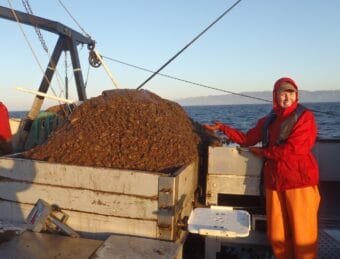
Rebecca Howard, on a 2019 survey cruise, stands next to a muddy trawl net catch of bottom dwelling creatures. Seattle-based Howard was one of the Alaska Fishery Science Center biologists who was terminated by NOAA Fisheries in late February. (Photo courtesy of Rebecca Howard)

Rebecca Howard is a marine biologist who spent six years in graduate school — largely funded by federal scholarship dollars — to earn a doctorate at Oregon State University. Last April, she was hired by the National Oceanic and Atmospheric Administration’s fisheries branch to join in annual surveys off Alaska that gather data vital to the management of the nation’s biggest seafood harvests.

This year, the Seattle-based Howard was scheduled to spend three weeks aboard a chartered fishing boat sampling Gulf of Alaska marine life, and another three weeks on a Bering Sea survey.  But on Feb. 27, more than 10 months into a yearlong probation, she received an email from a NOAA vice admiral informing her that she was being terminated. Her ability, knowledge  “and/or skills” no longer fit the agency’s needs.

“This is what I wanted to do. I wanted to stay at this job,” Howard said in an interview from Seattle, where she worked at the main branch of the Alaska Fisheries Science Center. “It was a huge disappointment.”

Howard was one of the 13 staffers fired from the science center, a roughly 5% cut of that scientific workforce, according to sources with NOAA Professional Employees Association, a union representing much of the staff. She was an early casualty in what is expected to be a widening wave of staffing cuts in NOAA Fisheries offices and research hubs in Alaska, the Pacific Northwest and other coastal regions as President Donald Trump’s administration unleashes a broader campaign to slash federal spending.

NOAA Fisheries has declined to release numbers on the scope of the cutbacks to date, which has left congressional delegations scrambling to try to track the force reductions in Alaska and other states. Meanwhile, NOAA and other branches of the federal governments must develop plans, due March 13 for more substantial workforce reductions, according to a Feb. 26 memorandum from the two executive branch offices.

Scientists aboard NOAA Ship Henry B. Bigelow sort a catch during an East Coast fall 2023 Bottom Trawl Survey. This particular tow had a lot of Atlantic sea scallops.(Photo by Catherine Foley/NOAA Fisheries)

NOAA Fisheries plays a huge role in managing the U.S. seafood harvest, most of which unfolds within a 200-mile federal zone off the nation’s coasts and in 2022 were valued at nearly $6 billion in commercial landings. The agency’s key responsibilities also include ongoing research to help track the populations of marine mammals, fish and other marine species.

All of this makes America’s fishing fleets tightly tied to the labor of  NOAA workers whose tasks range from performing stock surveys that help prevent overfishing to drafting harvest regulations that open harvest seasons.

And, within the ranks of NOAA Fisheries, and among some in the fishing industry, there is a growing unease that the agency’s ability to carry out core missions could be undermined by the  Trump administration’s push to shrink the federal government.

“The indiscriminate firing of NOAA personnel could cripple our fisheries,” said Linda Behnken, executive director of the Sitka-based Alaska Longline Fishermen’s Association. “The impact to resources and the seafood industry will be substantial unless the administration corrects course.”

The first round of  NOAA Fisheries staffing cuts have been accompanied by a freeze on most credit card spending. One Alaska Fisheries Science Center biologist, who requested anonymity to avoid retaliation, said she would typically use her credit card to buy gloves, life vests, extension cords and other gear needed for upcoming survey cruises off Alaska.

“I am trying to figure out how to supply our surveys with the gear we really need.  It’s really frustrating,” the biologist said. “We’re going to do our best.”

NOAA Fisheries credit cards also are typically used to finance hotels and other expenses for staffers to attend meetings of regional fishery councils, which are a mix of federal state, industry and other representatives who help develop harvest limits and other rules for fisheries.

“The only travel that is being authorized right now is mission critical,” said Jennifer Quan, the West Coast regional administrator, who was one of the few NOAA Fisheries officials authorized to attend a Pacific Fishery Management Council meeting that began last week in  Vancouver, Washington. The council covers Northwest and California federal fisheries.

In her opening remarks, Quan also said, “We are still, in general, in a state of mourning over the loss of staff,” but did not offer any details about the layoffs, so far, in the West Coast offices. During a Thursday public comment period at the Pacific council meeting, union representatives said the Northwest Fisheries Science Center had nine probationary members terminated who belonged to their chapter. They included an oceanographic modeler and a scientist studying the changing migration patterns of hake — also known as whiting — which sustain a major Northwest commercial trawl fishery.

Snow crab comes aboard the FV Pinnacle during a 2022 Bering Sea harvest. NOAA Fisheries surveys found that — in the aftermath of a Bering Sea marine heat wave — the stocks had imploded, which prompted sharp cuts in that winter harvest, and no harvests in 2023 and 2024. (Photo by Hal Bernton)

The Trump administration policies to shake up the federal bureaucracy also have created new regulatory challenges for NOAA Fisheries. Trump’s executive orders include a request for a 60-day freeze on any new regulations, as well as a separate initiative to remove 10 regulations for every new one that is put in place.

These orders are complicating the publication of rules in the federal register to open some fisheries that are supposed to happen in the weeks ahead.

Quan cited these executive orders in her Thursday remarks to the Pacific Fishery Management Council. “We are still awaiting explicit guidance” on how to proceed, she said.

In Alaska, commercial fishers are unsettled by the prospect of not getting rules published, and individual fishing quotas allocations made by regional NOAA Fisheries officials, in time for a planned March 20 opening of the halibut and sablefish (also known as black cod) harvests. Halibut fisheries also are scheduled to open off British Columbia on that date, and Alaska fishers don’t want to be beaten to the early market by Canadian competitors, according to Behnken, the longliner association executive director.

In response to an inquiry from the Alaska Beacon, a NOAA Fisheries spokeswoman said, “The annual process for authorizing the halibut and sablefish fisheries is ongoing, and we will inform fishery participants if we anticipate a delay in issuing individual fishing quota or opening the commercial halibut or sablefish fishery on March 20, 2025.”

The uncertainty over the regulatory process also was noted  by industry representatives in a March 4 letter sent by 170 fishing businesses and associations to U.S. Commerce Secretary Howard Lutnick and Agriculture Secretary Brooke Rollins.

“U.S. fisheries are heavily dependent on the regulatory process to open the fishing season and implement reasonable management measures, and any delays or inconsistencies can have immediate and severe consequences for our fishermen’s livelihoods,” said the letter.

As they brace for the next round of staff cuts, NOAA Fisheries regional leaders have struggled to maintain morale.

A federal fisheries employee, who spoke on condition of anonymity due to concerns about retaliation, said regional staff were asked to identify what work is necessary to perform legally required tasks. But the details of the force reduction plan are expected to be “determined up the chain.”

Some NOAA workers also have been angered by the tactics of billionaire Elon Musk, who launched the U.S. DOGE Service with the stated goal of increasing federal efficiency. In a February email that Musk directed to be sent from the Office of Personnel Management, federal employees were told to list five things they had done the previous week or risk losing their jobs.

“This was  basically a check to see if the employee had a pulse and was capable of replying to an email,” Musk wrote in a Feb. 23 post on X, the social media platform that he owns. “Lot of people in for a rude awakening and strong dose of reality. They don’t get it yet but they will.”

Andrew Dimond, shown here after sport fishing for king salmon, is a Juneau-based biologist. He conducted longline surveys and other research for the Alaska Fisheries Science Center until he was let go Feb. 27, just 11 days before the end of his probationary status would have ended. (Photo courtesy of Andrew Dimond)

Andrew Dimond, a Juneau-based Alaska Fisheries Science Center biologist, got the email when there was still hope he would survive his yearlong probation in a new job that offered more stability and opportunities for advancement than the contract and shorter-term positions he had held since 2015.

Dimond’s survey work involved weeks at sea pulling 12-, sometimes 14-hour days, on deck for tasks such as tagging black cod as they came on board, and pulling out ear bones for sampling. His other tasks included surveying Pacific cod in the Gulf of Alaska, which, in the aftermath of ocean warming, helped to predict a huge downturn in the stocks.

Dimond has tried to not pay much attention to Musk’s belittling of federal workers.

“I’m disappointed it gets the attention it does,” Dimond said. “Because I like the work. It’s great, but the people are too. They’re all hard workers that care about the things they do.”

On Feb. 27,  Dimond received the same form notification as Rebecca Howard, informing him of his termination by a NOAA vice admiral. That email came 11 days before his probationary status would have ended.

Since then, there have been changes to an Office of Personnel Management memorandum that set the stage for the layoff of probationary workers. The revised document, updated on March 4, said it was up to the agencies to decide whether to discharge these workers.

Both Dimond and Howard hope they will get asked back to their jobs. If not,  they hope to find some way  to regain their jobs through an administrative appeal process or, perhaps, the courts.

Earthquake activity in Alaska quieted a bit in 2024, but more landslides are being tracked

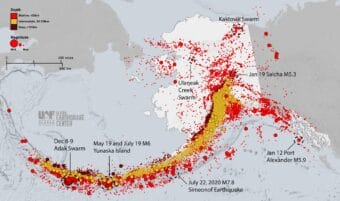
Seismic events that struck Alaska and neighboring areas in 2024 are shown in this map. Although there were fewer events than in preceding years, Alaska remains one of the world’s most seismically active regions, and there were nearly 40,000 events throughout the year (Map provided by the Alaska Earthquake Center/University of Alaska Fairbanks)

Alaska, one of the world’s most seismically active locations, just completed a relatively quiet year for earthquakes but a busy year for landslides in the Southcentral region, according to an annual report issued by seismic experts at the University of Alaska Fairbanks.

There were 39,836 seismic events in Alaska and nearby regions in 2024, according to the Alaska Earthquake Center’s newly released 2024 Alaska Seismicity Summary.
That is about 5,700 fewer than in 2023 and about 15,000 fewer than in 2018, when a record was set, according to the center. Still, there were 50 quakes of magnitude 5.0 or greater, equating to about one a week, the center said.

Seismic events are defined as earthquakes or any other earth-shaking phenomena.

The year’s seismic record was notable because, for the first time since the major Nov. 30, 2018, earthquake that damaged the Anchorage and Matanuska-Susitna Borough areas, there were no detected aftershocks from that magnitude-7.1 event, the center said.

There were, however, more than 1,000 aftershocks throughout the year from the magnitude-7.8 Simeonof earthquake that struck on July 21, 2020, off the Alaska Peninsula, the report said. The most powerful of those was measured at magnitude 5.6.

The most powerful earthquakes in 2024 were two magnitude-6.3 events that occurred as part of a swarm of quakes that struck the central Aleutians in early December, the report said. The first of the magnitude-6.3 quakes occurred on Dec. 8 in the Andreanof Islands region, and the second occurred the following day, the report said.

Earthquakes reported in the Alaska earthquake catalog over the past 10 years are shown in this graph. The highest number of events, about 55,000, was in 2018. (Graph provided by the Alaska Earthquake Center/University of Alaska Fairbanks)

While there were fewer earthquakes detected in 2024 than in past years, a relatively new effort at the center has resulted in stepped-up monitoring of landslides in a region considered to be at elevated risk: Prince William Sound.

That program uses an array of instruments to track the seismic signals of landslides, which are different from those produced by earthquakes. Seismic detections of landslides are followed by visual confirmation, under the new system.

In 2024, the monitoring system identified 31 landslides, including some events that produced localized tsunamis.

Five separate landslides occurred within the span of about an hour on Sept. 20 at Surprise Glacier, which is near Harriman Fjord in Prince William Sound. Together, they produced over 3.5 million cubic meters of debris, or 4.6 million cubic yards, the report said. They also produced a small but measurable tsunami, at 4 centimeters, or a little over 1.5 inches, the report said.

These were the first Prince William Sound landslides with debris that reached the water since dedicated instrument-based landslide monitoring in the region started in 2020, the report said.

A more significant tsunami resulted from an Aug. 7 landslide at Pederson Lagoon southwest of Seward. It dumped about 2 million cubic meters of material and generated a localized tsunami of about 17 meters, or nearly 56 feet, that damaged boardwalks at a local lodge and reached a Kenai National Park campsite, the report said.

Another cluster of landslides detected by the instruments was at Denali National Park and Preserve, the report said. Other slides were detected elsewhere in Southcentral Alaska, mostly in coastal regions.

The landslide monitoring program is still being developed, said Elisabeth Nadin of the Alaska Earthquake Center. The hope is to have a landslide-related tsunami warning system, she said.

The seismic-detection program is limited to an approximately 200-mile radius, so it does not cover the vast majority of Southeast Alaska. It was not used for the Aug. 25 Ketchikan landslide that killed one person, injured three others and damaged several houses.

Surprise Cove before and after the Sept. 20, 2024, series of landslides, as seen in satellite images. The debris that slid off the slope crashed partially onto the glacier, breaking free ice that filled the bay. Surprise Cove is in Prince William Sound, a region vulnerable to landslides and the tsunamis they cause. (Images prepared by Lauren Schafer/U.S. Geological Survey/Provided by Michael West, Alaska state seismologist)

Alaska’s glaciers are melting faster than anywhere else

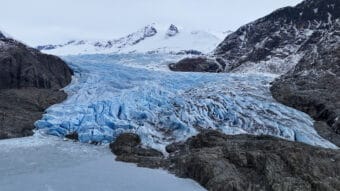
The Mendenhall Glacier on Friday, Feb. 21, 2025. (Photo by Clarise Larson/KTOO)

Every year, hundreds of thousands of tourists flock to Glacier Bay National Park in Southeast to see towering ice formations hanging over the water.

But that ice is melting. And fast.

A new report published last week in the journal Nature examines the trend here and in 18 other regions across the globe, including the Alps, Andes and Himalayas. Researchers concluded that the world’s glaciers have lost about 5% of their ice since 2000 – and that they’re melting faster than ever.

But Alaska takes the cake. The report says the state’s glaciers have shrunk by more than 8% over the same time period – the fastest of any region. All told, Alaska alone accounts for the largest chunk, or nearly a quarter, of global glacier loss.

“Alaska is ahead of the curve in terms of losing its glaciers,” said report co-author Tyler Sutterly, a scientist at the University of Washington’s Polar Science Center.

Alaska has a lot of glaciers to lose

It’s an important finding that Alaskans and visitors alike can see with their own eyes, Suttlery added.

“You go to the ice fields in Alaska, you can see visually the bathtub ring of where those glaciers were a few decades ago and where they are now,” he said. “All a glacier expert does is take that stuff that you can see by the eye, by going to these ice fields, and just putting it all together.”

Alaska is warming two to three times faster than the global average, according to the 2023 National Climate Assessment. And the state has a lot of glaciers to lose. According to the National Park Service, Alaska is home to nearly 20,000 glaciers, which cover an area nearly the size of West Virginia.

The vast majority of melting is happening in mountainous, coastal regions like Southeast, where glaciers are more concentrated. Glacier Bay National Park, for instance, has lost about 20% of its glacial area since 1985.

“A phenomenal metric for measuring climate change”

The new report in Nature is the result of a collaboration between dozens of international scientists who study glaciers and how they’re responding to climate change. Sutterly says the goal was to compare, contrast and combine more than 200 regional estimates of glacier weight to develop one of the most comprehensive understandings of glacier loss worldwide.

“Tens of thousands of glaciers taken together are a phenomenal metric for measuring climate change,” Sutterly said.

Scientists use a range of methods to get that measurement. Satellite imagery can be used to create three dimensional pictures of glaciers. Radars and lasers fired from space help measure changes in topography. And another method, called gravimetry, gauges earth’s gravity field to shed light on things like ocean circulation and the growth and loss of glaciers.

Scientists have conducted similar research on the massive ice sheets in Greenland and Antarctica. But this project instead looks at the smaller glaciers that are found in more places.

It’s a more challenging task, Sutterly said, because they’re smaller, more difficult to see from space, and located in less accessible places. Think: the ragged mountains that tower over Haines, Skagway and Gustavus. But they’re also crucial sources of information – and have major impacts on nearby ecosystems and communities.

“So these are individually smaller, but are huge parts of the landscape, and are very important for freshwater resources, tourism, river health,” Sutterly said.

Head of Alaska Aerospace sees Kodiak Island spaceport as solution for national congestion

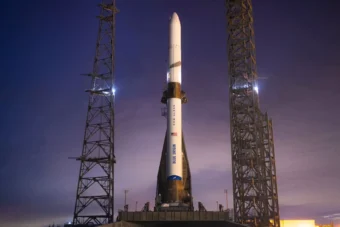
Blue Origin’s New Glenn on the launch pad at Launch Complex 36 in Cape Canaveral, Fla., on Dec. 27 2024. Rocket launches like these are increasing across the nation’s three main spaceports, resulting in more demand for additional spaceport space. (Blue Origin)

No rocket launches are scheduled as of yet for this year at the spaceport on Kodiak Island, but the head of the Alaska Aerospace Corporation is hoping to capitalize on what’s becoming a national shortage of launch space in the Lower 48.

According to reporting from the Wall Street Journal, there were a record 145 orbital missions launched from the U.S. in 2023. That’s a five time increase since 2017.

The bulk of these launches are conducted by the U.S. government and companies like SpaceX or Blue Origin, which had its New Glenn rocket successfully launch from Florida on Jan. 16 for its inaugural flight into orbit. These entities mainly use three key spaceports: Cape Canaveral in Florida, which is federal, Vandenberg Space Force Base in California, which is also federal, and the SpaceX Starbase in Texas.

Alaska Aerospace’s president and CEO John Oberst went on NBC’s “Today” show earlier this month to discuss what is being described as a “traffic jam” at the country’s spaceports and how Alaska’s facilities could relieve that congestion.

“Now is the time because we offer availability. We can take a customer and get them up on time,” Oberst said. “We are not congested.”

At the Pacific Spaceport Complex-Alaska, near Narrow Cape on Kodiak Island, potential customers could launch satellites, support space missions or test government defense projects.

The spaceport is licensed by the Federal Aviation Administration to have up to nine launches per year. That facility’s last successful launch was in 2022. Two other attempts, one each in 2023 and 2024, all failed.

But at this point, Oberst said via email that no commercial launches are on the books yet for the island spaceport. He added that new customers are interested in launching from Kodiak Island. But he said he cannot release any more information until they sign commitments.

California-based companies ABL Space Systems and Astra are already usual customers. SpaceX is not one of those customers and does not launch from the Pacific Spaceport Complex-Alaska on Kodiak Island, but the company does have an antenna set up at the facility.

Oberst previously told KMXT that he expects at least a few launches this calendar year, featuring both commercial and government customers.

When a launch is scheduled, a public notice must be given 30 days in advance.

Quintillion fiber ring could quell Alaska’s Arctic internet outages

Workers aboard a barge transfer materials to a Quintillion-operated ship. (Courtesy Quintillion)

Just 100 feet under the surface of the Bering Sea, a thin 2-inch-wide cable silently pulses on the seafloor. A flurry of ones and zeroes flash through the cable at near-lightspeed, carrying with it social media posts, Zoom meetings and medical records.

This is Quintillion’s Arctic fiber network, which stretches north from Nome all the way to Prudhoe Bay. There, it meets up with a landline that runs down to Fairbanks and on to the Lower 48. But for coastal communities south of Nome, there’s nothing like it.

Quintillion’s director of operations, Art Paul, said the telecommunications company is taking steps toward changing that.

Map of Quintillion’s future fiber ring around Alaska. (Courtesy Quintillion)

“So Nome, Kotzebue, everywhere north of them gets to use that fiber pathway. We recognize there’s more customers to serve, of course, in the southwest,” Paul said.

For all the good subsea fiber brings – blazing fast speeds and low latency – it comes with its own challenges. The thin armored cables span hundreds of miles on the seafloor, where they’re susceptible to line breaks.

So what happens if a cable does break?

In June 2023, a cable scoured by sea ice 34 miles offshore of the North Slope took Quintillion’s entire Arctic fiber network down. Utqiaġvik, Wainwright, Kotzebue and Nome were all taken offline.

Paul said that this new project will complete a ring around Alaska, giving Quintillion the ability to simply send traffic the opposite direction should another line break occur.

“In the future if there’s an ice scour event or a boat anchor event, we can reroute traffic the other direction,” Paul said. “So never again will those communities be stuck while our ship mobilizes from the Lower 48 to replace that fiber break.”

The new route will stretch from Nome to Homer, where five subsea cables already convene. Paul said Homer’s established infrastructure and port makes it an ideal end point for the new, 950-mile-long cable.

“It’s an ice free port, so it’s a pretty easy place to to do business. But primarily it’s because the other cables land there, it’s kind of a hub for fiber in Alaska,” Paul said.

Quintillion plans to begin construction this summer with help from its new partner, Xtera Inc. The Texas-based company signed a $77 million agreement last November to provide procurement and expertise for the network.

Quintillion said it expects to invest $61 million of its own capital for the project and estimate the total cost to be around $150 million. Construction of the Nome to Homer Express is expected to wrap up by late 2026, with the network operational by early 2027.

A Fairbanks lab is testing a prototype of a new cold climate heat pump

National Renewable Energy Laboratory Fairbanks campus Chief Scientist Tom Marsik describes how the lab is testing LG’s new air-source heat pump prototype, which is supposed to be an effective home heating tool down to -30 degrees Fahrenheit. (Patrick Gilchrist/KUAC)

How low can you go, really?

That’s one question Alaska researchers are asking of a new heat pump prototype this winter.

The new LG model purports to heat homes effectively even at -30 degrees Fahrenheit, and may soon do so for hundreds of residents in northern Alaska.

Along with installing solar power systems and battery storage, heat pump deployment was one of three major components of a $55 million U.S. Department of Energy grant awarded to the Northwest Arctic Borough back in February.

That deployment is to the tune of 850 air source heat pumps installed in 11 different villages.

But before that grant-funded rollout begins, the borough must select which model to deploy. That means generating data and crunching numbers, said Ingemar Mathiasson, the Northwest Arctic Borough’s energy manager.

“We have now a test going on with an LG heat pump … that can go down to 30-, 40-below, and still produce 70 degrees inside the house,” Mathiasson said, referring to temperatures measured in degrees Fahrenheit. “And we’re gonna test one of those here through the rest of the winter. We’re installing it pretty quick here, and there’s also one in Fairbanks that’s being installed over there by NREL.

A few hundred miles southeast of Mathiasson, National Renewable Energy Laboratory (NREL) Chief Scientist Tom Marsik walked to the corner of a classroom on the second story of the lab’s main building. He pointed out the window.

“You can see it right here,” Marsik said as his footsteps echoed on the hard floor. “So that’s the outside unit of the heat pump,” he added, directing his gaze at a microwave-sized metal box with a fan on its backside.

Then his attention moved away from the snow-covered scenery outside the window.

“We can see the indoor unit hanging here on the wall, the indoor unit of the heat pump. We can see lines connecting it, going through the wall, connecting it to the outside unit,” he said.

A 6-foot collapsible table stood between Marsik and the eggshell-colored indoor unit. Some hand tools and wire were scattered across the table’s surface.

The setup wouldn’t look out of place in the garage of an avid do-it-yourselfer, but it’s exactly where the testing is happening this winter that will help determine whether – and how – the Northwest Arctic Borough will go about putting in and using hundreds of new heat pumps in the coming years.

“We are evaluating the preferments of this heat pump, so they can decide, is it really the model they want to use? And if so, then we can also provide guidelines for how to potentially operate it in the most beneficial way,” Marsik said.

Marsik explained that the technology works by capturing heat from the air – however cold the air may seem – and then sending it inside to warm up a space. The process is like refrigeration – which removes hot air from an enclosure to keep it cool – but in reverse.

“The coil of the outside unit is colder than the outside environment, that’s how it can extract the heat from that because heat flows, heat flows from hot to cold,” he said.

Heat pumps aren’t exactly new. In some fashion, they’ve been a part of the home-heating picture since the 1960s. But the technology is evolving, working at colder and colder temperatures, an earlier this year, the MIT Technological Review listed heat pumps as one of the 10 breakthrough technologies of 2024.

The LG prototype at NREL is designed to operate down to temperatures about 10 degrees Fahrenheit colder than the backup model for the Northwest Arctic Borough’s project, which is a Mitsubishi heat pump.

But, Mathiasson, the energy manager, said that capability could come with its own set of limitations the borough needs to assess before making a final selection on the model.

“It’s a new variation to be able to go down into the lower temperatures, but they also draw more power, so we want to measure how efficient they are and how well they can substitute for a Toyo stove or boiler in the house,” Mathiasson said.

That’s where the testing comes into play.

Throughout the Fairbanks winter, Marsik and others will keep tabs on how the LG prototype responds to natural fluctuations in the temperature outside. Also, to mimic differing levels of building insulation, they’ll pit the heat pump against a portable air conditioner that will run incrementally in the room. The U.S. Department of Energy is funding the $130,000 testing project.

“So we have put a bunch of sensors on the indoor unit and the outdoor unit to measure how much electrical energy we are putting into it and also how much heat this heat pump is supplying into this environment,” Marsik said.

Whichever model makes the cut, Mathiasson expects the installation of heat pumps to get underway this summer in villages already converted to renewable-centric microgrids.

“So that’s Shungnak and Kobuk and Noatak and Deering,” he said.

The heat pumps will then be deployed to the other villages, but only after their microgrids introduce solar power and battery storage to offset some diesel in the production of electricity.

“If you put heat pumps into the communities without the renewables, you’re actually going burn more diesel,” Mathiasson said, adding he expects the conversion to be complete by 2029.

Although their efficiency can decrease in extreme temperatures, heat pumps can generate about three to four times as much energy in the form of heat as they use in electricity. That’s why advocates say they’ll prove a critical tool for global decarbonization efforts.

The International Energy Agency says heat pumps currently supply about 10% of the world’s heating demand. To keep pace with the Net Zero by 2050 scenario, the IEA estimates that supply would need to hit 20% by 2030.

Upfront capital costs remain one of the bigger roadblocks for heat pumps, and after years of growth, global heat pump sales dropped by 3% in 2023.

But, in Alaska, 2024 held a couple policy-related developments for the technology. There’s the pending Northwest Arctic Borough rollout, and there’s the $39 million federal grant announced in July to help homeowners in Southcentral and Southeast Alaska purchase heat pumps.

So, for Mathiasson, at least, “It’s definitely the year of heat pumps for Alaska.”

Site notifications
Update notification options
Subscribe to notifications