Science & Tech

Nonprofit coordinating Arctic research will shut down as federal funding dries up

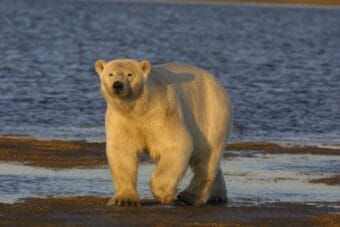
a polar bear
A polar bear walks along the shore in Alaska on Sept. 6, 2019. (U.S. Fish and Wildlife Service)

A nonprofit coordinating academic research on the Arctic plans to shut down as its federal funding dries up. The Arctic Research Consortium of the United States says it plans to wind down operations at the end of this month.

The group announced the decision in an email to members late last month, saying the National Science Foundation’s decision to scrap plans for a grant that provides the bulk of its funding left it no choice but to close its doors.

The Arctic Research Consortium brings together scientists working with universities, government agencies and nonprofits to collaborate and share their findings. Researcher Michael Walsh, a nonresident senior fellow at the Foreign Policy Research Institute who has worked with the organization, said the shutdown comes at a critical time as the federal government seeks input on a new five-year plan for government-funded Arctic research

“That new National Plan for Arctic Research is going to have to answer some of these big questions,” he said. “What are the policy drivers? What are the priority areas? What should, you know, the US government focus on supporting in the context of Arctic research?”

The group also connects thousands of Arctic researchers and provides grants that allow early-career academics to travel to other institutions or conferences Walsh said. Eliminating those opportunities will leave scientists isolated from one another and stunt young researchers’ professional development, he said.

A spokesperson for the National Science Foundation confirmed the grant funding much of the consortium’s activities would end in 2026 but declined to say why the agency scrapped plans to reissue it. The spokesperson said NSF would remain engaged with the Interagency Arctic Policy Research Committee, a federal working group that prepares the five-year Arctic research plan.

“NSF remains committed to supporting national interests in the Arctic through our continued leadership of IARPC and through collaborations with partners, including the research community, to support innovative scientific research about the Earth’s polar regions,” the NSF spokesperson said via email.

President Donald Trump has repeatedly said he would like to expand the U.S.’s presence in the Arctic by acquiring the self-governing island of Greenland from Denmark. But Walsh said the administration has not matched that apparent interest with investment.

“One would expect that what would follow from that would be a proliferation of Arctic studies centers to be able to develop the capacities and the resources and the knowledge the United States needs in order to be able to advance our national interests in those areas,” Walsh said. “We haven’t seen that yet.”

Kodiak spaceport hosts secretive federal government rocket launch, likely a hypersonic missile test

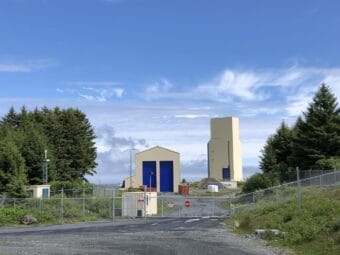
The state-owned Pacific Spaceport Complex is seen on July 13, 2021, in Kodiak. (Photo by James Brooks/Alaska Beacon)

Alaska’s state-owned Pacific Spaceport Complex on Kodiak Island launched a secret U.S. Department of Defense missile last week during what observers believe was a hypersonic weapon being tested by the U.S. military.

The launch, which was not disclosed beforehand, took place about 10 p.m. Thursday night and was observed by people across the Kodiak Archipelago and was visible as far away as Seward.
Hypersonic missiles are those that can travel at least five times the speed of sound.

While long-range ballistic missiles — produced since World War II — frequently exceed that threshold, they cannot typically maneuver to avoid defenses and are locked on a fixed trajectory.

Modern hypersonic missiles, under development by several countries, would be able to avoid anti-missile systems being deployed by the United States, Israel and other countries.

KMXT-FM public radio and the Kodiak Daily Mirror first reported the launch, which was preceded by warnings to navigators and road closures on Kodiak, home to Alaska’s state-owned spaceport.

The spaceport is owned and operated by the Alaska Aerospace Corporation, a state-owned public corporation created in the late 1990s as part of legislative efforts to diversify Alaska’s economy.

Officials issued a written statement the day after saying that “a successful government rocket launch” took place Thursday night and that it was the 35th launch from the Kodiak spaceport since its creation in 1998.

“The residents of Kodiak should be proud of yesterday’s achievement and the significant contribution their community provides to the space legacy of the United States,” the statement said in part.

The corporation did not state the purpose of the launch.

Warning messages issued ahead of the launch are similar to those that observers saw in 2021, when the Department of Defense twice attempted and failed to launch a hypersonic missile from the Kodiak spaceport.

The corporation declined to answer questions asking about the launch on Monday.

John Oberst, president and CEO of the corporation, said by email, “The Alaska Aerospace Corporation considers transparency with Alaskans a priority.  On occasion, there are some launches, like the one last week, that do not permit us this latitude. Thank you for your interest in our business.”

Research scientist Dr. Marco Langebroek, who tracks space launches from his home in the Netherlands, observed that the warnings to navigators match a planned three-stage missile test splashing down near the U.S. military’s rocket site at Kwajalein, Marshall Islands in the central Pacific Ocean.

Four years ago, the U.S. Army published documents indicating that it intended to test a hypersonic missile from Kodiak. The information in those documents matches the warning messages published ahead of last week’s flight.

In 2021, a prior test launch from Kodiak failed due to problems with the booster rocket intended to lift the hypersonic weapon to a high altitude.

Toxin that causes paralytic shellfish poisoning blamed for Alaska seal deaths

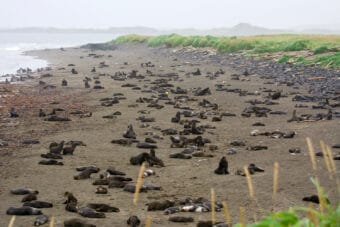
Northern fur seals rest on a beach south of St. Paul Island’s Polovina Rookery in August of 2021. Dead fur seals found on the island in August of 2024 are determined to have been victims of saxitoxin, an algal toxin that causes paralytic shellfish poisoning. (Photo provided by the National Oceanic and Atmospheric Administration Fisheries Service)

For the first time, scientists have made a definite link between the toxin produced by algae that causes paralytic shellfish poisoning and marine mammal deaths.

Fur seals found dead last August on Alaska’s St. Paul Island had significant levels of saxitoxin in their bodies, as did several of the dead fish around them.

It was the clearest evidence ever found for this type of toxin-caused death, scientists say.

“I would say this is the absolute strongest case for saxitoxin poisoning in marine mammals anywhere,” said Kathi Lefebvre, a National Oceanic and Atmospheric Administration research biologist and the lead author of a study detailing the findings, published in the journal Marine Mammals Science in May.

The discovery, a warning for local communities that rely on subsistence hunting, comes as long-term warming in the Bering and Chukchi seas is increasing the prevalence of a type of algae that produces saxitoxin is becoming more prevalent in these bodies of water.

Dangerous blooms of the Alexandrium have long been observed in more southern waters of Alaska, where paralytic shellfish poisoning is a well-recognized and sometimes deadly hazard. Clams are notorious for accumulating saxitoxin, and there are frequent safety advisories that warn people of specific sites’ shellfish poisoning dangers, and two labs in the state — one in Anchorage operated by the Department of Environmental Conservation and one in Sitka operated by the Sitka Tribe of Alaska — test harvested shellfish to determine whether it is safe for human consumption.

A subadult fur seal is hauled out on St. Paul Island in 2007. About two-thirds of the world’s northern fur seal population uses the Pribilofs for breeding. (Photo by Carla Stanley/U.S. Fish and Wildlife Service)

Farther north, the emergence of large Alexandrium blooms and potentially dangerous saxitoxin levels is new. But, as Lefebvre explains it, the conditions to create those toxin hazards have been set up over decades and possibly even centuries.

Over time, ocean currents have carried bits of Alexandrium algae north, and over time, that algae has dropped to the bottom of the ocean. That created massive beds of dormant cysts, the equivalent of algal seeds.

The Bering, Chukchi and even Beaufort seas hold some of the highest concentrations of Alexandrium cysts ever found in the world, according to Don Anderson, a harmful algal specialist with the Woods Hole Oceanographic Institution. Anderson led research teams that mapped out Alaska cyst beds over several years, including a bed in the Chukchi that he said is the biggest ever discovered.

Those cyst beds were dormant until recently, said Lefebvre, who works closely with Anderson.

“They’ve just been building and building and building. And then in the last couple decades – actually, the last 10 years, maybe — the bottom temperature finally was warm enough for cyst germination,” Lefebvre said. That appears to be the cause of the large blooms now being found routinely in the Bering, Chukchi and Beaufort seas, she said.

Dead fur seals and fish

In the case of the St. Paul fur seals, local beachcombers found 10 dead animals at a site on the northeastern side of the island called Benson Beach. It is a catchment site where marine debris, kelp and other items are known to accumulate, said Lauren Divine, director of the island’s Tribal ecosystem conservation office.

Tribal representatives managed to retrieve some of the dead seals, as well as some of the dead fish with them, said Divine, who works for the Aleut Community of St. Paul Island. They photographed the scene and gathered whatever information they could, and they contacted the NOAA-coordinated Alaska Marine Mammal Stranding Network and Anchorage-based veterinarian pathologist Kathy Burek-Huntington to continue the investigation, she said.

It was clearly a startling discovery, Divine said.

“This was something that everyone was quite alarmed (at) and noticed as something that was wrong in the ecosystem and something that really hadn’t ever been noticed or detected before,” she said. “So we were pretty adamant about really trying to do the best job that we could to collect as much information as we could about the event, and also with quite little capacity that we have out in the remote community.”

In all five of the adult seals tested, saxitoxin was found in feces or urine, significant because they indicate higher exposure when tainted food was eaten. Two fish were sampled as well, and both turned up saxitoxin in their intestines.

At about the same time, samples being taken by researchers in the southeastern Bering Sea — the same area where the dead fur seals would have been foraging — revealed dense Alexandrium blooms, large cyst beds and extremely high prevalence of saxitoxin in fish, zooplankton, clams and worms.

Anderson, who noted that his team has already found a huge Alexandrium cyst bed near St. Paul, the seal discovery is significant for two reasons.

“The seal mortality demonstrates that dangerous levels of toxin can accumulate there and that local communities need to be careful about what they consume during certain times of the year,” he said by email.

Seed-like cysts of the harmful alga Alexandrium, which produces saxitoxin, are seen in this microscopic image. (Image provided by the National Oceanic and Atmospheric Administration)

Additionally, because scientists know that ocean currents run north from that region, “this might be yet another source of cells that can affect the Alaskan Arctic,” he said.

Lefebvre said all the evidence about the seals’ bodies, the fish samples and the environmental conditions were needed to show that the algal toxins killed the seals.

Up to now, it has not been possible to prove such a strong link between saxitoxin and marine mammal deaths, she said.

Mammals poisoned by saxitoxin are likely to disappear while at sea, she said. “They become paralyzed. They’re going to basically suffocate, not even drown, not even taking a breath of air, of water,” she said. “They’re going to just stop breathing.”

That contrasts with effects of a different type of algal toxin that, since the 1990s, has caused mass strandings and deaths since 1990 of marine mammals in California. That toxin, domoic acid, is produced by the Pseudo-nitzschia algae. Rather than causing paralysis, it overstimulates the nervous system, causing seizures that can result in death.

Lefebvre and others have documented thousands of cases of domoic acid poisoning among marine mammals in California, including sea lions, dolphinsseals, and whales, with animals easily seen by people on the beach. Mass die-offs of seabirds have also been documented.

So far, there have been no domoic acid poisoning cases documented in Alaska, though Lefebvre and her colleagues have consistently found low levels of it in various marine mammal species.

But a new study suggests that continued warming may make domoic acid a future problem in Alaska. The study, also led by Lefebvre, found that bowhead whales hunted over a two-decade period carried higher levels of both saxitoxin and domoic acid in years when waters were warm and sea ice was low.

Saxitoxin risks in various wild foods?

For now, saxitoxin and the paralytic shellfish poisoning it causes remain the main algal toxin concern in Alaska.

Among people, there were 132 reports of paralytic shellfish poisoning between 1993 to 2021, with the highest prevalence in Southeast Alaska and the Kodiak Archipelago, according to a bulletin published in 2022 by the Department of Health’s epidemiology section. The last fatal case concerned a person who ate shellfish at Unalaska Island.

Information about saxitoxin poisoning in wildlife has been more difficult to pinpoint.

In past years, it was suspected in some marine mammal deaths in Alaska, but it was not proven.

In the fall of 2017, four dead walruses found in the Bering Strait region had saxitoxin in their stomachs or intestines. They were among 39 walruses that, though otherwise in good body condition, were found dead in the region that August and September.

Two years later, another piece of the puzzle came when scientists retrieved clams from the Bering Strait area and the Chukchi Sea that had levels of saxitoxin above the thresholds for safe consumption by humans. That added another piece to the puzzle. Clams are an important part of the Pacific walrus diet, though the saxitoxin threshold for walruses has yet to be determined.

There are other suspected cases. For example, saxitoxin poisoning was a suggested cause of a 1987 sea otter die-off in the Kodiak Archipelago, though test results were inconclusive.

Beyond mammals, Alaska seabirds are known to have been killed by saxitoxin. That toxin caused a 2019 die-off of Arctic terns in the Juneau area; the birds had been feeding on sand lance, a type of fish known to accumulate saxitoxin.

A female northern fur seal is seen in this undated photo. (Photo provided by the National Oceanic and Atmospheric Administration)

For people in St. Paul and elsewhere in Western Alaska, who live far away from the two Alaska labs that currently test shellfish for toxins, the new information is concerning, Divine said.

St. Paul residents and others in the Pribilof Islands harvest various types of animals beyond the clams and mussels that are routinely screened for consumption safety, she said. But there is not much known yet about saxitoxin levels in the full breadth of subsistence foods, she said. “We just don’t have robust information on how much is accumulating and how things are impacted across the food web,” she said.

A grant from a NOAA program called ECOHAB funded much of the work that supported the new study. The grant for that work, which is led by Lefebvre and Anderson, runs through this year.

Anderson said the team just learned that it has been awarded ECOHAB grant funding for another year of work, part of what had been planned as a five-year follow-up program to better understand the saxitoxin risk in wild foods gathered in Indigenous subsistence harvests.

News of the one-year award is encouraging, but the scientists are worried about future years, Anderson said

The Trump administration has targeted NOAA for deep cuts, he noted. The administration is proposing to entirely terminate NOAA’s National Centers for Coastal Ocean Sciences, the agency arm that supports research into algal toxins.

Termination of the National Centers for Coastal Ocean Sciences would end funding for NOAA’s entire Integrated Ocean Observing System. Within the IOOS is the Alaska Ocean Observing System, which monitors algal blooms, among other work.

Divine said the same people who have been drawn together by their concerns about toxins in the food web are also worried about the potential loss of scientific research.

“We have just an incredible amount of interest in this, and the funding that has been secured to really tackle this in a coordinated way is all on hold in this administration. And I do think that that’s worth noting,” she said.

Proposed NOAA cuts could shutter research institutes that train the next generation of Alaska scientists

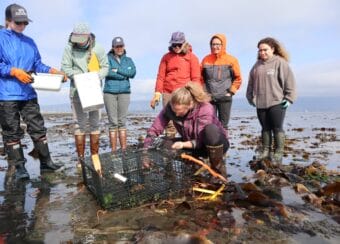
Students, staff and partners with Kachemak Bay National Estuarine Research Reserve check a crab trap at a community workshop. (Photo courtesy of reserve staff)

Alaska could lose several research institutions and a pipeline into science for budding researchers in the state if the Trump administration’s proposed cuts to the National Oceanic and Atmospheric Administration’s budget become a reality. 

“Even the possibility of the disruption is affecting the students and the researchers,” said Joshua Hostler, a Ph.D. student at the University of Alaska Fairbanks. His research group met this week to discuss if they’d apply for a new federal funding opportunity. Because of the uncertainty, they probably won’t.

“Even if they do approve the funding, are they going to take it away later?” Hostler said.

He said that groups across the university system have been easing up on submitting research proposals for the same reason. 

The Trump administration proposed to slash the National Oceanic and Atmospheric Administration’s budget by about 27% and eliminate climate research in a memo leaked this month. The draft cuts would terminate funding for several research institutes that rely on the agency to finance their work in Alaska. Among those on the chopping block are the Cooperative Institute for Climate, Ocean, and Ecosystem Studies (CICOES), the Alaska Ocean Observing System, Alaska Sea Grant, the Alaska Center for Climate Assessment and Policy and the Kachemak Bay National Estuarine Research Reserve. 

The institutions share projects, faculty and student researchers with the University of Alaska so the state can understand and adapt to climate change while training the next generation of in-state experts.

Hostler is currently developing a seasonal lightning forecast system to help wildfire managers in Alaska plan for the upcoming fire season. Lighting strikes most in Interior Alaska, and that’s where the biggest wildfires in the state happen. Hostler is using machine learning models to predict the intensity of lightning a season in advance, so fire managers know where to put their resources. 

But he’s funded by a NOAA grant from the Oceanic and Atmospheric Research office that would be eliminated under the draft cuts, and he applied for the grant with help from CICOES, which would also be cut. The funds cover Hostler’s wages of $29 per hour.

“Without that funding, I just wouldn’t be able to pay my rent,” he said. “I’d have to stop doing the research that I’m doing now and I’d have to go get a job somewhere.”

Hajo Eicken heads the International Arctic Research Center at UAF. He said these NOAA-funded institutes have helped create a pipeline for students to develop research in Alaska and then have opportunities to continue working here after graduating.

“These students, in particular, the Ph.D. students, they’re at the cutting edge of the field,” he said. “They help us respond much more effectively to various opportunities and challenges that we’re facing in Alaska.”

CeCe Borries-Strigle, a Ph.D. student at UAF who is set to finish her degree this summer, was planning to stay at the university for another year as a post-doctoral researcher to finish her work improving fire weather forecasts in the state. But, like Hostler, that project would be funded through a NOAA office and a research institute that may soon cease to exist.

Borries-Strigle is based in Kenai and was there in 2019 when the Swan Lake Fire jumped Sterling Highway and smoke choked the region for several months. She said she wants to stay in Alaska working on wildland fire research, but might have to change those plans due to funding uncertainty. 

“I think there’s going to be a huge generation of scientists that miss out on more early career training because the funding is not there,” she said. “Those jobs aren’t there.”

At Kachemak Bay National Estuarine Research Reserve in Homer, 10 college students participate in community-driven research projects each year. Katherine Schake manages the reserve and said that past students have gone on to manage invasive European green crab with the Metlakatla Indian Community, track fish stocks at the Alaska Department of Fish and Game and been hired on to continue freshwater research at the reserve. 

The reserve receives more than $800,000 per year from NOAA, and a 30% match from the University of Alaska Anchorage. That covers facilities and half of the staff’s salaries, Schake said. Without the base NOAA funds, she said that the staff would likely drop from 10 to four, and they wouldn’t be able to continue mentoring students.

One key service that students help with in Alaska is collecting data at sea. Seth Danielson leads an oceanography lab at UAF. His team tracks ocean conditions such as the temperature, nutrient content and salinity off the coast of Alaska over long time periods. That data, which shows how the seas are changing, feeds into how fisheries are managed.

“So NOAA develops the ecosystem status report for the North Pacific Fisheries Management Council every fall, and the council uses the assessments of ocean conditions as they set harvest levels for next year’s catch limits,” Danielson said. “So not all that data is collected only by NOAA — some of it’s collected by university researchers like us.”

More than 60% of Danielson’s funding comes from NOAA through the Alaska Ocean Observing System, one of the institutes that would be closed under the proposal. If that happens, he says he would probably have to lay off four of his five staff members. 

He’d lose more than staff. Last August, his team moored half a million dollars worth of equipment to the bottom of the ocean. To get the data it’s been collecting all year, they need funding to sail out there and retrieve it. 

“So not only is the data at risk and the students who are relying on that data for their graduate research, but the equipment itself is at risk — the batteries don’t last forever,” he said. 

If the batteries die before Danielson can secure funding for the expedition, all of the data would be lost.

In Juneau, Curry Cunningham runs a fisheries lab through UAF. He estimates that NOAA pays for at least 30% of his research and staff, and said that the bleak funding outlook means he’s planning to scale back the number of graduate students and research projects he’ll take on in the future.

Right now, Cunningham oversees six graduate students and four post-graduate researchers. Three of them are working on NOAA-funded projects. 

“A lot of the job opportunities that may have been available in the recent past are unlikely to be available for some of our students as they exit our program,” he said.  

The proposed cuts come as UAF has set a goal to become one of the top-tier research institutions in the nation, called R1 status. To qualify, the university needs to award an average of 70 doctorates per year. Laura Conner is vice chancellor for research at UAF. She said that roughly a quarter of the university’s operating budget comes from the federal government, and graduate researchers rely on federal dollars.

“It’s likely that large decreases in federal support could impact R1,” Conner said.  

But, she said it’s hard to predict how it will play out and UAF is still hopeful it can achieve the status. 

Even so, she said that a deep cut to NOAA funding, “will have a chilling effect on research across the nation, more generally.”

Staff at NOAA’s Juneau offices and the White House declined to comment, and final funding decisions have not yet been made. 

A stargazer’s dream: For the next 2 weeks, NASA will be shooting rockets at the aurora

The aurora seen from the Old Nenana Highway near Fairbanks in October, 2015. (Photo by Ian Dickson)

People living in the northern part of the state will have a chance to watch rockets soar through aurora-lit skies for the next couple of weeks.

Starting on the night of March 24, the research rockets will launch intermittently from the Poker Flat Research Range, about 35 miles from Fairbanks. Scientists will be observing the launches from sites all over the Interior and the Arctic — from Utqiagvik to the north, to Eagle in the east, all the way down to Fairbanks.

It’s all part of a NASA experiment called Auroral Waves Excited by Substorm Onset Magnetic Events, or “AWESOME,” which seeks to observe how auroras affect Earth’s upper atmosphere. Scientists hope the study might also improve space weather forecasts. The idea is to measure the timing and strength of the energy waves thrown around by this spring’s strong aurora.

Don Hampton, a scientist at the University of Alaska Fairbanks and a partner on the AWESOME project, said the way the aurora interacts with the atmosphere works somewhat like ripples on the surface of a body of water.

“The aurora is sort of a rapid energy input,” he said. “It’s like dropping a big pebble into a lake. And when you do that, the atmosphere actually heats up. You will see what are called atmospheric gravity waves come out from sources like that. So, the idea is to look for that.”

Hampton said spectators are in for a pretty spectacular light show, with the rockets emitting a glowing, multi-colored vapor trail for more than 10 minutes at a time — and that’s not even including the aurora. He said it’s no coincidence that the experiment is taking place right now.

“We’re at what’s called the solar max, so we get a lot of aurora,” Hampton said. “Typically, this time of the year, there’s at least a little bit more of a chance of seeing active aurora. That has to do with sort of the orientation of the Earth’s magnetic field at the time.”

Depending on weather conditions, the rockets will blast off in a window of time from 11 p.m. to 4 a.m. The last possible launch will be on the night of April 6.

To get live updates on when the rockets will be visible, you can text PFRRLAUNCHES to the number (866) 485-7641. You can also check the live feed on the Poker Flat Facebook page.

Alaska glaciologists reflect on a rapidly changing icescape

Mendenhall Glacier on Friday, Feb. 21, 2025. (Photo by Clarise Larson/KTOO)

Listen to this story:

Glaciers shape the land and lives of Alaskans — carving mountains, funneling cold freshwater into rivers, carrying nutrients to the sea and reflecting sunlight back to space. 

Friday marked the first-ever World Day for Glaciers, a day observed by the United Nations to sound the alarm on the accelerating pace of global melting. Scientists who study Alaska glaciers spoke about their research to uncover how these rapidly changing systems affect our world. 

Kiya Riverman studies what makes glaciers flow as a glaciologist and associate director of the Juneau Icefield Research Program. 

“Often we have this sense that glaciers are this really static thing,” she said.  

Before and after pictures show glaciers retreating, sure, but usually over the span of years and decades. It’s much faster than that, she said. 

“They’re almost like living, breathing creatures that change a little bit every day,” she said. 

They speed up in the heat of the day, and slow down as they cool at night. 

Glaciers make up an area of land in Alaska nearly equal to the size of West Virginia — but we’re losing them quickly. The state is warming two or three times faster than the global average, and glaciers here have shrunk more — in gigatons per year — than anywhere else since the turn of the century.

As the ice melts, the average global sea level rises. Although this doesn’t directly affect much of Southeast Alaska, where the land is rising faster than the sea as it sheds the weight of glaciers. That’s called isostatic rebound, and it’s one reason why rising seas won’t lap up to every coastal community the same way. 

Riverman said it’s challenging to predict and quantify the extent to which melting glaciers cause sea level rise.

“So we know that glaciers are changing, we know that the ocean is changing, but how those two impact each other is kind of the edge of the field still, and that’s a problem” because low-lying areas by the sea will get hit hard and that will impact millions of people worldwide, Riverman said. Alaska’s glacial meltwater has already contributed significantly to sea level rise, and scientists predict that will continue

To understand what’s happening under the ice, Riverman and her team ski out onto the Juneau icefield every summer and put out seismometers that measure vibrations. 

They strike the ice surface with a sledgehammer or shoot it with blank shotgun shells.

“We use those miniature earthquakes to study how thick the ice is and what materials sit underneath,” she said.

She also uses radar to pinpoint where pockets of water have formed, since water lubricates the ice and makes it flow faster. 

Other scientists look at glacier mass, a measure of how much glacier matter there is. Louis Sass is part of the oldest study of glacier mass in North America as a glaciologist with the U.S. Geological Survey’s Alaska Science Center. It’s called the Benchmark Glacier Project, and it started tracking a few of Alaska’s glaciers — Lemon Creek in Juneau, Wolverine on the Kenai Peninsula and Gulkana in the Alaska Range — in the 1950s and 60s.

Back then, Sass said, it wasn’t clear whether Alaska’s glaciers were retreating continuously, or if they had just retreated some after the Little Ice Age and then stabilized. 

“People didn’t really know what was happening, because people hadn’t paid really close attention,” Sass said. “There were just very few glaciers that had any sort of picture record or enough data.”

Sass and his team venture out to the same survey sites each spring and fall to calculate the change in mass. They dig pits into the snow or take cores and weigh it. Then they drill long stakes down into the glacier to measure the levels of snow and ice. This is all very similar to what was done back in the 1960s, Sass said.

But now, using satellite imagery, they calibrate that data with the elevation changes of those survey sites as they slide down toward the ocean — since ice melts faster at lower, hotter elevations. The sliding poses a research challenge, Sass said. 

On Wolverine Glacier in the Kenai Mountains, “a sinkhole opened up, and that section of the glacier just sort of disintegrated, and the ice beyond it all melted away” so they lost the survey site stationed there, Sass said. “We’ve had to replace sites that have disappeared on all the glaciers now, as they melted out — and it’s changing so much faster.”

Suicide Basin, the birthplace of Juneau’s annual glacial outburst floods, sits about two miles above the terminus of Mendenhall Glacier. On Aug. 5, 2023, nearly 13 billions gallons of water drained from the basin, triggering the most destructive glacial outburst flood in Juneau’s history. (Anna Canny/KTOO)

Rapid melting has created a relatively new problem for people who live in the path of the freezing water’s path: glacial outburst floods. 

In Juneau, Suicide Basin is a pool contained in steep rock and dammed by Mendenhall Glacier. During the summer, the pool fills with meltwater and puts pressure on the ice dam until it suddenly breaks and drains into Mendenhall Lake, which then floods parts of the neighborhood in the surrounding valley. 

Jamie Pierce is a hydrologist at the U.S. Geological Survey who monitors Suicide Basin. 

Equipment stationed in Mendenhall Lake shows Pierce early warning signs when a flood is coming. 

“Water temperature will plummet, that’s a big one,” he said. “Then, of course, the lake stage will start rising precipitously.”

One summer day in late June of 2018, when he was setting up some monitoring gear in Suicide Basin, he thought he was witnessing the dam break in real-time. Bubbles started to rise up to the water’s surface among floating icebergs. It was noisy — crackling and popping. 

“And then all of a sudden, a massive iceberg started to overturn, and it kind of set off a chain reaction,” Pierce said.

The glacier calved off a chunk of ice roughly 100 feet deep and 200 feet long. Pierce and his colleagues thought it was going to trigger the big release. It didn’t, but it showed the huge scale of change the glacier is going through, and meant that the ice dam went quite deep. 

Major questions remain about Alaska’s glaciers. How long will they last? How big can glacial outburst floods get? And what will happen when the ice is gone?

Researchers are chasing answers to help Alaskans navigate a rapidly changing relationship with ice.

Site notifications
Update notification options
Subscribe to notifications