Anna Canny

Local News Reporter

Kensington Gold Mine reports 105,000 gallon tailings spill earlier this winter

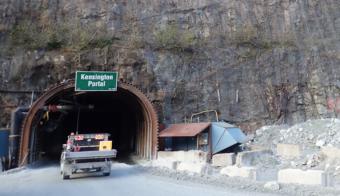
A mine vehicle enters the Kensington Portal on Oct. 15, 2019.
A mine vehicle enters the Kensington Portal on Oct. 15, 2019. It’s one of two accesses for a network of about 28 miles of underground tunnels. (Photo by Jacob Resneck/CoastAlaska)

Kensington Gold Mine, which operates about 45 miles north of Juneau, has reported a 105,581-gallon spill of mine waste that happened back in late January. 

A leak in an underground pipeline that carries mine tailings from the mill to the mine’s tailings storage pond released a mixture of water and ground up rock that contained small concentrations of heavy metals. Some of that slurry reached the nearby Johnson Creek, which empties into Berners Bay. 

According to an incident report from the mine’s parent company, Coeur Alaska, the spilled tailings “pose no long-term impacts to Johnson Creek.”

A loss of pressure in the pipe alerted a mine employee of the spill, which came from a small hole that formed in a section of the pipe near the mill. The spill lasted nearly 24 hours, but according to Coeur’s report it only came into contact with Johnson Creek for just under three hours.

Samples taken from the creek by mine staff just after the spill began showed levels of aluminum, cadmium, copper, iron and lead that exceeded state water quality standards, as well as cloudy water and elevated acidity. But follow-up samples taken the next day and a week later showed that the contamination had been diluted to acceptable levels. 

Testing by the Alaska Department of Fish and Game also found that metals in the creek bed sediment did not exceed baseline concentrations.

Portions of Johnson Creek downstream from the mine are spawning grounds for salmon. Berners Bay is an important subsistence fishery and is considered an essential fish habitat for many species of ground fish under federal law. 

According to Coeur’s report, the spill did not touch the creek’s lower reaches. But the National Atmospheric and Oceanic Administration has called for an additional assessment to ensure that the spill has not negatively impacted those fisheries. 

The report states that crews at Kensington Mine were able to remove about half of the spilled tailings from a nearby road and from areas around the creek. Cleanup efforts to remove more tailings from the creek’s margins will resume this spring as snow and ice recede.

The Alaska Department of Environmental Conservation will compare the cleanup efforts detailed in Coeur’s report against state standards. 

“We’re going to review this report, and then look at it and identify any gaps in information that we want to hear more on from Coeur,” said Rachael Krajewski, coordinator of spill prevention, preparedness and response for the Southeast region. “We’re not walking away from this until we are confident that cleanup has been done to state standards.”

Krajewski said the state will likely require additional water quality sampling. 

In 2019, the mine incurred more than half a million dollars in fines from the Environmental Protection Agency for discharge violations.

Coeur Alaska declined KTOO’s request for additional comment. According to its report, the section of the pipeline that leaked has been replaced. 

It also says the mine plans to conduct a full inspection of the rest of the pipeline later this year, and implement new training protocols and monitoring technology to catch future leaks faster. 

Why do Juneau’s thrift stores fill up so fast? And what can we do about it?

The Salvation Army Family Store on a busy Saturday donation day in February 2024 (Photo by Anna Canny/KTOO)

Dick Wood wrestled white garbage bags and cardboard boxes from the backseat of his beat up red car.

There were children’s books, toys and clothes that once belonged to Wood’s son, who is 35 now with a brand new baby.

“We were saving it for his kid, and they don’t want it,” Wood said. “His generation, they don’t want clutter.”

Wood pulled out a yellow, plastic hobby horse mounted on a rusted blue frame, then a crib with a sun-faded orange cover.

Do you have a Curious Juneau question? Submit it at the bottom of the page.

“Vintage,” Wood said. “Vintage is hot!”

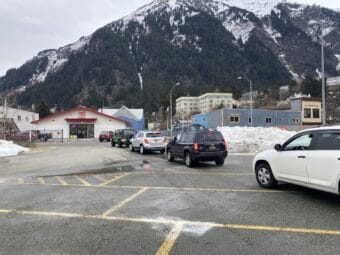
When Juneau residents want to get rid of their vintage wares — or their junk — they can line up for Saturday donation days at the Salvation Army Family Store. Behind Wood, there are dozens of cars waiting. They spill over into the parking lot across the road.

Everything that’s dropped off gets packed into a shipping container in the store’s back parking lot. Once that fills up, anyone left waiting in line is turned away. Sometimes, the store gets so full that they have to stop taking donations altogether.

That’s left people like KTOO listener Mary McEwen with would-be donations piling up in their attic or the trunk of their car.

“I mean, a lot of us have a bag somewhere that’s like, ‘Oh man, next time I have time on a Saturday morning for that one window where you can drop things off at Salvation Army,” McEwen said.

For this installment of Curious Juneau, McEwen asked KTOO to find out why it’s so hard to get rid of things in town — and what alternatives are there when the thrift stores fill up.

Volunteer Jamie Raymond packs donations into a shipping container is the back lot of the Salvation Army Family Store downtown (Photo by Anna Canny/KTOO)

Everything — including the kitchen sink

On a sunny Saturday in February, Salvation Army store manager Christina Austin was all bundled up. But the weather hinted of spring. That usually leads to a spike in donations.

Juneau’s many seasonal residents also contribute to the ebb and flow. Austin said there’s more people trying to get rid of things at the ends of the legislative session and the tourist season.

“They just get stuff, just for the season, and then they fill their apartment or their studio just temporarily,” Austin said. “People always say that they’re just borrowing it, and it’s coming back to the store.”

The store’s capacity to accept those donations is mostly limited by staffing, Austin said. She’s one of two full-time employees, but all of the sorting and pricing is done by volunteers.

Those volunteers ebb and flow with the seasons too. Folks drop off during the holidays or over the summer. Also, a lot of volunteer groups disbanded during the pandemic. It’s taken a while to rebuild them.

Mary Ellen Frank stands next to the sorting table at the Salvation Army Family Store. All the donated household items – including two kitchen sinks – are examined and priced here by volunteers (Anna Canny/KTOO)

Mary Ellen Frank stuck around. She spends every third Saturday in the store’s back room, stationed in front of a giant sorting table, which has everything — a box of dented water bottles, a teasing comb in its original packaging from the 1960s, a vintage dissection kit in an alligator leather carrying case. And not one, but two kitchen sinks.

“I don’t know why the kitchen sink has to be there. I don’t even think I could pick that up,” Frank said. “That’s unusual. There’s always something new.”

Frank’s job is to decide what’s sellable. She’s an avid second-hand shopper herself — it’s how she sources materials as the curator of Juneau’s doll museum — so she approaches the table with an open mind.

Other options for recycling old clothes: Clothing swaps — host one with friends or participate in a public one such as the swap at the Mendenhall Valley Public Library on Saturday 3/23 at 12 p.m.


“We’ve got a good balance of people that are kind of like, ‘Ehhh, get rid of it,’ Frank said. “And me like, ‘Ahhh, that has so much potential!’”

Still, Frank estimates they throw out about 20% of what gets dropped off. So far, she’s discarded some cloth face masks, a tote bag with torn handles and a scorched, stained potholder.

It’s not unheard of for people to donate straight up trash. Austin worries that could become more common because of rate hikes at the landfill. 

Junk items can clog up operations at the St. Vincent De Paul thrift in the Mendenhall Valley, too, according to store manager Sharon Mallet. And at both stores, things that don’t sell within a few weeks have to be cleared to make more space on the store floor —  which means some things might head to the landfill later.

Mallet said she does her best to prevent that, because she learned to make the most of secondhand materials while growing up in the Caribbean.

“I grew up on an island, so this to me — I think I just fit right in,” Mallet said. “I remember as a kid, you made everything last or you reused it a different way.”

Items that are beat-up but usable go to the Dan Austin Center Free Store. Shrunken wool sweaters get put aside for a local artist who makes mittens for people experiencing homelessness. And ripped cotton t-shirts become rags, which the store sells to boat owners or contractors.

Though the garbage collectors come once a week, Mallet said she can’t remember the last time the store’s dumpster was full.

Still, Juneau’s thrift stores say they can barely keep up, even for perfectly sellable items. Unlike the Salvation Army store, the St. Vincent De Paul store is open four days a week instead of just one. And they have more full-time staff.

Store manager Sharon Mallett stands in the storage room of the St. Vincent De Paul thrift store. The store received more than 400 donations in the first three weeks of February 2024 (Anna Canny/KTOO)

Even so, Mallet says they have to put a cap on how much stuff they can take.

“Because once we take it we also have to sort it, price it, hang it,” she said. “There’s a lot involved with it after we get it.”

In February alone they took more than 500 donations. By March, St. Vincent De Paul’s had posted a sign that said “No More Clothes” in the window by their donation drop-off.

“Clothing we have an abundance of,” Mallet said. “We never lack for clothing cause we get so many donated.”

Both stores say they receive an abundance of women’s clothes, especially shoes and accessories.

Some community organizers have started to hold occasional clothing swaps, to provide an alternative to thrift stores. Community Clothing Swap Juneau and the Southeast Alaska Gay Lesbian Alliance each hold one quarterly.

An old-timey solution

After local artist Mary McEwen submitted her Curious Juneau question, she found herself dreaming up her own ways to reuse old clothing that she and her friends had piling up.

“I was thinking about it in the context of Juneau, where like, if you can’t donate clothes, what do you do with them?” McEwen said. “And so that got me thinking about reuse. And that got me thinking about weaving.”

Artist Mary McEwen weaves scraps of a pink cotton sweatshirt into her current project (Anna Canny/KTOO)

Though she had never woven before, McEwen bought a vintage loom on Craigslist. Now, three years later, her downtown weaving studio houses three wooden looms and a huge variety of used textiles. There’s a bag of worn-out pajama pants in one corner, a stack of misprinted t-shirts on the floor, and a big garbage bag full of socks.

There are a half-dozen multi-colored rugs around, and on every loom there’s a work-in-progress. One small rug incorporates strips of plastic bags. Another has alternating stripes of old jeans and a pink cotton sweatshirt.

McEwen uses the local thrift stores herself.

“I mean, everything I’m wearing, except for my socks and underwear, was thrifted,” McEwen said. “At this point in my life, I don’t buy any clothing firsthand.”

But she found herself frustrated when they couldn’t take donations. More than that, she found herself wondering what to do about clothes that don’t last long enough to make it to the second hand market. 

“We have more like, fast fashion throwaway kind of stuff that doesn’t survive long enough, without falling apart to become something in a thrift store,” McEwen. “So I was thinking, you know, what if what if we use this kind of old-timey solution to this current problem?”

Artist Mary McEwen shows off what remains of a pair of jeans, which she cut up to to weave into rag rugs (Anna Canny/KTOO)

Rag rugs, which people have woven from scrap fabric for hundreds of years, became her answer. McEwen has been able to source most of her materials from friends and family — stuff they had a hard time donating but couldn’t bring themselves to throw out.

Though she advocates for reducing clothing purchases and mending or repairing garments when possible, McEwen said that using rugs to keep stuff out of the landfill has been a great challenge for her as an artist.

“I think, what color combinations am I going to use, and what other ways can I think of to elevate the aesthetics of it?” McEwen said. “Even though it is garbage, and even though we are going to step on it on the floor.”


Curious Juneau

Are you curious about Juneau, its history, places and people? Or if you just like to ask questions, then ask away!

Technology that detects volcanoes and nuclear explosions will listen for avalanches in Juneau

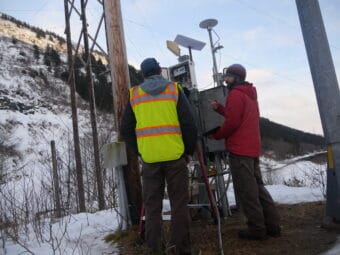
Pat Dryer (left) and Scott Havens (right) install the finishing touches to bring an infrasound avalanche detection system online (Photo by Anna Canny/KTOO)

On a sunny February afternoon by the roadside of Thane Road, Scott Havens opened the door of a nondescript, white metal box to reveal a jumble of sensors and computer cables. Then he pointed to the steep slope of Mt. Roberts across the road.

“As the avalanche is coming down, it’s going to create that rumble that we’re picking up,” Havens said.

Humans can’t hear most of the rumbling generated by snow coming down the mountain because it’s infrasound — a kind of sound that’s too low-frequency for our ears to pick up.

Picking up infrasound could help Alaska Department of Transportation track high mountain avalanches that often go undetected. That in turn could improve their avalanche mitigation strategies and shorten the closures along Thane Road every winter.
All kinds of things generate infrasound. Similar detection systems have been used to keep track of volcanic eruptions and illegal nuclear weapons tests across the world. Havens’ company, Snowbound Solutions, is pioneering infrasound for avalanche monitoring using sensors developed with researchers at Boise State University.

The sensors measure the subtle changes in atmospheric pressure that are generated by every sound. On Thane Road, the challenge is distinguishing between noises like helicopters, cruise ships or the humming of the power lines.

“Like, we’re picking up this car that’s coming by us,” Havens said. “As it’s moving through the atmosphere, it’s emitting infrasound. And so with the array, we can basically track where that’s coming from.”

This white metal box houses sensors and communication equipment that will alert Alaska Department of Transportation when an avalanche occurs on the slopes above Thane Rd. (Photo by Anna Canny/KTOO)

The infrasound detection boxes are arranged in triangles at the bases of different avalanche paths along Thane Road. Each triangle is called an array.

“The array works a lot like your ears. As the sound moves across the array, you can differentiate where the sound is coming from because it’ll arrive at each of those sensors at a different time,” Havens said.

And when the sound can be traced to somewhere up the slope, in an avalanche start zone, they’ll know it was an avalanche.

Snowbound Solutions has already deployed similar systems in Utah, California, Colorado and New Zealand. The system in Juneau, funded by a grant from the Alaska Department of Transportation, will be the first in Alaska.

Pat Dryer is the avalanche program specialist for the Alaska Department of Transportation on Thane Road. He says infrasound is part of the department’s larger effort to develop an avalanche monitoring and warning system on Thane road.

According to Dryer, “hearing” avalanches with infrasound is crucial because it’s often impossible to see them. Most don’t make it all the way down to the road. They happen high up the mountain, where storms can cloud visibility, or they happen at night.

“We’re assuming that avalanches are occurring, or we’re predicting that they are occurring, but not having that positive feedback loop that something is happening,” Dryer said.

Dryer said that over time, the record they’ll build of when avalanches happen and in what weather conditions will help improve their avalanche forecasting.

“We can start to make some assumptions or even predictions of when they’ll occur in the future,” he said. “So that we can better refine our methods of managing that hazard or closing the roadway.”

Dryer and Havens read infrasound signals (Photo by Anna Canny/KTOO)

More data will also help Havens refine the technology so it may be possible to identify avalanches not just by their location, but by their distinct soundwaves. Avalanche infrasound does have a kind of recognizable rumble, but the signal still varies a lot based on the type of avalanche and its size.

“So yeah, we’re hoping to figure out what an avalanche sounds like? Like, what is the kind of characteristic signal,” Havens said. “If we can apply some fancy machine learning or AI algorithms, can we start picking out and classifying these better?”

And in the future, Havens said, infrasound detection could be used to monitor hazards like rockfalls and landslides too.

Study reveals 30% decline in Alaska humpbacks in last decade

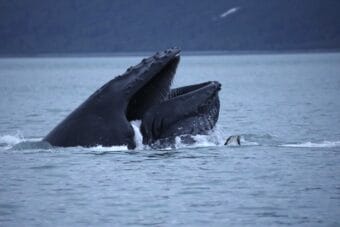
A whale surfaces in Glacier Bay in July, 2023. (Clarise Larson/KTOO)

Wildlife biologist Janet Neilson keeps a close eye on Alaska humpbacks. For the National Park Service whale monitoring program, she keeps a count of the whales that migrate up from Hawaii to feed in Glacier Bay and Icy Strait every summer.

During the summers between 2014 and 2018, she and researcher Chris Gabriele, who has led the park’s monitoring program for three decades, noticed something was off.

“Young whales, calves went missing. We had whales in the prime years of their lives go missing. And we certainly had some older whales go missing as well,” Neilson said. “But it really seemed like it hit all the whales.”

Neilson is one of 75 co-authors on a new study, which finds that almost 7,000 North Pacific humpbacks went missing between 2012 and 2021 — a 20% drop-off from the peak population of more than 33,000. Researchers believe they starved to death during the record-setting marine heatwave known as “the blob.”
Naturalist Ted Cheeseman is the one who brought all the whale researchers together. He’s the founder of Happy Whale, a photo database that uses artificial intelligence to quickly identify individual whales by the unique black-and-white patterns on the underside of their tail fins, or flukes. With Happy Whale, Cheeseman set out to do a simple population count.

“But when we first saw these numbers, it turned a population study into a climate study,” Cheeseman said.

That’s because the database revealed a sharp decline in humpbacks that coincided with “the blob,” which spiked ocean temperatures from Alaska to California between 2014 and 2016, killing fish, seabirds and more than 30% of Alaska’s humpbacks.

Climate change may complicate the species’ conservation success story. Back in the 1990s, Cheeseman worked as a tour guide in Antarctica. And he said humpbacks were hard to come by back then.

“We didn’t see many whales at all,” Cheeseman said. “We did, however, visit some of the largest whaling stations that were ever built — you know, they’re factories. Absolutely factories to turn living whales into product.”

Commercial whaling pushed humpbacks  to the brink of extinction, but their populations in the North Pacific have boomed since it ended. Humpbacks were taken off the endangered species list in 2016. But around that same time, researcher Heidi Pearson was seeing the whales around Juneau get skinnier and skinnier.

Pearson, who researches at the University of Alaska Southeast, says these whales are usually more adaptable than other marine species. They can travel long distances to find food. And their diet is flexible.

“So the fact that they still declined due to what we think is lack of prey means that it must have been really bad,” she said.

She says she still believes in the resilience of humpbacks. But the study’s results make it clear that the species is feeling the pressure of warming driven by the burning of fossil fuels.

“I really learned a lot about the fragility, actually, of the ocean system to this warming,” Pearson said. “Animals and systems are resilient, but clearly during the heatwave they reached this tipping point.”

For Neilson, in Glacier Bay, the decline emphasizes the need to protect humpbacks even when their populations seem healthy. Though they’re recovering in Glacier Bay, she says, they’re still not back to their pre-heatwave levels. And they’re also frequently threatened by ship strikes and entanglements in fishing gear near the coast.

“It’s important to realize that the whales that we do see out on the water these days are survivors of a major ecological disruption,” Neilson said. “Those survivors deserve protection because more heat waves are coming.”

As those heatwaves come, real-time population monitoring for humpbacks may be more important than ever bef0re. The whales, which are large, coastal animals that are easy to track, can be indicators of overall ecosystem health in a rapidly changing ocean.

Technology like Happy Whale can help researchers better track whales as they migrate all across the North Pacific. The new study pulled more than 200,000 fluke images from the database, which were collected from researchers and more than 4,000 citizen scientists.

“The scale of problems that our world is facing today within the environmental realm — climate change being the biggest one — they’re only going to be solved by collaboration,” Pearson said. “No one can do it alone, in their one study site.”

Federal agency says Alaska’s coastline has potential for more renewable energy, carbon storage projects

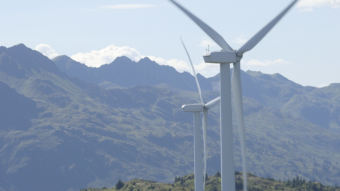
Kodiak generates about 20 percent of its electricity from wind. The Kodiak Electric Association has installed six turbines on Pillar Mountain since 2009. (Photo by Eric Keto/Alaska's Energy Desk)
Wind turbines in Kodiak. (Photo by Eric Keto/Alaska’s Energy Desk)

A little-known federal agency called Bureau of Ocean Energy Management has a big role in regulating nearly 7,000 miles of coastline in Alaska.

Last week, the bureau’s Regional Director Givey Kochanowski and Public Affairs Officer John Callahan met with dozens of lawmakers in Juneau. They also met with KTOO reporter Anna Canny, who asked them about the emergence of new technologies like offshore renewable energy and carbon storage projects in the state.
This interview has been edited for length and clarity.

Givey Kochanowski: Good morning. I’m Givey Kochanowski. I’m the Regional Director for the Alaska region of the Bureau of Ocean Energy Management.

John Callahan: Yeah, John Callahan, and I’m the Public Affairs Officer for the Alaska Region.

Anna Canny: Thanks for joining me this morning. So I want to start off just for some of our listeners who haven’t heard of the Bureau of Ocean Energy Management. Could you give us a little rundown of some of the work your agency does?

Givey Kochanowski: We were created by Congress, originally to economically and environmentally friendly developed the Outer Continental Shelf, and those means the federal waters of the United States. And here in Alaska and elsewhere, that begins three miles offshore. So we’re not a funding or development agency. We’re a regulatory and permitting agency. So we work with other federal and state agencies to accomplish our mission in partnership.

John Callahan: Um, if you wanted to explore for oil and gas, or minerals, or develop any energy sources in that zone — more than three miles offshore — we’re the bureau that you would come to.

Anna Canny: Sounds like that would apply to a wide variety of resource development projects. And I know in the past, the agency has focused on oil and gas projects, but I’m wondering if you could speak a little bit to the agency’s recent shift towards renewable energy projects?

Givey Kochanowski: It’s kind of a shift, but it’s kind of not a shift at the same time. We have never stopped doing our legacy mission of conventional energy, we have active leases and Cook Inlet and on the North Slope for conventional energy. We have petroleum engineers on staff that helped maintain our work and the conventional side. But in addition to that, we’re expanding into some exciting new areas, which include renewable power, critical minerals and marine minerals, and also carbon storage. But on a renewable front, what’s really exciting right now is a study that just came out from the National Renewable Energy Lab that we funded, looking at the renewable energy potential for Cook Inlet. And that has grid-wide impacts for Alaska where the majority of our population lives.

John Callahan: Tidal energy is promising, wind energy is probably more promising in terms of a development prospect in the near-term. There’s an area off Southern Cook Inlet, north of the Barren Islands, that has literally literally some of the best winds in the world — it blows hard, it goes constantly — and those are the sort of resources that we’re looking to bring to bear.

Anna Canny: Okay, so developing renewables, that’s huge for cutting the amount of carbon emissions we’re putting into the atmosphere. On the flip side of that, I noticed you mentioned carbon storage or carbon sequestration — basically taking carbon out of the atmosphere and storing it, in this case, underground. And I thought that was really interesting. That’s been a hot topic here in Alaska, since Governor Dunleavy introduced his carbon management bill last session. So what will BOEM’s role be in, in safely rolling out those types of projects in the state?

Givey Kochanowski: If you look at a map of the state, many of the areas in coastal Alaska that fall in the federal jurisdiction, are very well suited for carbon storage — so the Cook Inlet and Northwestern Alaska — I think this is an exciting time to be in this space to be in the ground level of it. And that it’s also wonderful to come down here and learn that the state government is working in parallel to a lot of what we’re trying to accomplish, that there could be a lot of synergies there and collaboration.

John Callahan: Yeah, and, and very relevant to that, so carbon sequestration, as you know, is a very promising technology, right? But it’s in its relative infancy. Our bureau, we again, are the ones who are going to be tasked with regulating that, in the offshore space. And in fact, we have been developing draft regulations in concert with other cooperating agencies, and expect to have draft regulations out to that effect later this year.

Anna Canny: And finally, you’re in town this week talking with legislators about some of these things — the carbon sequestration, the new renewable energy projects – how are those conversations going? And could you give us an idea of, of what that might mean for the agency’s future work in the region?

John Callahan: All the legislators down here, both left and right, are very focused on energy issues — well-informed, we’ve gotten good questions. And we really appreciate the opportunity to educate them on how BOEM is part of that energy mix, especially as we get this renewable energy initiative kicked off.

Givey Kochanowski: Yeah, and you know, as Alaskans, many of us have concerns about the overreach of the federal government pushing stuff onto the state without state coordination or collaboration, and there’s no better way to get collaboration than working with the state, coming down here talking to legislators working with state agencies, like the Alaska Energy Authority, and the Department of Natural Resources, Department of Revenue. And we have several state agencies as part of our Cook Inlet workgroup, looking at ways to harmonize the development pathway for industry, so that you don’t get nine or ten different answers from nine agencies, that you get a solid approach to what will it take to actually make a project happen in Alaska.

An urban avalanche obstacle course trains Juneau’s four-legged search and rescuers

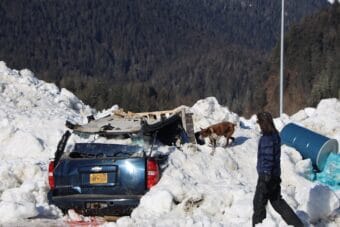
Bizzy, the oldest dog on the SEADOGS team, sniffs out a fake avalanche victim that’s hidden in the car (Clarise Larson/KTOO)

Wren, a black and white border collie, wove through barrels, climbed over snow berms and hopped over piles of splintered timber and hunks of blue plastic scattered beneath her paws. 

With her nose to the ground, she could smell the scent of some old moose bones, scattered in the gravel nearby, and a bucket of food buried somewhere deep in the snow. But after a few minutes of sniffing, she narrowed in on the smell she was looking for, and bounded back across the lot to jump on her handler, Will Metcalf.

“Where are they? Point to them. I don’t see them,” Metcalf said. 

Wren led him back to a half-buried, junked minivan. She stuck her head into the smashed up windows, and a person in a bright red winter jacket emerged.

“What a good dog,” Metcalf said.

Wren has joined canine search and rescue missions around the state, including at the site of the fatal November landslide in Wrangell. Running the obstacle courses helps her to prepare for scenarios like that (Clarise Larson/KTOO)

Wren is one of the most experienced canines with Southeast Alaska Dogs Organized for Ground Search, or SEADOGS. She was part of the four-legged search and rescue team deployed at the site of Wrangell’s deadly landslide last November.

The obstacle course she just ran through was designed to prepare her for scenarios like that, where disasters hit more populated places. In this case, a snowy 2-acre parking lot in Lemon Creek was set up as a rough imitation of an avalanche coming down on a neighborhood — a realistic scenario for Juneau. 

Dog handlers with Juneau’s Southeast Alaska Dogs Organized for Ground Search, or SEADOGS, pose in the snowy parking lot that was designed to imitate an urban avalanche (Photo courtesy of Marcy Larson)

The course features distracting smells to imitate the kinds of things that might get caught up in an urban disaster. 

“There’s going to be refrigerators out there and there’s going to be laundry,”  said handler Marcy Larson. “We don’t want our dogs alerting on that. We want our dogs alerting on people.”

They also need to navigate junk scattered across the snow and ice to simulate hazards like crushed houses, splintered trees and toxic waste.

“Even something as simple as, as you know, the chips – the wood chips that are out here,” Larson said. “Some dogs that haven’t ever experienced that are like, ‘what’s this?’”

For the SEADOGS, urban disaster search and rescue is an important skill set. But Mike Pilling, one of the most senior handlers, says it’s not the only skill these dogs have to know. 

“For Southeast, since we’re kind of in a bubble here, you know, we don’t have the road system, so if anything happens, we’re it,” Pilling said. “And we’re one of the few places in the country – few teams in the country, that we kind of have to do it all.”

Pilling has trained four of his own dogs, who have helped out in all kinds of crises across Alaska. He said perfecting even one discipline of canine search and rescue can take up to two years.

Pilling’s current dog, Bizzy, a stout brown-and-white mutt, has been trained and certified in tracking missing people on both land and water.

According to Pilling, a lot of dog teams in the Lower 48 specialize in just one type of search and rescue mission. In Alaska, that’s not a luxury SEADOGS can afford.

“I’ve always trained our dogs to be able to find anybody, anywhere,” Pilling said.

But to succeed in an urban environment, the dogs actually have to learn when to work against some of their other training instincts.

Handler Mike Kreis rewards his dog Korra with a game of tug-of-war after she successfully located a fake avalanche victim who was buried in the snow (Clarise Larson/KTOO)

Take Korra, a German shepherd, for example. She runs the course, keeping her nose glued to the ground, the way she would to track a missing person. And because she can’t pick up their scent, she can’t find her fake avalanche victim the first time around. 

With a bit of correction, she does better on the second run. She keeps her head up and catches a scent on the wind, which leads her to Pilling, who is buried in a culvert behind a heavy wooden pallet.

Since Korra can’t dig him out, like she would in a backcountry avalanche, she learns to wait patiently for help.

“Right there, as you can see, there wasn’t anything really for her to dig into. But she stayed right there,” said her handler Mike Kreis.

Once Kreis reaches Korra, he helps to pull Pilling out. With that, Korra earns her reward — a round of “good girls” and a rousing game of tug-o-war.

Correction: An earlier version of this story included the name of the wrong brown-and-white dog. Pilling’s dog is named Bizzy. Both are good dogs.

Site notifications
Update notification options
Subscribe to notifications