Kavitha George, KTOO

Kodiak Island spaceport preparing to launch satellite for DARPA challenge

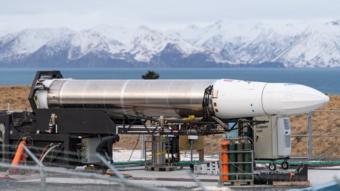
The nose of Astra’s rocket, named “One of Three,” pokes out of a shipping container at the Pacific Spaceport Complex on Feb. 21. (Photo by Kavitha George/KMXT)

Astra CEO Chris Kemp is keeping expectations low for the company’s upcoming launch at the Pacific Spaceport Complex on Kodiak Island’s Narrow Cape.

“We’re taking a rocket that’s never flown before and we’re attempting to reach orbit,” Kemp said. “So, it’s an incredibly difficult challenge and we’re trying to lower expectations as much as possible that we’ll get everything right the first time,” he said in an interview in early February.

The launch is a part of the Defense Advanced Research Projects Agency (DARPA) Launch Challenge to place satellites in low Earth orbit, twice, within a two-week time frame.

Launch teams typically work for months or years to set up a new rocket. But that timeline has been reduced dramatically, from years to days.

Taking a break from launch preparations at the spaceport recently, DARPA project manager Todd Master said the challenge encourages rocket designs that are flexible, upgradeable and ready to go in a short period of time.

“The ability to sort of be adaptable in that sense is not something we’ve ever done,” Master said. “We sort of pre-planned these things very, very long in advance. And so we’re trying to say, ‘How can we do this quickly? How can we do it in a flexible way?’”

Astra is part of a new wave of rocket companies focused on achieving those goals.

Instead of spending five or 10 years building a rocket, Astra has a nine-month production schedule that makes it easy to make adjustments along the way.

Kemp said that while producing lots of designs quickly might seem slapdash, ultimately it’s supposed to result in a more reliable rocket. The idea is that more models means more data collected, and therefore higher reliability. But that is not their absolute top priority.

“Our number one priority is safety, not reliability,” Kemp said. “So (what) we designed our systems for is to be safe.”

Kemp also said they want want them to be most cost-effective and reliable.

“Because reliability at any cost will keep people out of space for the next hundred years,” Kemp said.

Essentially, space travel is so inherently risky, Kemp wants to focus on building a safe, cheap rocket, rather than chasing the virtually impossible goal of a 100 percent success rate.

That’s part of the reason his expectations are low for this launch. Astra’s rocket is basically brand new.

So, in addition to the tight launch schedule, Kemp said there are a lot of factors that they can’t test their design for. They expect the rocket will launch, “leave Alaska and fly away.” Beyond that, he said they’re just hoping to learn as much as they can. The longer the flight lasts, the more information they’ll get.

“If the flight doesn’t perform absolutely everything perfectly, deliver a payload into the perfect orbit and win the DARPA challenge, we’re fine with that.” Kemp said with a laugh. “Because there’s another rocket right behind it, and we’ll take everything we learned, we’ll make some changes… and apply again.”

Rocket “One of Three” is set up to mount at Launch Pad B on February 24, 2020. (Photo courtesy DARPA).

Many Kodiak residents have expressed concern about Astra’s launches on Narrow Cape in 2018, one of which resulted in spilled fuel and debris.

Kemp doesn’t characterize those launches as failures. He said they hit nearly all of their objectives. He estimates that cleanup, including having to remove and replace more than 230 tons of contaminated soil, cost less than $50,000. Astra is held financially responsible for any cleanup costs and carries $50 million insurance on each launch.

Amid some community concern — primarily about potential environmental damage — Alaska Aerospace Corporation has been positioning the spaceport as a prime location for commercial space flight.

Launching directly over the Pacific Ocean doesn’t pose nearly as much risk as launching near heavily populated areas in the Lower 48. And state investment in the spaceport, along with military presence on the island, provides a high level of infrastructure for such a remote place.

“The things that we’re doing here at Kodiak is similar to what you’d do at a federal range. But the agility, the flexibility, the responsiveness is right in line with what DARPA is trying to do with Astra,” said Mark Lester, CEO of Alaska Aerospace Corporation. “So I think it’s exciting for Kodiak, I think it’s exciting for Alaska, to be right at the forefront of launching this type of mission.”

Kodiak’s spaceport will host two launches for the Launch Challenge. If Astra completes both successfully, they’ll win $12 million. Astra is the last remaining competitor in this year’s challenge, after the other finalists either dropped out or went bankrupt.

The first launch was expected as early as Feb. 27. But the launch team chose to delay it until Feb. 29 at the earliest.

A second ‘Blob’ marine heat wave has disappeared, but the warming trend will continue, scientists say

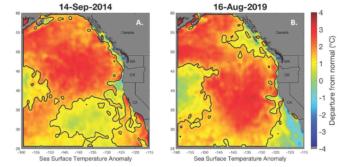
The marine heat wave known as “the Blob” at its near maximum areal extent in September 2014, at left. The 2019 blob is shown at its near maximum areal extent in August 2019, at right. (Graphic courtesy of NOAA)

This past summer, the North Pacific was hit with the second marine heat wave of the decade.

Mirroring the first so-called “Blob” of 2014, scientists measured ocean temperatures as more than 5 degrees above normal, across millions of square miles stretching from Alaska to California.

The first “Blob” decimated fisheries, caused a mass seabird die-off, and spurred toxic algal blooms up and down the coast. In the last year and a half, a second heat wave began brewing.

But then, it disappeared — at least for now.

National Oceanic and Atmospheric Administration research scientist Nate Mantua said they’re seeing surface ocean temperatures drop back to the 30 year average before the first “Blob.”

“Parts of the Bering Sea, the temperatures are a little below normal, which is nice to see for the first time for a few years,” he said. “And most of the area around the Aleutians and the coastal waters in Alaska are back to about normal — normal being the average from 1981 to 2010.”

But that’s not to say that the troubling long-term warming trend that comes with climate change has slowed. Mantua said we may see short-term warm and cold periods, but the warming trend will continue.

“It could go either way in the next few months and the next year. But the longer term, you know, next few decades, you’d expect that background warming is just going to continue to build up.”

University of Washington climate scientist Nick Bond said it’s important to note that the North Pacific never fully returned to “normal” temperatures after the first “Blob.” The second “Blob” just compounded the heat wave, warming waters at a greater depth and at higher temperatures than before.

This winter brought cold, northern winds and heavy storms to Alaska. Storms help to mix up ocean waters and release heat trapped below the surface, but Bond said deeper ocean layers are still hotter than normal.

“This winter, there has been some cooling of those subsurface temperature anomalies, but they’re still well above normal,” he said. “There’s just some concern that, even if these storms keep up, they won’t remove all that extra heat at depth.”

Kris Holderied is a NOAA scientist who studies algal blooms in Kachemak Bay. She said it’s hard to tease out what the effects of this most recent heat wave are — and what’s just a hangover from the first “Blob.”

It’s not always easy to predict where toxic algal blooms will pop up, but recent rising ocean temperatures brought them to many parts of coastal Alaska, she said.

In the Gulf of Alaska, “there were some areas that actually had fairly high blooms and more paralytic shellfish poisoning, and then some that didn’t. And what we’re finding up in the Bering and Chukchi (seas) in the Arctic is that there’s some very high levels of these … cells that cause paralytic shellfish poisoning. And that, with the really warm temperatures that they had up there, was a big concern.”

But with these somewhat colder waters, Holderied is hopeful that coastal ecosystems might start to bounce back.

“We’re going into this spring and summer with the water cooled off a bit. And you can imagine that the near-coastal waters, the shallower waters, can cool off faster because they’re not as deep. And so we’re hopeful that for the near-coastal ecosystems … that’ll be an advantage,” she said. “But it remains to be seen.”

Monitoring over the next few months and fishery surveys this year will help give a clearer picture of the ecosystem impacts of the second “Blob.” But right now, scientists say, it’s just too soon to know for certain.


Gulf of Alaska cod appears likely to lose key sustainability label

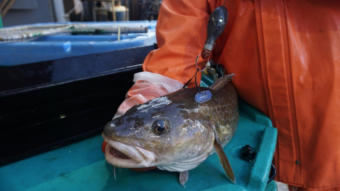
A fisher in an orange wet suit holds a Pacific cod.
Researchers prepare to release a Pacific cod with a satellite tag. (Public domain photo by NOAA Fisheries)

Take a walk past a grocery store seafood counter and you might notice the little blue stickers that mark certain types of fish as “sustainably caught.” As demand for environmentally-conscious seafood goes up, sustainability certifications are increasingly important. But at the same time, climate change is threatening Alaska’s longstanding reputation for sustainable fisheries. In just a few months, Gulf of Alaska cod may be losing its blue sticker.
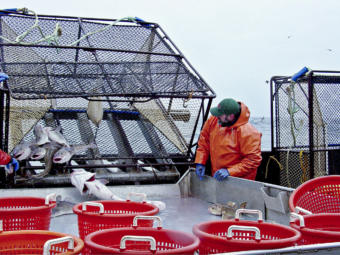
Gulf of Alaska cod have had a rough go of it in the last few years. During a massive Pacific Ocean heat wave from 2014 to 2016 cod numbers crashed by more than half in the Gulf. This year, managers were forced to close the federal fishery entirely for the first time due to low stock. And now, Gulf cod appears likely to lose its sustainability certification from the Marine Stewardship Council, or MSC.

The MSC is a global nonprofit that sets the standard for sustainable fisheries around the world.

“What the MSC certification really does is — along the supply chain — it allows for there to be traceability,” said Jackie Marks, senior public relations manager at the MSC. “And — at the end of the supply chain — allows that product to have the MSC blue fish label on it signifying to consumers that it has been caught sustainably.”

Gulf of Alaska cod has carried that label for 10 years. It’s a branding tool emblematic of Alaska’s history of well-managed fisheries. Other fisheries, like North East Atlantic Mackerel, have lost MSC certification in part for management issues. So cod industry leaders worry that losing it would cast the Gulf in a bad light, even though this is a climate-caused crash.

Before the crash, the Gulf accounted for 20-25% of Alaska’s cod market, but warming waters have driven the population down to just above overfished status, and now the fishery is being reassessed.

“From what we understand of the MSC standard, it does look likely that the certification will be suspended,” said Julie Decker, executive director of the Alaska Fisheries Development Foundation.

With the federal fishery closed and only a small state fishery open this season, she says it’s hard to predict what impact losing MSC certification will have on the market.

“The fact that the fishery is closed and there’s less biomass on the market also probably could have more impact to the price than the certification,” she said. “So, you know, it’s very hard to sort of tease those two issues apart.”

In other words, not having much Gulf cod to sell will probably impact the market more than losing a sustainability label this year. In any case, the majority of Alaska’s cod — sold fresh or frozen, and processed for foods like fish and chips — comes from the Bering Sea and Aleutian Islands, both of which are MSC-certified.

“But there are specific export markets that require MSC certification,” said Nicole Kimball, a representative of Alaska seafood processors and a member of the North Pacific Fishery Management Council. “So those markets wouldn’t be available if MSC certification was suspended later in 2020 for any Gulf of Alaska state waters cod. I’m sure processors would be looking for alternative markets if they’ve been dependent on MSC markets for that.”

The bigger issue for Kimball and other industry members is distinguishing why Gulf cod might have its MSC certification suspended. As Julie Bonney, executive director of the Alaska Groundfish Data Bank pointed out: it’s not management that’s to blame.

“Here we’re actually basing our fishery management based on the best available science and they’re taking a cautionary approach by closing directed fishing in the federal fishery, and they’ve also accounted for the small amount of catch that’s going to come through the state fisheries,” said Bonney.

The MSC publishes the reasoning behind suspending a fishery’s certification, but from a consumer marketing angle, there’s no distinction between a fishery suspended for management issues versus one suspended for environmental problems.

“I think as we sort of continue to see how climate change is having an impact on fisheries, we might need to take another look at that,” Marks, with the MSC said. “Climate change is, of course, a very important one and something that we’re going to continue to have to address.”

The reassessment for Gulf of Alaska cod is slated to begin in February, with results following around April.

Extremely low cod numbers lead feds to close the Gulf of Alaska fishery for the first time

A man in an orange raincoat watches Pacific cod slide out of a black cage onto the boat.
NOAA Fisheries scientists collect Pacific cod samples in the Aleutian Islands. (Public domain photo by NOAA Fisheries)

In an unprecedented response to historically low numbers of Pacific cod, the federal cod fishery in the Gulf of Alaska is closing for the 2020 season.
It’s a decision that came as little surprise, but it’s the first time the fishery has closed due to concerns of low stock. Warming ocean temperatures linked to climate change are wreaking havoc on a number of Alaska’s fisheries, worrying biologists, locals and fishers with low returns that jeopardize fishing livelihoods.

A stock assessment this fall put Gulf cod populations at a historic low, with “next to no” new eggs, according to National Oceanic and Atmospheric Administration research biologist Steve Barbeaux, who authored the report.

At their current numbers, cod are below the federal threshold that protects them as a food source for endangered Steller sea lions. Once below that line, the total allowable catch goes to zero — in other words, the fishery shuts down.

After the report was released, the stock assessment still had to pass through the North Pacific Fisheries Management Council for review. The council unanimously passed the final decision to close the fishery today in Anchorage.

Up until the emergence of a marine heatwave known as “the Blob” in 2014, Gulf cod was doing well. But the heatwave caused ocean temperatures to rise 4 to 5 degrees. Young cod started dying off, scientists said.

“A lot of the impact on the population was due to that first heatwave that we haven’t recovered from,” Barbeaux said during an interview last month. Following the first heatwave, cod numbers crashed by more than half, from 113,830 metric tons in 2014 to 46,080 metric tons in 2017.

The decline was steady from there.

“Retrospectively, we probably should have shut the fishery down last year (too),” Barbeaux said.

Cod only enter the fishery at age 3, so the environmental effects on the fishery are somewhat delayed. There are now signs of a second warming event. Scientists like Barbeaux and say it’s hard to predict what the future of the fishery will look like.

“We’re just well beyond what we’ve ever seen before. It’s this very unusual, warm event,” said Mike Litzow, a NOAA Fisheries ecologist based in Kodiak. “What the climate scientists are showing us, our best understanding is that this is going to be the new average within a short time frame.”

With uncertainty looming, Gulf cod fishers in Kodiak are struggling with a decline of what used to be a major part of the island’s winter economy. Many fishers have already moved on from cod. For the few remaining, the federal fishery closure further jeopardizes their livelihoods.

Cod fisherman Frank Miles sits on the deck of the Sumner Strait, docked in Kodiak’s St. Paul Harbor. (Photo by Kavitha George/Alaska’s Energy Desk)

State cod fishery limits for 2020 have yet to be set.

“It’s kind of devastating,” Kodiak-based pot cod fisher Frank Miles said last month, hoping at the time that the situation would turn around for next year’s season.

Before the first heatwave, Miles said about 70% of his income came from cod fishing. Since then he’s worked to diversify, but he’s still concerned for the future.

“I’m more worried about my son and his generation, the younger guys coming up,” he said. “I’m 60, I’m probably just about done. I’d like to think that I could fish cod one more time before I retire, but I don’t know. I simply don’t know where we’re going here.”

9 hospitalized after Coast Guard and Navy vessels collide near Kodiak

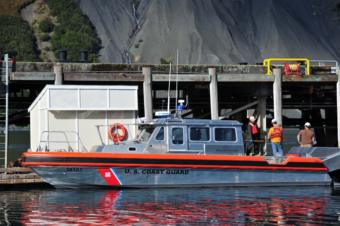
A Coast Guard 38-foot special purpose craft training boat sits at the fuel pier in Womens Bay at Coast Guard Base Kodiak, Sept. 23, 2011. A vessel similar to this one was involved in a collision with a Navy boat in Womens Bay on Wednesday. (Public domain photo by Petty Officer 2nd Class Charly Hengen/U.S. Coast Guard)

Six Coast Guard service members and three Navy sailors were hospitalized in Kodiak on Wednesday evening after a Coast Guard and Navy vessel collision, according to a statement released by Coast Guard Public Affairs late Wednesday night.

The collision occurred around 7:30 p.m in Womens Bay, according to Coast Guard Public Affairs Lt. Cmdr. Scott McCann. All six service members aboard the the Coast Guard vessel were transported to the Providence Kodiak Island Medical Center with apparently minor injuries.

“The injuries were to the extent that our Coast Guard members were released from the hospital last night,” McCann said

According to Kodiak Fire Department Chief Jim Mullican, one injured service member was medevaced to Anchorage at 11:30 p.m. Wednesday. The medevaced individual was likely one of the three Navy sailors.

In an emailed statement, Naval Special Warfare Command Lt. Matthew Stroup said that the injured Navy sailors are in stable condition.

McCann confirmed that the two vessels were Coast Guard and Navy “small boats.” The Coast Guard small boat was a 38-foot special purpose training boat. The Navy boat was a Naval Special Warfare combatant craft, according to Stroup.

The collision caused damages to both boats, but details around the cause of the collision remain unclear, said McCann.

“We will be doing an investigation into who was at fault and why it happened and what type of damage was sustained to both boats,” he said.

He added that such investigations can take weeks to months to complete.

Both the Coast Guard and Navy vessels involved are now moored at the Coast Guard base, but it’s also unclear how they made it back to port.

According to McCann, the collision occurred as the Coast Guard small boat was coming back from performing hoisting exercises with a Coast Guard helicopter, a part of routine search and rescue training. The Navy boat was not involved in the Coast Guard training exercise, though Stroup’s statement did say it was completing “routine training operations” when the collision occurred.

This story has been updated.

Kodiak police hope new reality TV show will help improve recruitment woes

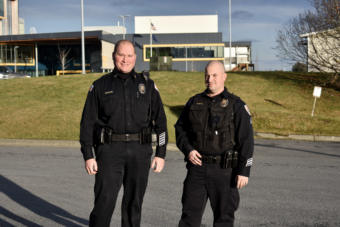
Two police officers pose outside for a photo.
From left to right, Kodiak Police Chief Tim Putney and Sgt. Michael Sortor. (Photo by Kavitha George/KMXT)

Cable television network A&E is launching a new reality series called “Alaska PD,” following law enforcement in Kodiak, Petersburg, Kotzebue and Fairbanks. A teaser released last month casts the show as exciting and dramatic, chock-full of wildlife and violent crime.

Kodiak’s police force is on the small side — about 15-18 sworn officers at any given time. But it’s no stranger to a television film crew. The department has been featured in a number of TV shows, from the program “Alaska State Troopers,” to a German reality TV show, to the original, “Cops,” back in the early ’90s.

“It’s a big interest for people to see what goes on behind the works with policing,” said Sgt. Michael Sortor, one of the Kodiak officers featured on the show. Policing in rural Alaska is already so different from anywhere in the Lower 48. Sortor said the location just amplifies the excitement of a regular cop show.

The promo for the show is pretty heavy-handed with that idea.

“Alaska has the most extreme climate, the harshest terrain and more violent crimes per capita than any other state,” the voice-over declares over a series of quick cuts between officers running and carrying guns. Some shouting cops hold a suspect to the ground. There’s something that looks like a car chase, and there’s some obligatory b-roll of two brown bears fighting.

https://youtu.be/8zH6E6O2BLM

Under-policing and high levels of violent crime are major issues in parts of Alaska. Over the summer, Attorney General William Barr declared a “law enforcement emergency” in rural Alaska. The Department of Justice has allocated tens of millions of dollars to help Alaska Native villages address crime and violence.

But Sortor doesn’t expect the Kodiak portion of the show will include a lot of violence, and certainly no car chases.

“Primarily bears and just your summertime responses,” he said. “I think maybe some vehicle accidents and traffic stops, DUIs. Stuff like that.”

The film crew followed two Kodiak police shifts all last spring. They rigged police cars with GoPros, miked up each officer and rode along on everything from traffic stops for a broken taillight, to an incident last May when troopers and police were hunting a startled bear that had killed a dog in Spruce Cape.

“Nothing was staged. It really wasn’t,” Sortor said. “They would go and they would film it, and then afterwards, they would do something with us like a debrief. They’d go, ‘Tell us what happened.’ So truly what people are seeing is what it’s actually like, almost like ‘Cops.’”

Kodiak Police Chief Tim Putney said A&E approached the city for the show in early 2018.

The main reason they said yes?

“The appeal was definitely recruitment,” Putney said. “I think not just Kodiak, or Alaska, but just nationwide, I know a lot of departments are having a hard time with recruitment. This was just, you know, this was one way to kind of get some free advertising out there.”

Putney and Sortor take a lot of pride in their city, and they both view the show as an opportunity to showcase the community.

At the same time, they said there are parts of a Kodiak police officer’s job that people might be surprised to learn about. One filmed traffic stop turned up over a pound of methamphetamines, which Kodiak police said is a reflection of a growing drug problem in Kodiak.

“You’re going to see another facet of Kodiak, which might not always be a fun thing to watch,” said Sortor. “But it’s a reality of what we have to see a lot.”

But is a reality TV show the best place to educate the public about increasingly urgent public safety issues? Both officers said they felt some trepidation about the way Kodiak would be represented, but they’re hoping the audience will look at the show with curiosity, more than anything else.

Sortor even has a warning for viewers.

“I would tell people if you’re learning about Kodiak, please don’t rely solely on cop shows. Maybe start off with some nature shows and then work your way into it. But I think (‘Alaska PD’ is) going to have a lot of quintessential Alaskan things in it.”

When asked in November, A&E network representatives declined to provide an interview for this story until December. The series launches New Year’s Day.

Site notifications
Update notification options
Subscribe to notifications