Kavitha George, KTOO

New Kodiak park dedicated to Alutiiq ancestors uprooted from their homeland

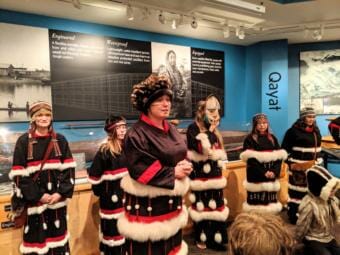
Candace Branson introduces the next song she and and her fellow Alutiiq dancers will perform.
Candace Branson introduces the next song she and and her fellow Alutiiq dancers will perform. (Photo by Kavitha George/KMXT)

The Kodiak Alutiiq/Sugpiaq Repatriation Commission has been working for years to recover artifacts and human remains of the community’s ancestors. As part of that effort, a new park in downtown Kodiak is dedicated to ancestors uprooted from their homeland.

More than a thousand silver salmon cutouts line the sides of the wooden archway at the entrance to the Alutiiq Ancestors’ Memorial park. Each one represents an ancestor brought home to the island. A Russian Orthodox priest gives the new park a blessing, sprinkling holy water among a few dozen community members gathered in the rain for the somber ceremony.

More than a thousand metal salmon cutouts, each representing a repatriated Alutiiq ancestor, cover the inside of the archway at the Ancestors Memorial park in downtown Kodiak. (Photo by Kavitha George/KMXT)

For at least 7,000 years, the Alutiiq, or Sugpiak, people have lived across the Kodiak Archipelago stretching from the Alaska Peninsula up to Kachemak Bay and beyond.

As recently as the last century, archaeologists would excavate Alaska Native graves, often without the consent of tribes. Some did it in the name of trying to preserve what they feared was a vanishing culture. But well-meaning or not, the result was thousands of people’s ancestors put on a shelf, or displayed in cases for museum visitors to gawk at.

Passage of the Native American Graves Protection and Repatriation Act in 1990 was an attempt to remedy those wrongs. It directs all federally funded organizations to return the human remains and sacred objects of Native Americans to their original communities.

Margaret Roberts is a slight woman in her 70s, standing about five feet tall in the nearby Alutiiq Museum. “When I was growing up, we didn’t have anything … We just didn’t,” she says. “So much was taken away from Kodiak Island. And many of our elders had a lot of hurt inside of them because what they had endured.”

Margaret Roberts, chair of the Alutiiq Heritage Foundation, poses in the Alutiiq Museum gallery following the opening of the Ancestors Memorial Park in downtown Kodiak. (Photo by Kavitha George/KMXT)

Despite her small stature, Roberts is a commanding presence here. She’s chair of the Alutiiq Heritage Foundation, which is working to get these items back — and not just things.

In a sometimes emotional speech, she tells the story of two young girls, ages 11 and 13, who were relocated from nearby Woody Island to the Carlisle Indian Boarding School in Pennsylvania. They both died there.

It’s a personal story. One of the girls was a relative. “We need to bring them home,” she says. “Honor, love, and respect for all they suffered, and rebury them home again on Kodiak Island.”

It’s been decades since the struggle began to repatriate cultural artifacts and ancestors’ remains. Susan Malutin, an Alutiiq artist says the process helps with closure.

“They may have taken their remains, but they didn’t take their spirit from us,” she says, standing in the museum gallery. “And now both are returned. And both are together again.”

About two dozen Native corporations and tribal councils have signed on to the Kodiak Alutiiq/Sugpiaq Repatriation Commission with the goal of bringing ancestral remains and artifacts home.

Malutin says it’s brought people together from across the archipelago.

“This community is an amazing community. So many work together and all the different cultures that are here all contributed as one unit. It is, like they say, a village. And Kodiak is an amazing village. We’re very unique in all the efforts that are done to have something like this come together.”

Inside the gallery, Alutiiq dancers are about to give a performance in honor of the new memorial. The small crowd from the park is packed into the museum gallery, standing among artifacts displayed in glass cases.

“Cama’i!” Candace Branson, language project manager for the Sun’aq tribe greets the audience. “We are so excited to be here, dancing to honor our ancestors. We talked before coming on, we want to honor the ancestors that we can remember,” she says, “and the ancestors that we can’t remember, or don’t remember.”

Alutiiq dancers perform at the Alutiiq Museum in downtown Kodiak. (Photo by Kavitha George/KMXT)

Some of the dancers are as young as 4. Many are dressed in elaborate black, red, and white robes. Beaded headdresses, masks and fur hoods complete the ensemble. Almost 20 dancers altogether, they instantly make a powerful impression, filling the small gallery with voices and drum beats.

Roberts says watching young people embrace their cultural is stirring. It gives her hope.

“It always brings tears to my eyes and makes my heart swell,” she says. “We’ve come a long, long way.”

At one time, the community was working to repatriate the remains hundreds of individuals at once. With the remains from more than 1,200 people recovered so far, now it can be more focused: sometimes working on recovering a single bone from a museum or university collection.

The goal is to give respect to the ancestors — to bring them home to a final resting place with decency.

As this work continues, the newly built Ancestors Park in downtown Kodiak, will serve as a reminder of the importance of protecting the archipelago’s heritage.

Kodiak goat dairy faces uncertain future amid proposed budget cuts

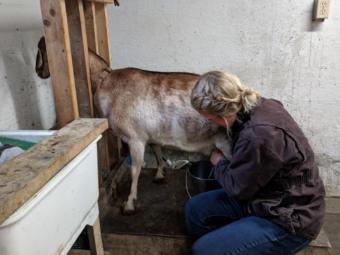
Kelli Foreman milks a Heritage Farms mother goat by hand.
Kelli Foreman milks a Heritage Farms mother goat by hand. (Photo by Kavitha George/KMXT)

Gov. Mike Dunleavy’s proposed budget would eliminate the state’s only dairy inspector, making it nearly impossible for up-and-coming dairies like Kodiak Baptist Mission’s Heritage Farms to sell milk commercially. The House passed a workaround to the issue in their version of the bill last week, but it remains to be seen whether that makes it into the final budget.

Dressed in work boots and a chore jacket, Kelli Foreman bends to milk a mother goat named Jellybean. Just across from them are four baby goats in a pen. Foreman explains that the newborn kids are bottle-fed with milk she collects from the mothers.

Spring is kidding season for Foreman’s goats, meaning the babies get first dibs on milk. But in a couple months, the mother goats will be able to start producing milk primarily for human consumption.

Continuing a tour of her farm, Foreman walks through a spotless, industrial-looking barn with an indoor milking rack and a shiny new holding tank and pasteurizer.

“This is where the magic happens,” she says with a laugh.

By summer, Foreman predicts that her brand-new automatic milkers will be able to collect about 10-20 gallons of fresh goat milk per day.

For the last two years, Foreman has been working to get Heritage Farms certified as a “Grade A” dairy, the FDA standard for farms that sell the bottled milk you can buy at a store. She says a lot of people tried to convince her that starting a goat dairy was a terrible idea, but Foreman isn’t the type of person to be easily discouraged.

“I remember having people in my life growing up that didn’t take the easy way out, that worked really hard, and those are the people that inspired me,” she says. “And we’re about the kids and families and our community, and so … let’s try it.”

Heritage Farms has been working closely with the Department of Environmental Conservation, state veterinarians and the state dairy inspector to get certified. Every month the state inspector takes samples for lab testing, and every three months they do a facility check. Heritage Farms isn’t too far off — Foreman says they’re set to be certified and ready to sell goat milk, cheese and ice cream by late May or early June.

But Dunleavy’s budget would eliminate the state’s one dairy inspector, leaving Foreman’s dairy without a lot of options for getting their milk Grade A certified.

Four baby goats mill about in a pen at Kodiak Baptist Mission’s Heritage Farms.
Four baby goats mill about in a pen at Kodiak Baptist Mission’s Heritage Farms. (Photo by Kavitha George/KMXT)

Dr. Sarah Coburn, assistant state veterinarian, said Heritage Farms is the farthest along in the certification process.

“They’re the closest, as far as their investment and planning over the past year,” she said over the phone. “They’re the closest to being permitted and going into production this year.”

According to Coburn, the effects of eliminating the dairy inspector are much wider-reaching than just forcing an end to Foreman’s endeavor. Like Havemeister Dairy in Palmer, the last certified cow dairy in Alaska, Foreman purchases her goat feed in-state from Alaska Mill and Feed. Havemeister even purchases the plastic for their milk jugs from a local plant in Palmer itself.

“Really it’s part of a bigger connection of the economy for that community,” she said. “So that’s one thing that I think there’s a bigger impact than just saying it affects that one dairy. And of course, the consumers that are actually purchasing from these dairies.”

Coburn added that other options, like bringing an inspector up from the Lower 48, are just not feasible.

“Basically if the program goes away, as things stand for them, they would not be able to operate,” Coburn said.

Kelli Foreman, Assistant Executive Director of Kodiak Baptist Mission, holds up a pail of fresh goat milk at the mission’s Heritage Farms in April 2019.
Kelli Foreman, assistant executive director of Kodiak Baptist Mission, holds up a pail of fresh goat milk at the mission’s Heritage Farms. (Photo by Kavitha George/KMXT)

And while she admits she was shocked when the proposed budget came out in February, Foreman said her mind went quickly to figuring out next steps, including contacting her legislators and speaking at a budget town hall in March.

“For me, the best thing to do is show, ‘Look at this, we can do it, don’t take this away from our state, we need this,’” Foreman said, adding, “Even if it’s six months, well, we did it for six months. We did it. I can at least show our kids, ‘We can do it, we did it.’”

Kelli Foreman shows off a newborn piglet at the Baptist Mission’s Heritage Farms.
Kelli Foreman shows off a newborn piglet at the Kodiak Baptist Mission’s Heritage Farms. (Photo by Kavitha George/KMXT)

And that’s because for Foreman, Heritage Farms isn’t just a business. It’s a way of making sure that Kodiak is a little more self-sufficient.

“I’m not saying our microdairy tomorrow is going to be able to supply all the milk for Kodiak, but it’s a start,” Foreman said. “And that’s a big part of all the agriculture for our state. Maybe not today or maybe not tomorrow, but we really need to think towards food sustainability.”

Foreman said she’s willing to put her skin in the game to achieve that goal. But realistically, she can’t do it alone.

And it’s possible she might not have to.

Last week, the Alaska House of Representatives passed its version of the budget — including an amendment that would allow the state to continue performing inspections while a “fee-based system and fee schedule” is set up. The idea is that dairies would pay a set amount for their own inspections. But it remains to be seen whether that amendment makes it into the final budget — and even if it does, whether Dunleavy will spare it from a line-item veto.

In any case, Foreman said she’s holding off on placing an order for milk bottles until the budget shakes out.

AEL&P announces price hikes starting in January

AEL&P's main offices, pictured here on March 24, 2018, are located in the Lemon Creek area in Juneau.
AEL&P’s main offices, pictured here on March 24, 2018, are located in the Lemon Creek area in Juneau. (Photo by Jeremy Hsieh/KTOO)

AEL&P announced Monday that electricity bills are going up starting in January due to low rainfall this year. Residential customers can expect an average increase of $13.62 per month.

The company normally provides renewable hydropower energy to Juneau, relying on multiple lakes and reservoirs around the city. Director of Consumer Affairs Debbie Driscoll said we didn’t get enough rain this summer and fall to ensure a surplus of hydropower energy.

For more than ten years, AEL&P has had contracts with what they call “interruptible” customers like Greens Creek Mine and the Princess Cruise lines.

“We entered into agreements with them to purchase electricity when surplus water is available,” said Driscoll. “If we didn’t have interruptible customers to buy surplus energy, that energy would often just spill … lost water.”

The revenue gained from the interruptible contracts actually worked like a discount for “firm” customers, like residents and commercial businesses in Juneau. Over the last five years, those contracts offset an average resident’s energy bill by about $30 a month. Driscoll emphasized that there’s not going to be any increase to the actual energy usage rate, but firm customers won’t be getting that discount anymore.

Given the low level of rainfall this year, AEL&P determined that there would not be enough water to produce that surplus in hydropower energy.

“This is unusual,” Driscoll said. “In the fall, about September and October, we normally get a tremendous amount of rainfall, and that’s when we see our lakes just top off. They just fill. That’s what we normally see every year, so this was definitely not typical for this area.”

Brian Brettschneider, a climatologist with the University of Alaska Fairbanks, said this year’s precipitation levels fall within typical variability, and isn’t necessarily a result of climate change. “I wouldn’t feel comfortable drawing any conclusions from it,” he said over the phone.

AEL&P says the price hike is a temporary change — as long as rainfall returns to normal levels, they’ll resume selling surplus energy, which will once again lower regular customers’ energy bills.

Is testing Juneau’s student athletes for drugs and alcohol effective?

Camden Erickson and Nick Tipton spar during a Thunder Mountain High School wrestling practice on December 12, 2018 (Photo by Annie Bartholemew/KTOO)

The Juneau School District has been randomly drug testing student athletes since 2009. But among administrators, students, parents, and coaches, there doesn’t seem to be a consensus about its purpose or its effectiveness.

Nine years later, apart from anecdotal reports, there is little hard evidence to show that it’s succeeded in keeping kids off of drugs and alcohol.

The policy originated from a grassroots effort to address growing drug use among high school students. Since then, the district has spent anywhere from $11,000 to $46,000 a year on drug tests. Even in the face of budget cuts in 2013, the district opted to keep the policy in place.

The feedback from the administrators at the high schools at the time was that, even if they had to figure out a way to administer this process without additional staff, they would figure it out because they felt like it was so important,” said Kristin Bartlett, the district’s chief of staff.

Here’s how it works: A kid will get pulled out of class to take a urine test, and then a technician analyzes it immediately. They test for a range of substances, including cocaine, marijuana, opiates, oxycontin, tobacco and alcohol. Depending on budget constraints, as much as 15 percent of each sports roster is randomly tested, once a week and only while in season.

If the test is positive, parents are notified and the student is asked to produce another sample, which is sent out to a lab for confirmation. Every week the testing service sends the school a report of positive results. The consequences for a confirmed positive test include suspension from sports as well as an online course about the effects of substance abuse. Suspensions from sports range from 10 days to a full year depending on how many times the kid has been caught with a positive test.

[googleapps domain=”drive” dir=”file/d/1Xmnx9CoJQdJMMWN4LCqDLq47Sk1txwDQ/preview” query=”” width=”640″ height=”480″ /]

(PDF courtesy of Juneau-Douglas High School Site Council)

Jake Jacoby, Thunder Mountain High School’s activities director, described the number of positive tests he’s seen in fours years on the job as steady and low.

“Not very many,” he said during an interview, adding, “I would say at least half of the maybe 8 to 10 positive tests we’ve had in the last four years have been tobacco-related.”

But beyond handling these cases one by one as they come up, the district doesn’t seem to be tracking the program’s effectiveness — that is, has mandatory testing actually reduced the number of kids using drugs and alcohol over the years?

“It would be hard for us to measure that with some kind of statistical validity of any sort,” said Juneau-Douglas High School principal Paula Casperson.

To try to compile that kind of data for Thunder Mountain athletes, Jacoby said he’d have to go back through years of hard-copy weekly reports. “It’s not going to happen anytime soon,” he added.

Higher-ups have the same answer. Interim Superintendent Bridget Weiss said in an email that “anecdotally we have few positive [test results],” but that the district does not keep yearly records of the number of positive tests. The consensus there is that the district doesn’t have the time or capacity to keep track of year-over-year testing results.

So how do they know it’s working? Weiss says that the program is meant to give kids a reason to say “no,” rather than catch them in the act. That’s something Casperson as well as Rhonda Hickok, assistant principal at Thunder Mountain, echoed.

“It kind of gave kids an out, if they didn’t have the courage before,” Hickok said in an interview. “We know peer pressure is pretty high, and it could be a challenge for some kids to not be able to say no. Well now they had an out that they could say, ‘No, I participate in this program and I could be drug tested, so I can’t do this.'”

On top of that, Hickok said that the district has taken strides to train teachers to identify risk behaviors, including a two-day drug impairment training program for administrators alongside the Juneau Police Department. The school also holds educational sessions with athletes and their parents about the consequences of drug and alcohol abuse.

Another common refrain from administrators is that the drug policy opened the door to a larger community discussion about youth substance abuse.

“It really elevated the conversation, and people opened up about what the problems were, and people shared more information about how to get help and how to prevent it in the first place,” said Bartlett. “That, I think, contributed a lot to the reduction in the incidences that we were seeing.”

Even without hard numbers, Activities Director Jacoby said he’s confident reports of athlete drug use are just less prevalent. “That sort of conversation I don’t hear anymore,” he said. “I think that it’s a pretty serious deterrent to know that, that you’re in a pool of people that could be tested on a weekly basis.”

But talking to kids and parents, you might hear a different story.

At a Thunder Mountain wrestling practice last month, some players doubted the effectiveness of testing, and others weren’t even sure it’s happening. Wrestling sophomore Nate Houston and senior Derek Mason debated the latter point in the hallway outside the auxiliary gym.

Nate Houston, a sophomore wrestler at Thunder Mountain High School on December 12, 2018 (Photo by Annie Bartholomew/KTOO)

“I haven’t heard of anybody on the team getting tested,” Mason said.

“We got drug-tested for football. I just didn’t get drug-tested,” said Houston. “Only just like a few kids got drug-tested.”

“Jacoby at the front office said that no one got drug-tested for football,” Mason countered.

The boys said their wrestling season was about halfway over, but neither of them had been tested yet. Over the phone, Jacoby confirmed that the school’s wrestlers are being tested, but because of the small size of the team, it’s at most one or two kids per week.

Derek Mason, a senior wrestler at Thunder Mountain High School on December 12, 2018 (Photo by Annie Bartholomew/KTOO)

Most kids said they wouldn’t change the current system, but they also agree that testing doesn’t prevent kids who want to use drugs from using them. “It just depends on the kid, you know?” said Camden Erickson, a senior at Thunder Mountain. “I think if a kid really wants to do drugs, it’s not going to matter if he’s in season or not.”

The small sample size might actually be part of why some athletes feel comfortable risking it. “I knew some kids that got drug-tested five or six times in a season,” said Trevor Jones, a former Thunder Mountain swimmer who graduated in 2015. “And then like, my last two years in high school, I didn’t get drug-tested at all.”

Camden Erickson, a senior wrestler at Thunder Mountain High School on December 12, 2018 (Photo by Annie Bartholomew/KTOO)

Beyond the testing, some student athletes say that even the educational part of the district’s drug policy isn’t particularly effective.

“A lot of students, it just goes over their heads,” Sunny Tveten, a senior on the Juneau-Douglas swim team said over the phone, adding, “They don’t pay much mind to it because many of the students who have done it, they know how to work their way out of getting caught.”

How do they work their way around it? Parents, students — and even Jacoby — report that some kids cheat. “They’ll have other people like, pee for them or whatever,” said Erickson. “I mean, it’s hard to cheat, but it happens.”

It’s not clear just how often kids try to subvert the system, but their attitude does throw into question the value of the testing budget. To be clear, even at its highest in 2010, $46,457.50 for the year, the testing budget is a drop in the bucket in a district budget that has grown from around $65 million to over $80 million in the last nine years. That’s one explanation for the program continuing without thorough understanding about what it’s doing.

Merry Ellefson, a Juneau-Douglas cross country coach and parent of a Juneau-Douglas student, said over the phone that she’s unclear on the effectiveness of the policy, but “the money that we’re putting into it is so small right now that perhaps it’s doing what it needs to do.” She noted, however, “We also know that there’s a lot of the young people that have figured out the system, and we know there’s kids in our schools walking around with clean pee … in case they get called out.”

She laughed, adding, “I mean, they’ve figured it out.”

For Ellefson, the bigger issue is making sure kids have a positive, supportive environment in which to get help.

“I’m feeling like, if I have kids on my team caught smoking, I’d rather have them smoking and running than not coming to practice,” she said. “I’d rather have them with this group of young people that are active and making good choices and traveling with me, than spending more time on their own and perhaps unsupervised.”

At the same time, parents like Ellefson say it’s unreasonable to expect the district to be solely responsible for solving the issue of substance abuse. “And at the same point, it’s where we are at,” she added. “We’re all participating … and $11,000 might be an important little wedge in trying to keep our community healthy.”

National studies of high school drug testing programs haven’t shown a strong correlation — if any — between testing and lowered substance abuse, arguing that improvements in school environment may be a more effective use of resources to reduce substance abuse. A 2015 statement from the American Academy of Pediatrics denounced “widespread implementation” of testing programs due to a “lack of solid evidence for their effectiveness.”

Drug testing is just one part of Juneau School District’s strategy to address the issue, along with education and outreach resources. But seemingly satisfied with anecdotal evidence, it appears unlikely that administrators will be changing the program anytime soon.

How does Mike Dunleavy like his cookies? ‘More chocolate chip than dough.’

Gov. Mike Dunleavy greets community members at a holiday open house at the governor’s mansion on Dec. 11, 2018 (Photo by David Purdy/KTOO)

On Tuesday afternoon, Gov. Mike Dunleavy hosted the annual holiday open house at the governor’s mansion in Juneau. The event was an opportunity for the community to meet the governor and first lady in their new home, as well as sample a few cookies.
10 varieties of cookies arranged in the Governor’s Mansion dining room for the annual open house on December 11, 2018 (Photo by David Purdy/KTOO)

That second part is a big priority for some of the open house’s younger guests.

“We go pretty much every year,” said 11-year-old Dane Hubert, waiting in line on Calhoun Avenue with his younger brother Jaeger and their parents. Asked his favorite kind of cookie, Dane replied, “That’s a hard decision. … There’s a lot of different types of cookies.”

“The M&M one is really good,” Jaeger supplied.

Juneauites — mostly families like the Huberts — lined up outside in the snow starting around 3 p.m. Volunteers ushered guests into the elaborately decorated mansion to shake hands with Dunleavy, Lt. Gov. Kevin Meyer and their wives, and then on to the dining room where cookies were already piled high. Children’s music groups performed in the living room as guests milled around, admiring gingerbread houses and sipping cider.

Gingerbread houses made by Dzantik’i Heeni 7th/8th grade students (Photo by David Purdy/KTOO)

This year all 10 varieties of cookies were baked in-house by mansion staff and Creations by Cynthia. Lisa Boman, executive residence manager, said that cookie dough preparation for the holiday meet-and-greet started in late September and wrapped up by the end of October.

“We have a little over 23,000 cookies out there,” she said. “And in order to do that in-house, two people, it was a project.”

In her seven years as residence manager, Boman says they’ve never run out of cookies. Leftovers go to nonprofits in Juneau like the AWARE shelter, the fire and police departments and the Glory Hall.

Gov. Dunleavy’s favorite cookie, if you were wondering? “Chocolate chip. More chocolate than chip — I guess, more chocolate chip than dough.”

https://www.facebook.com/ktoopublicmedia/videos/327119571213628/

No injuries reported in Douglas Bridge car accident

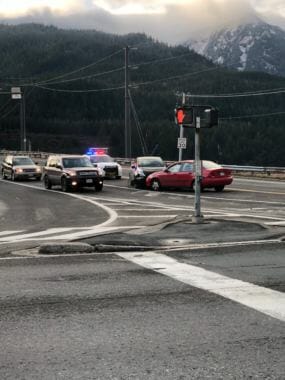
A two-vehicle crash involving a downtown Bullwinkle’s Pizza Parlor delivery man caused a 45-minute traffic obstruction in one lane of the Douglas Bridge on Friday afternoon.

Juneau Police Sgt. Sterling Salisbury said the delivery person took a very wide right turn onto the bridge from Egan Drive. His red Ford Focus ended up in the opposite lane and collided head-on with an oncoming car. Salisbury said both cars were totaled, though the manager at Bullwinkle’s disputed this, saying that the Ford Focus did not look irreparably damaged. No injuries were reported.

Police closed one lane of the Douglas Bridge on Friday afternoon after two cars collided head on. (Photo courtesy Scott Ciambor)

Earlier in the afternoon, a bystander called into JPD about the delivery driver after they noticed him “swerving back and forth on the roadway erratically” said Lt. Krag Campbell. Officers stopped the man in front of Bullwinkle’s but found “no signs of impairment,” Campbell said.

Annie Bartholomew, a KTOO employee, happened to be on her way into the State Office Building around 11:45 a.m., when she noticed the officers talking to the delivery man.

“They were just kind of questioning him,” she said. “He had his red polo on and some pizzas there with his red car. … Looked like he was going out to make a delivery.”

About 20 or 30 minutes later, after officers let the man go without issuing a citation, Bartholomew said she saw him again after he delivered pizzas to the KTOO office on the corner of Whittier Street and Egan. “I was walking into the KTOO parking lot, I see this red vehicle kind of driving erratically, a little bit faster than is safe in a parking lot, I think,” she said. “And it was the pizza guy! It was the same guy in his red polo.”

Salisbury said the crash was reported shortly after, at 12:35 p.m. Officers who responded to the scene administered a field sobriety test to the delivery man, which he passed. The driver told officers that he had had some vehicle problems, and was issued a citation for negligent driving.

Site notifications
Update notification options
Subscribe to notifications