KBBI - Homer

KBBI is our partner station in Homer. KTOO collaborates with partners across the state to cover important news and to share stories with our audiences.
Homer resident saves kayaker’s life on Six-Mile Creek

Homer resident Obadiah Jenkins was spending his 33rd birthday last weekend kayaking Six-Mile Creek in Hope at the 10th annual Whitewater and Bluegrass Festival.

Kayakers hold a friendly race as part of the festivities.

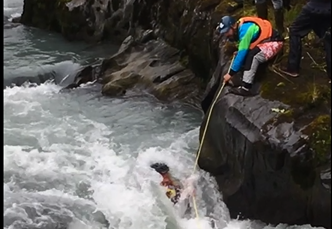
Obadiah Jenkins tries to help Daniel Hartung pull himself from Six-Mile Creek in Hope. (Photo courtesy James Bennett)

Jenkins was taking a practice run through the class four rapids when a bystander filming the event, noticed another participant, Daniel Hartung, 64, of Indian Valley, flipped out of his kayak and became pinned under a log.

Jenkins wasted no time organizing a rescue effort to save the man’s life.

After about five minutes of trying to pull Hartung from the river, Jenkins jumped into the rushing water to save the man.

Jenkins and James Bennet, the bystander who noticed Hartung was in trouble, stayed in contact after the incident.

Hartung still is recovering, but is doing well.

The three men plan to meet for dinner and a few drinks at Jenkins’ farm in Homer over the weekend.

Bennett filmed the entire rescue and wrote about the experience for the Alaska Dispatch News.

Can sea stars make a comeback in Kachemak Bay?

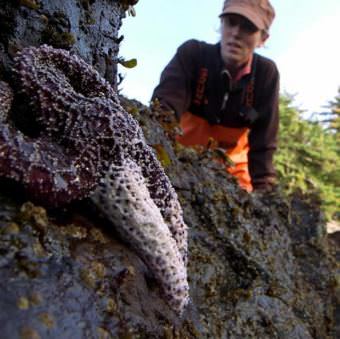
A researcher examines an ochre star with whitened arms — a symptom of sea star wasting syndrome. So far, about 20 different species along the Pacific Coast appear to be vulnerable to the disease. (Photo courtesy Greg Davis)

Sea star wasting syndrome, or disease as it has become known, hit Kachemak Bay hard in 2016, killing about 90 percent of sunflower and true star populations.

Researchers eagerly waited for spring to roll around in hopes their numbers would rebound.

As the days got longer, it quickly became apparent that wasn’t going to happen this year, but there is some hope the disease is waning.

Sea star wasting disease has been demolishing sea star populations along the West Coast for the past few years.

It begins with lesions and quickly progresses to full-blown deterioration.

“Eventually the sea stars appear to be melting away and rotting away,” Katie Gavenus said.

Gavenus works with the Center for Alaskan Coastal Studies and has been monitoring sea star populations at three sites in Kachemak Bay for about four years.

The disease was first documented in the area in 2014, but populations of true stars remained relatively steady until August of last year.

Gavenus then saw a significant increase in the number stars in the ladder stages of the disease, essentially melting away.

Since last year, adult true stars have shown little sign of their existence in Kachemak Bay.

“I just looked back at our data from late June and what we just collected last week, and we found two true stars in one of them, zero in another,” Gavenus said of the three beaches she monitors. “So, really a significant decrease in the number of true stars that we’re seeing.”

Gavenus notes prior to the disease, 50 to 75 true stars could be seen at these sites.

Other species have also been hit hard in the bay.

University of Alaska Fairbanks marine biology professor Brenda Konar has worked with Gulf Watch Alaska to monitor Kachemak Bay since 2002.

Konar trains scuba divers in Kasitsna Bay near Seldovia every spring and sends trainees to survey for sunflower stars.

“This year, not a single sunflower star was seen there, which is crazy, because normally they’re everywhere,” Konar said.

But, not all hope is lost. Konar’s Ph.D. student Ben Weitzman tracks sea star populations in Prince William Sound. Weitzman also works for the U.S. Geological Survey as a wildlife biologist.

This year, he’s been seeing signs of a rebound.

“At some of the sites around Knight Island, we were seeing juvenile sunflower stars, the pycnopodias, about the size of your palm,” he said. “We weren’t seeing them everywhere, but it was nice to see them at least some places.”

However, Weitzman is cautiously optimistic.

Locations from northern California to the coast of British Columbia have seen increases in juvenile recruitment over the past year, but survival has been a mixed bag.

Weitzman has the same questions other researches have been asking.

“Our big question is are these guys going to survive? Will this recruitment pulse that’s come in actually start to repopulate the sunflower stars in the system?” he wonders. “Maybe they don’t survive. Maybe they survive in only some of the bays, we’ll see.”

Weitzman notes other sites Gulf Watch monitors in Katmai and Kenai Fjords national parks haven’t seen the same signs of life.

As to why researchers are seeing a pulse in Prince William Sound, Weitzman said that’s a complicated answer.

Starfish are satellite spawners, releasing eggs and sperm into the water column.

Where their larva lands is largely depends on ocean currents.

“There could be more local retention of larva there,” Weitzman said. “It could just be conditions are a little cooler or warmer, they vary in some way that allows the sunflower stars to be successful this year.”

Konar thinks conditions in Kachemak Bay could lead to a similar spike in juvenile stars in the next few years, and there are small signs that could happen.

Researchers have found juvenile true stars hiding under rocks and in non-surveyed locations, but only time will tell if those signs translate into a rebound.

BlueCrest to pause drilling in Cook Inlet

The Buccaneer jackup rig drills for oil and gas just north of Anchor Point, in Cook Inlet, Alaska in 2015. (Photo by Bill Smith)

A Texas-based oil company plans to pause its onshore drilling operation in Cook Inlet in September, leaving about 150 workers without a job for the time being.

Currently, BlueCrest Energy has two wells drilled at its 38-acre drill site just north of Anchor Point and plans to finish a third before halting operations. CEO Benjamin Johnson says the company isn’t shutting down the field, but it won’t drill any new wells until it is paid $75 million in tax credits it’s owed by the state or finds funding elsewhere.

“We reached the point that we need the other money. Now, the state has paid us $27 million in tax credits, and we’ve taken that money and reinvested that 100 percent to get us where we are, “ Johnson explained. ”Without the receipt of the remaining tax credits, we’ve got to now change our investment plan, and that’s not easy to do.”

Currently, just one well is producing oil, and BlueCrest plans to bring the remaining two online in the coming months.

Johnson expects the $525 million project to produce thousands of barrels of oil per day, but it needs more wells brought on line to make the operation financially sustainable.

Alaska’s Legislature eliminated the state’s cash-credit program last month, which gave cash payments to companies producing less than 50,000 barrels of oil per day to promote oil exploration. The state has also been slow to pay out tax credits companies have already earned as it deals with the fiscal crisis.

Johnson says the company can live with the new law, but he says BlueCrest is looking elsewhere to fund its operations for the time being.

“Some companies may be able to deal with not getting the payments. Perhaps we could deal with not getting all the payments, but this is the result of not getting at least a substantial portion of them,” Johnson said. “We have to stop for now.”

He doesn’t know when workers will get back to work and declined to say where and how BlueCrest is seeking additional funding.

Mandated reporting of prescribed controlled substances begins in Alaska

Medical professionals prescribing controlled substances in Alaska are now required to provide hard numbers. (Photo by Aaron Bolton/KBBI)

The state has been collecting data on prescription opioids and controlled substances since 2012, but until last month, prescribers and pharmacies have been volunteering that data.

As part of an ongoing legislative effort, medical professionals prescribing controlled substances are now required to provide hard numbers.

The effort will help the state grasp the size of the opioid crisis and doctors’ prescribing habits.

Alaska’s Prescription Drug Monitoring Program, or PDMP, is getting a facelift because of two pieces of legislation, Senate Bill 74, passed last year, and House Bill 159, which Gov. Bill Walker signed in late July.

On July 17, SB 74 began requiring any licensed prescriber of opioids and other controlled substances to report the number of prescriptions they’re writing.

Pharmacists also are mandated to report the number of those prescriptions going out the door weekly.

The program is ran by the state Division of Corporations, Business and Professional Licensing.

Director Sara Chambers said the data will help providers understand their prescribing habits.

“There is a new report through HB 159 that authorizes our agency and the Board of Pharmacy, which is within our agency, to create what are called prescriber report cards,” Chambers said.

These reports will let providers know just how many prescriptions they are writing and how that compares to their peers. Chambers explains the PDMP will serve as an educational tool for prescribers and pharmacists, and adds that it’s not a punitive measure.

However, governing boards, such as the Board of Pharmacy, will be able to access the data, and it can make decisions based on the information.

Prescribers also are required to access the PDMP database before prescribing controlled substances.

The database allows them to see the last time a patient was prescribed a controlled substance such as an opioid, how many pills they received and the frequency of those prescriptions.

A provider also will be able to see where the prescriptions are coming from.

“It can really help reduce doctor shopping. If there are people who don’t necessarily have a medical need for these substances, and if they’re going from doctor to doctor, pharmacy to pharmacy, this is a huge tool in deterring that type of activity,” Chambers said.

The division hopes to have every licensed prescriber in the state on board and reporting by the fall.

HB 159 will also require providers to shift from weekly reporting to providing daily reports next summer.

PDMP estimated numbers already are aggregated into annual reports for Alaska’s Legislature, but Chambers notes the division will be looking to spread the hard numbers far and wide.

“To help inform communities, to help inform age populations,” Chambers said, explaining who will benefit from the data. “Really spread the educational opportunities around to those who may be vulnerable and at risk and to those prescribing without realizing the impact that they’re having.”

The division will continue to examine trends and monitor their relation to medical professionals’ prescribing habits.

So far this year, the division estimates about 282,000 opioid prescriptions have been dispensed statewide.

On the Kenai Peninsula, there have been enough opioids prescribed to supply 54 out of every 100 people with a prescription.

Only the Prince of Wales-Hyder census area in Southeast Alaska has a higher per capita rate, and the Ketchikan Gateway Borough is a close third.

Correction: A previous version of this story reported that House Bill 74 required providers and pharmacists to report the number of prescriptions they’re writing and dispensing. The correct bill is Senate Bill 74. 

Marine debris won’t stop, but neither will those cleaning it up

Millions of pounds of plastic debris washes up on the Gulf of Alaska’s remote shores each year. It washes up faster than it can be collected and clean-up efforts cost millions. That can seem overwhelming for volunteers who are out there year after year, cleaning the same beaches. But, one man doesn’t let that discourage him in the slightest.

Chris Pallister is president of Gulf of Alaska Keeper, an environmental non-profit that focuses on marine debris. It’s been raining all day and his crew of family and friends climb over wet logs,

Marine debris neatly organized before it’s rebagged and weighed. Photo by Aaron Bolton / KBBI News

collecting every shred of plastic wedged in the maze of dead trees. Pallister and his wife Patty Zwollo are weighing the trash, then sorting the plastic into more than 150 different categories.

“We’ll have five-gallon jugs, fuel canisters, nets, lines and various categories of that. We have all the beverage bottles which we break into three categories,” Pallister explains.

Even the plastic wads from shotgun shells are individually counted.

“What we’re trying to do is figure out the sources of it. You know at some point, somebody has to pay to clean this stuff up,” Pallister says as he pored over fishing buoys piled on a red tarp. “So you have to have some kind of assessment, who you pin it on, which industry, which countries.”

Zwollo keeps track of the numbers. The data shows the source of the trash and also how fast some of these items are crossing the Pacific Ocean, particularly pieces from the 2011 tsunami in Japan.

Light material like styrofoam peaked in 2012 and has now tapered off to pre-tsunami levels. But, heavier plastics, such as Japanese aquaculture baskets, are still showing up. Pieces of the vibrant containers litter the beach, several of them stuck beneath heavy logs.

This is day two of a six-day trip to clean up Gore Point near the eastern tip of the Kenai Peninsula. It’s relatively short compared to Pallister’s typical 30-day trips. Pallister and his family have been involved in cleaning up beaches since 2002, and he formed Gulf of Alaska Keeper in 2005.

Yesterday, they cleaned up 1,500 pounds. Today, Pallister is expecting much more.

“This is really bad. I think by the time we get done with this little section of beach, we’ll probably pick up maybe 3 tons of debris on a third of a mile,” Pallister notes as he looks down the beach.

Plastic washes up faster than it can be picked up. There are places in Prince William Sound, where Pallister also works, that have 20 to 30 tons of plastic per square mile. The remote locations and mountains of plastic make Pallister’s work incredibly expensive.

One summer of beach combing can cost about $1 million. What’s collected is stored in large nylon bags placed above the tide line. Pallister hires helicopters and barges to remove nearly 1 million pounds of plastic every few years. Those projects can run about $25,000 per day.

Tracking down funding for that work can be a full-time job of its own. Pallister does all his own grant writing and maintains two boats in order to keep the non-profit going. All this can sound pretty defeating.

“All this stuff, who knows. It’ll keep you awake at night if you think about it too much,” Pallister sighed.

Pallister has made several trips to Washington D.C. to testify before Congress, and he said he’s been working with Alaska’s congressional delegation.

There are two bills related to marine debris working their way through Washington D.C. Pallister said things could move quite a bit faster, but he’s pleased decision makers are shifting their attention to the issue. But, until legislative action actually happens, Pallister will continue working to clean up the problem piece by piece.

Coastal Studies marine debris initiative goes beyond the classroom

The Center for Alaskan Coastal Studies will wrap up a one-year grant aimed at teaching Kenai Peninsula classrooms about marine debris.

Marine debris collected on Gore Point. (Photo by Aaron Bolton/KBBI)

funding from the National Oceanic and Atmospheric Administration is coming to an end this fall, said Marine Debris Coordinator Henry Reiske, but the project is doing more than working in the classroom.

Coastal Studies worked with 15 classes from 11 schools last year.

The Zero Waste Schools program aims to give elementary students a first-hand look at how much single-use plastics they consume.

Reiske is at Gore Point on the western side of Kachemak Bay State Park, but, the program began closer to home.

“They got a first-hand look through cleanups in Kachemak Bay, just around where most of them live,” Reiske said. “We got some schools up from Soldotna, we got one from out in Anchor Point and one out in Anchorage, but for the most part, they’re from Kachemak Bay. So they clean up their area.”

Classrooms created their own projects to reduce single-use plastics in their schools after kids participated in a cleanup.

Solutions ranged from using ketchup pumps in the lunchroom rather than packets to ditching disposable lunch trays.

Coastal Studies will stay involved with those classrooms through the fall and will return next spring to see how much each class reduced waste.

“One of the things we’re hoping to be able to do is look at the schools’ total waste” Reiske said. “Say a school use to get two dumpster pickups a week – if you’re reducing styrofoam trays and plastic sporks, can that be cut to one?”

The initiative has extended beyond the classroom.

Coastal Studies used its funding from NOAA for two-multi-day trips to remote beaches, where plastics pound the shoreline every year.

It brought several volunteers in June to Augustine Island, about 80 miles southwest of Homer. In July, Reiske teamed up with Gulf of Alaska Keeper to clean beaches on Gore Point.

Two Homer High School students, Tanner and Rio, are working to clean the first of three beaches.

They said they came on the trip to see a remote location on the peninsula, but both were surprised to see just how much trash piles up here.

“There’s been some bigger stuff, like buoys, there’s gas tanks, there’s a bunch of rope. It’s all around here somewhere. Right there, there’s a bunch of cool stuff,” Tanner said, as he climbed toward a few old fuel jugs caught in the log jam, stretching about a half-mile.

The boys scour the beach, balancing on dead trees. They shout as they find souvenirs. Rio picks up a toy helmet and laughs.

“It’s a fake viking helmet thing that has no horns in it,” he said, putting it on.

Reiske hopes trips like these, which cost thousands of dollars, help change perspectives.

“Because you can tell people don’t use single-use plastics all you want, but as long as there’s still that culture of disposable plastics, the problem is going to still persist,” he said. “We’re just helping the next generation, and it can get ingrained in them, ‘Oh, this plastic has a cost to it.’”

Even Reiske himself is surprised to see how prolific the problem is.

On day one, the team picked up 1,500 pounds of trash.

Gulf of Alaska Keeper President Chris Pallister guided everyone through the cleanup. Pallister has been cleaning three of Gore Point’s beaches for over 10 years.

On day two, he estimated the second beach would produce substantially more.

“This is really bad. I think by the time we get done with this little section of beach, we’ll probably pick up 3 tons of debris on a third of a mile,” Pallister said.

Reiske and the boys were only able to join Pallister and his crew for a few days.

He said Coastal Studies will search for funding to provide more remote trips, but for now, Reiske considers this trip a success.

Site notifications
Update notification options
Subscribe to notifications