KBBI - Homer

KBBI is our partner station in Homer. KTOO collaborates with partners across the state to cover important news and to share stories with our audiences.

Interest in kelp farming drives state tideland applications

Like in Alaska, kelp forests in California provide habitat and shelter for a variety of fish species. Photo courtesy Sonia Ibarra.
Like in Alaska, kelp forests in California provide habitat and shelter for a variety of fish species. (Photo courtesy Sonia Ibarra)

The Alaska Department of Natural Resources is beginning to work through tideland lease applications for the mariculture industry.

Current and potentially new farmers are applying to use state tidelands to grow Pacific oysters and geoducks.

Those are all typical requests, but what’s different this year is the acreage farmers are requesting and the increasing interest in kelp farming.

The number of applications for mariculture tideland leases this year are the highest DNR Leasing Unit Manager Christy Colles can remember.

“This was a large year. We actually got 18 applications, 15 of those being new,” Colles said.

The roughly 1,000 acres requested are staggering compared with last year’s three applications for about 18 acres.

Most of the spike for this year can be attributed to an increasing interest in kelp farming.

Just under half the applications are for kelp permits, but they make up about two-thirds of the requested acreage.

“Kelp farming requires more acreage, and a lot more people are putting in for acreage,” Colles said. “We also have a lot more oyster farmers that are putting in larger areas. They’re at least requesting larger areas for growing Pacific oysters.”

The mariculture industry can be difficult to break into with long turnarounds for profits.

Geoduck farmers just starting out can wait up to 10 years before money starts rolling in and pacific oysters typically take about half that time.

A 2015 Alaska Division of Economic Development study shows that larger mariculture operations generally make profits faster because of efficiency. Farms that also diversify their harvest are more likely to see profits sooner rather than later.

Director Britteny Cioni-Haywood began overseeing the division as the study concluded. She’s not surprised by the interest in kelp and the increasing acreage that follows.

“I think throwing in kelp now, if we were to go back and redo this study, that you would find that incorporating kelp would increase the success of those farms because it allows a cash flow much sooner,” she said.

The division also oversees the Mariculture Revolving Loan Fund.

Farmers can borrow up to $300,000 to plan, construct and operate their mariculture businesses.

Established businesses typically use it to expand their operations, Cioni-Haywood said.

The fund could also see a spike in applications as DNR and other state agencies, such as the Alaska Department of Fish and Game, work through the necessary permits for mariculture applicants.

“We always have a steady stream on inquiries, but we haven’t seen an increase in the number of loan applications,” Cioni-Haywood said. “Now, those tend to follow business planning. You’re going to do your business plan. You need to get the application through fish and game. We tend to come after all of that.”

Public notices have begun to go out for some of this year’s tideland applications.

Leasing manager Colles hopes to wrap up the public process this fall, but doesn’t know how long it will take with a larger load.

Kodiak-based commercial fisherman Nicholas Mangini is among this year’s applicants.

His business, Kodiak Island Sustainable Seaweed, harvested about 15,000 pounds of ribbon and sugar kelp on one acre this spring. He hopes to expand his operation to 18 acres.

Mangini sold to one buyer last year. He plans to sell to that buyer again, but he also hopes to develop new kelp products and directly market them.

Mangini adds that those jumping into the evolving kelp industry should know it’s not easy.

“I think there’s a lot of people excited about it, but I think the application process is a lot more rigorous than people are realizing.  It’s not just as easy as throwing some lines in the water and growing some kelp,” he said. “There’s quite a bit to it. I did a lot of research and read a lot of manuals, other peoples’ issues for year before I even got involved.”

Mangini plans to harvest his first large batch in May 2018 if his expansion is approved.

Homer Rotary Club plans peace-based arts program for elementary kids

Peace written in sand.
(Flickr photo by Hc_07)

The Rotary Club of Homer is collaborating with a German foundation aimed at cultivating peace through painting. The Together in Peace Foundation has been running its United Paintings program throughout Europe for 21 years.

The initiative aims to educate elementary-aged children about the idea of peace through curriculums in the classroom. At the end of the program, kids express what peace means to them by painting on canvas banners.

The program will now take root right here in Alaska. The founder of the program, Olaf Ring, contacted Homer Rotary Club President Jane Little about implementing the program in the U.S. earlier this month.

Little said she has been looking for a project for some time, and she jumped at the opportunity to work with Ring.

“Right now, he has about three miles of length of banner, and what our goal is to get another three miles in Alaska, the Yukon and the U.S. in the next two, two and a half years,” Little explained, “So we can present this string of banners at the Rotary International Convention in Germany in 2019.”

Little has served as district governor for Rotary clubs in Alaska and Canada, and she said the project will fit the humanitarian organization’s mission. She will be working with the Rotary Club of Fairbanks to design a curriculum for the program.

“What we see this as is not a one-day project, but perhaps several weeks or months of having the curriculum to teach the children about peace,” Little said. “Then at the end of it, have them paint a picture that is peace and also depicts their hometown, their community, their school.”

Painting pictures can seem like such a simple idea, but Little likes the program’s ground-up approach because it cultivates understanding of others and helps broaden understanding of what peace can look like.

“I think that for most of us that are involved in the peace movement of some sorts is that we will see a kinder, gentler world. We’ll see people that are able to get along better and that we’ll have dialogue,” she said. “It’s one person at a time.”

Little explains the topic of peace can be a large one, and she doesn’t know exactly what the U.S.-based program will look like. She plans to work with schools throughout Alaska, the Yukon and the Lower 48. Little hopes to have a timeline for its implementation later this summer.

Medication dating back to the 1800s stolen in Homer

Homer police patch
(Flickr photo courtesy scoutnurse)

Tracking down antique vials of medication dating back to the late 1800s isn’t typically on the Homer Police Department’s agenda, but it is this week. A long-time Homer resident reported a box full of antique medical supplies stolen Tuesday. Some of the items taken were destined to return to the village of Wiseman, where they were collected nearly 70 years ago.

Judith James has been gathering several items belonging to her deceased husband, Walter Johnson, to bring to the University of Alaska Anchorage’s Consortium Library and the village of Wiseman. Johnson, a former physician, attended the University of Alaska Fairbanks in the 1940s. He owned the Wiseman Trading Company store in the small village about 240 miles north of Fairbanks while he attended college.

James intended to donate several records and items he collected during that time, but when she stopped by her storage unit Tuesday, several items were missing, including the box full of antique medical equipment.

“Sealed glass tubes I remember seeing in the box with silk suturing thread and a sterile needle,” James explained. “That’s how they kept it sterile. These things are well over 100 years old, and the packaging is a little bit rough.”

Some of the medications date back to the 1880s. Johnson collected medical supplies that were sold in the store and some that had been sitting in the attic. He brought them with him when he left for medical school in 1948.

Johnson also collected several records on gold mining in the Wiseman area and has written several papers on a variety of historical topics in Alaska. The university’s Consortium Library already has several of Johnson’s papers and items in its collection.

James was preparing for a trip back to Wiseman in July to spread her husband’s ashes and return the antique medical equipment to the store, which now serves as a museum.

“They’ve the refurbished the old trading company store and there are many antique and historical items on display there,” James said.

She is upset someone would steal such sentimental items, but James is also concerned about some of the medication could be extremely toxic.

“I just started getting really worried yesterday thinking about somebody leaving these things perhaps in a place where children could access them, pull the corks or break the seal and maybe smell or ingest these things,” James explained.

James still has some of Johnson’s collection from his time in Wiseman, including business licenses dating back to the 1920s. She still intends on making the trip to donate them.

James has reported the incident to police. She asks that anyone with knowledge of the box and its contents bring it to the police department or another location where it will be safe. She has not heard if there are leads in the case. Homer Police could not be reached for comment in time for this story.

Study examines the ripple effect of fishing charters’ choices

Fishing Boat in Kachemak Bay.
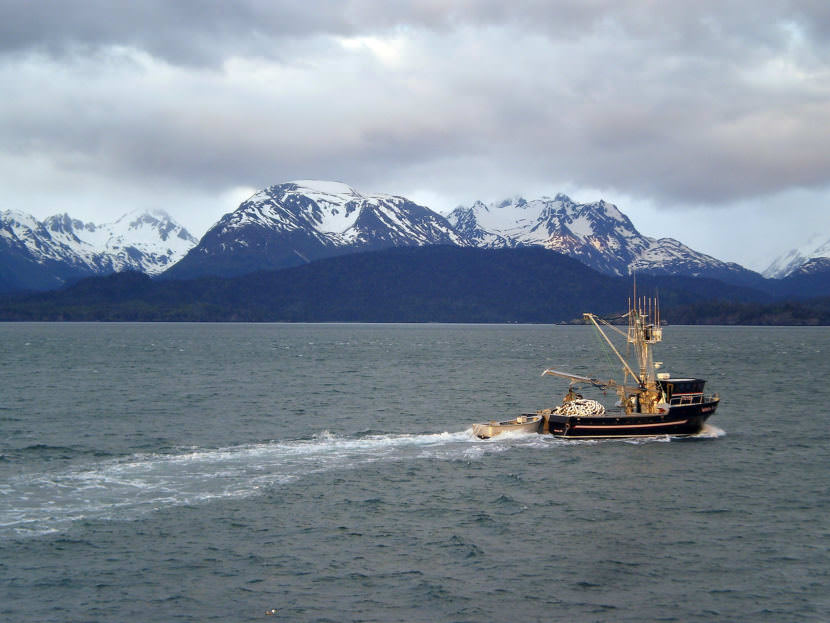
Fishing Boat in Kachemak Bay. (Photo by James Brooks)

Homer is known as the “Halibut Fishing Capital of the World.” But, charter operators aren’t just targeting the prized bottom fish these days. An ongoing study published in the scientific journal Public Library of Science aims to find out how charter operators’ fishing habits have evolved and the ripple effect of their decisions.

University of Fairbanks Ph.D. candidate Maggie Chan wants to know how and why the fishing charter industry is changing in Southeast and Southcentral Alaska.

Chan and Associate Professor of Fisheries Anne Beaudreau interviewed several fishing charter owners in Sitka and Homer, most of whom have been in business since the 1990s.

Part one of Chan’s study focuses on where charters are taking their customers.

“So in a way, I’d like to think of this first paper as putting the picture frame down,” Chan explained. “We’re going to start filling in the picture of what people are seeing in the water and the changes they’ve seen over time in the next few papers.”

This is important because popular fishing grounds are chosen not just for the availability of fish, but the variety of species that can be caught in one place. Chan found in the early 1990s, charters primarily targeted halibut around Kachemak Bay and in Lower Cook Inlet. In the ladder part of the decade, fishermen started offering multi-species trips.

“When we see the addition of combination or multi-species trips, people were traveling further south to the Barren and Chugach islands,” Chan said. “That is very distinctly associated with a multi-species trip because there’s more habitat down there for things like lingcod, rockfishes, etc.”

Then, when fuel prices hit an all-time high in 2008, fishermen stayed closer to town.

Captain Greg’s Charters owner Greg Sutter has been guiding fishing trips around   Homer since 1995. Sutter caters to families and large groups. He said multi-species trips are still in high demand.

“When they come up to Alaska, they’re not only looking for the adventure, they would like to bring home as much meat as they can,” Sutter said of why people choose combo trips.

Chan conducted her interviews in 2014 and 2015. During that time, the decisions Homer charter operators were making were mostly business driven. Fishermen in Sitka say they chose their fishing grounds because of regulations imposed by the International Pacific Halibut Commission.

Homer charter operations have seen halibut regulations come down since. The halibut commission started cutting out days of the week operators could target the bottom fish. Sutter said multi-species trips have picked up some of the slack, but he’s turned away customers and has canceled advance bookings for halibut trips.

“We can try to sell a salmon trip, which some Wednesdays I’m able to, but not every Wednesday,” Sutter said.

Chan doesn’t just want to know what’s driving fishermen like Sutter’s choices. In subsequent papers, she will lay out what changes anglers are seeing in the waters they fish. She hopes her study will spur conversation between fishery managers and fishermen. Chan said that dialogue can help decision makers make big-picture management decisions.

Scott Meyer is a fishery biologist for the Alaska Department of Fish and Game in Homer. Meyer collaborated on the study and agrees the study’s findings could be valuable for both federal and state fishery managers.

“It just helps everybody understand the behavioral response by the charter fishery to changes in halibut regulations,” Meyer explained.

Although halibut harvests are federally regulated, Meyer said fisheries around the state have felt the ripple effect of halibut regulations.

“We saw, for example, a big shift in Sitka and also in Kodiak, response to halibut regulations where it didn’t take many more boats targeting black rockfish to dramatically change the harvest in those areas,” he said. “So we had exponential increases in harvest in both of those fisheries.”

Chan and Beaudreau plan to publish the rest of the study within the next year.

Aquaculture association commissions study in Tutka Bay

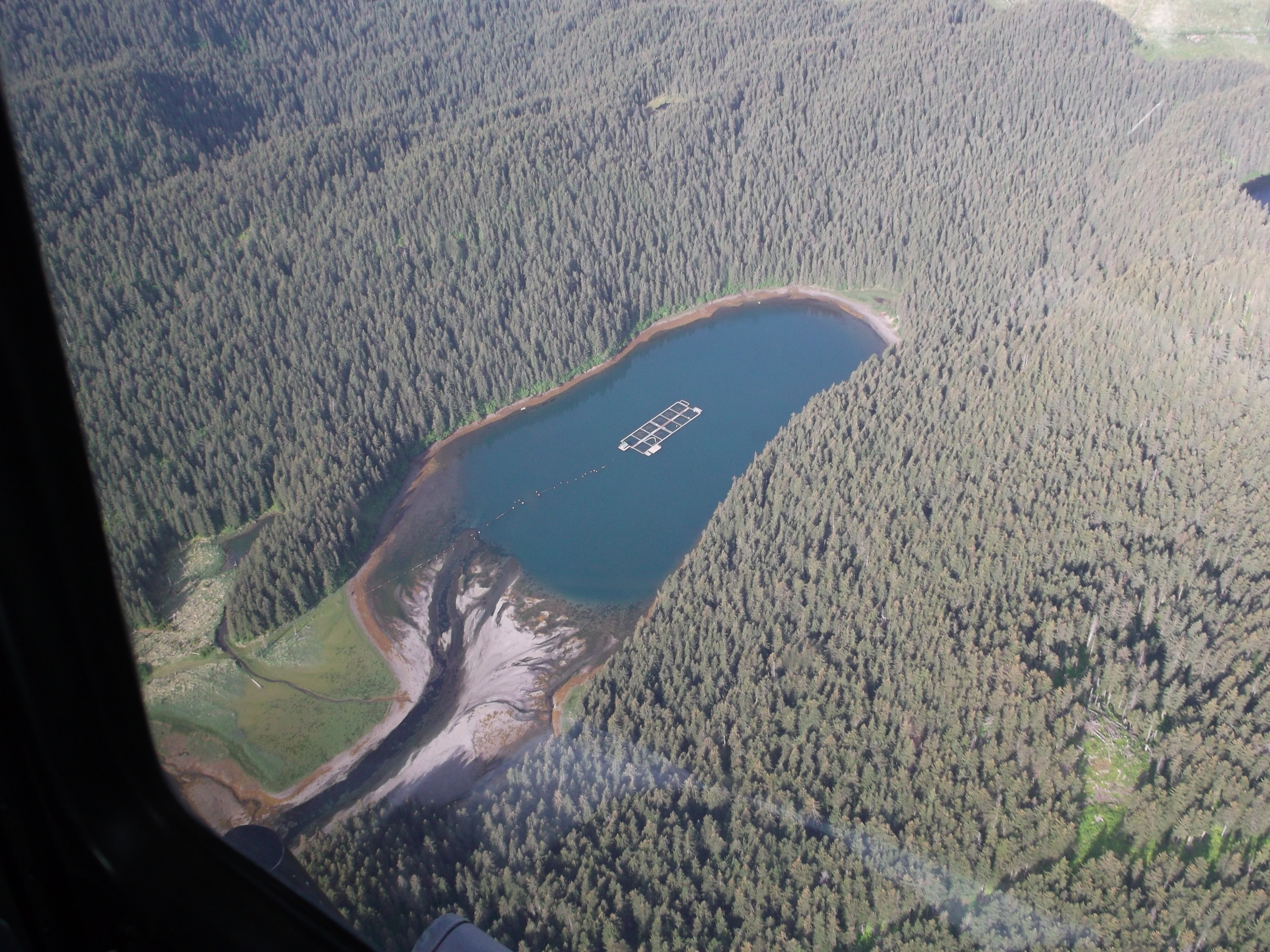
Tutka Bay Lagoon Hatchery. (Photo courtesy Cook Inlet Aquaculture Association.)
Tutka Bay Lagoon Hatchery. (Photo courtesy Cook Inlet Aquaculture Association.)

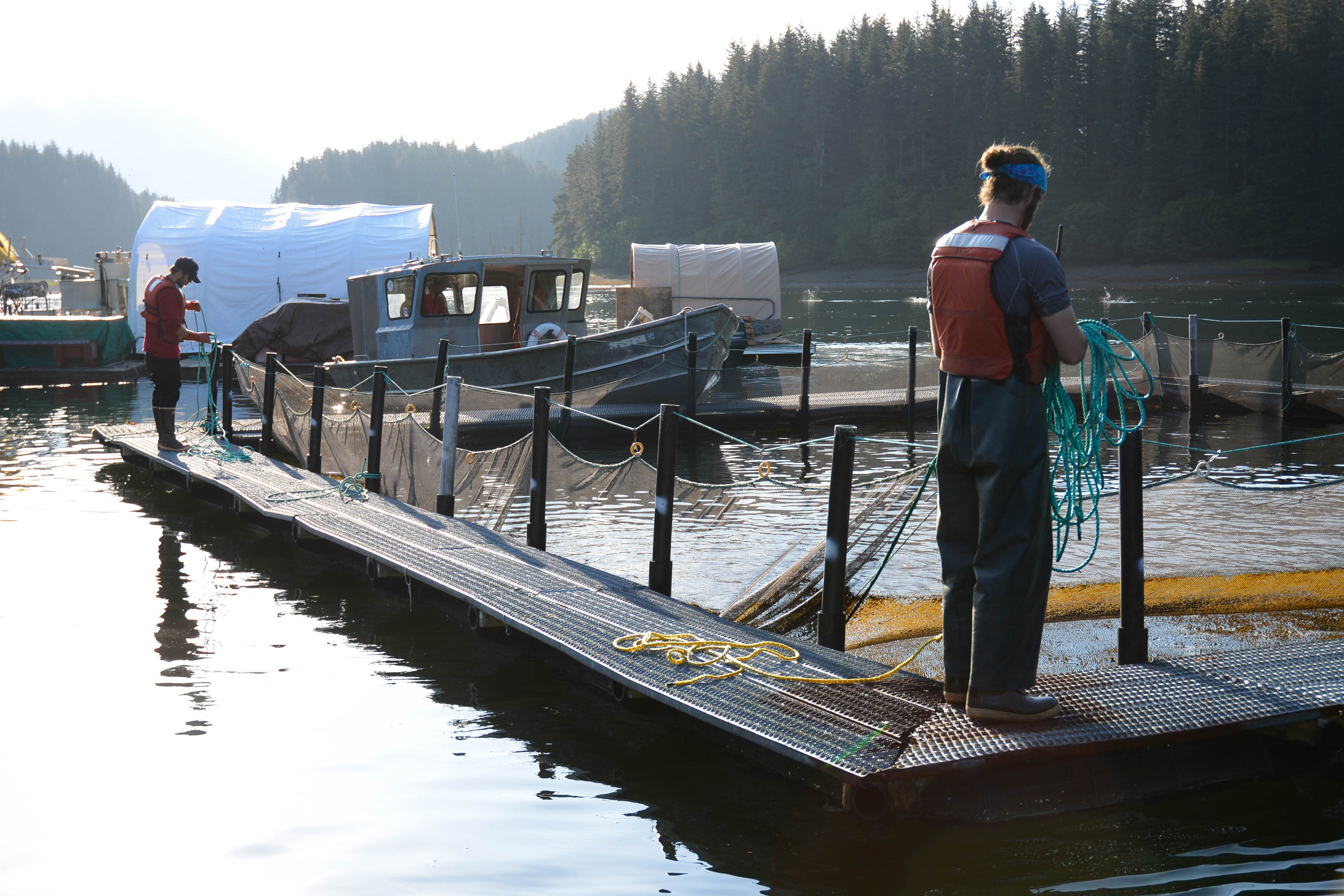
The Cook Inlet Aquaculture Association has been trying to move a majority of its net pens in the Tutka Bay Lagoon to the head of Tutka Bay for about four years.

The hotly debated issue has led to packed community meetings and questions about the impact of raising fish in the area.

Due to the controversy, the hatchery association has contracted the Kachemak Bay National Estuary Research Reserve to study the bay’s food supply and potential impacts of the net pens.

The association wanted to move the majority of its hatchery operation, permitted to raise up to 100 million pink salmon, from the lagoon to the head of the bay this season.

It plans to place about 25,000 square feet of net pens in the area for about six to eight weeks each year, but the move was delayed by the permitting process.

Research reserve biologist Steve Baird said that was a stroke of luck.

“By having to start next year instead, that gives us a year to get some baseline data,” he said.

Baird is leading the study, which began in May. Researchers’ work will focus primarily on assessing zooplankton populations in the area.

“We’re going to look at both population mix and density of zooplankton in the water,” Baird said .

Zooplankton are juvenile salmon’s primary food supply, and the young fish have been known to target particular varieties.

The reserve also will study the ocean floor directly below and around the future net pens.

A claw will scoop up samples on the bottom to assess its makeup and find out what animals are living in the gravel, mud or sediment.

The study will end later this year.

Tutka Bay Lagoon Hatchery. Photo courtesy Cook Inlet Aquaculture Association.)
(Photo courtesy Cook Inlet Aquaculture Association.)

The short timeframe won’t allow researchers to understand how conditions in Tutka Bay vary year to year, but Baird said it’s enough to see if the pens have an impact.

“A year will still give us a good snapshot that will let us see if things change dramatically,” he said. “If things are wildly different next year and water temperature and salinity and those things are the same, then there might be an effect of raising all those fish back there.”

Cook Inlet Aquaculture Association executive director Gary Fandrei said the association typically conducts these studies itself with help from the Alaska Department of Fish and Game.

But, after hearing concerns from area residents over the ecology and food supply, Fandrei said it wanted a third party to do the work.

“Historically, we have sampled for zooplankton when we’ve released fish in the past, and we would continue with doing that,” Fandrei said. “This study here was to look a little bit more detailed in terms of where the net pens are located, to look at the bottom organisms to see if there were any changes occurring there as a result of the net pens.”

If the study finds zooplankton are in short supply, the association could reduce the number of fish being raised at the head of the bay.

The research reserve will deliver its report at the end of 2017.

Fandrei said it could be contracted for additional research after the pens are in place, but that decision will be made later this year.

The association still needs one more permit from the Alaska Department of Environmental Conservation before it can move the pens.

Some of the hatchery operation will remain in the lagoon, where eggs will continue to be harvested.

Homer recall effort fails, council members retain their seats

Update | 9:45 a.m. Tuesday

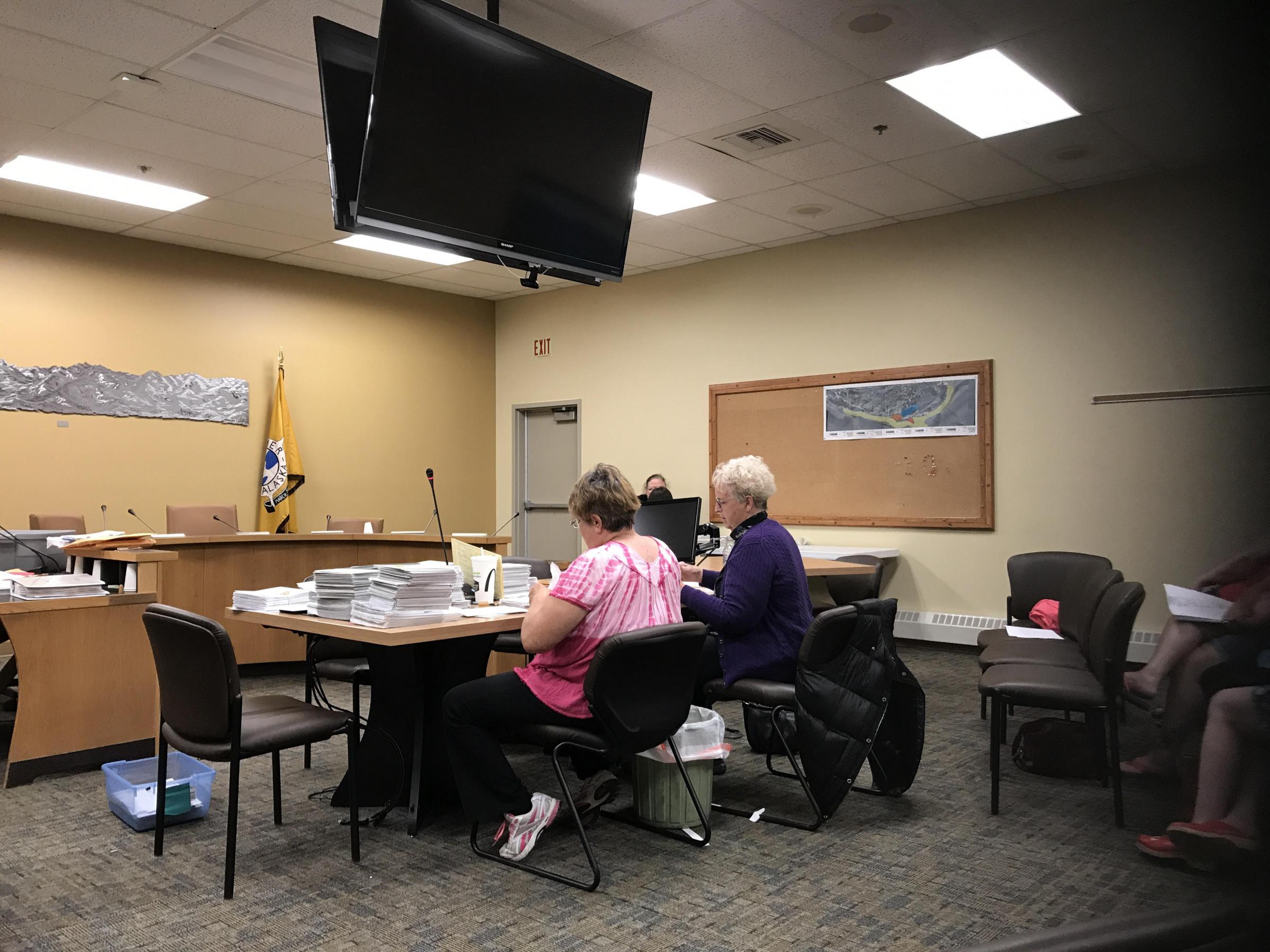
Homer’s canvas board counts absentee ballots in recall election. (Photo by Aaron Bolton/KBBI)

Three Homer City Council members subject of a highly contentious recall effort will retain their seats.

The political battle led to a court case with the American Civil Liberties Union of Alaska and two political groups have formed around the issue.

Council members David Lewis, Catriona Reynolds and Donna Aderhold all enjoyed double digit wins as the official results came in Friday.

As the canvas board counted hundreds of absentee ballots Friday afternoon, several Heartbeat of Homer supporters in the audience eagerly awaited the results.

The pro-recall political action committee’s spokeswoman, Sarah Vance, sat quietly as the stacks of ballots were counted.

The three council members narrowly eked out a win Tuesday in the regular vote and needed a strong showing from absentee voters.

City Clerk Mellissa Jacobsen read the results for the record and those in attendance.

Aderhold and Lewis were both favored by 57 percent of voters and Reynolds came away with 56 percent of the vote. Vance and her supporters were noticeably disappointed as they walked out of City Hall.

“Of course we are disappointed in the outcome,” Vance said. “We feel that they definitely were dishonest in their dealings over the issues, but the people have spoken and we’ll proceed from here.”

The three council members found themselves subjects of the recall effort this spring. Petitioners took issue with two resolutions they crafted and sponsored, namely an inclusivity resolution.

Petitioners argue it was the council members’ intent to make Homer a sanctuary city, damaging the tourism industry. They also claim their actions were misconduct in office.

The council members all had one word for the results, vindicated. On Friday evening, Homer Citizens Against the Recall gathered in the very place the inclusivity resolution began, Homer resident Hal Spence’s living room.

Council member Reynolds gave an impromptu speech to supporters.

“There hasn’t been anything I could do about any of this for a long time, but knowing that you were all working to show the recall was not valid, I think we did that today with the results,” Reynolds said in Spence’s living room. “We did it Tuesday with the results.”

Lewis and Reynolds both say they’re happy the special election is over. However, Lewis notes the division created by it will not dissipate overnight.

“You know I went back and read some of the articles, and we’ve been called Marxists and all sorts of stuff,” Lewis said. “That doesn’t go away.”

Aderhold, an avid writer and runner, added she is particularly excited to have time in her personal life.

Homer Citizens Against the Recall Chairman Ron Keffer explained the one-issue political action committee will be dissolved. But, Keffer noted its progressively minded supporters will remain a group.

“Because we don’t want to get ourselves into a position in which we have not been active enough and things happen and we have to play catchup,” Keffer explained. “We want to be an active part constantly at this point.”

The Homer City Council held a special meeting Monday to certify the results.

Reynolds and Lewis’ terms are up in October. Lewis, a three-term councilman, said he decided not to run prior to the recall effort. Reynolds noted the recall, as well as other obligations, pushed her away from running for reelection. Aderhold, whose term expires in 2018, said it’s too early to make that choice.

However, all is not said and done. Heartbeat of Homer is seeking reimbursement for its legal fees from the council members.

Update | 11:08 a.m. Monday

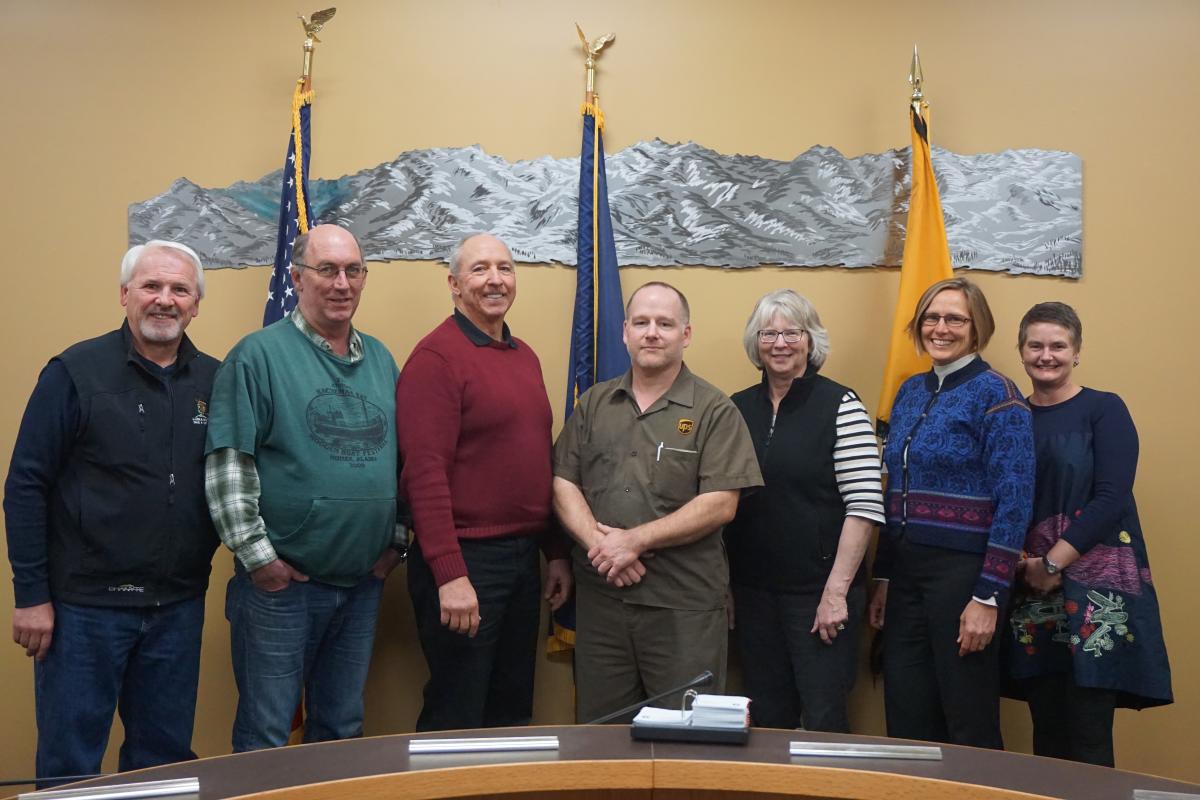
Council Members Tom Stroozas, David Lewis, Mayor Bryan Zak, Heath Smith, Shelly Erickson, Donna Aderhold and Catriona Reynolds. (Photo courtesy City of Homer)

Three Homer City Council members subject of a highly contentious recall effort will retain their seats. Each council member was voted on individually.

After the election day Tuesday, each council member obtained little more than 50 percent of the regular vote. Margins widened since the unofficial results.

David Lewis and Donna Aderhold both took 57 percent of the vote and Catriona Reynolds came away with 55 percent.

The results were announced shortly after 5 p.m. Friday. The city council will hold a special meeting at 4 p.m. Monday to finalize the election results.

All three council members had one word for how they felt, vindicated. Reynolds was notified of the results by phone.

“I felt elated at that point,” Reynolds said. “I feel like this has given clear direction as to the fact that recall in this situation was not acceptable to the majority of the community.”

All the council members said they tried not to focus too much on the count as the canvas board worked through much of the afternoon.

Several supporters of the pro-recall political action committee, Heartbeat of Homer, attended the entire canvas board meeting.

Heartbeat spokeswoman Sarah Vance looked disappointed as she walked out of the council chambers.

“Of course we are disappointed in the outcome that they’re not being recalled,” Vance said. “Because we feel that they definitely were dishonest in their dealings over the issues, but the people have spoken and we’ll proceed from here.”

Vance is happy with the strong voter turnout, which was about 41 percent.

Heartbeat isn’t going away, Vance said, but declined to say what topics it would focus on next.

Now that the recall is over, she said the town needs to be accepting of each other despite beliefs and political views.

“I hope we don’t go back to the way things were before because we need to proceed and find a new normal,” Vance said.

Lewis, who said he’s not going to the “campfire to sing Kumbaya” at the last council meeting, still thinks it will be hard for the politically divided town to reconcile.

“You know I went back and read some of the articles and we’ve been called Marxists and all sorts of stuff,” Lewis said. “That doesn’t go away.”

Lewis, a three-term councilmember, does not plan to run again in October, a decision he came to before the recall.

Council member Reynolds’ term is also up this year. She noted the recall issue made her decide not to run. Reynolds added other commitments also have led her to that decision.

Aderhold, who will remain on the council until 2018, said it’s too early to decide. She’s excited to have more time in her personal life, she said.

“I write a lot, and I’m looking forward to getting back to writing. I’m looking forward to getting back to running, doing some other things that give me peace of mind,” she said.

Aaron Bolton, KBBI


Original story | 4:21 p.m. June 17

All 3 Homer City Council members survive recall election

HOMER, Alaska — The recall election in Homer has failed, and all three members of the city council will keep their seats.

City officials say council members Donna Aderhold, David Lewis and Catriona Reynolds survived the recall election that was held after some residents were upset after the three sponsored a resolution promoting inclusivity after President Donald Trump’s election. A revised version that the council voted on did not mention Trump, and it failed.

The count of outstanding ballots in Thursday’s election was delayed Friday after city officials found an 18-vote difference between the number of ballots cast and the number counted. But late Friday the city announced that the tabulation was complete and the results were certified.

The Associated Press

Site notifications
Update notification options
Subscribe to notifications