
KBBI - Homer

KBBI is our partner station in Homer. KTOO collaborates with partners across the state to cover important news and to share stories with our audiences.

Homer and ACLU cut a deal after recall case ruling

Homer City Hall (Photo courtesy of City of Homer)

The American Civil Liberties Union of Alaska and the City of Homer have struck a deal following a recent court battle over a recent recall effort.

The ACLU represented Homer City Council members Donna Aderhold, Catriona Reynolds and David Lewis, all subjects of the recall, in a lawsuit to halt the election.

The council members have been targeted over two resolutions they sponsored, particularly a resolution regarding inclusivity. Petitioners argue the council members intended to make Homer a sanctuary city.

As part of the deal, the city will not seek repayment of legal fees spent defending itself, and the ACLU did not appeal the case to a higher court in exchange.

ACLU spokesman Casey Reynolds said both parties began working out the deal within a couple of days of Superior Court Judge Erin Marston’s ruling in favor of the city.

It would have been unfair to appeal the case with just three weeks until the special election, Reynolds said.

“If we got the decision saying this is inappropriate, the election wouldn’t go forward and we would all know that, but if we continued with the legal battle, it would be uncertain,” Reynolds said. “That would certainly be unfair to the citizens  of Homer to not know whether it was going to happen or not.”

In the case, the ACLU argued legal grounds listed in the recall petition weren’t sufficient and the recall election infringed on the council members’ right to freedom of speech.

Judge Marston ruled the recall process was followed properly.

City Attorney Eric Sanders hasn’t billed the city for his time in court yet. He plans to send out an invoice in the coming weeks.  The ACLU is covering the legal costs for the council members.

Sanders advised the city and council members to refrain from speaking about the deal until after the election.

Voters headed to the polls Tuesday.

Unofficial results are too close to call, but regular voters narrowly cast their ballots in favor of the three council members retaining their seats. Absentee votes will be counted and the vote certified Friday.

Absentee ballots will decide Homer recall election

Voters line up at the polls to cast their decision in the recall election of three Homer City Council members. The unofficial results are too close to call until the vote can be certified Friday. (Photo by Aaron Bolton/KBBI)

The unofficial results are out for the recall election of three Homer City Council members, but it’s too close to call until the vote is certified Friday afternoon.

The roughly 1,070 voters who showed up at the polls Tuesday voted in favor of keeping council members Donna Aderhold, Catriona Reynolds and David Lewis on the panel.

About 740 in-person absentee ballots were cast and another 80 were mailed out to absent voters.
Homer residents were nearly split on whether to recall Reynolds, who waited in the lobby of City Hall for the results.

The recall election was sparked over two resolutions the three council members crafted and sponsored.

Recall petitioners claimed that by crafting and sponsoring separate resolutions on the Dakota Access Pipeline and inclusivity, council members engaged in political activity and violated their oath of office.

Reynolds feels vindicated, she said, but acknowledges the results could flip once absentee votes are counted. She added it’s been hard keeping her spirits up through the entire process.

“Having heart for it has been difficult during the last few months,” Reynolds said. “I think I’ll feel better about that come the meeting on the 26.”

Aderhold obtained the most support with 54 percent of Tuesday’s voters casting their ballots in her favor. She also refrained from predicting an outcome until the numbers are official, but says it will be a relief if she retains her seat.

“I will be pleased that the community understands that we were doing our jobs,” Aderhold said.

Lewis was on his way to join supporters shortly after hearing the news. About 53 percent of voters wanted him to remain on the council.

Lewis wishes the number of no votes were larger, but has hope absentee ballots will mirror the regular votes.

“It feels good. It’s nice to hopefully have this whole thing over with and we can get back to ‘normal life,’ whatever that’s going to be now,” he said.

Supporters on both sides of the fence stood along Pioneer Avenue waving signs throughout the day.

The pro-recall political action committee, Heartbeat of Homer, maintained a strong presence downtown. The PAC’s spokeswoman Sarah Vance noted while the vote is close, she has confidence going into Friday.

“I think that Heartbeat has the early and absentee voters in their favor,” Vance said. “A lot of people who are working are out and wanted to get their votes in before they had to go out on the fishing fleet or go on vacation.”

Voter turnout could be about 39 percent, excluding ballots sent out electronically and via mail.

In the 2016 presidential election, turnout in Homer was at about 29 percent.

FAA addresses aircraft noise concerns in Homer

Floatplanes on Beluga Lake.
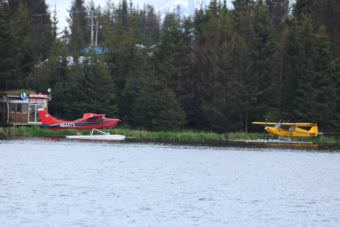
Floatplanes on Beluga Lake in Homer. (Photo by Aaron Bolton/KBBI)

Floatplanes and other aircraft are taking off from Beluga Lake and Homer’s airport several times a day. With more than a handful of flightseeing, bear viewing and air taxi operations in town, some residents are concerned about low flying aircraft and the noise that accompanies them.

Homer City Council member Donna Aderhold started hearing complaints last year during a meeting about a floatplane access road. She started working with City Manager Katie Koester to see what the city could do to mitigate the issue. She added residents also suggested their own measures.

“There was a suggestion of a no-fly zone over Homer, changing traffic patterns, things like that,” Aderhold explained.

Aderhold and Koester asked Ken Thomas with the Federal Aviation Administration what could be done.

Ken Thomas works with the FAA’s Flight Standards Division. He was in Homer last month to hold a general safety meeting but returned Thursday for a community discussion. Thomas told the few in attendance that he’s heard the complaints.

“Over the past couple of years, I’ve heard a lot of different instances. ‘They’re 200 feet over my house, 500 feet over my house, the noise is rattling the dominos on my table,’” Thomas said, listing general complaints called into the FAA. “I know those are real, but what it boils down to for flight standards to get involved is a safe operation, and 200 feet over somebody’s house is not a safe operation.”

Thomas explicitly said the FAA’s primary concern is safety. It does not hold any direct authority over small aircraft noise but can impose measures when safety and efficiency are a concern. Its Airports Division also can guide airports through a few initiatives to mitigate noise.

Thomas notes that if pilots are following safety standards, noise should be minimal. Homer is considered a congested area, and planes should gain a minimum of 500 feet before making any turns away from the airport’s traffic pattern and must climb to 1,000 feet after takeoff.
“There’s plenty of room in Homer to get that 1,000 feet prior to turning towards the bluff. To take off and make the decision over the west end of the airport to turn towards the bluff immediately, that would be a really poor choice,” Thomas explained, “from the noise factor flying right over town, but we never climb into rising terrain.”

Planes flying over towns and crowds are required to fly 1,000 feet over the tallest object within a 2,000-foot radius. Thomas said pilots can fly along the coast to gain that altitude before passing over Diamond Ridge.

FAA inspectors need proof to identify any problem pilots. Thomas said pictures and video are best, but identification numbers on the aircraft, time and direction of flight are all important.

Pilot and flight instructor Tom Young said he’s seen problems as well but adds it’s generally pilots from out of town that are the issue.

“They’ll not follow the traffic pattern or fly over the ridge low, just conflicts with traffic sometimes,” Young said. “Generally it’s people who aren’t familiar with the area.”

The FAA does mandate that pilots obtain information about the airport they’re flying to. Thomas said he’ll keep tabs on the Homer area going into the future and plans to hold another pilot safety meeting this fall.

Tustumena’s return delayed until August

AMHS Ferry Tustumena in Homer
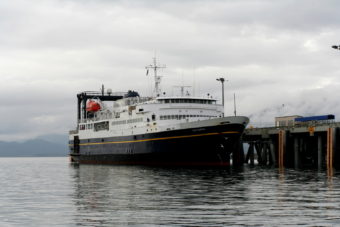
The Tustumena docked in Homer in 2009. (Creative Commons photo by Isaac Wedin)

The F/V Tustumena’s return to service has once again been delayed.

The Alaska Marine Highway announced Monday more of the vessel’s steel structure would need to be replaced.

The Tustumena has been in Ketchikan for scheduled maintenance since March, and its return to Western Alaska was set for May 27. Staff found the first batch of damaged steel in early May, cutting the vessel’s scheduled sailings in half.

Marine Highway spokeswoman Meadow Bailey explained after the latest discovery, communities from Homer to Unalaska won’t have service until August 15.

“There’s nothing that we can do at this point. Usually there are 10 trips down the chain, and this year, as long as everything stays on schedule, we’ll only be able to provide three,” Bailey said. “We recognize that this really impacts communities.”

Bailey added there was no way to fill gaps in service without impacting the whole system.

The Tustumena is 53 years old. Until the vessel is replaced, Bailey said repairs will be more common.

“We’re seeing more and more of the instances of wasted steel, and unfortunately it takes time to make those repairs,” Bailey said. “It’s not something that they see immediately when they walk through. It’s something that becomes discovered as you’re going through making repairs.”

A new vessel has been designed to replace the Tustumena.

The federal government would fund most of the $240 million project.

The state would pay for 10 percent of the vessel, but the Legislature still needs to approve that funding.

Data crunchers work to build comprehensive Alaska salmon database

King salmon at a market in Seattle.
King salmon at a market in Seattle. (Creative Commons photo by Jill /Blue Moonbeam Studio)

Scientists are gathering temperature data to determine what warming waters mean for salmon.

There’s still a lot scientists don’t know and it’s become a hot topic.

One of the first studies in Alaska was published in the Canadian Journal of Fisheries and Aquatic Sciences this month, as  part of a larger effort to design a statewide database on all things salmon.

The five-year study collected stream and temperature readings in 48 non-glacial streams every 15 minutes to capture high and low temperatures every hour.

Cook Inlet Keeper science director Sue Mauger led the effort and has been working for over a decade monitoring temperatures in salmon streams on the Kenai Peninsula.

Her results provide a baseline for salmon habitat in the Cook Inlet Basin.

“This kind of information that’s on a large regional scale but is site specific gives us that real important tool to decide where should we do one type of protection or conservation activity versus another kind of development  project,” she said.

Mauger studied multiple streams in a single watershed, streams fed by wetlands, lakes and at high and low elevations.

All of these factors play into how susceptible each stream is to climate change, which she said is a concern.

In 2009, Mauger recorded notably high temperatures in about a third of the streams. Warmer waters can make fish expend more energy to breath, make it harder to put on weight and make them more susceptible to predation.

This information can be valuable for management agencies and other stakeholders, but it’s is only useful if they know it exists.

Several groups of researchers, data crunchers and interns are looking to solve that problem through a data-compiling initiative known as State of Alaska Salmon and People or SASAP.

“The goal of SASAP is basically to ask three questions,” Leslie Jones said, an aquatic ecologist at the Alaska Center for Conservation Science. “What do we know? What don’t we know? How we can we better integrate and share the knowledge of what we know?”

The center is located at the at the University of Alaska Anchorage campus. Jones is one of more than 100 people and eight focus groups compiling existing and new data on all things salmon.

“As part of these efforts to sort of synthesize data across the state of Alaska to support salmon science and conservation, we’re crowdsourcing existing stream temperature data to build the first comprehensive stream temperature database for the state of Alaska,” said Jones, whose focus is on stream temperature.

Jones and her colleges have already compiled a preliminary database, known as the Alaska Online Aquatic Temperature Site, listing who is collecting stream info around the state.

Those scientists will work with the National Center for Ecological Analysis and Synthesis at the University of California Santa Barbara to collect, clean and make sense of that data.

“They actually have rooms of interns of students down there that are soliciting the data, cleaning the data, creating a standardized database for not only stream temperature but biological data for salmon populations across the state,” Jones said.

Students will begin reaching out to stream temperature data-holders in the coming weeks.

Those same interns also will be crunching data collected by seven other working groups. Groups are collecting numbers of fish who make it upstream to spawn, data on the size of fish, river conditions and local knowledge on river systems.

“Looking past that is how can we use the data once we build this comprehensive database, how can we create maps and create maybe interactive web portals or predictive models that can further help and support research efforts?” Jones said of the possibilities.

All this in hopes of answering some of the most pressing questions we have about salmon, everything from marine survival to impacts of rising stream temperatures.

People like Jones and Mauger say this will help state and federal agencies and other stakeholders as they make management decisions across the state.

Jones adds that once the database is launched, SASAP will work to continue compiling data as it rolls in from researchers and organizations so long as there’s funding.

The database will be publicly available late next year.

Special session puts 30 Kenai Peninsula teaching jobs in limbo

About 200 Anchorage teachers received pink slips Wednesday after the Alaska’s Legislature missed its 90-day deadline to solidify the budget. As uncertainty over teachers’ job security around the state grows, teaching staff on Kenai Peninsula are retaining theirs. But, 30 unfilled positions are still in limbo.

As the Legislature goes into a special session, school districts hope they predicted as close as possible as to where the budget will land. Both the House and Senate have individually passed operating budgets, but have not agreed on a fiscal plan. Among several disagreements, education funding remains a sticking point.

The House wants flat funding while the Senate aims to cut education by 5 percent. That could leave the Kenai Peninsula Borough School District with a $5 million shortfall, something the district’s budget didn’t account for.

“The problem is we moved a budget forward based on status quo funding from the state,” Assistant Superintendent Dave Jones explained.

The district has already backfilled a $3.7 million budget gap, using about $1 million in reserves. About $2.6 million in cuts were doled out to fill the rest, eliminating about 30 positions. About 17 of those were teachers and tutors.

Unlike Anchorage and other districts, Jones explains the school board awarded contracts to remaining tenured and non-tenured teachers this spring, but 30 unfilled teaching positions remain in question due to a hiring freeze. Those jobs will remain unfilled to absorb any possible cuts coming out of the Legislature.

“We’re trading the certainty of knowing that we have our non-tenured staff coming back with the uncertainty of knowing if we’re going to have to move teachers around in buildings,” Jones added.

The open positions aren’t evenly distributed across the peninsula. Jones notes the district will try to keep teachers in their communities, but can’t guarantee anything. He declined to say which schools have the most openings.

The state accounts for about two-thirds of the district’s budget and the borough picks up the remaining third but is only allowed to contribute so much. The district has requested the maximum amount, about $3 million over last year.

As it waits for the numbers to roll in from the borough and state, Jones explains that qualified teachers won’t wait around.

“That’s the frustrating part of it is we work to attract the highest quality teachers, and we’d like to retain the highest quality teachers, but we can’t do that without a solid fiscal plan,” Jones said frustratingly.

The Kenai Borough Assembly is set to revisit its budget on June 6.

Site notifications
Update notification options
Subscribe to notifications