KDLG is our partner station in Dillingham. KTOO collaborates with partners across the state to cover important news and to share stories with our audiences.
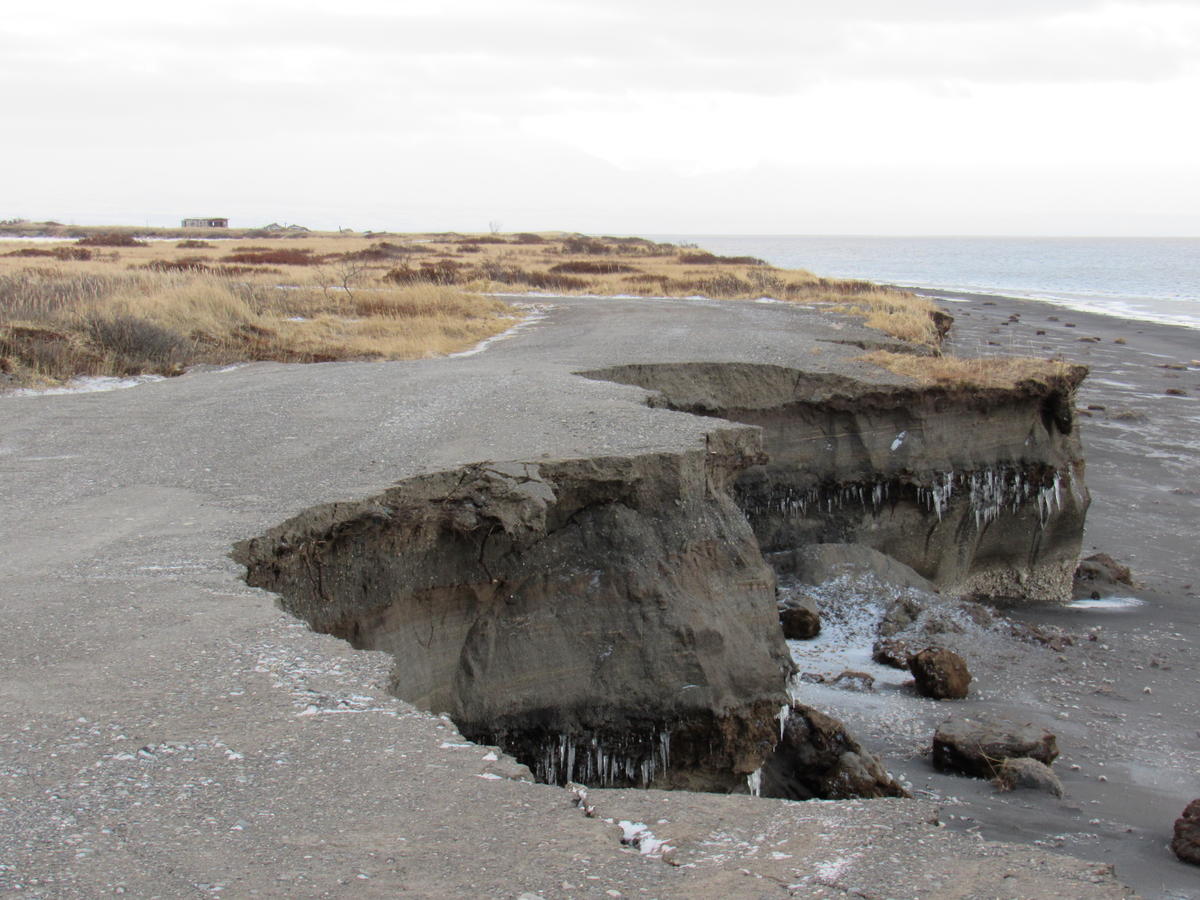
Port Heiden’s road to the safe harbor and old village was closed in November due to erosion. Photo taken November 22, 2017. (Photo courtesy Chasen Cunitz)
Port Heiden is losing shoreline, and they are losing it quickly.
Wind and waves have pushed the coast inland by an average of about 30 feet this year.
Areas along the road from Port Heiden to their safe harbor and old village site lost roughly 17 feet in November.
At the end of the month, the village closed the road because it is no longer safe to drive.
A crucial section of that road winds along a 12-foot bluff above the beach. It is a crust of dry land hemmed in by the bluff edge one side and Goldfish Lake on the other.
“The road is basically gone. (Erosion’s) cut right half into the road,” said Scott Anderson, tribal environmental director for the Native Village of Port Heiden.
With the road crumbling onto the beach below, Goldfish Lake will soon breach. Water from the lake already is steadily seeping through the bluff.
Anderson said it is not clear how precisely how landscape will look when the lake does breach, but he is willing to speculate.
“I figure once it breaks through, the water that runs into the lake from the water shed, it’s going to make a large river. And it’s going to drain out,” Anderson said.
Losing the road means losing access to the safe harbor, a protected lagoon down the road where village residents keep and launch skiffs in the summer and fall. Instead, they will have to launch their boats into the bay closer to the village.
“It’s not really a good area to launch boats at all,” Anderson said. “Trying to offload our boats on the bay side here with no protection, with no harbor, it’s pretty rough on the boats. Every year we have some kind of an incident where we’re spending thousands of dollars to repair our boats. So it’s significant for us.”
Anderson hopes once the lake breaches that the village will be able to turn it into a safe harbor. Whether or not that is feasible depends on how the landscape and watershed interact.
The other effect problem the crumbling road creates is that no one can drive to the old village site.
The site was abandoned due to encroaching erosion by 2008. The village has cleaned up many of the old buildings in order to keep them from becoming debris in the ocean and on beaches.
Port Heiden hopes to re-establish access to the village site from the beach once the Goldfish Lake breaches so that it can finish removing the handful of remaining buildings.
Anderson anticipates that the lake will breach this winter based on the recent rate of erosion.
Pebble announced a new partner early Monday morning to help carry its mining project through at least the permitting phase.
Canadian-based company First Quantum Minerals currently operates seven mines and one copper smelter across six countries, including a large copper project in Panama.
“They just finished a project that is very similar to the Pebble project in Panama,” said Pebble Limited Partnership CEO Tom Collier, pointing to welcomed experience First Quantum brings to PLP. “(Cobre Panama has) gotten very positive reviews from the industry in terms of the design of the project, its efficiency, the financial economics of it, and also the way in which they have related to the community that they have built the project in.”
First Quantum has agreed to buy in at $150 million, paid in four installments over the next four years, which will fund Pebble through the permitting phase.
“That’s the most important step for us,” he said. “Then at the end of that option period, they can exercise the option for an additional $1.35 billion, and if they pay that money, they will be a 50 percent owner of Pebble Partnership along with Northern Dynasty.”
In 2013, Pebble’s original partner Anglo American walked away from a similar arrangement, after having invested more than $500 million towards the controversial copper and gold prospect northwest of Iliamna.
Collier said Pebble still intends to file its permit application before the year is out.
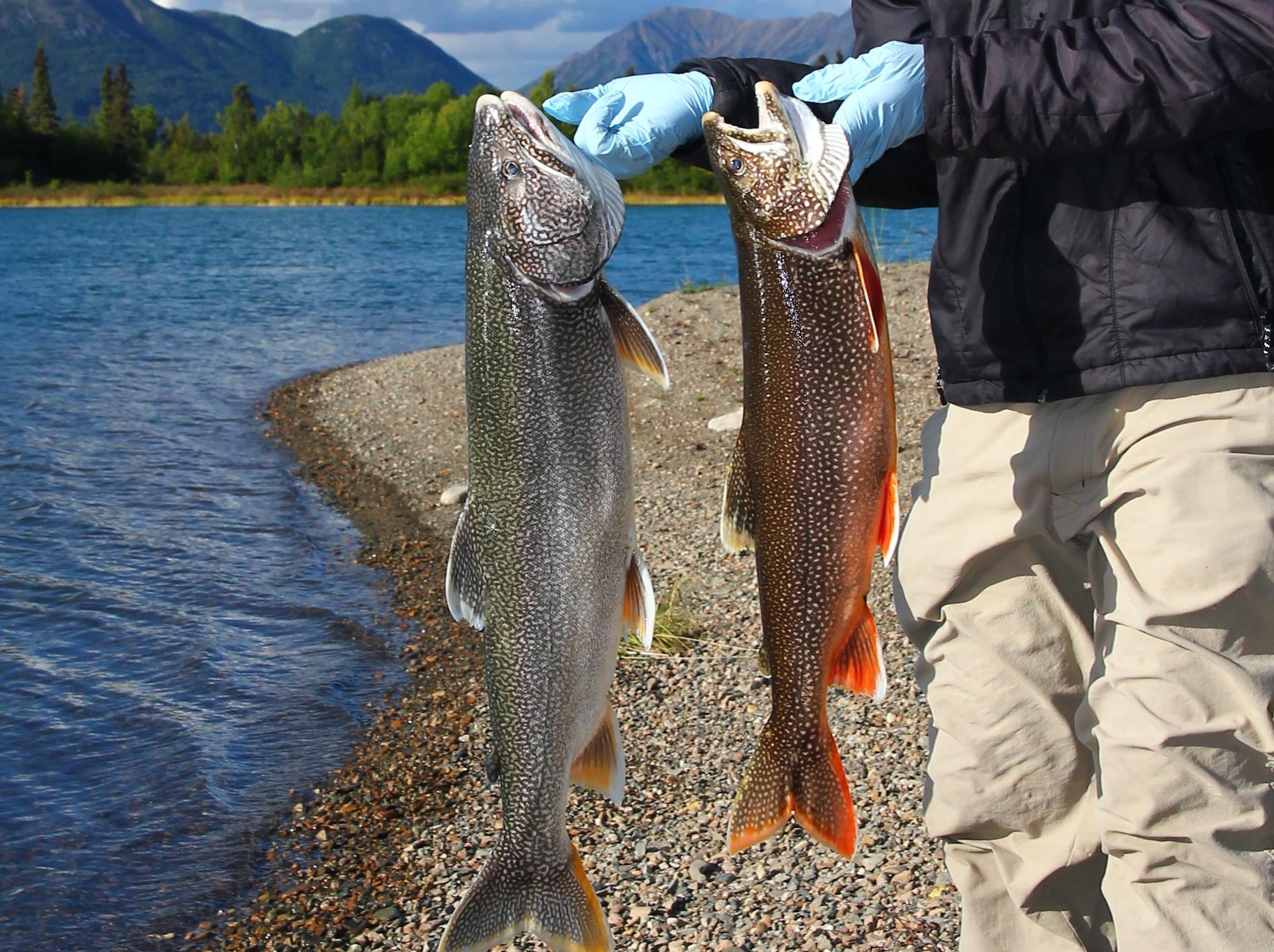
Two lake trout are collected for mercury analysis from Lake Clark National Park and Preserve. (Photo by S. Huffman/ NPS)
Mercury is a metallic element that that is present in elevated levels in some lakes in southwest Alaska. It can build up in fish that live in these lakes year-round.
Then as birds, people and other animals dine on fish from those lakes, mercury can make its way up the food chain.
The National Park Service, United States Geological Survey and other agencies study mercury levels in southwest Alaska’s lakes in order to better understand mercury’s effect on ecosystems and how it gets there.
In 2005, the National Park Service began monitoring mercury levels in non-migratory lake fish in Katmai National Park and Preserve and the Lake Clark National Park Preserve.
“Since then we’ve collected around 400 fish samples, representing nine species from 20 lakes, said Krista Bartz, an aquatic ecologist with the NPS’ Southwest Alaska Network inventory and monitoring program. “We’ve found that filets from long-lived predator species, like lake trout and northern pike, can have elevated concentrations of mercury and they tend to increase with fish age.”
The amount of mercury in lakes varies widely throughout the parks.
Researchers observed the highest concentrations in lake trout in Katmai’s Lake Brooks, an average of 0.53 parts per million.
The state recommends women of childbearing age, nursing mothers and young children limit their consumption of fish with mercury concentrations greater than 0.20 parts per million.
In contrast, the concentration of mercury in the trout found in Lake Clark National Park and Preserve’s Turquoise Lake is well below that limit.
In high enough levels, mercury can cause a host of physical problems for vertebrates, including neurological and reproductive issues.
A 2014 study by the United States Geological Survey noted that in Lake Clark National Park and Preserve concentrations of mercury in Lake Kontrashibuna and Lake Clark could cause impairment to fish-eating birds.
Mercury enters ecosystems in several ways.
Industrial processes can release it into the atmosphere, and it can settle continents away. It can also enter a system naturally through volcano vapor, melting glaciers and latent reservoirs of atmospherically deposited mercury.
Bartz said the differences in mercury levels between all these lakes in a relatively small area is a good clue to how mercury got into them.
“If the thing that was driving the variation among lakes was something caused by the atmospheric deposition of coal burning in another continent, then I don’t think that we would see this strong variation at the scale that we’re seeing it. However, if that variation is caused more by like bedrock geology or surficial geology, like something going on in the soils, then you might expect to see these regional localized hotspots of mercury. I think it could be, at this point, it’s just a natural cause,” Bartz said, stressing that there are many contributing factors to these elevated mercury levels, including mercury emissions from distant sources.
The point of research like this is to understand the situation with mercury in Southwest Alaska parks — how much is there, what is the affect, and is it changing over time?
That data then makes its way to natural resource managers, park superintendents, state agencies and the public.
As a result of the 2014 USGS study, for example, the Lake Clark National Park and Preserve began providing information on its websitefor visitors about which species in which lakes have high mercury levels and how many servings are safe for women and children to eat.
Bartz said that there is still plenty of research to be done.
Soil analysis, for example, could shed more light on the way mercury travels throughout these ecosystems.
She anticipates that the National Park Service will publish results from the past three years of study on resident lake fish in Katmai and Lake Clark in 2018.
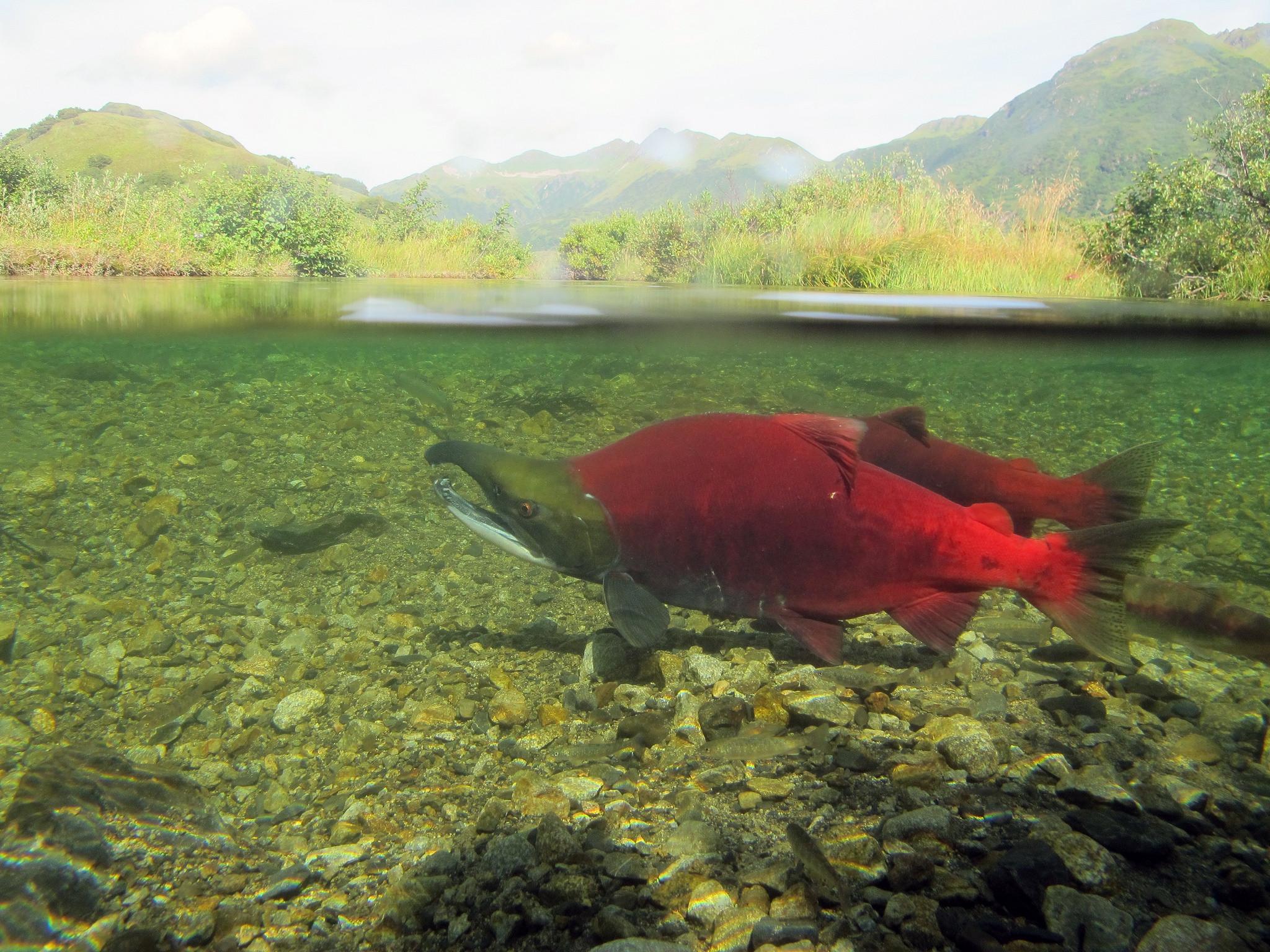
A new report says salmon, including sockeye, shown here, could have habitat disrupted by new rainfall and snow patterns caused by climate change. (Photo by Katrina Mueller/U.S. Fish and Wildlife Service)
Female salmon build nests or redds when they spawn by turning onto their sides and flapping their tales to stir up sediment, which can expose the riverbed and lead to erosion nearby and downstream.
A study recently published in the journal Geomorphology found that over time salmon may play a significant role in sculpting landscape surrounding the rivers where they spawn.
The team of researchers conducted the study by creating a computer model to simulate chinook, sockeye and pink salmon’s spawning activities.
The model showed that land and mountains around rivers where salmon spawn could be nearly a third taller if salmon were not present.
“We figured that there would be an effect, but, to be honest, I thought it would be rather small, maybe a few percent,” said study co-author Brian Yanites, an assistant professor in the Department of Earth and Atmospheric Sciences at Indiana University.
The crux of the study for Yanites is the way it demonstrates the inter-connectedness of scientific disciplines.
“We often think of geologists working on the rock and the mountain ranges, and the biologists are over working on their fish,” Yanites said. “But really the biology and the earth interact over these long time scales. If one thing changes in the biologic system or geologic system, it can propagate through a bunch of different earth system.”
The next step for scientists is to apply their computer model to the physical world.
“What we’re thinking about now is, can we see the actual impacts in a real landscape and be able to attribute that (to salmon)?” Yanites said.
The model is a theoretical one so far. It has not been applied to specific river systems in Alaska or elsewhere.
But it does suggest that the salmon that have shaped culture and history in Alaska for generation upon generation have shaped some of its landscapes and mountains as well.
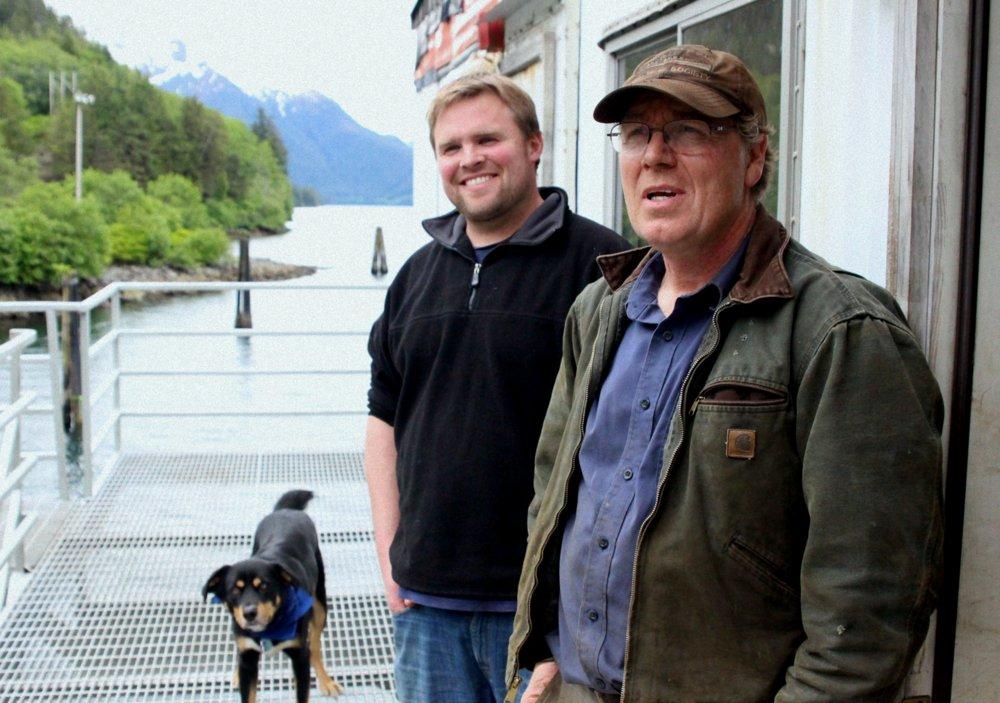
Pat Glaab, left, and Ben Blakey in Sitka, where Northline Seafoods has been developing its freezing barge for use in Bristol Bay in 2018. (Photo by Rob Woolsey/KCAW)
The Bristol Bay fishery has been evolving in fits and starts since its inception in the 1880s.
From fish wheels to sail boats, from canneries to fillet lines, the industry is constantly searching for the most efficient way to tackle the massive volume and supply today’s sought-after product.
In 1999, Leader Creek Fisheries revolutionized Bristol Bay’s quality standards with an all-refrigerated fleet, and four years ago Silver Bay Seafoods revolutionized the Bay’s volume freezing.
Most of the other big seafood companies have followed their success, and now hardly any Bristol Bay catch goes into cans.
Alaska’s largest sockeye fishery is stumbling its way to a point where quality is more valuable than volume.
Within a few years, Bristol Bay fishermen will have very few markets to sell non-chilled deliveries to. But upgrades to onboard refrigerated systems are not yet worth the $40,000-$50,000 cost for some skippers, and there’s not always enough ice available during the peak of the season.
Into that gap comes Northline Seafoods for 2018.
Like many small buyers before it, Northline has a new scheme in mind and hopes to bring on a few fishermen willing to give it a try: produce tons of ice for their fleet, then flash freeze the delivered catch whole, all from a floating barge that may need less than two dozen employees to operate.
Northline president Ben Blakey is no stranger to Bristol Bay’s fishery or its challenges.
He came up in the Snopac family that processed up to a million pounds a day at Wood River and on the M/V Snopac Innovator (now the Gordon Jensen, after Snopac sold to Icicle Seafoods in 2012).
“I grew up spending summers in Bristol Bay working with my family’s former company,” said Blakey said, who worked on the processing side until he was 18 or 19, then bought a boat and started fishing in the early 2000s.
“I fished up until 2015, when I took a hiatus to build Northline Seafoods.”
He and partner Pat Glaab share a vision for how to better freeze fish quickly, and found an old 150-foot logging barge they converted into an ice-making, salmon-freezing floating processor.
Woolsey described Glaab as a “self-taught engineer, and one of Alaska’s most prolific seafood plant builders. He met Blakey after he built the Leader Creek plant. He also built the Silver Bay Seafoods plant in Naknek — and its plant across the harbor here in Sitka. This barge is actually his 11th processor.”
Northline bought fish in Southeast in 2016, freezing about 70,000 pounds, according to Blakey.
It bought again in 2017 on the new barge, and continued to fine tune operations ahead of next summer’s Bristol Bay debut.
“What we’ve really been focusing on is how to freeze a round fish properly,” Blakey said. “That is, minimize the labor input and try to freeze it as quickly as you can, as shortly after it’s caught as you can.”
If anybody else is freezing Bristol Bay catch in the round (whole, un-gutted), they are not advertising it well.
Most salmon are now filleted or headed-and-gutted, and the unused portions are ground up and deposited back in the water.
University of Alaska Anchorage associate professor Angie Zheng co-authored a report this year that highlighted the growing market for salmon heads, skins, and bones in China, where the overall demand for wild seafood is growing, too.
“For fish head and bones, usually we cook it in soups, and Chinese consider those soups as very healthy soups, and for the skins sometimes people do the skin salad,” Zheng told KDLG last summer.
The report found that heads were selling for up to $4.99 per pound, skins for $2.46 per pound, and bones for $5.10 per pound.
Blakey did not specify exactly where Northline salmon will be shipped, but he does believe his markets want more than just the filleted or headed-and-gutted fish.
“Like the heads, there’s plenty of use for the entire fish downstream,” he said. “A major component of what we’re working on is how we get the most utilization out of Bristol Bay salmon. We’ve had good luck maintaining roe quality with frozen in round form.”
Unlike floating processors that cut fish, the Northline barge will focus on freezing only, meaning fewer workers and fewer permits will be needed for the operation.
Drift boats can pull alongside the barge to offload, and the vessel will produce an estimated 90 tons of ice per day for the fleet.
“The housing is suspended over the deck, so we have a large, flat area to work with. Essentially our platform is one giant freezer that just produces a lot of ice and freezes a lot of fish. Perhaps most importantly it has space for buying stations,” Blakey said.
For now he is not planning to use tenders, and will need to find fishermen who are willing to deliver to Clark’s Point.
Bristol Bay may be as challenging a fishery as exists, and it has chewed up and spit out many small, rookie buyers.
This year the Akutanaimed to buy from a small fleet and freeze the salmon onboard; the vessel arrived weeks late and out of cash, everyone lost money, and the 100,000-plus pounds of processed sockeye ended up in the dump.
Extreme Seafoods made an attempt in 2014 at coupling fish buying with reality TV. They also failed after one season, had to trash a whole tender load of fish, and liens and lawsuits were required to pay some of the fishermen who had given the company a chance.
The Bay has a long history of flops big and small, but Blakey and Glaab believe Northline will not be listed among them.
“We’re not rushing into this. We came up with this idea nearly three years ago, and we’ve been crossing t’s and dotting i’s both with markets and our technology ever since. It took us a while to find a platform that will work and also to raise the appropriate funds, and I’m confident that we’ll be able to deliver and provide a good market to a few boats.”
Northline was originally planning to buy in Ugashik, but decided recently that it would be easier to operate in the Nushagak, where they were going to offer a market and ice in the fall anyway.
Blakey will be in Dillingham to meet with interested skippers Nov. 13.
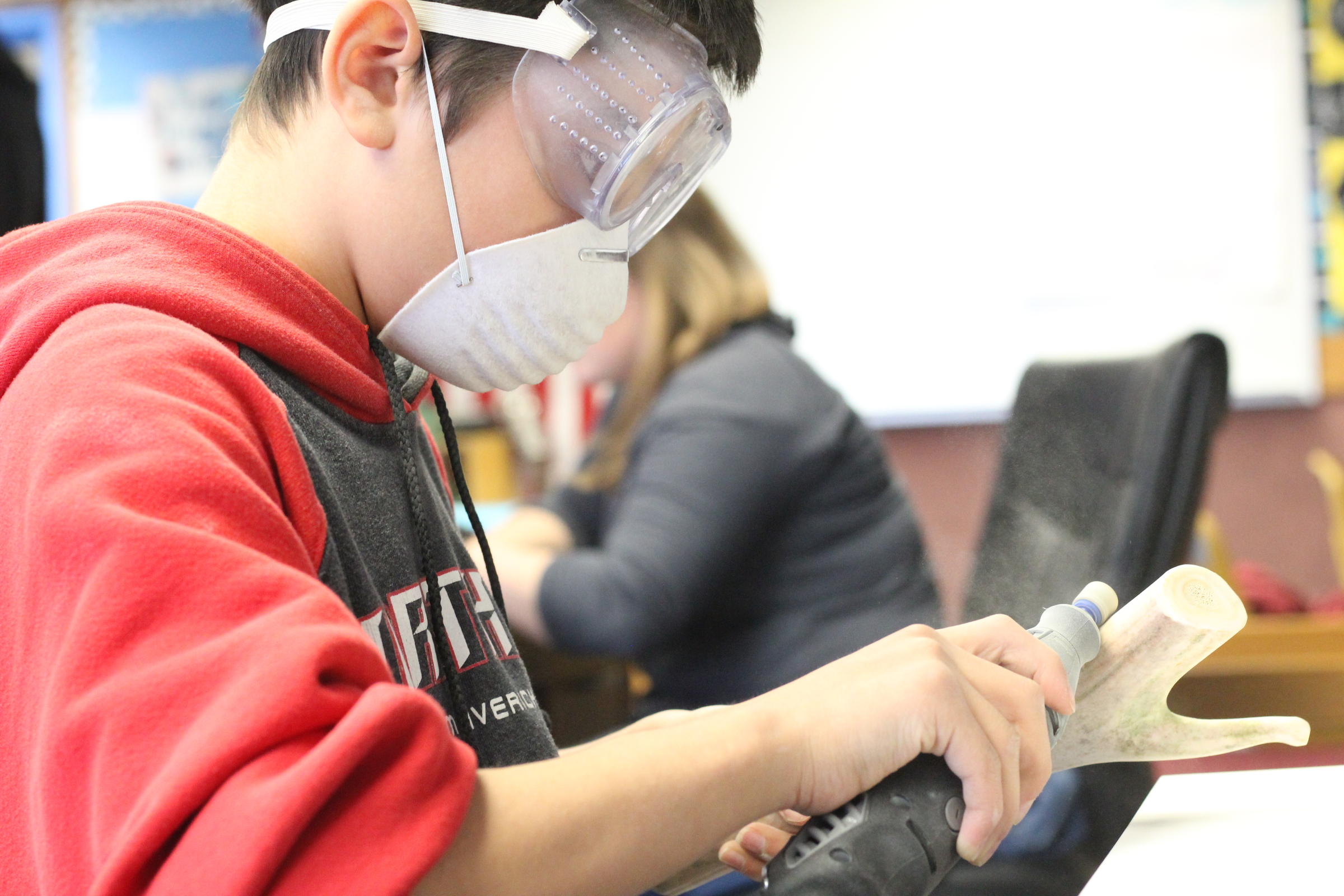
Tyler Croom polishes the caribou antler he is turning into a cribbage board. (Photo by Avery Lill/KDLG)
There was a sharp, burnt smell in the air as seventh-grader, Tyler Croom, guided an electric polishing tool along the surface of a caribou antler with steady hands.
A whirring, buzz filled his classroom at Meshik School in Port Heiden. The areas he had already polished gleamed bright and white.
“I’m making a cribbage board out of it,” said Croom, removing the surgical mask he wore to keep from breathing particles from the antler that he polished away. “I’m going to do scrimshaw in it, and we’re going to stain it brown. I’ve always wanted to make a cribbage board.”
The Lake and Peninsula School District is piloting a new calendar this year. They have dubbed it the “subsistence calendar.”
By starting later and ending earlier, the new calendar cuts 77.5 hours of instruction and saves more than $400,000.
The tricky part is students still have the same requirements they need to fulfill in a year, but they have less time to finish the standards.
That’s where project’s like Croom’s come become crucial.
“We were able to tie in lots of different standards,” said Kirsten Buckmaster, Croom’s teacher who is helping him with the project. “He’ll have a writing component. He has science, engineering, arts and his cultural side.”
In addition to completing projects during the school year that fulfill a variety of requirements concurrently, students can also document summer activities, like commercial fishing, to count toward school standards.
While fulfilling school standards efficiently and effectively may be challenge, Kasie Luke, principal of Meshik School and Chignik Bay School, said that it is one of the new calendar’s most positive aspects.
“I think the main strengths really show in our students having spent more time with their families and doing what they do in their summer,” Luke said. “It gives them the opportunity to experience more place-based education opportunities and to really take advantage of their experiences in the summer to count as some of our standards toward their graduation requirements.”
For the 12 schools in the Lake and Peninsula School District, classes started Sept. 5 this year. School lets out May 1.
Close
Update notification options
Subscribe to notifications
Subscribe
Get notifications about news related to the topics you care about. You can unsubscribe anytime.