KDLG is our partner station in Dillingham. KTOO collaborates with partners across the state to cover important news and to share stories with our audiences.
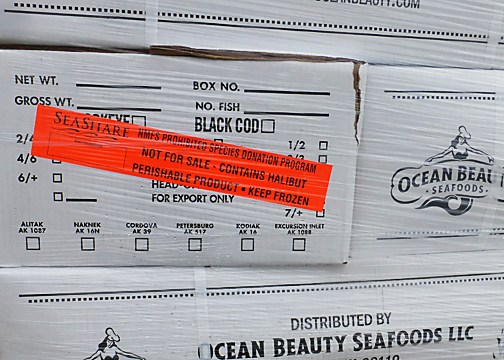
Box of frozen halibut from a SeaShare operation to Arctic Alaska in 2016. (Photo by Kayla Desroches/KMXT)
Fish from across Alaska and the Lower 48 is going toward recovery from hurricanes Harvey and Irma.
Washington-based nonprofit SeaShare, which works with seafood companies to donate fish to those in need, is partnering with food bank network Feeding America on the disaster relief, according to a news release.
The nonprofit writes that 2 million servings of seafood are headed to food banks in Miami, Houston and 10 other states.
SeaShare executive director Jim Harmon said the last time the organization rallied donations like this was in the wake of Hurricane Katrina in 2005.
Harmon said the majority of the fish still comes from Alaska, but the recent need has caught the attention of the seafood industry nationwide.
“We’ve been able to show the other seafood companies around the country how Alaska processors and the Seattle processors have stepped up, so we’ve got some great donations from New Hampshire, from Chicago, some other people who don’t normally participate in this kind of thing,” Harmon said.
Harmon said among the donations are 30,000 pounds of salmon steak that came out of the Bering Sea and two truck-loads of Alaska-fished Pollock.
SeaShare also is seeking shelf‐stable donations to aid Puerto Rico’s recovery from Hurricane Maria.
Companies can reach out to info@seashare.org if they have cans or pouches of seafood to send.
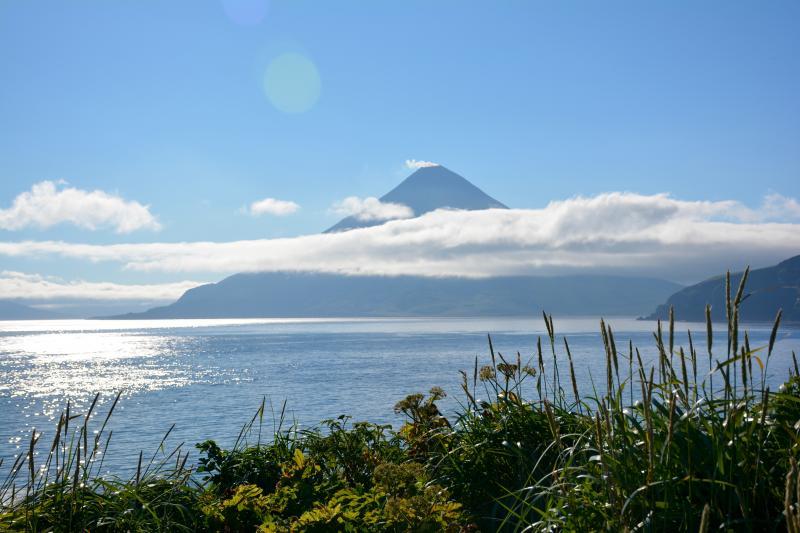
Mount Cleveland in July of 2016. (Photo courtesy John Lyons/Alaska Volcano Observatory/U.S. Geological Survey)
Cleveland Volcano in the Aleutians near Unalaska is restless.
Scientists at the Alaska Volcano Observatory observed that a new lava dome formed in the summit crater over the weekend, and lava is trickling out.
The dome is about 4,200 square meters, a little smaller than 10 NBA basketball courts.
“This happens relatively routinely at Cleveland that we grow small little lava domes,” said Dave Schneider, a geophysicist with the observatory. “They’re kind of shaped like a pancake in the summit crater. Those typically exist for weeks to months before they’re blown up and we start the process all over again.”
It has been about a decade by Schneider’s estimate since Cleveland has exploded with a significant amount of lava. This pattern of building pressure and spewing small amounts of lava is one it goes through frequently.
“We grow somewhere between one to two to three domes per year it seems. Sometimes there’s more, then less,” Schneider said. “In 2017, we’ve had at least three periods of dome growth, the last of which was in August. That was destroyed by an explosion.”
Even though Cleveland’s explosions are frequent, its pattern does not give scientists much clue as to when this new dome will explode. It could be a matter of days or months.
The Alaska Volcano Observatory can detect explosions with the limited monitoring equipment they have on the island.
When Cleveland does explode they work with the Federal Aviation Administration and National Weather Service to get word out about ash clouds and other potential aviation dangers.
AlexAnna Salmon joined the Pebble Advisory Committee to have a voice at the table as choices are made that will affect her region for a long time to come. (Photo by KDLG)
This summer AlexAnna Salmon of Igiugig quietly agreed to join the newly formed Pebble advisory committee.
The decision was not an easy one for the young leader and mother of six, especially after she saw what happened to Kim Williams.
Williams was ousted as the director of Nunamta Aulukestai, and the Bristol Bay Native Corporation board of directors threatened a recall vote for her board seat there before Williams resigned from the committee.
“I have a lot of friends that I may have lost over sitting on this advisory committee,” Salmon said. “I’m willing to accept that, because I cannot afford to not know what’s happening in my backyard for the future generations of this community.”
Salmon serves as the Igiugig Tribal Council president, and has trailblazed on initiatives to develop renewable energy and revitalize the Yup’ik language and culture in the village of 70.
The Dartmouth graduate was invited to President Barack Obama’s roundtable discussion with Alaska Native leaders during his visit 2015 to the state, and was praised by U.S. Sen. Dan Sullivan early this year on the Senate floor for helping strengthen her community and make it an incredible place to live.
Igiugig, which sits at Iliamna Lake’s outlet to the Kvichak River, is paradise and a perfect place to be, she said.
“We live in Igiugig because we love it here, we like it just the way it is. This is something that money cannot buy, and we’re not ready to change.”
A Pebble Mine could bring a lot of change to her village and others around the Lake, including Nondalton, Newhalen, Kokhanok and Pedro Bay.
“Imagining a mine of that size … it’s just, I’ve read it in the surveys, I feel it in my heart, I’ve told them myself, when it comes down to it, of course fish first, we all rely on fish, but we are here because we like it just the way it is. You cannot get this anywhere else in the world,” she said.
Salmon is stepping past the mine’s organized opposition, who have made it clear there will be no discussion that allows for the possibility of a mine, to join the advisory committee.
William Johnson, Kim William’s father and a longtime commercial fisherman, also is a member.
Others include Alaska Native leader Willie Hensley, conservationist Jim Maddy, former Vice Chairman of the Joint Chiefs of Staff Gen. Joe Ralston, and former principal deputy assistant of the U.S. Army Corps of Engineers Terrence “Rock” Salt.
Celebrating the repatriation of remains at a cemetery near Igiugig in September. (Photo by KDLG)
Pebble is not a project she supports.
Most of her neighbors don’t either, she believes.
But she earned the community’s backing to join the committee when she explained that the deposit lies on state lands set aside for mineral development and is now on track to enter a permitting process.
“You have a company that says they spent $150 million up to this point, they’re not going to walk away from that. It seems illogical to go after the company that has the rights to develop it, they’re not going to just go home,” she said.
Since joining the advisory committee, Salmon has peeked behind the curtain and seen the plans Pebble will put forward.
The mine will be much smaller, she said, and the company intends to show that any fish habitat near the Koktuli River that will be disturbed can be mitigated or perhaps even added to.
“Both sides have been fully focused on fish for so long. If they can prove fish and mining can co-exist, then what’s the next argument?”
Hers is to make sure that Igiugig and other villages around the Lake have a bright future that is not determined only by the mine developers.
For Salmon, that means coming inside and taking a seat at the table.
“Sitting on the outside, you’ll hear facts from the opposition. Then when you go into the room, the opposition will say you’re just being fed lies. Whatever you’re being fed, in between what’s being said and what’s not being said, in between what’s being presented and what’s not being presented, lies a story. And information. I’m out there seeking everything. That’s just part of the process and it’s not just a waste of time.”
Iliamna Lake residents have long felt like the “annex” of a Bristol Bay headquartered in Dillingham, she said.
Past Levelock, none of the communities are included within the Bristol Bay Economic Development Corporation’s jurisdiction. That means the 70 residents of a village like Igiugig watch two-person villages like Portage Creek and Ekuk soak up massive amounts of funding, including an annual $500,000 block grant.
She criticizes the short-sightedness of the CDQ program to leave out the Lake villages, who have also now left the Bristol Bay Area Health Corporation for the Anchorage-based Southcentral Foundation.
“Has the sharing of resources been equal? Let’s look at ourselves in the mirror Bristol Bay. You’ll see in our (Lake) communities people selling their fishing permits to build houses. If there’s one thing Pebble could do for our region, it’s united us and make us change our ways, and be more fair about sharing the resources we all depend on.”
Salmon is not sure what is coming next, or if Pebble Mine will be permitted, and if so what that will mean. That’s why she intends to weather the slings and arrows of her critics and stay on for now as an adviser.
“I cannot be bullied. There’s nothing I have to lose,” she said.
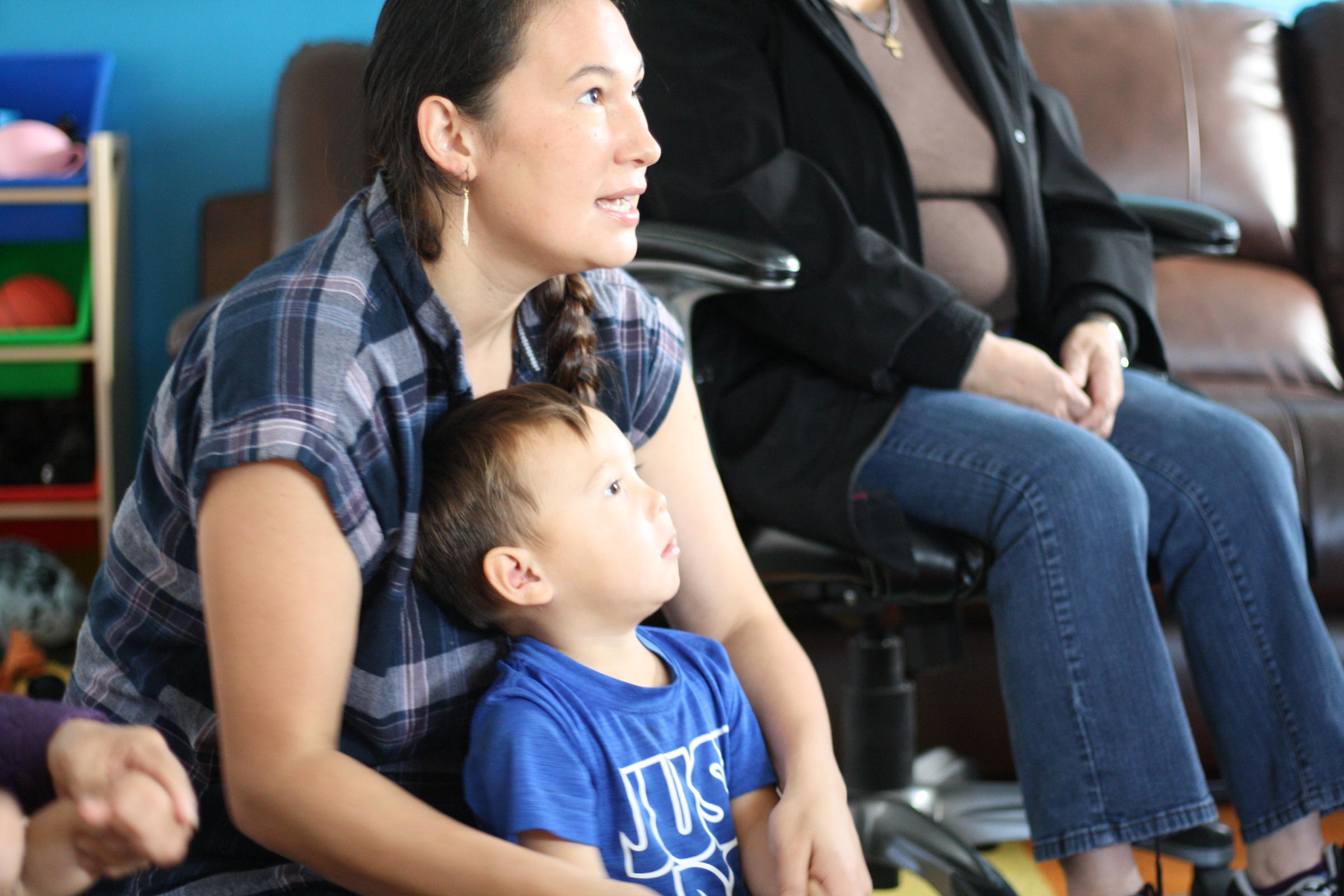
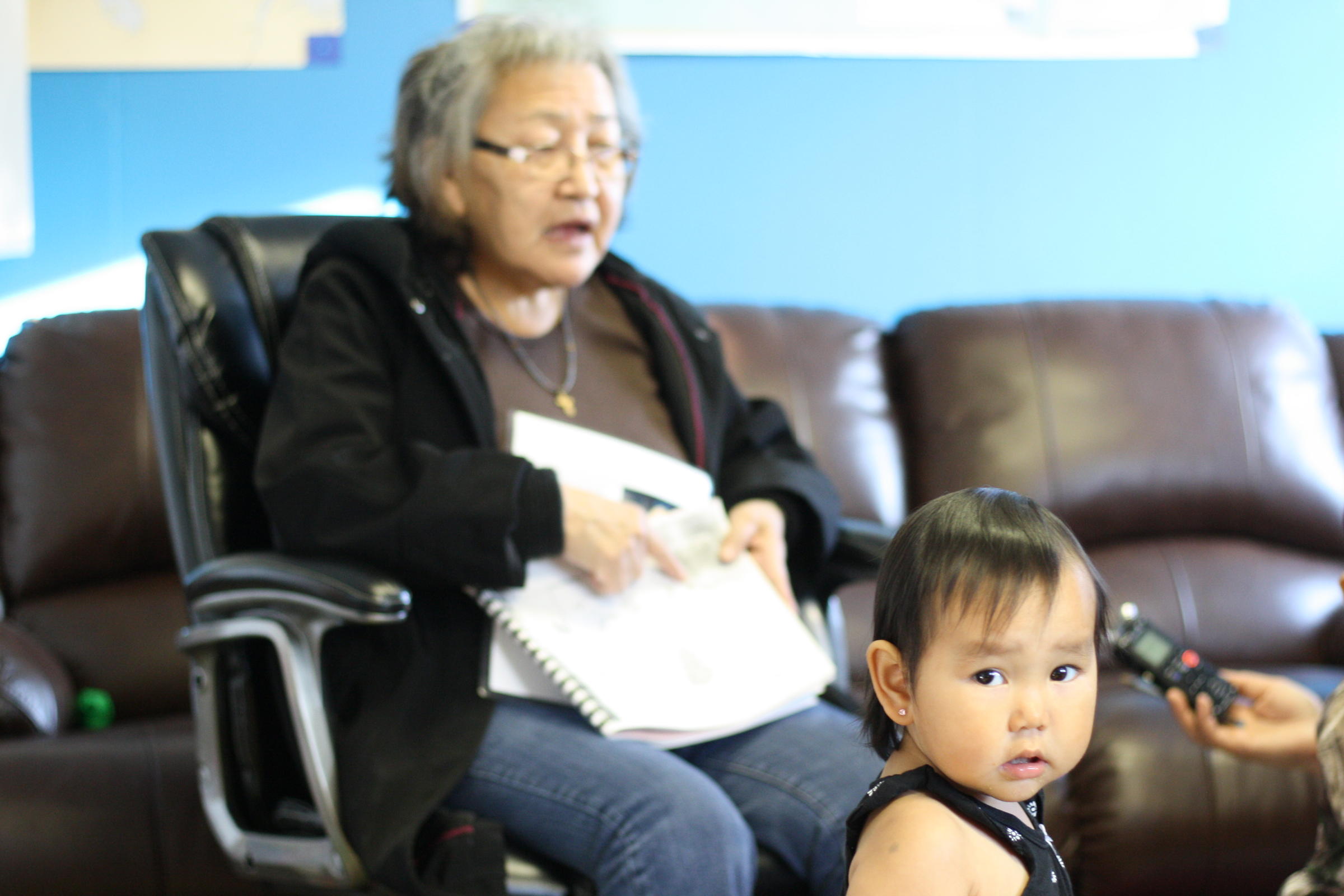
Evelyn Yanez points to pictures and says the Yup’ik name of the animal, object or activity, during a Yup’ik immersion program for infants to 5-year-olds in the village of Igiugig. (Photo by Avery Lill/KDLG)
Four kids toddle around a cozy room. There are all the items typical for a pre-kindergarten classroom — stuffed animals, puzzles and teachers.
The puzzles are the kind with a hole cut out for each piece, and each piece is labeled in Yup’ik.
School has been underway in the village of Igiugig for a couple of weeks now. This year even the youngest set are included.
The village has opened its only early childhood education program, Unglu. It is a Yup’ik immersion program for infants to 5-year-olds.
Unglu means “nest.” It’s a part of the larger endeavor, Wangkuta Qanriarait Nanvarparmiut Yugestun, which means “We all speak Lake Iliamna Yup’ik.”
The village started the project with an $850,000 Language Preservation and Maintenance Grant from U.S. Administration for Native Americans.
The grant is in its third and final year.
For the past two years, language apprentices have learned the language from elders who speak Yup’ik fluently.
Apprentices have also taught in the village school 30 minutes a day, four days a week during the school year. Now, they are expanding their efforts, and elders and apprentices are teaching a handful of toddlers three hours a day, five days a week.
“It’s far more than language. It’s spiritual, mental and physical,” said project director, AlexAnna Salmon. “It’s everything into becoming what the Yupik really were,”
The vision behind Unglu is for kids to learn to speak Yup’ik from their earliest days.
Loretta Peterson grew up speaking English, so she is learning her native language alongside her 16-month old daughter.
“It’s just better for her to grow up with her original language. I only knew a small handful of words before I started,” Peterson said.
And the kids are learning.
They dance to the Yup’ik songs and listen as instructors point to pictures and say the names of animals and activities in Yup’ik.
Most of children are too young to talk, but when Salmon told her son to point to different parts of his body, like his knees and toes. The 3-year-old did it without hesitation.
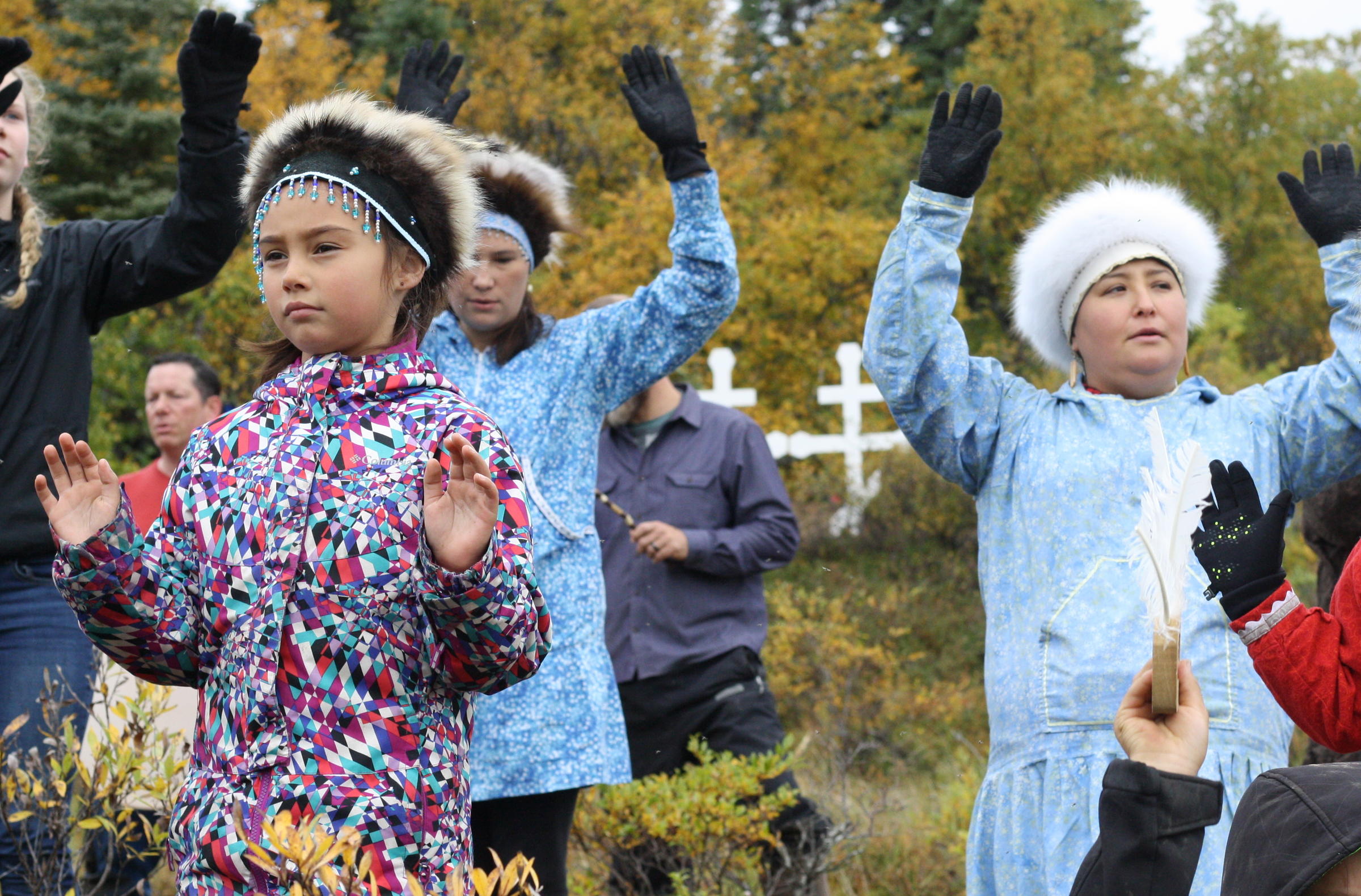
The Igyararmiut, the residents of Igiugig, perform a traditional blessing dance. (Photo by Avery Lill/KDLG)
About half Igiugig’s 69 citizens crowded into Saint Nicholas Orthodox church last week.
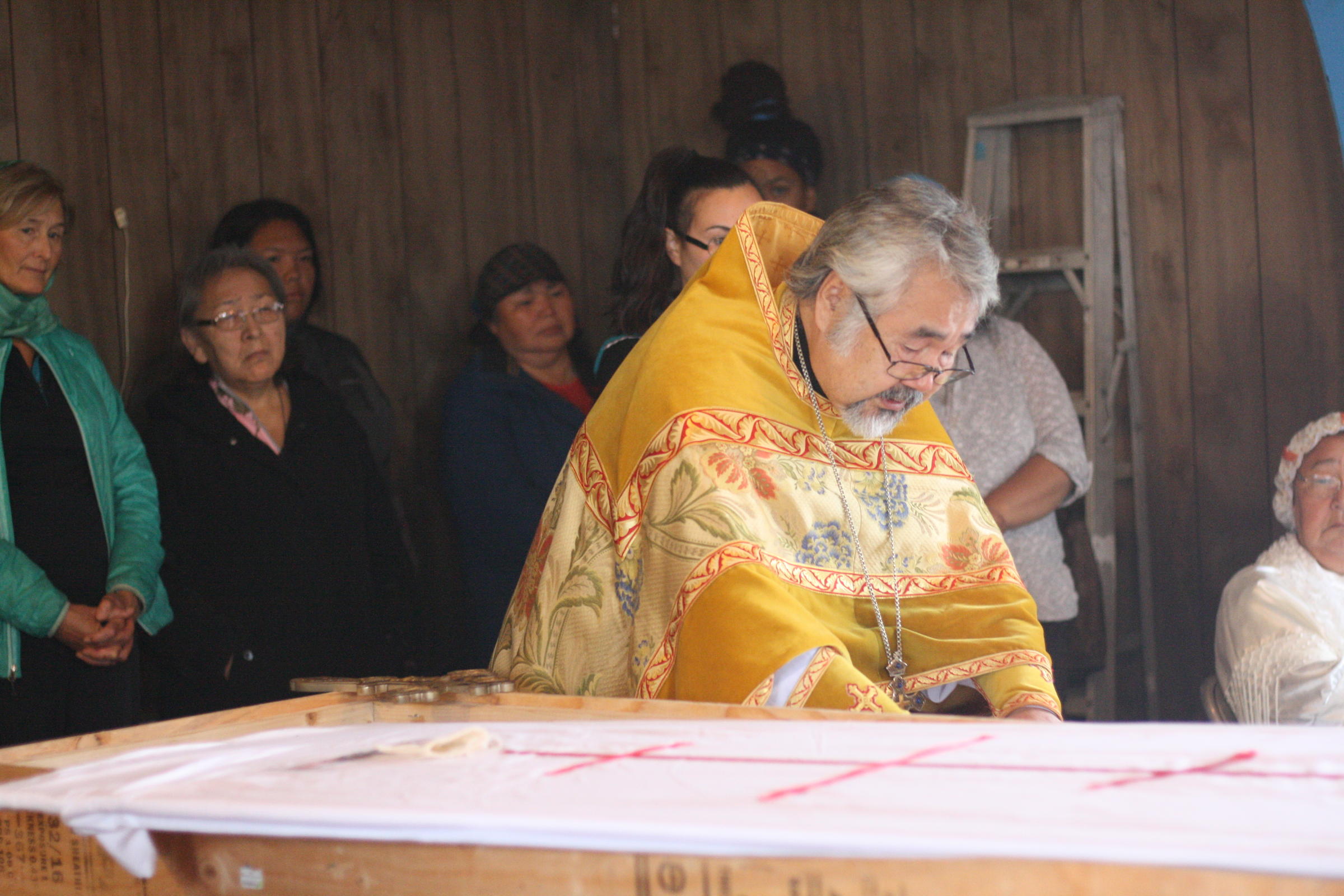
The nave was hazy with incense as a priest conducted the funeral service in a mix of English and Yup’ik.
Three handmade, wooden coffins sat in the center of the room.
Inside were the bones of 24 men, women and children from the now abandoned settlement of Kaskanak inside.
Eighty-seven years ago, the head of the anthropology department in what is now the Smithsonian’s National Museum of Natural History unearthed their remans.
During his 1931 trip to Bristol Bay, Aleš Hrdlička likely excavated their remains near Aleknagik, Ekwok, Koliganek and other communities as well.
The question of how people originally came to North America and from where drove him to dig up the bones of Native Americans all around the United States.
Historians estimate that he took thousands to Washington D.C. for further research.
After more than eight decades in the museum’s collection, Igiugig’s ancestors finally returned home.
The Rev. David Askoak places the prayers of absolution in a coffin. (Photo by Avery Lill/KDLG)
“Our healing now begins,” the Rev. David Askoak told the gathered congregation. “We know the sacredness of our graves and our loved ones and those that were there. This is the peace that comes to us. You have to show love to all your loved ones.”
The Smithsonian is ostensibly an institution that collects objects. Nonetheless, returning pieces of history has become part of its duty in recent decades.
Smithsonian’s National Museum of Natural History director Kirk Johnson helped carry the coffins out of the church.
“There was a movement started in the ’70s as Native American cultures began to realize that much of their material culture had been appropriated and moved into museums,” Johnson said.
Several laws now govern the repatriation of Native American remains and funerary objects.
The National Museum of the American Indian Act and Native American Graves Protection and Repatriation Act, passed in 1989 and 1990, require museums to make these materials available to federally recognized tribes.
“Some of their grandparents or their more recent relatives are actually in museums as collection items, which just doesn’t make much sense from a human point of view,” Johnson said. “There is something that is very unfair that was done here, and we want the tribes, groups or corporations to be able to petition to have their bodies or their funerary objects returned to them.”
But that process can be complicated.
To start with, when the National Museum of the American Indian Act passed, museums throughout the United States had the remains of about 200,000 Native American individuals.
The natural history museum had 19,000 of those.
The museum cataloged its collection and reached out to tribes with that information, but they cannot simply start sending out bones.
Every repatriation starts with a request made by a tribe.
Then the museum works to verify that the remains or objects requested are culturally affiliated with that tribe.
“It’s not easily done. We may have a location, and it may be a name that was written down in the 1880s or the 1920s,” said Bill Billeck, director of the Smithsonian’s Repatriation Office. He also was present at the reburial. “What is that place called today, and what community should we be contacting with? Our strategy has been to send everybody as much information as possible, but that leaves a difficult responsibility on someone in the community to try to figure out, does this actually affect them?”
In the case of this repatriation to the village of Igiugig, the tricky part was establishing the site from where the remains were taken.
Hrdlička wrote that he excavated the bones at Kaskanak, but the location of that spot was unclear.
“We went through all the evidence,” Billeck said. “This is assembling everything from looking at the human remains, looking at the original documents, looking at the diaries of the person who collected the remains and learning from the people in the community the history of the community.”
The Smithsonian’s research leaned heavily on the work of Igiugig local, AlexAnna Salmon, who researched the history of Igiugig and the community’s old village sites extensively for her master’s thesis.
That work became invaluable in establishing that the Igyararmiut, the people of Igiugig, are related to the people of Kaskanak.
She spearheaded the project out of respect for her ancestors.
What she didn’t anticipate was the profound impact the repatriation would have on her community.
“This was a collaborative effort between the Smithsonian and our village, but it was really us telling them that these are ours. This is who we are. It’s not anthropology coming from the other direction, telling you who you are and where you came from,” said Salmon. “This has been a part of just reclaiming everything—our native language, our cultural knowledge.”
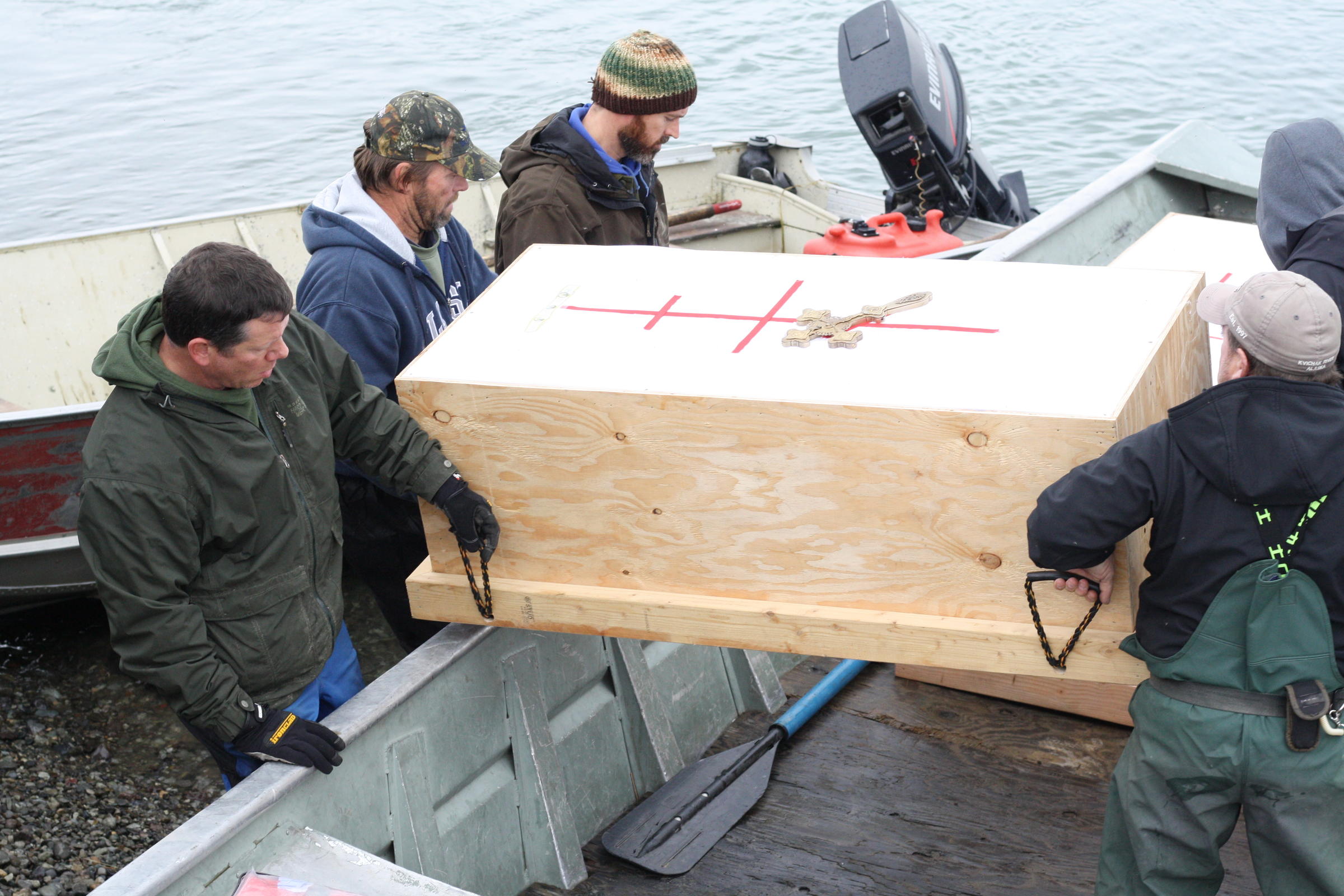
Several people place the coffins in a skiff for the final piece of their journey from Igiuigig to the old village site of Qinuyang. (Photo by Avery Lill/KDLG)
Igiugig elder Alice Zackar, 85, only speaks her native language.
Annie Wilson asked her in Yup’ik what she thought about the repatriation.
“I guess with everything going on she’s kind of a little bit emotional at the moment,” Wilson translated. “But at the moment she feels really honored to have all that taken back down to there.”
Wilson, herself an elder, explained that Hrdlička’s excavation was fundamentally objectionable in Yupik culture.
“We were always taught you don’t dig up old bones of anything or anybody. That’s their resting place until the good Lord comes someday,” said Wilson.
When the bones left the church after the funeral service, they had one more stretch of their journey. The coffins were loaded into a skiff, and the rest of the village piled into a few other boats. The foliage along the banks of the river was bright with fall colors on the 15 minute boat ride from Igiugig to Qinuyang.
It was decided that the ancestors would be reburied there instead of Kaskanak because Kaskanak is now on private property. Qinuyang is a more recently abandoned village site and one that belongs to the village corporation.
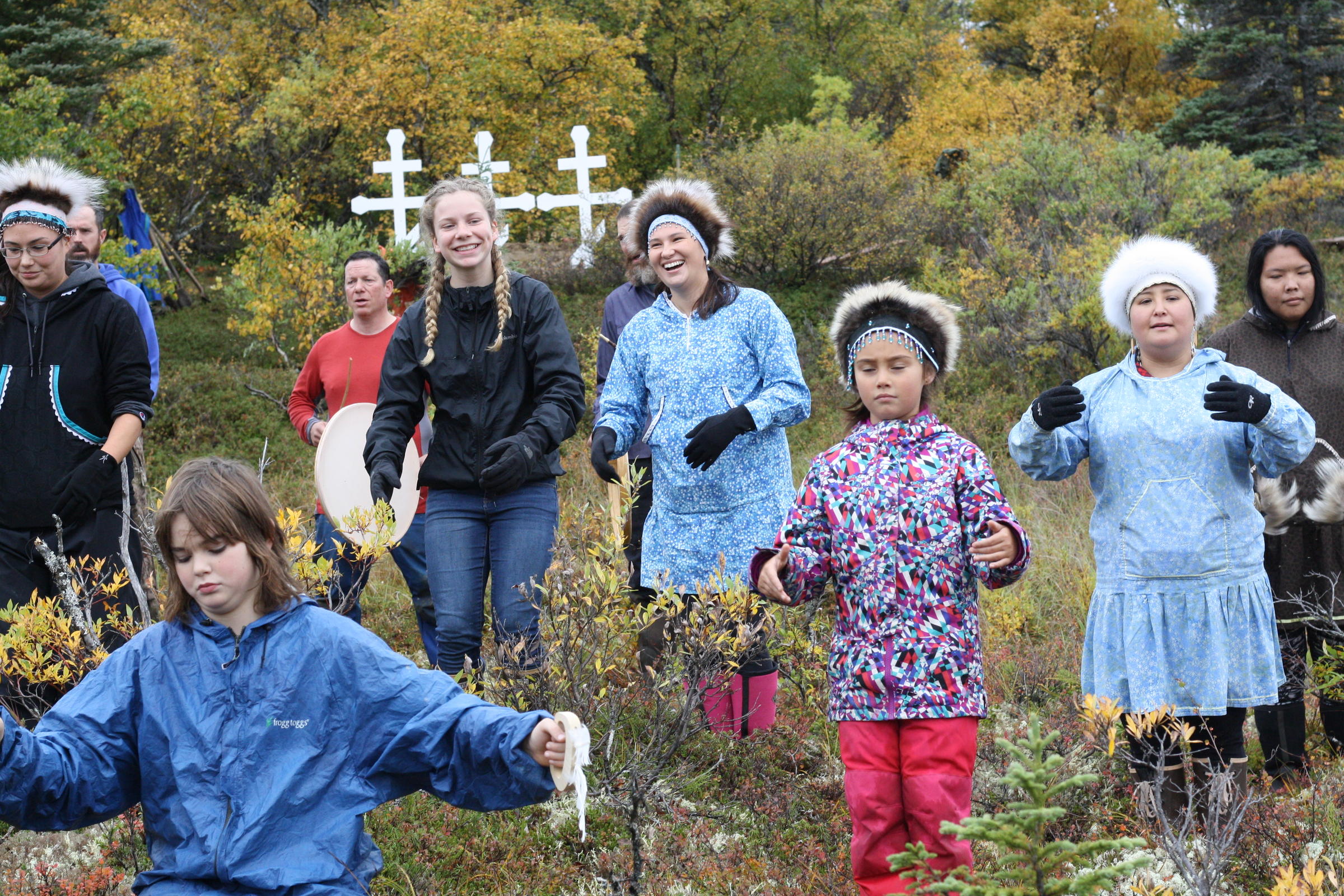
At the old site a hole was already dug on the hillside overlooking the Kvichack river. The priest prayed as the coffins were lowered. Then he sprinkled dirt into the graves with a long-handled shovel. He passed the shovel to Johnson. Alongside the director of the NMNH, the children of Igiugig tossed in dirt by the handful. The rest of the village pitched in, and soon only three white crosses and a fresh pile of soil marked the grave.
The bones finally laid to rest, the village performed a yuraq, a traditional Yupik dance. Facing east with dance fans held high, voices raised and drums beating loudly, they blessed their ancestors and reclaimed two dozen members of their community.
Volcanic area of Krafla in Northern Iceland. Iceland uses hot springs like this one for its geothermal energy. (Creative Commons photo by Fougerouse Arnaud/Flickr)
A program is leading representatives of Arctic nations to Alaska, Canada, Iceland and Greenland to look at the microgrids in remote communities.
The Arctic Remote Energy Network Academy, or ARENA, is in the middle of its pilot year and gives participants a look at innovative remote energy networks. They hope to gather information and contacts that could benefit their communities.
This week, some academy participants are in Finland to present at the Arctic Energy Summit, which begins today and continues until Wednesday.
In March, participants stopped by Yellowknife, Canada, for a week. In June, they visited Kotzebue, Fairbanks and Nome.
One participant — George Roe is a University of Alaska research professor affiliated with the Alaska Center for Energy and Power, one of the organizations behind ARENA — visited Kodiak. And next, they’ll go to Iceland.
Roe said networking is a big part of the program.
“It’s a great opportunity for us to be interacting and building strong, respectful peer relationships internationally at the grass roots level.”
The Lower 48 can learn from successful remote energy systems and move toward greater resiliency, he said, especially if they figure out how to encourage private investment instead of relying on grants.
Kodiak Area Native Association economic development project manager Tyler Kornelis’ goal is to build his network and learn about the different technologies out there.
Kodiak boasts an isolated grid that uses wind and hydropower to provide its residents with affordable, green energy. He said both the city of Kodiak and the city of Port Lions tap into that grid, but the other communities of Akhiok, Karluk, Larsen Bay, Old Harbor and Ouzinkie do not.
“They’re not all 100 percent diesel but in general they have costs of power that on average are more than double what we’re paying in Kodiak here. Our success is great, but you can’t lose sight of the challenges that these communities that are so close to us are having.”
He’d like to bring back his experiences and connections to push forward some of the communities’ projects and goals.
“It’s a huge priority for the communities in the Kodiak region to not only produce more energy, ideally with renewable resources, but also to find ways to reduce their energy consumption through conservation or energy efficiency activities.”
He said the last site visit with be Reykjavik, Iceland, where they’ll focus on geothermal heat.
Iceland meets most of its energy demands with hydropower and geothermal power, said Ludvik Georgsson, the director of the United Nations University Geothermal Training Program.
He said they’ll show participants how Iceland uses geothermal power for green houses, spas, and electricity generation.
Georgsson encourages Alaskans to look for geothermal resources in the vicinity of their communities.
“You have, for example, hot springs not far away from Nome, which could be utilized for heating or greenhouses and production of vegetables for the local society instead of having to import it all from far away.”
ARENA participants will fly to Iceland to meet with Georgsson and his colleagues in November.
Close
Update notification options
Subscribe to notifications
Subscribe
Get notifications about news related to the topics you care about. You can unsubscribe anytime.