KUAC is our partner station in Fairbanks. KTOO collaborates with partners across the state to cover important news and to share stories with our audiences.
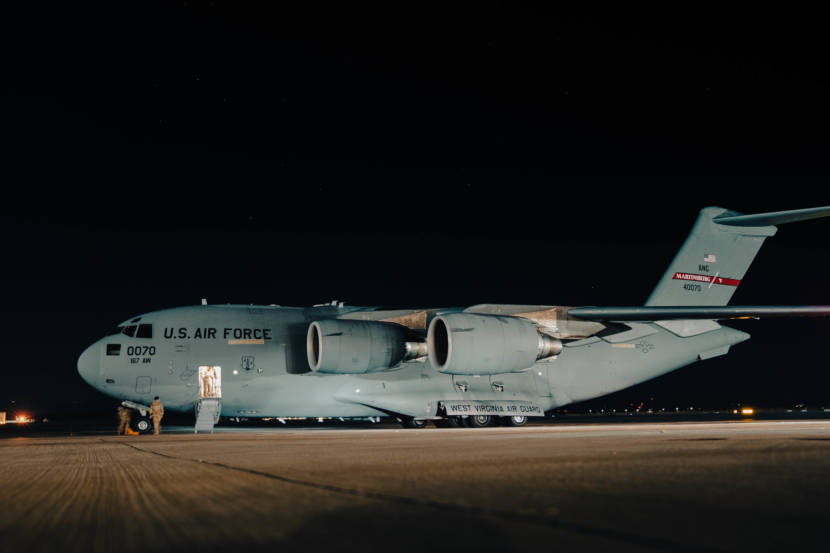
A U.S. Air Force C-17 Globemaster lll carrying Afghanistan evacuees arrives at Naval Air Station Sigonella, Aug. 22, 2021. (U.S. Marine Corps photo by Sgt. William Chockey)
The U.S. evacuation in Afghanistan that ended Monday got some help over the past few weeks from an Alaska National Guard unit based at Joint Base Elmendorf-Richardson.
An Alaska Air National Guard spokesperson says the Guard’s 176th Wing provided two C-17 cargo planes and four aircrews to help U.S. forces evacuate Americans and others from Afghanistan.
The spokesperson says an additional aircrew left J-BER over the weekend.
An Air National Guard news release said the two C-17s are assigned to the Alaska Air National Guard’s 144th Airlift Squadron that’s also based at JBER. The crews include both Guard members and active-duty military personnel from another JBER based unit, the 517th Airlift Squadron.
The news release said Alaska-based crews had helped evacuate about 1,700 people from Afghanistan as of Friday morning. And it says a total of about 111,000 have been transported from the region since U.S. and coalition forces began the evacuation.
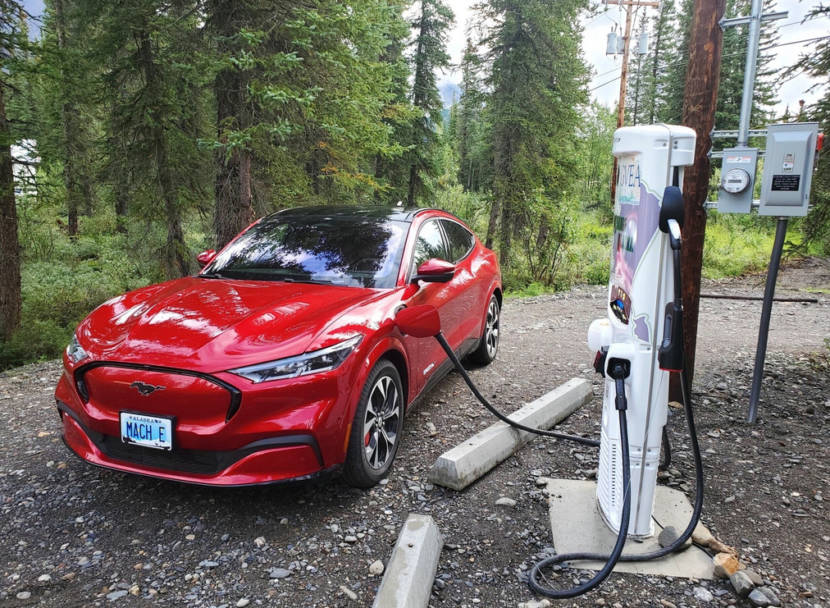
The 50-kilowatt fast charger in Cantwell will recharge electric vehicles in about an hour. (Courtesy of ReCharge Alaska)
Golden Valley Electric Association and a nonprofit that promotes electric vehicles in Alaska celebrated on Saturday the installation of a new electric-vehicle charging station in Cantwell. It’s the fastest EV charger in the state.
The charging station is on a property owned by Kirk Martakis, a local businessperson, EV owner and true believe in the technology.
“Man, it’s just been so wonderful driving electric,” he said. “We can’t even think of going back to gas anymore.”
Martakis has operated an EV charging station at the site for about four years now, using energy collected from his solar panels. Hence, the name of the facility: Driving on Sunshine.
“I started with solar and wind power for running my home,” he said in an interview Thursday.
But the old charger’s technology was much less powerful and slower than the new 50-kilowatt DC charger, which has been operating for about a month now. Martakis says it would take about six hours for the old system to charge an EV battery enough to get from there to Anchorage or Fairbanks.
The new fast charger cuts that time to about an hour. And Martakis has plans on how to keep customers occupied.
“As time goes on, there’ll be a little coffee shop and lodge here,” he said, “and people will be stopping in and having things to do while they charge.”
The fast charger was made available largely through the efforts of Kris Hall, an Anchorage engineer and EV owner and advocate. He and wife, Sara, run ReCharge Alaska, an organization that’s helping develop a network of charging stations throughout the state.
Golden Valley Electric Association partnered with ReCharge Alaska to set up the fast charger in Cantwell. GVEA is supporting the effort with a $49,000 grant and other assistance.
“This is a unique charger, in that it’ll be the fastest one in Alaska,” says Golden Valley spokesperson Meadow Bailey.
She says the utility is interested in supporting the fast charger because its members have expressed a lot of interest in EVs. And also because, if EVs begin replacing fossil-fuel-powered vehicles, it might help clear the air in Fairbanks.
“We know we have issues with air quality,” she said, “and electric vehicles are one of the solutions that we see.”
Bailey says Golden Valley will soon begin installing an EV charging station at its Fairbanks office that’ll feature two units that will charge even faster than the one in Cantwell. And she says Golden Valley wants to support development of another charging station in Delta Junction, to cover the eastern portion of its service area.
“So then we would have one on the Cantwell side, we’d have one in the Fairbanks area,” she said. “Delta would be the other.”
The Alaska Energy Authority also plans to develop more charging stations around Alaska. Martakis says ReCharge Alaska is working with AEA to set up new stations in Nenana, Healy and Talkeetna.
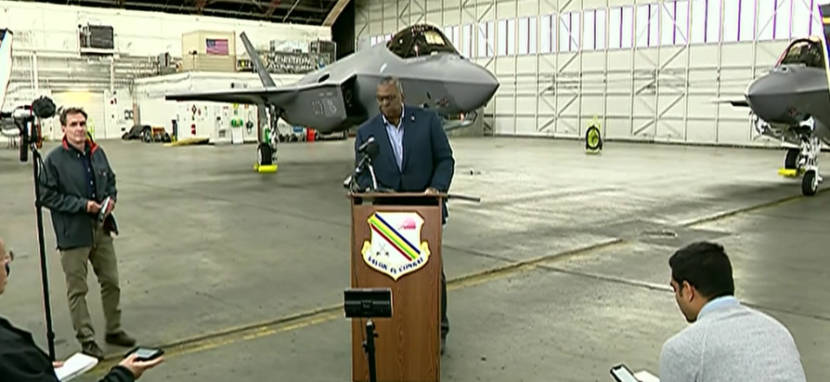
Defense Secretary Lloyd Austin speaks during a July 24 stopover at Eielson Air Force Base after a tour of Alaska military installations. It was Austin’s first stopover on a weeklong visit to U.S. military facilities and allied leaders around the Indo-Pacific region. (Defense Visual Information Distribution Service screenshot)
U.S. officials say Alaska is ideally located to launch or assist in military operations in the Indo-Pacific region, but so far Army and Air Force resources based here are not being used in the U.S. evacuation efforts in Afghanistan.
U.S. Defense Secretary Lloyd Austin last month said what many other U.S. leaders have stated over the years: that Alaska’s forward location enables U.S. military units based here to respond quickly to events throughout the region adjacent to the Indian and Pacific oceans.
“We are an Indo-Pacific nation. And we are an Arctic nation,” Austin said during a July 24th visit to Eielson Air Force Base. He said the buildup of Alaska-based military assets in recent years has given the Army and Air Force substantial capabilities for both offensive and defensive operations.
“This is where we can project power into both regions,” he said, “and where we must be able to defend ourselves from threats coming from both places.”
Former Defense Secretary Jim Mattis touched on the same theme during his visit to Eielson in June of 2018.
“It is probably the gateway to the Pacific for us in many, many ways,” he said.
But Alaska-based military assets apparently are not part of U.S. efforts to evacuate remaining American and allied citizens from Afghanistan, along with Afghans and others who’ve helped the U.S. military during its occupation of the country.
Spokespersons for the U.S. Army Alaska and the Air Force’s Alaskan Command say their organizations don’t have any assets supporting the effort. And a Pentagon spokesperson said he wasn’t aware of any involvement of Air National Guard assets based here.
A University of Alaska Fairbanks analyst says both the Alaskan Command and Alaska Air National Guard could help with the operation, if tapped by the Pentagon.
“Their ability to go support the mission right now would be very reasonable, expected — no surprise at all,” says Troy Bouffard, who directs UAF’s Center for Arctic Security and Resilience. “They do this stuff all the time.”
Bouffard says he has no inside information, but he wouldn’t be surprised if the Air Force calls on the Alaskan Command to provide aircraft, like the big C-17 cargo planes based at Joint Base Elmendorf Richardson.
Bouffard is a 22-year Army veteran and Defense Department contractor as well as an instructor with the university’s Homeland Security and Emergency Management Program. He says he’s not surprised that the Pentagon hasn’t ordered troops and equipment from U.S. Army Alaska. He says that’s because an evolving policy set out in the Army’s Arctic Strategy issued earlier this year directs Alaska-based units to focus mainly on operating in and around the circumpolar north.
“And that meant kind of removing them from a lot of taskings and rotations and exercises,” he said.
Defense Department spokespersons didn’t respond to questions about why Alaska-based military assets aren’t involved in the Afghanistan operation that’s going on near the western edge of the Indo-Pacific region.
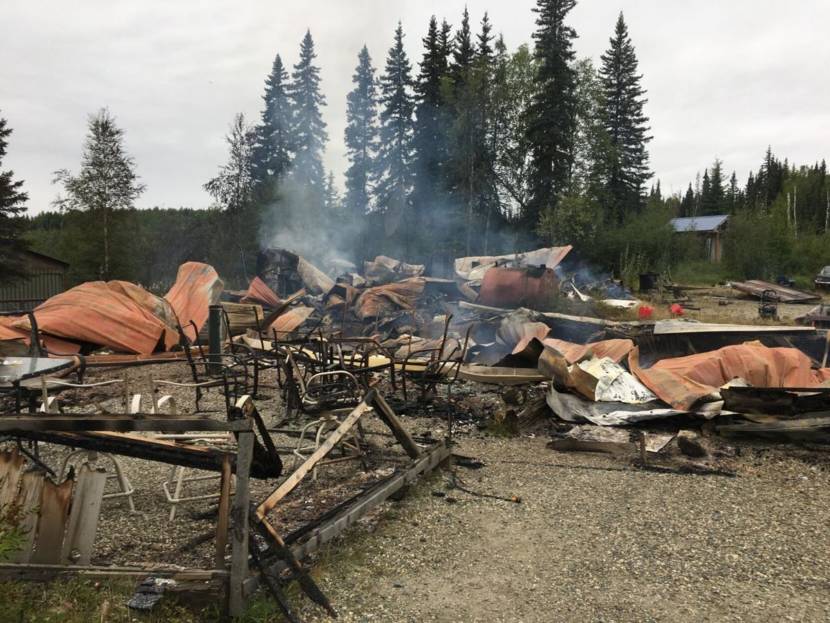
The Two Rivers Lodge burned in the early morning hours of Monday, Aug. 23, 2021. (Maisie Thomas/Fairbanks Daily News-Miner)
The Two Rivers Lodge east of Fairbanks burned in the early morning hours of Monday, amid a string of still-unsolved arsons in the Two Rivers-Pleasant Valley area this summer.
So far, public safety officials have not said arson caused the fire at the lodge, seen completely engulfed in flames a little after midnight in videos on social media. But fire marshals are investigating nine other structures that have burned in the area that they say were intentionally set.
KUAC’s Dan Bross joined Alaska Public Media’s Casey Grove to talk about the latest fire and the continuing arson investigation.
Listen here:
The following transcript has been lightly edited for clarity.
Casey Grove: The Two Rivers Lodge is an iconic part of the area. What do we know about the fire there very early Monday morning?
Dan Bross: Well, not much so far. I mean most of the information has come from social media posts about a pretty serious fire going on at the lodge. It is a log structure, so I did see subsequent posts about the logs being wetted down, in other words, that the fire I guess had calmed enough that people went out there and tried to salvage whatever might be salvageable. But I really don’t have any specifics on that. I have not been able to reach anyone from the lodge.
Dan Bross: I mean this is just not an unusual summer in terms of wildfire. There are always wildfires and, you know, there’s a lot of wild country that surrounds Chena Hot Springs Road. And this summer, there was a big fire out toward the end of the road, near the hot springs itself. And that went on for most of the summer. The fire was started by lightning back in June and had a serious response.
But these arson attacks are really unprecedented. I mean, to have this many intentionally set fires, and them ranging from public to commercial to residential fires, some of which occurred when the residents were in their homes. It’s just a really scary situation. It made everybody look over their shoulder, and they continue to do that. So it’s just psychologically really devastating, over months now.
Casey Grove: So you’ve been talking with residents in the area, what is it like for them to just keep having structures burning and no arrests made at this point?
Dan Bross: They’re frustrated. But I think there’s also consensus that troopers and the FBI have made a real presence out there. But it’s a spread out rural area. And there’s just been no real break. However, at a recent public meeting, one of the speakers with the community association out at Pleasant Valley said that the FBI had told him that they have a lot of pieces of this puzzle, and it was just a matter of spending time and trying to put them together. It wasn’t a dead end — that they were going somewhere with it. But it’s not soon enough for people who have been afraid to leave their homes, you know, afraid to go to sleep at night, watching out for each other and at the same time being suspect of one another.
Casey Grove: As far as what progress the investigators have made, have they said what that is or given any indication of how close they might be to catching the person?
Dan Bross: No, they’re just not sharing any details or any specifics. I even asked about some video surveillance camera hard drives recovered from the community association building that partially burned earlier this summer. And those were sent to a national crime lab to try to recover some footage from them. They were heat damaged. And I’ve been told that they’re working on them, but that you won’t hear anything about any evidence until it is used in court.
Casey Grove: What are the residents doing in response to the fires themselves, like when they pop up?
Dan Bross: So most of the area does not have fire service, except when you get closer to town. Two of the fires that occurred in the last week — the two earlier ones — were within a fire service area and fire departments came but it was really too late for them to do much. Both of those structures were complete losses. And part of that has to do with the fact that these are arsons and there were accelerants used and the fires progressed really rapidly.
But out in the Two Rivers-Pleasant Valley community initially, you know, residents took it upon themselves to prepare to fight the fires. A lot of people have water tanks for hauling drinking water, but they set up their trucks with pumps and with the idea being that they could deploy to fires on their own and help put them out and there’s been some use of those but it’s really just not the kind of capacity and not the kind of response time you need to really make a difference in a rapidly progressing fire.
So on the other front, there’s an effort to form a volunteer fire department in Two Rivers-Pleasant Valley, and they’ve actually made some pretty good success with that. The City of Nenana is donating firetruck and an ambulance and I believe one other response vehicle. So it’s kind of moving along relatively rapidly. But there’s steps there that need to happen before they actually have that fire department ready to respond, but they’re working on it.
Casey Grove: That’s interesting. You mentioned there’s been a lot of chatter on social media, what are the investigators, the troopers or anybody saying about that? And is it does it seem to be helping or hurting?
Dan Bross: Well, there was a meeting earlier this summer in July where a state trooper captain addressed a large group at a church in Pleasant Valley. And he really discouraged sharing information on social media because it’s just sent out there and everyone can read it, including the arsonist or arsonists. So he really encouraged people to form a community watch group and have an email list. And that’s happened. And he also, most importantly, encouraged residents to talk directly with state troopers when they have any information or suspect something. So that it’s not just out there on social media. But that hasn’t stopped social media. As you know, it’s the most powerful tool we have in terms of communication at our disposal, and daily there are all kinds of posts related to these fires. There’s a lot of rabbit holes and, as a reporter, it’s super challenging to interpret that and follow up on things and try to find out what might be true.
Former Alaska Writer Laureate and University of Alaska Fairbanks professor Frank Soos has died. Soos was on a solo bicycle ride in Maine last Wednesday when he suffered a fatal accident.
Frank Soos was born in 1950 and grew up in the Virginia coal mining town of Pocahontas. His parents owned a market, and that upbringing taught Soos and his brother the value of hard work and community. Soos never lost his regional drawl nor his self-deflecting courtesy. While his literary interests sparked in high school,they took flame at Davidson College.
“Davidson sort of looked like this dream,” Soos said in 2019. “There were all these guys sitting under trees reading books and talking. I thought, wow, if this is college, I can do this.”
At Davidson Soos would meet his lasting friend and sometime collaborator, the art historian and painter Kesler Woodward. After college Soos taught high school for a time and discovered he loved it, but the writing life beckoned and he entered University of Arkansas’ Creative Writing program, graduating with an MFA. Soos said grad school was instructive in unexpected ways.
“It was an awful program,” he said. “It was intentionally cruel, and I made up my mind I would never participate in a program like that if I were a teacher.”
Those lessons found expression when he joined the University of Alaska Fairbanks English Department in 1986. There he met poet Peggy Shumaker and together helped forge a creative writing program that attracted writers from across the country and formed a new generation of noted Alaska authors.
“We had graduate students who would come to see me and I would say ‘Here’s where you can compress’,” said Shumaker. “And then they’d go see Frank and Frank would say ‘Well, maybe this is a place where you can make it longer.’ And I’m sure we bewildered a lot of students at first, but believe it or not, it worked.”
Shumaker said Soos was the most generous teacher she’d ever met.
“You learn when you’re a teacher that if you’re going to make demands on students, you’re going to make them on yourself,” Soos said in 2019. “So, to turn that stuff around mean you sit at your desk and read a lot of papers and make a lot of comments to get ready for all these conferences. That’s what teaching is.”
That commitment to hard work extended to his writing. Shumaker says besides his elegantly crafted sentences and uncanny ear for dialogue, Soos kept writing no matter what.
“He worked for decades with very little recognition, and then suddenly he had two books at once,” she said. “And he was characteristically modest. But what he did always, in good times and bad, he kept plugging away.”
That tenacity resulted in Soos winning the Flannery Connor award in 1998 and serving as Alaska Writer Laureate in 2014. A posthumous collection of Soos’ stories is scheduled to be published in 2023.
While Soos always claimed he was a loner, he managed to form a series of creative collaborations — with Shumaker and painter Woodward and most intimately with his wife and artist Margo Klass. He is also inescapably linked to Fairbanks’ biking and skiing clubs. Long-time friend and fellow Nordic skier Susan Sugai said if Soos wasn’t participating in races like the 50K Sonot Kkaazoot, he was volunteering handing out bibs or timing races.
“He knew that times are important to people,” she said. “It’s not the people who necessarily win, it’s the people who participate and try to improve. He loved that.”
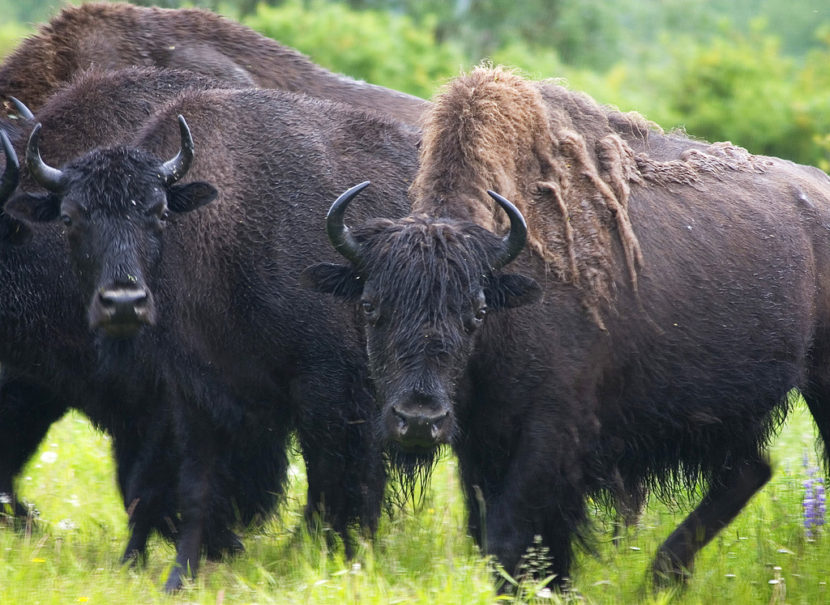
Alaska wood bison. Wood bison are the largest native land mammals in the Western Hemisphere. (Photo by Laura Whitehouse/USFWS)
State biologists completed an annual survey of the Innoko-Yukon River wood bison population earlier this summer, and they say the results show the animals are doing well six years after a seed group of bison was released in the area.
Biologists counted 103 wood bison this summer — an increase of more than 10% from last year’s herd size. Twenty-six calves joined the herd this year — the most the herd has produced since it was established in 2015. The survey also showed that the animals are in better physical condition than in previous years.
Darren Bruning, a regional wildlife conservation supervisor for the Alaska Department of Fish and Game, said the survey shows the bison are succeeding in the wild.
Bruning flew along in the plane that took photos for the count. He said seeing a thriving herd of wood bison in the Innoko-Yukon River area is a testament to members of the public who advocated for the reintroduction and Fish and Game.
“So to see them in the wild is almost indescribable. It’s extremely rewarding, and I feel good for everyone, knowing the bison are there,” he said.
According to Bruning, the herd’s success in the last year is related to weather. The population tends to decline when a layer of ice forms on top of the snow during spring rains. That barrier prevents bison from accessing the food they need, so fewer animals survive. That wasn’t the case this year, Bruning says.
“The bison probably had more consistent access to forage, which led to healthier cows that were carrying calves, and therefore more calves were born,” he said.
The wood bison were released onto the landscape in 2015 after years of planning. Ken Chase represented Grayling, Anvik, Shageluk and Holy Cross on the Alaska Wood Bison Management Planning Team. Chase said people who live in his area supported the reintroduction because they wanted to hunt the bison.
“We just wanted to see something positive done, you know, with our area, we have no oil development, we have no gas development and so we look to the food source instead,” he said.
Despite the herd’s success this year, biologists say it will be several years before there are enough animals to hunt. But Chase said local people are willing to be patient.
“The main thing is just to try to maintain the herd and let the animals get used to the environment and how to survive,” he said.
Chase hopes once the bison are available for hunting it will provide opportunities for local people. Residents could get involved in managing the bison. Hunters from out of state could bring revenue to the villages. Bison meat could be processed locally. Animals from the herd could be transported to other places to re-establish wild bison. But mostly, Chase wants his people to eat the meat themselves.
Close
Update notification options
Subscribe to notifications
Subscribe
Get notifications about news related to the topics you care about. You can unsubscribe anytime.