KUAC - Fairbanks

KUAC is our partner station in Fairbanks. KTOO collaborates with partners across the state to cover important news and to share stories with our audiences.

UAF team excavates Chena, the abandoned gold rush town that lost out to Fairbanks

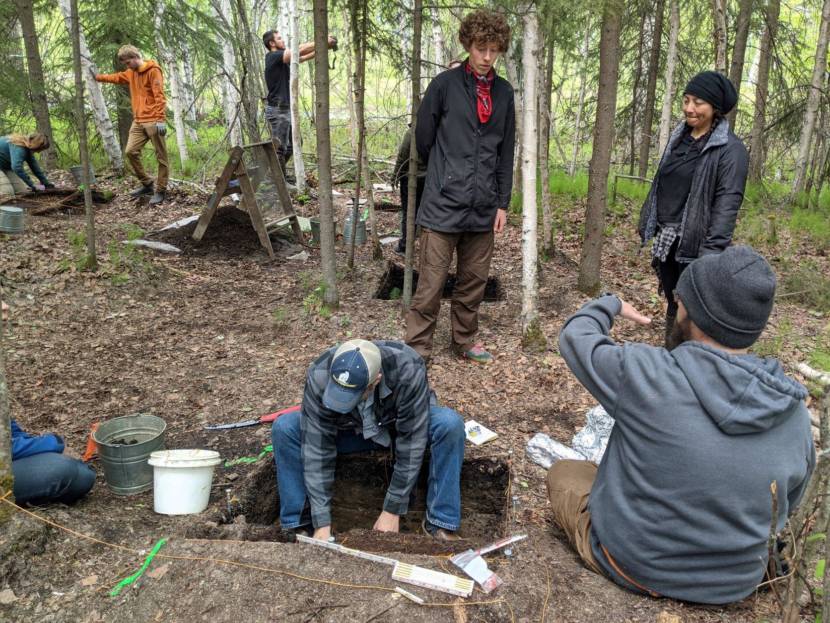
UAF archeologist Josh Reuther, center, examines an excavation at the Chena Townsite while term Assistant Professor Justin Cramb explains the technique to students and project volunteers, in background from left: Katie Baum, Sam Steele, Kent Lisibach, Kyler Collier and Sheri Karikomi. (Tim Ellis/KUAC)

A group of University of Alaska Fairbanks researchers and students who spent six weeks at an archeological site just west of the city are compiling reports on what they found in the area, where the gold-mining town of Chena boomed more than a century ago — before going bust.

UAF Term Assistant Professor Justin Cramb took a break from helping excavate the foundation of an old log cabin to explain to a visitor why he and a group of students are digging around in a wooded area off Chena Pump Road near the north bank of the Tanana River.

“What we’re looking at is basically the foundations of old structures,” he said. “Things that were left behind after the town of Chena was abandoned.”

The casual observer wouldn’t know a town with dozens of buildings and hundreds of residents once stood in what’s now a swampy thicket, overgrown with willow and alder.

The town was founded in 1902 and served as a commercial hub during a gold rush that drew hordes of miners into the Interior during the first decade of the last century.

“Fairbanks comes into existence just a little while later,” he said. “And they become competitors.”

Chena had the advantage of location — right on the Tanana, conveniently accessible to the big riverboats and also near the mouth of the Chena River. Freight could be off-loaded there and and transferred onto smaller boats, which took the goods and passengers on to Fairbanks and beyond.
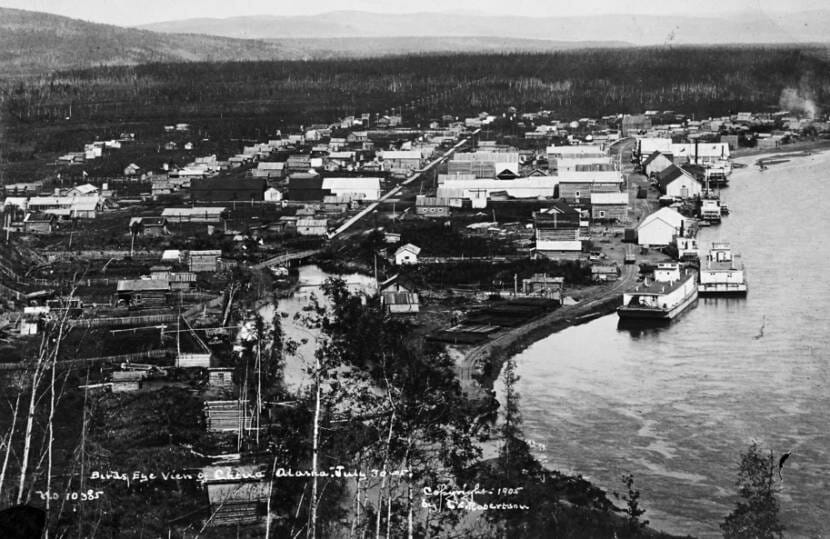
Chena boomed in the first decade of the 20th century, largely because of its location on the Tanana River that enabled the town to handle freight and passengers for the area, which was booming due to the gold rush under way around the Interior. (Rasmuson Library Alaska & Polar Regions Digital Collections & Exhibits)

But historians said Fairbanks had a different advantage.

“Fairbanks was far more successful politically, which was one of the factors that led to the downfall of Chena within 20 years,” Cramb said.

The political success came in the form of influence exercised by the legendary Judge James Wickersham, who persuaded federal authorities to build a courthouse in Fairbanks. Miners had to go there to stake their claims, which attracted other gold-related businesses, including some formerly based in Chena.

Before long, most of the town’s population followed. Railroad tracks were pulled up. Vacant structures were dismantled and salvaged.

“Buildings were repurposed — taken to either Fairbanks or Nenana,” Cramb said. “People moved out, and then Chena was just abandoned.”

Several decades later, the state built a day-use picnic park at the townsite. But for the most part, it sat empty for nearly a century. Then, seven years ago, UAF researchers Josh Reuther and Scott Shirar began excavating the site. And in May, Cramb and his students picked up where Reuther and Shirar left off.

“We’ve found glass bottles,” Cramb said. “We’ve found leather boots that we tentatively will place with the Chena era. A ton of metal nails that are of course one of the hallmarks of historic archeological sites …”
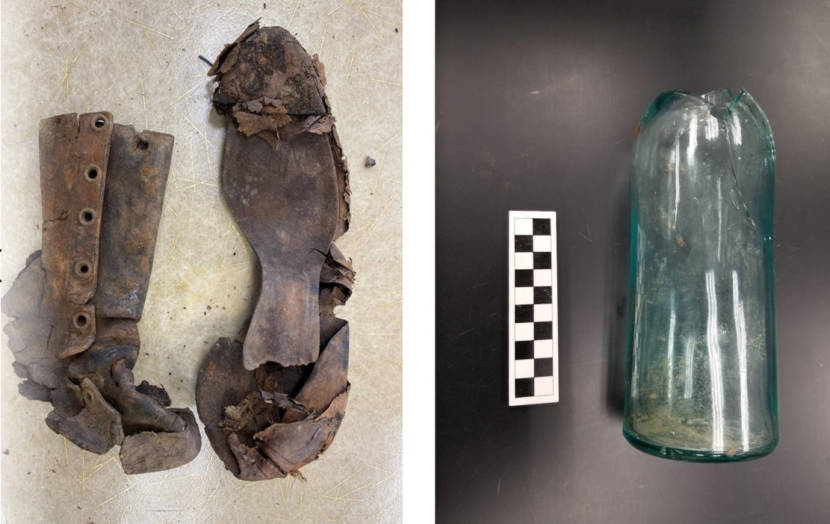
Artifacts found and catalogued by Cramb, Reuther and Shirar include a pair of boots, left, and numerous pieces of glass, like this bottle. (Courtesy Justin Cramb/UAF)

One of the UAF undergrads working at the site says excavating and analyzing all those artifacts has deepened her appreciation for anthropology. And it’s convinced Sheri Karikomi to apply for grad school to continue study the subject.

“It helps me understand a lot more about cultural anthropology,” she said. “How people — how they lived, y’know, based on their culture and things that are left behind — their structures, their small artifacts, big artifacts.”

The students have cataloged most of the artifacts they collected during the archeological field school, which ended late last month. Cramb said he and Reuther and Shirar are analyzing their findings and compiling a detailed report, which they plan to present at this year’s Alaska Historical Society meeting and a national historical archaeology conference in Philadelphia next year. After that, they plan to publish their findings in academic journals.

Editor’s note: Click here to read a report on the challenges of locating and surveying the Chena Townsite written in 2013 by Fairbanks historian, surveyor and retired municipal platting officer Martin Gutoski.


World Eskimo Indian Olympics returns to Fairbanks for 60th anniversary

Kim Gumera of Unalaska kicking at 110 inches during the Native Youth Olympics in 2015. The high kick is one of the skills showcased at the World Eskimo Indian Olympics. (Photo by Zachariah Hughes/Alaska Public Media)

The World Eskimo Indian Olympics is going ahead with its 60th anniversary games next Wednesday. The games were canceled last year and special safety precautions are in place this year to deal with the COVID-19 pandemic. The event is back at the Big Dipper building in Fairbanks, but a lot of contests will be outdoors.

The first World Eskimo Indian Olympics were in 1961 on the banks of the Chena River in Fairbanks. The traditional games and dances have been held every year until 2020. This year, the celebration will keep COVID in mind as coordinators ask attendees to be vaccinated or wear masks.

“Our people have a long and sordid history with epidemics. So it’s not anything we really want to play with. We want to do as much as we can, but we still are going to have some considerations,” said Gina Kalloch, who is Koyukon Dena and chair of the WEIO Board of Governors.

The nine-member board is organizing the games as volunteers because they raised no money last year to hire a staff person for the big event. This 60th anniversary event is likely to require 30 to 40 volunteers. Kalloch says instead of having a contributor of the year award, they’ll have a special acknowledgment of that volunteering tradition.

“Having a commemorative pin made and we will name them all contributor of the year,” Kalloch said.

The games are derived from hunting and whaling, and many are designed to build up brute strength or test endurance to survive in rural Alaska. Events like the knuckle hop and the ear pull challenge the ability to withstand pain, and contests like the Alaska high kick and the toe kick hinge on balance and agility. In some years, dancers and athletes have come from Greenland, Siberia, Canada and Hawaii.

Kalloch says for most events, athletes and judges can stand apart. But coordinators are asking athletes who will be right next to each other to be fully vaccinated before the events begin July 21. That includes the Indian stick pull, Eskimo stick pull, greased pole walk, four-man carry, ear pull and arm pull.

“So, for those games we are requiring vaccinations,” Kalloch said.

Those athletes or volunteers will be given special wristbands that allow them more access around the venue.

Kalloch says she knows they will be asked to make exceptions.

“Its already happened, and we said ‘maybe next year,’” she said.

With athletes, dancers and vendors coming from all over Alaska and the Arctic, the games become like a four-day family reunion. But some of that festive atmosphere will still be muted.

“Dance in place and do not come down to the floor,” Kalloch said.

All daytime events, except for the high kick, will be outdoors on the field behind the Dipper building. All the events will be free.

A special guest, Molly of Denali will be at the event from 6-8 p.m. during the opening ceremonies. A schedule of events and registration information are on the World Eskimo Indian Olympics website.

‘Boondoggle’: financial woes may jeopardize proposed Alaska-Canada railroad project

A2A Vice Chair Mead Treadwell explains the project route in an April 2019 talk with the World Trade Center Anchorage. (Courtesy of Fyodor Soloview/InterBering.com)

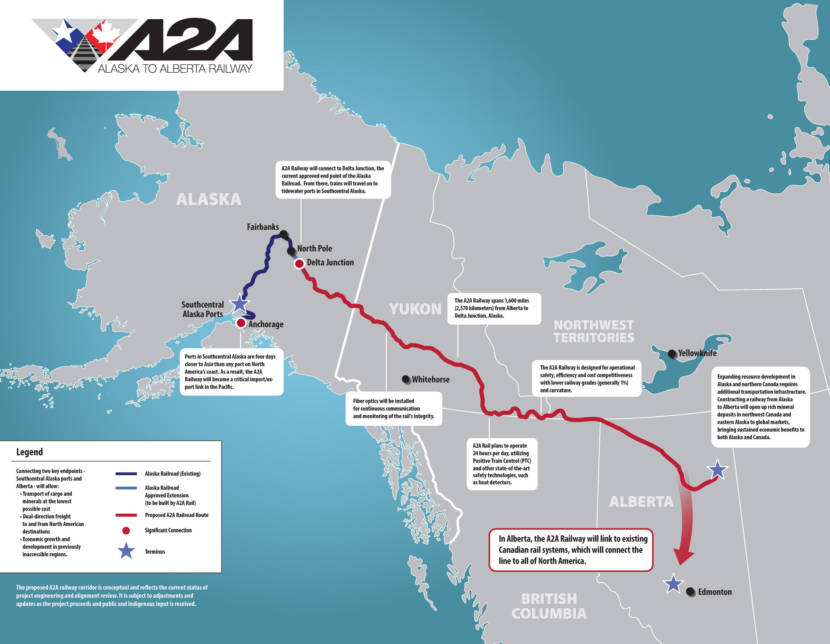
An ambitious plan to build a 1,600-mile railroad that would link the Alaskan and Canadian rail systems is on hold and appears to be in jeopardy.

A year ago, former Alaska Lt. Gov. Mead Treadwell and other state leaders were gushing with enthusiasm over the Alaska to Alberta Railway’s plan to build a railroad from northern Alberta to the eastern Interior of Alaska to transport raw materials like minerals or bitumen for export.

“We’re hoping to begin formal permitting with the environmental impact statement process sometime either late this year or early next,” Treadwell said in an interview last September.

But now it’s hard to find any of that initial enthusiasm. Treadwell, the project’s vice chair, isn’t talking publicly about the $17 billion project. Also, the chairman of the Calgary-based railway company has left, along with other top executives, after he was accused of financial improprieties.

Meanwhile, those still with the company are seeking to protect it from creditors to avoid liquidation while they try to sell it or refinance the project. And the main lender for the proposed railway is in court-ordered receivership while authorities investigate it over allegations of financial wrongdoing.

A map on the A2A website shows the railway’s proposed route.

All of which has left Alaska Railroad President and CEO Bill O’Leary wondering about the future of the project.

“It certainly appears to be a tough situation at this point,” he said, “and I think most of their efforts are going towards trying to figure out what their next steps are.”

O’Leary said in a recent interview that he’s still supports the idea of an Alaska-Canada railway that would link up with the Alaska Railroad. It’s a concept that’s been proposed several times over the years, and he says the Alaska to Alberta Railway’s proposal is the most promising he’s seen. Now, however, he’s uncertain about its future.

“But, at this point, I’m not sure I have any – I know I have no – inside information on how this is going to all play out,” he said.

Fairbanks Economic Development Corporation President and CEO Jim Dodson also strongly supports of the project. But he says he, too, is now worried whether it’ll come to fruition.

“Quite a boondoggle over the financing of the project,” he said. “Whether the guy that owns it is in financial trouble, or it’s an institution that’s in financial trouble …”

The guy who owns it is Winnipeg businessman Sean McCoshen. And evidence uncovered by investigators suggests he and the lender, Bridging Finance, both are indeed in trouble. The CBC reports that an investigation by the Ontario Securities Commission has found many financial “irregularities” between McCoshen and Bridging Finance. And according to the Toronto Globe and Mail, millions of dollars from the lender intended for the rail project have instead been transferred into McCoshen’s personal bank account. His name now no longer appears on the A2A company website, and the Globe and Mail says he hasn’t been seen for more than two months now.

“I honestly don’t know if we should still be hopeful,” Dodson said.

He says he’s trying to reserve judgement about the company and its ability to build the A2A Railway. But he adds that it’s hard to remain enthusiastic, especially because the company has failed to provide any information about the project since it sent out a news release three weeks ago announcing its bankruptcy and the lender’s receivership.

“There’s been no additional clarity offered, that I know of,” Dodson said.

Some clarity may come from an Alberta judge’s decision on Monday to appoint an interim receiver and authorize it to take control of the Alaska to Alberta Railway and manage its operations and assets.

A person who’s knowledgeable about the issue who spoke on background says the judge’s action should clear the way for selling the company or refinancing the project.

Beaver dams burst, blocking Richardson Highway with debris. Twice.

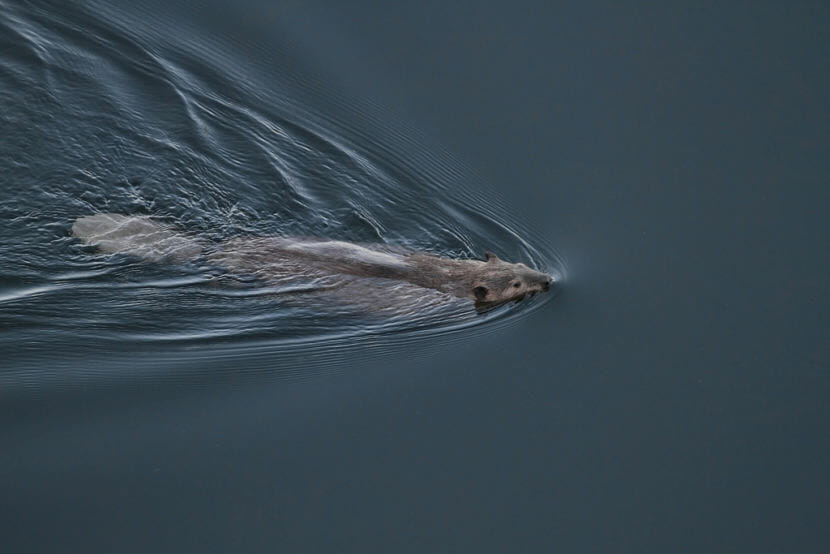
A beaver. (Creative Commons photo courtesy Larry Smith)

Burst beaver dams caused landslides that blocked the Richardson Highway near Paxson — first on July 1, then again on Monday.

Alaska Department of Transportation spokesperson Danielle Tessen says that on both occasions, beaver dams built uphill of the highway near mile 187 swelled ponds, eventually breaking the dams.

“Essentially a whole flash flood of debris, materials and water from the ponds comes slashing down the side of the hill and covers the road,” she said.

Tessen says no vehicles were caught in either slide, and in both incidents the highway was cleared and re-opened in about 2 hours. But there’s concern that another such release could result in a more serious outcome.

“You know, the first time you’re like, ‘Whoo, that was lucky,'” she said. “And then the second time I was like, ‘Okay, this is really lucky.'”

Tessen says DOT materials experts are going over the site to better understand the situation and consider possible remedies.

Fairbanks therapeutic courts focus on addiction treatment, not criminal punishment

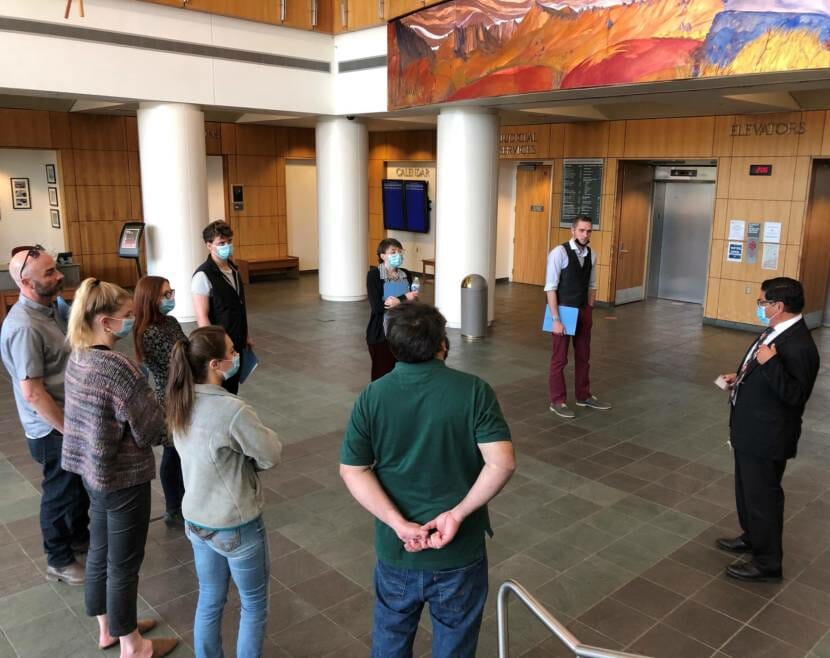
Raul Calvillo (far right) shows news reporters around the Rabinowitz Courthouse. (Robyne/KUAC)

Inside Alaska’s court system there are therapeutic courts for handling crimes where alcohol and drugs play a significant part. Fairbanks’ DUI and drug courts started in 2007 with the idea that people could change their behavior toward alcohol and drugs and not repeat their crimes. The idea has been working.

Superior Court Judge Brent Bennett oversees a caseload of about 30 people in two therapeutic courts in Fairbanks where people convicted of drug and alcohol-related crimes work on overcoming addiction in an 18-month long program instead of going to jail.

“A big part of why I’m interested in working with the therapeutic courts is, we’ve tried this system of criminal justice, and people just keep coming back,” he said.

The recidivism rate for people convicted of drug and alcohol crimes and sent to jail is normally about 50%. The model for the Fairbanks Wellness Court focuses on addiction treatment rather than criminal punishment.

“This is an opportunity to try something different that helps folks rehabilitate, in a way that they are not going to recidivate, which benefits them, benefits their families, but also benefits the community,” Bennett said.

Bennet works with Amy Bollaert, a project coordinator for Fairbanks’ wellness courts. She says that since the DUI court and the drug court launched in Fairbanks, 156 people have graduated from the program. Very few have committed crimes again.

“Just solely based on Fairbanks, our recidivism usually averages between 5% to 7%,” she said.

Over a year to 18 months, the program requires participants to confront their substance abuse. They must provide random urine analysis, get jobs and proceed through drug and alcohol counseling. The Fairbanks therapeutic courts contract with Pacific Rim Counseling for intensive outpatient treatment.

But, as Bollaert says, some people need more than that, and there is regularly a shortage of inpatient treatment available in Fairbanks, and it is hard to get in to most treatment programs — inpatient or outpatient.

“The waitlist. That’s another barrier that we have,” she said.

Bennet says the therapeutic court is working on wraparound services with The Bridge, a local reentry program, and it is easy to find support among peers.

​“We also have an incredible amount of recovery meetings that are available. A broad gamut of recovery meetings, that aren’t necessarily religious-based. And those are available online at this point as well,” Bennett said.

Alaska has fourteen therapeutic courts statewide. Eight are for cases in which there is a clear link between crimes committed and addiction, three work primarily with defendants with mental health issues, two work with families in cases involving children and Anchorage has a veterans court.

Fairbanks, too, is working on launching a veterans court that could cater to the special mental health needs of the area’s huge veterans population. And the state is looking to collaborate with Tanana Chiefs Conference to set up a healing court.

But those projects are still in the planning stages. Bennett says in addition to preventing repeat crime, the program is life-changing.

“By and large everyone who’s finishing this program, can tell you at the end, ‘I’m doing this for me now, ‘I’m doing this because it feels good to be sober, it feels good to be somebody that can be relied upon, it feels good to be responsible,’” Bennett said.

No arrests yet in string of arson attacks east of Fairbanks

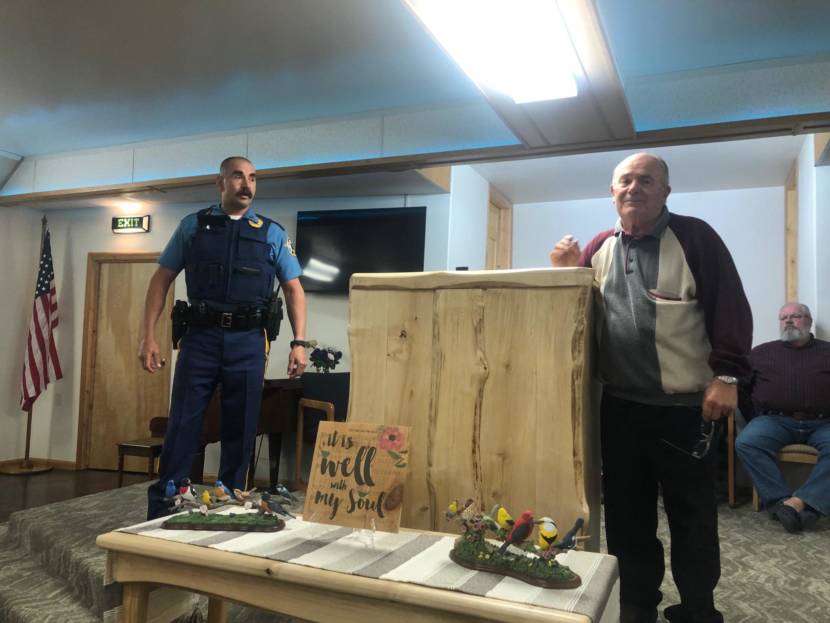
State Trooper Captain Eric Spitzer (L) and Pleasant Valley Community Association chairman Wayne Shea speak at a July 10th community meeting. (Dan Bross/KUAC)

Residents of Two Rivers and Pleasant Valley filled the Pleasant Valley Baptist Church on July 10 to hear an update on a series of arson attacks in the two communities east of Fairbanks. Police are investigating fires that have burned three residential and two community association properties since early May.

State Trooper Captain Eric Spitzer did not mince words in addressing the situation.

“Let’s face it, there’s forces of darkness at work here,” he said.

Spitzer emphasized that the arson investigation is a high priority.

“Whoever’s responsible for this, they should not be sleeping soundly at night,” he said.

Spitzer urged local people to keep an eye out for suspicious activity and to form an email group to coordinate and share information.

“I need some community leaders out here to step up and put together a community watch,” Spitzer said. “I’m not talking about a vigilante thing.”

It was earlier disclosed that there has been written communication from someone claiming responsibility for the arson attacks, but no details are being released. Spitzer said he would alert the community if there’s a specific threat, but that other case details are being held close by troopers, the state fire marshal’s office and the FBI.

“In order to preserve the integrity of the investigation, there’s certain things law enforcement wants to keep only law enforcement knowing,” he said.

Pleasant Valley Community Association buildings are among those targeted. Association chairman Wayne Shea said there’s a possibility that some security video can be salvaged from a heat damaged hard drive.

“It’s not being sent to a forensic crime laboratory in Virginia,” he said. “Now, if they can’t get it, probably nobody can, but there is a chance.”

Shea, who’s also pastor of the Pleasant Valley Baptist Church, expressed appreciation for local people staying calm given the scary situation.

“We’re not gonna operate on fear in this community,” he said. “We’re tougher than that.”

One of the arson attacks displaced six people in three households on a single property earlier this month. Don and Virginia McKee lost their home, plus two rental units, and large shop buildings. Standing in front of pile of the blackened debris, the McKees described a concussive blast that started the early morning fire.

“The explosion of the gas being lit that they had spread on the far side of my shop,” he said.

“From the time he woke up, it was 2:07. At 2:15 the front of the house just blew out,” Virginia McKee said.

Virginia McKee says the fire followed another arson attack that burned a relative’s home nearby less than a day earlier. She says they have no clue about who’s responsible.

“We have gone over that so many times with the FBI and the troopers, and — okay, there’s a lot of people don’t like me much on Facebook cause I am very conservative, and I’m not afraid to say so,” she said.

The McKees say many people — some they know, and some they don’t — are helping them and the others who’ve lost property in the arson attacks.

“The generosity of our neighbors is overwhelming,” she said.

A $2,000 reward is being offered for information leading to the arrest and conviction of the person or persons responsible for the arson attacks.

Site notifications
Update notification options
Subscribe to notifications