KUAC is our partner station in Fairbanks. KTOO collaborates with partners across the state to cover important news and to share stories with our audiences.
A commercial plane carrying a pilot and 8 passengers was damaged in flight on a scheduled run between Fairbanks and Huslia Monday.
National Transportation Safety Board Alaska region chief Clint Johnson called it a “significant event” and said the NTSB would investigate.
“The airplane was level at 10,500 feet in cruise, and we understand that there was an upset — a significant drop in altitude,” Johnson said. “The pilot was able to regain control of the airplane and subsequently made an emergency landing back in Fairbanks. However, there was substantial damage to the airplane.”
A social media post by a passenger said the Wright Air Service Cessna Caravan “twirled upside down twice,” and photos of the plane on the tarmac in Fairbanks show a bent aileron on the aircraft’sright wing.
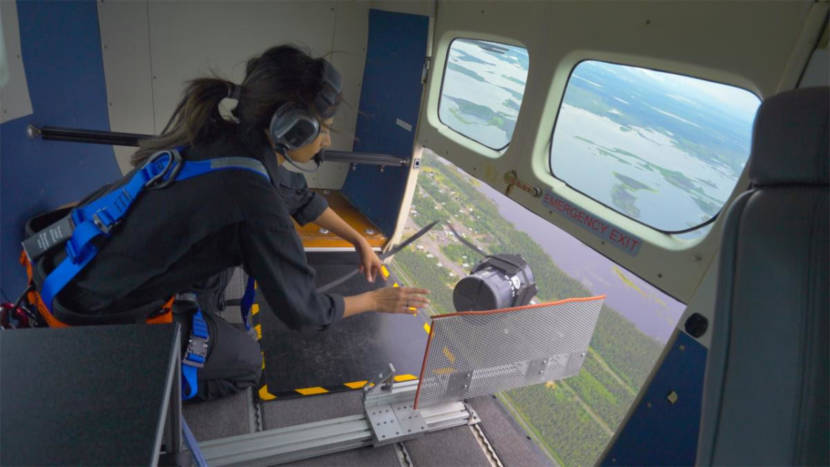
A Dash package is dropped over an Alaska community in July, 2021. (Courtesy of Dash systems)
A California-based technology company successfully dropped supplies from airplanes into remote towns and government facilities in rural Alaska this summer. It was the first time a private company delivered supplies that way.
In a promotional video for Dash Systems, a woman sits on the floor of an airplane high in the sky. The door of the aircraft is open. The wind whips her hair. She grabs a box that appears to have a wide propeller attached to one side, slides the cargo to the edge of the plane’s door and pushes the box out. The blades catch the wind, steering the box. Close to the ground a parachute erupts from the package. It floats gently to the ground.
Dash Systems aims to make next-day delivery available in remote areas using a “land the package, not the plane” approach. The company ran a test expedition in rural Alaska in July. Over nine days, they tested the technology at four drop sites over 7,000 miles.
Beth Klein has worked to get supplies to rural Alaskan communities for years. She says she hopes Dash can be an alternative to existing delivery systems.
“I think that if there was a different opportunity for delivery methods, I would say that would be amazing,” Klein said.
Klein works for RurAL CAP, an organization that supports rural Alaskans. She says the high cost and complexity of existing delivery systems can prevent rural communities from getting the supplies they need. When pilots stopped traveling to villages during the COVID-19 pandemic, people had to go without important supplies. Fresh food often spoils before it arrives. Immunizations expire before they can be delivered.
“I think the timeliness of the potential for these deliveries would be a huge impact for our communities,” Klein said.
Dash partnered with the University of Alaska Center for Innovation, Commercialization, and Entrepreneurship and the Office of Naval Research to explore whether remote supply drops would be effective in Alaska.
Dash founder and CEO Joe Ifill started the company with hard-to-reach areas like rural Alaska in mind. Ifill’s family is from Barbados, where hurricanes regularly disrupt shipping. He saw a solution to that problem when he started working with technology for remotely dropping bombs. He wondered about other applications.
“Could we reuse this technology for a peaceful purpose, you know, help people?” he said.
Ifill said the expedition proved the technology is a good fit for Alaska.
“We flew over 7000 miles in one week, delivered to multiple locations,” he said. “We didn’t get to pick the weather, we didn’t get to pick the drop zone. But we always found one that was safe and would work.”
Rural Alaskans shouldn’t expect their packages to start falling from the sky any time soon. Dash is seeking contracts with government agencies and other business partners to continue developing their systems. They hope to increase the weight they can deliver in each pod so that eventually they can drop full pallets. For now, this experiment shows that dropping supplies from an airplane into remote locations in Alaska is possible.
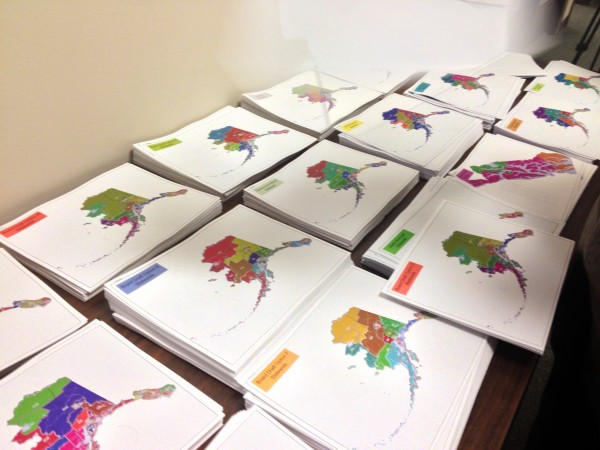
Multiple versions of redistricting maps considered in a public comment period during the 2011 redistricting cycle. (KTOO file photo)
The U.S. Census released its reapportionment data for states this week. That means states now must redraw congressional and state legislative districts to make sure everyone has fair representation and voting rights.
In Alaska, a five-member board is appointed every ten years to re-draw the 40 state House and 20 state Senate districts. It will take them some time to crunch today’s data and draw new voting maps.
Nicole Borromeo was appointed to Alaska’s redistricting board by former Alaska Supreme Court Chief Justice Joel Bolger. She says now that the Census has released the data, there’s a lot of work to do before new districts are in place for the 2022 statewide election.
“The process is going to begin with our software contractor, taking the legacy files and putting it into a format that the board can work with. He’ll need roughly a week to do that,” Borromeo said.
The board will meet in Anchorage Aug. 23 and 24. They’ll cut the state into four parts.
“And each of the board members would take one of those segments, and we would start to really home in on those regions of the state and look at the districts as they now stand, how they’ve either grown in population or had an out-migration and lost individuals, and then come back together for a series of workshops and public meetings throughout the entire month of September,” Borromeo said.
The Census counted 733,391 Alaskans, which means the target population for each of Alaska’s 40 House districts will be 18,335 for the coming redistricting cycle. With fewer than a million people, Alaska gets only one congressional district, unlike populous states like California and New York.
The board has been meeting about twice a month since last September. The governor appoints two members. The presiding officer of the senate, the presiding officer of the house of representatives and the chief justice of the supreme court each appoint one.
The redistricting cycle after the 2010 census was highly contested. Deputy Director T. J. Presley says a series of lawsuits caused Alaska to miss the redistricting deadline for the next statewide election.
“The board was appointed on time,” Presley said. “They drew their maps. It’s just that they were sued by the Fairbanks North Star Borough and a number of other parties as well.”
That meant the board had to redraw the map after the election.
“Because the litigation took so long, the court realized that they were not going to resolve the issue in time. So the court actually just ordered that the map that was under consideration under the lawsuit would just be used for one year. And so for just one election, just for the 2012 election, the courts ordered the board to use that,” Presley said.
The legislative districts we use now we finally settled in 2013, three years after the census.
Citizens who want to comment on or follow the 2021 process can sign-up for updates online.
Correction: A previous version of this story stated Nicole Borromeo was appointed to the state’s redistricting board by Alaska Supreme Court Justice Daniel Winfree. Borromeo was appointed by former Chief Justice Joel Bolger.
In April, Tanana Chiefs Conference donated hundreds of vaccine doses to Eielson Air Force Base. (courtesy of Eielson Air Force Base)
U.S. military service members in Alaska and worldwide will be required to get COVID-19 vaccines beginning next month.
Defense Secretary Lloyd Austin announced yesterday that he’s ordering mandatory vaccinations in response to President Biden’s request to add the COVID-19 vaccine to the list of required vaccinations for service members.
Austin says the new policy will become effective either when the president approves his plan to implement the it by mid-September or when U.S. Food and Drug Administration fully approves licensure of one of the widely available COVID-19 vaccines — whichever comes first. In a news release, Austin said the Pfizer-BioNTech vaccine is likely to achieve full FDA licensure early next month.
Austin said he consulted with Joint Chiefs of Staff chairman Army Gen. Mark Milley, the armed services secretaries and medical professionals on the vaccine-mandate plan.
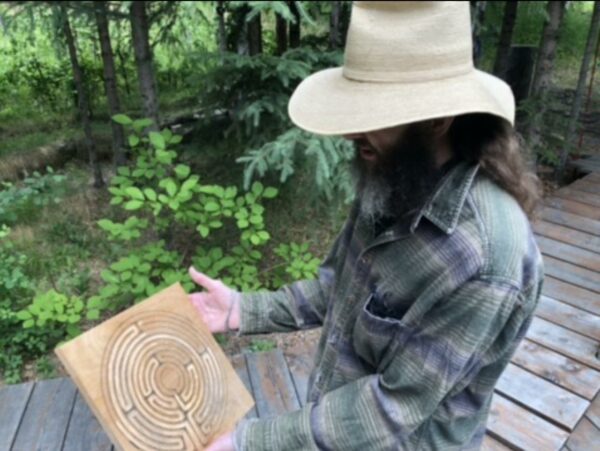
Ramey Wood shows a finger board labyrinth that uses a design similar to the labyrinth on his property. (Dan Bross/KUAC)
The labyrinth constructed on Ramey Wood’s land in West Fairbanks is hidden by willow, alder, birch, grass and wildflowers. It isn’t until you begin walking through it that you see its narrow circular paths were precisely sculpted into the earth or that they’re regularly maintained in concert with the forest.
“It’s work but it’s doing as much as me,” Wood said.
Wood suffers from chronic neurologic pain. He says the labyrinth provides a literal path to calming and focusing the mind.
“The pattern allows one to not have to worry about where one’s going. You can allow yourself to concentrate on whatever it is that you’re thinking about, whatever your intention is — your question, your problem, your concern, what you’re stressing about, what you’re excited about — and then allow yourself to just go through that motion,” he said.
It takes about 20 minutes to walk the medieval-style labyrinth, which spans 66 feet. There’s one path to the center and a different but adjacent path back out. When you walk the labyrinth, you know where you’re going, but the circuitous path to get there requires a certain surrender.
“Trust the pattern, and then do what you can with it,” he said.
Wood stresses that a labyrinth itself isn’t a cure or remedy.
“To make them be something like a prescription, I think that’s goofy,” he said. “I like it. I enjoy it. I’m dependent on it. I love the relationship with it. And at the same time like, it’s only worthwhile in that relationship, it’s only worthwhile in the act of engagement. It isn’t a thing.”
Wood characterizes the labyrinth as a friend of sorts, helping him navigate through pain.
“I know that sounds…whatever it sounds like, you know, to have it as your friend. But I hope more people can find friends like that,” he said.
Wood shares the labyrinth with local people as well as travelers passing through town.
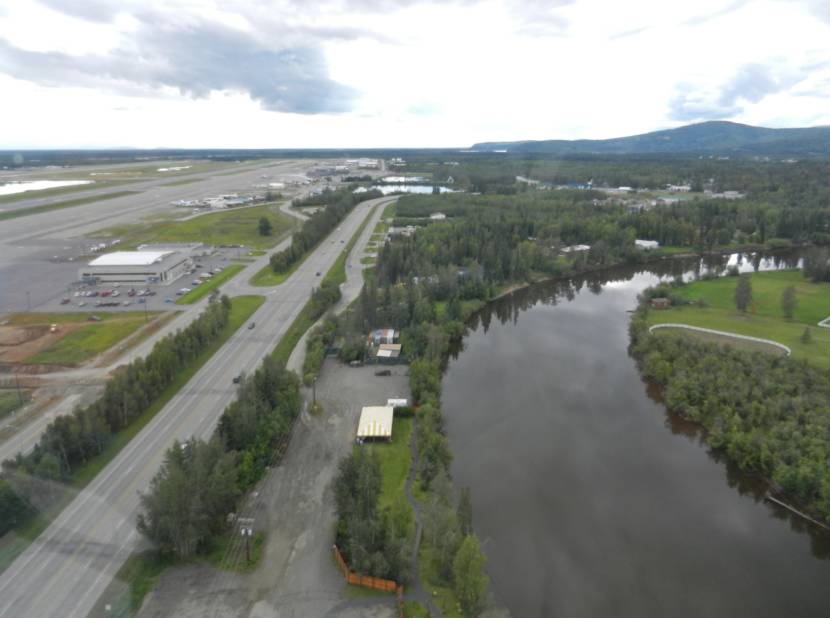
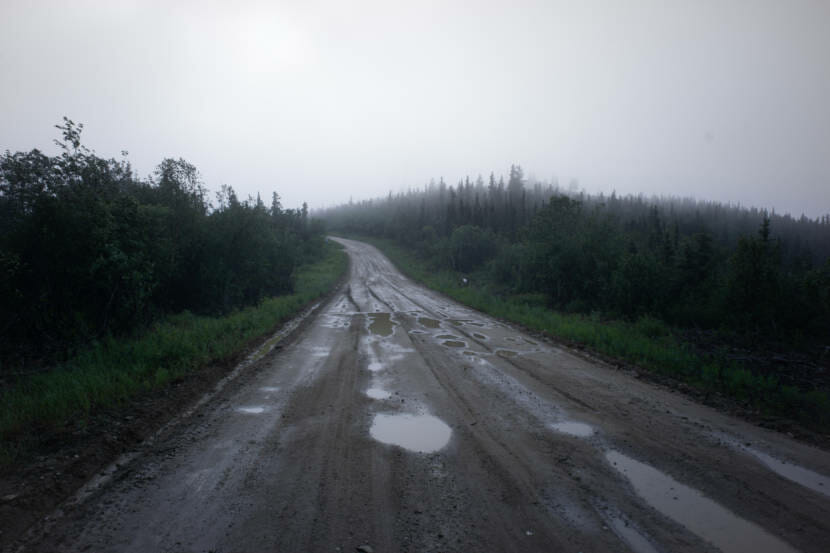
Ester Dome Rd. uphill of the junction with Henderson Rd. (Ian Dickson/KTOO)
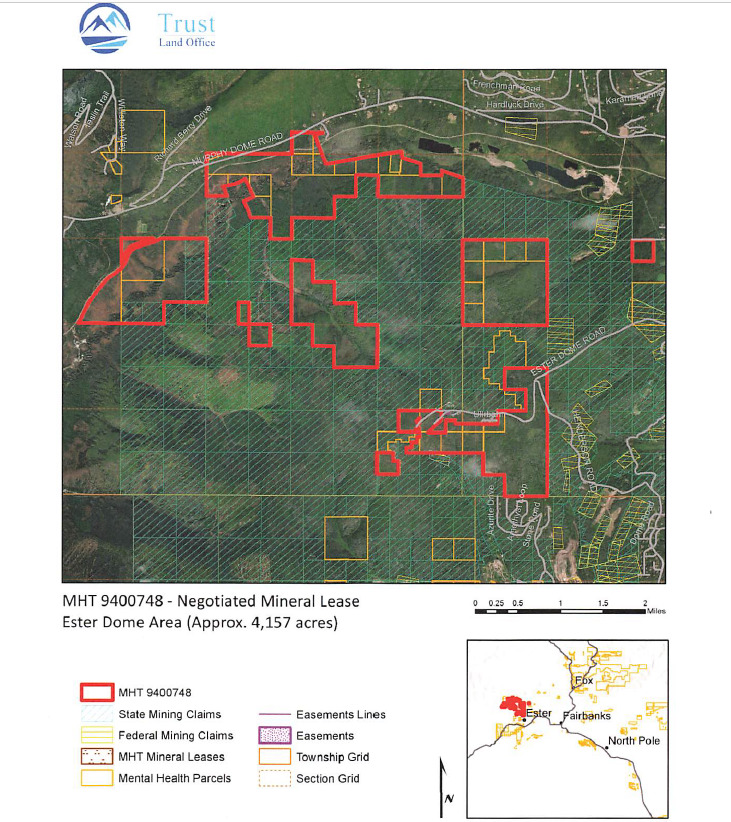
An Alaska Mental Health Trust Authority decision to lease more than 10,000 acres north of Ester to an Australia-based gold-mining company has alarmed residents and people who enjoy hiking, biking and other forms of recreation and subsistence in the area.
Ester Community Association President Monique Musick said the list of reasons the organization opposes the decision begins with the nuisance and hazards it would inflict on the people who live in the area.
“You’ve got 24-hour noise pollution,” Musick said in an interview Friday. “There’s blasting — this is hard-rock mining. There’s going to be equipment noises. That equipment is going to impact our traffic. There’s pollution from mining, including the increased levels of dust from that activity that has impact on residents who have respiratory illnesses. There are groundwater impacts — arsenic and other heavy metals.”
On top of that, Musick said the hundreds of people who live near land likely to be developed — around Ester Dome, Ester Lump, Henderson Road and Murphy Dome — also will see the value of their property plummet.
“Mining in your back yard does not exactly improve your property values,” she said.
Musick said mining also would have a much broader impact on the many other people who come to enjoy the area’s underdeveloped forestland and maze of back trails.
“The entire recreational trail system that connects us to Murphy Dome and these other areas — the Equinox Marathon Trail, the Dunbar Trail, the Fireplug Trails and dozens of offshoots and connectors that makes Ester Dome one of our premier recreational sites,” she said.
The 10,206 acres that the Alaska Mental Health Trust Authority Trust Land Office’s identified in its June 25 best-interest decision include several areas around Ester. (Alaska Mental Health Trust Authority)
Musick said both locals and area residents value the land for traditional use, including hunting, trapping and berry-picking.
The head of Alaska’s mining-industry trade group said those concerns are premature. Alaska Miners Association Executive Director Deantha Skibinski said any development of those lands would first have to be reviewed during the state’s permitting process.
Area residents should trust in the process — and participate in it, she said.
“That permitting process requires a lot of really close looks at how all of the various aspects to the environment are impacted,” Skibinski said. “That permitting process has a lot of different opportunities for public input.”
Musick said opponents of the proposal don’t find much comfort in the process because the Mental Health Trust Authority’s June 25 decision concludes mining is the highest and best use of the land. That suggests Felix Gold’s proposal is a done deal if the company finds gold, Musick feels. And given the history of gold mining in Ester, that seems quite likely.
“This lease allows them to go and immediately start that process for development, based off of what they find,” Musick said.
Skibinski said it’s not that simple. Public comments will be allowed before development: That input helps mining companies develop mitigation plans to operate without excessive impacts for nearby property owners.
That’s what was done with Kinross Alaska’s gold mine near Fox, she said.
“They went in, as part of the permitting process, did stakeholder engagement, came up with ways to mitigate concerns,” Skibinski said. “Now we have an incredibly successful gold mine, which is one of the primary economic drivers of the Interior.”
Musick said opponents don’t believe Felix Gold would make the kinds of effort Kinross did. She said their skepticism is fueled by what they say is the Mental Health Trust Authority’s efforts to conduct its best interest decision-making process behind the scenes, with minimal notice provided only through legal ads published in the Fairbanks Daily News-Miner.
“There was no public announcement,” Musick said. “There wasn’t a public hearing. Those of us in the community directly impacted have not had the opportunity to ask questions, to discuss alternatives or to express our concerns.”
Skibinki disagreed.
“I have to take exception with an allegation (regarding) too little notice, too short of notice, not enough information,” she said. “When mining development is proposed, there’s very early-on stages of whether or not the land should even be leased. That doesn’t mean that a mine is going to be approved tomorrow and be built.”
Musick said she and other opponents aren’t persuaded by those assurances, she said.
But now the Felix Gold mining proposal is out in the open, the public can weigh in before Friday when the deadline for public comment on the Mental Health Trust Authority’s Best Interest decision are due.
Close
Update notification options
Subscribe to notifications
Subscribe
Get notifications about news related to the topics you care about. You can unsubscribe anytime.