NPR News

KTOO is the NPR member station in Juneau. NPR offers its members radio and digital stories.
U.S. judge temporarily blocks Trump’s birthright citizenship order

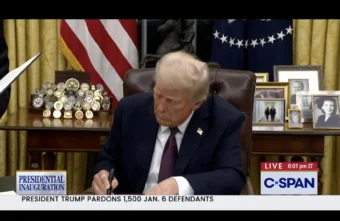
President Donald Trump signs an executive order at the White House supporting natural resource development in Alaska on Monday, Jan. 21, 2025 in Washington. (C-Span screenshot)

U.S. District Judge John C. Coughenour issued a ruling on Thursday temporarily blocking President Trump’s executive order that aimed to end birthright citizenship for children born to migrants in the U.S. temporarily or without legal status. Coughenour issued the temporary restraining order after a hearing in Seattle.

The judge signed the temporary restraining order in response to a lawsuit brought by Oregon, Arizona, Illinois and Washington state, one of several suits opposing the administration’s effort to curb the right of citizenship for anyone born on U.S. soil.

In a standing-room-only courtroom in downtown Seattle, Coughenour interrupted the attorney for the Justice Department, Brett Schumate, to tell him how unconstitutional he thinks the administration’s order is.

“I’ve been on the bench for four decades, I can’t remember another case where the question presented is as clear as this one is,” Coughenour said, describing Trump’s order as “blatantly unconstitutional.”

“There are other times in world history where we look back and people of goodwill can say, ‘Where were the judges? Where were the lawyers?’ ” the judge said, according to KUOW News.

Coughenour’s order blocks federal agencies from implementing the executive order, signed Monday by Trump, while the case is under review.

“Obviously, we’ll appeal it,” Trump said, referring to the judge’s ruling during an appearance at the White House on Thursday.

A spokesperson for the U.S. Justice Department told NPR in email that the new administration will “vigorously defend” Trump’s executive order. “We look forward to presenting a full merits argument to the Court and to the American people, who are desperate to see our Nation’s laws enforced,” the DOJ official said.

Outside the courtroom, Washington state Attorney General Nick Brown applauded the judge’s skepticism.

“This is step one,” Brown said. “But to hear the judge from the bench say that in his 40 years as a judge, he has never seen something so blatantly unconstitutional sets the tone for the seriousness of this effort.

Brown is among 22 Democratic state attorneys general who have joined lawsuits to block the executive order. In a statement after Thursday’s ruling, Brown said the “unconstitutional and un-American executive order will hopefully never take effect.”

Another attorney general who sued, California’s Rob Bonta, said in an interview with NPR that he expects a “similar reception from courts throughout the United States. Any court that is fair, that is objective, that looks at the facts and applies the law, I believe will find the same way.”

Bonta said there are about 25,000 children born every year in California who would be entitled to birthright citizenship. If Trump’s executive order went into effect, those children would be “deportable at any time, wouldn’t have access to federal programs that provide food assistance or housing or health care, things like Medicaid or our Children’s Health Insurance Program, and many other services, programs and privileges of citizenship.”

The 14th Amendment of the U.S. Constitution grants full citizenship to all persons “born or naturalized in the United States, and subject to the jurisdiction thereof.” That provision has been interpreted for decades to grant American citizenship to everyone born in the U.S. Some conservatives believe babies born to migrant families without legal status in the U.S. should be excluded.

In his executive order, Trump said the “privilege of United States citizenship is a priceless and profound gift.” This case is expected to be decided by the U.S. Supreme Court.

Law enforcement correspondent Martin Kaste contributed to this story.

Jimmy Carter to be honored with a state funeral before being buried next to Rosalynn

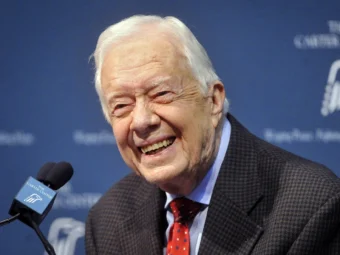
Former U.S. President Jimmy Carter takes questions from the media during a news conference at the Carter Center in Atlanta on Aug. 20, 2015. (John Amis/Reuters)

Jimmy Carter, the 39th president of the United States, died Sunday at age 100. The Carter Center announced he died in his hometown of Plains, Ga.

Carter was president from 1977 to 1981, but he was perhaps more famous for the life he led after leaving office. Carter was one of the biggest advocates for peace, democracy and international human rights.

James “Jimmy” Earl Carter Jr. was born in Plains, Ga., on Oct. 1, 1924, and spent his childhood on a farm just outside that tiny southwest Georgia community. His father was a peanut farmer; his mother, “Miss Lillian,” was a nurse. He was the first president of the United States to be born in a hospital.

“Other than Jimmy Carter, no person from the Deep South since the American Civil War had been elected president,” said Steven Hochman, a longtime assistant to the former president who works for the Carter Center.

Jimmy who?

Growing up on the farm, Carter learned the value of hard work and determination. He qualified for the U.S. Naval Academy and became an engineer, working on submarines. But Carter resigned from the Navy in 1953 after his father died.

Back in Plains, he was elected to the Georgia Senate and became the first Georgia governor to speak out against racial discrimination.

A lifelong Democrat like most Southerners at the time, Carter was a political unknown when he began a national campaign in 1974 and was first referred to as “Jimmy Who?

But a grassroots effort changed that, Hochman said. “He would campaign on the street corners and go to radio stations. Nobody knew who he was except that he was running for president.”

Carter’s friends and family from Georgia, called the Peanut Brigade, traveled to New Hampshire, Iowa and all over the country talking to voters and campaigning for Carter, the dependable Southerner who wanted to be president.

During the campaign, Carter told audiences, “I’ll never tell a lie. I’ll never make a misleading statement. I’ll never betray the trust of those who have confidence in me, and I will never avoid a controversial issue.”

Carter was elected when the mood of the country was bitter and cynical in the wake of the Vietnam War and the Watergate scandal. The man from Georgia struck out on a different course on his inauguration day: Carter and his wife, Rosalynn Carter, stepped out of the bulletproof limousine and walked to the White House to demonstrate their connection with the American people.

“It was mainly an attempt to draw a distinction between what he saw as the people’s presidency and the more imperial presidency of Richard Nixon,” said historian Dan Carter (no relation to Jimmy Carter).

The Carter White House

Among Jimmy Carter’s accomplishments were the Camp David Accords, which brought together the prime minister of Israel and the president of Egypt in 1978. They signed peace agreements on the White House lawn, and Carter spoke about the dedication and determination of the leaders who had been enemies for so many years.

The accords led to a peace treaty, but the relationship between the two Mideast countries remained tenuous. While in office, Carter also worked on the SALT II nuclear weapons agreement and signed the Panama Canal treaties, giving control of the canal to Panama.

But Carter’s most difficult challenge was the Iran hostage crisis. Militants stormed the U.S. Embassy in Iran in 1979 and took dozens of Americans hostage. People were glued to reports on the crisis for more than a year, as Carter continued to negotiate for the release of the hostages. In 1980, a failed rescue attempt led to the deaths of eight American servicemen.

The administration also battled domestic problems, including an energy crisis and double-digit inflation. Carter held a series of meetings among his Cabinet members that resulted in a blunt television address in 1979 that came to be known as the “malaise” speech.

“It’s clear that the true problems of our nation are much deeper — deeper than gasoline lines or energy shortages, deeper even than inflation or recession. And I realize more than ever that as president, I need your help,” Carter pleaded.

Carter established a federal energy policy. He created the departments of Energy and Education. Still, he lost his bid for reelection by a landslide to Republican Ronald Reagan. And it wasn’t until moments after Reagan was sworn in as president on Jan. 20, 1981, that the 52 remaining hostages were released. Carter was allowed to welcome them home.

“I had received word officially for the first time that the aircraft carrying the 52 American hostages had cleared Iranian airspace on the first leg of the journey home and that every one of the 52 hostages was alive, was well and free,” Carter said as his voice broke.

Life after Washington

After leaving office, Carter became dedicated to promoting democracy, monitoring elections, building homes with Habitat for Humanity and eradicating disease in some of the world’s poorest countries. In 1982, the president and his wife opened the Carter Center in Atlanta.

In an interview with NPR in 2007, Carter talked about his experiences. “And for the last 25 years, my life could not have been more expansive and unpredictable and adventurous and gratifying,” he said.

In 2002, Carter won the Nobel Peace Prize, an honor some said he had earned a quarter century earlier when he negotiated the Camp David Accords. He ended his acceptance speech with a plea for peace.

“War may sometimes be a necessary evil, but no matter how necessary, it is always evil, never a good. We will not learn how to live together in peace by killing each other’s children,” Carter said.

The former president continued international peace missions throughout his lifetime, meeting with the leaders of countries that some U.S. presidents refused to acknowledge, including North Korea, Nicaragua and Cuba. In 2008, he met with the exiled leader of the militant Islamist group Hamas, despite harsh criticism from the U.S. government.

Historian Dan Carter said that the former president did prove to be a kind of honest broker for peace in many cases and that as Jimmy Carter grew older, he was less afraid of speaking out.

“And his meeting with Hamas, sure it was a provocative thing, but he felt it was the right thing to do,” said Dan Carter.

Jimmy Carter wrote more than 20 books, the most controversial titled Palestine: Peace Not Apartheid. He was a religious man, attending a Baptist church and teaching Bible school for many years. And he was a statesman — hardworking and plain talking.

The Carter Center’s Hochman said the 39th president was one of the most remarkable leaders in U.S. history. “I think he’ll be remembered as a champion of human rights and peace, both as president and as a former president,” Hochman said.

Carter entered hospice care in February 2023. The longest-lived former president had suffered from a series of health challenges in recent years, including surviving cancer, a broken hip and other recent hospitalizations for a fractured pelvis and a urinary tract infection.

He and Rosalynn celebrated their 77th wedding anniversary in 2023, a few months before she died at the age of 96.

Carter’s wishes were to be buried next to Rosalynn in his hometown of Plains, Georgia.

Copyright 2024 NPR

Millions face wintry weather for what could be a record-setting holiday travel season

A traveler makes their way into the Nashville International Airport, Friday, Dec. 20, 2024, in Nashville, Tenn. (George Walker IV/AP)

Millions of people have started traveling for the holiday, braving cold temperatures, snow showers and wet roads as wintry weather snarls traffic across the country.

More than 119 million people are expected to travel for Christmas and Hanukkah, which both fall on the same day this year, through the New Year, a figure that would break a travel record set in 2019 before the coronavirus pandemic, according to AAA.
Here is what you need to know about holiday travel.

Rain and snow is making travel messy for some

Rain and snow showers have impacted the Pacific Northwest since Saturday, while in the Northeast and areas around the Great Lakes, cold air from the Arctic has sent temperatures plunging, according to the National Weather Service.

Travelers at several airports have already been experiencing delays heading into the holidays. On Friday, heavy fog caused hundreds of delays at San Diego International Airport, according to KPBS. Those flying in and out of Boston Logan International Airport have also seen delays because of ice and snow.

On Sunday, heavy snow is expected across the northern Cascades in the Pacific Northwest and the Rockies, while flooding could take place along coastal parts of northern California.

Rain will continue across the Pacific Northwest on Monday, the NWS says. Western parts of the Great Lakes could also see more snow.

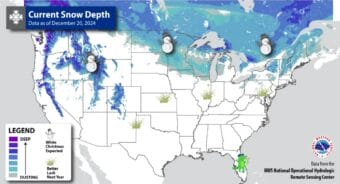
On Christmas Eve, travel will be messy in many parts of the country as thunderstorms are forecast in the southern Plains. Rain is expected to slow travel on the West Coast and in the Ohio Valley as well. There is also likely to be snow in the Northeast, where some places could see 1 to 3 inches of snow, potentially waking up to a white Christmas.

This graphic of the U.S. shows areas that are most likely to have snow on the ground on Christmas Day. (NWS/weather.gov)

Parts of the West Coast — including Washington, Oregon and northern California — the Midwest, areas around the Great Lakes and northern New England could also wake up to a white Christmas, according to the NWS.

Be prepared for delays

If traveling for the holiday, be prepared for long lines at airports and long drive times.

Arrive at airports early and allow for extra time to check luggage as well as go through airport security, said David Pekoske, administrator of the Transportation Security Administration.

“We’ve recently added over 600 new officers to support the surge, but it’s still going to take time to make your way through the airport,” Pekoske wrote in a social media post on Friday.

More than 43,000 flights are expected to take off Sunday and around 43,500 are expected to fly on Monday as well, according to the Federal Aviation Administration. At least 10,000 flights in and out of the U.S. were delayed Friday and over 9,500 were delayed on Saturday, according to FlightAware. Around 3,500 flights in and out of the U.S. have been delayed as of Sunday afternoon.

Christmas Eve and Christmas Day are expected to have the least amount of travelers by air, with a little over 30,000 flights taking off each day, the FAA says. And if traveling by car, Christmas Eve and Christmas Day may be better days because of minimal traffic impacts, according to AAA.

If you’re riding the rails, Amtrak is warning travelers of “lengthy delays” in the Northeast because of single tracking and overhead wiring, which has led to cancellations at some stations.

The U.S. Department of Homeland Security on Friday in a public service campaign also urged travelers to prepare by creating alerts in the FEMA app and following TSA for updates. It also cautioned drivers to make sure they have an emergency car kit.

Richer countries are starting to pay poorer ones for climate change damages

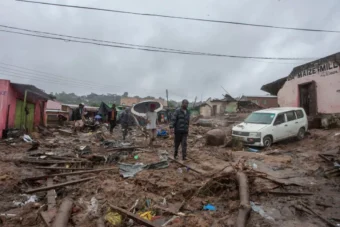
More than 1,000 people died in 2023’s Cyclone Freddy and hundreds of thousands more were displaced in Malawi. Many low-income nations are bearing disproportionate impacts from more intense storms. (Amos Gumulira/AFP via Getty Images)

It was 2 a.m. when floodwaters started pouring into Christopher Bingala’s house. Cyclone Freddy, the longest-lasting tropical cyclone ever recorded, brought a deluge of rain to southern Malawi in 2023. He managed to get his six kids to higher ground but lost his house and livestock.

As a subsistence farmer, Bingala didn’t have the resources to start over. But then he got a payment of about $750, which he used to build his family a new house.

The payment is one of the first examples of “loss and damage” compensation, a new kind of funding specifically for climate change-related disasters. Low-income countries are bearing the brunt of more intense storms and droughts but have done little to produce the pollution that’s heating up the planet. So last year, wealthier countries agreed to create a fund specifically to pay for the damages from climate change.

So far, about $720 million has been pledged from countries, like the European Union, U.S. and United Arab Emirates. But climate experts warn that with hurricanes and floods only getting worse, that amount will fall far short.

At the COP29 climate summit underway in Baku, Azerbaijan, countries are negotiating how much is owed to developing nations, as part of a larger “climate finance” package that includes loans and investments.
“We just hope that the global north and the nations whose economy is fueled by the emissions – they come to the plate and take up their responsibility to look at what they’re causing us,” says Philip Davis, prime minister of the Commonwealth of the Bahamas.

Finding a way to start over

The havoc from Cyclone Freddy was widespread across several countries, displacing 650,000 people from their homes in Malawi alone. The country received six months of rain in just six days.

After their house collapsed in the floodwaters, Bingala and his family took refuge on higher ground, but the situation quickly deteriorated. They started running out of food.

Christopher Bingala, a farmer in Malawi, stands outside his new home. After losing his house in Cyclone Freddy, he received a payment from a new fund for the damages from climate-related disasters. (Henderson Mhone)

“We got to a point where we would eat meat from animals that had died from the cyclone because we lacked food,” Bingala says. “This was a very difficult moment in my life.”

Along with thousands of others, he and his family were relocated to temporary camps. But as a small-scale farmer and fisherman, Bingala had no safety net to fall back on. Then he received the cash payment, which allowed him to move to a new village and build a better house. There are still challenges – Bingala is still trying to get his kids back in school and he’s hoping to get a few livestock again. But he’s glad his family is living in a less flood-prone region.

“They are better off here because they are not in danger of the water challenges we had back in Makhanga,” Bingala says. “This is a dry and upper land, so my children are ok and they’re happy. They’re living a happy life.”

Piloting a system to pay damages

The payment Bingala received came from the government of Scotland, the first country to dedicate funding specifically for loss and damage. The funds have gone to several countries so far. In Malawi, they were given out by GiveDirectly, a non-profit that specializes in providing cash grants to those in need with no strings attached.

About 2,700 families got payments of around $750, which can be equivalent to two years of income in Malawi. Many used the money to rebuild homes, while others invested in seeds, fertilizers and livestock, or putting their kids back in school.

“Low-income households in low-income countries have far less protections from extreme events,” says Yolande Wright, vice president of partnerships at GiveDirectly. “They may not have any sort of insurance. There may not be any insurance products available, even if they wanted to buy them.”

The program in Malawi is a pilot, in a sense, for a larger system to pay for loss and damage. Last year, countries agreed to create the fund as a way to compensate lower-income countries, which have low greenhouse gas emissions overall. Almost half of all emissions since the Industrial Revolution have come from the U.S. and Europe.

“The very poor, low-income households in Malawi have contributed the least to the climate problem,” Wright says. “Many of them are not connected to electricity. They don’t own a car or even a motor bike.”

A ballooning need for loss and damage funding

Increasingly severe hurricanes, storms and droughts pose a massive financial burden on developing countries, especially those already in debt. In the Bahamas, Prime Minister Davis says his country’s national debt went up after Hurricane Dorian hit in 2019.

“For me to recover and rebuild, I have to borrow,” Davis says. “Forty percent of my national debt could be directly attributed to the consequences of climate change.”

So far, the majority of $720 million pledged for loss and damage has yet to start flowing. At the COP29 summit, countries finalized the paperwork to create the fund, which will be housed at the World Bank. The fund’s guidelines have yet to be set up, like determining which countries will receive funding and for what kinds of damages.

Many low-income countries have argued the funding should go to more than just disaster recovery. Some could be used to relocate villages in the path of sea level rise, or to compensate countries for the loss of important cultural sites or ecological resources, like coral reefs.

The need for loss and damage funding is only expected to balloon as disasters get more extreme. One recent study found it will reach $250 billion per year by 2030. Davis says he hopes richer countries will contribute more in “enlightened self-interest,” since many humanitarian crises do not stay confined to country borders.

“If they do nothing, they will be the worst for it,” Davis says. “When my islands are swallowed up by the sea, then what do my people do? They’ll either become climate refugees or they’ll be doomed to a watery grave.”

Trump picks North Dakota Gov. Doug Burgum to lead the Interior Department

Governor of North Dakota Doug Burgum speaks during the final campaign rally for former US President and Republican presidential candidate Donald Trump before election day at Van Andel Arena in Grand Rapids, Michigan, on November 4, 2024. (Photo by KAMIL KRZACZYNSKI / AFP) (Photo by KAMIL KRZACZYNSKI/AFP via Getty Images)

President-elect Donald Trump said Thursday night that he will nominate North Dakota Gov. Doug Burgum to be secretary of the Department of the Interior.

“He’s going to head the Department of Interior, and it’s going to be fantastic,” Trump said in a speech during an America First Policy Institute dinner at his Mar-a-Lago resort. He said there will be a formal announcement on Friday.

“We’re going to do things with energy and with land interior that is going to be incredible,” Trump said.

As secretary, Burgum will play a key role in pushing Trump’s agenda to increase oil, gas and coal production on public lands.

Interior is a sprawling department responsible for managing 20% of U.S. surface land, as well as federally owned mineral rights. This gives Interior control over nearly a quarter of all energy development in America, on- and off-shore.

Burgum is known as a big booster of oil and gas drilling, though his state’s boom has mostly occurred on private land such as the Bakken oil field. Historically, Interior secretaries have generally come from Western states with large tracts of federal public land, while North Dakota is only about 4% federally owned.

The Trump administration is expected to reverse President Biden’s focus on conservation and renewable energy policy enacted by current Interior Secretary Deb Haaland, the nation’s first Indigenous Cabinet member.

Haaland also has been implementing a controversial and first of its kind rule that will allow public land to be leased for conservation, not just drilling.

“In this era of this really terrible climate crisis, those are considerations that need to be made when we’re managing our public lands,” Haaland told NPR last month.

Interior is also in charge of U.S. national parks, monuments and wildlife refuges. It also oversees relations with 566 federally recognized Native American tribes, including Alaska Natives, Hawaii Natives and affiliated Island Communities.

Burgum was elected governor in 2016 on a campaign focused on anti-establishment politics. Before that, he led a software company that he sold to Microsoft for $1.1 billion in stock in the early 2000s.

Leveraging his other entrepreneurial success in his real estate development firm and software venture capital group, Burgum ran a largely self-funded campaign in the 2024 Republican presidential primary and focused on energy and taxes before dropping out of the race last December. He then became a vocal supporter of Trump and hosted fundraising events for him while being shortlisted for the Republican vice presidential nomination.

Restoring and expanding fossil fuel energy development should be priority one at Interior in the coming Trump term, former Interior official William Perry Pendley wrote in Project 2025, a blueprint for the new administration published by the the Heritage Foundation.

Emissions from burning and extracting fossil fuels from public lands and waters account for about a quarter of U.S. carbon dioxide emissions, according to the U.S. Geological Survey.

Trump’s previous Interior secretaries became embroiled in ethics scandals. He dismissed Ryan Zinke, a Republican congressman from Montana, after 21 months as Zinke was facing multiple ethics investigations. An investigation by Interior’s inspector general found Zinke had misused his position to advance a development project in his Montana hometown.

Trump then elevated former oil industry lobbyist and Deputy Interior Secretary David Bernhardt to the top of the agency. Nine months after his appointment, the Government Accountability Office found Bernhardt had twice violated the law at Interior when he directed the National Park Service to use park entrance fees for maintenance to keep parks open during the 2019 government shutdown.

Donald Trump has won the presidential election and will return to the White House

Republican former President Donald Trump, joined by, from right, Melania Trump and Barron Trump, arrives to speaks at an election night watch party. (Alex Brandon/AP)

WEST PALM BEACH, Fla. — Former President Donald Trump will return to the White House, according to a race call by the Associated Press.

Trump won the key states of Wisconsin and Pennsylvania, with a combined 29 electoral votes to clinch the 270 necessary to win the presidency. As of 5:34am ET Wednesday, Trump had 277 electoral votes total.

Prior to the race call for Wisconsin, and before the Associated Press had called the race in his favor, Trump spoke at Palm Beach Convention Center in West Palm Beach, Fla., where he stood flanked by family and staff and spoke to a crowd of supporters.

“We overcame obstacles that nobody thought possible,” Trump said.

“Every single day I will be fighting for you and with every breath in my body, I will not rest until we have delivered the strong, safe and prosperous America that our children deserve and that you deserve. This will truly be the golden age of America,” he said.

“We’re going to help our country heal, help our country heal,” Trump said.

Trump said that he won the popular vote, but those results have not been fully tabulated.

He will return to the White House after falsely claiming the 2020 election was rigged and stoking the Jan. 6 attack on the Capitol. He is also the first convicted felon to win the White House.

Republicans say Trump won the election for one simple reason. Voters felt that they were better off four years ago than they were today.

“Voters have really short memories,” said Alex Conant, a Republican strategist who helped lead Senator Marco Rubio’s presidential campaign in 2016. “And while I think everyone is appalled by what happened on January 6, they’re also appalled by what they have to pay for eggs today. People think about inflation every single day when they’re buying gas, when they’re going to the grocery store.”

The former reality star and real estate magnate weathered crisis after crisis, each one career ending for most any politician. But he maintained steadfast and unwavering support among his base and convinced just enough Americans to send him back to the White House.

The results were a blow not only to Vice President Harris, but also to the legacy of President Biden whose administration struggled with border challenges, high inflation and increasing uncertainty around the world.

This story has been updated. 

Site notifications
Update notification options
Subscribe to notifications