Kaiser Health News

Lessons from Germany to help solve the US medical debt crisis

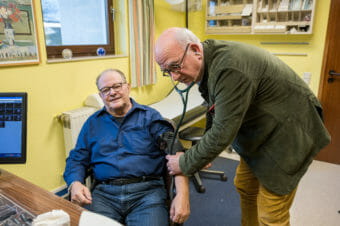
A doctor checks a man's blood pressure.
Dr. Eckart Rolshoven examines a patient at his clinic in Püttlingen, a small town in Germany’s Saarland region. Although Germany has a largely private health care system, patients pay nothing out-of-pocket when they come to see him. (Pasquale D’Angiolillo for KHN)

PÜTTLINGEN, Germany — Almost every day, Dr. Eckart Rolshoven sees the long shadow of coal mining in his clinic near the big brownstone church that dominates this small town in Germany’s Saarland.

The region’s last-operating coal shaft, just a few miles away, closed a decade ago, ending centuries of mining in the Saarland, a mostly rural state tucked between the Rhine River and the French border. But the mines left a difficult legacy, as they have in coal regions in the United States, including West Virginia.

Many of Rolshoven’s patients battle lung diseases and chronic pain from years of work underground. “We had an industry with a lot of illnesses,” said Rolshoven, a genial primary care physician who at 71 is nearing the end of a long career.

The Saarland’s residents are sicker than elsewhere in Germany. And like West Virginia, the region faces economic hurdles. For decades, German politicians, business leaders and unions have labored to adjust to the mining industry’s slow demise.

But this is a healthier place than West Virginia in many respects. The region’s residents are less likely to die prematurely, data shows. And on average, they live four years longer than West Virginians.

There is another important difference between this former coal territory and its Appalachian counterpart: West Virginia’s economic struggles have been compounded by medical debt, a burden that affects about 100 million people in the U.S. — in no state more than West Virginia.

In the Saarland, medical debt is practically nonexistent. It’s so rare in Germany that the federal government’s statistical office doesn’t even track it.

The reason isn’t government health care. Germany, like the U.S., has a largely private health care system that relies on private doctors and private insurers. Like Americans, many Germans enroll in a health plan through work, splitting the cost with their employer.

But Germany has long done something the U.S. does not: It strictly limits how much patients have to pay out of their own pockets for a trip to the doctor, the hospital or the pharmacy.

Rolshoven’s patients pay nothing when they see him. That not only bolsters their health, he said. It helps maintain what Rolshoven called social peace. “It’s really important not to have to worry about these problems,” he said.

German health officials, business leaders and economists say the access to affordable health care has also helped the Saarland get back on its feet economically, bolstered by the assurance that workers could get to the doctor.

“Without this, the Saarland would be dead,” said Beatrice Zeiger, managing director of the Arbeitskammer des Saarlandes, a regional labor group. “It’s unthinkable.”

While health costs rise in the U.S., Germany contains them

In West Virginia, whose wooded valleys and decaying industrial plants could be mistaken for the Saarland’s, access to health coverage has been important as the state weathered the decline of its mines.

A decade ago, state leaders moved to expand the Medicaid insurance program through the Affordable Care Act. And as of last year, just 6% of state residents were uninsured, less than half the rate before the 2010 law.

But growing numbers of West Virginians without government insurance are in private health plans with deductibles that require they pay thousands of dollars out of their own pockets before coverage kicks in.

The typical individual health plan an American gets through work now comes with a more than $1,500 deductible, a particularly big sum in a state like West Virginia where residents often earn less than residents of other states.

That, in turn, is driving medical debt. A quarter of West Virginians with a credit report have medical bills in collections, almost twice the national rate, according to data compiled by the nonprofit Urban Institute. In several counties in the state, the rate is about a third.

And those figures likely understate the problem. Many more people put medical bills on their credit cards, borrow from family or enroll in installment plans with a hospital or other providers to pay off their bills.

“It’s a huge problem here,” said Jessica Ice, executive director of West Virginians for Affordable Health Care. “Folks with medical debt aren’t able to apply for loans to start a business or buy a starter home for their family. It’s really preventing people from climbing up the economic ladder.”

In German health plans, known as sickness funds, there aren’t typically deductibles.

Physician visits are almost always free for patients. Copays for most prescription drugs are capped at 10 euros or less, about $10. And people admitted to the hospital pay only 10 euros a day.

“Access to medical care with minimal costs for patients has been essential,” said Armin Beck, regional director of the Knappschaft Bahn See, of KBS, a health insurance plan whose roots stretch back to the 13th century, when miners set up a mutual aid society to protect one another in case of injuries or accidents. “This has been a foundation of our community,” Beck said.

‘So glad we don’t have to worry’

Along the Saar River in Germany, rusting steelworks and shuttered coal-fired power plants bear testament to the region’s economic struggles. Many towns like Püttlingen carry on in the shadow of hulking mounds of debris — Berghalde, as they are called — the detritus left behind as coal was separated from the rocky earth hauled up from underground.

An aerial photo of a coal mine in a clearing in a forest.
The now-shuttered Bergwerk Saar coal mine in Germany’s Saarland closed in 2012, ending centuries of mining in the region. Coal from the Saarland helped fuel Germany’s industrialization and once employed tens of thousands of workers. (Pasquale D’Angiolillo for KHN)

Today, new challenges confront the region. Ford, which has operated a car factory here for decades, plans to shutter the plant in a few years and move production to Spain.

But at Rolshoven’s clinic — a small set of offices tucked into a residential neighborhood — few patients can conceive of the burdens that medical bills put on Americans.

Andrea Fecht, 63, who has diabetes and came to see Rolshoven because recent tests revealed a concerning rise in her blood sugar, estimated she pays 120 euros a year, or about $125, to fill all six of her prescriptions, including her daily insulin.

In the U.S., the average price for insulin alone is nine times that in Germany, according to a recent report from Rand Corp., a research group.

Andreas Mang, a former miner who left the industry 20 years ago after a series of accidents, would likely pay even more out-of-pocket for his family’s drugs. Mang’s wife recently underwent a course of chemotherapy that would cost thousands of dollars if not for Germany’s limits on medical bills, Rolshoven said.

“I can’t imagine what it would be like not to have this support,” Mang said.

Christine Wagner said she’s had a glimpse of what Americans face. Wagner’s 18-year-old son, Jonas, has Down syndrome and has required more than 20 surgeries.

In global Facebook groups with other parents who have children with disabilities, Wagner said she’s amazed to see how much fundraising American parents do to pay family medical bills. “I’m so glad we don’t have to worry about that,” she said. “We have enough to do looking after Jonas.”

Countries where health care is actually affordable

International surveys underscore the difference Wagner observed between her experiences and those of American families.

In one recent study of health care in 11 high-income countries, the nonprofit Commonwealth Fund found that 44% of Americans had out-of-pocket medical expenses that topped $1,000 in the previous year. Just 16% of Germans reported paying that much. The rates were even lower in France, at 10%, and Great Britain, where only 7% reported similar medical expenses.

U.S. patients were also more than twice as likely as patients in any of the 10 other countries studied to say they had serious problems paying medical bills.

“Many Americans may not understand how affordable health care is for patients in other countries,” said Reginald D. Williams II, who oversees international research at the Commonwealth Fund. “Medical debt is a largely U.S. phenomenon. It just doesn’t happen in other countries.”

Most wealthy countries in Western Europe, East Asia and elsewhere limit patients’ out-of-pocket costs.

In the Netherlands, where patients enroll in private health plans as they do in Germany, insurers typically cover all medical expenses after patients pay a standard deductible of 385 euros, or about $400. Physician visits are fully covered.

In Great Britain, where medical care that is “free at the point of service” has been a foundation of that country’s government-run National Health Service for almost 75 years, there are rarely any doctor or hospital bills.

When the government asked Britons who’d gone into debt about the causes, just 2% cited paying for medical treatment. A similar share attributed their debt to gambling or another habit.

In the U.S., 41% of adults currently have debt from medical or dental bills, according to a KFF poll.

How Germany regulates hospital, doctor and drug prices

Germany’s strict limits on medical bills have periodically stoked concerns about patients overusing the health system.

But when health plans tried implementing a copay of 10 euros for physician visits, it was quickly rolled back amid criticism from patients and frustration among doctors, who didn’t like chasing after their patients for bills.

A man sits behind a desk wearing a stethoscope around his neck.
Germany’s limits on how much patients pay out-of-pocket at the doctor’s office have been critical to ensuring people get needed care, especially in a mining region where many battle lung diseases and chronic pain, says Dr. Eckart Rolshoven. “We had an industry with a lot of illnesses,” he says. (Pasquale D’Angiolillo for KHN)

At the hospital in Püttlingen, which is operated by the Knappschaft, Dr. Marion Bolte said asking patients to pay more isn’t worth the risk, even if it might bring in more money.

“It’s better to have 20 unnecessary visits than to have one patient get harmed because they didn’t come to the hospital because they were worried about how much it would cost,” said Bolte, the chief medical officer. “We don’t want patients to worry about money. We want them to worry about getting better.”

Nationally, German patients are less likely than Americans to die from conditions that can be treated with good access to medical care, such as heart attacks, diabetes, pneumonia and some cancers, according to regional data compiled by the Paris-based Organization for Economic Cooperation and Development.

Germans are also less likely than Americans to say they had to wait to see a doctor, surveys show.

Lower-cost health care that protects workers from going into debt has meant fewer concerns for the Saarland’s policymakers, as well. “All that our predecessors had to worry about was creating jobs,” said Oliver Groll, a senior official at IHK Saarland, the regional chamber of commerce. “Health care took care of itself.”

As mining jobs disappeared, the Saarland shifted toward other industries, such as auto manufacturing, which has been a major employer since Ford opened its factory in 1970, sparking the development of a robust auto parts sector. The chamber and other business leaders are now working to lure technology and pharmaceutical jobs to the region.

For Mang, the former miner whose wife had cancer, knowing that medical bills wouldn’t drive him into debt helped give him the peace of mind to switch careers. “I never had to think about how much health care would cost me,” said Mang, who is now a nurse.

Maintaining this system has required that Germany do something else that U.S. policymakers have historically eschewed. Germany, like most wealthy nations, regulates the prices that hospitals, doctors and drugmakers can charge. This regulation occurs through a highly structured system in which insurers negotiate collectively with physician and hospital groups to set prices.

American hospitals and other medical providers for decades have fiercely resisted limits on their prices, spending millions to fight government regulation.

Price regulation can put more financial pressure on providers, who, unlike their American counterparts, can’t just demand higher prices from insurers to bolster their bottom lines.

Mario Schüller, the hospital administrator who runs the Knappschaft hospital in Püttlingen, said hospitals must instead compete to attract patients with better care and better customer service. Those that can’t compete may close, he said.

But Schüller said he wouldn’t want to charge patients more, even if he could.

“If I had to bill patients and then try to collect from them, I’d have to pay for all that,” he said. “We’d need new staff, who would have to get paid. And if we used collections companies, they’d have to be paid, too. It becomes a devil’s bargain.”

Copyright 2022 Kaiser Health News. To see more, visit Kaiser Health News.

KHN (Kaiser Health News) is a national newsroom that produces in-depth journalism about health issues. Together with Policy Analysis and Polling, KHN is one of the three major operating programs at KFF (Kaiser Family Foundation). KFF is an endowed nonprofit organization providing information on health issues to the nation.

More people are opting to get sterilized — and some are being turned away

Dani Marietti’s “sterilization shower” in Helena, Montana, features cookies with abortion-rights slogans, such as “My Body, My Choice,” written on them in frosting. (Photo by Ellis Juhlin/Yellowstone Public Radio)

In July, a handful of people gathered in the shade of a large pine tree in Helena, Montana for a going-away party of sorts.

Their friend, Dani Marietti, was going to have her fallopian tubes removed.

It was a decision she had made after a draft of the U.S. Supreme Court’s decision to overturn the constitutional right to abortion was leaked to the press.

The small group kicked off the “sterilization shower” for the 25-year-old by laying out chalk-written signs that said “See Ya Later Ovulater” and “I got 99 problems but tubes ain’t one.” They munched on cookies that had abortion-rights slogans, such as “My Body, My Choice,” written on them in frosting.

Marietti is a full-time graduate student in Helena working toward becoming a therapist. She doesn’t want kids to get in the way of her career. She had considered permanent sterilization before, but the possibility that the Supreme Court would overturn Roe v. Wade pushed her to seek out an OB-GYN who would help her with a permanent method of contraception.

“‘I want to do this as soon as possible,'” she recalled telling the doctor.

“I always knew I didn’t want children, and of course when you say that as a younger person, everyone is like, ‘Oh, you’ll change your mind,’ or, ‘Just wait until you find the one,'” Marietti says. “I always kind of ignored that.”

Doctors see growing demand for sterilization

Abortion is still legal in Montana, but whether it will remain so is unclear.

State Attorney General Austin Knudsen, a Republican, has asked the Montana Supreme Court to overturn its 1999 decision that said the state constitution’s right to privacy includes the right to end a pregnancy.

The uncertainty around abortion access in Montana and other states where abortion is now or could become illegal, plus the fear of future legal fights over long-term contraception, has seemingly spurred a rise in the number of people seeking surgical sterilization, according to reports from doctors. That includes Marietti, who is having a salpingectomy — a procedure in which the fallopian tubes are removed instead of tied, as in tubal ligation, which can be reversible.

How many people sought permanent sterilization after the fall of Roe won’t become clear until next year, says Megan Kavanaugh, a researcher for the Guttmacher Institute, which gathers data related to reproductive health care across the U.S. and supports abortion rights.

But anecdotal reports indicate that more people have been undergoing permanent birth control procedures since the Supreme Court’s June 24 decision in Dobbs v. Jackson Women’s Health Organization, which struck down Roe.

Dr. Kavita Arora, who chairs the American College of Obstetricians and Gynecologists’ Committee on Ethics, says providers across the country are beginning to see an influx of patients into their operating rooms.

Arora, an OB-GYN in North Carolina, recounted what one of her patients said just before a recent surgery: “She wanted to have autonomous control over her body, and this was her way of ensuring she was the person who got to make the decisions.”

More adults in their 20s and 30s without children are coming to the hospital for sterilization consultations, says Dr. Marilee Simons, an OB-GYN at Bozeman Health Deaconess Hospital in Montana.

Many are women who already use long-term birth control options, but “they are still worried about an unintended pregnancy and what that might mean in the future,” she says.

Most are asking to have their tubes removed to permanently prevent pregnancy. A smaller number of people are asking for hysterectomies, which surgically remove part or all of the uterus. To meet demand, Bozeman Deaconess has dedicated at least one provider to work with these patients multiple days a week.

Planned Parenthood of Montana President and CEO Martha Fuller says clinics statewide have seen an “unprecedented” increase in patients asking to be sterilized, including requests for vasectomies.

A group of people sitting on picnic blankets in a park
Dani Marietti (holding sign) and her friends gather for a “sterilization shower” in Helena, Montana, in July before Marietti was scheduled to have her fallopian tubes surgically removed. (Photo by Ellis Juhlin/Yellowstone Public Radio)

Patients face obstacles

But some people seeking sterilization procedures across the U.S. are being turned away.

Arora says patients who don’t have children and are in their childbearing years are reporting difficulties finding physicians willing to sterilize them. Their reluctance may stem from studies that suggest patients who are sterilized at age 30 or younger are about twice as likely as those over 30 to express regret after getting the procedure. However, other studies had mixed results and found that some women feel less regret over time.

Some patients who have been denied sterilizations have turned to therapists like Barbara DeBree, who has a private practice in Helena and writes letters to providers attesting that the patients have thought through their decisions. “This is not a quick decision for them,” DeBree says.

Cost and insurance coverage can also be issues for patients seeking sterilization procedures.

Helena resident Alex Wright, 23, doesn’t plan to have children and wants to be sterilized.

She plans to schedule a consultation to see whether her provider will perform the procedure. If her regular provider won’t do it, she says she will seek out someone from online lists of providers who are willing to perform the procedure on younger people.

“That’s only helpful if I can get the financial assistance to get it taken care of through those people,” she says. Wright says her insurance company estimates she’ll pay about $4,000 out-of-pocket if she goes with an in-network provider. Using an out-of-network doctor could cost substantially more.

Some fear future “attacks on contraception”

Although some people are seeking permanent procedures in reaction to the Dobbs decision, others are doing so because they believe the U.S. Supreme Court will continue upending reproductive health norms.

Kavanaugh, the researcher at Guttmacher, says Justice Clarence Thomas opened that door by suggesting in his concurring opinion in Dobbs that other precedents should be revisited, including the 1965 Griswold v. Connecticut decision that says banning contraceptives violates a married couple’s right to privacy.

“I think we are anticipating that there’s going to be some attacks on contraception,” Kavanaugh says.

That’s what worries Shandel Buckalew, of Billings, Montana, who wants a full hysterectomy.

The 31-year-old says her doctor thinks she has endometriosis, a painful condition in which tissue that normally grows inside the uterus grows on other parts of the reproductive organs. Buckalew hasn’t undergone the full range of testing that can be required for a diagnosis because she doesn’t have health insurance and can’t afford it.

“Even though I have an IUD [intrauterine device], the amount of cramps and the pain I go through — oh, I get so sick,” she says.

Buckalew hopes a hysterectomy will alleviate that pain, in addition to providing permanent birth control because she doesn’t want kids. But her lack of health insurance makes the procedure unaffordable.

She’s trying to get health insurance before her IUD expires in two years, because she fears the reproductive health care landscape could shift dramatically.

“It feels like my life doesn’t matter,” she says.

KHN (Kaiser Health News) is a national newsroom that produces in-depth journalism about health issues. Together with Policy Analysis and Polling, KHN is one of the three major operating programs at KFF (Kaiser Family Foundation). KFF is an endowed nonprofit organization providing information on health issues to the nation.

Copyright 2022 Kaiser Health News. To see more, visit Kaiser Health News.

Patients’ perilous months-long waiting for Medicaid coverage is a sign of what’s to come

""
Stacey Whitford applied for Medicaid for herself and her son in December. He needs the coverage for hearing aids but the family had to wait months before finally being approved on the last day of March. “It’s just like hanging a golden ticket right in front of your face and saying, ‘Here it is, but you can’t touch it,’” Whitford said in early March as their wait neared 100 days. (Photo by Christopher Smith for KHN)

Korra Elliott has tried to avoid seeing a doctor while waiting to get on Medicaid. She worries she can’t afford more bills without any insurance coverage. But in early March — five months, she said, after applying and with still no decision about her application — a suspected case of the flu sent her blood pressure soaring and landed her in the emergency room.

The 28-year-old mother of four from Salem, Missouri, is among the tens of thousands of uninsured Missourians stuck waiting as the state slogs through a flood of applications for the state-federal health insurance program. Missouri expanded the program last year after a lengthy legal and political battle, and it now covers adults who earn up to 138% of the federal poverty level — about $18,800 annually for an individual.

Missouri had nearly 72,000 pending Medicaid applications at the end of February and was averaging 119 days to process one, more than twice the maximum turnaround time of 45 days allowed by federal rules. Adding people to Medicaid is labor-intensive, and the jobs require training and expertise. The program covers many populations — children, people with disabilities, seniors, adults who are pregnant or have children, and some without children. Different rules dictate who qualifies.

Missouri simply doesn’t have the workers to keep up. Last fiscal year, 20% of its employees who handled Medicaid applications left their jobs, said Heather Dolce, a spokesperson for the Missouri Department of Social Services. And the average number of job applications received for each opening in the department’s Family Support Division — which oversees enrollment — dropped from 47 in March 2021 to 10 in February 2022.

Just about every industry is struggling to find workers now, but staffing shortages in state Medicaid agencies around the country come at a challenging time. States will soon need to review the eligibility of tens of millions of people enrolled in the program nationwide — a herculean effort that will kick off once President Joe Biden’s administration lets the COVID-19 public health emergency declaration expire. If Missouri’s lengthy application backlogs are any indication, the nation is on course for a mass-scale disruption in people’s benefits — even for those who still qualify for the insurance.

“If you don’t have people actually processing the cases and answering the phone, it doesn’t matter what policies you have in place,” said Jennifer Wagner, director of Medicaid eligibility and enrollment for the Center on Budget and Policy Priorities, a left-leaning think tank in Washington, D.C.

Federal officials have said they will give states 60 days’ notice before ending the public health emergency, so it’s unlikely to expire before summer. Once it does, enrollees won’t be kicked off immediately: States can take up to 14 months to complete renewals, although budget pressures may push many to move faster. A bump in federal Medicaid funds to states, provided by Congress through covid relief legislation in 2020, will end shortly after the emergency’s expiration.

Ultimately, workers are needed to answer questions, process information confirming someone’s Medicaid enrollment should be renewed, or see whether the person qualifies for a different health coverage program — all before the benefits lapse and they become uninsured.

State Medicaid officials have said staffing is one of the top challenges they face. In a January meeting of the Medicaid and CHIP Payment and Access Commission, an outside panel of experts that advises Congress, Jeff Nelson said 15% to 20% of the Utah Department of Health’s eligibility workers were new. “We’ve got a fifth of the workforce that potentially doesn’t know what they’re doing,” said Nelson, who oversees eligibility for Utah’s Medicaid program.

Eligibility worker vacancies at the Texas Health and Human Services Commission quadrupled over roughly two years — 1,031 open positions as of late February compared with 260 as of March 31, 2020, according to spokesperson Kelli Weldon.

Medicaid renewals are less labor-intensive than initial applications, but it takes time before an eligibility worker knows the ins and outs of the program, Wagner said.

“It’s months before you are fully functional,” said Wagner, who previously oversaw the Illinois Department of Human Services’ offices that determine applicants’ eligibility for Medicaid, the Supplemental Nutrition Assistance Program that provides food stamps, and other assistance programs.

Other social services may be gummed up in the process because many workers also handle applications for other programs. In addition to Medicaid, workers for Kentucky’s Department for Community Based Services handle SNAP and child care assistance applications.

Consumer advocates who connect people to safety-net programs worry that an overwhelmed workforce won’t be able to keep up.

“It’s going to be a lot of work for everyone,” said Miranda Brown, who helps people apply for benefits as outreach coordinator for the Kentucky Equal Justice Center, a legal aid group.

Brown said she recently called a state office on behalf of a client toward the end of the day. She waited on hold for an hour only to be told by a caseworker that the agency couldn’t process any more cases that day.

“I even have a [phone] line that I get through faster than a consumer calling for themselves,” she said. “If it’s hard for me, it’s very hard for consumers who are trying to call on their lunch break at work.”

South Carolina planned to hire “a couple hundred workers” beginning this spring to help manage renewals at the end of the public health emergency, said Nicole Mitchell Threatt, deputy director of eligibility, enrollment, and member services at the Department of Health and Human Services. The turnover rate among eligibility workers was about 25% from July 2020 to June 2021, jumping from a 15% rate in the previous 12 months.

In Missouri, Dolce said her department hopes a recently approved pay increase will help recruit more workers and improve staff morale and retention. The department is being sued over delays in enrollments for SNAP benefits, which it also oversees.

Kim Evans, director of the Missouri Department of Social Services’ Family Support Division, told the state Medicaid oversight committee in February that her division was offering overtime and she was even offering to buy pizza to speed up the processing of applications. But the department is enrolling fewer than 3,000 people per week, leaving tens of thousands waiting and delaying their care.

In the suburbs of Kansas City, Missouri, Stacey Whitford, 41, applied in December for Medicaid for herself and her 13-year-old son. Her son needs hearing aids that she said cost $2,500 apiece without insurance. She also lined up a support worker for the boy, who has autism, through the Department of Mental Health but said she was told the worker can begin only once her son is enrolled in Medicaid.

“It’s just like hanging a golden ticket right in front of your face and saying, ‘Here it is, but you can’t touch it,’” she said in early March.

Whitford spent hours on the phone trying to sort out the status of their applications, then on March 31, just shy of four months after applying, they were finally approved.

“I am so excited! We can run with scissors now,” she joked.

But Elliott, the mother of four in Salem, is still waiting. She gave up calling the state’s Medicaid helpline after growing frustrated from spending hours on hold and being disconnected because of high call volumes. Instead, she checks on her application through the enrollment specialists at the clinic where she applied.

She was sent home from the ER with ibuprofen and Tamiflu and has yet to see a bill. If her Medicaid application is approved, her coverage will be backdated to the month she applied, likely covering her ER trip. But if her application is rejected, that cost will be added to her medical debt, which Elliott estimates is already tens of thousands of dollars.

“It makes me feel like it’s a joke,” Elliott said of Missouri’s expansion of Medicaid. “Like they’re just throwing it out there to get all these people to apply for it, but they’re not going to really help anybody.”

KHN (Kaiser Health News) is a national newsroom that produces in-depth journalism about health issues. Together with Policy Analysis and Polling, KHN is one of the three major operating programs at KFF (Kaiser Family Foundation). KFF is an endowed nonprofit organization providing information on health issues to the nation.

Subscribe to KHN’s free Morning Briefing.

Solar-powered boat sails the Inside Passage

David Borton with his boat, the Wayward Sun. (Katie Anastas/KFSK)

Boaters coming and going in Petersburg’s North Harbor may have noticed a new visitor this weekend. David Borton and his son, Alex, sailed from Bellingham, Washington, in a 27-foot solar-powered boat.

Because the Wayward Sun runs on solar, every day at sea can look a little different. Today, it’s cloudy, and Borton is waiting for his boat to recharge.

“Well, today is actually a three or four knot day,” he said. “In the rain, it might be a two or three knot day. If we had plenty of sun, we’d go five or six knots. So it all depends on the sunshine because we run only on sunshine.”

Borton and his son, Alex, have spent the last three weeks sailing north from Bellingham through the Inside Passage. After 20 days at sea, they made it to Ketchikan.

A solar-powered boat might not seem like the best option in the Pacific Northwest and Southeast Alaska. But despite the slow-downs that come with cloudier days, Borton still sees the benefits of solar power.

“Most boats don’t operate continuously — they stop at the dock for a while,” he said. “We’re on a continuous cruise, so you’re always ready to get in. There’s no noise. There’s no smell. You turn the key, and you’re off.”

Still, Borton said it has been a learning experience.

“Now, I knew already that if you’re running all on sunshine, you have to be aware of how much energy you get and how much energy you use,” he said. “I was aware of that. I’ve been doing that for years. But on this voyage, it really comes home and you’re, you know, it’s in front of you all the time.”

Borton grew up rowing Adirondack guide boats in upstate New York. He eventually became a physicist. Solar-powered boats let him combine his love of physics with his love of sailing.

“There was a time when I could not buy gasoline,” he said. “That makes you look for other things, and so I got into solar energy.”

Borton started out by building the boats himself, adding solar panels onto wooden boats. Then, he and a marine architect worked on a 44-foot solar-powered boat. It’s now used for tours in the Hudson River.

Borton and Alex had the Wayward Sun built by Devlin Boat Builders in Olympia, Washington. On their way up to Petersburg, they stopped in Thorne Bay, where Borton once worked as a logger. Their ultimate destination is Glacier Bay.

Until they can set sail again, Borton said he’ll keep enjoying Petersburg. His next destination in town was Coastal Cold Storage for a cup of seafood chowder.

“You are 100% solar-powered. All your food is solar energy. All the fresh water you drink was distilled by the sun,” he said. “So, you know, why not boats?”

You can read a blog written by Borton’s wife, Harriet, with updates on their trip here.

Supreme Court backs broad enforcement of travel ban — for now

The U.S. Supreme Court will temporarily allow the Trump administration to block many refugees from six mostly Muslim countries without direct familial ties in the United States from entering this country.

In a brief order issued Monday, Justice Anthony Kennedy delayed implementation of a ruling issued by the 9th Circuit Court of Appeals last week that would have allowed entry to refugees with formal ties to resettlement agencies here.

Kennedy put that ruling on hold until lawyers opposing the travel ban can file their response to the administration’s motion by noon Tuesday.

The action comes after an emergency request to set aside the appeals court ruling from the Trump administration which is seeking to enact the broadest travel ban possible before the full Supreme Court hears arguments on its constitutionality on October 10.

The appeals court also had ruled that grandparents and other relatives of people already living in the U.S. cannot be barred entrance under the president’s travel ban. Lawyers for the Justice Department did not challenge that part of the ruling.

Kennedy’s ruling Monday is the latest in the see-saw legal battle over the Trump administration’s effort to block entry to travelers and refugees from Iran, Libya, Somalia, Sudan, Syria and Yemen.

In June, the Supreme Court partially backed the travel ban but said the administration could not bar people with “a credible claim of a bona fide relationship with a person or entity in the United States.” The high court did not define what it meant by a “bona fide relationship.”

The administration initially allowed entry to parents, children, spouses, siblings and in-laws. But it excluded grandparents, aunts, uncles and cousins from its interpretation of that ruling. The administration also excluded some 24,000 refugees with ties to resettlement agencies.

In July, the justices sided with a lower court ruling that grandparents and cousins of a person in the U.S. fit the definition of a close relationship. But they disagreed with the lower court which also ruled in favor refugees “with formal assurances” from a U.S. resettlement agency. The justices sent the case back to the 9th U.S. Circuit Court of Appeals for further consideration, setting the stage for last week’s ruling.

Copyright 2017 NPR. To see more, visit http://www.npr.org/.

Public restrooms become ground zero in the opioid epidemic

A public restroom on the platform of the Central Square MBTA station in Cambridge, Massachusetts., which people have used as a place for getting high.
A public restroom on the platform of the Central Square MBTA station in Cambridge, Massachusetts, which people have used as a place for getting high. (Photo by Jesse Costa/WBUR)

A man named Eddie threads through the mid-afternoon crowd in Cambridge, Massachusetts. He’s headed for a sandwich shop, the first stop on a tour of public bathrooms.

“I know all the bathrooms that I can and can’t get high in,” says Eddie, 39, pausing in front of the shop’s plate glass windows, through which we can see a bathroom door.

Eddie, whose last name we’re not including because he uses illegal drugs, knows which restrooms along busy Massachusetts Avenue he can enter, at what hours and for how long. Several restaurants, offices and a social service agency in this neighborhood have closed their restrooms in recent months, but not this sandwich shop.

“With these bathrooms here, you don’t need a key. If it’s vacant you go in. And then the staff just leaves you alone,” Eddie says. “I know so many people who get high here.”

At the fast food place right across the street, it’s much harder to get in and out.

“You don’t need a key, but they have a security guard that sits at the little table by the door, directly in front of the bathroom,” Eddie says. Some guards require a receipt for admission to the bathroom, he says, but you can always grab one from the trash.

A chain restaurant a few stores down has installed bathroom door locks opened by a code that you get at the counter. But Eddie and his friends just wait by the door until a customer enters the restroom, then grab the door and enter as the customer leaves.

“For every 10 steps they use to safeguard against us doing something, we’re going to find 15 more to get over on their 10. That’s just how it is. I’m not saying that’s right, that’s just how it is,” Eddie says.

Eddie is homeless and works at a restaurant. Public bathrooms are one of the few places where he can find privacy to inject heroin. He says he doesn’t use the drug often these days. Eddie is on methadone, which curbs his craving for heroin, so he only uses the drug occasionally to be social with friends.

He understands why restaurant owners are unnerved.

“These businesses, primarily, are like family businesses; middle class people coming in to grab a burger or a cup of coffee. They don’t expect to find somebody dead,” Eddie says. “I get it.”

Managing public bathrooms is “a tricky thing”

Many businesses don’t know what to do. Some have installed low lighting — blue light, in particular — to make it difficult for people who use injected drugs to find a vein.

The bathrooms at 1369 Coffee House in the Central Square neighborhood of Cambridge, Mass., are open for customers who request the key code from staff at the counter. The owner, Joshua Gerber, has done some remodeling to make the bathrooms safer. There’s a metal box in the wall next to his toilet for needles and other things that clog pipes. And Gerber removed the dropped ceilings in his bathrooms after noticing things tucked above the tiles.

1369 Coffee House owner Josh Gerber opens the bathroom door, which has a combination lock given to patrons at the front counter.
1369 Coffee House owner Josh Gerber opens the bathroom door, which has a combination lock given to patrons at the front counter. (Photo by Jesse Costa/WBUR)

“We’d find needles or people’s drugs,” Gerber says. “It’s a tricky thing, managing a public restroom in a big, busy square like Central Square where there’s a lot of drug use.”

Gerber and his staff have found several people on the bathroom floor in recent years, not breathing.

“It’s very scary,” Gerber says. His eyes drop briefly. “In an ideal world, users would have safe places to go [where] it didn’t become the job of a business to manage that and to look after them and make sure that they were OK.”

There are such public safe-use places in Canada and some European countries, but not in the U.S., at least not yet. So Gerber is taking the unusual step of training his baristas to use naloxone, the drug that reverses most opioid overdoses. He sent a training invitation email to all employees last week. Within 10 minutes he had about 25 replies.

“Mostly capital ‘Yes’ exclamation point, exclamation point, ‘I’ll be there for sure!’ ‘Count me in!’ ” Gerber recalls with a grin. “You know, [they were] just thrilled to figure out how they might be able to save a life.”

Safe spaces and hospital bathrooms

Last fall, a woman overdosed in a bathroom in the main lobby of Massachusetts General Hospital in Boston. Luckily, naloxone has become standard equipment for security guards at many hospitals in the Boston area, including that one.

“I carry it on me every day, it’s right here in a little pouch,” says Ryan Curran, a police and security operations manager at Massachusetts General Hospital, pulling a small black bag out of his suit jacket pocket.

The woman who overdosed survived, as have seven or eight people who overdosed in the bathrooms since Curran’s team started carrying naloxone in the last 12 to 18 months.

“It’s definitely relieving when you see someone breathing again when two, three minutes beforehand they looked lifeless,” Curran says. “A couple of pumps of the nasal spray and they’re doing better. It’s pretty incredible.”

Massachusetts General Hospital began training security guards after emergency room physician Dr. Ali Raja realized that the hospital’s bathrooms had become a safe haven for some of his overdose patients.

“There’s an understanding that if you overdose in and around a hospital that you’re much more likely to be able to be treated,” Raja says, “and so we’re finding patients in our restrooms, we’re finding patients in our lobbies who are shooting up or taking their prescription pain medications.”

Many businesses, including hospitals and clinics, don’t want to talk about overdoses within their buildings. Curran wants to be sure the hospital’s message about drug use is clear.

“We don’t want to promote, obviously, people coming here and using it, but if it’s going to happen, then we’d like to be prepared to help them and save them and get them to the (Emergency Department) as fast as possible,” Curran says.

Ryan Curran, the day shift operations manager of police and security at Massachusetts General Hospital, stands in front of the bathrooms in the main lobby.
Ryan Curran, the day shift operations manager of police and security at Massachusetts General Hospital, stands in front of the bathrooms in the main lobby. (Photo by Jesse Costa/WBUR)

Speed is critical, especially now, when heroin is routinely mixed with fentanyl. Some clinics and restaurants check on bathroom users by having staff knock on the door after 10 or 15 minutes, but fentanyl can deprive the brain of oxygen and cause death within that window. One clinic has installed an intercom and requires people to respond. Another has designed a reverse motion detector that sets off an alarm if there’s no movement in the bathroom.

Limited public discussion

There’s very little discussion of the problem in public, says Dr. Alex Walley, director of the Addiction Medicine Fellowship Program at Boston Medical Center.

“It’s against federal and state law to provide a space where people can use (illegal drugs) knowingly, so that is a big deterrent from people talking about this problem,” he says.

Without some guidance, more libraries, town halls and businesses are closing their bathrooms to the public. That means more drug use, injuries and discarded needles in parks and on city streets.

In the area around Boston Medical Center, wholesalers, gas station owners and industrial facilities are looking into renting portable bathrooms.

“They’re very concerned for their businesses,” says Sue Sullivan, director of the Newmarket Business Association, which represents 235 companies and 28,000 employees in Boston. “But they don’t want to just move the problem. They want to solve the problem.”

Walley and other physicians who work with addiction patients say there are lots of ways to make bathrooms safer for the public and for drug users. A model restroom would be clean and well-lit with stainless steel surfaces, and few cracks and crevices for hiding drug paraphernalia. It would have a biohazard box for needles and bloodied swabs. It would be stocked with naloxone and perhaps sterile water. The door would open out so that a collapsed body would not block entry. It would be easy to unlock from the outside. And it would be monitored, preferably by a nurse or EMT.

There are very few bathrooms that fit this model in the U.S.

Some doctors, nurses and public health workers who help addiction patients argue any solution to the opioid crisis will need to include safe injection sites, where drug users can get high with medical supervision.

“There are limits to better bathroom management,” says Daniel Raymond, deputy director for policy and planning at the New York-based Harm Reduction Coalition. If communities like Boston start to reach a breaking point with bathrooms, “having dedicated facilities like safer drug consumption spaces is the best bet for a long-term structural solution that I think a lot of business owners could buy into.”

Maybe. No business groups in Massachusetts have come out in support of such spaces yet.

This story is part of a reporting partnership with NPR, WBUR and Kaiser Health News.

Copyright 2017 WBUR. To see more, visit WBUR.
Site notifications
Update notification options
Subscribe to notifications