National News

In a boost for EVs, EPA finalizes strict new limits on tailpipe emissions

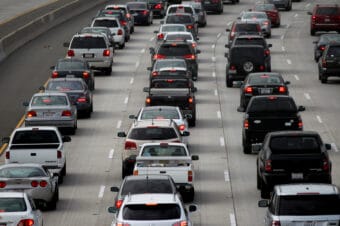
Morning traffic fills the SR2 freeway in Los Angeles, California. The EPA released new rules for vehicle emissions that are expected to cut tailpipe pollution and greenhouse gas emissions, which are fueling climate change. (David McNew/Getty Images)

After nearly a year of frantic lobbying and debate, the EPA has finalized strict new rules on vehicle emissions that will push the auto industry to accelerate its transition to electric vehicles.

The EPA expects that under the new rules, EVs could account for up to 56% of new passenger vehicles sold for model years 2030 through 2032, meeting a goal that President Biden set in 2021.

The regulations are a cornerstone of the Biden administration’s efforts to fight climate change.

Combined with investments the U.S. is making in battery and electric vehicle manufacturing, the auto regulations will help shift the U.S. away from relying on fossil fuels for transportation, a senior administration official said during a call with reporters.

“Three years ago, I set an ambitious target: that half of all new cars and trucks sold in 2030 would be zero-emission,” Biden said in a statement, adding that the country will meet that goal “and race forward in the years ahead.”

Biden added that U.S. workers “will lead the world on autos making clean cars and trucks, each stamped ‘Made in America.‘”

The new rules require auto manufacturers to slash emissions of greenhouse gasses like carbon dioxide that are heating the planet, as well as air pollutants that contribute to soot and smog. The administration says the new standards will avoid more than seven billion tons of carbon dioxide emissions and deliver almost $100 billion in annual benefits, including $13 billion in health benefits as a result of less pollution.

“That’s going to have immediate benefits in improving air quality, but also improving people’s health,” Cara Cook, director of programs at the Alliance of Nurses for Healthy Environments, told reporters ahead of the EPA’s announcement. “So they’re not breathing in dirty air, especially for those who are living near major roadways and highways, heavy traffic [areas]. Those are the ones that are going to really experience a significant amount of benefits from these rules.”

Entire fleets, not individual cars, must meet strict rules

The rules cover light- and medium-duty vehicles — cars, SUVs, vans and pickup trucks, but not 18-wheelers — from model years 2027 to 2032.

For light-duty vehicles, the EPA expects the rules will result in an industry-wide average emissions target of 85 grams of carbon dioxide per mile, representing an almost 50% reduction compared to existing standards for model year 2026 vehicles. The agency expects the average CO2 emissions target for medium-duty vehicles to fall by 44%.

The EPA rules are not written as an EV mandate or a ban on the sale of gas cars, like some states and other countries have adopted. Instead, the EPA sets standards that apply across an entire fleet — meaning an automaker still can make vehicles with higher emissions, as long as they also make enough very low or zero-emission vehicles that it averages out.

That means over the next decade, automakers can continue to offer a range of vehicle types, but the “menu” that’s available to consumers will shift to be cleaner overall.

The rules will likely drive a shift not just among automakers, but among their suppliers and in infrastructure, says Thomas Boylan, regulatory director at the Zero Emission Transportation Association, which advocates for electric vehicles.

“I think it creates a substantial tailwind in the EV market itself, but I think it’s even more pronounced throughout the supply chain” for things like parts manufacturing and charging infrastructure, Boylan said.

“It’s really that full supply chain that has an additional level of certainty with these types of rules.”

The EPA says consumers will also be able to opt for gas-powered vehicles with particulate filters and gas-electric hybrids.

Electric vehicles have higher price tags, on average, than gas-powered vehicles, although the gap has been narrowing and federal tax credits sometimes exceed the difference. Consumer groups have expressed support for the EPA’s rules, noting that EVs save drivers money over the life of the vehicle because it’s almost always cheaper to charge than to fuel up. Researchers last year found the proposed rule would save all drivers money, with the biggest savings for lower-income Americans.

The EPA says it expects the new rules will deliver fuel savings to consumers of up to $46 billion annually, plus savings on maintenance and repairs that the agency values at $16 billion annually.

“This is one of the biggest pieces of climate regulation in history,” Chris Harto, senior policy analyst for transportation and energy at Consumer Reports, said on a call with reporters.

“It’s going to have opponents,” Harto added, because the money consumers will save is “coming out of the pockets of the oil industry.”

In addition to reducing greenhouse gas emissions, the rules also call for a reduction in other types of tailpipe pollution. A senior Biden administration official said those pollution regulations will reduce hospitalizations and prevent 2,500 premature deaths in 2055.

Auto industry asked for a slower start

The auto industry is in the midst of a dramatic transformation, with virtually all major companies pivoting toward making electric vehicles — albeit at different speeds.

In the U.S., EV sales increased by 50% last year, to just under 10% of new car sales. Automakers are also looking to Europe and China, which have embraced the idea of an electric future, and shifting their global plans accordingly.

But U.S. charging infrastructure is not increasing fast enough to keep pace with EV growth. Most EVs for sale right now are luxury vehicles, with relatively fewer options on the cheaper end of the scale. And, significantly, legacy automakers are making far more money on their gas-powered vehicles than their EVs, some of which are not yet profitable at all.

The Alliance for Automotive Innovation, a trade group representing auto manufacturers, asked the EPA to adjust the timeline for the new rules, dialing down the ambition for the next few years and then cranking up the pace toward the end of the time frame. The United Auto Workers union made a similar appeal.

The approach reflected what the Alliance calls a “Goldilocks problem”: automakers see huge risks if they move too slowly or too quickly toward EVs.

Of course, the auto industry is not a monolith. All-electric automakers like Tesla and Rivian encouraged the EPA to set even more stringent rules. Dealers, who have generally been more skeptical of EVs than manufacturers, sharply criticized the EPA’s original proposed rules.

The final rules the EPA settled on reflect the input from auto makers, labor unions and car dealers, a senior administration official said. Manufacturers will be able to make more gradual cuts to emissions in the early years, the official said, but the rules will ultimately deliver the same reductions as the agency’s initial proposal.

The oil industry is fundamentally opposed

The oil industry, meanwhile, has been an even more vocal critic of these rules and other policies promoting EVs. Rising adoption of electric vehicles is expected to reduce oil demand over time, although it will take decades for the global fleet of vehicles to turn over.

Oil trade groups call the new EPA rule a ban on gas-powered cars, although the regulations allow the continued sale of gas vehicles. The American Petroleum Institute has said the rule “threatens consumer freedom, energy reliability and national security.”

The American Fuel and Petrochemical Manufacturers, which has spent millions on ads against the EPA rules and other policies, also criticized the EPA for not considering the environmental impact of manufacturing a giant battery or charging an EV. A large body of research has found that even with those impacts factored in, EVs are still vastly better for the planet than comparable fossil fuel vehicles. It’s true, however, that larger, less efficient EVs have a bigger environmental footprint than smaller ones.

But the oil industry’s opposition goes even further. The attorney general of Texas has previously filed a lawsuit challenging the EPA’s authority to set rules designed to promote electric vehicles. Multiple oil trade groups backed Texas in the case. The auto industry sided with the EPA, noting that carmakers are investing billions in going electric and that reducing greenhouse gas emissions is a “national priority.”

In fact, cutting greenhouse gas emissions is a global priority. The world has now agreed that transitioning away from fossil fuels is key to reducing the devastating impacts of climate change that, even in the best-case scenario, will disrupt ecosystems and human lives around the world.

And as the EPA sets rules designed to accelerate the shift away from fossil fuels, carmakers and oil producers are responding very differently.

The auto industry sees a profitable zero-emissions future for itself — if it can figure out how (and when) to get there. The oil industry is fighting to defend its core product.

On a call with reporters earlier this month, Chet Thompson, the CEO of the AFPM, lambasted media reports that the EPA was considering a “compromise” that would give the auto industry a few more years of more lenient standards, buying companies time to prepare for the EV transition.

Thompson emphasized that the EPA rules would still be, fundamentally, aimed at making most cars sold in the U.S. run on batteries.

“At 2032, it’s the same outcome,” Thompson said, frustrated. “This administration should not be calling that a compromise when in fact, they want to take us to the same place.”

Copyright 2024 NPR. To see more, visit https://www.npr.org.

The US bans most common form of asbestos after decades of pushback from industry

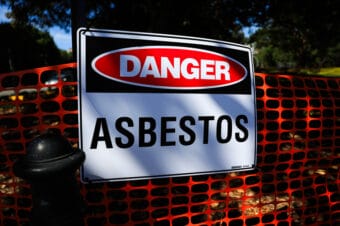
An asbestos warning sign is seen at Victoria Park in in Sydney, Australia on February 29, 2024. (Jenny Evans/Getty Images)

The Environmental Protection Agency announced Monday that it is banning the most common form of asbestos, a cancer-causing substance that’s linked to the deaths of tens of thousands of Americans every year.

The U.S. is prohibiting the use of chrysotile asbestos, joining more than 50 other countries that have already outlawed the substance. The ban comes after decades of pushback from companies that have used it in everything from consumer goods to manufacturing processes.

“The science is clear – asbestos is a known carcinogen that has severe impacts on public health,” EPA administrator Michael Regan said in a statement. “This action is just the beginning as we work to protect all American families, workers, and communities from toxic chemicals.”

People who inhale the tiny fibrous strands that make up asbestos can develop a slew of illnesses, including lung and ovarian cancer, asbestosis and mesothelioma. More than 40,000 deaths in the U.S. each year are connected to asbestos exposure.

Most consumer products that once contained the substance in the past no longer do, such as building materials and household appliances.

But the EPA’s ban targets certain products that still carry asbestos, including some gaskets and aftermarket automotive products. It also phases out the use of asbestos diaphragms by the chlor-alkali industry, which produces various chemicals.

Arthur Frank, a professor of environmental and occupational health at Drexel University, said the rule doesn’t outlaw all forms of asbestos, and the substance still lurks in many existing buildings and products across the country.

“This is not a total ban by any means,” Frank said. “It is a modest step that reduces future exposures.”

Why it’s taken so long for the EPA to outlaw asbestos

Federal regulators said Monday that the ban was the first rule to be finalized under the updated Toxic Substances Control Act, the national chemical safety law that was overhauled in 2016.

Previous attempts to prohibit the use of asbestos fell flat.

The EPA tried to ban asbestos outright in the late 1980s, but companies fought back. When the agency announced its 1989 prohibition on the use of asbestos, there was a carve-out for the chlorine industry.

Then, two years later, a panel of federal judges deemed the rule too onerous and overturned it, scuttling for decades any additional attempts by the EPA to ban asbestos and other dangerous chemicals.

“An immediate ban on the import of chrysotile asbestos for the chlor-alkali industry is a long overdue step forward for public health,” Sen. Jeff Merkley, D-Ore., said in a statement. “However, it cannot be the end of the road when it comes to phasing out other dangerous asbestos fibers, and Congress has a role to play here when it comes to providing stronger protections for our health.”

What this ban will do

Though the use of asbestos in the U.S. has been on the wane, it hasn’t vanished altogether.

The chlor-alkali industry uses large filters containing asbestos called diaphragms to make chemicals such as sodium hydroxide and chlorine, which can be used to disinfect drinking water and wastewater.

The EPA is immediately banning the import of chrysotile asbestos for the industry and requiring the eight chlor-alkali plants in the U.S. still using asbestos diaphragms to phase out their use.

Asbestos isn’t required to produce chlorine, the agency noted, and two-thirds of the chlorine made in the U.S. is done so without the use of asbestos.

Producers will have five years to transition from using asbestos diaphragms to ones that don’t contain the substance. Those that shift from asbestos diaphragms to non-asbestos membrane technology will have five years to convert their first facility, eight years to convert their second and 12 years to convert their third.

The ban also prohibits the use of asbestos in certain products. Oilfield brake blocks, aftermarket automotive brakes and linings, and other vehicle friction products and gaskets will be barred from containing asbestos six months after the rule’s effective date.

Sheet gaskets containing asbestos will also be outlawed two years after the effective date of the rule, though there will be exceptions when it’s used to make titanium dioxide or for the disposal of nuclear material.

Copyright 2024 NPR. To see more, visit https://www.npr.org.

The arts and crafts giant Joann files for bankruptcy, but stores will remain open

A Joann store is seen in Tigard, Ore., in August 2020. The arts and crafts retailer announced Monday that it was filing for bankruptcy. (Ted Hsu/Alamy Stock Photo)

Joann — the craft store chain formerly known as Jo-Ann Fabrics — has filed for bankruptcy amid ongoing financial troubles.

But DIYers need not worry just yet: The company’s more than 800 stores nationwide will remain open and its website will stay active as the Hudson, Ohio-based company restructures its finances.

“We remain committed to our suppliers, partners, Team Members and other stakeholders, and are focused on ensuring we continue to operate as usual so we can continue to best serve our millions of customers nationwide,” Joann’s chief financial officer Scott Sekella said in a statement.

Joann and certain affiliates have filed for Chapter 11 bankruptcy in the U.S. Bankruptcy Court for the District of Delaware.

As part of the court-supervised bankruptcy process, Joann expects to receive $132 million in new financing. It said it will also slice its funded debt by about $505 million, but that “customers[,] vendors, landlords, and other trade creditors will not see any disruption in services.”

Additionally, Joann will become a private company again and will be delisted from the Nasdaq stock exchange, just two years after it went public in March 2021.

The company said in an SEC filing earlier that year that the COVID-19 pandemic had spurred growth in the sewing and broader crafting industry, with people across the U.S. fashioning their own masks and using the additional time at home for DIY pursuits.

“[W]e view the significant number of new customers and increased engagement by new and current customers as a very encouraging signal for the future of our business,” the company said.

But in September 2023, during a sales slump, Joann announced that it was restructuring its field and corporate operations and laying off an unknown number of workers, Retail Dive reported.

The company said in a December earnings report that its third-quarter net sales had dipped by 4.1% compared to the same period the year before, and its long-term debt was roughly $1.2 billion.

Copyright 2024 NPR. To see more, visit https://www.npr.org.

Boeing whistleblower John Barnett, who raised alarm over plane quality, is found dead

Boeing 787 Dreamliners are built at the aviation company’s North Charleston, South Carolina, assembly plant on May 30, 2023. The plant is located on the grounds of the joint-use Charleston Air Force Base and Charleston International Airport. (Photo by Juliette MICHEL / AFP) (Photo by JULIETTE MICHEL/AFP via Getty Images)

Police in Charleston, S.C., are investigating the death of John Barnett, a former Boeing quality control manager who became a whistleblower when he went public with his concerns about serious safety issues in the company’s commercial airplanes.

Barnett’s body was found in a vehicle in a Holiday Inn parking lot in Charleston on Saturday, police said. One day earlier, he testified about the string of problems he says he identified at Boeing’s plant where he once helped inspect the 787 aircraft before delivery to customers.

Police say officers were sent to the hotel to conduct a welfare check after people were unable to contact Barnett, who had traveled to Charleston to testify in his lawsuit against Boeing.

“Upon their arrival, officers discovered a male inside a vehicle suffering from a gunshot wound to the head,” police said in a statement sent to NPR. “He was pronounced deceased at the scene.”

The office of Charleston County Coroner Bobbi Jo O’Neal said that Barnett, who had been living in Louisiana after retiring from Boeing, died “from what appears to be a self-inflicted gunshot wound.”

Charleston police say detectives are actively investigating the case and are awaiting a formal cause of death as they try to determine the circumstances surrounding Barnett’s death.

Barnett, who spent decades working for Boeing at its plants in Everett, Wash., and North Charleston, S.C., had repeatedly alleged that Boeing’s manufacturing practices had declined — and that rather than improve them, he added, managers had pressured workers not to document potential defects and problems.

Barnett, 62, made international headlines in April of 2019 when he and other former Boeing employees spoke to The New York Times about what he called shoddy manufacturing problems at Boeing. Barnett accused the company of adopting a culture that prioritized raw numbers and profits over quality — and by extension, passenger safety.

“As a quality manager at Boeing, you’re the last line of defense before a defect makes it out to the flying public,” Barnett told the newspaper. “And I haven’t seen a plane out of Charleston yet that I’d put my name on saying it’s safe and airworthy.”

By the time the article appeared, Barnett had already filed a whistleblower complaint against Boeing, saying that his attempts to raise quality and safety problems had been ignored and that he was punished for continuing to flag them.

Copyright 2024 NPR. To see more, visit https://www.npr.org.

What to know about the political debate around daylight saving time

The Zeitfeld (Time Field) clock installation by Klaus Rinke is seen at a park in Düsseldorf, Germany, in 2019. (Maja Hitij/Getty Images)

Twice a year, every year, the ritual returns as literal clockwork: the start and end of daylight saving time.

Millions of Americans, with grunts or glee, tap at their devices or wind their watch hands, manually — and mentally — changing the time to reflect a change in seasons.

In recent years, lawmakers have talked about this timeworn tradition being on its last legs. A raft of bills on the federal and state levels that take aim at the biannual time changes are waiting for action or stalled, at least for now.

Here’s a look at where things stand.

What’s the status of that Senate bill to end time changes?

In March 2022, the Senate passed the Sunshine Protection Act. The intent behind the bill was to make daylight saving time permanent starting in the spring of 2023.

And at first, it looked as though it might become a reality. The Senate passed the bill through an expedited process and with unanimous consent — legislative rarities in this day and age.

But the bill wasn’t taken up in the House. Members cited higher priorities, like a budget deficit and the war in Ukraine, but there was also a growing chorus of criticism about the bill’s approach (more on this below).

Sen. Marco Rubio, R-Fla., reintroduced the bill in March 2023, and it was sent to the Senate Committee on Commerce, Science and Transportation, but there has been no notable movement on it since. A companion bill, introduced by Rep. Vern Buchanan, R-Fla., is similarly stuck in committee at the House level.

Even if either bill manages to pass both chambers, it’d still need to be signed by President Biden, who hasn’t indicated how he leans on the issue.

So for now, the tradition remains intact.

Who observes daylight saving time?

All states but two — Hawaii and Arizona (with the exception of the Navajo Nation) — observe daylight saving time. The U.S. territories of American Samoa, Guam, Puerto Rico, the Virgin Islands and the Northern Mariana Islands also don’t change their clocks.

What’s the argument against the Sunshine Protection Act?

When the Sunshine Protection Act was first debated in a House subcommittee, experts said switching to permanent daylight saving time would do everything: save lives, reduce crime, conserve energy and improve health.

And pretty much everyone agrees that ending the time changes is generally a good idea. Our bodies can be very sensitive to disruptions to our circadian rhythms.

But the medical community has taken issue with how the bill proposes to make the change — specifically, that it mandates all states adopt permanent daylight saving time rather than sticking to standard time.

Doctors and scientists argue that standard time is better for our health. Our internal clock is better aligned with getting light in the morning, which, in turn, sets us up for better sleep cycles.

The bill’s sponsors aren’t budging though. Rubio is still pushing for permanent daylight saving time.

And the biggest argument for this approach may be an economic one. The idea is that having more light in the evenings encourages people to go out and do things — i.e., spend money.

The nation’s convenience stores, for example, told a congressional subcommittee that they see an uptick in spending when clocks are set to daylight saving time.

Could the states adopt their own time-change rules?

With federal legislation stuck in a holding pattern, states could take up the issue, but they’re still subject to some federal limitations.

The Uniform Time Act, which was passed in 1966, says that states can enact permanent standard time but not permanent daylight saving time.

At least 550 bills and resolutions have surfaced concerning time changes at the state level in recent years, according to a tally from the National Conference of State Legislatures (NCSL). So the same debate that’s happening at the federal level is playing out in statehouses across the United States.

Save Standard Time, a nonprofit that works to end daylight saving time, regularly updates a detailed chart with the exact status of state bills.

Which states are trying to end daylight saving time?

In 2023, at least 29 states considered legislation related to daylight saving time.

At least half of those states have enacted or passed measures pledging to switch to permanent daylight time if Congress changes the rules to allow for such an action.

Several of those states were also actively considering legislation that would end daylight saving time, but by switching the state to year-round standard time, according to the NCSL.

Last month, an Oregon bill to keep most of the state in Pacific Standard Time for the entire year didn’t advance in the state’s Senate. But supporters agreed to amend the bill to say that Oregon will end daylight saving time only if California and Washington make the same change within the next 10 years.

Lawmakers in Oregon’s neighboring states of Idaho, California and Washington proposed similar bills.

When will daylight saving time end?

That’ll be Sunday, Nov. 3. Mark your calendars.

Copyright 2024 NPR. To see more, visit https://www.npr.org.

Ageism in health care is more common than you might think, and it can harm people

Dr. Louise Aronson, a geriatrician and author, speaks with a patient at UCSF’s Osher Center for Integrative Health in San Francisco. (Julia Burns)

A recent study found that older people spend an average of 21 days a year on medical appointments. Kathleen Hayes can believe it.

Hayes lives in Chicago and has spent a lot of time lately taking her parents, who are both in their 80s, to doctor’s appointments. Her dad has Parkinson’s, and her mom has had a difficult recovery from a bad bout of Covid-19. As she’s sat in, Hayes has noticed some health care workers talk to her parents at top volume, to the point, she says, “that my father said to one, ‘I’m not deaf, you don’t have to yell.'”

In addition, while some doctors and nurses address her parents directly, others keep looking at Hayes herself.

“Their gaze is on me so long that it starts to feel like we’re talking around my parents,” says Hayes, who lives a few hours north of her parents. “I’ve had to emphasize, ‘I don’t want to speak for my mother. Please ask my mother that question.'”

Researchers and geriatricians say that instances like these constitute ageism – discrimination based on a person’s age – and it is surprisingly common in health care settings. It can lead to both overtreatment and undertreatment of older adults, says Dr. Louise Aronson, a geriatrician and professor of geriatrics at the University of California, San Francisco.

“We all see older people differently. Ageism is a cross-cultural reality,” Aronson says.

Ageism creeps in, even when the intent is benign, says Aronson, who wrote the book, Elderhood. “We all start young, and you think of yourself as young, but older people from the very beginning are other.”

That tendency to see older adults as “other” doesn’t just result in loud greetings, or being called “honey” while having your blood pressure taken, both of which can dent a person’s morale.

Aronson says assumptions that older people are one big, frail, homogenous group can cause more serious issues. Such as when a patient doesn’t receive the care they need because the doctor is seeing a number, rather than an individual.

“You look at a person’s age and say, ‘Ah, you’re too old for this,’ instead of looking at their health, and function, and priorities, which is what a geriatrician does,” says Aronson.

She says the problem is most doctors receive little education on older bodies and minds.

“At my medical school we only get two weeks to teach about older people in a four-year curriculum,” she says.

Aronson adds that overtreatment comes in when well-meaning physicians pile on medications and procedures. Older patients can suffer unnecessarily.

“There are things…that happen again and again and again because we don’t teach [physicians] how to care about older people as fully human, and when they get old enough to appreciate it, they’re already retired,” says Aronson.

Kris Geerken is co-director of Changing the Narrative, an organization that wants to end ageism. She says research shows that negative beliefs about aging – our own or other people’s – are detrimental to our health.

“It actually can accelerate cognitive decline, increase anxiety, it increases depression. It can shorten our lifespans by up to seven-and-a-half years,” she says, adding that a 2020 study showed that discrimination against older people, negative age stereotypes, and negative perceptions around one’s own age, cost the health care system $63 billion a year.

Still, beliefs can change.

“When we have positive beliefs about age and aging, those things are all flipped,” Geerken says, and we tend to age better.

Geerken conducts anti-ageism trainings, often over Zoom, including trainings for health care workers. She also advises older adults on how to push back if they feel their medical concerns are being dismissed with comments like, “It’s to be expected at your age.”

Age-Friendly Health Systems are another initiative designed to curb ageism in the health care industry.

Leslie Pelton is vice president at the Institute for Healthcare Improvement, which launched the concept of Age-Friendly Health Systems in 2018, along with the John A. Hartford Foundation.

She describes the effort as one in which every aspect of care, including mobility, mental health and medication, is centered on the needs and desires of the older adult.

Pelton says 3,700 sites across the US – including clinics, hospitals, and nursing homes – are now designated age-friendly.

She describes the system as “a counterbalance to ageism, because it requires that a clinician begins with asking and acting on what matters to the older adult, so right away the older adult is being seen and being heard.”

That sounds great to Liz Schreier. Schreier is 87 and lives in Buffalo. She walks and does yoga regularly. She also has a heart condition and emphysema and spends plenty of time at the doctor. She lives alone and says she has to be her own advocate.

“What I find is a disinterest. I’m not very interesting to them,” she says. “And I’m one of many – you know, one of those old people again.”

She goes from specialist to specialist, hoping for help with little things that keep cropping up.

“I had a horrible experience with a gastroenterologist who said I was old, and he didn’t think he wanted to do a scope on me, which was a little insulting,” she says.

She later found one of his colleagues who would.

Schreier says navigating the health care system in your 80s is tough. What she and her peers are looking for from health care workers, she says, is kindness, and advice on how to stay active and functional no matter how old they are.

Copyright 2024 NPR. To see more, visit https://www.npr.org.
Site notifications
Update notification options
Subscribe to notifications