National News

Research at the heart of a federal case against the abortion pill has been retracted

The Supreme Court will hear the case against the abortion pill mifepristone on March 26. It’s part of a two-drug regimen with misoprostol for abortions in the first 10 weeks of pregnancy. (Anna Moneymaker/Getty Images)

A scientific paper that raised concerns about the safety of the abortion pill mifepristone was retracted by its publisher this week. The study was cited three times by a federal judge who ruled against mifepristone last spring. That case, which could limit access to mifepristone throughout the country, will soon be heard in the Supreme Court.

The now retracted study used Medicaid claims data to track E.R. visits by patients in the month after having an abortion. The study found a much higher rate of complications than similar studies that have examined abortion safety.

Sage, the publisher of the journal, retracted the study on Monday along with two other papers, explaining in a statement that “expert reviewers found that the studies demonstrate a lack of scientific rigor that invalidates or renders unreliable the authors’ conclusions.”

It also noted that most of the authors on the paper worked for the Charlotte Lozier Institute, the research arm of anti-abortion lobbying group Susan B. Anthony Pro-Life America, and that one of the original peer reviewers had also worked for the Lozier Institute.

The Sage journal, Health Services Research and Managerial Epidemiology, published all three research articles, which are still available online along with the retraction notice. In an email to NPR, a spokesperson for Sage wrote that the process leading to the retractions “was thorough, fair, and careful.”

The lead author on the paper, James Studnicki, fiercely defends his work. “Sage is targeting us because we have been successful for a long period of time,” he says on a video posted online this week. He asserts that the retraction has “nothing to do with real science and has everything to do with a political assassination of science.”

He says that because the study’s findings have been cited in legal cases like the one challenging the abortion pill, “we have become visible – people are quoting us. And for that reason, we are dangerous, and for that reason, they want to cancel our work,” Studnicki says in the video.

In an email to NPR, a spokesperson for the Charlotte Lozier Institute said that they “will be taking appropriate legal action.”

Role in abortion pill legal case

Anti-abortion rights groups, including a group of doctors, sued the federal Food and Drug Administration in 2022 over the approval of mifepristone, which is part of a two-drug regimen used in most medication abortions. The pill has been on the market for over 20 years, and is used in more than half abortions nationally. The FDA stands by its research that finds adverse events from mifepristone are extremely rare.

Judge Matthew Kacsmaryk, the district court judge who initially ruled on the case, pointed to the now-retracted study to support the idea that the anti-abortion rights physicians suing the FDA had the right to do so. “The associations’ members have standing because they allege adverse events from chemical abortion drugs can overwhelm the medical system and place ‘enormous pressure and stress’ on doctors during emergencies and complications,” he wrote in his decision, citing Studnicki. He ruled that mifepristone should be pulled from the market nationwide, although his decision never took effect.

Matthew Kacsmaryk at his confirmation hearing for the federal bench in 2017. (AP)

Kacsmaryk is a Trump appointee who was a vocal abortion opponent before becoming a federal judge.

“I don’t think he would view the retraction as delegitimizing the research,” says Mary Ziegler, a law professor and expert on the legal history of abortion at U.C. Davis. “There’s been so much polarization about what the reality of abortion is on the right that I’m not sure how much a retraction would affect his reasoning.”

Ziegler also doubts the retractions will alter much in the Supreme Court case, given its conservative majority. “We’ve already seen, when it comes to abortion, that the court has a propensity to look at the views of experts that support the results it wants,” she says. The decision that overturned Roe v. Wade is an example, she says. “The majority [opinion] relied pretty much exclusively on scholars with some ties to pro-life activism and didn’t really cite anybody else even or really even acknowledge that there was a majority scholarly position or even that there was meaningful disagreement on the subject.”

In the mifepristone case, “there’s a lot of supposition and speculation” in the argument about who has standing to sue, she explains. “There’s a probability that people will take mifepristone and then there’s a probability that they’ll get complications and then there’s a probability that they’ll get treatment in the E.R. and then there’s a probability that they’ll encounter physicians with certain objections to mifepristone. So the question is, if this [retraction] knocks out one leg of the stool, does that somehow affect how the court is going to view standing? I imagine not.”

It’s impossible to know who will win the Supreme Court case, but Ziegler thinks that this retraction probably won’t sway the outcome either way. “If the court is skeptical of standing because of all these aforementioned weaknesses, this is just more fuel to that fire,” she says. “It’s not as if this were an airtight case for standing and this was a potentially game-changing development.”

Oral arguments for the case, Alliance for Hippocratic Medicine v. FDA, are scheduled for March 26 at the Supreme Court. A decision is expected by summer. Mifepristone remains available while the legal process continues.

Copyright 2024 NPR. To see more, visit https://www.npr.org.

It’s no surprise there’s a global measles outbreak. But the numbers are ‘staggering’

Photo courtesy Gates Foundation, Flickr Creative Commons.

Measles is on the rise around the world, and even experts who saw it coming say the increase is “staggering.”

The World Health Organization said in December that its European region (which extends into parts of western and central Asia) saw an “alarming” increase in measles cases – from under a thousand in 2022 to more than 30,000 last year.

John Vertefeuille, director of the U.S. Centers for Disease Control and Prevention’s Global Immunization Division, said in a statement that the numbers are “staggering.”

The WHO’s most recent global numbers, released in November, reveal that measles cases increased worldwide by 18% to about 9 million, and deaths rose 43% to 136,000, in 2022 compared to 2021. Some 32 countries had large, disruptive outbreaks in 2022, and that number ticked up to 51 in 2023, Dr. Natasha Crowcroft, WHO’s senior technical adviser for measles and rubella control, told NPR.

The worrying uptick in measles outbreaks and deaths is, “unfortunately, not unexpected given the declining vaccination rates we’ve seen in the past few years,” noted John Vertefeuille of the CDC in his statement. “Urgent, targeted efforts are critical to prevent measles disease and deaths.”

Measles is one of the most contagious infectious diseases, and also one of the most preventable: two doses of vaccine in childhood is 97% protective. WHO estimates that some 61 million doses were missed or delayed in 2021. In 2022, about 83% of the world’s children received one dose of measles vaccine by their first birthday – the lowest proportion since 2008, when the rate was also 83%.

“We’re going to see outbreaks any time we have an accumulation of people who haven’t been vaccinated,” says Cyndi Hatcher, unit lead for measles elimination in the African Region at the CDC. “When you have immunization disruptions, measles is always going to be one of the first epidemics that you see.”

Low-income countries continue to have the lowest vaccination rates – five sub-Saharan African countries have rates below 50% for the first dose.

“Measles is called the inequity virus for good reason. It is the disease that will find and attack those who aren’t protected,” says Dr. Kate O’Brien, WHO director for immunization, vaccine and biologicals.

In Ethiopia, for example, conflict and weaknesses in the rural health system have taken a toll on vaccination rates, says Dr. Ngozi Kennedy, UNICEF’s Ethiopia health manager.

“We have a lot of pastoral communities that are often on the move so they may not know how to, or may not be able to, get to health centers for the vaccine. Also, as a result of the protracted conflicts, services are often disrupted with populations and even some health-care workers being displaced,” she says.

Children who don’t get their vaccines on schedule are at risk of death and serious illness, particularly children under age 5 who are at highest risk for severe complications including pneumonia, encephalitis (brain swelling) and death. Measles can also put children at higher risk for other potentially fatal childhood diseases – such as diarrheal diseases and meningitis – because the virus can cause the immune system to forget its learned defenses against other pathogens.

“I think that people may have forgotten how dangerous measles can be if they haven’t seen cases before,” Hatcher says.

But global health experts didn’t forget, and many predicted that outbreaks would be coming.

“During the pandemic, when everything was locked down, there wasn’t much measles being spread … because no one was going anywhere,” says WHO measles and rubella senior technical adviser Dr. Natasha Crowcroft. “It’s the usual human thing that no one does anything until the problem starts. It’s really hard to sell prevention.”

Last year a coalition including the Bill & Melinda Gates Foundation and Gavi, the Vaccine Alliance, launched “The Big Catch-Up” – an effort to get vaccination rates back up to at least their pre-pandemic levels. (Editor’s note: The Gates Foundation is one of the funders of NPR and this blog.)

Kennedy says efforts continue in Ethiopia to shore up vaccination rates. Health workers there have begun to track childhood immunizations electronically in hopes of keeping more children current, and the country has prioritized 14 “equity zones” to catch kids up on their shots.

But the CDC’s Cyndi Hatcher says much more needs to be done.

“I think we need to be very honest with ourselves at the global level,” she says. “Are we truly committed to making [measles] a public health priority and do we have the resources that we need to make full immunization a reality at the global level, the regional level but especially at the country and community level?”

Fran Kritz is a health policy reporter based in Washington, D.C., and a regular contributor to NPR. She also reports for the Washington Post and Verywell Health. Find her on X (Twitter): @fkritz

Copyright 2024 NPR. To see more, visit https://www.npr.org.

Scientists explore whether to add a ‘Category 6’ designation for hurricanes

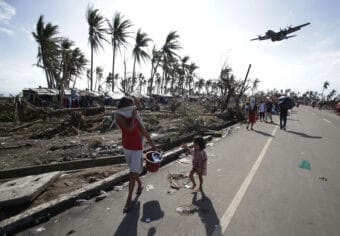
Residents of Tacloban in the central Philippines in 2013, after Typhoon Haiyan devastated the area. Scientists are renewing calls for a new Category 6 designation for the the most powerful hurricanes and typhoons, such as Haiyan. (Aaron Favila/AP)

Hurricanes are rated on a scale from one to five, depending on their wind speeds. The higher the speed, the higher the category. But as climate change makes powerful storms more common, it may be necessary to add a sixth category, according to a new paper published by leading hurricane researchers.

The current five point scale, called the Saffir-Simpson scale, was introduced in the 1970s and is used by forecasters around the world including at the National Hurricane Center in Florida. Under the scale, storms with maximum wind speeds of 157 miles per hour or higher are designated as Category 5 hurricanes.

Category 5 storms used to be relatively rare. But climate change is making them more common, research shows. And some recent Category 5 storms have had such high wind speeds that it would make more sense to assign them to a Category 6, if such a category existed, the authors argue.

The authors of the new paper, James Kossin of the First Street Foundation and Michael Wehner of the Lawrence Berkeley National Laboratory, have been studying the effects of climate change on hurricanes for decades. They propose that Category 5 should include hurricanes with maximum sustained winds of 157 to 192 miles per hour, and that a new Category 6 should include any storm with wind speeds above 192 miles per hour.

Under the new scale, Category 6 hurricanes would be exceedingly rare right now. For example, it might apply to 2013’s Typhoon Haiyan devastated the Philippines with wind speeds around 195 miles per hour. In fact, scientists in Taiwan argued at the time that Haiyan necessitated a new category designation.

Four other storms since 2013 would qualify for Category 6 status, including 2015’s Hurricane Patricia, which hit Mexico, and three typhoons that formed near the Philippines in 2016, 2020 and 2021.

But other powerful storms wouldn’t make the cut. For example, Hurricane Irma had sustained winds around 185 miles per hour when it hit the U.S. Virgin Islands in 2018 as a Category 5 storm. The wind damage from Irma led some residents to suggest that the storm should have been given a Category 6 designation by forecasters, because they felt that they hadn’t been adequately warned about the extraordinarily dangerous wind. But under the new proposed scale Irma would remain a Category 5 storm.

Similarly, Hurricane Dorian had wind speeds of about 185 miles per hour when it made landfall in the Bahamas in 2019. It was, and would remain, a Category 5 storm.

And the new scale would do little to convey the particular danger from storms such as Hurricane Harvey, Hurricane Florence or Hurricane Ida, which fit cleanly into the current wind speed scale, but caused deadly flooding from extreme rain. Climate change is to blame – studies have found that hurricanes and other storms are dropping more rain because a warmer atmosphere can hold more water.

The National Hurricane Center, which handles official category designations for hurricanes that threaten the United States and its territories, has not weighed in on the question of adding a Category 6. The center has done other things to update hurricane forecasts in response to climate change, however, including new storm surge forecasting tools, and upgrades that allow forecasters to predict the intensity and location of storms earlier, so people have more time to prepare and evacuate.

Copyright 2024 NPR. To see more, visit https://www.npr.org.

NTSB says key bolts were missing from the door plug that blew off a Boeing 737 Max 9

Alaska Airlines N704AL, a 737 Max 9, which made an emergency landing at Portland International Airport on January 5 is parked on the tarmac in Portland, Oregon, on January 23, 2024. (Photo by Patrick T. Fallon / AFP)

WASHINGTON — The National Transportation Safety Board says four key bolts were “missing” when a door plug blew off an Alaska Airlines flight in midair last month. That’s one of the findings from the NTSB’s preliminary investigative report released Tuesday.

The Boeing 737 Max 9 jet had departed Portland, Ore. and was climbing through 14,800 feet when the door plug explosively blew out. It resulted in a rapid depressurization and emergency landing back at Portland.

No one was seriously hurt, but the January 5th incident has renewed major questions about quality control at Boeing and its top suppliers.

In its 19-page report, the NTSB says four bolts that were supposed to hold the door plug in place were not recovered. Nevertheless, investigators say “the observed damage patterns and absence of contact damage” on the door panel and plane itself indicate the four bolts were “missing” before the door plug was ejected from the plane.

The door plug was originally installed by contractor Spirit AeroSystems in Wichita, Kan. and then shipped to Boeing’s factory in Renton, Wash. for assembly. Once it arrived in Washington, the NTSB says damaged rivets were discovered on the fuselage which required the door plug to be opened for repairs. After that work was completed by Spirit AeroSystems personnel at the Boeing plant, the four bolts were not reinstalled, according to photo evidence provided to the NTSB by Boeing.

The report does not say who was responsible for the failure to ensure the bolts were reinstalled.

The incident has touched off another crisis for Boeing. The troubled plane maker was still working to rebuild public trust after 346 people died in two 737 Max 8 jets that crashed in 2018 and 2019.

In a statement, Boeing said it would review the NTSB’s findings expeditiously.

“Whatever final conclusions are reached, Boeing is accountable for what happened,” Boeing CEO Dave Calhoun said in a statement. “An event like this must not happen on an airplane that leaves our factory. We simply must do better for our customers and their passengers.”

The NTSB investigation is ongoing and may take a year or more before a final report is completed.

The Alaska Airlines 737 Max 9 incident came up during a Congressional hearing on Capitol Hill Tuesday. The administrator of the Federal Aviation Administration, Michael Whitaker, told lawmakers on the House Transportation and Infrastructure Committee this latest 737 accident has created several issues for the FAA.

“One, what’s wrong with this airplane? But two, what’s going on with the production at Boeing?,” Whitaker said. “There have been issues in the past. And they don’t seem to be getting resolved. So we feel like we need to have a heightened level of oversight to really get after that.”

a man
Federal Aviation Administration Administrator Michael Whitaker testifies before the House Transportation and Infrastructure Committee on February 6, 2024 in Washington, D.C. (Photo by Kevin Dietsch/Getty Images)

Whitaker says the FAA has sent about 20 inspectors to Boeing’s Washington facilities, and six to the Spirit AeroSystems factory in Wichita, Kan. where the 737 fuselages are produced. And he said some inspectors may have to remain at those factories permanently.

“Going forward, we will have more boots on the ground closely scrutinizing and monitoring production and manufacturing activities,” Whitaker said. “I do anticipate we will want to keep people on the ground there. We don’t know how many yet. But we do think that presence will be warranted.”

The FAA is in the midst of a six-week audit of production at both facilities, and an employee culture survey at Boeing. Whitaker testified that the agency will wait until those are complete before making any decisions about a permanent inspection plan.

Copyright 2024 NPR. To see more, visit https://www.npr.org.

How are atmospheric rivers affected by climate change?

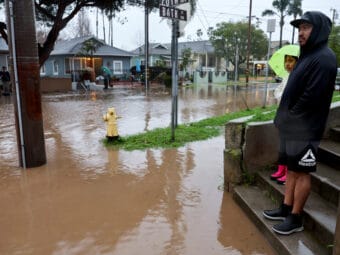
Residents stand along a flooded street in Santa Barbara, California, as a powerful atmospheric river pummels the region. The storm has caused landslides, power outages, and road and airport closures across Southern California. (Mario Tama/Getty Images)

The second atmospheric river to hit the West Coast in as many weeks has stalled over Southern California, dumping more than 9 inches of rain over 24 hours in some areas near Los Angeles. Streets are flooded in Santa Barbara and Los Angeles; creeks are raging like rivers; and rainfall records in Los Angeles County are nearing all-time records.

At least three people were reported to have died due to storm-related injuries, including two people killed by fallen trees. As of Tuesday morning, the severe weather had knocked out power for more than 150,000 Californians.

The National Weather Service said Los Angeles received nearly half of its average seasonal rainfall in just two days, but the storm isn’t over yet.

Areas east and south of Los Angeles could see several more inches of rainfall through Wednesday. That includes San Diego, which was inundated a few weeks ago by a different storm.

Atmospheric rivers are well-known weather phenomena along the West Coast. Several make landfall each winter, routinely delivering a hefty chunk of the area’s annual precipitation. But the intensity of recent atmospheric rivers is almost certainly affected by human-caused climate change, says Daniel Swain, a climate scientist at the University of California, Los Angeles.

Climate change has made the ocean’s surface warmer, and during an El Niño year like this one, sea water is even hotter. The extra heat helps water evaporate into the air, where winds concentrate it into long, narrow bands flowing from west to east across the Pacific, like a river in the sky, Swain says. An atmospheric river can hold as much as 15 times as much water as the Mississippi River.

Human-driven climate change has primed the atmosphere to hold more of that water. Atmospheric temperatures have risen about 2 degrees Fahrenheit (just over 1 degree Celsius) since the late 1800s, when people started burning massive volumes of fossil fuels. The atmosphere can hold about 4% more water for every degree Fahrenheit warmer it gets. When that moist air hits mountains on the California coast and gets pushed upwards, the air cools and its water gets squeezed out, like from a sponge.

Swain estimates those sky-rivers can carry and deliver about 5 to 15% more precipitation now than they would have in a world untouched by climate change.

That might not sound like a lot, but it can—and does—increase the chances of triggering catastrophic flooding, Swain says.

In 2017, a series of atmospheric rivers slammed into Northern California, dropping nearly 20 inches of rain across the upstream watershed in less than a week. The rainfall fell in two pulses, one after another, filling a reservoir and overtopping the Oroville dam, causing catastrophic flooding to communities downstream.

The back-to-back atmospheric rivers that drove the Oroville floods highlighted a growing risk, says Allison Michaelis, an atmospheric river expert at Northern Illinois University and the lead of a study on the Oroville event. “With these atmospheric rivers occurring in succession, it doesn’t leave a lot of recovery time in between these precipitation events. So it can turn what would have been a beneficial storm into a more hazardous situation,” she says.

It’s not yet clear if or how climate change is affecting those groups of storms—”families,” as one study calls them.

It’s also too early to say exactly how much more likely or intense climate change made the current storms on the West Coast. But “in general, we can expect them to all be intensified to some degree” by human-driven climate change, Michaelis says.

Scientists also don’t yet know if climate change is affecting how often atmospheric rivers form, or where they go. And climate change doesn’t mean that “every single atmospheric river storm that we are going to experience in the next couple of years will be bigger than every other storm” in history, says Samantha Stevenson, an atmospheric and climate scientist at the University of California, Santa Barbara.

But West Coast communities do need to “be prepared in general for dealing with these extremes now,” says Stevenson. “Because we know that they’re a feature of the climate and their impacts are only going to get worse.”

Copyright 2024 NPR. To see more, visit https://www.npr.org.

A new FAFSA setback means many college financial aid offers won’t come until April

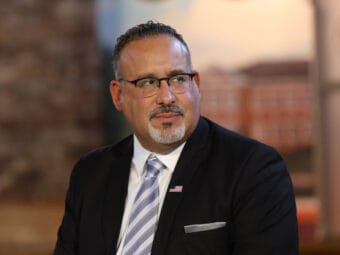
U.S. Secretary of Education Miguel Cardona has led the department through a massive FAFSA overhaul mandated by Congress about three years ago. (Colin Myers/Claflin University/Getty Images)

Families and students will have to wait even longer for financial aid offers from colleges and universities.

On Tuesday, the U.S. Department of Education announced yet another delay in the already-turbulent FAFSA (Free Application for Federal Student Aid) timeline: The department says it won’t be sending students’ FAFSA data to schools until the first half of March. Previously, it had said it would start sending that data in late January.

For more than 17 million students, the FAFSA is the key to unlocking government dollars to help cover the cost of college, including federal student loans, work-study and Pell Grants for low-income students.

This new, four-to-six-week delay puts schools in a difficult bind as colleges can’t determine what financial aid students should get until they receive the government’s FAFSA data.

There is some good news: One big reason for the delay is that the department is fixing a $1.8 billion mistake in the FAFSA that could have especially hurt lower-income students. Proceeding without a fix would have, at best, confused many lower-income borrowers. At worst, it would have taken money out of their pockets and likely discouraged some from enrolling in college.

When that fix was announced, Justin Draeger, president and CEO of the National Association of Student Financial Aid Administrators (NASFAA), said it was “the right thing to do.”

Undersecretary of Education James Kvaal said in a statement Tuesday, “Updating our calculations will help students qualify for as much financial aid as possible. Thank you to the financial aid advisers, college counselors, and many others helping us put students first.”

Kvaal and the department know this delay will hit college financial aid offices especially hard and further compress their timeline for sending out financial aid offers. Draeger tells NPR that if schools don’t receive FAFSA data until early to mid-March, many of them likely won’t be able to send financial aid offers to students until April. For many of those students, that leaves less than a month before they’re expected to commit to a college.

Charles Conn, a top aid administrator at Cal Poly Pomona, tells NPR he is “relieved” the Education Department is fixing that $1.8 billion mistake, but “our hearts sank as we learned that schools will now not begin receiving FAFSA data until the first part of March, at the earliest.”

“It’s going to be difficult to get aid offers out to prospective students before April,” says Brad Barnett, the financial aid director at James Madison University in Virginia. “It’s unfortunate that these delays could impact whether a prospective student goes to college at all this fall, or at the very least where they go.”

The problem for schools — which, by extension, is now a problem for families too — is that, because this year’s FAFSA is the result of a massive overhaul, financial aid offices aren’t entirely sure what to expect from the data they’ll be receiving. Ideally, they’d like several weeks to understand the new datasets and do some quality control of the new financial aid process.

“Schools are furiously reworking their timelines to see just how quickly they could turn around financial aid offers for students, to get them accurate aid offers as soon as possible,” says Draeger of NASFAA. But he points out, “This could be more difficult for under-resourced institutions that lack the funding, staffing, or technology capabilities of their peers.”

This new setback gives schools very little room for error.

Scott Skaro, the financial aid director at United Tribes Technical College, in North Dakota, says this new FAFSA timeline will be tough on tribal colleges, where more than 80% of students are low income and qualify for a federal Pell Grant.

“This is pretty devastating news,” says Skaro.

It’s good, he says, that the department is acting to make sure students get all the aid they’re entitled to, but not being able to make aid offers to prospective students until April or May could also do real harm.

“Our students rely on the peace of mind that comes with grant aid. And this uncertainty may lead them away from education. I don’t want the seniors of 2024 to be just a lost generation.”

He worries that the longer seniors have to wait to know if college is affordable, the harder it will be for some to resist “the temptations to just find some entry-level job and give up on additional schooling. I just worry how many there are out there.”

Copyright 2024 NPR. To see more, visit https://www.npr.org.
Site notifications
Update notification options
Subscribe to notifications