ProPublica

How Some Alabama Hospitals Quietly Drug Test New Mothers — Without Their Consent

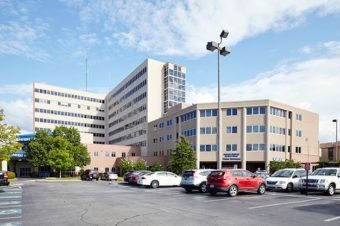
Gadsden Ragional Medical Center in Gadsden, Ala. (Rob Culpepper/ProPublica)

In Alabama, a positive drug test can have dire repercussions for pregnant women and new mothers. Their newborns can be taken from them. They can lose custody of their other children. They can face lengthy sentences in the most notorious women’s prison in the United States and thousands of dollars in fees and fines.

Yet the hospitals that administer those drug tests — and turn the results over to authorities — are exceedingly reluctant to disclose their policies to the public. In many cases, they test mothers and babies without explicit consent and without warning about the potential consequences, ProPublica and AL.com have found.

According to a review of hundreds of court records, drug testing is ubiquitous in some Alabama counties — sometimes of mothers, sometimes of infants, sometimes both. In some parts of the state, hospitals test on a case-by-case basis, employing criteria that virtually ensure greater scrutiny for poor women.

ProPublica and AL.com began examining hospital drug-testing policies as part of an investigation into Alabama’s chemical endangerment law, the country’s toughest law targeting drug use in pregnancy. Since 2006, the law has been used to charge nearly 500 women with endangering their unborn children. In many cases, law enforcement officials cited hospital-administered drug tests as probable cause for arrest.

Forty-two of the 49 hospitals that deliver babies in Alabama declined to answer an AL.com/ProPublica questionnaire about testing policies, despite repeated requests over several months. Of the seven that did respond, three provided only partial information. Officials at several hospitals declined interview requests to explain why they didn’t want to answer the questionnaires.

In six consent forms obtained from patients and a handful of hospitals — paperwork that patients sign when they check in to deliver their babies — drug testing is specifically mentioned in only two. None indicate that positive results can trigger arrest and prosecution under the Alabama chemical endangerment statute.

“If hospitals are not informing their patients about what their drug-testing policies are, particularly when those results are used to involve law enforcement in their patients’ lives, that is an unconstitutional act,” said Sara Ainsworth, director of legal advocacy for the New York–based National Advocates for Pregnant Women.

Under Alabama law, drug abuse in pregnancy is considered a form of child abuse, and medical providers are “mandatory reporters,” meaning they are required to report positive test results to child welfare authorities, who then must report them to law enforcement. At least 15 other states also treat prenatal drug use as child abuse, but only three — Alabama, South Carolina, and Tennessee — explicitly allow mothers to be criminally prosecuted.

The potential penalties under Alabama law are especially stiff: one to 10 years in prison if a baby is exposed but suffers no ill effects; 10 to 20 years if a baby shows signs of exposure or harm; and 10 to 99 years if a baby dies.

Rosemary Blackmon, executive vice president of the Alabama Hospital Association, spoke on behalf of three hospitals that declined to answer the AL.com/ProPublica questionnaire. She said hospitals fear that discussing their drug testing policies could keep pregnant women from seeking medical care.

“I think there’s just sort of a general hesitancy that the more they talk about the drug screening and reporting, the greater the likelihood the mother will avoid delivering at a hospital,” Blackmon said.

But drug policy experts, medical groups, and civil libertarians say it’s the threat of losing their children and ending up behind bars that creates an atmosphere of fear.

“Criminal laws tend to make women less forthcoming,” said Dr. Stephen Patrick, professor of pediatrics and health policy at Vanderbilt University School of Medicine. “It doesn’t set up a place where people have the opportunity to engage with their providers honestly.”

The severe consequences for women and families make it even more important that doctors and hospitals are transparent in their testing policies, experts say.

The American College of Obstetricians and Gynecologists guidance states that drug testing “should be performed only with the patient’s consent … Pregnant women must be informed of the potential ramifications of a positive test result, including any mandatory reporting requirements.”

In 2001, the U.S. Supreme Court struck down a program in South Carolina that involuntarily tested pregnant drug users solely for law enforcement purposes. It’s unclear how often hospitals in Alabama report positive drug tests directly to law enforcement, but a bill proposed earlier this year by the sheriff of Etowah County, northeast of Birmingham, would have required reporting within two hours whenever a pregnant woman or newborn tested positive.

Hospital testing policies are so opaque that even state health officials say they are in the dark about specifics. “Some hospitals, any pregnant woman that comes in, they’ll test for drugs,” said Janice M. Smiley, director of the Perinatal Health Division at the Alabama Department of Public Health. “Some will test all their newborns. It’s not one thing where everybody does the same. There’s no consistency there.”

Does she know which hospitals take which approach? “We don’t,” Smiley said.

Drug testing is an issue that U.S. medical providers are increasingly likely to confront. The incidence of babies born dependent on drugs, especially opioid painkillers and heroin, nearly doubled from 2009 to 2012, according to research by Patrick. Hospitals charged $1.5 billion to treat babies in withdrawal in 2012, according to the same study.

There are many medical reasons to screen pregnant women and new mothers for drug use, experts say: to provide proper prenatal care, to prevent pregnancy complications and to anticipate problems that may arise at birth. Many medical organizations, including the American Medical Association, support universal screening: asking women about their use of drugs as well as legal substances, such as alcohol and tobacco, that can affect prenatal health as much, if not more, than illicit ones.

But studies have found that many women lie about substance use during pregnancy, so some hospitals and communities have turned to testing — sometimes urine, sometimes blood, sometimes the baby’s first bowel movement, or meconium.

Several hospitals in Cincinnati announced universal drug testing for pregnant women earlier this year, and hospitals in New York City and Maryland have regularly tested new moms and pregnant women, according to research. Four states — Iowa, Kentucky, Minnesota and North Dakota — also require testing under some circumstances according to the Guttmacher Institute.

Hospital officials in those states have said they are responding to an increase in opioid use leading to drug-dependent babies. But none of those states has a law allowing women to be prosecuted for drug use in pregnancy.

In 2003, the federal government began requiring states to create strategies for dealing with drug-dependent babies. But the law left open the question of which babies and mothers should be tested, allowing hospitals to set their own parameters.

In Alabama hospitals, every facility from Thomas Hospital, in the prosperous bayside community of Fairhope, to the sprawling, urban campus of UAB Hospital in Birmingham, sets its own criteria.

Of the hospitals that answered the AL.com/ProPublica questionnaire, UAB Hospital appears to hew most closely to the American College of Obstetricians and Gynecologists guidelines. Doctors there use a separate form to seek consent for drug testing; women can opt out simply by not signing.

According to court records and interviews with prosecutors, some hospitals have a policy of testing all newborns, in part because federal laws protecting patient privacy don’t apply in cases of child abuse. If an infant tests positive, mothers are then tested and reported to authorities.

Hospitals that take this approach appear to include Decatur Morgan in Morgan County, which has the largest number of chemical endangerment arrests in the state — including a high percentage of first-time offenders who test positive for marijuana only. Decatur Morgan officials declined numerous requests for comment.

Other hospitals single out patients with certain symptoms and those who received little to no prenatal care, the hospital questionnaires indicate. “A lack of prenatal care is a red flag,” the hospital association’s Blackmon said.

Women who use drugs are more likely to go without prenatal care, according to a 2004 study in the Journal of Maternal-Fetal and Neonatal Medicine. But so are women with less education and no health insurance.

Legal experts worry that singling out women who haven’t received prenatal care could unfairly target poor women and those who live far from medical facilities.

More than half of the births in the state are paid for by Medicaid, which is only available to women who earn less than $1,433 a month ($17,196 per year). What’s more, the number of rural hospitals in the state offering obstetrical care has dropped by about 60 percent since 1980, according to the Alabama Rural Health Association, which makes it more difficult for rural women to obtain prenatal care

“You don’t have to be on drugs not to receive prenatal care,” said Linda Fentiman, a professor at Pace University School of Law, who has studied fetal protection laws. “It could just be that you can’t afford it.”

The U.S. Supreme Court has addressed the issue of drug testing maternity patients only once, in Ferguson v. Charleston in 2001. The justices found that a policy at a South Carolina public hospital to involuntary test women (in this case, almost exclusively black) and turn positive results over to law enforcement solely for prosecution purposes violated Fourth Amendment protections against search and seizure.

“The reasonable expectation of privacy enjoyed by the typical patient undergoing diagnostic tests in a hospital is that the results … will not be shared with nonmedical personnel without her consent,” Justice Anthony Kennedy wrote in his majority opinion.

But that decision focused on publicly funded hospitals. “Legally, this is a very ripe area for attack,” said Daniel Abrahamson, director of legal affairs at the Drug Policy Alliance, which helped organize amicus briefs against the hospital’s policy in the Ferguson case.

In admissions forms obtained by ProPublica and AL.com, references to drug testing were almost always obscured in vague boilerplate language giving consent to things like “diagnostic procedures,” “usual and customary medical/emergency treatment,” and “other… care considered advisable or necessary by the physician.”

The consent forms are “really unclear,” said R. Alta Charo, a medical ethicist, former senior adviser to the Food and Drug Administration and University of Wisconsin law professor who reviewed them for ProPublica and AL.com. “This is a global consent to anything in medicine that they want to do. That is not at all a standard for consent. … It does not count in my mind as informed consent for drug screening.”

The absence of clarity is even more striking when compared with other detailed and explicit consent forms maternity patients can be required to sign.

When Casey Shehi checked into Gadsden Regional Medical Center in Etowah County to deliver her son in August 2014, her admissions paperwork totaled 17 pages. The consent forms covered everything from potential medical complications to the photographing of Shehi’s newborn and hospital visitation rules.

The only reference to possible drug testing was a blanket statement: “I consent to examinations, blood tests … laboratory and imaging procedures, medications, infusions, nursing care, and other services or treatments …” No one at Gadsden Regional orally informed her that she would be drug tested, Shehi said.

When traces of benzodiazepine were found in Shehi’s urine — from a Valium she had taken to help her sleep — she was turned over to child welfare and law enforcement authorities, then charged with chemical endangerment. Etowah has arrested more pregnant women and new mothers for chemical endangerment than any other Alabama county in the last two years.

Shehi’s case was recently dismissed, but her experience with drug testing has been mirrored by women across the state, according to a recent AL.com reader survey.

A mother who gave birth at Huntsville Hospital this summer reported that she was “appalled” when she found out she had been drug tested. Two women who gave birth at other Alabama hospitals — Marshall Medical Center South and Brookwood in Birmingham — only found out they were drug tested after false positives, they said in the survey.

“[B]ecause [testing] is now considered the standard of care, patients are not given an option to refuse it,” said a doctor who anonymously provided a Huntsville Hospital consent form. “[N]or are they told that this is included in their consent before signing … I’ve been told by moms that they just get handed the urine cup and told to void.”

Fifty-six of the 110 women who responded to the reader survey said they had no idea whether they’d been drug tested. Officials at Brookwood Medical Center, Huntsville Hospital and Marshall Medical Center South all declined to comment and did not return questionnaires.

In a few counties, notably Madison, where Huntsville is located, defense lawyers recently have been more aggressive in challenging the legality of drug tests and law enforcement investigations based on them, according to court records. A number of those cases have been dismissed.

General medical consents are not the same as consent to a police search, said Lynn Paltrow, executive director of National Advocates for Pregnant Women and a lead attorney in the Ferguson case. “Unless … there [is] a search warrant or the woman [gives] a specific consent to being searched for criminal justice purposes,” she said, “the collection and transmission of the test results constitute an illegal search and seizure in violation of the Fourth Amendment.”

State Rep. Patricia Todd, a Birmingham Democrat with a background in public health, said there was little political appetite to change the way Alabama addresses drug use during pregnancy. “It’s easy to throw someone in jail for something they do,” Todd said. “You don’t have to deal with the real issue.”

That may leave the matter in the hands of lawyers. Hospitals and medical providers that test women without notice or consent and turn over positive results to authorities are leaving themselves open to legal challenge, said Randall Marshall, legal director of the American Civil Liberties Union of Alabama.

The closer hospitals and law enforcement officials are working, the more likely they are to run afoul of the Ferguson ruling, he said. “This is an issue that we are very interested in.”

Drug Tested When Giving Birth? Tell Us Your Story.

In many parts of the country, the war on drugs has a new front: the maternity ward. But policies meant to protect babies can have unintended, and sometimes dire, consequences for women’s constitutional and reproductive rights. Have you or someone you know been drug tested during pregnancy or childbirth? Did you give your consent? ProPublica would like to hear from you. If you’re uncertain about whether you or your child were tested, you can request your admission and medical records from the hospital or ask your doctors. Get all paperwork for you and your child, including consent forms and hospital testing policies. Be aware: You have a legal right to your medical information. You can help our reporting on the issue by taking this short survey:

Thanks for submitting our form!

ProPublica is a Pulitzer Prize-winning investigative newsroom. Sign up for their newsletter.
Read Original Article – Published Sep. 30, 2015, 11 a.m.
How Some Alabama Hospitals Quietly Drug Test New Mothers — Without Their Consent
This story was co-published with AL.com.

New Data Reveals Stark Gaps in Graduation Rates Between Poor and Wealthy Students

(Photo by Lisa Phu/KTOO)

A new report released Thursday provides a detailed look at the graduation rates of low-income college students. At many colleges, low-income students graduate at much lower rates than their high-income peers.

At the University of Missouri-Kansas City, only 35 percent of Pell Grant recipients graduate college, a rate that is more than 20 percentage points lower than that of their wealthier peers. And at St. Andrews, a liberal arts college in Laurinburg, North Carolina, only 13 percent of Pell Grant recipients graduate, more than 50 percentage points less than students who don’t receive the grants.

The study found 51 percent of Pell students graduate nationwide, compared to 65 percent of non-Pell students. The average gap between wealthy and poor students at the same schools is much smaller: an average of 5.7 percentage points. That’s because many Pell students attend schools with low graduation rates. (You can now look up whether poor students are graduating at the same rate as their classmates in our newly updated interactive database, Debt by Degrees.)

Ben Miller, the senior director for postsecondary education at the Center for American Progress, said that schools with large graduation gaps deserve greater scrutiny.

“Colleges have responsibility to ensure that the students they enroll are well served,” said Miller. “If you’re going to enroll someone, you should do the absolute best you can to graduate them, or else don’t take their money.”

The new report comes on the heels of recently released federal education data that has brought new focus on how low-income students fare at college, including how much federal debt they take on and how much they earn after graduation. The graduation rates of low-income students were not included in that data.

The group behind the new report, the Education Trust, collected the graduation rates of Pell Grant recipients — typically students whose families make less than $30,000 a year — for a selection of more than 1,000 colleges across the country.

A spokesman for University of Missouri-Kansas City said many of their students are low-income and that the school is working to do better. “We are not satisfied with that gap,” said John Martellaro. “We are investing more resources in our student success programs in an effort to narrow that gap.” (Read their full statement.)

St. Andrews did not immediately respond to requests for comment.

At more than a third of the colleges studied, schools were able to serve their Pell students almost as well as non-Pell students, with a gap of less than 3 percentage points.

Other schools have managed to graduate Pell students at an even higher rate than their non-Pell peers. According to the new data, nearly 90 percent of Pell recipients are able to graduate Smith College, compared with an 85 percent graduation rate of non-Pell students. And at Western Oregon University, Pell recipients have a graduation rate of 50 percent — nearly 10 percentage points better than their peers.

Both schools worked hard to ensure high graduation rates, including improving admissions policies and bolstering financial aid, as well as increasing advising and support services for students at school, says the new report.

The Pell Grant program is the nation’s largest need-based student grant program, giving out billions of dollars annually. Yet for years, the data on Pell recipient graduation rates was mostly hidden from the public eye.

Although colleges are required to give the government graduation-rate data that’s broken down by gender and race, the data is not required to be reported by income or Pell Grant status. Since 2008, schools are required to disclose Pell graduation rate data if it’s requested by prospective students.

“It’s kind of astounding when you think about how much money is spent on the Pell Grant program,” said Andrew Kelly, the director of the Center on Higher Education Reform at the American Enterprise Institute. “We don’t have any idea about how much of that money goes to producing degrees. We don’t know what happens to Pell recipients after they enroll.”

In order to collect Pell graduation rates, the Education Trust filed requests for data through state higher education systems as well as with the schools themselves. Some of the data was purchased from U.S. News and World Report. However, only around 1,150 schools were included in the report, out of the more than 7,000 institutions in the country. The survey also did not include data from for-profit colleges, where many Pell-recipients attend school.

Sisi Wei contributed to this report.

ProPublica is a Pulitzer Prize-winning investigative newsroom. Sign up for their newsletter.

Read Original Article – Published Sept. 24, 2015, 3:33 p.m.
New Data Reveals Stark Gaps in Graduation Rates Between Poor and Wealthy Students

Small Group Goes to Great Lengths to Block Homeschooling Regulation

(Illustration by Emily martinez/ProPublica)

In the fall of 2003, police in New Jersey received a call from a concerned neighbor who’d found a boy rummaging in her garbage, looking for food. He was 19 years old but was 4 feet tall and weighed just 45 pounds. Investigators soon learned that the boy’s three younger brothers were also severely malnourished.

The family was known to social workers, but the children were being homeschooled and thus were cut off from the one place where their condition could have gotten daily scrutiny — a classroom.

After the story of the emaciated boys appeared in national newspapers, New Jersey Senate Majority Leader Loretta Weinberg was moved to introduce new legislation. “My question was, how does someone fall off the face of the earth so that no one knows they exist? I was told it was because he was homeschooled,” she said.

Her bill, introduced in 2004, would’ve required parents, for the first time, to notify the state that their children were being homeschooled, have them complete the same annual tests as public school students, and submit proof of annual medical tests.

Soon afterward, a small group of homeschooling parents began following Weinberg around the capitol. The barrage of phone calls from homeschooling advocates so jammed her office phone lines that staffers had to use their private cellphones to conduct business. “You would have thought I’d recommended the end of the world as we know it,” said Weinberg. “Our office was besieged.”

Many of the “hundreds and hundreds” of calls she said her office received came in response to an email alert from the Home School Legal Defense Association, a small but fierce advocacy group based in Purcellville, Virginia. The email, sent May 3, 2004, urged members to immediately place calls opposing a bill that would “devastate homeschooling in New Jersey” by giving the state Board of Education “virtually unlimited power to impose additional restrictions” — a claim Weinberg said was untrue. Additional alerts with similar language were sent out on May 13, 14, 18, 21, 26 and 28.

“There are very few fights I have given up in the more than 20-some-odd years I have been involved in the state Legislature, but this was one of them,” Weinberg said. While Weinberg dropped the bill that year, she has picked it up several times since — as recently as 2014 — even removing the testing requirement in favor of reviews of student work in an attempt to compromise with the HSLDA. Each attempt has failed.

To lawmakers who have made similar efforts across the country, this comes as no surprise. Since homeschooling first became legal about 25 years ago, HSLDA’s lobbying efforts have doomed proposed regulations and rolled back existing laws in state after state. The group was founded in 1983 by lawyer and ordained Baptist minister Michael Farris, who also founded Patrick Henry College. Although its members represent only about 15 percent of the nation’s estimated 1.5 million homeschooled children — up from 850,000 in 1999 — its tactics have made it highly influential.

“To my knowledge, I can’t think of an occasion where we went backwards [in our goal],” said Farris, who said the HSLDA has been involved in “virtually all” legislative efforts involving homeschooling in the past two decades.

“Somebody who wants to file a bill, they should expect to hear from every homeschooler in their state. We will do everything we can do to make sure every homeschooler knows what is going on,” said Farris.

Judy Day, a former Democratic assemblywoman in New Hampshire, experienced this firsthand when she attempted to pass a bill that would have required annual tests and evaluations of student work, called portfolio reviews, in 2009. In November 2008, before the text of the bill was even released, the HSLDA sent an email alert to its members, listing Day’s phone number and personal email address. A subsequent alert sent in January 2009 called the bill the “most serious legislative threat ever faced by New Hampshire homeschoolers.”

Day said she often talked with homeschooling parents for upward of an hour, explaining that the only intent of the bill was to catch the children who were receiving a poor education. “The general response was that they weren’t that interested in the other kids — they were interested in their own children and that’s where it stopped,” she said. These discussions, she said, further convinced her that regulation was necessary. The bill went to a vote but overwhelmingly failed. Day believes other legislators didn’t want to deal with the blowback she’d received.

That same year, David Cook, a former representative from Arkansas, attempted to pass a bill that would have required homeschooling parents to seek approval from the local district to homeschool. I was a superintendent for 18 years, and in that time I saw a lot of folks that said they were homeschooling and they really weren’t,” he said. But all of Cook’s cosponsors removed their names from the bill after HSLDA-prompted calls flooded in. “They thought it was good legislation until the heat got to them,” he said, noting that a similar bill he’d written in 2005 had died in committee. After meeting with several homeschooling groups to attempt to compromise on the 2009 bill, Cook came up empty. “They told me the only legislation they wanted was what Alaska had, which was nothing,” he said.

In an alert sent shortly afterwards, the HSLDA thanked its members. “There is no question that your outcry against this terrible bill is what made the difference,” the email read. “I have no doubt that had you not contacted these legislators, this bill would have become unstoppable.”

The HSLDA’s campaigns have continued over the past few years. At the end of 2013, Ohio Sen. Capri Cafaro proposed a bill that would have required social services to interview parents who wished to homeschool. Her office was flooded with angry phone calls from all over the country. She wasn’t surprised when the particularly threatening email arrived. According to a copy provided by the senator’s office, it said she had made a “fatal” mistake and that she “wouldn’t see her next birthday,” By that time, she’d received thousands of emails, more responses than she’d gotten for any other piece of legislation during her more than seven years in office. She withdrew the bill two weeks after introducing it. Last year, Pennsylvania — among the few states that broadly regulates homeschooling — rolled back some of its laws under pressure from the HSLDA. And this year, West Virginia’s state Legislature passed bills that would have drastically reduced homeschooling requirements in the state, but the governor vetoed the measures.

“I’ve never seen a lobby more powerful and scary,” said Ellen Heinitz, the legislative director for Michigan Rep. Stephanie Chang, who ran up against HSLDA backlash when she tried to pass homeschooling regulations a few months ago. “They make the anti-vaxxers seem rational.”

The HSLDA has even fought and won battles over a broad swath of issues that seem only tangentially related to homeschooling. Farris said the group has three “bedrock” concerns — not only homeschooling, but also parental rights and religious freedom. In Washington, the group’s efforts blocked laws that would have allowed grandparents to petition for visitation rights, claiming that such policies made it possible for disapproving grandparents to stop children from being homeschooled. In Montana, the group thwarted proposals that would have made high-school attendance mandatory beyond age 16. Initiatives ranging from prekindergarten programs at public schools to the legalization of gay marriage have pushed the HSLDA to action.

Farris said the HSLDA “always encourages people be polite” and often provides a script to help guide conversations. Threats are not sanctioned by the organization, he said. “I get death threats. I would never want anyone else to receive a death threat,” he told me. Still, he recognizes that the calls and visits can get out of hand. He said it comes with the territory. “Look, politics is a rough-and-tumble business at times,” he said. “If somebody can’t take some criticism, then they shouldn’t be in politics.”

When Farris established the HSLDA in the mid20131980s, homeschooling was illegal across the country. Today, it’s legal in all 50 states, but regulations vary dramatically. Some of the discrepancies (many of which were highlighted in a new report from the Education Commission of the States) include:

  • Forty-eight states have no background-check process for parents who choose to homeschool. Two have some restrictions. Arkansas prevents homeschooling when a registered sex offender lives in the home, while Pennsylvania bans parents previously convicted of a wide array of crimes from homeschooling.
  • Fewer than half of states require any kind of evaluation. In some of these, including Washington, New Hampshire and Georgia, homeschooled students are tested, but these tests are not submitted to the school district and there are no ramifications for failure. Others, like Oregon, require parents to submit the test scores only if the local districts request them. A third category of states, including Maine, requires that test scores be submitted but set no minimum score.
  • Seventeen states have no required subjects for homeschooled students. Of the 33 states that do, 22 have no means of checking whether a parent is actually teaching those subjects.
  • In 40 states, homeschooling parents are not required to have a high-school diploma, even if they intend to homeschool through 12th grade.
  • Twenty-five states do not require homeschoolers to be vaccinated. Another 12 mandate vaccinations but do not require records. Only five states require homeschoolers to submit proof of vaccinations at any time.

In states with more vigorous homeschool regulation, officials have a good idea of how each child is performing. In New York, for instance, parents who wish to homeschool must notify the state and submit an education plan. Each year, they must provide the results of one of several approved standardized assessments — including the Iowa Test of Basic Skills and the Stanford Achievement Test — or, if parents prefer not to test their children, an agreed-upon portfolio review. If their children aren’t making adequate progress, parents can be put on probation and eventually forced to enroll their children in school.

But if parents don’t like this degree of oversight, they can move across the Hudson to New Jersey. The word “homeschooling” is not mentioned once in the education regulations of New Jersey; it’s covered under a broadly worded provision that allows children to receive “equivalent instruction elsewhere than at school.” The state is so uninvolved in homeschooling that it took me two weeks and over a dozen phone calls to the New Jersey Department of Education to locate someone who could answer any questions about it. The person who eventually fielded my call said he’d never been asked about homeschooling before and called our conversation “a learning experience.”

Christopher Lubienski, an education professor at the University of Illinois at Urbana-Champaign who studies homeschooling, notes that public-school students are flagged if they are chronically truant, while homeschooled children might be illiterate, suffering from acute medical conditions or enduring abuse and no one would notice. “We put basic requirements and limitations for who can teach our children in schools,” he said. “But when you introduce homeschooling outside the ability for the community to see what happens in the home, that becomes even more of a problem.” Parents who have committed violent crimes against children, he said, can legally homeschool, and there’s often “nothing the state can do.”

Similar criticisms have been levied against private schools, which frequently do not require children to pass state-mandated assessments or follow the same background check processes as public schools. In some states, accreditation is optional, giving private schools greater freedom to deviate from public-school requirements. But even these schools are expected to meet minimum requirements and conduct screenings that may expose abuse or neglect. In Texas, where homeschooling is not regulated in any capacity, private schools are at least required to offer vision and hearing screenings, as well as screenings for scoliosis. New Jersey, where homeschooling is also totally unregulated, prevents private schools from using corporal punishment.

Milton Gaither, a professor of education at Messiah College in Pennsylvania and the author of “Homeschool: An American History,” pointed out that private schools, by their nature, also fulfill a need homeschooling does not: to have eyes other than the parents’ observing the child.

There’s one way the government can check in on homeschooled families: by sending social workers. These visits typically happen only when officials get a tip from a concerned neighbor or have other reasons to suspect neglect or abuse.

Farris believes such visits present a dire threat to homeschooling families, encroaching on personal freedom and family life. Social workers, he said, fundamentally misunderstand homeschooling and too often target families that are in no way abusing their children. “These are armed officers invading people’s houses, in many instances without a warrant,” Farris said. “The reality is that we want to stand together as a movement. If they touch one of us we are going to go to their defense, and we have the ability to go to their defense with rigor and expertise.”

Farris said his group gets 300 calls a year from dues-paying members worrying about “social workers at the door.” This number, however, represents just 0.35 percent of the HSLDA’s membership, assuming each call came from a different family.

But Gaither said Farris’ view is outdated. When homeschooling was first legalized, social workers often misunderstood the intent of parents who chose to keep their children home, he said, and visited homes unnecessarily. He said similar behavior today is rare because of how mainstream homeschooling has become.

If social workers are particularly interested in homeschooling families, it’s not because they assume those parents are predisposed to be abusive, said Barbara Knox, a University of Wisconsin pediatrician who specializes in child abuse. It’s because parents who do have a pattern of abuse often pull their children from school under the guise of homeschooling in order to avoid scrutiny. A 2014 study conducted by Knox and five colleagues looked at 38 cases of severe child abuse and found that nearly 50 percent of parents had either removed their children from public school or never enrolled them, telling their respective states they were homeschooling.

“This is a pattern all of us see over and over and over again,” Knox said. “Certainly there are wonderful homeschooling families. But the lack of regulation for this population makes it easier to disenroll children from public school to further isolate them and escalate abuse to the point of reaching torture.”

Farris acknowledged that such cases exist, but believes more often social workers are simply harassing parents who choose to educate their children outside the mainstream.

In 1995, when the organization was first growing into a national power, the HSLDA put out a role-playing guide called “How To Handle Visits From Social Service Agents,” written by former HSLDA attorney Chris Klicka. The social worker in the scene is named Orwell, and he forces his way into the home without a warrant and attempts to strip search the children.

Every family who pays the HSLDA’s annual $120 membership fee is entitled to legal aid from the group whenever social workers come calling. Farris said families would otherwise find it “almost impossible” to track down a lawyer who understood the applicable laws and had the resources to act quickly.

Whenever a family does reach out to the group for help, the HSLDA sends out electronic alerts to all its other members and posts articles on its site advising families how to avoid the same fate. An article from August 2014 is titled “Social Workers Snatch Sick Kids.” Another, from 2013, is headlined “Social Worker Says 2018I’ll Be Back!’ Attorney Says 2018Make My Day.'” Another, from 2012: “Let Me In or I’ll Huff and I’ll Puff and 2026 I’ll Take Your Kids!”

Farris is frequently paid to give talks to conventions and homeschooling organizations on the risks of allowing children to talk to social workers. He published the book “Anonymous Tip” in 1996 — a 470-page fictional account of an overzealous and abusive social worker who fakes bruises in order to take a mother’s children away. A fictional lawyer (and fictional graduate of Farris’ real-life law school) comes to the mother’s rescue.

Julie Ann Smith, who homeschooled her seven children in Oregon until last year, joined the HSLDA after she heard one of the group’s attorneys speaking at a conference, telling parents about “difficult cases” in which children were taken from homeschooling parents. She began receiving the group’s monthly magazine and clipping out instructions on handling social workers, taping them to the inside of her cupboard for easy access. She even followed HSLDA’s advice not to tell any of her neighbors or family members she was homeschooling for fear one of them would call social services. Her children weren’t allowed to play outside or answer the door during school hours because she thought someone would report her for truancy. “It robbed my kids of opportunities to be outside, and honestly, it robbed my sanity not to send them outside for a break,” said Smith, who now sends her children to a local school.

LaDonna Sasscer had a similar experience when she was homeschooling her two children in Florida. She was so worried about social workers that she became the legislative liaison for her local homeschooling group, and she was the HSLDA’s main point of contact for lobbying efforts. She said she encouraged people to join the HSLDA by telling them “scary stories that social workers were going to come and take your children.”

“I used to read [the monthly report] cover to cover and flip to my state right away and say 2018Oh my gosh! Look what’s happening in Florida!'” said Sasscer, who has since left the HSLDA and no longer homeschools. “They had us all paranoid.”

Farris rejected the idea that the HSLDA is scaring people into buying memberships. “I think it would be strange that anyone would think I would do anything differently than teach people their constitutional rights,” he said. “I don’t know how it’s scary to tell the stories of my experiences.” He adds that Smith and Sasscer represent only a “small percent of people,” and that those who are unhappy are free to leave the HSLDA at any time and receive a full refund.

Although the HSLDA is the nation’s leading homeschooling advocacy group, its 85,000 memberships — which Farris said encompass more than 250,000 children, an average of three per member — represent only a small portion of the homeschooling population. Some of these families, and almost certainly a majority of HSLDA members, have religious motivations for choosing to homeschool; many use alternative textbooks that teach creationism instead of evolution and offer a Christianity-centered view of American history.

Non-HSLDA members, who constitute about 85 percent of the nation’s homeschoolers, choose to homeschool for a variety of reasons, said Gaither, the Messiah College professor and homeschooling expert. Some hope to protect their children from what they see as the systematic racism of public schools, while others want to give a child with special learning needs more individual attention. Some families homeschool because a parent’s job requires constant moving, and still others do it simply to become closer to their children.

Karen Myers Bergey homeschools her two daughters, ages 10 and 13, in Pennsylvania, the most heavily regulated state for homeschooling in the country. She said she began homeschooling because she thought she could give her daughters a better, more self-driven education than her local school district could.

“I wanted to be able to live as creative of a life as possible,” she said. “If we want to go take in a show in the city, I can have them get their schoolwork done to allow time for that. We can also take a week off to do an educational trip or even a fun trip somewhere without someone questioning that.”

While she says her family is faithfully Christian, she doesn’t homeschool because of that. She teaches evolution and Howard Zinn’s “A People’s History of the United States,” which she says her evangelical friends frown upon. While she’s confident homeschoolers like her make up much of the population, she said she’s frustrated she doesn’t see this represented.

“We aren’t for or against anything in society at large — we are just experiencing life together with our children. That voice isn’t heard,” she said. “What you hear on TV and the radio is the HSLDA saying to leave us alone.” Bergey said she’s never felt like she was “jumping through hoops” to meet Pennsylvania’s standards, and says she’s willing to deal with the regulation if it means keeping kids safe.

“I’m confident that I’m doing a good job for [my children] but I’m willing to give up some of my freedom to make sure that every child is being educated in a healthy and beneficial way,” she said.

Gaither said many parents like Bergey never join homeschooling organizations because their reasons feel so unique to their own families. Secular homeschooling groups exist in every state, but their primary role is to offer support and resources, not to lobby politicians. Even if these groups were to feel strongly about a potential new law, their lack of organizational prowess and funding would make it impossible for them to mount campaigns on the scale of the HSLDA’s.

Some of these smaller groups complain that the HSLDA is perpetuating a stereotype. “Because of the HSLDA, people think we are all far-right, extremely religious, maybe even fanatics,” said Shay Seaborne, a long-time homeschooling activist and former board member of The Organization of Virginia Homeschoolers.

The HSLDA argues that it is advancing the goals of all homeschooling parents, not only through its lobbying but by funding most of the published research on homeschooled children. There are few independent studies measuring how much these kids are learning, Gaither said, since it is difficult to get a random sample of students because notification laws vary so drastically by state. When homeschoolers take the ACT and SAT, they tend to perform fairly well. But those who choose to take these tests are likely already on the higher-achieving end of the group; as a whole, studies have shown homeschoolers take college entrance exams at a lower rate than their public or private-schooled peers.

The HSLDA has funded dozens of studies on homeschoolers’ academic performance, most of them conducted by Brian Ray at the National Home Education Research Institute. Every study Ray has published on homeschoolers indicates they are performing at or above the level of similarly situated public school students. Studies not funded by the HSLDA do not tend to be as positive or have such definitive findings, though most find that the small sample of homeschooled students studied are not performing demonstrably worse than their peers.

Gaither said Ray’s studies are generally as sound as surveys, but they don’t necessarily indicate how homeschooling impacts the average student, since they rely on voluntary surveys given to members of HSLDA and similar organizations. Parents whose children do poorly, he said, are unlikely to volunteer to submit their results.

The HSLDA tends to draw conclusions from Ray’s studies far beyond even Ray himself. While Ray typically includes disclaimers that the studies should not be used to draw broad conclusions, one HSLDA pamphlet touting his research leaves this out, claiming, “Homeschoolers are still achieving well beyond their public school counterparts — no matter what their family background, socioeconomic level, or style of homeschooling.”

Ray acknowledges the way in which his work is used by the HSLDA. “I wouldn’t say it’s fine, but it’s what they do,” he said. “I try to be responsible for what I write, but I’m not their policeman.”

Over the past few years, some members of the first homeschooled generation have begun advocating for stronger regulations. Ryan Stollar is the co-founder of Homeschool Alumni Reaching Out, with a mission of improving homeschooling for future generations. “When homeschooling is done responsibly, it can be amazing,” the group says on its website. “What we oppose is irresponsible homeschooling, where the educational method is used to create or hide abuse, isolation, and neglect.”
Stollar said the homeschool alumni he has spoken with “never felt like they had a right” to speak out because they were always expected to be “perfect examples and show homeschooling can work.” Now, he said, that’s changing. “These last three years have been the first time people have felt like it’s okay to say, 2018Hey, everything wasn’t perfect.'” On the HARO website, alumni are encouraged to share their experiences of abuse and neglect and provide critical analysis of the curricula, principles and leaders who dominated the field when they were growing up.

Rachel Coleman, a co-founder of the Coalition for Responsible Home Education, said she felt for years that if she criticized homeschooling she would be labeled “a traitor.” Her group advocates for homeschool reform and aims to make homeschooling “a child-centered option, used only to lovingly prepare young people for an open future.”

When asked about the groups, Jim Mason, an attorney with the HSLDA, told me that, while he takes issue with what he called their “tone,” he thinks “some of their criticisms [are] very well taken or valid.” The HSLDA is “certainly open to considering constructive criticism” he said. But when I spoke to Farris, he dismissed both organizations outright, calling them “a group of bitter young people” who are “fighting against homeschooling 2026 to work out their own issues with their parents.”

Farris has rebuttals to each of the five practices recommended by CRHE, Coleman’s group. At the moment, no state follows all five recommendations, and only a small percentage of states follow any of them.

First, CRHE said all states should require homeschooling parents to annually notify the state of their intent to homeschool. “Do we ask parents to annually notify the state that they are feeding their kids?” Farris responded. “No. But that’s necessary for well-being, too. We trust parents to feed their kids, and we have an elaborate infrastructure called society that interfaces with people and checks up on them. Does it work every time? No. Do people fall through the cracks? Yes. Nonetheless as a free country we have decided that we do not want the country invading every home.”

The HSLDA also takes issue with CHRE’s second suggestion: that all parents who choose to homeschool are subjected to a background check. The HSLDA contends such a policy would be redundant, as parents convicted of abuse are already subject to additional oversight. But Coleman said this isn’t always the case, as social workers tend not to remove children from the home unless extreme circumstances are present. Also, she said, parents convicted of crimes such as drug abuse or assault against someone other than their child may still have custody.

The CHRE’s third recommendation is that homeschooled students complete annual standardized tests or a portfolio review, to be assessed by a non-relative. The HSLDA strongly opposes all types of standardized testing, which Farris said forces a curriculum onto parents by default. The group recently succeeded in lobbying the state of Arkansas to repeal its testing provision, which an HSLDA news alert said had “no stated purpose.” (This was true — the test had no minimum score and was not submitted to the state, which meant it could not be used to intervene in a child’s education.)

Fourth, the CRHE advocates for a system that would flag homeschooling families with a troubling history of social services involvement, subjecting them to additional oversight such as random visits or additional testing. Mason, the HSLDA lawyer, said this ran counter to American principles by punishing families for unproven wrongdoing. “We live in a country of presumed innocence,” he said. “Suspicion of wrongdoing shouldn’t limit the actions of anyone.”

Knox, the abuse expert, disagrees. She supports increased communication between family services agencies and school systems, so that when a child with a history of family services involvement is removed from public school for homeschooling they can be flagged and monitored.

Finally, CRHE said homeschooled students should be subject to the same medical requirements as public-school students. At the moment, almost every state requires public school students to submit medical forms filled out by a doctor. The HSLDA is neutral on whether parents should vaccinate their children, but it opposes “any attempt to weaken exemption provisions currently in state law” and sends out emergency alerts when states propose removing exemptions. This year alone, alerts have been sent out warning parents of bills concerning vaccination requirements in Maine, California, Rhode Island, New Jersey, Oregon, Maryland, and Mississippi.

Rob Reich, a professor of political science at Stanford who has written extensively about homeschooling regulation, said it’s “hard to oppose” laws that would limit abusive parents from homeschooling. But, he said, legislators should first pass laws that gather data on homeschooling.

“The HSLDA points out their success stories, and the skeptics point out the abuse,” he said, but neither side has real numbers to back up its claims.

Luis Huerta, an associate professor of education and public policy at Teachers College-Columbia University, is also in favor of CRHE’s data collection proposals and says he’s fascinated by the group’s emergence.

“Never have we had this strong of a group who are advocates [of homeschooling] and who are also demanding that we have information from which to be able to draw empirical conclusions that influence policy decisions,” he said. “This can potentially change the landscape.”

Farris is frustrated by the criticism from groups like CRHE and HARO, insisting that many of these groups will “say the opposite, no matter what we say.” When I told him that I’d spoken to homeschoolers who told me HSLDA doesn’t represent their views, he responded, “We don’t ever say that we do. But 15 percent, I will say, is bigger than anything they can organize.”

Stollar, the co-founder of HARO, said his group is constantly struggling to let legislators know there are other perspectives out there. Last year, he and several other former homeschoolers showed up at the Virginia statehouse to lobby in favor of a resolution proposed by Tom Rust, a Republican assemblyman. Rust had proposed a study of the state’s religious exemption law: In Virginia, homeschoolers are officially required to register and document their children’s progress. But parents who file a religious exemption are allowed to forego school without any requirements at all. About 7,000 Virginia children are currently homeschooling under this provision. Rust said he wrote the bill after receiving phone calls from constituents who felt members of their extended family were receiving a poor education under the exemption.

HSLDA quickly sent a notification out to its member families, urging them to “accept the possibility that Rust’s call for a study is a mere pretext, and that his true intention is to try to take away some of your freedom once the study gives him some 2018cover.'” Carol Sinclair, Rust’s legislative assistant, answered most of the group’s phone calls, which came from all over the country. She said most of the callers were “downright difficult” and refused to acknowledge that some homeschooled children were being poorly educated. “If you care enough about homeschooling, I would think you would want to make sure children didn’t slip through the cracks of the system,” she said.

Until I spoke to Rust, he had assumed, as many legislators do, that the HSLDA represents the majority of homeschooling families. “They clearly came across as speaking for all homeschoolers — that’s certainly the impression they gave — and to be honest with you, I thought that’s what they were doing,” he said.

It may take some time to change that impression, said Stollar. When he and his fellow homeschooling alumni showed up at the statehouse to voice their support for Rust, many of the legislators assumed they were part of the HSLDA and dismissed them immediately.

“One legislator in particular put her hand up and said 2018I’m not even going to talk to you guys,'” he recalled. “We explained our position several times, and she just didn’t get it. Finally, it dawned on her that we were in favor of the bill. She was astonished by that.”

Jessica Huseman recently graduated from the Stabile Center for Investigative Journalism at Columbia University, which provided support for this project.

ProPublica is a Pulitzer Prize-winning investigative newsroom. Sign up for their newsletter.
This story was co-published with Slate.

Read Original Article – Published Aug. 27, 2015, 6 a.m.
Small Group Goes to Great Lengths to Block Homeschooling Regulation

The FBI Built a Database That Can Catch Rapists — Almost Nobody Uses It

The Federal Bureau of Investigation created the Violent Criminal Apprehension Program, or ViCAP, but the database is hardly used. (Public Domain photo)

QUANTICO, Va. — More than 30 years ago, the Federal Bureau of Investigation launched a revolutionary computer system in a bomb shelter two floors beneath the cafeteria of its national academy. Dubbed the Violent Criminal Apprehension Program, or ViCAP, it was a database designed to help catch the nation’s most violent offenders by linking together unsolved crimes. A serial rapist wielding a favorite knife in one attack might be identified when he used the same knife elsewhere. The system was rooted in the belief that some criminals’ methods were unique enough to serve as a kind of behavioral DNA — allowing identification based on how a person acted, rather than their genetic make-up.

Equally as important was the idea that local law enforcement agencies needed a way to better communicate with each other. Savvy killers had attacked in different jurisdictions to exploit gaping holes in police cooperation. ViCAP’s “implementation could mean the prevention of countless murders and the prompt apprehension of violent criminals,” the late Sen. Arlen Specter wrote in a letter to the Justice Department endorsing the program’s creation.

In the years since ViCAP was first conceived, data-mining has grown vastly more sophisticated, and computing power has become cheaper and more readily available. Corporations can link the food you purchase, the clothes you buy, and the websites you browse. The FBI can parse your emails, cellphone records and airline itineraries. In a world where everything is measured, data is ubiquitous — from the number of pieces of candy that a Marine hands out on patrol in Kandahar, to your heart rate as you walk up the stairs at work.

That’s what’s striking about ViCAP today: the paucity of information it contains. Only about 1,400 police agencies in the U.S., out of roughly 18,000, participate in the system. The database receives reports from far less than 1 percent of the violent crimes committed annually. It’s not even clear how many crimes the database has helped solve. The FBI does not release any figures. A review in the 1990s found it had linked only 33 crimes in 12 years.
Canadian authorities built on the original ViCAP framework to develop a modern and sophisticated system capable of identifying patterns and linking crimes. It has proven particularly successful at analyzing sexual-assault cases. But three decades and an estimated $30 million later, the FBI’s system remains stuck in the past, the John Henry of data mining. ViCAP was supposed to revolutionize American law enforcement. That revolution never came.

Few law enforcement officials dispute the potential of a system like ViCAP to help solve crimes. But the FBI has never delivered on its promise. In an agency with an $8.2 billion yearly budget, ViCAP receives around $800,000 a year to keep the system going. The ViCAP program has a staff of 12. Travel and training have been cut back in recent years. Last year, the program provided analytical assistance to local cops just 220 times. As a result, the program has done little to close the gap that prompted Congress to create it. Police agencies still don’t talk to each other on many occasions. Killers and rapists continue to escape arrest by exploiting that weakness. “The need is vital,” said Ritchie Martinez, the former president of the International Association of Law Enforcement Intelligence Analysts. “But ViCAP is not filling it.”

Local cops say the system is confusing and cumbersome. Entering a single case into the database can take an hour and hits — where an unsolved crime is connected to a prior incident — are rare. False positives are common. Many also said the FBI does little to teach cops how to use the system. Training has dropped from a high of about 5,500 officers in 2012 to 1,200 last year.

“We don’t really use ViCAP,” said Jeff Jensen, a criminal analyst for the Phoenix Police Department with 15 years of experience. “It really is quite a chore.”

The FBI has contributed to the confusion by misrepresenting the system. On its website, the FBI says cases in its database are “continually compared” for matches as new cases are entered. But in an interview, program officials said that does not happen. “We have plans for that in the future,” said Nathan Graham, a crime analyst for the program. The agency said it would update the information on its website.

The agency’s indifference to the database is particularly noteworthy at a time when emerging research suggests that such a tool could be especially useful in rape investigations.

For years, politicians and women’s advocates have focused on testing the DNA evidence in rape kits, which are administered to sexual assault victims after an attack. Such evidence can be compared against a nationwide database of DNA samples to find possible suspects. Backlogs at police departments across the country have left tens of thousands of kits untested.

But DNA is collected in only about half of rape cases, according to recent studies. A nationwide clearinghouse of the unique behaviors, methods, or marks of rapists could help solve those cases lacking genetic evidence, criminal experts said. Other research has shown that rapists are far more likely than killers to be serial offenders. Different studies have found that between one-fourth to two-thirds of rapists have committed multiple sexual assaults. Only about 1 percent of murderers are considered serial killers.

Studies have questioned the assumptions behind behavioral analysis tools like ViCAP. Violent criminals don’t always commit attacks the same way and different analysts can have remarkably different interpretations on whether crimes are linked. And a system that looks for criminal suspects on the basis of how a person acts is bound to raise alarms about Orwellian overreach. But many cops say any help is welcome in the difficult task of solving crimes like rape. A recent investigation by ProPublica and The New Orleans Advocate found that police in four states repeatedly missed chances to arrest the former NFL football star and convicted serial rapist Darren Sharper after failing to contact each other. “We’re always looking for tools,” said Joanne Archambault, the director of End Violence Against Women International, one of the leading police training organizations for the investigation of sexual assaults. “I just don’t think ViCAP was ever promoted enough as being one of them.”

The U.S. need only look north for an example of how such a system can play an important role in solving crimes. Not long after ViCAP was developed in the United States, Canadian law enforcement officials used it as a model to build their own tool, known as the Violent Criminal Linkage Analysis System, or ViCLAS. Today, the Royal Canadian Mounted Police maintains a database containing more than 500,000 criminal case profiles. The agency credits it with linking together some 7,000 unsolved crimes since 1995 – though not all of those linkages resulted in an arrest. If the FBI collected information as consistently as the Mounties, its database would contain more than 4.4 million cases, based on the greater U.S. population.

Instead, the FBI has about 89,000 cases on file.

Over the years, Canada has poured funding and staff into its program, resulting in a powerful analytical tool, said Sgt. Tony Lawlor, a senior ViCLAS analyst. One critical difference: in the U.S., reporting to the system is largely voluntary. In Canada, legislators have made it mandatory. Cops on the street still grumble about the system, which resembles the American version in the time and effort to complete. But “it has information which assists police officers, which is catching bad guys,” Lawlor said. “When police realize there’s a value associated with it, they use it.”

The ViCAP program eventually emerged from the fallout shelter where it began. It set up shop in an unmarked two-story brick office building in a Virginia business park surrounded by a printer’s shop, a dental practice and a Baptist church.

In a lengthy interview there, program officials offered a PowerPoint presentation with case studies of three serial killers who were captured in the past eight years with the help of the ViCAP program. They called the system “successful.”

“We do as good a job as we possibly can given our resources and limitations,” said Timothy Burke, a white-haired, 29-year agency veteran who is the program manager for ViCAP. “As with anything, we could always do better.”

Pierce Brooks was the father of the system.

A legendary cop, he had a square jaw, high forehead and dead serious eyes. During 20 years with the Los Angeles Police Department, he helped send 10 men to death row. He inspired the fictional Sgt. Joe Friday character in Dragnet. And he became famous for tracking down a pair of cop killers, a hunt chronicled in Joseph Wambaugh’s 1973 non-fiction bestseller, “The Onion Field.” “Brooks’ imagination was admired, but his thoroughness was legend,” Wambaugh wrote.

In the late 1950s, Brooks was investigating two murder cases. In each, a female model had been raped, slain and then trussed in rope in a manner that suggested skill with binding. Brooks intuited that the killer might commit other murders. For the next year, he leafed through out-of-town newspapers at a local library. When he read a story about a man arrested while trying to use rope to kidnap a woman, Brooks put the cases together. The man, Harvey Glatman, was sentenced to death, and executed a year later.

The experience convinced Brooks that serial killers often had “signatures” — distinct ways of acting that could help identify them much like a fingerprint. An early adopter of data-driven policing, Brooks realized that a computer database could be populated with details of unsolved murder cases from across the country, then searched for behavioral matches.

After Brooks spent years lobbying for such a system, Congress took interest. In July 1983, Brooks told a rapt Senate Judiciary Committee audience about serial killer Ted Bundy, who confessed to killing 30 women in seven states. The ViCAP system could have prevented many of those deaths, he said. “ViCAP, when implemented, would preclude the age-old, but still continuing problem of critically important information being missed, overlooked, or delayed when several police agencies, hundreds or even thousands of miles apart, are involved,” Brooks said in a written statement.

By the end of the hearing, Brooks had a letter from the committee requesting $1 million for the program. Although the program was endorsed by then-FBI director William Webster, agency managers weren’t particularly thrilled with the new idea.

The FBI grafted ViCAP into a new operation — the Behavioral Analysis Unit. The profilers, as they were known, were later made famous by Thomas Harris’ “The Silence of the Lambs” as brainy crime fighters who combined street smarts and psychology to nab the worst criminals. But at the time, the unproven unit was seen as a kind of skunk works. The FBI housed it in the former fallout shelter — “ten times deeper than dead people” as one agent later recalled. It was a warren of rooms, dark and dank. Others referred to the oddball collection of psychologists, cops and administrators as “rejects of the FBI” or the “leper colony,” according to “Into the Minds of Madmen,” a nonfiction account of the unit. Still, the new program captured the imagination of some. Murder mystery author Michael Newton penned a series of novels which, while not quite bestsellers, featured the heroic exploits of two ViCAP agents “accustomed to the grisly face of death and grueling hours on a job that has no end.”

Brooks was the first manager for the ViCAP program. The agency purchased what was then the “Cadillac” of computers — a VAX 11/785 nicknamed the “Superstar.” It filled up much of the room in the basement headquarters and had 512KB of memory. (An average household computer today has about 4,000 times more memory.) Brooks was “ecstatic” when the system finally came online on May 29, 1985, according to the account. His enthusiasm was not to last.

To get information into the database, local cops and deputies had to fill out by hand a form with 189 questions. The booklet was then sent to Quantico, where analysts hand-coded the information into the computer. It was a laborious process that flummoxed even Brooks. He had a hard time filling out the booklet, according to one account — as did officers in the field. Only a few hundred cases a year were being entered.

Enter Patricia Cornwell, the bestselling crime author, famous for her novels featuring Dr. Kay Scarpetta, medical examiner. In the early 1990s, she visited the subterranean unit during a tour of the academy. She recalled being distinctly unimpressed. An analyst told her that ViCAP didn’t contain much information. The police weren’t sending in many cases.

“I remember walking into a room at the FBI and there was one PC on a desk,” said Cornwell, who had once worked as a computer analyst. “That was ViCAP.” A senior FBI official had told Cornwell that the academy, of which ViCAP was a small part, was in a financial crunch. She contacted Utah Sen. Orrin Hatch, a friend, and told him of the academy’s troubles. In 1993, Hatch shepherded a measure through Congress to put more money into the academy — and ViCAP.

As the money made its way to the bomb shelter, the FBI conducted a “business review.” It found that local cops were sending the agency only 3 to 7 percent of homicides nationwide. The miniscule staff — about 10 people — could not even handle that load, and was not entering the cases on a timely basis. Cops on the street saw the system as a “black hole,” according to “Cold Case Homicide,” a criminal investigation handbook.

The FBI decided to kill the program. They picked Art Meister to be the hit man.

Meister spent much of his career at the FBI busting organized crime, beginning at the New Jersey field office. He rose through the ranks to supervise a national squad of more than 30 agents, investigating mob activities at home and overseas. He had no real experience with behavioral analysis or databases. But he did have an analytical approach that his superiors admired. They gave him instructions: “If it doesn’t work, do away with it. Kill it,” recalled Meister, now a security consultant with the Halle Barry Group.

Meister heard plenty of complaints. At one conference of police officers from across the country, a cop pulled Meister aside to talk about the program. “I’ve used it and all it gives me is bullshit leads,” the officer told him. “The general perception was by and large that the program didn’t work,” Meister said.

But instead of killing ViCAP, Meister became the system’s unlikely champion. Even with its small staff, the program was connecting far-flung law-enforcement agencies. The 189 questions had been slimmed to 95 — making it easier to fill out the form. Meister used the new funding from Hatch’s bill to reach out to 10 large jurisdictions to persuade them to install terminals that could connect with the database. By 1997, the system was receiving 1,500 or so cases per year — a record, though still a fraction of the violent crimes committed.

Meister saw the potential for the database to help solve sexual-assault crimes. He pushed the development of new questions specifically for sexual-assault cases. They weren’t added to the system until after his departure in 2001. “I felt it would really pay off dividends,” Meister said. “There are a lot more serial rapists than serial killers.”

But he found it difficult to make headway. Top officials showed no real interest in the program. After all, it was designed to help local law enforcement, not the agency. Meister called ViCAP “the furthest planet from the sun” — the last in line to get funds from the FBI. His efforts to improve it “were met with skepticism and bureaucratic politics. That’s what drove me nuts,” he said.

By the time he left, the program was muddling along. “ViCAP never got the support that it needs and deserves.” Meister said. “It’s unfortunate.”

On July 13, 2007, at 4 in the morning, a 15-year-old girl was sleeping in her bedroom in Chelmsford, a former factory town in northeastern Massachusetts bisected by Interstate 495.

She was startled awake when a man dressed in black with a ninja mask pressed his hand against her face. He placed a knife to her throat and told her “If you make any noise, I’ll fucking kill you.”

The girl screamed, rousing her mother and father. The parents rushed in, fighting with the man until they subdued him. Adam Leroy Lane, a truck driver from North Carolina, was arrested. In his truck, Massachusetts police found knives, cord and a DVD of “Hunting Humans,” a 2002 horror film.

Analysts for ViCAP, which has a special initiative to track killings along the nation’s highways, determined that the Massachusetts attack was similar to an earlier murder that had been committed in New Jersey. Acting on the tip, New Jersey state police detectives interviewed Lane in his jail cell. Lane confessed to killing Monica Massaro, a 38-year-old woman, in her home in the town of Bloomsbury — just a few blocks off Interstate 78. Lane, dubbed the Highway Killer, was connected via DNA samples to a killing and a violent attack in Pennsylvania; both women lived near interstates. Lane is now serving a life sentence in Pennsylvania.

New Jersey State Police Detective Geoff Noble said his case had been stalled. But once ViCAP connected Noble to Massachusetts police officers, they provided him a receipt that placed Lane at the truck stop in the small town where Massaro was killed. And when Noble confronted Lane, the killer started talking. Under a state attorney general’s directive, all New Jersey law enforcement agencies are supposed to report serial crimes to ViCAP. “The information provided by ViCAP was absolutely critical,” Noble said. “Without ViCAP, that case may have not ever been solved.”

FBI officials said the case, one of three success stories provided to ProPublica, showed the critical role of the database. (The other two: The case of Israel Keyes, a murderer who committed suicide after his arrest in Alaska in 2012 and has been linked to 11 killings; and that of Bruce Mendenhall, a trucker now serving a life sentence in Tennessee who was linked to the murder of four women in 2007.) “Given what we have, it’s a very successful program,” Burke said.

But in a dozen interviews with current and former police investigators and analysts across the country, most said they had not heard of ViCAP, or had seen little benefit from using it. Among sex-crimes detectives, none reported having been rewarded with a result from the system. “I’m not sending stuff off to ViCAP because I don’t even know what that is,” said Sgt. Peter Mahuna of the Portland, Oregon, Police Department. “I have never used ViCAP,” said Sgt. Elizabeth Donegan of Austin, Texas. “We’re not trained on it. I don’t know what it entails or whether it would be useful for us.”

Even Joanne Archambault, the director of the police training organization who sees the potential of ViCAP, didn’t use it when she ran the sex-crimes unit at the San Diego Police Department: “In all the years I worked these crimes, we never submitted information to ViCAP,” she said. “As a sex-crime supervisor, we invested time in effort that had a payout.”

Local authorities’ skepticism is reflected in the FBI’s statistics. In 2013, police submitted 240 cases involving sexual assault to the system. The FBI recorded 79,770 forcible rapes that year. Local agencies entered information on 232 homicides. The FBI recorded 14,196 murders.

“It’s disappointing and embarrassing,” said Greg Cooper, a retired FBI agent who directed the ViCAP unit before becoming the police chief in Provo, Utah. “The FBI has not adequately marketed the program and its services. And local law enforcement has not been committed to participating.”

Not all rapes or murders involved serial offenders, of course. But with ViCAP receiving information on only about 0.5 percent of such violent crimes, it struggles to identify those that do.

“Cops don’t want to do more paperwork,” said Jim Markey, a former Phoenix police detective and now a security consultant. “Anytime you ask for voluntary compliance, it won’t be a priority. It’s not going to happen.”

But at some agencies where ViCAP has been incorporated into policing, commanders have become staunch defenders of its utility. Major J.R. Burton, the commander of special investigations for the Hillsborough County Sheriff’s Office in Tampa, Florida, said detectives at his agency are mandated to enter information on violent crimes into the database. “I love ViCAP,” said Burton, who served on a board of local law enforcement officials that advises the FBI on the system. “There’s many cases where you don’t have DNA. How do you link them together?”

Burton said he understood the frustration that other police experience when they get no results back from the system. When pressed, Burton could not cite any investigations in his jurisdiction that had benefitted from the database. But he said the time and effort to use the system was worth it. “It allows you to communicate across the nation, whether serial homicide or serial rapist,” Burton said. “That’s awesome in my book.”

FBI officials said they had taken steps to address complaints. In July 2008, the program made the database accessible via the Web. Police can now enter their own searches, without having to rely on an FBI analyst, through any computer with an Internet connection. The program has also whittled down the number of questions. Graham says he tells police that it should take only about 30 minutes to enter the details of a case. “I tell them if they can fill out their taxes, they can fill out the ViCAP form,” Graham said.

In November 1980, children began vanishing across Canada.

Christine Weller, 12, was found dead by a river in British Columbia. A year later, Daryn Johnsrude, 16, was found bludgeoned to death. In July 1981, six children were killed in a month, ages six to 18. They were found strangled and beaten to death.

The killer: Clifford Olson, a career criminal, who eluded capture in part because the different jurisdictions where he committed his crimes had never communicated.

The murders prompted Canadian police officials to create a system to track and identify serial killers. After an initial effort failed, the Royal Canadian Mounted Police sent investigators to study the ViCAP program. They returned troubled by some aspects. The FBI system was not being used by many police agencies. Nor did it track sexual assaults. The Mounties decided to improve on the U.S. system by developing their own behavioral crime analysis tool — ViCLAS.

The ViCLAS system has three advantages over its American cousin: people, money and a legal mandate. More than a hundred officers and analysts work for the system, spread across the country. It’s funded at a reported cost of $14 million to $15 million per year. The most important development was that over the years, local legislative bodies passed laws making entry mandatory. All Canadian law enforcement agencies now file reports to the system.

The agency also greatly expanded the list of crimes that can be entered. Any crime that is “behaviorally rich” — usually an incident involving a criminal and a victim — can be entered into the database. It also created stringent quality control. A Canadian analyst who uncovers a link between crimes must submit the findings to a panel for review. Only then can the case be released to local agencies — reducing the chances for bad leads.

Today, Canada’s system has been repeatedly endorsed by senior police officials as an important tool in tracking down killers and rapists. The agency routinely publishes newsletters filled with stories about crimes that the system helped to solve. One study called ViCLAS the “gold standard” of such systems worldwide. The Mounties now license ViCLAS for an annual fee to police forces in Belgium, the Czech Republic, France, Germany, Ireland, the Netherlands, New Zealand, Switzerland and the United Kingdom.

The volume of information submitted has made the all the difference, Lawlor said. The system works when enough agencies enter cases to generate results. But agencies are reluctant to enter cases until they see results. “It’s a catch–22 situation,” Lawlor said. “If nothing goes in, then nothing can go out.”

When Burke, ViCAP’s program manager, speaks at national law enforcement conferences, he asks how many people in the audience have heard of his program. Typically only about one-half to two-thirds of the hands go up. A smaller percentage say they actually use it.

“We don’t have a club to force them to sign up with us,” Burke said.

The program’s main goal now is to ensure that the 100 largest police agencies in the country are enrolled. About 80 are. The agency continues to slowly develop its software. Training occurs monthly to encourage more participation.

The FBI doesn’t see the need for major changes to ViCAP, Burke explained. “It’s still supportive,” Burke said. “It’s still viable.”

Ryan Gabrielson contributed to this report.

ProPublica is a Pulitzer Prize-winning investigative newsroom. Sign up for their newsletter.
Read original story – Published July 30, 2015, 6 a.m.
This story was co-published with The Atlantic.
The FBI Built a Database That Can Catch Rapists — Almost Nobody Uses It

Agent Orange Act Was Supposed to Help Vietnam Veterans — But Many Still Don’t Qualify

Five decades after the Vietnam War began—and four decades after it ended— veterans exposed to the chemical brew dubbed Agent Orange are still fighting for compensation and benefits for themselves and their children.
And it turns out, not all veterans exposed to Agent Orange are being treated the same.

The fight is playing out in the halls of Congress, in courtrooms and at veterans meetings across the country.

Agent Orange is the name given to a mixture of toxins used during the Vietnam War to remove leaves from trees and bushes, leaving the enemy more exposed. (It got its name from the orange stripes on barrels containing it.)

All told, about 9 million military personnel served on active duty during the Vietnam era, but most were not stationed in the country. Of those, some 2.6 million were potentially exposed to Agent Orange, the U.S. Department of Veterans Affairs estimates.

The VA began receiving claims related to Agent Orange exposure in 1977, according to a November 2014 report from the Congressional Research Service. In 1991, Congress passed the Agent Orange Act, which said that certain diseases tied to chemical exposure would be presumed to be related to a vet’s military service and would make the vet eligible for benefits. The list has grown over time and now includes various cancers, diabetes, Parkinson’s Disease, peripheral neuropathy and heart disease, among others.

To get these benefits, though, veterans “must have actually set foot on Vietnamese soil or served on a craft in its rivers (also known as ‘brown water veterans’),” the Congressional Research Service wrote. Those who instead spent time on deep-water Navy ships (called “Blue Water Navy” veterans) do not qualify unless they can show that they spent time on Vietnam land or rivers, the report said.

Below are various groups who receive Agent Orange benefits or are seeking them.

Those Who Served in Vietnam

Since 2002, more than 650,000 veterans have been granted benefits because of their Agent Orange exposure, the VA estimates. (The department did not keep data prior to then.)

According to the VA’s annual benefits report, it spent nearly $1.3 billion on compensation for Vietnam era veterans in fiscal year 2013, the most recent year for which data is available. That is about one-third of the $3.7 billion in compensation provided that year for all veterans. That figure includes monthly cash compensation payments, but not health care services.

The VA’s website says that: “For the purposes of VA compensation benefits, Veterans who served anywhere in Vietnam between January 9, 1962 and May 7, 1975 are presumed to have been exposed to herbicides, as specified in the Agent Orange Act of 1991. These Veterans do not need to show that they were exposed to Agent Orange or other herbicides in order to get disability compensation for diseases related to Agent Orange exposure.”

Veterans can obtain information on the VA’s website, where they can also file claims for benefits.

ao-benefits-630Air Force Personnel Exposed to Contaminated C-123 Aircraft

In June, the VA expanded benefits to Air Force and Air Force Reserve personnel who served as flight, medical and ground maintenance crew members on C-123 aircraft that were used to spray Agent Orange. These troops, estimated to number between 1,500 and 2,100, will be eligible for benefits if they have a health condition from the same list that applies to on-the-ground troops.

This followed a report earlier this year from the national Institute of Medicine, which found that “some reservists quite likely experienced non-trivial increases in their risks of adverse health outcomes.”

“Opening up eligibility for this deserving group of Air Force veterans and reservists is the right thing to do,” VA Secretary Robert A. McDonald said in a statement in June.

Two other senators, Richard Burr, R-N.C., and Jeff Merkley, D-Ore., had long pushed the VA to provide benefits to C-123 veterans.

“The effort of these veterans to secure overdue VA care and benefits for harmful exposure to Agent Orange has not been one of the agency’s finest hours,” Burr said in a statement. “This frustrating, four year process has laid bare the lengths that the VA will go to disregard science and the facts of the historical record. I am pleased Secretary McDonald has chosen to finally do the right thing for these ailing veterans, but it shouldn’t have been this hard or taken so long.”

Blue Water Veterans

The VA does not currently provide Agent Orange benefits to an estimated 90,000 “blue water” veterans who say they were exposed to the chemical in their drinking water while working on Navy ships off the coast of Vietnam.

In 2002, a VA report found there was insufficient evidence to connect health problems of blue water sailors with chemical exposure aboard ships, establishing the basis for denying benefits to vets who didn’t set foot in Vietnam. That decision was upheld by a federal appeals court in 2008. A 2011 report by the Institute of Medicine, however, identified several “plausible routes” for Agent Orange exposure through the water distillation process aboard Navy ships, as well as through the air.

Such vets can only receive Agent Orange-related benefits if they show “on a factual basis” that they were exposed to the chemicals during their military service.

Following the decision last month to grant Agent Orange benefits to C-123 crews, Sen. Kirsten Gillibrand, D-N.Y., said the VA should do the same for blue water Navy vets. Bills introduced in the Senate and House this year would extend presumptive Agent Orange health coverage to sailors who served in territorial waters as far as 12 miles from the Vietnam coast.

“We owe it to the veterans who bravely served our country and have fallen victim to Agent Orange-related disease to enact this legislation that will provide the disability compensation and healthcare benefits they have earned,” Gillibrand said in a statement.

In April, the U.S. Court of Appeals for Veterans Claims struck down VA rules that denied presumptive Agent Orange compensation for sailors whose ships docked at the harbors of Da Nang, Cam Ranh Bay and Vung Tau. Those ports, the court determined, were in the Agent Orange spraying area. The VA is not appealing the ruling.

Those Who Served Elsewhere

Veterans who served in or near the Korean demilitarized zone between April 1968 and August 1971 and who have a disease associated with Agent Orange are entitled to benefits under VA rules that took effect in 2011.

The VA acknowledges that vets stationed at Air Force bases in Thailand between 1961 and 1975 may have been exposed to Agent Orange, which was sprayed along the perimeters of the installations. But those who served at bases in Thailand must prove they performed duties that may have led to exposure.

Lawyers who routinely argue on behalf of Vietnam-era veterans seeking benefits say it can be difficult to satisfy the VA’s requirement for proving exposure in Thailand. For example, Army veterans must produce documentation showing their duties sent them to the outskirts of a base, either through written orders, statements from fellow veterans, or through photographic evidence, lawyers said.

Children of Veterans

For decades, Vietnam veterans have voiced concern that their Agent Orange exposure has led to health issues for their children and grandchildren. Over the past three years, Vietnam Veterans of America has recorded hundreds of testimonials from offspring of Vietnam veterans who believe their health has been affected by a parent’s exposure. The VA, though, says there’s insufficient research to make a scientific connection.

Despite that, the VA provides benefits for a limited number of birth defects in children of Vietnam veterans, including spina bifida for children of all vets (male and female) and 18 other health conditions solely for children of female vets. To date, about 1,200 children with spina bifida have received those benefits, along with 14 children of female veterans with other covered birth defects, according the VA.

In its most recent report to the agency, published in 2013, the Institute of Medicine concluded that “a connection between toxin exposure and effects on offspring, including developmental disruption and disease onset in later life, is biologically plausible.” The report recommended further study.

Bills pending in the Senate and House would create a national research center to study medical conditions that arise in the descendants of those exposed to toxic substances during military service, not only in Vietnam, but also in the Gulf War, Afghanistan and Iraq.

“When an individual serves their country in the military, I would assume that they recognize the challenges and the sacrifices that they may make,” said Sen. Jerry Moran, R-Kan., during a Committee of Veterans Affairs hearing last month. “When something happens to them, it’s a terrible thing. But I cannot imagine the pain or concern that comes to a father or a mother who now sees the consequence of their military service now affecting their children or their grandchildren.”

The legislation has the backing of many veterans organizations, but the VA opposes the bill. Rajiv Jain, a VA assistant deputy under secretary for health, told lawmakers last month that other federal agencies are better suited to research the effects of toxic exposure. Further, Jain testified, “a proposed center focusing solely on military toxic exposures would likely not have the statistical basis to support conclusive findings.”

Are you a Vietnam veteran? ProPublica and the Virginian-Pilot are interested in hearing from veterans and family members for our ongoing investigation into the effects of Agent Orange on veterans and their children. You can help inform our reporting by completing this short, confidential questionnaire. Here’s a look at just a few of the nearly 1,500 stories people have shared with us so far. Help us investigate by sharing your story now at www.propublica.org/agentorange or hamptonroads.com/agentorange.

Read Original Article – Published July 17, 2015, 4 p.m.
Agent Orange Act Was Supposed to Help Vietnam Veterans — But Many Still Don’t Qualify

How Much Acetaminophen a Day is Safe? Canada May Decide It’s Less

Many common over-the-counter drugs, like the ones shown, contain acetaminophen. (Image from ProPublica)

Canada’s top health agency is considering lowering the maximum recommended daily dose of acetaminophen, the active ingredient in Tylenol and other pain relievers.

Citing the risk of liver damage from overdosing on the popular pain medication, Health Canada announced it will review changes to labels, the creation of an educational awareness campaign and possible revisions to dosage recommendations.

Acetaminophen is considered safe when taken at recommended doses. Tens of millions of people use it weekly with no ill effect. But in larger amounts, especially in combination with alcohol, the drug can damage or even destroy the liver. In severe cases, acetaminophen overdose can cause death.

“Our goal is that we will have fewer effects on liver, less hospitalization, less instances of unintentional overdose, and we have more people that are informing themselves about all the products that they use, not just acetaminophen,” Supriya Sharma, senior medical adviser for Health Canada’s Health Product and Food Branch, told the Toronto Star, in an interview.

The announcement comes after the Star published a lengthy investigation last year on the potential dangers of acetaminophen. The Star, which was assisted in its reporting by ProPublica, found that acetaminophen use in Canada had been responsible for hundreds of deaths, tens of thousands of hospitalizations and tens of millions of Canadian dollars in health-care system costs over the last decade.

An earlier ProPublica investigation done in collaboration with This American Life examined the toll of acetaminophen in the United States. The investigation found that 1,500 people in the U.S. had died and tens of thousands more had been hospitalized as a result of overdosing on acetaminophen over the past 10 years.

ProPublica and This American Life also found that the Food and Drug Administration had delayed implementing safety measures for decades. McNeil Consumer Healthcare, the Johnson and Johnson unit that makes Tylenol, had worked to repeatedly block tougher safety warnings on its billion-dollar product.

Both investigations found a common problem known as “double dipping.” Acetaminophen is present in hundreds of over-the-counter medicines. Thus, people may take several medicines containing acetaminophen — say Tylenol and Theraflu — and not realize that they have exceeded the maximum recommended daily dose of acetaminophen, which is four grams, or eight 500-mg pills.

Another problem with acetaminophen: While generally recognized as safe and effective, the drug has a narrow safety margin — the dosage that can help is relatively close to the dosage that can begin to affect liver function. Some studies have suggested that liver damage can result from taking a few additional pills over the recommended daily dose for several days.

Canada and the United States are among the few industrialized nations in the world to allow unlimited access to acetaminophen. Countries such as Britain, France and Germany restrict access to the amount of acetaminophen that can be purchased, as well as the amount of medicine in an individual pill.

In response to the ProPublica story, McNeil said the company has always put consumer health first and that Tylenol is safe as long as it is used as directed.

After a 2009 FDA hearing in which experts raised new concerns about acetaminophen safety, McNeil changed the label on its Tylenol product to recommend no more than 3 grams, or six extra-strength tablets, per day.

The company maintains that acetaminophen’s safety compares favorably with other over-the-counter pain medications. (The FDA recently announced additional warnings about the risk of heart attacks of taking non-steroidal anti-inflammatory drugs, or NSAIDs, found in popular brands such as Advil.)

“McNeil takes acetaminophen overdose very seriously, which is why we have taken significant steps over the years to mitigate the risk,” the company wrote in an emailed statement.

“We will continue to work hard to educate and warn consumers of the dangers of acetaminophen overdose, reminding them to read the labels on all medicines before taking them, to take medicines only as directed and to be aware that any medicine they take has risks.”

The FDA did not respond to a request for comment on Friday. The agency has previously acknowledged that its procedure for regulating over-the-counter drugs, known as the monograph process, is cumbersome and slow. More than 38 years have passed since the FDA first began hearings on acetaminophen, and the FDA has yet to issue final guidelines on the safe use of the drug.

Last year, the agency announced that it would begin to review the monograph process in order to improve it.

It has yet to take any action.

ProPublica is a Pulitzer Prize-winning investigative newsroom. Sign up for their newsletter.

Read Original Article – Published July 15, 2015, 12:08 p.m.
How Much Acetaminophen a Day is Safe? Canada May Decide It’s Less

Site notifications
Update notification options
Subscribe to notifications