ProPublica

Trial and Error: Report Says Prosecutors Rarely Pay Price for Mistakes and Misconduct

Twitter Facebook Comment Email Republish Donate Trial and Error: Report Says Prosecutors Rarely Pay Price for Mistakes and Misconduct
Photo:

The Innocence Project released a report Tuesday alleging that prosecutors across the country are almost never punished when they withhold evidence or commit other forms of misconduct that land innocent people in prison.

The Innocence Project, a nonprofit legal group that represents people seeking exonerations, examined records in Arizona, California, Texas, New York and Pennsylvania, and interviewed a wide assortment of defense lawyers, prosecutors and legal experts.

In each state, researchers examined court rulings from 2004 through 2008 in which judges found that prosecutors had committed violations such as mischaracterizing evidence or suborning perjury. All told, the researchers discovered 660 findings of prosecutorial error or misconduct. In the overwhelming majority of cases, 527, judges upheld the convictions, finding that the prosecutorial lapse did not impact the fairness of the defendant’s original trial. In 133 cases, convictions were thrown out.

Only one prosecutor was disciplined by any oversight authorities, the report asserts.

The report was issued on the anniversary of a controversial Supreme Court ruling for those trying to achieve justice in the wake of wrongful convictions. In a 5–4 decision in the case known as Connick v. Thompson, the court tossed out a $14-million dollar award by a Louisiana jury to John Thompson, a New Orleans man who served 18 years in prison for a murder and robbery he did not commit.

The majority ruled that while the trial prosecutors had withheld critical evidence of Thompson’s likely innocence – blood samples from the crime scene – the Orleans Parish District Attorney’s office could not be found civilly liable for what the justices essentially determined was the mistake of a handful of employees. The decision hinged on a critical finding: that the District Attorney’s office, and the legal profession in general, provides sufficient training and oversight for all prosecutors.

The Innocence Project study echoes a 2013 ProPublica examination focused on New York City prosecutors. In 2013, ProPublica used a similar methodology to analyze more than a decade’s worth of state and federal court rulings. We found more than two dozen instances in which judges explicitly concluded that city prosecutors had committed harmful misconduct.

Several of the wrongfully convicted people in these cases successfully sued New York City. In recent years, New York City and state have doled out tens of million dollars in settlements stemming from such lawsuits. Former Brooklyn District Attorney Charles Hynes was voted out of office, in part because of wrongful convictions gained through misconduct on the part of his prosecutors or police detectives working with them.

But only one New York City prosecutor, ProPublica’s analysis found, was formally disciplined: Claude Stuart, a former low-level Queens Assistant District Attorney, lost his license. He was involved in three separate conviction reversals.

Just as we found in New York, the Innocence Project’s report found that appellate judges and others almost never report findings of misconduct to state panels and bar associations that are authorized to investigate them.

“In the handful of situations where an investigation is launched,” the report found, “The committees generally failed to properly discipline the prosecutor who committed the misconduct.”

The report concludes with several recommendations on how to improve accountability for prosecutors. It suggests, among other things, that judges ought to mandatorily report all findings of misconduct or error and that state legislatures pass laws requiring prosecutors to turn over all law enforcement material well before trial.

But perhaps most powerful is the report’s introduction, a 2011 letter to then-Attorney General Eric Holder and two national prosecutor associations. It was written in response to the Connick ruling and signed by 19 people whose wrongful convictions were secured in part by prosecutorial misconduct.

“We, the undersigned and our families, have suffered profound harm at the hands of careless, overzealous and unethical prosecutors,” the letter said. “Now that the wrongfully convicted have virtually no meaningful access to the courts to hold prosecutors liable for their misdeeds, we demand to know what you intend to do to put a check on the otherwise unchecked and enormous power that prosecutors wield over the justice system.”

According to the Innocence Project, the Justice Department never responded to the letter.

Read original article – March 29, 2016
Trial and Error: Report Says Prosecutors Rarely Pay Price for Mistakes and Misconduct

Department of Education Report Calls on Colleges to Step Up Support for Poor Students

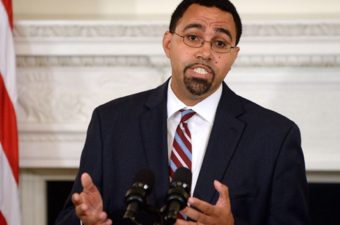
"There are far too many barriers preventing far too many low income students from enrolling in and graduating from college," said John B. King, the secretary of education. (Olivier Douliery/AP)
“There are far too many barriers preventing far too many low income students from enrolling in and graduating from college,” said John B. King, the secretary of education. (Olivier Douliery/AP)

Colleges should be doing more to recruit low-income students and to support them as they work to finish their degrees, says a new report released Thursday by the U.S. Department of Education.
The report also shines a light on the successes some colleges have had in promoting greater access to low-income students and increasing graduation rates.

“Many colleges and universities have taken important steps to make college a reality for low income students, but unfortunately today those success stories are the exception–they ought to be the rule,” said Education Secretary John B. King, in a press briefing yesterday. “There are far too many barriers preventing far too many low income students from enrolling in and graduating from college.”

Last year, a ProPublica analysis of federal data found that many wealthy colleges leave poor students with large debts. We also found that while some wealthy schools give big discounts to poor students, they also admit few of them. (In our interactive database, Debt by Degrees, you can look up how well a college is supporting its low-income students.)

Stephen Burd, a senior policy analyst from the New America foundation, believes that many colleges need to better prioritize low-income students in the admission process.

“Unfortunately, many schools are more focused on increasing their prestige and revenue than making college accessible and affordable for those who come from less privileged backgrounds,” said Burd. “It’s critical that we bring attention to those that are failing to enroll low-income students or support them adequately.”

The new report also calls on schools to improve the graduation gaps between poor and wealthy students. As we previously reported, low-income students struggle more to complete their degrees than their wealthier peers. On average, 51 percent of Pell recipients–students whose families typically make less than $30,000 year–graduate from college, compared to 65 percent of non-Pell recipients.

“For years, colleges and universities have adopted an approach that was around admitting the best students they could and the onus was on the student to make it,” said Andrew Nichols, a researcher at The Education Trust whose data underpinned the report. “Now we look at it differently. We understand that you can’t put all the responsibility on the student. Certainly they need to do their part, but there are things colleges and universities can do.”

The report comes on the heels of recent proposals from the White House to improve access and outcomes for low-income students. The administration has recently proposed expanding access to Pell Grants by allowing year-round eligibility to the program.

Additionally, President Obama made a splash during last year’s State of the Union address, when he proposed making two years of community college free to all students. Earlier this year, he also asked Congress to permanently index Pell Grants to inflation, an adjustment that is set to expire after 2017.

Read original article – March 24, 2016, 9 a.m.
Department of Education Report Calls on Colleges to Step Up Support for Poor Students

Privacy Violations Rising At Veterans Affairs Medical Facilities

Brandon Coleman, an addiction therapist for the Phoenix VA Health Care System, filed a privacy complaint after a social worker accessed his medical file in 2014. Madison Kirkman/AP Images for ProPublica
Brandon Coleman, an addiction therapist for the Phoenix VA Health Care System, filed a privacy complaint after a social worker accessed his medical file in 2014.
Madison Kirkman/AP Images for ProPublica

When Anthony McCann opened a thick manila envelope from the Department of Veterans Affairs last year, he expected to find his own medical records inside.

Instead, he found over 250 pages of deeply revealing personal information on another veteran’s mental health.

“It had everything about him, and I could have done anything with it,” McCann said in an interview.

It wasn’t the first time McCann had received another veteran’s medical records. In the past, he informed the VA, then threw away the misdirected documents. This time, after failing to make contact with the other veteran on his own, McCann took the documents to a town hall meeting held by the director of the VA’s Tennessee Valley Healthcare System.

When the floor opened for questions, McCann was the first to raise his hand.

“I got 256 pages of another person’s extremely confidential, extremely explicit mental health records,” he said, waving the documents in his hands, an exchange captured by local media. When an official asked for the documents back, McCann refused, doubting the VA’s ability to safeguard the material or make sure it ended up in the right hands. “I don’t trust them,” McCann told ProPublica. “They don’t do what they say they’re going to do.”

Employees and contractors at VA medical centers, clinics, pharmacies and benefit centers commit thousands of privacy violations each year and have racked up more than 10,000 such incidents since 2011, a ProPublica analysis of VA data shows.

The breaches range from inadvertent mistakes, such as sending documents or prescriptions to the wrong people, to employees’ intentional snooping and theft of data. Not all concern medical treatment; some involve data on benefits and compensation.

Many VA facilities and regional networks are chronic offenders, logging dozens of violations year after year.

The VA’s Sunshine Healthcare Network, which includes Florida, Puerto Rico and southern Georgia, has had more privacy incidents than any other region, with at least 370 over the past five years, according to ProPublica’s analysis. The C.W. Bill Young VA Medical Center in Bay Pines, Fla., had more privacy reports than any other facility, with 112 incidents. (ProPublica’s new tool, HIPAA Helper, allows you to read reports on these incidents and search by facility.)

In an interview Tuesday, a VA official said the department considers patient privacy a top priority and that it fares well in comparison with health providers and insurers in the private sector, some of which have been targets of cyberattacks this year. The VA runs the largest integrated health care system in the nation, with 150 hospitals and hundreds of clinics that collectively serve around 9 million patients annually.

“We take any loss of data very seriously,” said John Oswalt, the VA’s associate deputy assistant secretary for privacy and records management. “Over a third of our employees are veterans. … We have a vested interest in protecting the data personally, too.”

The VA also released a written statement that said, in part, “Inappropriate access of patient health records, either during or post treatment, is absolutely unacceptable and in violation of privacy laws and regulations, VA policies and procedures, and our principles.”

Responsibility to act on privacy violations falls both to the VA itself and to the Office for Civil Rights within the Department of Health and Human Services. That’s the agency charged with enforcing the Health Insurance Portability and Accountability Act, the federal patient privacy law known as HIPAA. The civil rights office has cited the VA more frequently than any other health provider in the nation, yet it has not sanctioned the VA or publicly identified it as the top HIPAA violator.

VA facilities were the subject of more than 300 privacy complaints to the Office for Civil Rights from 2011 to 2014. In 220 cases, the VA submitted a corrective-action plan or received “technical assistance” on how to comply with the law. (See our previous story.)

Two senators told ProPublica they found the volume of privacy breaches involving the VA to be deeply troubling.

“It’s just one more area in which the VA fails to operate in a way that’s worthy of our veterans,” said Kansas Republican Sen. Jerry Moran, a frequent critic of the VA who serves on the Senate Committee on Veterans’ Affairs. “There’s 127 community hospitals in Kansas. I have visited each and every one of them. When I visit a hospital, you can sense that they are very cautious about what I see and what I hear when it involves a patient. … That same kind of attitude ought to exist at the VA.”

The VA provides monthly reports to Congress on data breaches and posts them on its website, but these reports don’t contain all of the incidents provided to ProPublica under the Freedom of Information Act.

Moran said he would support requiring the VA to report all privacy incidents to Congress.

A 2013 investigation by the Pittsburgh Tribune-Review found that privacy violations were rampant within the VA, affecting tens of thousands of veterans. ProPublica asked for the data provided to the newspaper, as well as all privacy violations since then. The number of reported incidents has increased, the data show.

In fact, from 2011 to 2014, the number of reports per year nearly doubled, from 1,547 to 3,054.

The VA’s Oswalt said the increase is less a result of a growing problem and more an indication that the VA has been successful in encouraging employees to report potential breaches.

“I think we have a pretty good track record of getting people to report when they make a mistake or when they observe something happening,” he said. “If we were out there punishing people for human error, I think you would see the number of reported incidents go down, but that doesn’t serve the needs of the veteran.”

Under HIPAA, medical providers are responsible for keeping patients’ medical information confidential. Releasing a patient’s treatment information without consent is illegal. VA employees who have access to medical records are only supposed to access the minimum necessary in order to perform their jobs.

The majority of the VA privacy incidents appear to be inadvertent ones –medical records left in waiting rooms or faxed to the wrong recipient, for example. But even unintended errors can cause grief, particularly in the case of mistaken identities.

There were several cases of widows who received letters extending sympathy for the death of unrelated veterans and outlining survivor compensation and burial benefits for those veterans.

The privacy incident reports also reveal more systemic issues across the VA: Employees repeatedly accessed the medical records of patients not under their care, from co-workers to suicidal vets to whistleblowers.

For example, in September 2011, after a veteran committed suicide on the grounds of a VA facility in Biloxi, Miss., more than 40 employees accessed his medical records. In response, the VA provided training and a reminder about privacy laws and sent the veteran’s family a letter informing them of the violation.

Two years later, a VA employee who worked at the same facility in Biloxi committed suicide and, again, several co-workers inappropriately snooped in the medical records.

In January 2015, a veteran who works at C.W. Bill Young VA Medical Center attempted suicide. Afterward, many co-workers who had no direct involvement in his medical care seemed to know about his attempt and asked how he was doing. Following an investigation, the VA’s incident response team found that an employee had indeed inappropriately accessed the veteran’s medical records “out of curiosity.”

The problems were noted both within the VA’s internal data and in letters sent by the Office for Civil Rights to the VA when it closed its complaint investigations. (Patients can complain to the VA, the Office for Civil Rights or both.)

Some VA employees have used their access to medical records as a weapon in disputes or for personal gain, incident reports show.

A patient treated at the West Virginia VA Medical Center had his medical records impermissibly accessed by co-workers of his wife. His records were then used against him during divorce proceedings, according to a May 2013 letter from the Office for Civil Rights.

A VA employee at C.W. Bill Young VA Medical Center suspected that his ex-girlfriend, a nurse at the facility, accessed his Social Security number from his confidential medical files in order to change his AT&T account information. He requested a list of everyone who had looked at his file, which revealed that his ex-girlfriend had accessed it 55 times. According to the Office for Civil Rights investigation letter from November 2012, the ex-girlfriend was suspended for 10 days and given training, and the incident was documented in her employment record.

As the VA’s overall problems have mounted in the past couple of years — including long waits for care — some whistleblowers contend that HIPAA has been used as a sword against them. Some have reported being accused of violating HIPAA for collecting material to inform members of Congress about care problems at the VA. Others say their own medical records were looked at by co-workers and officials without their consent.

VA addiction therapist Brandon Coleman, now on administrative leave, testified about widespread problems with privacy breaches before the Senate Committee on Veterans' Affairs in September. Madison Kirkman/AP Images for ProPublica
VA addiction therapist Brandon Coleman, now on administrative leave, testified about widespread problems with privacy breaches before the Senate Committee on Veterans’ Affairs in September.
Madison Kirkman/AP Images for ProPublica

“This is a problem that is widespread throughout the VA,” said Brandon Coleman, a VA whistleblower who testified before the Senate that his private medical records were inappropriately accessed by a co-worker. “I realized right away that she had no right to be in there. She had never treated me and had nothing to do with my medical care.”

Coleman, an addiction therapist for the Phoenix VA Health Care System who is on administrative leave, said a social worker mentioned during a meeting in October 2014 that she had accidentally accessed his medical file a few months earlier. Coleman said he was horrified and filed a complaint with the privacy officer at the Phoenix VA.

Shortly after he came forward in December 2014 to the Office of Special Counsel, a federal office that handles whistleblower allegations for the VA, Coleman was placed on administrative leave for allegedly threatening other employees. While on leave, he discovered that yet another administrative officer at the VA, who also was not involved with his medical care, had accessed his health files after he filed his complaint with the Office of Special Counsel.

“They come up with ways to try to discredit you or say you are unfit for duty,” said Coleman, who is still on leave nearly a year later. “There is zero accountability.”

Another VA whistleblower, Dr. Katherine Mitchell, was inappropriately investigated for a privacy violation after she came forward with allegations of patient harm.

Mitchell, a physician who has worked at the VA for over 16 years, contacted the office of Sen. John McCain, R-Ariz., in 2013, alleging that the Carl T. Hayden VA Medical Center in Phoenix didn’t provide adequate care for its suicidal veterans and that the hospital statistically manipulated its patient wait list.

Mitchell submitted a formal report through the senator’s office, hoping that a congressional push would secure a review by the VA’s inspector general. However, shortly after she submitted her request, she was placed on administrative leave and investigated for alleged privacy violations: Her superiors told her that she had violated privacy laws by accessing the records of the suicidal veterans she alleged had not received adequate care.

“It’s not a violation to provide that information to your congressman to request an investigation into inappropriate behavior,” said Mitchell, who believes that many whistleblowers are investigated for merely trying to bring attention to flaws in the system.

The VA’s internal records indicate that its incident response team found that Mitchell accessed at least 15 patients’ charts without “proper authorization.” But a recent VA accountability review found that Mitchell’s actions were indeed protected because she was acting as a whistleblower, and her placement on leave was deemed to be retaliatory.

“The management uses HIPAA rules inappropriately to prevent whistleblowers from speaking up,” said Mitchell, who received the Office of Special Counsel’s Public Servant award the year after her allegations. “If they don’t report the cases, no one will investigate.”

The experiences of Coleman and Mitchell were reflected in recent testimony from Carolyn Lerner, who heads the Office of Special Counsel. Lerner expressed concern that VA employees are accessing whistleblower medical records to discredit their claims. She emphasized that the VA should consider “system-wide corrective action” to better protect whistleblowers.

“Quite simply, it is too easy right now for a mischief-minded employee to enter the medical record system and access information on his or her co-workers,” Lerner wrote in her written testimony. “A better ‘lock’ on the system would potentially eliminate, and certainly reduce, this problem.”

Sen. Richard Blumenthal of Connecticut, the ranking Democrat on the Senate Committee on Veterans’ Affairs, said he too is concerned about this.

“Nothing is more devastating and unconscionable than the misuse of power to subjugate legitimate complaints,” he said in an interview. Blumenthal has proposed a bill, called the VA Patient Protection Act, which, among other things, would punish VA supervisors or employees who retaliate against whistleblowers.

“The VA still has a significant way to go in restoring trust and credibility,” he added, “and part of that task is to take sufficient disciplinary action against wrongdoers so as to deter them and reassure all veterans that it has a very strict standard of accountability.”

In its statement, the VA told ProPublica that it will not tolerate any retaliation “against those who raise issues which may enable VA to better serve Veterans.”

“Complaints that VA receives from whistleblowers about inappropriate access to their health records are thoroughly investigated and appropriate actions are taken where warranted,” said the VA.

This story is part of a yearlong examination into how secure medical privacy is. Has your medical privacy been compromised? Help ProPublica investigate by filling out a short questionnaire. You can also read other stories in our Policing Patient Privacy series.

Copyright 2015 ProPublica. To see more, visit ProPublica.
Read Original Article –  December 30, 2015 5:00 AM ET

The FBI Checked the Wrong Box and a Woman Ended Up on the Terrorism Watch List For Years

This story was co-published with The Daily Beast.

As the Senate debated a proposal earlier this month that would have barred gun sales to people on the government’s terrorism watch lists, Republicans decried the lists as unfair, unreliable and un-American. “There’s no due process or any way to get your name removed from it in a timely fashion,” Sen. Marco Rubio told CNN. “This is not a list you can be certain of,” Jeb Bush said. Mike Huckabee asserted that some people end up on the no-fly list due to “suspicion, not necessarily even so much as probable cause.”

Rahinah Ibrahim, a Malaysian architect with a doctorate from Stanford, knows from personal experience that they have a compelling point. Ibrahim is the only person since 9/11 to file a court challenge that ultimately removed her name from the watch lists. It took her almost a decade to prevail in court and even that victory has proved phyrrhic. While a federal judge agreed that her inclusion on the no-fly list was groundless, she remains unable to obtain a visa that would allow her to visit the United States even to attend academic conferences. A close look at her case by ProPublica provides dramatic evidence of what was argued this month in Washington: It is indeed remarkably easy to get on the list and nearly impossible to get off.

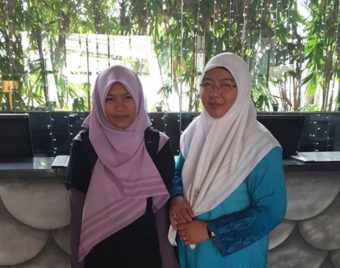
Rahinah Ibrahim with Rafeah Mustafa Kamal
Rahinah Ibrahim, right, with her daughter Rafeah Mustafa Kamal, at the Park Royal Hotel in Kuala Lumpur. This photo was taken at a conference of the International Association for the Study of Traditional Environments, which Rahinah co-chaired. (Photo by Raymond Bonner for ProPublica)

The questions of terrorism lists and visas appear likely to take center stage in the coming months. While the Senate rejected the amendment barring gun sales, Connecticut’s governor imposed just such a ban on a threat that is more theoretical. Between 2004 and 2014, more than 2,000 people on the government’s watch lists purchased firearms in the United States, according to a study by the Government Accountability Office. Questions are also emerging about how Tafsheen Malik, one of the perpetrators in the San Bernardino terrorism attack, managed to get a visa to join her husband despite her pro-jihadi postings on social media.

Taken together, the two cases offer a disturbing look at the ability of U.S. authorities to effectively and fairly guard the border.

Ibrahim’s saga began on Jan. 2, 2005. A devout Muslim, she got up before dawn and said her morning prayers. A friend drove her up Highway 101 from San Jose to the San Francisco International Airport. She was booked on United Airlines Flight 41. Ibrahim planned a stopover in Hawaii, where she would deliver a paper at a prestigious conference, before continuing to Malaysia.

The 44-year-old mother of four felt good about her forthcoming trip although she was still in pain from an emergency hysterectomy months earlier. She had just completed four years of demanding course work, while also working as a volunteer at the Stanford hospital. She had just passed her oral exams, a considerable accomplishment for someone who had grown up in rural Malaysia and not been out of the country until she was 18.

When Ibrahim, wearing a hijab that allowed not a strand of her brown hair to show, reached the counter, the ticket agent looked at her reservation and summoned a supervisor. Soon, Ibrahim saw two San Francisco police officers striding purposefully through the terminal. After speaking with the supervisor, the officers told Ibrahim that she was under arrest, handcuffed her and marched her through the crowded terminal to a police car that drove her to the airport police station. Inside, as she would later recall, she found herself in a deeply uncomfortable setting, “a handcuffed Muslim woman surrounded by three male policemen.” The officers locked Ibrahim in a cell where she sat on a cold, stainless steel bench and cried, the scar across her abdomen aching.

Ibrahim had no idea why she had been detained. She explained to the police that two FBI agents interviewed her just nine days earlier and she showed them the business card that one of them, Kevin Kelley, had given her. Kelley was a member of the South Bay Joint Terrorism Task Force in San Jose. He had asked about her academic work (her area of concentration at the engineering school was affordable housing); her husband (he’s very progressive and had allowed her to pursue her career, something most men in her conservative country would not do) and about Jemaah Islamiyah, a terrorist group created in Malaysia but best known for bombings of night clubs in Bali. Ibrahim told Kelley she didn’t know much about Jemaah Islamiyah beyond headlines on the Internet, but that she was a member of Jemaah Islam Malaysia, a professional organization for people who had studied in the United States and Europe and encouraged the practice of more moderate forms of Islam.

After she had been detained at the police station for more than two hours, an official from the Department of Homeland Security, Lee Korman, showed up. He apologized to Ibrahim for her arrest and told her that she had been removed from the no-fly list and was now free to fly. It was the first time Ibrahim knew she was on the no-fly list.

Before 9/11, there were perhaps a dozen people worldwide on America’s no-fly list. The numbers soared after the attacks and by 2013 there were some 47,000 individuals on the list, according to a Justice Department audit. Grandmothers, infants, honorably discharged veterans and the disabled have found themselves barred from boarding. A few notorious cases made headlines, such as when Sen. Edward Kennedy was stopped several times — because, it turned out, there was a “T. Kennedy” on some agency’s terrorist watchlist. Kennedy’s name was, of course, removed. For tens of thousands of others, it was not so easy.

The no-fly list is part of the post 9/11 security apparatus, which is a labyrinth of euphemisms and acronyms. The effort is coordinated by the Terrorism Screening Center (TSC), a multi-agency group of officials managed by the FBI in coordination with the CIA. All federal departments and agencies are responsible “for collecting information about potential terrorists or attacks’’ and sharing that information with the FBI or the CIA, either of which can “nominate” individuals for inclusion in the Terrorist Screening Database (TSDB).

From that database, names are passed “downstream” (in bureaucratic jargon) to the so-called “frontline” agencies — for example, to the Transportation Security Agency (TSA), which administers the no-fly list and to the State Department, where the names are put into the Consular Lookout and Support System (CLASS), which American consular officers around the world call up when a foreigner applies for a visa.

State and local law enforcement officials have access to the database, which now has some 700,000 records. A police officer pulling over a driver for speeding can check the name on the driver’s license against the TSDB. In addition, the lists are shared with more than 20 foreign governments.

An FBI agent need only have a “reasonable suspicion,” to “nominate” someone, the FBI guidelines say. It is supposed to be more than “a mere guess or hunches.” But, as Huckabee noted, the standard is well short of the probable cause the police need to arrest a person.


Ibrahim was born in 1969, the second of five children, into modest circumstances, her father a mid-level civil servant. She inherited school uniforms and textbooks from her older sister, and then passed them on to her younger one. Neither of her parents had finished high school, and they pushed their children to get an education.

Ibrahim had mild dyslexia and was something of a loner in school who found solace in drawing. She finished first in her high-school class, and was one of 25 students nationwide selected to study in the U.S. She had been on an airplane only once before, a small one, to return home from boarding school when her father died. When the flight stopped for a layover in Hong Kong, Ibrahim got separated from the rest of the group. Another student in the honor’s program, Mustafa Kamal, the son of primary school teachers in a small rural town, volunteered to find her. Kamal would continue chasing Ibrahim, changing her life — romantically, unconventionally, profoundly. Ibrahim enrolled in the University of Washington to study architecture; Kamal studied civil engineering at California State University, Long Beach. After a long-distance, telephone romance, they married in the summer between their third and fourth years. Ibrahim graduated with honors in 1984 after the birth of the couple’s first child and moved to Southern California to study for a masters at the Southern California Institute of Technology in Santa Monica.

Kamal assumed primary responsibility for domestic chores. “I was a stay-at-home dad,” he said. He was becoming Americanized. Evenings he watched the ABC News with Peter Jennings, and he was such a diehard Los Angeles Lakers fan that he and his friends would adjust the time of their evening prayers so they could watch the games on television.

“I always feel in love with America,” Kamal told me in an interview in Malaysia. “We consider America our second home.” The years in the United States had a profound impact. “I would say that we grew up in the States. It changed our perspective on the world.” One of his favorite television programs was Meet The Press, which he liked to watch “just to see how these people argue.” On his Facebook page, Kamal lists Henry Kissinger’s “Diplomacy” as one of his “likes.”

Living in America also changed their approach to Islam. They began to practice their religion in a more Western context. “We call it progressive Islam,” Ibrahim told me, during the only interview she has given about her experiences.

After Ibrahim got her masters degree, the family returned to Malaysia and she launched her career as an architect. At the age of 32, and pregnant with her fourth child, Ibrahim became the first female lecturer at University Putra Malaysia, a 7500-acre campus 12 miles south of downtown Kuala Lumpur She was soon intellectually restless and applied to Stanford, surprised when she was accepted.

In 2000, Ibrahim returned to the U.S. with an F1 student visa. Kamal remained in Malaysia. He was the managing director of an environmental consultancy business and had become deeply committed to international relief work. Kamal traveled to Palo Alto every three months to visit his wife.


On March 10, 2005, 10 weeks after her encounter at the San Francisco airport, Ibrahim was set to fly from Malaysia to Stanford with plans to put the final touches on her doctoral thesis. At Kuala Lumpur’s gleaming, modern airport, when she reached the Cathay Pacific counter, she put her bag on the scale — it was filled with presents for patients at the Stanford hospital where she had worked as a volunteer. A supervisory agent asked her to step out of line, and she watched as he made and received calls on his mobile phone. She was puzzled. Korman had told her she had been taken off the no-fly list; she gave Korman’s card to the supervisor. At 9:25, five minutes before the gate was to close, the agent told Ibrahim that he had spoken with the American embassy. Her visa had been revoked.

She was angry and perplexed. Why would the State Department do such a thing?

And so Ibrahim began the laborious process of trying to clear her name of an accusation about which she knew nothing.

She filled out the form for people who feel they are wrongly on the no-fly list. Called the Travel Redress Inquiry Program report (TRIP), it provides little in the way of relief. People get to lodge their complaints. When foreign nationals like Ibrahim are involved, the government declines to confirm or deny their presence on any lists but sends a form letter that says “applicable records” have been reviewed. The letter assures travelers that corrections to the records have been made if “warranted.’’


In January 2006, a year after Ibrahim was shackled in San Francisco, she filed a lawsuit in federal district court in San Francisco against a litany of federal agencies. She was not asking for monetary damages, or compensation of any sort. She only wanted her name removed from the no-fly list and any other terrorism databases.

Ibrahim was represented pro bono by a small law firm in San Jose, California, McManis Faulkner. “I wanted this case in a heartbeat,” said James McManis, whose legal hero is Clarence Darrow.. “What they did to this woman was just outrageous.”

The odds against Ibrahim were beyond astronomical. No one had ever prevailed in a legal challenge of the watch lists. The case was assigned to Judge William Alsup, a demanding, hard-working jurist who began his trials at 7:30, about two hours before his colleagues on the federal bench.

The government moved to dismiss, arguing that by law, challenges to Transportation Security Administration (TSA) rulings must be filed before the U.S. court of appeals, not the district court. Alsup agreed. Case dismissed.

Ibrahim’s lawyers appealed to the Ninth Circuit. The lead lawyer at the time, Marwa Elzankaly, was only three minutes into her argument when Judge Alex Kozinsky interrupted, and he didn’t let up, peppering her with questions. Kozinsky was the court’s chief judge, a gregarious, outspoken libertarian-leaning intellectual. Elzankaly stood at the podium, pen in her right hand, scribbling notes on a yellow legal pad, answering the questions with impressive poise.

It wasn’t as easy for the Justice Department lawyer. If the court had no jurisdiction, how was the plaintiff to get off the no-fly list, Kozinsky wanted to know. “If not here, where? If not now, when?” said Kozinsky, whose parents were Holocaust survivors. “It’s from the Talmud, you know.” The government lawyer was unaware of the saying.

The appellate court ruled in Ibrahim’s favor, 2-1. The Terrorist Screening Center actually determined who was on the no-fly list, not the TSA, Kozinsky wrote for the majority.

The case was sent back to Alsup for trial.

The Justice Department again moved to dismiss. Ibrahim could not avail herself of constitutional protections because she was not a citizen, nor did she live in the country, the government argued. Again, Alsup agreed. “She is an alien who voluntarily left the United States and thus voluntarily left her constitutional rights at the water’s edge,” he wrote, and dismissed the case. Again Ibrahim appealed. And again, the government lost, 2-1.

Ibrahim had a “significant voluntary connection” with the United States — her time at Stanford; continuing discussions with professors; plans to return — and that allowed her to raise constitutional issues, the appeals court said.

The judges were troubled by the watch list system. The Terrorist Screening Database had grown by over 700 percent since its inception, and 20,000 records were being added a month, the court noted. The judges found that the implementation of the no-fly list was problematic. “Tens of thousands of travelers have been misidentified because of misspellings and transcription errors in the nomination process, and because of computer algorithms that imperfectly travelers against the names on the list,” the majority wrote.

Meanwhile, the national security bureaucracy seemed uncertain whether Ibrahim was or was not a terrorist according to the documents unearthed by her lawsuit.

In December 2005, 11 months after Homeland Security agent Korman told Ibrahim that she had been removed from the no-fly list, Ibrahim was put on the list of terrorist suspects that was sent to Australia (TACTICS), and to Canada (TUSCAN). (She had never visited either country, and had no plans to.)

In September 2006, she was completely removed from the Terrorist Screening Database, with federal officials concluding there was no “nexus to terrorism’’ involved in her case.

Six months later, in March 2007, Ibrahim reappeared in the database.

Two months after that, she was again removed.

The reasons for all these moves remain unknown to Ibrahim, or her lawyers.

In 2009, Ibrahim applied for a visa so that she could go to San Francisco to work with her lawyers. When she went to the American embassy in Kuala Lumpur to pick it up, a consular officer slid a “Dear Visa Applicant” form letter through a slot in the bullet proof glass. Somehow, she was back on the list again.

“This office regrets to inform you that your visa application is refused because you have been found ineligible under the following section(s) of the Immigration and Nationality Act.” There was a check in the box beside “212(a)(3)B.” There was no explanation of what the section is. Ibrahim asked the consular officer. “(Terrorist),” he wrote on the form.

For the first time, Ibrahim knew that the United States government considered her a terrorist.

Ibrahim’s tribulations with the American government contrasted with her triumphs at the Malaysian university. She became a senior lecturer in November 2006; associate professor six months later; full professor in 2011, when she was named dean of the faculty of architecture and design. Her rapid ascent generated some grumbling, envy and enmity among her colleagues, virtually all men. She was acquiring an international reputation in the field of affordable housing — the list of academic papers in her c.v. ran to more than 10 pages — and she was invited to conferences around the world. The country she most wanted to visit — the United States — would not admit her. The Academy of Sciences of Malaysia collaborated with the New York Academy of Sciences, but she couldn’t attend meetings when they were in New York. She wanted to explore the establishment of a joint research center with Stanford, which would have been a coup for her university and as well as for the country.


Ibrahim’s resolve to clear her name was matched by the government’s determination that she never know anything that might help her, or the public, understand why she was considered a terrorist, why she had been on the no-fly list, why she had been denied a visa. In one legal brief, the Justice Department even redacted the names of 13 law cases, two statutes, one Federal Rule of Civil Procedure, as well as several pages of the argument.

“This is too hard to swallow!” Alsup wrote in one ruling. But swallow it he did and the black ink remained in place. The vast majority of documents in Ibrahim’s case — briefs, motions, letters to the judge, hearing transcripts — contain redactions, from a word or two, to a few paragraphs, to entire pages. This makes it impossible to fully assess the government’s claim that it had reasonable grounds to put Ibrahim on the terrorist list or whether she received due process.

Attorney General Eric Holder Jr. filed an affidavit with the court broadly summarizing the evidence the government was withholding on the grounds that it contained “state secrets,” and public release would harm national security. The government’s claim was sweeping, covering any information that “could tend to confirm or deny” whether Ibrahim “was or was not” the subject of an FBI investigation; “any information (if any) obtained by the FBI from the U.S. Intelligence Community” relating to the reasons for any investigation of Ibrahim “or her associates”; and “information related to whether court-ordered searches or surveillance, confidential human sources, and other investigative or operational sources and methods were used by the FBI.”

Ibrahim’s lawyers were skeptical. Take the matter of whether Ibrahim had been the subject of a terrorism investigation, which Holder had asserted was a “state secret.’’

“That’s not a secret. It’s not a secret,” Elizabeth Pipkin who had taken over as lead lawyer when Elzankaly married and moved back to Egypt, told Alsup during a hearing. And she had the documents to prove it. Kevin Kelley, FBI agent who interviewed Ibrahim in December 2004, had prepared a report. Ibrahim’s lawyers had obtained it through a request under the Freedom of Information Act.

“You have a document there you want to show me that you got from where, a FOIA request?” Alsup said.

Yes, said Pipkin, who was in her mid-thirties but already arguing what older colleagues told her was likely to be the biggest case of her career.

Alsup ruled that Kelley’s interview report was admissible. Pipkin then directed his attention to the number “315” written on the report. The bureau’s File Classification List said “315” was the designation for “International Terrorism Investigations.”

”Where did you get your hands on it?” Alsup asked of the classification list.

“We got it from the FBI’s web site,” Pipkin answered.

Alsup, astonished, admitted it into evidence.


At 7:30 a.m. on Dec. 2, 2013, one month shy of nine years since her ordeal at San Francisco Airport, Ibrahim finally got her day in court. She wasn’t there, however. She couldn’t get a visa.

In Courtroom 8 on the 19th floor of the federal building in San Francisco’s seedy Tenderloin district, Alsup entered and took his seat, the American flag on his right.

On the first day of the trial, the lawyers and Alsup embarked on a lengthy and contentious discussion about what could be made public, what documents would be sealed, when he would have to close the courtroom. Alsup believed passionately that judicial proceedings should be open. “It’s not so much to protect individual litigants,” he said during one exchange with the lawyers. “It’s to protect the public to have access to what is going on in their public institutions, so that the public will have confidence that decisions are being made in a fair and just and evenhanded way.” Still, at the government’s request, he closed the courtroom at least 10 times during the trial, and ruled in favor of the government in nearly all of its requests to redact or seal the record

Even when the courtroom was open, only a handful of spectators and one or two journalists were there to witness a bizarre case, one that bolsters assertions that due process is lacking.

The Justice Department’s opening argument — the portion that wasn’t delivered behind closed doors — reads like “Alice In Wonderland” meets Kafka. “Even if Professor Ibrahim were in the TSDB, a fact that we can neither confirm nor deny on the public record, the government cannot present an explanation for the placement” because it is a state secret, a Justice Department lawyer told Alsup. The government “cannot even respond to Professor Ibrahim’s accusations by confirming or denying whether they are correct,” she added.

The pivotal moments of the five-day trial came when two FBI agents, Debra Lubman and Kevin Kelley, testified. At the government’s request, Alsup closed the courtroom. Every word of Kelley’s testimony is blacked out in the publicly released trial transcript. It is possible, however, to know some of what Lubman and Kelley testified by piecing together un-redacted snippets from other documents in the case, including Alsup’s opinion.

Under questioning from one of Ibrahim’s lawyers, Christine Peek, Kelley testified that five weeks before he had interviewed Ibrahim, he had filled out the FBI’s “Violent Gang and Terrorist Organizations File Gang Member Entry Form.”

Using the boiler-pale language on the form, Kelley said he had opened the investigation on the basis of information from “an informant or individual of unknown reliability” that Ibrahim “frequents a documented group’s area, associates with known group members, and/or affects group dress, hand signals, tattoos, or symbols.”

On the form, there was a vertical row of the watchlists, with a box beside each:

  • Lookout and Support System (CLASS);
  • Interagency Border Information System (IBIS);
  • TSA No Fly list
  • TSA Selectee list;
  • TUSCAN (shared with Canada)
  • TACTICS (Australia).

Kelley checked five of the six boxes, leaving blank only “TSA No Fly List.”

How then did Ibrahim’s name end up on the No Fly list?

Kelley testified that he had made a mistake. The form instructed the agent to check the list, or lists, on which he did not want to put the individual. He should have checked the TSA No Fly list and left everything else blank.

On the final day of the trial, during closing arguments, Alsup engaged in an absorbing colloquy with the Justice Department lawyers. He harkened back to the 1950s when “thousands of visas and passports and other things” had been denied to alleged Communists. Often the information on which the denials were based was false, he noted.

He put it in the post-9/11 context.

“Let’s say instead of a Communist, let’s say that the file says this person has contributed money to Al-Qaeda. Is that a good reason to deny somebody, to put them on the watchlist?”

It would be, answered Justice Department lawyer John K. Theis.

“All right,” Alsup replied. “So let’s say it’s completely false; that they never contributed a nickel to Al-Qaeda. In fact, they hate Al-Qaeda. They raise the American flag in their front yard every day. Let’s say it’s totally false. How is that person supposed to know to even send in an affidavit saying ‘I’m not a member — I hate Al Qaeda?’“

He brought up a notorious case from the McCarthy era. “Do you know the story of Robert Oppenheimer and what they did to him?” he asked.

“I don’t, your Honor,” Theis said.

Alsup explained that Oppenheimer, a brilliant physicist, was the head of the Manhattan Project, which developed the atomic bomb. In the early 1950s, he was stripped of his security clearance based on allegations of links to the Communist Party — his wife and brother were members — and of spying for the Soviet Union.

“It was a low point in America’s history that we would have treated a hero like him in the terrible way we did. The information was bogus,” Alsup said. “They suspected him of being a Communist. He was not.”

In 1964, President Johnson awarded Oppenheimer the Medal of Freedom.


Alsup issued his opinion on Jan. 14, 2014.

He found that Ibrahim’s ordeal had been caused by Kelley’s error in filling out the form, an error that had led “to the humiliation, cuffing and incarceration of an innocent and incapacitated air traveler.” It was, he wrote, “a bureaucratic analogy to a surgeon amputating the wrong digit.”

Alsup’s next finding was even more startling.

“Government counsel has conceded at trial that Dr. Ibrahim is not a threat to our national security,” he wrote, describing some of the testimony he had heard while the courtroom was closed. “She does not pose (and had not posed) a threat of committing an act of international or domestic terrorism with respect to an aircraft, a threat to airline passenger or civil aviation security, or a threat of domestic terrorism. This the government admits and this order finds.”

So why then had the government blocked her from entering the U.S.?

Alsup provided a hint to the answer in three sentences, easy to overlook in his 38-page opinion, and carefully crafted so as not to reveal any classified information. Under the Immigration and Nationality Act, there are nine grounds for denying a person a visa. “Some of them go beyond whether the applicant herself poses a national security threat,” Alsup wrote. The judge did not list the nine grounds. But the immigration law is a public document. Eight of the categories apply to the applicant. One does not. The ninth basis for turning down a visa application is if the person “is the spouse” of a foreigner who has engaged in any terrorist-related activity in the preceding five years.

Thus, the basis for Ibrahim’s place on the watch lists would appear to be something the law purportedly abhors — guilt by association, or in this case, by marriage.

Alsup ordered the government to do what it said it could not do. “Given the Kafkaesque on-off-on-list treatment imposed on Dr. Ibrahim, the government is further ordered expressly to tell Dr. Ibrahim that she is no longer on the no-fly list.” Alsup also ordered all federal agencies that subscribe to the TSDB to search their records and remove Ibrahim’s name. Both orders were unprecedented.

Huckabee had said it can take as long as two years for a person to clear their name. It took Ibrahim almost a decade. And she wouldn’t have succeeded without the commitment of McManis Faulkner, which Alsup commended for “standing up to our national government and its large litigation resources,” and for doing so without being paid, “at a time that pro bono representation seems to have taken a second seat to money bono.”


A few months after Alsup’s ruling, I flew to Malaysia to interview Ibrahim. We met at the university. She was wearing a green headscarf with a cut-glass brooch and a traditional Malaysian dress — a brightly flowered knee-length blouse over a matching skirt that reached to her feet. Raihan, her oldest daughter and a newly minted lawyer, set up a computer on the table and plugged it in. Soon, Pipkin was with us, in voice and picture, via Skype. During the two-hour interview, she did not instruct Ibrahim not to answer any questions, or advise her on what to say. (Pipkin was not present during several subsequent interviews with Ibrahim).Ibrahim had not read Alsup’s opinion, and I told her that her husband might be the cause of her problems. She looked puzzled. “Is that true, Liz?” she asked.Pipkin explained what Alsup had said. “Putting two and two together,” it would seem to point to your husband, she told Ibrahim.It appears that Kamal — and by association, Ibrahim — became snared in the U.S. government’s war on terror as the result of his humanitarian activities. His first humanitarian work, including for victims of the tsunami in Indonesia, was with Jemaah Islam Malaysia, the professional organization. Later, he and Ibrahim established their own humanitarian organization, Action Caring Team Malaysia.

Kamal’s altruism is deeply rooted. ”I like to help people because I saw my father helping poor people,” Kamal told me. His father was a primary school teacher in a small, rural village. ”Old shoes, old socks, even old toothbrushes, he gave them to the students.” Kamal has the same impulses. “If I see somebody who is hungry while I am eating, I’ll say ‘come have a seat.’ “

While his wife was at Stanford, Kamal undertook several humanitarian missions to Mindanao, the predominately Muslim province in the Philippines. A civil war had been simmering there for nearly two decades, waged by Muslims seeking independence from, or at least greater autonomy in, the overwhelmingly Catholic country. The war had created more than 200,000 refugees. When Kamal visited for five days in 2003, providing food for widows and orphans, building wells and schools, restoring mosques, the province had become a front in the Bush Administration’s war on terrorism; CIA and FBI agents were all over the place. In addition to the various Muslim liberation groups, Washington covertly sought to obtain information about Abu Sayaff, an organization that had received financial support from Al Qaeda in the mid—90s, but had degenerated into a criminal gang that kidnapped for profit, including several Americans. Above all, Washington was watching Jemaah Islamiyah, the terrorist organization, which was using Mindanao as a training ground.

Former FBI and CIA agents who were working in that area at the time told me that Kamal, by his mere presence in Mindanao doing humanitarian work, would have come to the attention of American intelligence.

There may be another reason Ibrahim ended up on the no-fly list. “Maybe they got the wrong wife,” said an American official who has followed the case closely.

As allowed in Islam, Kamal has two additional wives. It is not something Ibrahim or her husband try to hide. He lists his wives, and posts photos of the families on Facebook. Altogether, Kamal has 13 children. They often gather at Ibrahim’s house on holidays. “We are one big family,” she told me.

Kamal’s third wife, Kurais Abdullah Karim, a Filipina, could also be a cause of Ibrahim’s problems. A lecturer at the International University of Malaysia, Karim, is from Mindanao and is, as Kamal put it, a “humanitarian activist.” In addition to having her own blog, about fashion, and posting regularly on Instagram, she is an unabashed supporter of the Muslim liberation movement in Mindanao. “The Sweetness of Sacrificing for the Sake of Allah: The Life of a Mindanao Freedom Fighter,” was the title of an article she wrote for Milinea Muslim Magazine. (In 2014, the Philippine Government and the secessionist Muslims signed a peace treaty ending more than four decades of civil war.)

Kamal said he has never had any involvement with Jemaah Islamiyah, or any other terrorist organization. Malaysian intelligence and security agencies keep close tabs on Malaysians who go to Mindanao, American and European intelligence officials told me, but they do not have a file on Kamal or Ibrahim. If they did, she would not be allowed to be a professor, let alone dean, at the government university, current and former Malaysian officials said, a conclusion shared by American officials who have worked in Malaysia.

Three months after Alsup issued his opinion, in April 2014, the State Department again denied Ibrahim’s application for a visa to travel to the United States. Explaining that action, the department checked subsection IX of the Immigration and Nationality Act, the spousal connection category, and also the subsection that says visas shall be denied to anyone who “has engaged in a terrorist activity.” This directly contradicted the testimony of the FBI that Ibrahim is not, and has never been, a terrorist threat.

Earlier this year, Ibrahim applied for a visa under a provision in the immigration law that allows the State Department to grant a waiver to individuals who are otherwise ineligible. She wanted to attend a planning meeting for a joint Stanford-University Putra research center, her long-time dream. The State Department delayed and by the time it granted a one-time waiver, it was too late for Ibrahim to attend. The State Department still considers her ineligible under the terrorism category, and she will have to apply again for a waiver should she seek to come to the United States.

Like this story? Sign up for our daily newsletter to get more of our best work.
Read Original Article – Published Dec. 15, 2015, 5 a.m.
The FBI Checked the Wrong Box and a Woman Ended Up on the Terrorism Watch List For Years

How to Vet Nonprofits Before You Give

2015-12-01 vetting nonprofits magnifying glass gift
(Illustration by Rob Weychert/ProPublica)

Charity solicitations are as much a part of the holiday season as decorations. If you give, it’s a good idea to know what the nonprofit organization does with your money. Here’s one way: use ProPublica’s Nonprofit Explorer, a tool for researching the financial details of nonprofits.

Nonprofit Explorer

Use the ProPublica database to search over 1.8 million tax returns from tax-exempt organizations and see financial details such as their executive compensation and revenue and expenses. Explore the app.

Organizations that receive a tax exemption from the Internal Revenue Service and take in at least $50,000 a year have to file an annual report, called a Form 990, which can serve as a guide to how they operate and what their programs are. Nonprofit Explorer summarizes the financial data in 990 forms and also provides links to the documents. While not a complete picture of an organization’s activities, the form does provide insight on how a nonprofit operates. Here are a few things to look for when deciding whether to make that contribution:

Program Spending

Charities often tell donors that a certain amount of every dollar goes directly to “programs,” which usually mean direct services provided to the recipients of their assistance (the homeless, for example, or children). But read the fine print, says CharityWatch: sometimes these statements say “of every dollar spent” and sometimes they say “of every dollar donated.” Those are two different numbers, as ProPublica’s reporting on the Red Cross demonstrates. The Form 990 not only lists the totals for money coming in and going out, but in Part III (often the second page of the completed form, as with the 2013 form for the New York-based Coalition for the Homeless), the group also describes the program services that it performed, how much they cost and indicates whether there were any significant changes to existing programs. If you’re unsure about exactly what a charity does, Part III can help clear up that uncertainty, but it is also the place where charities promote their accomplishments.

Amount Spent on Professional Fundraisers

Charities rely on volunteers to ask for donations, but many also pay for-profit companies to help them raise money via telephone and mail solicitations. In its investigation of “America’s Worst Charities,” the Tampa Bay Times and the Center for Investigative Reporting identified nonprofits that raise millions via professional fundraisers and “regularly give their solicitors at least two-thirds of the take.” One organization, the Committee for Missing Children in Lawrenceville, Georgia, paid its fundraisers nearly 90 percent of the $27 million it raised during the decade the report examined. The more that charities spend on fundraisers, the less money they have for direct program spending — the reason the organizations exist. On a 990 form, look for this amount on line 16a of the first page, labeled “Professional fundraising fees.”

Executive Compensation

Charity organizations are also required to list officers, directors, trustees, key employees and the five highest-paid employees of the organization — and the amount each person was paid — in Part VII of the 990 form. Because of this public disclosure, executive salaries are sometimes contentious, as recently highlighted during a congressional hearing on Planned Parenthood. (In 2013 the organization’s president, Cecile Richards, was paid $590,928 in salary, retirement contributions, bonuses and other pay.) But a high salary alone isn’t a red flag. The IRS requires only that compensation is “reasonable,” or what a similar position would be paid by a similar organization. A Charity Navigator study of charity CEO compensation noted that unsurprisingly, “as the size and to some degree the complexities of running a nonprofit increases, so does the salary of the institution’s top executive,” recommending that donors compare an organization’s executive salaries to other charities for a better assessment.

The study also points out that organizations that show $0 paid to executives may also warrant a closer look. “There are very few individuals that can afford to work full-time managing complex, multi-million dollar organizations without receiving any compensation.” There may be legitimate reasons for this, or the compensation figure may have been misreported to the IRS.

According to Ray Madoff, director of the Boston College Forum on Philanthropy and the Public Good, this could also be caused by a nonprofit outsourcing staff and management duties, essentially hiding the individual salaries of an organization by reporting it within an aggregate contractor payment. She points to Fidelity Charitable, the second-largest nonprofit in terms of donations: Although officers are listed in Part VII of the form 990, all salaries are listed as “$0*”, with the asterisk noting that “all services are provided to Fidelity Charitable” by FMR LLC, the parent company of the for-profit Fidelity Investments. A Fidelity spokesperson confirmed simply that “Fidelity Charitable does not report individual salaries because it does not itself pay any salaries” and that “it hires FMR LLC […] to provide a wide range of services.” They also point out that the charity “does, of course, report the fees paid to service providers, including FMR LLC.” According to Schedule O of the 990, FMR received over $32 million in “contractor compensation” from Fidelity Charitable.

Beyond the 990

While the 990 can help you root out scammers and gross underperformers, it does not tell you how effectively money spent on programs translates into results on the ground. In the words of the Foundation Center’s Luz Rodriguez, “some not-so-great charities are just really good at finances.” To examine a charity’s reputation in its target community, Rodriguez suggests looking through its social media for positive testimony or service complaints. Greatnonprofits.org aggregates crowd-sourced reviews of nonprofits. GuideStar has experts in the field weigh in on their favorite nonprofits on Philanthropedia.

In the absence of robust data on results, GuideStar CEO Jacob Harold said donors should look for groups that set out their work and measures of success with clarity and specificity. “Clarity is all too rare in the nonprofit sector,” he said. “Look for groups that clearly articulate the solution rather than just talking about the problem.” He recommends GiveWell, one of the more quantitatively rigorous nonprofit watchdogs, which weighs charities by lives improved per dollar spent. Its list is far from exhaustive, but incorporates the concept of scalability — it selects groups that have “room for more funding,” and can do the most with your money

Giving Overseas — One Thing To Remember

Sometimes your charity of choice’s mission could cause more harm than good by having unintended consequences for the recipients of its donations.

This is particularly relevant to “gift-in-kind” donations — those old clothes, shoes, toys and food that well-intentioned Americans send in bulk to the developing world. These influxes of free, secondhand goods can undercut and destroy local industry. Indigenous manufacturers are priced out of the market, and the community is denied the growth benefits of textile and food processing industries that placed countries like Mexico and South Korea on the development ladder. Countries like Kenya and Haiti are having this first rung broken right under their feet by good intentions.

Charity evaluators like GiveWell prioritize health and infrastructure sectors instead, in which nonprofit interventions have an exponential impact on the local economy by attacking the problems of poverty at their core. They also recommend GiveDirectly, a direct cash transfer charity with a 90 percent program-to-overhead cost ratio that consistently ranks among GiveWell’s top performing nonprofits. GiveDirectly sends donor money straight to the poorest families in Uganda and Kenya through mobile banking. The mobile route ensures that the entire sum reaches the target family, and is even safer than in-kind donations, which can be siphoned off to the black market.

As a nonprofit, ProPublica also files Form 990; you can see the most recent one here.

Like this story? Sign up for our daily newsletter to get more of our best work.

Read Original Article – Published Dec. 1, 2015, 12:52 p.m.
How to Vet Nonprofits Before You Give

Pentagon Task Force: We Want Villas and Flat-Screen TVs in Afghanistan

The Pentagon
A view of The Pentagon from the northeast. (Creative Commons photo by David B. Gleason)

The requirements were clear: Villas with no less than queen beds, flat-screen TVs of no less than 27 inches, meals of at least three stars and round-the-clock bodyguards.

Sounds more like a celebrity rider than a description of Afghanistan accommodations for U.S. government employees. But that’s what the Pentagon’s Task Force for Business and Stability Operations requested — at a cost of $150 million, according to a letter released today by the Special Inspector General for Afghanistan Reconstruction, or SIGAR.

The high-end demands add to a string of recent controversies involving the now-defunct task force. Last month SIGAR reported that the task force spent $43 million on a gas station that should have cost about $500,000 and had no customers regardless. There are also allegations the Pentagon has retaliated against a task force whistleblower as well on-going criminal investigations. And a standoff between SIGAR and Pentagon officials over access to documents that has gotten the attention of Congress.

The task force was supposed to be an entrepreneurial initiative to jumpstart the Afghanistan economy. The Pentagon hired investment bankers, equities traders from Bear Stearns, wealth managers and Silicon Valley expats. They were expected to create jobs and encourage foreign investors by bringing them into the country and showing them the money-making possibilities.

SIGAR has been digging into the task force to figure out what the Defense Department accomplished with five years and a budget of more than $800 million.

The “villas” were a special arrangement not often seen for war zone workers, and some task force officials told SIGAR the pricey set up supported only a handful of employees at a time. Rather than living on military bases, which would have likely been free for a DOD organization, or at the embassy, which SIGAR estimates would have cost just $1.8 million a year, the task force instead opted to spend about 20 percent of their total budget to live on their own in Kabul.

Army Lt. Col. Joe Sowers, a DOD spokesman, didn’t comment on SIGAR’s findings, saying only, “we have received the recent letter from SIGAR and will respond.”

The task force’s director, Paul Brinkley, has said they were shaking up a traditionally bogged down development system and couldn’t be bound by red tape. Avoiding connections to the military and having easier access to the local community was part of that.

“The goal was to show private companies that they could set up operations in Afghanistan themselves without needing military support,” Brinkley wrote in his book, “War Front to Store Front: Americans Rebuilding Trust and Hope in Nations Under Fire.”

Business initiatives are normally the bailiwick of USAID and not the military. John Sopko, head of SIGAR, told ProPublica last year that he wants to know: “Why the hell was the DOD doing economic development?”

U.S. officials have said the task force didn’t make many friends at the embassy. The task force, known by its acronym TFBSO, often didn’t share information or coordinate with USAID.

“TFSBO was a nascent organization with a much more flexible structure and mandate that was not nearly as conservative as USAID,” according to one senior State Department official. The task force was a like a venture capital idea, and “USAID was both appalled and slightly envious” they “could try nine things and hope that one would work.”

But SIGAR isn’t sure that anything did.

“As far as we can see, they accomplished nothing,” Sopko said last year.

The task force started in Iraq, and SIGAR has “grave concerns about whether that was a smart lesson to repeat in Afghanistan,” he said.

Sopko said SIGAR has received more allegations about the task force than any other reconstruction project. “There’s a whole list of concerns we have over TFBSO,” he said.

The task force shut down last spring. Many members quit after Congress decided that its mission should be under USAID and not the Pentagon. Brinkley told the Washington Post at the time that having a humanitarian agency do the work was “like asking General Motors to make potato chips.”

Brinkley has so far refused to cooperate with SIGAR.

What has happened to the task force projects is unclear. When ProPublica asked military officials in Afghanistan about the current status of TFBSO projects, they said they couldn’t provide answers and to talk to USAID. USAID said they had nothing to do with it and told us to talk to the military.

In Sopko’s letter to Secretary of Defense Ash Carter, he asked for more information, including whether a cost-benefit analysis had been done on the living arrangements, and a list of what private companies the task force had brought into the country and how much any of them ended up investing. SIGAR has had little success getting any answers to previous questions. The Pentagon has repeatedly told SIGAR that because the task force shut down, the DOD no longer had “the personnel expertise to address these questions.”

ProPublica is a Pulitzer Prize-winning investigative newsroom. Sign up for their newsletter.

Read original story – Published Dec. 3, 2015, 12:01 a.m.
Pentagon Task Force: We Want Villas and Flat-Screen TVs in Afghanistan

Site notifications
Update notification options
Subscribe to notifications