Syndicated

Federal budget deal maintains Alaska arts funding, state lawmakers OK arts restructuring

The federal budget deal cut by Congress includes some good news for arts in Alaska.

The compromise continues funding for the National Endowment for the Arts. The federal agency provides $800,000, about 30 percent, of the Alaska State Council on the Arts’ $2.8 million annual budget.

Chairman Ben Brown said the deal means the council will continue to pass federal money on to Alaska art programs.

“When the Office of Management and Budget released the so-called skinny budget a few months ago, there was this draconian proposal to eliminate all funding for the NEA. So we’re pleased to see that the NEA is still operating and there is leadership in place there that supports its continued existence,” he said.

While the Alaska Legislature’s budget isn’t complete, House and Senate spending plans keep the council’s funding flat.

Both chambers have also passed an arts council restructuring bill, which awaits the governor’s signature. The measure changes the state agency to a public corporation. Backers say that would help attract additional grants and partnerships.

The state council supports arts education, training and performances, as well as community arts groups and individual artists.

One newer program is called Creative Forces. It brings the arts to service members with traumatic brain injuries and psychological health issues.

Brown said the council and endowment will partner with therapists at Joint Base Elmendorf-Richardson.

“There was a great deal of concern that if anything had been done to implement the elimination of the agency — or even a significant reduction in funding — those plans might have been compromised,” he said.

The Anchorage-area base is one of 11 designated program sites around the nation.

Plan would boost Alaska’s Northwest Coast art

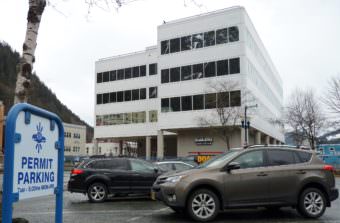
The Sealaska Heritage Institute plans to turn this downtown Juneau parking lot into a Native artists' park and market.
The Sealaska Heritage Institute plans to turn this downtown Juneau parking lot into a Native artists’ park and market. (Photo by Ed Schoenfeld/CoastAlaska News)

A major Southeast cultural organization plans to create a Native arts market and park in Juneau. That, and an advanced education initiative, are part of an effort to boost the region’s traditional arts economy.

A downtown Juneau parking lot is slated to be turned into a Native artists’ park.

Sealaska Heritage Institute President Rosita Worl said it will include totems and other large art objects, plus a tribal house.

“It would look like a tribal house, but it would be enclosed,” she said. “It would be an area where the artists can carve monumental art, as well as other art forms.”

The park is part of the institute’s multi-pronged effort to encourage, promote and sell Native art from Southeast Alaska. It’s branding the style as Northwest Coast Art.

Sealaska Heritage Institute President Rosita Worl is promoting a Native arts initiative in Southeast Alaska.  (Photo by Lakeidra Chavis/KTOO)

“Northwest Coast Art is developed around what we call formline and there are basic components that you have to master,” she said. “It’s a whole different art scheme than drawing naturalistic forms.”

Another part of the effort is an education initiative to develop Tlingit and Haida artists’ skills.

Sealaska Heritage Institute Senior Research Fellow Rick Harris said it starts with a two-year program at the University of Alaska Southeast, which already offers formline design courses.

Harris, a retired Sealaska Corp. vice president, said graduates could continue studies at New Mexico’s Institute of American Indian Arts, which offers degrees in writing, museum studies and studio arts.

“The idea is for students to be able to come to UAS, learn and be skilled and become experienced in Northwest Coast design and then actually be able to go to Santa Fe and to capture some of the additional benefits that they have been able to develop through their Indian arts program,” he said.

The three organizations signed a memorandum of agreement in November.

The Northwest Coast Arts Initiative also would push for federal recognition for formline design and funding to expand its programs.

The initiative is in its early stages.

Haida artist Robert Davidson's metal panel "Greatest Echo" adorns the front of the Walter Soboleff Building. (Photo by Elizabeth Jenkins/KTOO)
Haida artist Robert Davidson’s formline design panel “Greatest Echo” adorns the front of the Walter Soboleff Building. (Photo by Elizabeth Jenkins/KTOO)

Worl, also a Sealaska Corp. board member, said the Juneau arts park and market would cost $7 million to $8 million, including moving parking underground. It also hasn’t yet sought needed building permits.

The university and Indian arts programs would also have significant expenses.

She said it’s worth pursuing.

“What you’ve got to do is take yourself out of Northwest Coast Art and look at it in context of art throughout the world. And then you begin to see how unique and how different it is from other art forms,” she said.

Sealaska Heritage Institute already built the Walter Soboleff Center, which was completed about two years ago. It has archives, a theater, a store and exhibits in a building across the street from the proposed arts park.

Sealaska Corp. President and CEO Anthony Mallott said this will be phase two.

“Adding an outside park where artists are more engaged with the visitors or with residents of Southeast Alaska is a vision that has been put forward and we’ll continue to find ways to see if we can make it work,” he said.

The term Northwest Coast Art also refers to similar work from Coastal British Columbia and Washington state. But Worl said her institute’s efforts will focus on Southeast Alaska.

Southeast Alaska tribal government moves into defense contracts

Central Council of Tlingit and Haida Indian Tribes of Alaska President Richard Peterson, right, poses with delegates during this month’s Tribal Assembly in Juneau. (Photo courtesy Tlingit-Haida Central Council)

Southeast Alaska’s regional tribal government is developing its business side.

Central Council of Tlingit and Haida Indian Tribes of Alaska President Richard Peterson said funding cuts threaten its programs.

He said about nine-tenths of the council’s money comes from federal sources. And most of the rest comes from the state.

“That’s just not sustainable. That’s not sufficient,” he said. “So, we’re working on alternative sources of revenue.”

The Central Council has about 30,000 tribal members in Alaska, the Pacific Northwest and elsewhere in the Lower 48.

Addressing the organization’s recent Tribal Assembly in Juneau, Peterson said it needs to maintain its social-service, justice and training efforts. But that’s not all.

“We want to not just preserve programs that we have, but expand and grow,” he said. “If we’re going to do that, we need that economic self-sufficiency, that economic sovereignty,” he said.

That effort is being spearheaded by Tlingit-Haida’s Tribal Business Corp.

CEO Richard Rinehart said there’s growth because the organization purchased the government-services business KIRA last summer.

Its main customer is the U.S. Department of Defense, he said.

“We are running power plants, water systems, water-treatment plants. We have dozens of electricians, dozens of plumbers and a couple dozen carpenters,” Rinehart said. “We do vehicle maintenance, grounds maintenance. We do complete base operations services.”

KIRA has offices in the Bahamas, as well as Colorado and several other states.

Founder Carlos Garcia, who continues to be its president, said the company has about 600 employees.

He said it’s expanding, because tribal ownership allows it to bid for contracts under the 8(a) disadvantaged-business program.

“We’re going to need good employees, both Native and non-Native,” he said. “And I see in this room many, many people from all over the areas you represent that can help us.”

He asked the hundred or so Tribal Assembly delegates to point potential applicants to the company’s job openings.

But he said KIRA is a business purchased to make money for the Central Council, not an employment program.

Sealaska Corp. adds to seafood investments

Workers process seafood at a division of Odyssey Foods in Seattle. Sealaska has purchased a majority interest in the company.
Sealaska Corp. recently purchased a majority interest in Odyssey, a Seattle-based seafood processor that owns this building. (Photo courtesy Sealaska Corp.)

Sealaska officials say investments in two seafood processors will help drive future earnings.

But a critic of Southeast’s regional Native corporation doubts they will make much money.

Sealaska’s latest investment is Seattle-based Odyssey Foods.

It sells a variety of seafood, under the Treasure of the Sea and Chef’s Treasures brand. It also has a food service division and produces custom products for other companies.

Sealaska President and CEO Anthony Mallott said it’s more than a seafood company.

A worker portions halibut as part of a processing line at Odyssey. (Photo courtesy Sealaska Corp.)

“They do a lot of breaded and battered processing. But the real value was the people and the platform that provides a channel to market,” he said.

Sealaska bought 51 percent of the company, so it has majority ownership, Mallott said.

But the Juneau-based corporation will leave Odyssey’s business model and management team in place.

“The base of their global supply chain provides a good stable income, good cash flow,” he said. “The growth that we’ll be looking for is adding more wild Alaska product to their marketing channels.”

Odyssey is Sealaska’s second seafood investment in a year. And it’s part of an effort to change its direction.

Sealaska purchased a minority interest in Independent Packers Corp., a slightly smaller Seattle processor, last May.

“They were a great ground-floor platform for us to build upon, even with the minority position,” he said. “They have a client base, they have the expertise to get products directly to the retail market.”

Independent Packers employs about 180 people. Odyssey’s staff is about 200.

Sealaska said both could provide jobs for its shareholders who live in the Pacific Northwest, and not just on the processing line.

Anthony Mallott is CEO and president of Sealaska Corp., which is headquartered in Juneau. (Photo by Ed Schoenfeld)

Sealaska has not released the financial details of its most recent seafood investment. Mallott said that will be in the corporation’s annual report, to be released in early May.

Longtime Sealaska critic Brad Fluetsch said that information should already be available.

“This really goes to the point that Sealaska is not very transparent in its financials and financial dealings with shareholders,” he said.

Fluetsch, who is running for Sealaska’s board of directors, is an investments manager for the city of Santa Fe, N.M.

He also said the processor investments are the wrong approach to making money.

“This is taking all the risk of a private company, when they could have went out and bought a diversified portfolio of global fish companies, if they really want to get into the fishing industry, and earn a much higher rate of return,” he said.

Sealaska’s Mallott said the two companies will bring in more revenue than such investments. He also pointed to the corporation’s existing investments in the stock and bond markets.

Yukon cowboy shares love of old country songs at folk festival

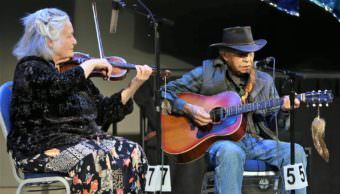
4-4-17 Tagish, Yukon, country singer Art Johns and Skagway fiddler Nola Lamken perform at the Alaska Folk Festival in Juneau April 4, 2017. (Photo by Brian Wallace Photography)
Yukon country singer Art Johns, 84, backed up by Skagway fiddler Nola Lamken, performs April 4, 2017, at the Alaska Folk Festival in Juneau. (Photo by Brian Wallace Photography)

Art Johns has been playing at the Alaska Folk Festival since 1995.

But his musical roots go way back, almost 80 years.
Johns grew up in the rural Yukon towns of Carcross and Tagish, about 60 miles northeast of Skagway, in northern Southeast Alaska.

Johns’ first inspiration came from phonographs his sister mail-ordered from a catalog.

The family listened to them on a human-powered machine.

“I’d crank a wheel with a handle to get the spring loaded and listen to her music,” he said. “She liked the Carter Family and Jimmy Rodgers and stuff like that. I guess it wore off on me and I’m the one who started playing.”

Tagish, Yukon, country singer Art Johns plays the Alaska Folk Festival in Juneau April 4, 2017. (Photo by Ed Schoenfeld, CoastAlaska News)

Johns loved the music and started singing along. Then, another relative decided to help him take another step.

“I had a cousin who was the same age as my sister. He taught me three chords on a guitar and he says, ‘OK, now you can do your singing,’” he said.

Along with music, Johns learned hunting traditions passed down by his parents, who were Tlingit and Tagish.

He also learned the family business, and became a big game outfitter, hunting guide and game warden. The work involved a lot of horse-wrangling.

“I like being a cowboy. You’re out there riding your horse and do what you want,” he said. “You read the signs of the land. Not some person who made this up for you.”

Then, in the 1990s, a filmmaker decided to make a documentary called “Life’s Dream,” which shows Johns caring for his horses and teaching one of his sons how to track, shoot and skin a moose.

The producer wanted to include the country song “God Must Be a Cowboy.” Johns said, “No.”

But the filmmaker was insistent.

“I tell you, I learned it and I sang it and that’s when the public got to know that I played music,” Johns said. “I was getting phone calls from here and there, come do a coffee house or something. So that’s how it all started.”

Around the same time, Johns connected with Alaska musicians playing the International Folk Festival, in Skagway and Whitehorse, The Yukon’s capital.

That led him to the big Juneau festival, where he became a regular, performing all but a few years since.

Johns sometimes plays solo, but other times has a backup band.

Art Johns learned country music from records on a hand-cranked player as a child. He's sung for nearly eight decades. (Photo by Ed Schoenfeld/CoastAlaska News), Nola Lamken and friends at the 2003 Alaska Folk Festival
Art Johns learned country music from records on a hand-cranked player as a child. He’s sung for nearly eight decades. (Photo by Ed Schoenfeld/CoastAlaska
News)

Most often, he’s with his long-time musical partner, Skagway fiddler Nola Lampken.

They had a hard time defining exactly what makes an Art Johns song.

“I never had any lessons in music, nothing,” Johns said. “Just, if I hear a song and I like it.”

“He plays what comes to his head and what he feels like at the moment. Very campfire-ish,” Lamken added.

At 84, Johns is slowing down. He has less energy and his fingers don’t always do what he wants them to.

But he plans to play for as long as he can.

Hear Art Johns, Nola Lamken and friends at the 2003 Alaska Folk Festival:

AEL&P: Bird top suspect in downtown power outage

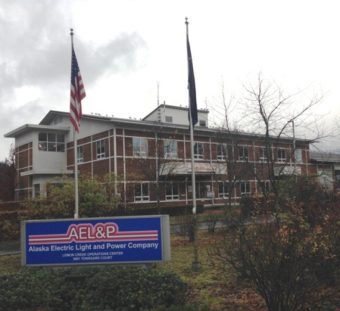
AEL&P headquarters in Lemon Creek. (Photo by Casey Kelly/KTOO)

Alaska Electric Light and Power believes a bird triggered the power outage in downtown Juneau Friday night.

Debbie Driscoll with AEL&P said power stopped flowing from the Second St. substation at 6:12 p.m. Friday.

“We didn’t see anything on inspection, but we were told by an eyewitness that they saw a bird make contact with the line and then fly away, and at that point is when the power tripped off,” Driscoll said.

Driscoll compared the situation to a breaker flipping in a home. She said the system is designed to “trip open” when a problem is detected – cutting power and preventing further damage or injuries.

“And so what we do is we make sure that there’s no hazards in the line, that we don’t see any issues, and then we close that breaker back in to allow power to flow again,” Driscoll said.

She said 1,154 AEL&P customers lost power, including KTOO, and AEL&P had all power back up 41 minutes after it went out.

Driscoll added that it takes time to restore power because employees physically check the lines and equipment before they turn the lights back on.

If you’re looking for quick answers next time there’s an outage, Driscoll said check AEL&P’s Facebook and Twitter feeds for updates.

Site notifications
Update notification options
Subscribe to notifications