Syndicated

Low oil prices hit Sealaska dividends

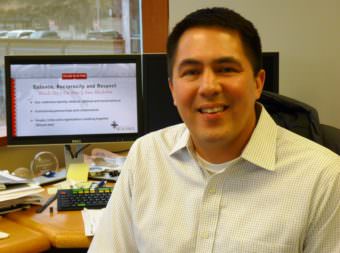
Sealaska President Anthony Mallott poses for a photo in his office. The Juneau-based regional Native corporation is distributing $10.6 million to its 22,000 members this month. (Photo by Ed Schoenfeld, CoastAlaska News)
Anthony Mallott is president and CEO of Sealaska, the Juneau-based regional Native corporation that’s distributing $10.6 million to its 22,000 members this month. (Photo by Ed Schoenfeld/CoastAlaska News)

Lower North Slope oil prices are taking a bite out of Native corporation dividends 1,100 miles away.

Sealaska, Southeast’s regional corporation, just announced it will pay out $10.6 million to its more than 22,000 members mid-month. That’s a third less than last year’s spring distribution.

Sealaska President and CEO Anthony Mallott said it’s dropped because of lower payouts from a pool of natural-resource earnings from all regional Native corporations.

Arctic Slope Regional Corp. is seeing declining oil royalties from the fields that are on their lands,” he said. “And that offers direct 7(i) (payments) to Sealaska and all of the other regionals.”

7(i) is a provision of the Alaska Native Claims Settlement Act describing how corporations are to share resource revenues. The settlement act created the corporations.

This month’s Sealaska payments will range from $133 to $609 per 100 shares, depending on membership in other Native corporations and other factors.

Resource revenue pool payments are the difference between the two amounts.

Mallott said the second-largest dividend revenue source is one of Sealaska’s investment accounts.

“The Permanent Fund distribution is very stable,” he said. “It offers close to $4 million annually in distributions.”

The other source is the corporation’s own business earnings, which have been down. They dropped significantly in 2013 after its construction subsidiary lost more than $25 million.

Mallott said that’s hitting the earnings part of the distribution because the corporation averages such revenues over five years.

“As we move out of that effect, as we move into 2018, we fully expect the distribution to have a good upward trajectory,” he said.

Sealaska has six different classes of shareholders, receiving different payments.

This chart shows the different shareholder classes and what dividends they’ll get in the April 14 distribution. (Graphic courtesy Sealaska Corp.)

Class B also covers those enrolled in an urban corporation, such as Juneau’s Goldbelt. They receive the full $609 per 100 shares, including the resource pool money.

Class A also is those enrolled in a village corporation, such as Kake Tribal. They don’t get the resource pool payment, so their total is only $133 per hundred shares. Sealaska pays the difference directly to the village corporations, which may or may not pass it on to shareholders.

Class C is at-large shareholders, who are not enrolled in another corporation. They get the full amount.

Mallott said about a quarter of shareholders are in village corporations and about three-quarters are with urban corporations, or none at all.

Class D is descendants of original shareholders, who receive the smaller payment, as do those who became shareholders after the original enrollment date in class L.

Also, Class E elders can receive an additional $133.

Many shareholders hold more than one class of stock, due to inheritance or gifting.

Celebrating Turkish culture in Anchorage

Rabia Duddy belly dances at a Turkish cultural event in Anchorage. (Photo by Zachariah Hughes/Alaska Public Media – Anchorage)

The Republic of Turkey is about as far as you can travel from Alaska on the other side of the globe. The country of nearly 80 million people straddles the edges of Europe and Asia, with a Mediterranean climate, and a rich history as the seat of both the Byzantine and Ottoman Empires. Again, not a lot of parallels with Alaska. But both places have food and dance at the center of their cultural traditions.

At the Wildberry Theater in Anchorage on a recent Saturday night, Engin Kılıç sharpened a long knife next to leg-sized cone of meat rotating near a flame.

“Makes it sharper,” he explained. “Gets dull very easily.”

Kılıç (who’s last name means ‘sword’ in Turkish) was slicing thin strips of meat and heaping it onto pillowy flatbread. It’s a dish called döner, which is was once just an inexpensive street food — almost like the Turkish equivalent of a hot-dog cart– but has spread around the globe and become ubiquitous in world capitals. The meat here is layers of beef and lamb pressed together and marinated for a full day.

“As it cooks, as you can see, its dripping. All that fat is dripping, so it keeps the whole meat very moist,” Kılıç said.

Cooking döner is a bit of a kitchen hobby for Kılıç, who taught himself out of curiosity. He plated the food up as part of a sold-out cultural event called Tables of Istanbul. It’s an evening of food, belly dancing and a documentary by a sociology professor.

“If someone had told me 23 years ago that one day I would live in Alaska, I would never have believed them,” said the film’s narrator, Prof. Zeynep Kılıç, as the screening began.

Kılıç grew up in Ankara, but got her doctorate in the U.S. A few years ago, she moved to Anchorage for a job at UAA, in part to be closer to her brother Engin — the same amateur chef slicing döner. In the film, “Tables of Istanbul,” Professor Kılıç uses her own experience as an immigrant missing Turkish cuisine as doorway into examining the country’s phenomenally complex culinary traditions.

“I just realized that my scholar self was a very critical … like, ‘food imperialism,’ and ‘racialization of ethnic food,’” Kılıç tossed out. “Then my regular self in the kitchen was like, ‘I eat baklava, yay!’”

For years, Kılıç would invite friends over and cook. People would often ask questions about the foods she was making. So she’d give an answer.

“And then there was all this, like, ‘oh my god, I’m telling people all this stuff about Turkish cuisine, but I don’t know anything about it.’ I just know what my mom showed me,” Kılıç laughed. “People treat as if your word is the last word if you’re the only Turkish person they know.”

Her film looks at restaurants and foods around Istanbul, Turkey’s enormous cultural capitol. Kılıç looks at the historical and class dimensions of different foods, and where they fit into the ways people come together to eat. The setting is Turkey, but it’s the kind of curiosity and awareness about food she believes can be applied anywhere.

“It’s not just about Turkish food, if anybody around the table can start thinking about ‘what does my table represent?’ Is this about me being Jewish and eating Kosher food? Or is this about me being Muslim and eating halal food? Or is this about being Alaskan and eating the fish that I fished last summer?” Kılıç posed. “I think these are universal questions.”

After the documentary ended, there was a second round of belly-dancing. In an elaborate costume with colorful, swirling veils, jangling metal talismans, and flashes of bare flesh, the main dancers’ hips ricocheted back-and-forth in time with a rapid drum. It was like watching the choreography to a music video, but with muscle movements one might not even know existed.

The performance was led by Rabia Duddy, who arrived in Anchorage in 2002 after growing up and studying dance in Turkey.

“It’s not a burlesque, it’s not a ballet,” Duddy said of belly-dance. “It’s a truly phenomenal dance form…you become a live instrument on stage.”

Like a lot of immigrants, Duddy acutely missed the things that were common place in her home culture. As a response, she made a little sliver of Anatolia in Anchorage teaching belly-dance, which was a challenge. For example, figuring out how to put highly specific bodily movements into language — a different language, no less.

Omuz atma,” Duddy offered, as an example, “meaning shoulder shimmy. Or shoulder accent. It took a while.”

Duddy estimates there are about 50 Turks in Alaska, mostly in Anchorage, and she knows the majority of them. In 2013, she decided to undertake a personal initiative, and began organizing events to bring Turks together and expose more people in Alaska to Turkish culture.

This particular night is bitter sweet: it’s one of the last gatherings Duddy is putting on before she and family move out of state this summer.

“It’s emotional” Duddy said. She’d like to see the community she’s helped bring together continue convening for celebrations and special occasions. “I’m hoping (they) continue to have gatherings like this.”

For now though, as guests filed out and the last desserts were scraped from their trays, Duddy felt accomplished with how many people came to eat, learn, and watch a little belly-dancing.

High school student honored for Gold Creek rescue

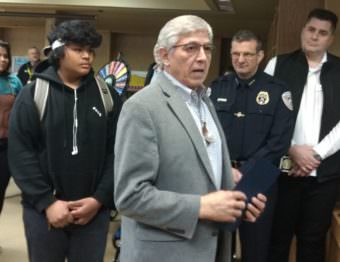
Left to Right: Yaakoosge Daakahidi High School student Iosefa Riley John, 14, was honored by Lt. Gov. Byron Mallott, Juneau Police Chief Bryce Johnson and Capital City Fire Chief Richard Etheridge during a ceremony on March 31, 2017 at the school. (Photo by Jacob Resneck/KTOO)

A 14-year-old Juneau high school student was honored by the governor’s office today for rescuing a 5-year-old boy he saw fall into a fast-running creek.
Juneau-Douglas High School sophomore Seth Gerrin was one of four friends hanging out at Cope Park on Wednesday at about 6 p.m. Gerrin said some small children and an adult walked up the path. One of the children in the group was walking near the fast-running water of Gold Creek when he lost his footing.

“He started to slide down and there was a fence and a tree there and it looked like he was going stop himself,” Gerrin said in an interview. “My friend Xavian tried to grab him — he fell off. Riley jumped into the water and grabbed him and handed him up to me. We carried him up to the ambulance and made sure he was OK and we left.”

Fast-running Gold Creek in downtown Juneau can be potentially deadly as this file photo from 2011 illustrates. (Photo by Casey Kelly/KTOO)

His friend Riley is 14-year-old Yaakoosge Daakahidi High School student Iosefa Riley John.

Authorities said the young man’s quick thinking and fast acting likely saved 5-year-old Mason Varner from drowning in the fast-moving creek. The teenager was honored Friday afternoon by Juneau police, rescuers and Lt. Gov. Byron Mallott who presented an award from the governor’s office.

“We never say, ‘Son or daughter, we want  you to perform an act of selfless courage that might put you in harm’s way,'” Mallott said during a ceremony at Yaakoosge Daakahidi High School. “And somehow it was there in this young man.”

The rescued child attended the short ceremony and appeared to be in good spirits as his visibly moved mother clung to him. Riley John spoke only briefly to thank everyone and to clarify that his friend, Seth Gerrin, also deserved to be recognized for helping get the boy to safety.

Southeast tribal court builds on its experience

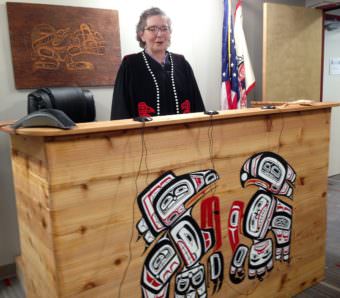
Presiding Judge Debra O'Gara stands in the Juneau courtroom of the Central Council of Tlingit and Haida Indian Tribes of Alaska. (Photo by Ed Schoenfeld/CoastAlaska News)
Presiding Judge Debra O’Gara discusses tribal justice  in the Juneau courtroom of the Central Council of Tlingit and Haida Indian Tribes of Alaska. (Photo by Ed Schoenfeld/CoastAlaska News)

Southeast Alaska’s largest tribal court operation just celebrated its 10th anniversary.

It started with child support and paternity cases and branched out to include domestic violence protection orders, custody disputes and adoptions. Now, it’s planning to further expand the kind of cases it handles.

Presiding Judge Debra O’Gara opens a hearing in the Central Council of Tlingit and Haida Indian Tribes of Alaska’s courtroom.

It follows a set procedure, but is less formal than state or federal courts. O’Gara sits at the bench and wears a black robe. But both are decorated with the council’s Eagle-Raven formline design logo.

She said the Juneau-based court has between 900 and 1,000 open cases. They involve some of the council’s approximately 30,000 members in Southeast, the rest of Alaska, the Pacific Northwest and elsewhere.

“We firmly believe that tribal members are more likely to come into court when the court is their own tribal court. And it’s their own tribal laws that are being implemented,” she said.

The Andrew Hope Building in downtown Juneau is home to the courtroom of the Central Council of Tlingit and Haida Indian Tribes of Alaska. (Photo by Ed Schoenfeld/CoastAlaska News)
The Andrew Hope Building in downtown Juneau is home to the Central Council of Tlingit and Haida Indian Tribes’ courtroom. (Photo by Ed Schoenfeld/CoastAlaska News)

The Central Council’s Tribal Assembly authorized the court in 1989, but it took a while before operations began.

It started out handling a short list of cases and related services. But that’s expanded, with grants, interagency agreements and new ideas.

One major focus is developing systems for young offenders, as well as those at risk of getting into trouble. That includes an early diversion program, which offers counseling and tutoring while encouraging involvement with extended family and cultural activities.

“If we don’t intervene early, the youth are more likely to end up committing crimes or getting into trouble and getting into the justice system,” she said.

About a year ago, the Central Council signed an agreement with the state giving it authority over some foster care and other services for Native children facing abuse or neglect.

Council Director of Family and Youth Services Francine Eddy Jones said only a few cases have been transferred so far. But they have potential.

“They’re coming into tribal court, but they’re also seeing familiar faces in terms of tribal caseworkers working with them to identify what they need to be working on,” she said.

“Our goal is always to support the families and see if we can move toward reunification,” Eddy Jones added.

The National Council of Juvenile and Family Court Judges is supporting the tribal justice program.

It recently chose Tlingit-Haida’s court as one of six nationwide to be studied and given expert advice. O’Gara said the scrutiny will help.

“It’s not any funding. But what we get is we get them to come out. They’re going to look at our system, they’re going to look at our codes, they’re going to meet our staff, they’re going to look at our procedures,” she said.

A team visited in February and its report is expected soon.

About 85 percent of the tribal court’s cases involve child support. But it has plans for further expansion. If funding becomes available, O’Gara said it will begin taking some criminal cases.

Central Council President Richard Peterson said those found at fault will be held accountable.

“We’re not trying to get some free pass for people. But we’re trying to make it so they are dealt with compassionately enough that they’re given a chance to right their wrongs,” he said.

O’Gara said there’s already an agreement with the state court system to make sentencing recommendations in some cases involving tribal members.

She said she hopes to begin what’s called “circle sentencing” soon. But cultural programs and other support services need to be put in place first.

The Central Council’s tribal court is one of several in Southeast Alaska. Others operate throughout the state.

Editor’s note: Debra O’Gara is a member of KTOO’s board of directors.

Alaska Department of Corrections denies reports of Douglas expansion

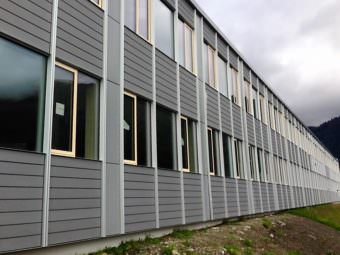
Alaska Department of Corrections houses administrative staff in the state’s Douglas Island Building, which recently underwent extensive renovation. (Photo by Ed Schoenfeld/CoastAlaska News)

Alaska Department of Corrections officials say Senate Bill 91 mandates expanded supervision of parolees who would otherwise be incarcerated. Rumors that a downtown Douglas office building could be the future processing facility has a neighborhood association alarmed and a state lawmaker demanding answers.

The Alaska Department of Corrections administrative presence in the capital city has long been in a Third Street office building in central Douglas. Recent building activity including the installation of what appeared to be reinforced glass caught the attention of nearby residents, many of whom have been calling their legislators.

“The public should know what the heck is going on,” Sen. Dennis Egan (D-Juneau) said. His office has been trying to get answers from the Commissioner of Correction’s office. “Now we’re hearing all these rumors. Some of these communications we get are totally different because — you know what happens with word-of-mouth — things change.”

The Department of Corrections is so far only saying where Juneau’s new facility won’t be.

“We are looking for suitable space but it will not be in Douglas,” Department of Corrections spokesman Corey Allen-Young said by telephone from Anchorage. He explained that Senate Bill 91 mandates closer supervision of parolees that have been diverted from prison.

The 2016 legislation was designed to reduce Alaska’s inmate population and create alternatives to prison.

“It’s a whole new section of Corrections, which means we have to set up a pre-trial in Juneau, Anchorage, Fairbanks, Mat-Su Valley, Kenai,” he said. “As part of that you have to have new offices, you have to have new UAs (for urinalysis) because pre-trial is basically something we’re working with the court system, law enforcement, attorneys.”

Sen. Egan said he and other legislators have recognized that SB 91 was rolled out faster than much of the state’s bureaucratic machinery could keep pace.

“Problem was, we implemented all of this stuff way before the departments had an opportunity to institute what we required them to do,” he said.

Plans for Juneau remain vague and there are still many decisions left to make, the Corrections spokesman said.

There will be a pre-trial in Juneau because we have to — a law gets passed — we have to follow the law,” Allen-Young said. “But determining where it is — it’s not going to be in Douglas.”

And that’s as much as the department is willing to divulge, he said, without a formal public records request. KTOO filed a freedom of information request; the agency replied Tuesday it would respond within 10 days.

The Douglas Island Neighbors Association is also seeking answers.

There was concern that a pre-trial service in that vicinity might be too close to other uses of those surrounding properties by other residents,” said Robert Sewell, association president.

State facilities are normally exempt from local zoning. Still, community members are digging in with this issue being the sole topic on next week’s agenda.

“One of our reasons to be is to work on a plan into the future for … Douglas as a community,” he said.

The meeting of the Douglas Island Neighbors Association will be held at 6 p.m. April 4 in the Douglas branch of the public library. The Department of Corrections has been invited to attend.

Longtime leader Rosita Worl to leave Sealaska board

Longtime Sealaska regional Native corporation board member Rosita Worl will step down as a director in June. She will continue to head up the Sealaska Heritage Institute. (Photo by Lakeidra Chavis/KTOO)

One of the Sealaska regional Native corporation’s longest-serving leaders is stepping down.

Rosita Worl has spent 30 years on the Juneau-based corporation’s board of directors. She said she’s been thinking about leaving for a while.

“I probably would have resigned three years ago, but at that point in time, I was chair of the Lands Legislation (Committee) and I felt like I wanted to see that completed before I left the board,” she said.

That controversial bill traded corporate land near shareholder communities for more valuable timber properties within Southeast’s Tongass National Forest.

After several attempts, it passed Congress in 2014.

Worl will complete her final three-year board term, which ends in June. That will leave an open seat on Sealaska’s board of directors, to be filled during spring shareholder elections.

In the past, many departing board members resigned during their terms and were replaced by an appointee, who then ran as an incumbent.

Worl will continue as president of the Sealaska Heritage Institute, the corporation’s cultural arm.

The anthropologist, who’s taught at the University of Alaska Southeast, says she’s looking forward to completing some academic projects.

“I’ve had to spend most of my energies on Sealaska and Sealaska Heritage Institute. And I’d like to finish a couple of manuscripts that I have: Tlingit property law and an ANCSA study, for example,” she said.

Worl, of Juneau, is one of the longest-served members of Sealaska’s 13-person corporate board.

Only Albert Kookesh of Angoon has served longer.

Worl’s leadership roles have extended outside Southeast Alaska.

She’s been on the boards of the Alaska Federation of Natives, the Indigenous Languages Institute and the National Museum of the American Indian.

She’s also chaired the federal Native American Graves Protection and Repatriation Act Review Committee.

Her Tlingít names are Yeidiklats’akw and Kaa háni and she is Eagle of the Shungukeidí (Thunderbird) Clan from the Kaawdliyaayi Hit (House Lowered from the Sun) of Klukwan and a Lukaax.ádi yadi (Child of the Sockeye Clan).

Site notifications
Update notification options
Subscribe to notifications