Syndicated

Late state budget delays fall-winter-spring ferry schedule

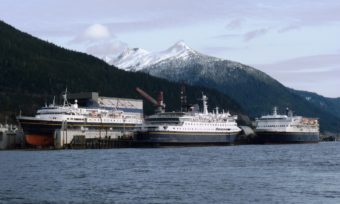
The ferry Malaspina is in drydock and the Columbia is tied up at the Ketchikan Shipyard in February, 2012. Federal funds have covered millions of dollars of repairs. (Photo by Ed Schoenfeld/CoastAlaska News)
The ferry Malaspina is shown in drydock and the Columbia is tied up at the Ketchikan Shipyard in February 2012. Damage to the Columbia is delaying its return to service this fall and the Malaspina will help fill in. (Photo by Ed Schoenfeld/CoastAlaska News)

Alaskans have until the end of the month to tell the Marine Highway System what they think of its fall, winter and spring sailing plans.

The schedule, which is similar to last year’s, came out later than usual and the comment period is shorter.

Last year, the fall-winter-spring ferry schedule was released in May. Residents had about a month to go through it and provide feedback.

This year, it wasn’t made available until mid-July, with a comment deadline two weeks later.

General Manager Capt. John Falvey said that’s because of the end-of-June resolution of the Legislature’s spending battles.

“We can’t put schedules out to comment on until we have a final budget figure,” he said. “Being that we were running a little bit late this year, we just got a late start.”

The ferry system wants a fast turnaround so it can begin taking reservations during the first week of August, he said.

Written comments on the schedule are due by July 30 and a teleconference will be held the following day.

Read the ferry system’s letter to communities, which includes the draft schedule and links for public comments.

Extra ferry life rings lean against other spare parts at the Ketchikan Marine Engineering Facility at Ward Cove. (Photo by Ed Schoenfeld/CoastAlaska News)

Marine Transportation Advisory Board Chairman Robert Venables doesn’t see that as a problem.

“It is a shorter public review and comment period,” he said. “But I think most folks are very familiar with the schedule and the system and their needs. So, it’s best to get that schedule published and open for reservations.”

One reason he isn’t worried is that the schedule is very much like the previous year’s.

Falvey said a few sailings have been added, but not many.

“Operating weeks is about the same, overall. Budget’s about the same, overall,” he said. “What you saw last year is about what you’re going to see this year, overall, with a little bit of a different switch on the ships.”

That’s due to lengthy repairs to the ferry Columbia, which usually sails between Southeast and Bellingham, Washington. It’s been out of service since last September, because of a damaged propeller system.

“Those parts don’t exist. It’s all 1973 vintage and over the winter, that entire system had to be rebuilt in Germany,” he said. “We’re still not there yet.”

The draft fall schedule shows the Columbia resuming service Oct. 1, but Falvey said that’s now pushed back about a month. Other ships will fill in.

The Columbia, the system’s largest ship, was damaged when it struck an underwater object.

Falvey’s not sure what it hit, but it wasn’t a rock.

“There was something floating under water. A lot debris could have been floating 10 to 15 feet under the water,” he said.

This summer’s ferry schedule was published last fall, long before lawmakers decided how much money the system would get.

Officials committed to keeping that schedule, saying any funding cuts would be absorbed later in the fiscal year.

Venables said the system had no choice, since last-minute changes would hurt summer tourism.

It’s not the best way to build a schedule, he said.

“When you have very little notice on what the funding level’s going to be, then that uncertainty leads into the No. 1 revenue-generating month, which is July … it has ripple effects throughout the rest of the year,” he said.

The schedule, which covers October through April, uses nine of the marine highway’s 11 ships.

The fast ferry Chenega is out, in long-term storage, and the mainliner Taku is for sale.

Newly found disease could threaten Southeast Alaska spruce

Forest Service Plant Pathologist Robin Mulvey points out infected spruce branches at Juneau's Shrine of St. Therese to shrine volunteer Brian Flory on July 11, 2017. (Photo by Ed Schoenfeld/ CoastAlaska News).
Forest Service Forest Pathologist Robin Mulvey points out infected spruce branches on July 11, 2017. at Juneau’s Shrine of St. Therese to shrine volunteer Brian Flory. (Photo by Ed Schoenfeld/CoastAlaska News).

A fungus that’s damaged trees in Southcentral and Interior Alaska has been discovered for the first time in Southeast.

But there’s a chance its spread could be stopped.
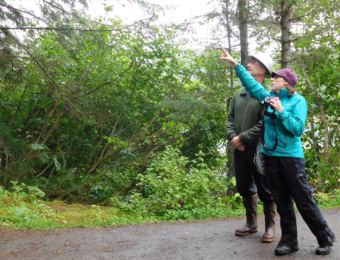
Forest Pathologist Robin Mulvey walks down the causeway to the Shrine of St. Therese, a forested island about 20 miles northwest of downtown Juneau.

“Right here you can see a small tree. It’s about 4 inches in diameter and it’s just a stump now because we removed that tree,” she said. “This was a fairly heavily infected tree, at least in the lower branches.”

The infection was spruce bud blight, which damages or kills the growing tips of branches. It was discovered here in late June, the first reported sighting in the region.

Fruiting bodies of spruce bud blight (Gemmamyces piceae) are shown on white spruce near Anchorage. (Photo by Lori Winton/U.S. Forest Service)

The blight could be a problem, because it infects Sitka spruce, one of the most common trees in Southeast Alaska’s rainforest.

“Right now, I’m considering it potentially a significant threat,” she said. “I’ll be incredibly happy to be wrong about that.”

Mulvey, who works for the U.S. Forest Service, explains that Southeast’s Tongass National Forest has just what the blight likes.

“The ideal weather conditions for the pathogen are temperatures between 55 and 65 degrees Fahrenheit, with precipitation,” she said. “If you’ve been in Juneau this summer, you know we’ve had very conducive weather conditions for this pathogen.”

The fungus is not easy to spot. It’s black and looks like a dead, crusty coating on the buds.

It’s actually a group of small, spherical fruiting structures.

If it doesn’t kill a bud, it hampers its growth, leaving another sign, a small, twisted branch with few needles.

“This is going to spread through spores moving on the air and it’s also going to spread through spores moving through rain splash,” she said.

But no one’s sure how the spruce bud blight found its way to this one, small patch of Southeast forest.

Mulvey said it’s unlikely it came in on the clothes or boots of one of the shrine’s many visitors.

It’s often found on Colorado blue spruce, a common ornamental plant used in landscaping. But her team found no infected trees in the area or at a nearby arboretum.

She said they were looking for another pathogen, the spruce aphid, when they came across the infestation.

“We just happened to turn and look at this spruce tree. And I said, ‘Hey! The shoots on that spruce look a little bit bent.’ So we went in for a closer look,” she said.

Spruce bud blight was first found in Homer four years ago, though it took until last year to figure out what it was. It’s also been identified elsewhere on the Kenai Peninsula and in Anchorage and Fairbanks.

Forest Service Plant Pathologist Lori Winton, who is based in Fairbanks, said her first encounter also was a surprise.

“The first time I saw it, I was skiing in the forest near Anchorage and I pretty much fell face-first right into a tree that had it,” she said.

That was about two years ago, and it wasn’t clear what it was.

Then, an article in a scientific journal described outbreaks on blue spruce plantations in central Europe’s Czech Republic.

“Suddenly, there were DNA sequences available that matched,” she said. “I had an identification and frankly it was a rather alarming identification.”

The potential for extensive damage in Southeast’s forests, or those statewide, is not known. And since no one’s sure how it got to Alaska, it’s not clear how rapidly it could spread.

The first trees hit by spruce bud blight were found at the Shrine of St. Therese, a Catholic church and landmark in Juneau. (Photo by Ed Schoenfeld/CoastAlaska News)
The first Southeast trees found with spruce bud blight were at the Shrine of St. Therese, a Catholic church and landmark in Juneau. (Photo by Ed Schoenfeld/CoastAlaska News)

Winton said there’s also a chance spruce bud blight could have been here all along and just hadn’t been spotted. After all, it is a big state.

“That’s currently the question, is whether it’s native to North America or not — or Alaska,” she said.

She said it could take a year of lab work to figure that out.

The blight has been found in eastern Canada, but not throughout the United States.

Mulvey wonders about the same question back in Juneau.

“Part of me says, ‘What are the chances that we detected the only site of infection in Juneau?’” she said. “I think the chances are pretty small.”

But if it isn’t here naturally, there’s a chance it could be stopped.

“I just have to do what I can to try and prevent any further spread, while it still seems feasible,” she said.

Her team is continuing its search for spruce bud blight in Southeast. It’s also asking for public help.

She suggests checking landscape plants on your own property, because it seems most common in developed areas.

“Look really closely at any dead buds on your spruce trees and if you see these small, spherical black fruiting structures, please give us a call because we’d love to come out and take a look,” she said.

And that’s just what was she doing during our visit to the Juneau landmark.

She and shrine volunteer Brian Flory were using binoculars to check out higher branches near the infected trees that were removed or trimmed. And sure enough, they found more.

Amalga Harbor hatchery chum run opened to seiners

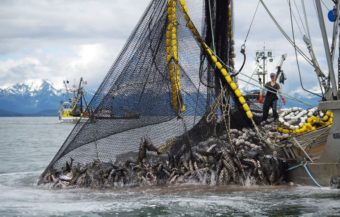
Commercial fishermen catch salmon at Amalga Harbor in 2013. Commercial openings begin Thursday. (Photo courtesy of Dave Harris/ADF&G)
Commercial fishermen pull up a net full of salmon at Juneau’s Amalga Harbor in 2013. Commercial hatchery chum openings begin Thursday and may continue later this month. (Photo courtesy of Dave Harris/Alaska Department of Fish and Game)

Southeast seiners will have a shot at a large run of hatchery chums for six hours Thursday.

The opening is at Amalga Harbor, about 20 miles northwest of downtown Juneau.
The salmon started out at Douglas Island Pink and Chum, a private, nonprofit hatchery known as DIPAC.

“We’ve been doing quite well in recent times and the returns have been strong. We don’t need as many of the fish that come back to the cost recovery area as we used to. So we’re opening up the Amalga special harvest area to the seine fleet,” said Eric Prestegard, the hatchery’s executive director.

About 45 boats were on site by Wednesday afternoon.

Prestegard said there could be as many as 75. He expects them to catch between 1 million and 2 million pounds during the opening.

Cost-recovery harvests, which pay for hatchery operations, have brought in up to 2.2 million pounds since June 28. Those will resume after the commercial opening.

The harvest area is relatively small and can become crowded.

But Prestegard said there have been no major problems in recent years.

“It seems like everybody is able to figure it out and make it work,” he said. “The last couple years have been real good and they’ve done well and no trouble, no accidents or anything like that.”

He said the Amalga Harbor area will reopen to seiners the next three Thursdays if strong chum runs continue.

The Amalga fishery includes ocean waters from Eagle River to the Shrine of Saint Thérèse.

Some of the action is visible from shore.

Tulsequah Chief Mine controversy deepens as it courts new investors

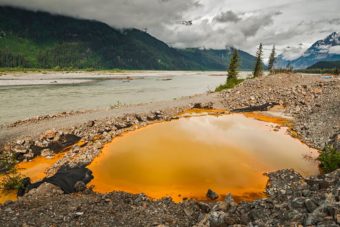
A Tulsequah Chief Mine settling pond overflows at the site about 40 miles northeast of Juneau Sept. 26, 2016. (Photo Courtesy of British Columbia Ministry of Energy and Mines)

Southeast Alaska tribal groups are calling for cleanup of British Columbia’s long-abandoned Tulsequah Chief Mine.

The call comes as a Canadian investment firm shops the prospect to potential new owners.

The Tulsequah Chief is an underground copper, gold, zinc, lead and silver mine about 40 miles northeast of Juneau.

Acidic wastewater has been draining into the Tulsequah River since the mine shut down 60 years ago. The river is a tributary of a waterway that flows through Alaska into the Pacific.

“The Tulsequah Chief Mine has been polluting the Taku River watershed since the 1950s,” said Frederick Olsen Jr., chairman of the United Tribal Transboundary Mining Work Group, which includes 16 tribal governments in Southeast Alaska.

Olsen also is president of the Organized Village of Kasaan, Prince of Wales Island city’s tribal government.

Those 16 groups, plus Juneau’s Douglas Indian Association, are calling for the U.S. and Canadian governments to clean up the mine site and end the pollution.

“This is an international issue. It needs international solutions. B.C. cannot be relied upon to clean this up,” he said.

British Columbia has promised to do just that.

B.C. Mines Minister Bill Bennett,center, Lt. Gov. Byron Mallott, center right, and Fish and Game Commissioner Sam Cotton, right, visit a Taku River fish wheel in Augst, after ab stop at the Tulsequah Chief Mine. (Photo courtesy lieutenant governor's office)
B.C. Mines Minister Bill Bennett, center, Lt. Gov. Byron Mallott, center right, and Fish and Game Commissioner Sam Cotton, right, visit a Taku River fish wheel in August, after a stop at the Tulsequah Chief Mine. (Photo courtesy lieutenant governor’s office)

Minister of Mines Bill Bennett visited the Tulsequah Chief in 2015 as part of a Southeast Alaska tour. He was visibly upset by what he saw and promised action.

Late last year, he reiterated his commitment to clean it up, though he also cited studies claiming the mine discharge did not harm fish.

“It’s still against our rules for that water to be flowing into the Tulsequah River,” he said. “One way or the other, we have to stop it.”

But Bennett is no longer minister of mines. He retired this spring.

His replacement, Rich Coleman, was not immediately available for comment. And he may not be at all.

That’s because his boss, B.C. Premiere Christy Clark, just resigned after losing a vote of confidence in the province’s Legislative Assembly.

Her replacement is from a competing party.

Chris Zimmer is an activist with the group Rivers Without Borders.

“Despite the promises from B.C. that they were going to clean up the mine, it looks like their real hope was to get a new buyer, shift the cleanup responsibility to them and hope that they would then develop the mine,” he said.

Mine owner Chieftain Metals shut down operations last fall, which left the Tulsequah Chief in the hands of an investment company.

Court documents filed in early June show the company has attracted more than a dozen potential buyers and identified one as most likely to take action.

But Chieftain and another companies already have gone out of business trying to reopen the Tulsequah Chief.

Zimmer said a new buyer will have the same problem.

“That’s a recipe for more bankruptcies, more pollution and heavy industrialized mining right above some of the best salmon habitat in the Taku,” he said.

He said studies showing the wastewater does not damage fish are flawed. But officials in Alaska and British Columbia say they’re accurate.

Mine critics have called for involvement in a U.S.-Canada commission that resolves boundary waters disputes.

That hasn’t happened so far.

Tribal officials are worried about damage to subsistence fishing, Olsen said.

“We need the federal government of the United States to uphold its fiduciary trust responsibility to tribal citizens and its federally recognized tribes,” he said. “To citizens of the state of Alaska, it needs to protect us and our way of life from these massive projects.”

Two new British Columbia mines opened recently in transboundary watersheds.

Several more projects are under exploration.

Municipal workers, Wrangell Borough officials return to bargaining table

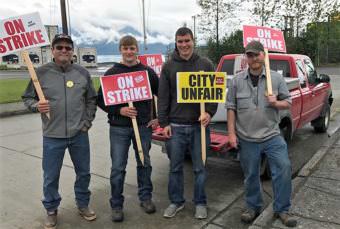
International Brotherhood of Electrical Workers representative Julius Matthew walked the picket line with Wrangell municipal workers Lorne Cook, Dwight Yancey and Andrew Scambler before the strike ended. (Photo courtesy IBEW)

Wrangell’s municipal employees’ strike is over, at least for now.

The International Brotherhood of Electrical Workers and Wrangell Borough officials returned to the bargaining table today. That came as the 24 striking workers went back to their jobs.
IBEW leader Dave Reaves said the union emailed Wrangell Borough officials Wednesday, asking for talks to resume.

“We’d be willing to put the unfair labor practice … in abeyance, which basically means it would be paused or put on hold if they were willing to come back and talk,” Reaves said.

The municipality agreed. Interim Borough Manager Carol Rushmore said the two sides planned to begin talks at 9 a.m. today.

She confirmed that striking workers were back on the job.

Union members went on strike June 22. That came after the union and municipality rejected each other’s final contract offers.

The main difference between the two sides is a wage increase. The borough offered 75 cents an hour, while the union proposed $2.50 an hour.

Union members left the picket line to help with several emergencies during the strike.

Reaves said electrical crews took care of two power outages.

“The first day, there was an eagle that got into some lines. The linemen responded and fixed that. That outage included the hospital,” Reaves said. “The other day there was another outage, a transformer had internal problems and a crew responded and fixed that too.”

During the strike, the municipality hired temporary workers to fill in for striking employees. About 35 managers and other non-union staff continued to work.

Shareholders re-elect Sealaska board incumbents

The Sealaska Heritage Institute plans to turn this downtown Juneau parking lot into a Native artists' park and market.
The Sealaska regional Native corporation is headquartered in downtown Juneau. (Photo by Ed Schoenfeld/CoastAlaska News

The management slate won this year’s Sealaska board election.

Three incumbents and a newcomer who ran with them beat out eight independent candidates.

Results were released Saturday via Sealaska’s Facebook page during the Southeast regional Native corporation’s annual meeting, held in Hydaburg, on Prince of Wales Island.

Another result: A measure to reduce the board’s size failed to attract enough votes to pass.

Juneau-based Sealaska has about 22,000 shareholders, which gives it the largest base of Alaska’s dozen regional Native corporations.

Sidney Edenshaw of Hydaburg is one of the three winning incumbents. He’s president of his community’s tribal association and has been on Sealaska’s board for 12 years.

Another is Ed Thomas of Kingston, Washington. The former Juneau resident spent 27 years as president of the Central Council of Tlingit and Haida Indian Tribes of Alaska. He’s been on Sealaska’s board for 27 years.

The third winning incumbent is Ross Soboleff of Juneau. The writer and fisherman won a board seat three years ago after running as an independent.

The fourth winning candidate is Morgan Howard of Kirkland, Washington, who owns a communications company. The board chose him from a group of about 50 shareholders who applied to run on its slate.

The seat he filled was vacated by Rosita Worl. The 30-year board member did not seek re-election this year. She continues to run the Sealaska Heritage Institute, the corporation’s cultural arm.

Eight independent candidates also ran for Sealaska’s board of directors. The highest vote-getters were Karen Taug and Doug Chilton of Juneau, and Nicole Hallingstad of Arlington, Virginia.

Taug works in finance, Chilton is an artist and teacher and Hallingstad works for the National Congress of American Indians. She used to be Sealaska’s corporate secretary.

The board-size measure would have shrunk the 13-member panel to nine members over several years. It targeted long-time incumbents.

Board election results list the number of shares cast for each candidate.

  • Sidney Edenshaw: 575,939
  • Edward Thomas: 571, 090
  • Ross Soboleff: 569, 600
  • Morgan Howard: 568,290
  • Karen Taug: 497,768
  • Doug Chilton: 479, 311
  • Nicole Hallingstad: 451,381
  • John Duncan: 182,755
  • Brad Fluetsch: 158,238
  • Adrian LeCornu: 106,418
  • Michael Roberts: 86,199
  • Cory Mann: 63,990
Site notifications
Update notification options
Subscribe to notifications